
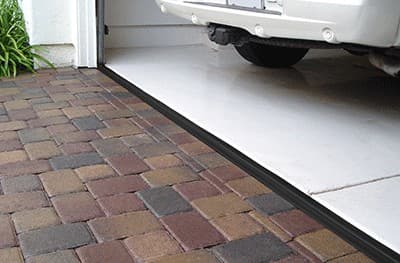
One often overlooked option when installing new garage flooring is a garage door threshold seal that affixes to the garage floor. For those not familiar, this is the raised vinyl polymer strip that runs the length of your garage floor from one edge of the door opening to the other. It helps your garage door seal out the elements and critters.
If you are getting ready to do a garage floor project of your own, take a look at what a garage door floor seal can do for you.
This post may contain affiliate links. If you use these links to make a purchase, we may earn a small commission. As an Amazon Associate, All Garage Floors earns from qualifying purchases. You can read our full disclaimer here.
Benefits of a garage Door Threshold Floor seal
Depending on where you live in the country, these floor seals do more than just keep warm air in your garage in the winter and cool air in during the summer.

They also help form a tight seal between your garage door and the floor, keeping rainwater, snowmelt, leaves, and anything that crawls from making their way into your garage. They are especially useful if you have a driveway that slopes towards your garage, allowing rainwater to pile up against the door and run under it onto the floor.
Made of a vinyl polymer, these strips are usually raised about ½” and are designed for one side to mate up with your garage door seal. This additional height not only helps to block out rising water, it also helps with sealing gaps created by uneven garage floors.
There are many brands of garage door floor seals to choose from, but a favorite of ours is the Tsunami Seal by Park Smart. It comes with a limited lifetime warranty against defects and is well-designed. They are sold as a kit and are available in a variety of lengths from 8’6″ to 50’.

All kits come complete with Liquid Nails adhesive and a caulking gun for application. The threshold seals are available in either black or gray. You can find the best deals on these here from Amazon.
Another very popular option is the Jin & Bao Universal Garage Door Threshold Seal kit. In fact, it’s an Amazon Best Seller. It is available in all black or black with yellow anti-trip lines.
Available in various lengths from 10′ – 20′, each threshold seal comes complete with adhesive. You can find the Jin & Bao Threshold Door Seal here from Amazon.
One disadvantage to consider about garage threshold seals is that they can be somewhat of an obstruction if you like to hose your garage out regularly. Because of the raised edge, the water will need to be forced over with a squeegee or water pressure.
They also create a small speed bump if you roll toolboxes, utility trays, or anything else with small wheels in and out of the garage.
Installation of a garage Threshold door seal
Installation is easy and directions are provided. Unroll the floor seal in a warm area or in sunlight before you start. This will let it relax and conform to the floor.
While the threshold seal relaxes, now is the time to clean your garage floor where the seal goes. Once ready, lay the seal out from one edge of the door opening to the other and cut to length. Next, manually close your garage door onto the floor seal so that you can adjust the fit before gluing it down.
Once you are satisfied with the way it is laid out, run a pencil mark on the floor against the edge of the floor seal on both sides. Open your door and then apply the glue according to the directions. Lay the floor seal back onto the floor between the pencil marks while pressing down firmly. You should then close the door to keep pressure on the seal. Wait 24 hours before opening the door or driving over the seal.
When done, you should have a garage floor door seal that will last the life of your garage. It will help keep your new garage floor clean, the crawly critters out, and your floor dry.
Could you tell me how long a newly poured concrete slab floor for my 12′ X20′ shed needs to cure before it can be sealed with epoxy?
Thank You!
Tom
You need to wait 30 days, Tom. Don’t forget that new concrete needs to be prepped properly for epoxy just as old concrete does.
Hello,
We live in Houston, TX and our garage door jamb is not flush with the floor and that appears to be what the builder gave all our neighbors as well, although I can’t seem to think of a reason why. The jamb tapers inwards vertically that creates a gap for insects and any other critters to come through both the corners. Is there a recommended product/solution to close that gap at the bottom of the door jamb?
Hi Allen. What type of garage door do you have? Is it the older style swing up or is it a roll up?
Thank you! It is the newer roll up and I found a website stating that the new building code requires a beveled trim at the bottom of the garage door side jambs in order to avoid wood rot due to moisture from the concrete.
So that means that even though the door can be well sealed, I need a way to prevent the beveled opening on the sides from letting insects or critters. Just curious about what the best solution is.
Hi Allen. Is it possible for you to take a picture or two and email it to us? The address is info@allgaragefloors.com
Hi Shea, I have a similar, if not the same issue as Allen. I have a rollup door that does not seal at the corners. The Jams were cut short and bevelled to prevent rot, which creates a super highway for insects to enter the garage. I will need to implement (cut and shape) some custom solution, but so far I can think of nothing that has anything but a “rigged” and unprofessional-like appearance. If you helped Allen, I would like to know your solution. Thank you!
Hello Ronnie. What worked for Allen was to install garage door seals on the exterior side moldings of the garage door. The sides of the seals go right to the ground and form a seal against the door when it is closed. There are many examples on Youtube that show how they work and how to install them.
Bought one of the common thresholds and per directions (but not on the internet page), it states to use a concrete sealant first (then let it dry) before putting the adhesive on it. My garage floor ends 9 inches before the door, where it starts a new grany concrete section that is flat but not smooth, and the door comes down smack in the middle.
I wonder if I need to worry about that (spending another 29-40) on a gallon of sealant or just go with what I have
Hi Art. If you live in a milder winter climate that does not experience snow and freeze thaw cycles, then you can let the apron be as is. However, if you do live in a harsher winter climate, then we would recommend sealing the apron with a good penetrating sealer.
Easy and clear instructions. I’m excited to put it down now.
Some of the reviews of the door seal commented that the seal shrinks up to 4 inches in cold months. How would you recommend installing to ensure the integrity of the seal and adhesion? Thank you!!
Hi Carly. Yes, the seals can shrink some in extreme cold. What can be done to prevent shrinking in very cold climates is to secure the ends and center section with a Tapcon or similar concrete anchor. They are available in either a hex head or screw. Here is an example.