
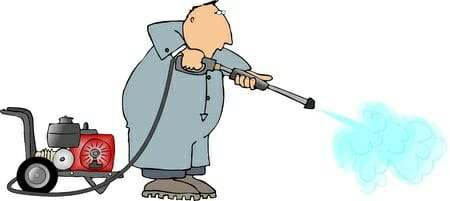
Using a pressure washer to clean an unusually dirty garage floor of oil stains, ground in dirt, and other debris can be highly effective. Plus, it requires less work than other traditional methods. The key, however, is to choose the correct type of pressure washer to use on your garage floor in order to get the best results. Choose the wrong one and you will be less than happy.
So let’s discuss what type of pressure washer to use, the best attachments, and recommended tips for cleaning your garage floor with a pressure washer. We also discuss important safety guidelines to remember.
Pressure washer or power washer?
Before we start, we need to learn the difference between a pressure washer and a power washer. Many times these terms are used interchangeably by the novice without realizing they are two different types of machines.
The main difference is that a pressure washer is a cold water unit while a power washer is a hot water unit. Power washers are much heavier due to the heating coil that is used to heat the water and they are more expensive to purchase or rent.
While hot water does work better at breaking down oils, pressure washers still work great at cleaning concrete under most conditions. They are also the better value when renting. Only if you have a seriously oily garage should you consider renting or purchasing a power washer instead.
Tip: Don’t hook a pressure washer up to a hot water line in your home. The seals and gaskets used for the pump are not designed for hot water temperatures and will deteriorate quickly if you do.
This post may contain affiliate links. If you use these links to make a purchase, we may earn a small commission. As an Amazon Associate, All Garage Floors earns from qualifying purchases. You can read our full disclaimer here.
How to Choose the correct pressure washer
Pressure washers come in both electric and gas engine models. Each model is rated for how much water pressure they produce. This pressure is measured in PSI (pounds per square inch) at the tip of the nozzle.
As well as being rated for PSI, they are also rated for water flow. Water flow is how much water they produce in gallons per minute or GPM.
So what kind of pressure washer should you use for a garage floor? For a bare concrete garage floor, a gas-powered pressure washer with a minimum rating of 3,000 PSI and a water flow rate of 3 GPM or more is recommended. Anything less will not be as effective and will take longer to get the job done.
The reason is that dirt-encrusted and oily concrete does not get cleaned as well with ratings of much less than 3,000 PSI. The minimum 3 GPM will also enable you to work quicker since you won’t be pushing around a pile of dirt and debris due to a lower flow of water.
Electric pressure washers are not the best option for most garage floors. This is because they rarely rate over 2,000 PSI. They are fine for general-purpose cleaning, but not for serious or heavy-duty jobs.
Some newer electric models are able to achieve 3000 PSI ratings, but the flow rate is still much lower.
This is a good video that shows how to set up a rented pressure washer
You can usually rent a gas-powered pressure washer from $45 – $65 a day. It tends to vary depending on where you live and the rental store you are dealing with.
Once you have selected a pressure washer to rent, make sure you know how to start it before you take it home. Start it yourself at the rental facility. This will ensure that it runs correctly and provides the opportunity to ask any questions about the operating procedures that you find confusing.
How to pressure wash a garage floor
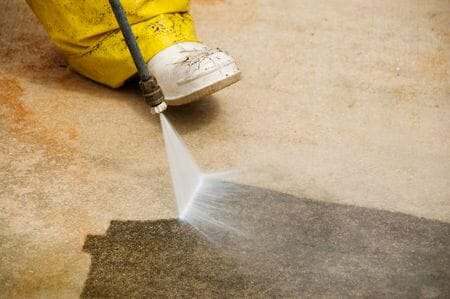
Wet down the floor first before cleaning it with a pressure washer. This will eliminate streaking that can occur in the concrete after it dries. Sometimes it’s best to work in sections.
Pretreat any oil or grease stains with a strong concentrate of degreaser. It helps to scrub it in with a deck brush if you have one. Be sure to let the stains soak for 10 minutes or longer without drying out.
While your stains are soaking, you can turn your attention to the rest of the floor. In order for a pressure washer to work best, you need to soak the remaining concrete with a degreasing solution as well.
Many pressure washers have a separate reservoir to add a degreasing product. We like Oil Eater Degreaser. You can find it here on Amazon.
While your pretreated stains are soaking, add the degreaser to the reservoir of the pressure washer and select the low-pressure tip for the cleaning wand. This is usually the black tip.
Start the pressure washer up and apply the degreaser to the garage floor. It should create a nice soapy solution. Make sure to turn off the valve that allows the degreaser to enter the hose when you are done.
If your pressure washer doesn’t have a reservoir for a degreaser, just mix up a strong solution in a bucket and spread it out on the floor. Either way, let the degreaser soak for a minimum of 10 minutes without drying out.
Spray some water on the surface if necessary to keep it wet. Once the concrete has soaked, you can start pressure washing the garage floor.
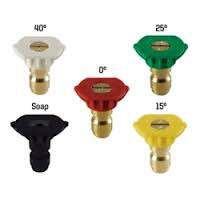
Select the yellow 15° spray nozzle. This works best for heavy cleaning in most areas. If the floor isn’t too dirty, you can try the green 25° nozzle as it will cover a larger area but uses less force.
The key is to keep the tip of the wand 6” -12” from the surface while pressure washing the concrete. Always keep the wand moving and don’t linger in one spot too long or you can possibly etch the concrete. A deliberate and methodical pattern works well and will keep you from missing any areas.
Pay particular attention to any oil spots that you have pretreated. Sometimes it may take a second application to get them completely clean.
Safety tips and tricks
Pressure washers can be dangerous and cause bodily harm if you are not careful. Never pressure wash in your bare feet. The high-pressure spray can rip the skin right off the top of your feet. Wear an old pair of shoes or rubber boots.
Never run your hand through the spray to check the pressure. It will injure your hands immediately. It’s a good idea to wear eye protection as well.
We recommend taping up some cheap plastic drop cloths to the lower 3 ft. of your walls to protect electrical outlets and finished drywall.
Because pressure washers use less water per minute than a regular hose, it’s a good idea to hose down your driveway before you start. The dirty water that is flushed from the garage is fairly concentrated and this will prevent the contaminants from getting deposited on your driveway and possibly staining it.
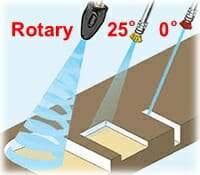
To get the best results for extremely hard-to-clean spots, you can use a special rotary tip called a turbo nozzle.
They work by spinning a 0° spray pattern in a 4” to 8” circle at 3000 RPMs. This allows the 0° spray to attack the concrete from various angles at once which will reduce the cleaning time considerably.
Most rentals don’t come with a turbo nozzle, so you may have to ask for it as an accessory or purchase it separately.
Lastly, don’t forget to purge your hoses and the pressure washing unit of air before you start it up. Also, make sure it’s set on level ground. Depending on the unit you have, some have a low oil level engine shut-off switch that may be triggered if it is sitting at an angle.
Using a pressure washer on your garage floor is not hard. The key is choosing the correct one to get the best outcome. Don’t use something less just to save a few bucks on a rental or purchase. If you follow these tips, you should be very satisfied with your results.

Should pressure washing be done before or after grinding? Both?
Hello Scott. If you have oil based stains and grit in the concrete you will want to pressure wash first before you grind. Once you grind, a good shop vac with a floor attachment works well for picking up the remaining dust or you can pressure wash again afterwords. Just be sure to test areas where the stains were to make sure they absorb water. If not, it may require a second round of degreasing and pressure washing that area followed by grinding again. If your floor is fairly oil free, you can pressure wash afterwards instead.
I couldn’t have advised people any better, Shea. Not only is this a great resource for someone looking to rent the right unit, but the cleaning tips are helpful, too. It’s not often you find info describing the difference between a pressure washer and a power washer, either.
Thanks for helping to put great info out there for people to find!
Thank you guys for all the information, when I had first started pressure washing I wasn’t letting the chemical sit long enough! +10 points for giving excellent tips
What about the garage door opener sensors? Should they be covered? Should power be turned off before pressure washing garage floor?
Hi Mike. You can cover the sensors with a plastic baggie if you like. However, the overspray from pressure washing will not affect them. You do not need to turn the power off to them.
Thank you.
Should you tape plastic to the walls if they are sheet rocked?
It’s a good idea to do so, Ashley. Just purchase the real cheap plastic drop cloths that you can get from your local home improvement center.
Thank you mate.
I am preparing to use the TS210 coating from Concrete Sealers USA on my 7 month old concrete shop floor that was machine troweled, but I have oil stains and North Carolina red mud stains. I started by pressure washing with the yellow nozzle. This was before I had read your article on stain removal, so I tried to remove them by getting closer to the concrete with the nozzle, and therefore ended up scarring lines in it.
I then bought Simple Green and it removed most of the mud stains in a test spot, but required a lot of elbow grease, and did not help the oil stains. As I was rinsing that test spot I put the white (delicate) nozzle on the pressure washer and was able to use that to kind of even out my previously scarred-in lines. However this was very slow and tedious and left behind some (less noticeable) lines of it’s own.
Tonight I will be using Oil Eater to remove the oil stains (and hoping it also does a quicker job of the mud stains than the Simple Green too). Assuming this takes care of my staining, my question is: What do you recommend for removing/evening out the scarred pressure washer lines? I’m considering renting a floor maintainer and using a pad (black?) to try to smooth it. I know the TS210 isn’t supposed to be applied to a very polished finish (they said something equivalent to the 100-200 grit range is ideal), so I want to make sure I don’t overdo it. And I want to make sure I don’t choose a grinder or something that will leave all sorts of marks. The fact that the delicate pressure washer nozzle seemed to be able to reduce the scarring makes me think it won’t take a lot of buffing/grinding. What do you recommend for this situation?
Hi Will. Something to consider is that any treatment that is performed on the surface of the concrete to remove the lines is not going to make it look like the surrounding concrete. You can remove those lines, but the color of the area treated may look lighter and have a slightly different look in texture as well. Coatings have a tendency to highlight differences in color tones and textures in concrete as well. Always start with the light and get progressively more aggressive as needed. A black pad is a good starting point. If that doesn’t do much, then you may need to start with a 150 grit sanding screen and get more aggressive from there if you need to. The sanding screen can be attached to the bottom of the black pad. Sanding screens and black pads will not polish the surface and won’t have an effect on how well TS210 adheres.
Hey Shea, great article! Can I pressure wash my painted garage floor? I was going to use the 40° nozzle to hopefully avoid any damage to the paint. What do you think? Thanks!
Hi Mitch. If it’s concrete paint and not an actual coating (2-part epoxy, etc.) then you need to be careful using a pressure washer. Pressure washers work well for removing paint from concrete and you don’t want that to happen. If it’s paint on the concrete, then a 40° nozzle should be OK providing it does not get too close to the surface.
Thanks for your prompt response, Shea. Yes, it is paint on the concrete and not an epoxy. I will use the 40° nozzle and I will exercise caution by keeping the pressure at a safe distance from the concrete. Thanks again!
Would love some advice on cleaning concrete. Replaced a dishwasher recently and as we wheeled out the old model it tipped a bit sideways, and some white/watery stuff came out and stained the concrete. Not sure if it was some sort of cleaning agent or calcium or hard water scale. Have tried everything. Pressure wash. CLR. Scrub. Just can’t seem to get it off. The CLR lifts it but spreads across the whole section. Even did CLR then vacuumed up the water – no dice it just spreads the whiteness around.
Hi Mike. Yes, it sounds like some sort of concentrated mineral slush was deposited. It can be a pain to remove successfully. Using a wet vac as you did before rinsing helps. Try a solution of one cup white vinegar to 1 gallon of warm water. Squirt some dish soap in the solution as well. Pour it on, let it sit a minute or two without drying out, scrub, and the use the wet vac to suck up the solution. Then rinse. This works fairly well sometimes for mineral deposits and salt residues in concrete.