
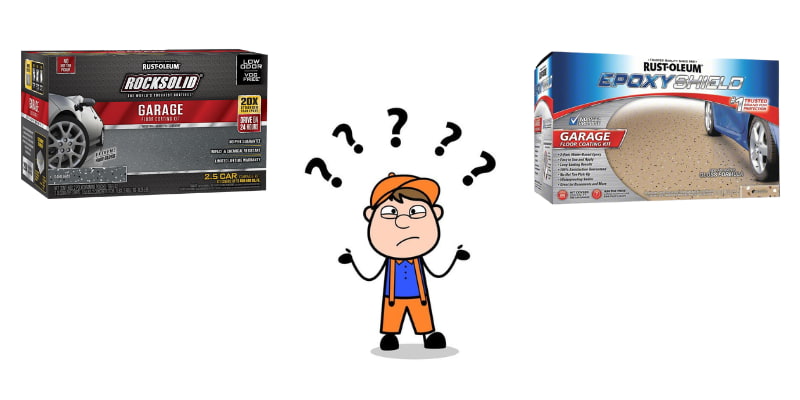
Is RockSolid better than EpoxyShield garage floor coatings? And what is the difference between RockSolid and EpoxyShield? These are common questions that frequently get asked regarding these two Rust-Oleum floor coating products. As a result, we will explain the primary differences between the two, list their pros and cons, and help determine which coating is best for you and your garage project.
EpoxyShield is arguably the most recognized brand of DIY garage floor coatings. It is an economical and easy-to-apply epoxy that has been available under different Rust-Oleum names and kits for close to 30 years. RockSolid Polycuramine garage floor coatings, on the other hand, are a relative newcomer that arrived on the scene in 2014. It has since become a very popular DIY coating for garage floors as well. Furthermore, RockSolid claims to be better than epoxy.
Unfortunately, there is some inaccurate and misleading information online and in videos when comparing the differences and durability of these two floor coatings. We will give you the correct facts and clear up any confusion you may have. This should help you decide which one is best for your garage flooring project and budget.
This post may contain affiliate links. If you use these links to make a purchase, we may earn a small commission. As an Amazon Associate, All Garage Floors earns from qualifying purchases. You can read our full disclaimer here.
What is the Difference between RockSolid and EpoxyShield?
Simply stated, EpoxyShield is a traditional water-based 2-part epoxy coating with a 52% solids content by volume. RockSolid is a 2-part Polycuramine coating with a 96% solids content by volume.
Now that we know that, let’s break it down further to explain exactly what this means in terms of application, performance, appearance, and durability.
EpoxyShield Features
EpoxyShield 2-part epoxy claims to be 5X more durable than 1-part epoxy paint. 2-part means that you need to mix 1-part epoxy resin with a 1-part polyamine hardener. The hardener is a catalyst that triggers a chemical reaction. This reaction is what causes the epoxy to chemically cure and crosslink to become extremely hard.
Instead of mixing the two components in a bucket, EpoxyShield now uses its burst pouch technology. The Part-A hardener and Part-B epoxy resin are contained in a pouch and separated with a seal. All that is required is to roll one end of the pouch to burst the seal. You then shake and rotate the bag around to mix the components.

Once mixed, you cut open one corner of the bag and pour the contents into a paint tray to begin the application. When applied at the recommended coverage rates, EpoxyShield will cure to a dry film thickness of 3 – 3.5 mils.
EpoxyShield is available in Gray, Dark Gray, and Tan colors with a gloss finish. A single-car kit comes with a total of 120 ounces of the Part-A and Part-B burst pouch. It also includes decorative color flakes, concrete etch solution, and instructions. One burst pouch single car kit will cover up to 250 ft².

Rust-Oleum has a nifty color tool for both EpoxyShield and RockSolid floor coatings that helps you envision what a particular color would look like in a garage. You can check it out here. Just select the product you would like to see.
EpoxyShield has a low VOC content of less than 50 g/l. This is due to using water as the primary carrier agent instead of solvents. The water evaporates out as it cures.
RockSolid Features
RockSolid Polycuramine is a proprietary blend of epoxy, polyurethane, and polyurea that claims to be 20X stronger than epoxy. It was originally stated to provide the best benefits of each of the three coating materials. However, they have since rescinded that claim. We explained at the time why this could not be true in our in-depth review of RockSolid below.
Read – Get the Facts on RockSolid Garage Floor Coatings
Like EpoxyShield, RockSolid is a 2-part coating with the same burst pouch technology. Once mixed, a similar chemical reaction occurs that initiates the curing process. However, due to the higher solids content, it must be poured in ribbons onto the concrete before you begin the application. If kept in a paint tray, it will accelerate the cure time and become unworkable before you can apply all of it.
Once applied at the recommended coverage rates, RockSolid will cure to a dry film thickness of up to 3 mils.
RockSolid is available in six different colors. These are Black, Gray, Dark Gray, Modern Greige, Mocha, and Tan. The finish is a high gloss.
A single-car kit comes with a total of 90 ounces of the Part-A and Part-B burst pouch. It also includes a foam roller, decorative color flakes, concrete etch, and instructions. One burst pouch single car kit will cover up to 200 – 250 ft².
RockSolid Garage Floor Coating qualifies as a no-VOC coating with a VOC content of less than 1 g/l. This is due to the 96% solids content. The remaining 4% is mostly alcohol that evaporates out as it cures.
RockSolid vs EpoxyShield Comparison Chart
| Features | RockSolid | EpoxyShield |
| Solids content | 96% | 52% |
| Dry Film Thickness | Up to 3 mils | 3 – 3.5 mils |
| Finish | High Gloss >95 @60° | Gloss – not rated |
| Abrasion Resistance | 40 mg – Good | N/A |
| Pot Life | 45 min to 1 hour | 2 hours |
| Recoat Window | 7 days | 4 days |
| Cure Time | Vehicle Traffic 24 – 36 hours | Vehicle Traffic 3-days |
| VOC Content | No VOC – <1 g/l | Low VOC <50 g/l |
| U.V. Stable | No | No |
| Application Temp | 40-90°F | 60-85°F |
EpoxyShield data sheet information.
RockSolid data sheet information.
Important to note is that RockSolid and EpoxyShield should not be intermixed or applied on top of each other to chemically bond. Rust-Oleum states that adhesion problems may be encountered.
Read: Can Concrete Primers be Used for EpoxyShield and RockSolid?
Is RockSolid Polycuramine Better Than EpoxyShield Epoxy?
In short, RockSolid is a better-performing garage floor coating than EpoxyShield. However, RockSolid is not without its faults and can possibly incur a much higher cost than anticipated. In addition, EpoxyShield is less expensive than RockSolid and is better suited for some people’s budgets.
As a result, we suggest reading on to learn why RockSolid is better. Furthermore, we discuss the pros and cons of these two coatings. Lastly, we will provide tips to increase the durability of each coating and show you where they can be purchased at the best price.
EpoxyShield Pros and Cons
Rust-Oleum EpoxyShield uses a much older water-based epoxy formulation that allows for budget pricing compared to other epoxy coatings. As a result, it is one of the least expensive garage floor coatings you can purchase. This is why EpoxyShield is still so popular.
It is much more durable than 1-part epoxy paint. And unlike 1-part epoxy paint, 2-part epoxy coatings seal the concrete as well. It has much better stain resistance, higher resistance to hot tire pickup, and will last 3 – 5 times longer.
It’s important to point out that budget epoxy kits like this will not provide the high gloss, build thickness, stain resistance, and longevity that higher-quality DIY coatings provide.
Something else to consider is the finish. Though EpoxyShield says it has a gloss finish, one of the more common complaints is that it looks more like a non-glossy satin finish.
We believe some of this disappointment is due to the marketing on the box. They use a computer-generated image that clearly shows the reflection of a car on a glossy surface. Water-based epoxy, in general, is not capable of providing such a high gloss finish.
Peeling from hot tire pickup at some point in the life of the coating is the most common complaint. This is despite their claim that it “will not peel or pick up from hot tires”.
The reason hot tire pickup occurs is due to the thin mil thickness and older epoxy formulation.
The hot tires actually cause the epoxy to soften ever so slightly. As the tires cool, they obtain a grip on the temporarily soft epoxy.
This grip allows the tire to pull it up off the concrete when the car is later moved.
If the coating is fortunate enough not to incur hot tire pickup, it will begin to wear out in high-traffic areas in 3 to 5 years. Our article that discusses why inexpensive epoxy coatings get a bad rap explains more. Though the article is dated, all the same reasons still apply.
Lastly, EpoxyShield is not UV stable. This means that it will turn a yellow tint (amber) if exposed to direct sunlight or strong indirect sunlight over a period of time.
The best way to increase the longevity and durability of EpoxyShield epoxy is to apply the optional EpoxyShield clear coat.
It’s a better quality 100% solids epoxy that will lock in the color flakes and protect the color coat. In addition, the higher heat tolerance of the clear coat and overall thickness of the two coatings do a much better job of resisting hot tire pickup.
We suggest reading our article that lists 10 reasons to apply a clear coat to learn more.
RockSolid Pros and Cons
As we stated earlier, RockSolid Garage Floor Coatings are superior to EpoxyShield. The reason for this is the performance characteristics of Polycuramine.
The data sheets reveal an abrasion rating of a 40mg loss for the CS 17 Taber Abrasion test. This translates to a higher wear resistance for longevity. It is equivalent to a high solids commercial quality epoxy. In addition, it has an impressive Shore D rating of 90 for hardness.
Furthermore, RockSolid has a gloss meter reading @60° of greater than 95. This means it is extremely glossy and on par with some of the glossiest commercial coatings available.
As a comparison, EpoxyShield does not submit their epoxy for most testing and lacks much of the information that can be found in data sheets to interpret performance. Instead, they use marketing claims to hype the durability instead of providing real-world testing results.
To learn more, we suggest reading our article on how to read data sheets to compare coatings.
Lastly, Polycuramine has a higher heat resistance and penetrates concrete surfaces better than EpoxyShield. This results in better adhesion to properly prepared concrete and rare complaints of hot tire pickup.
Though RockSolid performs better than EpoxyShield, it does have drawbacks that need to be considered. The first of these is cost. RockSolid is much more expensive than EpoxyShield. In addition, one burst pouch of RockSolid contains 90 ounces of coating material versus 120 ounces for EpoxyShield.
The next two complaints are the most common. One is that RockSolid floor coatings don’t provide enough material for the stated coverage rates. The other is that the finish and coloring can look dull or “off” and not very glossy in some areas.
There are two reasons for this, both of which are interrelated. The first is that Polycuramine penetrates properly prepared concrete very well. This is good since it ensures a stronger bond to the concrete. However, it also means that more material is required to achieve the stated mil thickness.
The second reason is that RockSolid coverage rates are overly generous or too high for the amount of material that is provided. To complicate the matter more, the instructions state the coverage rate is up to 200–250 ft². Well, which is it? 200 ft² or 250 ft²? How is one to know?
When you combine overly generous coverage rates with a coating that penetrates concrete well, the outcome can be a very thin surface layer. The resulting finish will lack rich color and gloss in areas because it’s simply not thick enough.
As a result, it requires a second coat of RockSolid to fix the problem. This doubles the initial cost of the color coat. You could purchase a commercial-quality single-part polyurea coating, which is almost twice as thick, for less money than two coats of RockSolid.
We believe a calculated risk was taken regarding coverage rates to try and keep the cost down. What RockSolid does not make clear in its instruction sheet is that 250 ft² can be achieved if it is applied over a previous coat of RockSolid or an older coating. This is because no material is lost due to concrete penetration.
Another interesting fact is that Rust-Oleum does not include the recommended wet film thickness and resulting dry film thickness for RockSolid in their data sheets. We had to call their tech line to get this information. For reasons we can only suspect, they do not want to publish this information.
The 200 ft² coverage rate is about the MAXIMUM we feel you will obtain over most properly prepared bare concrete surfaces to achieve the proper dry film thickness, color, and gloss. Smooth concrete may achieve a slightly higher coverage rate than 200 ft².
Additionally, there is always the issue of those who try and stretch coverage rates to save money. This makes the problem even worse. The number one rule of applying coatings is to NEVER stretch coverage rates.
Despite this common complaint, those who were happy with their initial application tend to report satisfaction and the performance that they expected from RockSolid.
Lastly, as with EpoxyShield, RockSolid is not UV stable. This is an example of why combining the technology of epoxy, polyurea, and polyurethane does not bring out the best attributes of each. Though polyurethane and polyurea are UV stable and will not amber, epoxy will. This is why RockSolid can turn a yellow tint if exposed to sunlight.
Where to Find the Best Price for RockSolid and EpoxyShield Coatings
The cost of raw materials for coatings has been increasing at a pace we have not seen in years. As a result, coatings are becoming more expensive. This is especially true for Polycuramine.
Both RockSolid and EpoxyShield can be found at most home improvement centers and hardware stores. Home Depot, Lowe’s, and Menards are examples. Though it may be more convenient for some people to purchase locally, these stores typically do not have the best prices.
We have found that Amazon has better pricing, particularly for RockSolid. A RockSolid 2.5 car kit could be purchased for almost 20% less than home improvement centers at the time this article was published.
RockSolid
1 car and 2.5 car kits
EpoxyShield
1 car and 2.5 car kits
If you want to extend the life of your coating, lock in the color flakes, and protect the color coat, then we suggest applying the optional clear coat. The clear coat should be applied within the 72-hour recoat to avoid further prep of the surface.
You need to wait a minimum of 6 hours before applying a second coat of RockSolid color or clear. Wait a minimum of 12 hours before applying a second coat of EpoxyShield color or clear.
RockSolid Clear
1 kit covers up to 500 ft²
EpoxyShield Clear
1 kit covers up to 500 ft²
Both the RockSolid and EpoxyShield clear coat kits come with just one burst pouch to cover up to 500 ft². This makes the clear coat extremely thin at approximately 1.5 mils. For better performance and longer wear, we recommend a coverage rate of no more than 250 ft². This will provide an average thickness of approximately 3 mils.
Final Thoughts
In terms of performance and durability, RockSolid garage floor coating is better than EpoxyShield. It is highly glossy, more durable for longer life, and highly resistant to hot tire pickup. However, it is more expensive and may require more than one color coat for the reasons stated above.
If cost is your primary concern, then EpoxyShield is the least expensive garage floor coating for your budget. It will last much longer than 1-part epoxy paint and provide much better protection.
If you apply the optional EpoxyShield clear coat, you will lessen the risk of hot tire pickup and increase the durability, gloss, and stain protection of the coating.
If you have any questions about these two coatings, just ask us in the comments section below!
Thank you for the great comparison between Epoxyshield and RockSolid.
Question: what is the best way to evenly spread flake?
Hi Thomas. Pinch a small clump in your fingers and toss them high into the air. As they reach the top of the arc, they will disperse fairly evenly and float down in a nice random pattern. DO NOT toss them directly toward the floor. You will get heavy flaked streaks and clumps that stand out. We discuss color flakes here if you want to learn more about them.
Tom, Great write-up! Well done and thank you for this information.
What are your thoughts behind adding a polyaspartic top coat over either product? Would durability be significantly improved?
Durability is improved, but it’s a waste of money to apply such a quality clear coat over a residential quality base coat. If you are going to spend the money for a good coating, then make sure the base coat is good as well. Here is a suggestion.
are the two of them compatible with each other as far as adhesion
Hello Keith. No they are not compatible for chemical adhesion during the recoat windows. Rust-Oleum states explicitly not to one over the other.
I want to go the Rocksolid way. I have a <450 sq ft garage that is 1.5 years old. It has no automotive stains, just mud and regular car traffic stuff that I believe Zep Cleaner, and then etching will suffice in prepping the surface. Do you agree? Additionally, I want to have more than enough so was contemplating getting the 2.5 & 1 car kits, or even 2 2.5 car kits so I have plenty to use on the 4" concrete edging in some areas, and to put on the wood steps going into the house. Do you think I should get 2 2.5 kits? I don't mind the cost so much, I just don't want to come up short. I have done 2 other 2 car garages witht the Epoxy Shield and found it was getting a little thin towards the end. Thanks for your reply.
Hello Adam. The prep work with the etching should be fine. However, one 2.5 car kit for close to 450 square feet is pushing it for RockSolid. And that’s not counting the other areas you want to coat. Adding the 1-car kit would be the most economical solution. Just make sure to properly divide up the square footage you want each kit to cover on the floor so that you don’t exceed it. Two 2.5 car kits will work for sure. Is the 4″ concrete edging you are referring to the stem wall that rises up above the floor? If so, those are typically rough in texture and soak up a lot of coating. Wood steps will as well. Makes sure to use the anti-slip additive in your final coat or the steps will be icy slick when wet.
For the money you are spending, we recommend that you look into a better quality product. Single-part polyurea would be our first choice. It’s almost twice as thick as RockSolid, it does not have coverage issues, it’s U.V. stable, and wears over twice as long. You can read about it here. You can get pricing for some of these kits from vendors we recommend here.
Can you put a rock solid clear coat over the epoxy shield base coat for better durability?
Hello Michael. RockSolid and EpoxyShield are not chemically compatible. You need to use EpoxyShield Premium Clear Coat with EpoxyShield color coats and RockSolid Clear Coat with RockSolid color coats. If the EpoxyShield has already been applied and cured, you can apply the RockSolid Clear Coat. It requires roughing up the surface first with 120-grit sandpaper, sweep/vac, and then wipe down with denatured alcohol or equivalent. Once you do that, you can apply the clear coat.
Hi,
I just laid the Rock Solid Polyacuramine in my garage with the flakes then used the Epoxysheild and anti skid not realizing the Epoxysheild clear coat was a different product? Can I apply the Rock Solid top coat over the Epoxysheild top coat now? What’s the best way to handle the situation without ruining the flakes and Rock Solid Polyacurmine that was just applied? It’s been less than a week and no cats driven on surface yet
Hello Mathew. The potential problem is how well the EpoxyShield Clear Coat has adhered to the RockSolid color base coat. According to Rust-Oleum, EpoxyShield and RockSolid should not be applied over each other during the recoat window due to compatibility issues. Applying RockSolid Clear Coat over EpoxyShield just doubles the problem. We recommend contacting Rust-Oleum Customer Support for guidance.
Can you apply Rock Solid over an Epoxy Shield floor that was applied two years ago?
Hi Glen. Yes, you can. It requires cleaning and degreasing the current surface, roughing it up with 120-grit sandpaper, sweep/vac, then wipe it down with denatured alcohol or equivalent. This provides the proper surface profile for it to achieve the best mechanical bond to the old coating and not peel. Rust-Oleum also sells a recoat primer that only requires degreasing the surface first, applying the primer, and then RockSolid over that. However, the reviews are mixed and not the first method we would recommend. You can read about it here. One thing to keep in mind is that no matter how well the RockSolid adheres to the old coating, the entire system depends on how well the old coating is adhered to the concrete. If it’s not adhered well, it will all peel up at some point.
Can you apply Epoxy Shield over RockSolid (same color) that was applied a 5-7 days ago? My painter did the concrete crack filling/touch-up after applying the RockSolid (he later realized that he should have done the filling work first before applying epoxy). Thanks!
Why not another coat of RockSolid? EpoxyShield can be applied over RockSolid after 2-3 days. It requires that the surface be roughed up with 120-grit sandpaper, sweep/vac, then wiped down with denatured alcohol or equivalent. However, EpoxyShield is not nearly as glossy, the color is not quite the same, and it’s not as durable. If you are under 7 days, you can apply another coat of RockSolid without any further prep. If you are over 7 days, then the same prep is required as the EpoxyShield.
Hi, appreciate the write up. I am recoating a 180sqft basement workshop that appears to be either basic floor paint or 1part epoxy that is 5+ yrs old. Its mostly in-tact with a few areas of worn/bare concrete in high traffic spots. Since it is indoors, grinding and etching/washing would be a little difficult – is this where i could clean the floor with degreaser and use recoat primer prior to rocksolid without grinding/etching?
Hi Dave. Yes, an area that receives only foot traffic would be considered a candidate for the recoat primer. If it was a garage where cars are parked, we would not recommend applying it over paint since hot tires could peel underlying paint up. Our only concern would be moisture from the basement floor. Paint breathes and will allow some moisture vapor to escape. Coatings such as RockSolid does not breathe and will trap it below the coating. This can lead to the coating peeling at some point in the future. Has a moisture test ever been conducted? Does it ever humid in the space or do you have to run a dehumidifier?
Assuming there are no moisture issues, we recommend taking a paint scraper to the surface to remove any loose paint that may appear adhered. Especially the edges where the bare concrete is. Scuff up the bare concrete with 100 grit sandpaper and then degrease. Wait a few days or so for the surface to dry before starting with the recoat primer. Coatings do not do well with water vapor that is still evaporating from within the concrete.
Hello. We are needing to finish a 168 square foot basement (bare) concrete floor. The floor has had some water seep in under the outside wall, in the past. What product would you recommend we put on that floor? Thank you.
Hi Wendy. Coatings don’t tolerate moisture from under the slab very well. Particularly if it’s enough for water to pool. This can be fairly typical in basements and why coatings are not always a good choice. If you apply a coating, chances are it will peel up during the rainy season due to the moisture. If you still like the idea of a coating, it’s extremely important to moisture test before you apply it. Again, the best time to moisture test is during the wet season.
We recommend covering the concrete with a breathable flooring surface. Interlocking tiles are an example. They will allow for air circulation under the tiles. This allows moisture vapor to pass through and will help to keep the concrete dry. We have an article here that discusses what you should know about interlocking tiles, including the pros and cons.