
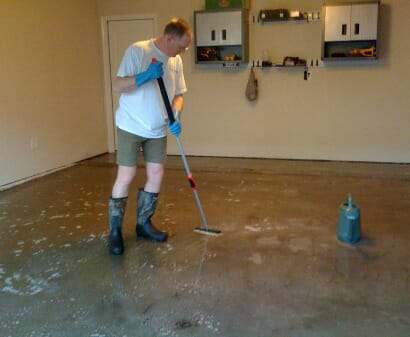
Can I etch the concrete of my garage floor or workshop before applying a densifier or penetrating sealer? The short answer is no. A densifier or sealer will not perform as expected if you do so.
It is one question we have received, and unfortunately, a mistake we have witnessed more often lately. It seems to be most common among those with power-troweled or extremely smooth concrete finishes. However, it has also occurred for those who mistakenly believe that etching cleans and preps the concrete for application.
To understand why etching should not be performed, it’s important first to understand how densifiers and sealers work to protect concrete.
Concrete densifiers react with free lime and other minerals in the immediate subsurface of a concrete slab. This reaction creates Calcium Silicate Hydrate, the substance that makes concrete hard.
The additional CSH fills many of the microscopic open pores and capillaries in the concrete subsurface, thereby making the concrete denser and harder.
Penetrating sealers work by reacting with free lime and highly alkaline minerals within the concrete subsurface, but not to the same extent as densifiers. This reaction creates a breathable, hydrophobic, silicone-resinous gel at the subsurface that, unlike densifiers, repels water and salts.
Why Densifiers and Sealers won’t Perform On Etched Concrete
Concrete etching solutions work by reacting with and dissolving the free lime and various minerals at the concrete surface. The dissolved mineral byproduct is then removed during the neutralization and rinsing process.
The result changes the concrete surface profile by opening pores and roughening the surface texture. Though this new surface profile is advantageous for viscous coatings to penetrate and form a mechanical bond, it is detrimental to densifiers and sealers.
The reason why is two-fold. First, the free lime and minerals that densifiers and sealers require to react with have been effectively removed. In addition, etching reduces the concrete’s higher alkalinity, which penetrating sealers require to perform effectively. Thus, the expected reaction to such is greatly reduced and largely ineffective.
Second, the densifier or penetrating sealer is absorbed too deeply by the concrete due to the more porous surface structure. Multiple applications would be required to build on top of the previous ones to be somewhat effective. The result is increased material expenses and performance that does not meet expectations.
What If the Concrete Surface is Too Smooth to Absorb a Densifier or Sealer?
Though it’s not that common, garage floors and workshops with power-troweled or burnished surfaces can inhibit the proper absorption of some densifiers or penetrating sealers.
If you feel that is the case, consider lithium silicate densifiers, such as PS103, or fluorinated sealers, such as PS100, by Concrete Sealers USA. These contain nanosized or micronized molecular materials that can lower surface tension and better penetrate extremely smooth or dense concrete surfaces.
Other considerations that block the penetration of sealers and densifiers include bond breakers, such as leftover surface membranes from curing compounds or previous sealers.
A solution for dense concrete or bond breakers is to wet-sand the surface with a floor maintainer and 80-grit sanding screens. Dry sanding can sometimes burnish the concrete surface or smear polymers, hindering penetration.
Can densifiers or sealers be applied to concrete prepped via grinding?
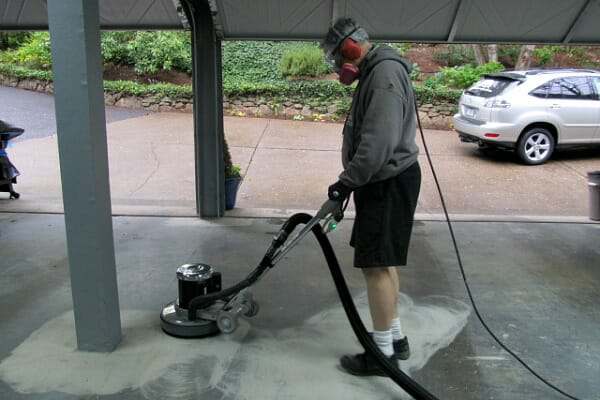
You can perform light grinding or honing before applying a densifier or penetrating sealer. However, most densifiers and sealers require that you do not exceed a 100-200 grit grind profile. Anything rougher (less than 100-grit) will absorb too much material.
Always check the manufacturer’s surface profile specifications for a densifier or penetrating sealer before proceeding.
Final Tips
Most densifiers and penetrating sealers for garage floors and workshops can be applied directly to bare, untreated concrete without further concrete preparation. The only requirement is that the concrete be clean and dry.
Be aware that etching is not recommended as a cleaning solution either. It only appears to clean concrete because it breaks down the concrete surface, giving it a lighter appearance.
Furthermore, etching is not very effective on oil or oil stains if that is your intention. The oily residue in the concrete repels the etching solution, preventing it from reacting with the concrete’s minerals and being effective.
Instead, follow recommended methods for cleaning concrete and removing oil stains before applying a densifier or sealer.

Leave a Reply