
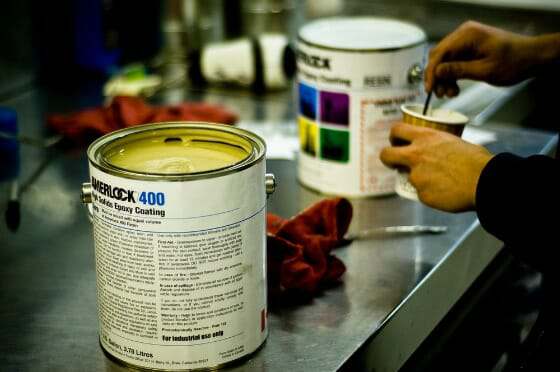
When you start considering an epoxy coating for your garage floor, it doesn’t take long to realize that not all are created equal. You soon find that there is water based and solvent based epoxy. Some manufacturer’s state they offer only 100% solids epoxy. Some are much less expensive than others for the same volume of product. So how do you know what differences to look for when comparing garage floor epoxy?
Because of this, it’s important to learn the basic properties of epoxy floor coating products before you decide to apply a floor coating yourself or hire a garage floor company to do the job for you. This knowledge will help you greatly when making a decision about which product is best for you. So let’s take a look at each type of epoxy available to better understand what these differences are.
The use of carrier agents in epoxy
Water or solvents are typically used as a carrier agent for some epoxy resins and assist in the adhesion, ease of application, and self-leveling properties. They also help to insure a longer period for application, also known as the pot life. As soon as you mix the part-A resin with the part-B hardener, the clock starts ticking as the epoxy begins its curing process and must be applied to the floor before the pot life runs out.
Because of their ease of application, these types of epoxies are more user friendly and tend to be the more preferred solution for the DIY crowd. The average pot life is around 2 hours, which means you don’t have to rush to get it down on the floor, and it rolls on smoothly like paint.
There are some disadvantages to these however. Once applied to the floor, these carrier agents evaporate leaving only the epoxy. So what you end up with is a thinner floor coating than what was initially applied. This happens because the carrier agent in the epoxy is not part of the actual floor coating.
This is defined as the percentage in volume of solids in epoxy and is most noticeable in the difference between wet film thickness and dry film thickness. If an epoxy is labeled as 50% solids for example, it would have a wet film thickness of approximately 7 mils. Once the carrier agent evaporates, it will have a dry film thickness of 3 – 3.5 mils.
Water based vs solvent based epoxy
Solvent used to be the preferred carrier agent in epoxy coatings for a few reasons. It can be applied in cooler temperatures and higher humidity and it does a better job at tolerating petroleum contaminates in the concrete surface. It used to have a slightly glossier surface than water based epoxy and in some cases is a bit more durable than their water based counterpart.
The biggest problem with solvent based products however is the high VOC’s content (volatile organic compounds). It cannot be used indoors at all due to the fumes. When used in the garage, proper respirators must be worn during application and any open flames such as a water heater or furnace must be extinguished due to the high flammability.
Because of the high VOC’s, many states do not allow solvent based products unless they have a lower VOC content. This has resulted in some solvent based epoxy products not being as good as they used to be. Consequently, they are getting harder to find as the industry has started using them less due to the tougher state regulations.
Water based epoxy on the other hand has come a long way since the states started prohibiting products with high VOC’s and has now become the more prominent epoxy in use between the two. In fact, many have proved to be as durable as most solvent based products and some are capable of just as much shine. Additionally, they do not produce any of the fumes and odor that is associated with solvent based epoxy which makes them environmentally safe as well.
Some water based epoxies can be applied to concrete that is still damp and can actually make for a good sealer to help stop hydrostatic pressure from moisture vapor transmission. This is why most epoxy primers are water based.
100% solids epoxy
A 100% solids epoxy doesn’t have any water or solvents to evaporate. As a result, they provide for a much thicker dry film coating of approximately 10 mils or more depending on the manufacturer and how it is applied. There are no VOC’s to worry about, thus making them environmentally friendly, and the coating cures solely by chemical catalization.
They are commonly used for commercial applications and by many garage floor coating companies as well. 100% solids epoxy is more abrasion resistant, chemical resistant, and stain resistant than its water based counter parts. They work well as a color coat and medium to accept vinyl acrylic flakes and can last upwards of 20 years or more. This makes it the most durable of the garage floor epoxies by far.
100% solids epoxy can be more difficult to work with however do its thicker consistency and shorter pot life of only 30 – 40 minutes depending on temperature. They can be applied as a DIY application, but it’s important for the person applying them to be confident in his or her skills and follow the manufacturer’s recommendations closely in order to achieve a successful application.
Though more expensive, 100% solids are the most cost effective garage floor coatings when comparing thickness and durability. Most epoxy paint kits sold aftermarket at the big box stores are not much more than 50% solids. They are designed as a one coat application and end up being 3 mils thick. There is aftermarket, multi-coat, water based garage floor epoxy systems that do better, but they still don’t compare to a 100% solids epoxy system.
A word about Technical Data Sheets
When making epoxy comparisons, be sure to take a look at the technical data sheets (also known as TDS) for the product. You can request these from the store or find them online. These sheets outline the properties and ingredients of the product and will give you a better idea of how one product compares to the other.
Knowing the differences in epoxy coatings is an absolute must if you are going to hire a contractor to do your garage floor. That way you will know exactly what you are getting for your money. If you are going to tackle the job yourself, then you are already one step ahead of the game when it comes time to determining which product is best for you.

Hi Shea,
Excellent resources on this site. What are your thoughts on a hybrid epoxy base and a polyaspartic top coat vs polyspartic base and top?
These are quotes from two national franchise installers:
1. Hybrid installer at $9.50 sq using 100% solid epoxy base.
2. Polyaspartic installer at $8.25 sq – 85% solid. Total coating thickness is 15 to 20 mils with decorative flakes.
Alan
Hi Alan. Wow… the cost of raw materials for coatings and epoxy especially have been going up, however, these are the highest prices we have seen yet for an installation. If it’s a full color flake coverage, we always opt for the 100% solids epoxy base. When applied at the recommended coverage rates, 100% solids epoxy is going to be 10-12 mils thick compared to 6-7 mils for polyaspartic. It provides a better foundation for the flakes to sink into and get hold, it does a better job of covering up irregularities in the concrete, and provides better impact resistance. Unfortunately, many companies try to dissuade customers from epoxy because it usually takes two days for the install instead of one.
Hi Shea,
Thank you for your prompt reply. I was told a fair price is around $7.50 sf for a professional crew. Contractors here in Long Island NY tend to command a premium base on zip code. The quotes are $3,420 and $3900 for a 410 sf coverage. They will also install slat walls (a separate charge), so I am sure they are making out nicely on both ends.
Regards,
Alan
How much for a double garage
Hi Bill. How much for what exactly?