
One name synonymous with garage floor mats for years is G-Floor by Better Life Technologies. It’s hard not to come across their name when shopping for roll-out vinyl flooring or parking pads for your garage. Considered the best garage floor mats for vehicles in the industry, they do provide many great benefits. However, they are not perfect and have some drawbacks or issues that you should be aware of.
As a result, we have compiled a comprehensive evaluation of G-Floor mats. We discuss their construction, various raised surface designs, benefits, and uses.
In addition, we address some of the more common questions, complaints, and potential problems of G-Floor vinyl flooring. Some of these include installation concerns, surface design patterns, questions about tire staining, mold, mildew, buckling, and how flat they lie.
Lastly, we provide a list of recommended retailers for purchasing G-Floor mats. Some, in particular, include great customer service and years of experience with garage mats – as well as competitive pricing. You can click here to jump ahead.
What is G-Floor Garage Flooring?
G-Floor is a very durable and universal polyvinyl roll-out flooring. It is most associated with full wall-to-wall garage flooring and individual garage parking pads. However, it is also popular for basements, sheds, trailers, home gyms, rec rooms, and more.
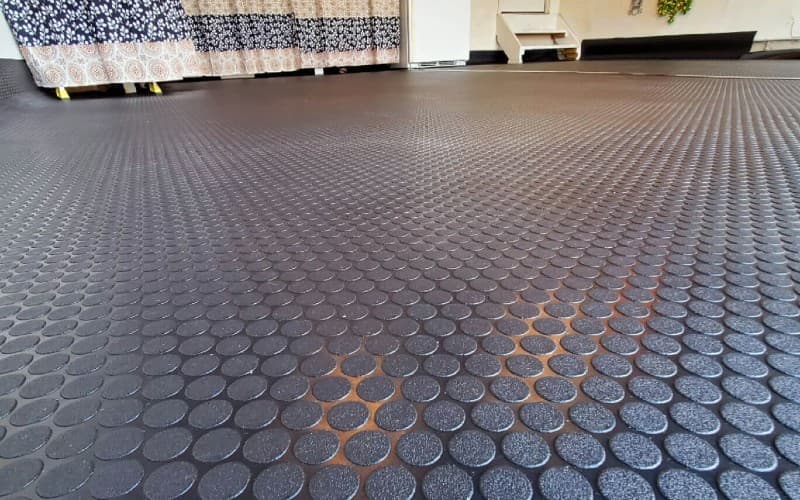
Manufactured in Emporia, Kansas, USA, it is constructed of a solid, thick layer of 100% polyvinyl. Unlike many competitor mats, there are no fillers or other inferior materials sandwiched between layers.
To be more specific, polyvinyl is short for polyvinyl chloride (PVC). It is a flexible yet strong material for flooring. The feel and texture are a bit like rubber, and it has a pleasing matte finish.
In addition, G-Floor parking pads and roll-out flooring are FloorScore® Certified and meet strict indoor air quality standards. If there is any type of vinyl smell detected after unpackaging it will dissipate rapidly.
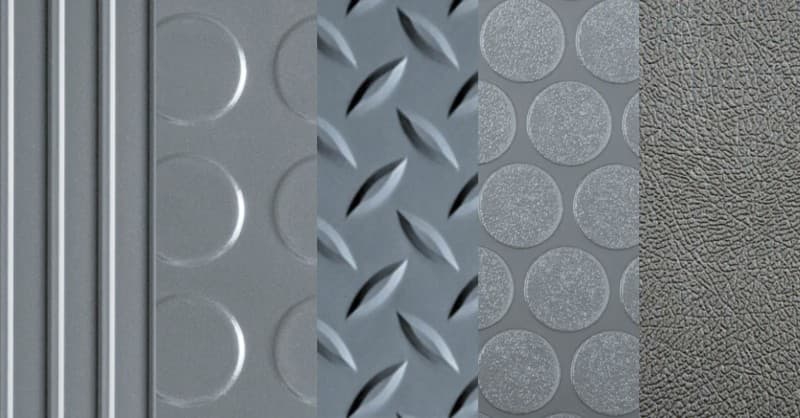
All mats are available in five surface tread designs and up to three colors, excluding clear. These colors are Sandstone, Midnight Black, and Slate Grey. Clear is available for two select mats, which we will discuss shortly.
Features and Benefits of G-Floor
Besides the option of completely transforming the look of your garage floor, there are many benefits to G-Floor roll-out flooring and garage parking pads.

First is the ease of installation. No surface preparation is required other than sweeping or cleaning your garage floor beforehand. G-Floor can cover ugly surfaces and cosmetic defects, such as oil stains, peeling paint, concrete dusting, and small cracks.
However, any larger garage floor repairs should be completed first. This would include large cracks, pitting, and spalling. Otherwise, they will show through and be felt through the flooring since it is flexible.
All G-Floor mats are resistant to staining from dirt and mud, automotive fluids, commercial chemicals, battery acid, road salts, deicing fluids, and other contaminants.
G-Floor is also waterproof. Water and other liquids cannot penetrate the surface and get to the concrete below. This can prevent future damage to the concrete from freeze-thaw and road salts.
This is a great benefit for those who live in wet climates or experience snowy winters. A single parking pad can prevent much water and snow from reaching the concrete.
In addition, G-Floor is rated slip-resistant. It has met the standards of many ASTM ratings for both wet and dry surfaces. However, care should still be taken when wet. Slip resistance does not mean non-slip.
Furthermore, it is a very easy flooring to clean. A mild soap-and-water solution or a household vinyl floor cleaner will get the job done. Many like to pull the parking pads out onto the driveway to clean and hose off.
Lastly, G-Floor has a limited lifetime warranty. It covers material defects and workmanship for the life of the flooring.
Now that we know what G-Floor is and the benefits it can offer a garage, we’ll discuss common questions and installation tips.
More importantly, we want to address some concerns and drawbacks of G-Floor and vinyl flooring in general. This will provide a more realistic understanding of what it can and cannot do for you.
This post may contain affiliate links. If you use these links to make a purchase, we may earn a small commission. As an Amazon Associate, All Garage Floors earns from qualifying purchases. You can read our full disclaimer here.
How thick are G-Floor Garage Mats?
Each mat lists two measurements for thickness. The first is the base thickness and does not include the raised tread surface design. The second is the overall thickness, which includes the base thickness plus the raised tread surface design.
These measurements are expressed in mils. One mil is 1/1000th of an inch. For reference, a penny is approximately 60mils thick. Depending on the mat, the overall thickness ranges from 50 mils to 130 mils.
Lastly, G-Floor mats are available in up to 5 sizes, depending on the design. These sizes are, 5ft x 10ft, 7ft 6in x 17ft, 8ft 6in x 22ft, 8ft 6in x 24ft, and 10ft x 24ft. Custom lengths in 10ft wide rolls can be specially ordered.
Coin
Color: Midnight Black, Sandstone, Slate Grey
5 ft × 10 ft, 7 ft 6 in × 17 ft
8 ft 6 in × 22 ft, 10 ft × 24 ft
Base Thickness: 75 mil
Overall Thickness: 110 mil
Diamond
Color: Midnight Black, Sandstone, Slate Grey
5 ft × 10 ft, 7 ft 6 in × 17 ft
8 ft 6 in × 22 ft, 10 ft × 24 ft
Base Thickness: 75 mil
Overall Thickness: 130 mil
Small Coin
Color: Midnight Black, Sandstone, Slate Grey
5 ft × 10 ft, 7 ft 6 in × 17 ft
8 ft 6 in × 22 ft, 10 ft × 24 ft
Base Thickness: 60 mil
Overall Thickness: 90 mil
Ribbed
Color: Midnight Black, Sandstone, Slate Grey
5 ft × 10 ft, 7 ft 6 in × 17 ft
8 ft 6 in × 22 ft, 10 ft × 24 ft
Base Thickness: 55 mil
Overall Thickness: 120 mil
Levant
Color: Midnight Black, Sandstone, Slate Grey
5 ft × 10 ft, 7 ft 6 in × 17 ft
8 ft 6 in × 22 ft, 10 ft × 24 ft
Base Thickness: 55 mil
Overall Thickness: 55 mil
Clear G-Floor mats are available in limited sizes for the Levant and Ribbed surface designs only. The Levant clear is called Ceramic and resembles frosted glass.
The Ribbed clear mat appears more translucent. Though they are not crystal clear, the floor beneath the mat shows through reasonably well.
Both are attractive choices for those with garage floor coatings or color-stained concrete who want to protect the surface from car tires, automotive fluids, or water from rain or snow. The mats don’t stand out as much as they do in other colors when placed on such floors.
Which G-Floor Mat or Surface Pattern is Best for a Garage?
This is a common question, and one that often has more to do with aesthetics than with how you plan to use your garage space. However, there are exceptions.
If you plan to contain water and debris, the Ribbed design is best. The tall ridges that run lengthwise (front to back) with the garage do a great job of holding water, snow, and general dirt. Plus, it’s easy to push the water and snow right out of the garage with a push broom.
For ease of rolling tool boxes, benches, chairs, creepers, and other items, the Small Coin and Levant mats work best. Other surface designs will still allow wheels to roll over them; they will just be less smooth and bumpier.
It is important to note that the Small Coin mat has an overall thickness that is 80% greater than that ofthe Levant mat. We also believe that the Small Coin mat is the best overall value. There are a variety of reasons for this, which we discuss here.
If you like a more industrial or heavy-duty look, then the Coin or Diamond mat is typically preferred. If the base thickness and overall thickness of the flooring are your primary concern, then Diamond is the clear winner, followed closely by Coin.
Do I Need to Glue G-Floor Mats to the Concrete?
G-Floor garage mats are free-floating and do not need to be glued down. Nor does double-sided tape need to be used in most circumstances. Because they are very heavy, they do a good job of staying put on their own.
This is particularly true for the parking pads. You just roll them out into position, use a push broom to push out air pockets, and then let them relax for a few days. That’s it.
However, there are some exceptions. Gluing down parts or all of the mat or using double-sided acrylic tape may be required. These methods are typically only incorporated when covering a large area with two or more mats. We will discuss this in more detail below.
How do G-Floor Mats Connect up Together?
You have a few options for connecting or lining up two or more G-Floor mats. This is usually done when covering the entire garage floor with roll-out flooring.
The first and most common is to just butt the mats up against each other and see how they do. It’s important to give them a few days to relax and completely flatten out. Repositioning may be required afterward.
Once they have relaxed, you can physically connect the mats if you feel it is necessary. Applying G-Floor brand seam tape to the underside is preferred. Seam tape is only sticky on one side and does not stick to the floor.
In addition, the G-Floor seam tape is 4” wide and waterproof. This is important to consider if you do not want any water to penetrate the seams between two mats and reach the concrete.
Butting the mats together and using seam tape is also the least noticeable for showing the mat seams. Of the 4 raised surface patterns, the Small Coin does the best job of minimizing seam visibility. This is due to so many coins being close together. They create a busy enough pattern so the seams don’t stand out.
The next option for connecting the mats is to use G-Floor Center Trim. This is a strip of polyvinyl with 1.5” slots on each side that the mats slide into. This trim strip also helps to keep water from getting between the joints of the concrete below.
A Center Trim strip is usually required when connecting more than two mats. We discuss this in detail below with our installation tips.
Double-sided acrylic tape is another option. This method is used only if the mat needs to be anchored to the floor in a specific area for some reason.
G-Floor Edge Trim can be used for the front of the garage. It does a good job of creating a nice transition from the concrete to the mat, giving it a more finished look.
Technically, Edge Trim does connect mats at the front. However, it should not be relied on as the only source to keep mats locked together if that is your goal.
One important note is that Center Trim and Edge Trim strips are available only in Midnight Black and Slate Grey. Sandstone is not available.
Will the Mats Mold or Mildew?
G-Floor mats are highly resistant to mold and mildew, particularly on the underside. Though it could happen under perfect conditions, we have yet to hear or read a complaint about it.
Here is another way to look at it. If moisture issues have never been a problem in your garage, the mats won’t create one.
Small amounts of water that might get through a seam or under the edges typically are not a problem. The concrete will eventually absorb it and the mat will dry out underneath. If necessary, just pull the edges back and pat the mat and concrete dry.
It’s not uncommon for water to sit on a mat for days during winter. No mold or mildew will be present after it eventually evaporates or gets wiped up.
Because the mats are waterproof, they will trap water if your garage floor is prone to moisture from below the slab. If so, then we highly recommend sealing the concrete first with a good, inexpensive sealer.
This one here is a good example of a sealer we recommend.
Do G-Floor Garage Mats Lay Flat or Curl Up at the Edges?
Curling up at the edges is a common complaint with many brands of garage floor mats and roll-out vinyl flooring. However, G-Floor lies flat and rarely curls.
Orders for G-Floor mats are shipped factory direct. This allows for the mats to be stored flat. They are only rolled on a core for shipping when an order is received. As a result, they don’t have a chance to take a permanent curl from being rolled up for long periods.
Most issues with G-Floor curling or not relaxing well are due to mats stored on rolls for long periods. Another is when they are left packaged at home for quite some time before installation.
Once a mat is received and rolled out, it can take up to 72 hours for it to relax and lie flat. It may take up to a week if the temperatures are cold at the time. However, they will still relax and lie flat.
We do not recommend purchasing G-Floor from warehouse clubs, home improvement centers, or auto parts stores that stock mats. The mats are pre-rolled and packaged for storage. You don’t know how long they have been stored in this condition, and it may be more difficult to get the edges to relax and lay flat.
Important note: Many competitor mats are packaged and stored rolled up. This is particularly true of those made overseas. These mats are notorious for not lying flat or curling up on the edges.
Nitro Rolls are an excellent example of this. They can spend weeks alone in shipping containers. In addition, because Nitro Garage Mats use fillers, they are lighter. The fillers tend to resist lying flat once stored on a roll for long periods.
Installation Problems and Drawbacks with G-Floor
As we mentioned previously, G-Floor garage mat and roll-out vinyl flooring is not perfect and does have some drawbacks to consider. Like all flooring, there is always a compromise to be made somewhere.
One trait of vinyl garage floor mats and parking pads is that they expand and contract with temperature changes. How much they expand and contract can depend on the size of the temperature change. And this is where the majority of problems and complaints arise with G-Floor, as well as other vinyl roll-out flooring.
The primary issue with expansion and contraction is the possible buckling or wrinkling of the mats. If this occurs, it is most often with wall-to-wall coverage when two or more garage mats are joined together. If the recommended installation instructions are not followed, you greatly increase the chances of it happening.
It is rare for it to occur with parking pads that use a single mat. However, it can happen under certain circumstances.
Examples would include a large trailer parked on the mat when it was very cool. When it finally warms later in the season, the mat will expand. Because it is anchored down by the trailer at three points and cannot expand evenly, wrinkles can occur.
This usually isn’t a problem with cars, since they are moved in and out of a garage more frequently. As a result, the mats can expand and contract without much issue.
G-Floor Garage Floor Mats will Stain from Car Tires
Yes, car tires can and will stain G-Floor garage mats. In fact, they will stain any brand of polyvinyl garage floor mats or tiles, regardless of what the manufacturer states.
As resistant as polyvinyl (PVC) is to staining, it will not prevent car tires from leaving their mark where you park. If any retailer states otherwise, then they are not being honest and should be avoided.
The blackish-brown plasticizers that leach from car tires have an uncanny ability to stain most surfaces and even some quality coatings. However, there are steps you can take to minimize the staining or make it less noticeable.
We recommend choosing the darker-colored garage mats, such as grey or black, if tire marks are a major concern. The darker colors do a better job of hiding the marks. Cleaning the areas where tires sit more frequently helps minimize staining as well.
There is a trade-off between black and grey. Though the black mats do a better job of hiding tire stains, they tend to show dust and dirt more than the grey mats.
Lastly, you can treat your G-Floor mats with Hilway Direct coating products. They do a better job of resisting tire staining and keeping it to a minimum.
Plus, it makes cleaning the mats even easier and provides more resistance to staining from other contaminants.
Garage Flooring LLC has much experience with using Hilway Direct. You can find it here. Follow the Revised Product Suggestions for PVC flooring.
Garage Mats can Wrinkle from Turning Vehicle
You should avoid turning the wheels of your vehicle when it is not moving. If you do, the tires can twist up the mats and wrinkle them since they are free-floating. This may cause permanent damage to the mat. Always make sure the vehicle is moving first.
If one area of your garage requires tight turns or vehicle repositioning during turns, a garage floor mat may not be for you. You will get frustrated with the mat buckling. If you still prefer a garage mat, the only option to prevent this is to glue the entire mat to the floor.
Installation Tips for G-Floor
To help prevent buckling and wrinkling of the mats, it’s important to leave a minimum of 1/2″ distance between walls and other immovable objects. This includes support poles, storage cabinets, and any heavy items that will not be placed on the mat. If the climate where you live experiences large changes in temperature, then you may want to consider a minimum 1″ gap.
This rule is critical when joining two or more mats. If the mats do not have enough room to expand, they will buckle up or wrinkle in areas.
If there will be only one seam (two mats), seam tape is the most popular option because it makes the seam less noticeable. The key when using seam tape is to butt joint the mats together first without the tape and let them relax and acclimate for a few days
This procedure allows any necessary adjustments to the two matsafter they relax before using the seam tape. If not, mat adjustments cannot be made, and wrinkling or bubbling up may occur as they relax.
Do not use seam tape if more than 2 mats will be joined. The reason for this is that center mats surrounded by mats on both sides cannot expand enough on their own and will buckle. G-Floor recommends using the Center Trim strips instead.
Unlike seam tape, the Center Trim strips allow the mats to expand and contract within their slots. As a result, there is much less chance of a mat buckling.
When installing the Center Trim strips, the wider base of the strip is the bottom side. The mats fit in the slot between the top and bottom edges of the strip. The slots are wide enough to allow a minimum 1/2″ gap within this slot to allow for expansion and contraction of the individual mats.
When to Glue Down G-Floor Mats
There are some circumstances where it may be required to glue down the entire mat. If you don’t want to deal with the natural expansion and contraction of the mats, you’ll need to glue the entire mat.
Another circumstance would be butt jointing three or more mats together without using the Center Trim strip for a more seamless look. When this is done, the entire mat must be glued down to prevent severe buckling or wrinkling.
Occasionally, the leading edge of the mats at the garage door may wrinkle when joined for wall-to-wall coverage. This is usually due to large differences in temperature swings at the garage door compared to the rest of the floor.
When this happens, it is recommended to glue the edge down with 3M #80 spray adhesive or double-sided acrylic carpet tape. Make sure the mat is relaxed first before using glue or tape.
As you can see, there is a great deal of information to absorb about G-Floor vinyl flooring. So let’s sum it up: the good and the bad.
Pros
- Quick and easy installation
- Good value and looks great
- 5 tread surface designs to choose from
- Durable and long-lasting
- Easy to clean
- Hides ugly garage floors and concrete dusting
- Resistant to staining from mud, dirt, and most automotive fluids
- Resists battery acids
- Waterproof
- Protects concrete from deicing fluids and road salts
- Parking pads keep the rest of the garage floor clean and dry
- Anti-slip properties wet or dry
- Highly resistant to mold, mildew, cracking, peeling, or curling
- Little to no concrete prep required
- No adhesives required for most installations
Cons
- Not as custom looking as coatings or garage tiles
- Limited color choices
- Tires will eventually stain the mat
- Expansion and contraction may cause buckling or wrinkles
- Not seamless
- May require gluing down
Best Retailers to Purchase G-Floor Garage Mats
There are a variety of retailers and vendors to purchase G-Floor garage mats and roll-out vinyl flooring. However, we have two in particular that we recommend.
The first is Garage Flooring LLC. The owner, Justin Krauss, has been selling G-Floor for well over 10 years. He and his staff have more experience with garage floor mats than any other vendor we are aware of.
G-Floor was the first brand of garage flooring I ever sold. To this day we still sell about as much G-Floor as we do everything else combined. They have always stood by us and stood by their product.
Justin Krauss
There probably isn’t an installation question or issue that he and his staff can’t answer or solve. In addition, the customer service is excellent, and he has great tips for those with larger garages and workshops that need to join three or more mats together.
Lastly, they offer competitive pricing and will not sugarcoat the benefits of G-Floor; they’ll tell you what you need to hear. He and his staff are very candid about G-Floor in terms of what it can and cannot do in regards to installation, protection, and durability.
The next retailer we can recommend is Amazon. They have a complete store dedicated to G-Floor products. In addition, they have a trusted reputation and are always a good place to shop if you’relooking at price alone.
Just keep in mind that there is no one at Amazon to directly answer your questions or provide quality advice on mat choice or installation.
Are Cheaper Brand Garage Floor Mats Good?
Be very careful if considering less expensive brands of garage floor mats. They are rarely a good value and the vast majority are made overseas. Also, be wary of any claims that they use 100% polyvinyl.
Technically, the way it is worded may be correct. However, they do not use 100% polyvinyl throughout the mat. Polyvinyl is only one of the many materials used (fillers) and is typically employed as a thin layer on the uppermost surface only.
Nitro garage mats are a great example of this. In fact, they are a different color on the underside of the mat because it’s a different material. There are even videos online that show people tearing Nitro mats by hand or peeling off the top layer.
With few exceptions, garage mats made overseas are known to have durability issues. Vehicle traffic can wear through the uppermost layer. Heavy items tend to crush the mats and permanently deform them.
In addition, because they are stored rolled up for long periods, there are numerous complaints of curling or the ends not lying flat.
Final Thoughts
We can confidently say that there is no better choice than G-Floor. They are the premium garage floor mats and roll-out vinyl flooring for garages and workshops in the industry and have been for many years.
G-Floor is easy to install, looks great, and provides a wide variety of benefits for garage floors and workshops. In addition, it will protect your concrete from water, road salts, and other automotive contaminants for years to come.
Though G-Floor is top-of-the-line, it’s important to know its drawbacks and limitations. If you don’t become aware of these, you may end up an unhappy customer. This includes all vinyl flooring in general for a garage.
However, as long as you understand the limitations of what it can and cannot do, we feel you will be very happy with G-Floor’s performance and how it can transform the look of your garage in a short time.
I recently removed the G-Floor mats I installed approximately 8 years ago. They began to fail 2-3 years after installation and got progressively worse over time. My mats were the ribbed pattern, 9′ x 20′.
The failure is extreme wrinkling, generally longitudinal. They held puddles of water and snow, requiring frequent brooming. The wrinkles were so tall they were a tripping hazard.
I replaced them with the expensive high solids epoxy professionally applied by the same company that did the General Motors Proving Grounds Garages. It is guaranteed for life.
Hi Mark. Thanks for the input. Are you sure they were G-Floor? I ask because we had not seen G-Floor offer that size. Other brands are out there with the same or similar design that are inferior. Fortunately, G-Floor has extended its warranty to lifetime. If something like that were to occur, it would need to be brought up to them for warranty review.
How does it hold up outside? Balcony floor fully glued
Hi Fred. It is U.V. stable and holds up exceptionally well outdoors when glued down fully.
Looking for 10×24 sandstone coin style is this size available any more
Hi Mike. You can find that size and color in the large coin here.
Can the edges be heated to help them conform to the surface and lay flat?
Hi David. Typically, they will lie down on their own, particularly when the weather warms. You could try using a hair dryer to accelerate the process, but you do not want to use a heat gun or anything that gets really hot.
Is the edge trim high enough to function as a containment mat? I live on a gravel road and am thinking something like this will hold up better than other containment mats. Thanks.
Hi Darrin. The top or upper section of edge trim that overlaps is only about 1/8″ thick. The design of the ribbed mat allows it to contain the most liquid and the edge trim will will do a decent job of containing it. However, it will not hold nearly as much liquids as an actual containment mat. Containment mat edges are typically 1-1/4″ tall.
I am going to install some type of flooring to protect my garage floor which is becoming pitted due to calcium being brought in from the car in the winter. I am exploring the best and most economical solution right now I am looking at doing a wall to wall G-Floor installation. I have one issue the floor of my garage has a dip in it that causes a small puddle from the snow melt or water dripping from the car, this is about 2 feet from the garage door. Anyhow my question is do you have any retailer/installer you would recommend in Ottawa Ontario Canada?
Hi Stephane. You should be able to purchase G-floor from Amazon Canada. G-Floor is a typical DIY install. We are not aware of any actual installers for the product. However, if you want the most economical solution, then we recommend purchasing a containment mat instead. These just unbox and get rolled out onto the floor. Here is a link where you can purchase them from Amazon in Canada. In addition, we have an article here that explains how they work.
Hi,
1 can the mat be cut or trimmed? it seems like the size of 8.6 x 22″ fit my garage the most. But length of my garage is 21.5 feet.
2 dose the mat release chemical or plastic like odor to the air?
3. I can see that your website will automatically link to Amazon website when i click the buy box. It is what is should be expected. One of the you tube reviewer advise to buy directly from you.
Thanks
Hi Eddie. Yes, you can trim the mat with a utility knife or industrial scissors. 100% polyvinyl is VOC safe and commonly used in living spaces. The mat might have a slight new smell when unrolled, but it dissipates rapidly. We don’t garage flooring products directly. We are an informational website which allows us to provide reviews and evaluations without a bias towards a particular product that we need to sell. If you do purchase from Amazon, we make a small commission, but it does not affect the purchasing price. Thanks for asking.
Hi Shea,
Great videos and information. I recently installed the 7.5′ x 17′ mat in my garage and have enough edge trim to put around it’s perimeter. Do you have any tips or tricks for installing the trim? I am especially interested in getting the trim to stay in place and not walk off the mat?
Hello Mike. We don’t have any tricks really. It’s not that hard to install. Just start at one end and work your way down. Two sets of hands makes it easier. The trim should be snug enough not to walk off. If you do encounter this issue, we recommend using a little bit of PVC vinyl adhesive every few feet or so. Spread open the seam of the trim and place the adhesive there before sliding it back onto the mat.
I have a few questions:
Does G Flooring reduce echoing when put on top of concrete?
Can you or should you put a real thin flooring insulation board underneath? Would this help with possible condensation issues in a heated room between the concrete and G Flooring?
Can you put G Flooring on top of other flooring such as carpet, linoleum, vinyl or laminate flooring?
Hi Grant. These are great questions. Yes, G-Floor will help to reduce the hollow sounding echo from sound bouncing off the hard concrete. No insulation board is required, nor is it recommended. Condensation is caused from relatively warm moist air coming in contact with relatively cooler concrete that is below the dew point. The G-Floor mats surface temp will more closely resemble the current air temperature and not the concrete temperature. Most concrete holds a cooler temperature until the warmer months and this is why some areas of the country experience condensation, AKA sweating concrete. If you are unsure if you have sweating concrete or moisture from below, I suggest you read our article here about sweating concrete. G-Floor should not be placed on carpet, but it can be placed on other hard flooring surfaces such as those you mentioned.
I have a new home and my garage has yet to be completed. Right now I have a 2-car garage over a living space, the floor is structurally thick treated plywood for load reasons. The original idea was to pour a 2” concrete floor, but many have commented it is too thin, will crack easily. I have done a lot of research over the last several months, today I spoke via chat with the people at G-Floor. They said I can use crack fill to prep the wood subfloor, sand to smooth, then use their recommended adhesive to lay down the G-Floor product. I also need to keep in mind the 2” that I need for the garage door to contact the floor, the vinyl product is quite thin so I need to use a product like GaraDry 2” stop at the point of contact for the garage door. My question to you is do you believe that I can safely use this proposed system over the present treated wood subfloor and avoid the pouring of a too thin slab?
Thanks for your time!
Regards,
Peter
Hi Peter. Yes, a 2″ thick concrete slab would turn into a concrete gravel parking space after a while, particularly with it being placed over a wood subfloor. I have a question about the exact placement of the garage door in relation to where the garage floor steps down 2″. Is it just inside that point? If so, how much? Is part of the wood floor exposed to the outside elements? Is the apron leading to the garage floor concrete?
Thanks for the reply and questions. I think I was probably not clear enough in my details. Right now I have a garage built over a living area, a bedroom to be precise. The garage floor has been engineered to withstand the potential slab as well as vehicles, so structural is no issue. Presently the garage floor is treated plywood, can’t remember the thickness, but it is heavy duty for the required structural aspects. The entire garage area sits at the same level, no step down. The 2″ is the space allocated for a slab and that will bring the entire floor up to the garage door required level. The concern is obviously the viability of a 2″ slab. Some say it can be done with the right prep and mixes, but the cost will be expensive. I have been researching other options to raise the entire floor 2″ without having to go the slab route if possible. Last night when I came across the G-Floor products I thought it might be a good option to install directly over the wood subfloor, keeping in mind that I do need to waterproof the subflooor so no moisture can get into the flooring system or living area below. With all of this in mind the G-Floor product is quite thin in comparison to the 2″ I need to raise in order for the garage door to come down and sit right. However in the meantime I have placed some treated wood where the garage door closes, 2″ in height precisely, and the garage door presently sits fine, no issues. I thought that I could possibly use the G-Floor on the entire floor, and then at the garage door contact point just install one of those GaraDry 2″ stops and it will be just like the 2″ buildup I presently have there now so the door shuts correctly.
The garage floor does extend beyond the garage door at the same height as the rest of the garage floor, maybe by about 3″. I need to make sure that all the floor, including the few inches on the outside is 100% weatherproof. As for the driveway apron, it has yet to be poured and will be done after I come up with a viable solution for the garage floor. In any case the exterior apron will be poured to meet the height of the finished garage floor.
I hope this helps. If you need more info I can send pics or whatever you feel necessary. I really appreciate your time!
Regards,
Peter
Hi Peter. To answer your original question, the GaraDry 2″ will work fine for the seal at the bottom of the garage door to rest on, thus filling the gap. And yes, the G-Floor will work well when properly glued down to the wood. However, my concern with the floor being 2″ lower and extended 3″ out past the garage door is; what will prevent the floor from collecting rain like a pond? That is why I wanted to clarify what you were explaining.
As far as concrete goes, it is inherently brittle and does not like to flex at all, but is extremely strong under pressure/compression. That is why it is typically reinforced with rebar, thick wire mesh, etc., which would be difficult to do with only 2″ to work with. 2″ isn’t enough for a post tension slab either if I’m correct. Though the wood floor is reinforced to handle the weight of the slab and vehicles, it will still minutely flex when pulling vehicles in and out. Thus, the cracking with low to no reinforcement.
There are Engineered Cementitious Composites made with polymer fibers that are designed to flex more than standard concrete, but it’s extremely expensive and may be hard to find for a such a relatively small pour. I’m guessing that is what you have learned.