
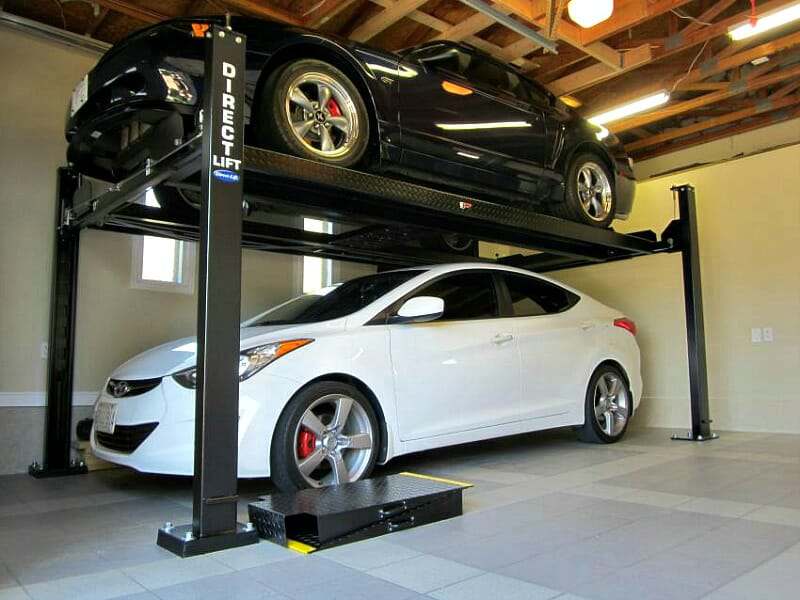
Yes, porcelain tile is one of the more durable garage floors that you can install in your home today and the toughest of all garage tile options – really! For a variety of reasons, and a few of which are very understandable, some people are having a hard time accepting the fact that it can be such a resilient and long-lasting garage floor choice.
As a result, we have decided to cover some of the more frequently asked questions regarding the durability of porcelain tiles for a garage floor. If the idea of this type of flooring is new to you, you can learn about the many benefits of porcelain tile in our first article.
F.A.Q.’s about porcelain garage floors
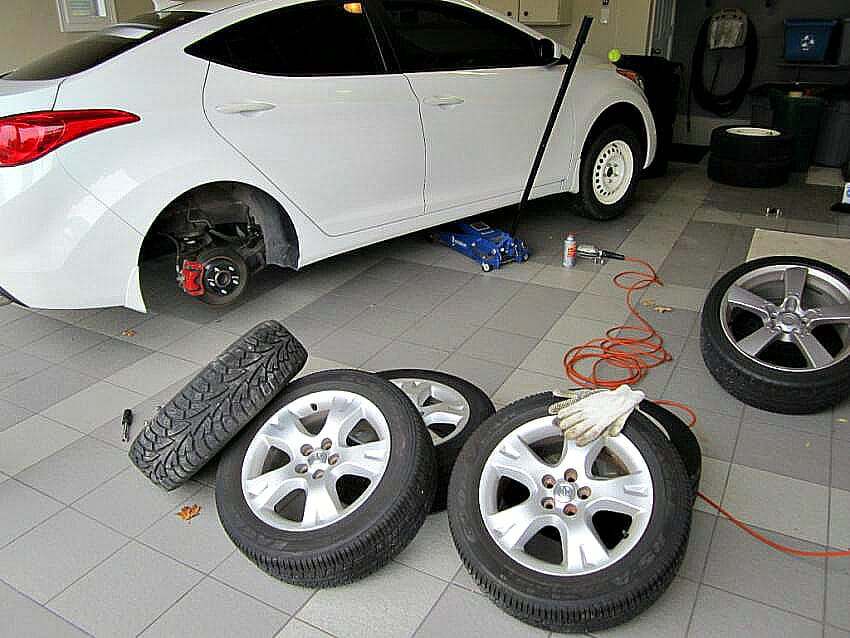
Will floor jacks damage porcelain tile?
This is the most popular question by far. No, floor jacks will not damage or crack the tile. The key to this is in the installation.
When laying the individual tile, it’s important that each tile has thinset (mortar) applied to both the concrete floor and the back of the tile (back buttering) before setting it. This insures that there are no air pockets under the tile and provides for a solid footing.
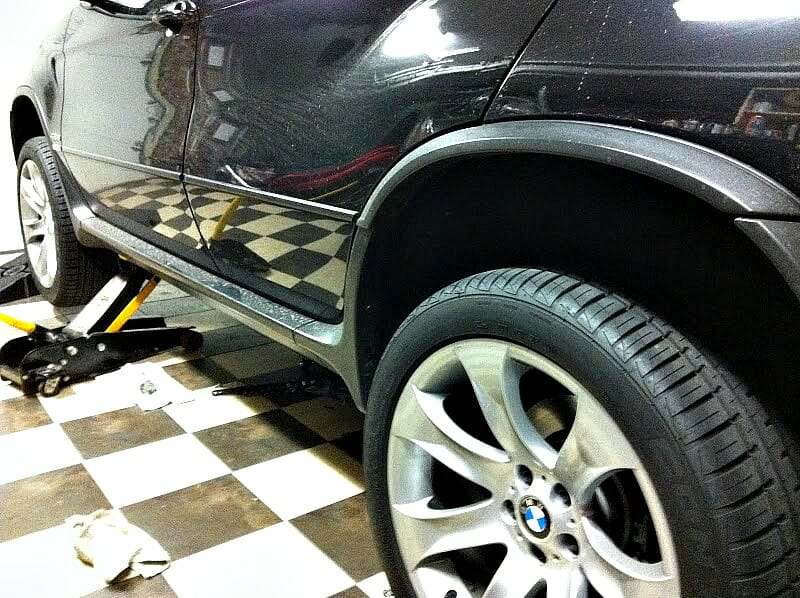 It’s also important to make sure all the tiles are level with each other and don’t have any raised edges. This prevents a small edge of tile from being the only load bearing source when using jacks or jack stands. Small grout lines of 3/16” or less help as well and make for easy rolling of tool boxes, creepers, and jacks.
It’s not uncommon at all to see porcelain tile used in mechanics garages and various automotive settings where jacks, lifts, and other heavy equipment are use.
Can porcelain tile be used in cold climates?
Yes. Because porcelain tile has an absorption rate of less than .05%, it will not absorb water which could cause damage if it freezes. If your winters traditionally get below freezing and your garage is not heated, there are a couple of requirements you must follow however.
The first is to use a thinset with a latex additive added to the mix. This makes the thinset more flexible and able to withstand the freeze/thaw cycles that a garage floor can go through.
 The second is to seal your grout or use a grout that doesn’t require a sealer. This will prevent water or snow melt from seeping into the grout and underneath the tile causing it to pop off when water refreezes. It also aids in preventing stains in the grout.
Can I use ceramic tile instead of porcelain?
If you can find a ceramic tile with a PEI rating of 4 or 5 and if you live in a climate without freeze/thaw cycles then ceramic tile can be used in the garage. There are a few things to consider however.
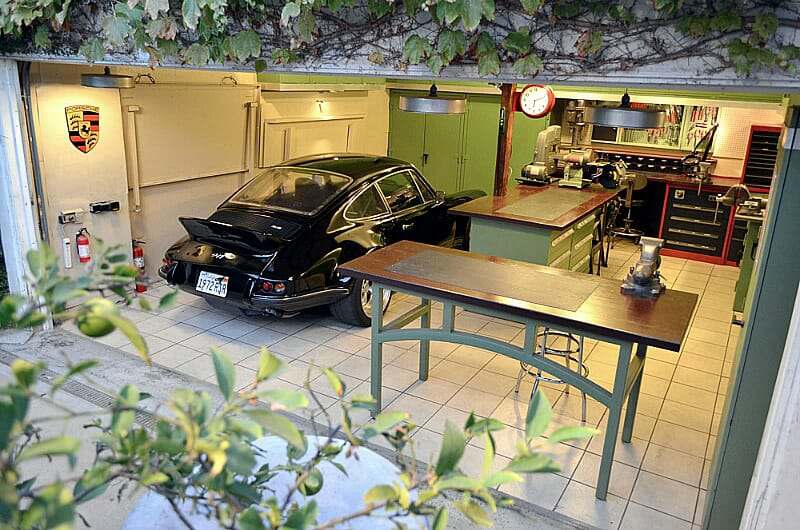
This is a ceramic tiled garage floor by Jack Olsen. It’s known as the 12-Gauge Garage because of the 12 gauge steel used for the Strong Hold cabinets he installed. You can visit Jack’s garage here.
Porcelain tile is more dense than ceramic due the manufacturing process. This high density is what provides for the extremely low absorption rate. Because ceramics have a higher absorption rate, they should not be used in cold climates as water absorption during the freeze thaw cycles will cause it to crack.
Porcelain tile is also colored through-out the tile whereas ceramic is not. If you chip ceramic tile it is very noticeable because of the different color underneath the glaze. If you do happen to chip porcelain, it is much less noticeable because the color does not change.
Won’t porcelain tile break easily in a garage?
No. When porcelain tile is installed correctly without any voids or air pockets underneath the tile, it is very hard to break or chip. The extreme density of the tile is what makes it so strong.
A good example is from this short video clip below. The flooring is actually ceramic tile from Jack Olsen’s 12-Gauge Garage as shown in the photo above. In the video, Jack pounds the tile with a sledge hammer without damaging it. The video camera on the floor actually jumps because he is hitting the tile so hard.
While we don’t recommend pounding on your floor like this, you need to remember that the tile being struck is ceramic. Porcelain is stronger yet.
Will road salts and deicing fluids damage porcelain?
No. Because porcelain tile is so dense and has such a low absorption rate, salts and deicing fluids will not damage it. This is why porcelain tile is extremely hard to stain as well.
One exception to this is polished porcelain which you would not want to use in a garage due to how slippery it would be – which leads us right into our next question.
Isn’t porcelain tile too slippery for a garage floor?
No, it won’t be slippery if you purchase tile with a higher coefficient of friction (C.O.F.) rating. Tile rated between .055 and .059 are generally considered equivalent to bare wet concrete. A rating of .060 and above is considered slip resistant and meets or exceeds OSHA and ADA requirements for a wet surface.
This is why it’s not uncommon to see porcelain tile used in entry ways in commercial settings. It reduces the chance of slip fall accidents that could cause law suits.
Will welding damage porcelain tile?
Yes. Welding can lead to small burn marks on the surface of the tile which is extremely difficult to remove. In fact, welding will eventually damage any surface including concrete. A welding blanket should be used.
Convinced yet?
Hopefully the answers to these popular questions have dispelled some of the myths about the durability of porcelain tile as a garage floor. If you still aren’t convinced, then porcelain probably is not for you. It’s important to be confident in your garage flooring of choice. If you are convinced however, then you will be rewarded with years of service, durability, and good looks that will make your neighbors envious.

What is the approximate square foot cost for a porcelain tile garage floor installed?
To be honest Kevin, it really varies depending on your area. We know of many readers who paid less than $2 a square foot and readers who have paid up to $4. If you are considering a porcelain tiled garage floor, we suggest visiting a few tile stores in your area to get some names and references of installers in your area. Give them a call to get an idea of your installation costs before purchasing your tiles.
I am convinced! So the durability of porcelain garage floor depends on workmanship leaving no voids or air-pockets; that is so hard to find! Given that, I am now shopping for those who may specialize in this type of garage flooring and offer decent period of guaranty/warranty. I would appreciate if you can refer anyone. Q: What tile is size is better for durable floor, 12×12 or 24×24, assuming no one would do perfect floor prepping and installation job?
Hello Aardee. The tile size does not matter for durability, but it does make a difference for other things. Larger tile sizes for example require less grout lines. Generally, 12″x12″ is the minimum size you want to use and you can go up from there. Smaller sizes tend to look too busy in a garage. For installion we suggest contacting the various tile setters in your area to get a quote.
What do you do with the expansion grooves in concrete? I would like to tile our carport floor and a large adjoining patio. However, the poured concrete patio has expansion joints cut in. Do we need to cut the tile along these lines and use a matching flexible caulk, or can we just continue the pattern and tile over the joints? Thank you for your help.
Hello Chris. Since the tile will be outside, it’s really best to honor the joints and cut the tile to match. You are going to get more expansion and contraction than you do in a garage. A sanded caulk in your matching grout color can be applied in those areas.
I am thinking about tiling my garage. Do I have to use a porcelain tile with PEI of 4 or 5? It’s a residential garage not a working garage. I live in MI, so it gets cold (below freezing temp in the Winter). My garage currently is concrete and I noticed with the weather or temp changes, the concrete has water on it’s surface, but not a lot of water it’s I think what they call “sweat”.
Another question I have is the joints inside the garage, do I need to fill those with cement before tiling ? Or I need to cut the tiles to match the joints? The joints I think are 1/2″ wide, so it will be kind of obvious if I cut the tiles around the joints
Hi Wally. You will need a minimum PEI rating of 4 for a garage floor. The rating determines the hardness of the tile. Anything less runs the strong chance of cracking under the weight of a vehicle. A PEI of 1 for example isn’t even rated for foot traffic. PEI 4 rated tile are not hard to find and are often on sale at home improvement centers for around $1 per square foot.
The moisture you see occasionally when the weather changes is most likely condensation. This is fairly typical when cold concrete comes in contact with relatively warmer air masses.
In terms of the contraction joints in a garage, most people fill the joint with thinset as they go. The most important part of laying tile for a garage floor is too make sure there are no air gaps under the tile or it can break under weight. Back buttering of the tile is highly recommended. Also, for areas of cold weather it’s best to use a polymer-modified thinset to avoid freeze thaw damage.
Oh, my garage floor is currently painted (gray paint I don’t think it’s epoxy), do I need to strip the paint from the floor before tiling? Or I can tile right on top of it?
Thank you
You will need to remove the paint before tiling. Thinset does not stick well to it, plus, you want the thinset to adhere to the concrete for a permanent bond. Paint does not have a permanent bond to concrete.
My garage has a little bit of a slope so that water flows outside. Will that affect tiling? Will water pooling be an issue? (I live in the Pacific Northwest)
If the garage floor slopes so that water flows to the outside, then that is ideal Zeke. You shouldn’t have any issues with pooling then if it’s laid properly.
Great article. I’m interested in doing my garage in 24 x 24 black and white checkerboard. A couple of questions. I love the look of high polished but will that scratch more easily and be too slippery in a garage environment. Is there a finish I should be looking for? And my biggest problem is I can’t seem to find anyone local that stocks pure black and pure white 24″ squares. Is there a national source I could tap?
Hello Bryan. You will need to do some Google searches to try and find what you are looking for. You may want to visit a good tile store in your local area to see what they can order in. The home improvement centers have the ability to order in tile as well. As an example, we quickly found these 24″ square tiles from Floor and Decor. Many of these large national chains will send out small samples for a small fee as well. A polished tile is naturally going to be more slippery. Generally, the less shiny tiles tend to be less slippery and have a higer COF rating. In terms of ratings, you need a PEI rating of 4 or 5 for durability and a wet coefficient of friction (COF) rating of .5 or better. Our article on porcelain tile explains these ratings a bit better. If you don’t find any of these ratings listed, be sure to call or email and ask.
With porcelain tile how is the edge handled at the front of the garage so there is a smooth transition when entering garage. Does space need to be left around edges of garage for expansion or can tile butt up to and then cover stem wall for a neat finish?
Hello Linda. Most people use the aluminum Reno Ramp by Schluter for the entrance to the garage. It makes for a nice transition ramp. Your local home improvement centers can usually order these if they don’t carry them in stock. In terms of where the tile terminates at the stem wall; you will need to leave an approximate 1/4″ gap from the wall. You can tile up the stem wall as well. Instead of using grout in this gap, you should use a sanded caulk that matches the color of the grout you have chosen. The caulk allows for movement between the slab and stem walls.
Hey Shea,
Looking at Porcelain in my garage. I’m pouring new concrete with a slight pitch off the front of garage towards rear with a trench drain about 6 feet from door. I live in WI, however I will be heating the garage. Also, I have a Ford F250 Super Duty. Any concerns with weight / Drain?
Thanks Mark
Sounds like a nice setup Mark. No concerns at all about weight. As long as there are not air gaps under the tile, it will accept thousands of pounds withou issue. Regarding the drain, just make sure to honor the break in the concrete slope with a joint.
Was reading up on tile garage floors to see if there are any updates. I used porcelain tiles on my second garage floor 3 years ago and its holding up beautifully. I used epoxy grout in the second one and it’s bullet proof. My first garage I did not and have to clean and seal the grout lines fairly often. I used 2 inch by 6 inch bull nose for the transition. I was concerned about applying this weight of the car to the bull most since the garage floor is elevated about an inch and no issues. It’s to bad this site does not allow pictures or at least I can’t figure out a way to upload.
Has anyone used bull nose for the wall molding? This way I could hose down the floor and not worry about damaging the wood molding. The downside is I would need to cut the tile within 1/8 of an inch since the bull nose is thinner than a wood molding
Hello Dwight. It’s great to hear your porcelain tile is holding up nicely. We have heard from many people who are thrilled with the choice. Yes, we think epoxy grout is the way to go as well. It just takes a little more effort to apply – especially with the clean up of the tiles after it has set. We have seen bull nose tile used before for the front transition. It can work well if done correctly. The key with the bull nose as with all tile for the garage is to make sure there are absolutely no air pockets or gaps in the mortar when the tiles are laid.
You can send pictures if you like directly to our email, info@allgaragefloors.com. If they are good examples, we can feature them for others to see.
Also for expansion joints there is a liner you can use that is glued down over the joint and extends 18 inches on either side. helps the tiles float with the floor and I have seen zero issues with my expansion joints. (I live in Ohio)
You are correct. They are called crack isolation membrane and can be used over concrete cracks and contraction joints.
Hi Shea
Great article, and I am hoping that it will be the solution I am looking for. I have a very sturdy wood floor garage that has a storage area underneath. It has been in continual use for 40 years. I was hoping that I would be able to cover the existing floor with plywood, (or something similar), and porcelain. What are your thoughts on how the tiles would hold up?
Thanks
Porcelain tile is extremely durable, Jim, but the issue you will need to overcome is the wood floor flexing under weight. Wood subfloors are easily reinforced to not flex under weight of people or furniture. However, it can be difficult to ensure that a wood floor under the weight of a 3500 to 4000 lb car will not flex. Porcelain will not flex at all and can easily crack if it does.
I really want to porcelain tile my garage. It is a new build house so I was told I can’t until the floor has settled (5 yrs) by the builder.
What are your thoughts on this? I was told my 22×24 could settle 1/8″
That’s a new one for us Al. There really isn’t a need to wait. If the soil for the slab was prepped properly it shouldn’t settle at all. Builders don’t wait 5 years to tile the inside of a house either.
You also don’t drive cars inside the house usually, I guess I will pay close attention to make sure they compact it well!
Haha… Yes that’s true, Al. However, we really don’t think it’s something you should worry about. Most cracks and such generally show up within the first few months as the concrete cures.
We live in NY in the Mid-Hudson Valley. My garage floor is 18 years old and has been well scarred by road salt. Do you suggest using a leveler before tiling?
Hello Chuck. If it is indeed well scarred, then yes, using a leveler beforehand to smooth it out is recommended. Thinset does fine with filling in the occasional pits and scars as you go, but if the surface is inundated with them, fixing the issue first is the way to go.
Polished or unglazed porcelain tile for garage/shop floor? I would think glazed, but want to be certain before I purchase. Thanks
Hello Randy. You definitely do not want polished porcelain. It will get real slippery when wet. A matte finish is best as these will have the highest coefficient of friction ratings. Matte finishes are generally available in unglazed tiles.
After reading here, I decided to go with porcelain tile in my garage. We will use the garage as a playroom and party room often, but still keep it available to park the car in when bad weather sets in. I found a good deal on nice looking porcelain tile with a PEI 4 rating. When my tile crew was 3/4 through with installing, one of the guys told me he doesn’t think my tile is thick enough to handle the weight of a car without cracking. It is 6″x24″ tile, 0.3″ thick. Residential/Commerical, PEI 4. He’s got me nervous now. The floor looks fantastic, and I don’t want to ruin it with the car. But also the garage looses significant function if we don’t park the car in it.
Is there a minimum thickness that is important for porcelain tile in the garage?
Hello David. It’s unfortunate to hear that the person you spoke with doesn’t understand the material that he is working with. All porcelain floor tile is 1/4″-3/8″ thick. A thickness of 0.3″ is almost in the middle of those figures. The most important aspect of laying tile is to ensure that there are no air pockets between the tile and concrete, no gaps of missing thinset under the edges, and that the tile does not bridge gaps in the concrete that have not properly been filled. The reason for this is that porcelain tile has an average compressive strength of 20,000 lbs per square inch. This article here explains more. The tile you chose has 12 square inches of area, meaning that it can withstand up to 240,000 lbs of weight evenly distributed across its surface. So, the few square inches that a car tire occupies is not going to exceed 60,000 lbs, as an example. This is why porcelain is used in so many commercial applications such as automotive repair shops, hotel drive up entrances, and etc. Now, if your installer were to lay the tile to bridge a large gap with nothing to support it underneath, then you most certainly will break it. I hope that helps to ease your fears.
I’m an old lady reading your replies and gotta say, “you are amazing.” I want you to do my garage and driveway. What a great knowledge base you so willingly share with US all. Thank you, Thank you. Now can I hire you please!
I am convinced! I am going to purchase my porcelain today. As far as mortar thinset, is mapei uncoupling membrane with the polymer additive a good choice ? It was that or Megalite mortar with the crack prevention. Thank you!
Hi Debora. Either of those products will work. Megalite would be our preference since it does not require the additive.
Thanks for the great article.
I found these locally. Pei 5, MOHS 8, slip greater than .42. But they are a matte glaze. Does that mean the color is not through the body? Do you think these would work? https://www.eleganzatiles.com/loft-grigio-12×24.html
That’s a great looking tile, Houtan. It will work well for the garage. The glaze makes it a color body tile. However, the interior color of the tile should be of the same color since it is porcelain. It just won’t have the glazed look if it is somehow chipped. We would suggest contacting the vendor or manufacturer to make sure.
Thank you. I asked the seller and they confirmed the color is great through the entire tile. Really appreciate the feedback, now hopefully I can strike a deal!
Got the tile! Thanks for your help.
Another quick question, installer recommendations versabond for the thinset. Others have recommended flexbond or pro lite. Should I be concerned about him using versabond? My thought is let him use what he is comfortable with, but just want to double check. In case it is a cost issue where I maybe should offer to cover the cost of more pricey thinset.
Here is a link to versabond: https://www.custombuildingproducts.com/products/setting-materials/polymer-modified-thin-set-mortars/versabond/versabond.aspx#
We recommend FlexBond, Houtan. It has flexibility within the thinset after it cures. This helps to prevent any cracks or movement that might develop in the concrete below from cracking the tile above. The standard VersaBond is good for smaller projects such as showers, bathroom floors, walls, and etc.
Hello,
Thanks for the article. I am planning to go with Porcelain tile for my garage and backyard. Can you confirm if you see any problem with the below tile?
https://www.mohawkflooring.com/tile/detail/8663-198670/Ashton-Park-Autumn-Dusk
SIZES
38×3, 38×6.5
MATERIAL
Glazed Porcelain
APPLICATION
Floor & Backsplash
LOCATION
Indoor, Covered Outdoor & Outdoor. Tough glaze & traction in rain & snow, suits indoor looks.
GROUT WIDTH
1/8″
THICKNESS
3/8″
Hi Kru. This particular tile has a PEI 4 rating which is good. Also, the matte finish has a much better slip resistance rating when wet (DCOF) than the polished version. Something to be aware of though are some of the common issues with plank tiles. Because they are so long and narrow, they always tend to have a very slight bow to them. This makes them difficult to lay without getting lippage (one side higher than its neighbor tile). It works best to offset them by 1/3 of their length. In addition, the length with the slight bow makes it harder to ensure that the thinset covers the entire backside of the tile without having any voids. It’s important to avoid air pockets for garage tiles. We would not recommend this style of tile if you are laying it yourself and you are not fairly experienced. Professionals always charge more to lay this style of tile as well.
Thanks Shea for your response. Can you suggest any PEI 4 or 5 Tile from Mohawk? I have a friend working for Mohawk and I can get some discount on the tiles. It will help me keep the overall cost down.
If you can stay within 12″ – 16″ for the tile size you will be good, Kru. Try not to go any larger than 20″ if you can help it. The larger they get, the more experience it takes to install. Make sure the tile is rated PEI 4 or 5 and has a DCOF, or dynamic coefficient of friction, that is greater than 42. You should be able to find these specs from the manufacturer.
Hi Shea. Our garage is about 25′ x 25′ with a floor drain in the center, making the whole garage a light ‘bowl’. I have not yet measured the slope, but it’s fairly small I believe. Is there any rules of thumb for tiling a porcelain garage floor with this shape?
Hello Dave. The only thing you really need to watch for is not to use too large a tile if you are dealing with areas where the slope makes transitional changes. 12″x12″ would be the max you would want to use unless these changes are very slight. The reason is that larger tiles make it much more difficult to make the transition without creating too large of a gap under the center of the tile or on the outboard edges depending on the transitional change (flat to slope or slope to flat).
Can I install tiles over an aged epoxy painted concrete floor? How should it be prepped before laying down thinset besides a cleaning and solid vacuuming?
Which thinset would you recommend for this? Megalite, Flexbond?
Hi Lukas. It can be done with the proper steps, but it’s not recommended. The first question you have to ask yourself is, how confident are you that the epoxy will not peel at some point? Is it a quality commercial coating or a store bought DIY kit? The tile would be adhered to the epoxy which is adhered to the concrete. If the epoxy ever loosens up, so will the tile. It’s a lot of work to put in only to have tiles come loose.
If you apply tile over the epoxy, it will require that you seriously rough up the finish first. We would recommend 60 grit sandpaper. After that, apply a skim coat of thinset and let it dry. Once dry, you can then tile over it as normal. Considering the additional work that is required, it just might be easier to grind the epoxy off.
How long do you need to wait until driving you cars into the garage after the porcelain tile has been installed?
Hi Richard. You need to wait a bit longer than standard since the tile is being back buttered as well. Wait a minimum of 48 hours before moving things in and 72 hours before parking cars.
What is the required minimum thickness of porcelain tile for a garage floor?
Hello Tom. Most through body porcelain tile for floors with a PEI rating of 4 or 5 are going to be 8mm thick or thicker. What you do not want is the thin bodied porcelain tiles. These are typically under 7mm and will not be as durable.
Great article. My garage is 20×20 and about 20 years old. There are dimples in the concrete carried over from using acid etching a few years back and some big box epoxy paint residues. How should I prep the floor bearing in mind this is Ontario Canada? Thanks for your time.
Hi Clemkonan. The dimples are not an issue as long as they are not large. The thinset will fill those. As far as the epoxy goes, you really want to try and remove what’s remaining. Thinset does not adhere to it well.