
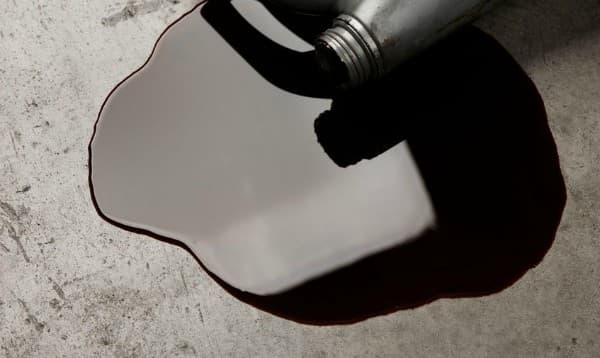
What is the best penetrating concrete garage floor sealer that repels and prevents oil stains? That is the never-ending question of consumers and the challenging quest of companies that sell them. The one irritating problem is that as good as these sealers can be at protecting your garage floor from the natural elements, they traditionally do not perform as well when it comes to oil resistance.
Fortunately, manufacturers have begun introducing sealers that resist oil. And Concrete Sealers USA is the latest introduction with their PS100 Fluorinated Water, Oil & Salt Repellant Sealer. Based on our review and testing, PS100 may indeed be one of the top-performing penetrating concrete sealers at resisting oil and oil stains on your garage floor.
As a quick refresher about garage floor sealers, it’s important to understand that penetrating sealers are non-film forming. Unlike a coating that creates a film-forming topical seal, penetrating sealers penetrate into the upper layers of the concrete surface and react with the minerals within.
This reaction creates and forms a breathable barrier at the subsurface that resists and repels most liquids. Since this barrier is not a coating, the concrete retains the same slip resistance, texture, and appearance in most cases.
However, because penetrating sealers do not form a topical coating, petroleum products such as oil are more prone to staining the immediate concrete surface.
Repelling Oil vs Resisting Stains
Before we discuss our review of PS100 and why we think it challenges the best garage floor sealers at repelling oil and oil stains, it’s important to learn how these types of sealers work.
Just bear with us here, as the following explanation will form a much better understanding of why PS100 is so effective.
As we stated previously, PS100 is not the only penetrating concrete sealer that repels oil. The market has slowly responded in the past few years or so to introduce sealers that do a better job at this. Our review of GhostShield 8510 oil resistant sealer is a good example and a product that we have high regard for.
However, repelling oil and then resisting possible oil stains on the concrete are often two different matters.
For example, if large drops of oil will bead for a period of time on the surface of concrete treated with a penetrating sealer, then it has successfully repelled the oil. If you wipe it up right away, more than likely there will be no evidence of it ever being there.
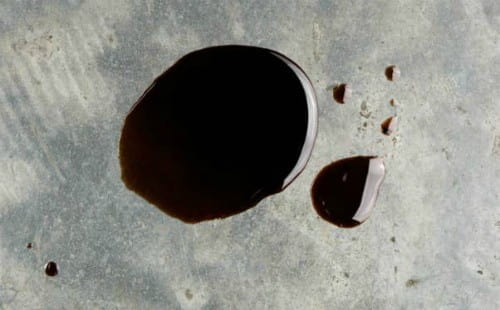
Traditional penetrating concrete sealers typically do not bead or repel oil like this. Though they may bead water, oil has a tendency to lay flatter on the surface. Sometimes it will run if left to sit.
Penetrating sealers that are touted to repel oil are described as being oleophobic. Oleophobic refers to the physical property of a molecule to seemingly repel oil. PS100 by Concrete Sealers USA is an example of an oleophobic concrete sealer.
The one common ingredient that all oleophobic sealers contain is fluorocarbons. Without getting too technical, this fluorinated material consists of fluorine-carbon bonds that carry a negative charge. This means that they will not easily bond with other materials.
Fluorocarbons have non-stick and friction-reducing properties. When used in a sealer, it causes oil film to be repelled or more accurately, not attracted. It is a similar molecular technology that is used for non-stick cookware and friction-reducing parts in the automotive industry.
Based on this knowledge, it’s natural for one to assume that if a garage floor sealer repels oil, then it should prevent staining. While this rationale sounds reasonable enough, unfortunately, this is not the case.
If oil is left to sit on your garage floor for a period of time, the majority of these oleophobic penetrating concrete sealers will leave an oil stain. How much of a stain remains is dependent upon the chemical components of the sealer and to some extent, the surface texture and density of the concrete.
The reason for the oil staining has to do with the fact that the main chemical ingredient of many (if not all) of these oleophobic concrete sealers is silane or a silane-siloxane mix.
Silane and siloxane are excellent at repelling water and moisture. It’s a common chemical ingredient in many penetrating concrete sealers. However, silanes and siloxanes are oleophilic (not oleophobic). In other words, they have a tendency to attract oil.
In addition, silanes and siloxanes are hydrocarbon-based and can allow chemical chains to remain active in the concrete. These active chemical chains look for other chemistries to react with.
If these chemical chains come in contact with another hydrocarbon, such as oil, it can result in a permanent stain on the concrete of your garage floor. This is a consequence of the oil attaching to the active chemical chain.
So, though these sealers use fluorocarbons to promote oil repellency, their main ingredient is still silane and/or siloxane. The characteristics of these two ingredients can fight with each other. If oil is allowed to sit for a long enough time, it will most likely stain the concrete to some degree (some are worse than others) despite the best cleaning efforts.
This post may contain affiliate links. If you use these links to make a purchase, we may earn a small commission. You can read our full disclaimer here.
How PS100 sealer Challenges the best at resisting oil stains
So, what makes PS100 Fluorinated Water, Oil & Salt Repellant Sealer for your garage floor different than the competition at repelling oil and resisting oil stains? It has to do with the fact that PS100 consists of 100% fluorinated materials with no silanes or siloxanes.

This fluorinated material is very stable and non-reactive. Without the silane or siloxane in the sealer, oil can sit longer on concrete treated with PS100. It does not risk the chance of being attracted to and reacting with active chemical chains which can create a more permanent stain.
This means that oil on a garage floor treated with PS100 concrete sealer will clean up and respond better to oil stain removal if required.
In addition, the extremely small molecular structure allows for good penetration into very dense surfaces. This molecular structure is even smaller than silanes and defines true nanotechnology.
To sum up, most companies have added fluorocarbons to the traditional silane siloxane sealers in order to create an oil repelling (oleophobic) reaction. What Concrete Sealers USA has done is develop a completely new product. It is made specifically with oil repelling and oil stain resistance in mind.
Will PS100 prevent oil stains? No. Simply stated, penetrating concrete sealers cannot physically prevent oil staining if left to sit long enough. This is due to their non-film-forming properties.
The best they can do is resist oil staining to varying degrees in order to allow oil clean-up in a reasonable amount of time. The only way to prevent oil stains on a garage floor is with the use of a topical, film-forming sealer.
However, PS100 Fluorinated Water, Oil & Salt Repellant Sealer allows oil to sit longer. In addition, it allows for easier cleanup and a better chance of removing a stain if one has set it.
Benefits of PS100 garage floor sealer
Important to mention is that oil repelling and oil stain resistance is not the only benefit of PS100 as a garage floor sealer.
When speaking with Concrete Sealers USA, we learned that besides repelling oil, fluorocarbon materials also exhibit strong water-repelling (hydrophobic) tendencies. As a result, PS100 provides excellent water repellency. This means it will protect your concrete from freeze-thaw damage, road salts, and deicing fluids.
PS100 Benefits
- Superior oil and oil stain repellency
- Easier cleanup of oil that does stain
- Repels other automotive fluids
- Provides a reasonable opportunity to clean up spills
- Protects against freeze-thaw damage, spalling, road salts, and deicing fluids
- Protects against efflorescence, mold, and mildew
- Offers excellent “hold out” and stain resistance for oil, grease, dirt buildup, and other common contaminants
- This level of protection is typically only surpassed through the use of topical coatings
- No change in the visual appearance of concrete
- Retains the same slip resistance as bare untreated concrete
- Does not require a densifier treatment first
- U.V. resistant
- Low VOC’s
- No harmful by-products
- Budget-friendly compared to coatings
- Easy to apply
In summary, PS100 Fluorinated Water, Oil & Salt Repellant Sealer offers a level of protection that is typically only surpassed through the use of topical sealers/coatings.
It will provide a reasonable opportunity to clean up automotive chemicals, oil leaks, and most accidental spills. However, all contaminants should be cleaned up as soon as possible to lessen any chance of staining or further staining. It’s a great choice when maximum protection is needed, but topical sealers/coatings are not desired.
There is one aspect of all penetrating sealers including PS100 that is important to note. Acids and other similarly caustic chemicals can etch the surface of the concrete to some degree. Only specific high-performance coatings will stand up to such chemicals.
If you think you need the extra protection of a coating, then you may want to read our review of TS210 by Concrete Sealers USA.
Interesting to note is that PS100 also does well on smooth-troweled driveways, natural stone, patios, pool decks, cement terrazzo, stucco, grout, and mortar.
However, we learned while talking with Concrete Sealers USA that the intended best results of PS100 are obtained on interior concrete surfaces such as garage floors, that contain a smooth troweled, burnished, or polished surface.
PS100 is not intended for overly porous concrete, concrete profiled via grinding, or concrete with a broom-type finish.
You can learn more about PS100 and its recommended uses here.
Our Review of PS100 Fluorinated Water, Oil & Salt Repellant Sealer
Concrete Sealers USA contacted us about their new oil repelling sealer after it was first released. They sent us a sample for us to test and review for ourselves. In addition, we discussed the countless number of tests that they conducted in-house against the leading oleophobic oil repelling concrete sealers on the market.
First, we had to do some unscientific testing of the sealer for ourselves. PS100 is intended for machine-troweled and smooth-troweled concrete, so we had to find some concrete that fit these criteria. In addition, Concrete Sealers USA provided us with a smooth troweled concrete sample to use as a testbed.
Finding concrete to test turned out to be more difficult than we anticipated. Because we have tested so many sealers, colored stains, and coatings, we didn’t have any smooth, bare untreated concrete at the time. We ended up using a small obscure section of a friend’s shop to run the tests.
Though the test area didn’t provide the best color uniformity to easily reveal staining, it still worked well enough.
For the tests, we applied tape to the concrete to separate our test areas. We then applied PS100 to the areas left of the tape. The area to the right was left untreated. We then waited the requisite 72 hours for PS100 to achieve its maximum water and oil repellency.
Once the treated areas were ready, we applied a large drop of used motor oil to our first test area on both sides of the tape and let it sit for just over 24 hours. We then wiped up the oil with a soft cloth.
As you can see from the images below, the area on the left that was treated with PS100 did not stain, while the area on the right did.
Impressed by these results, we conducted another test in the second area using other automotive fluids. In addition, we were curious and applied oil from an oil recycling container that was contaminated with small amounts of brake cleaner, carburetor cleaner, and used brake fluid.
In the images below you can see what the fluids looked like 24 hours after they were applied to the treated area on the left and the untreated area on the right. From left to right are brake fluid, antifreeze coolant, the contaminated used oil, transmission fluid, and gear oil.
The difference in how they look after 24 hours is remarkable. You can see that with the exception of the antifreeze coolant, all the other fluids stayed in a beaded form.
We then wiped up both areas with a soft cloth. The treated area on the left did extremely well with the exception of the contaminated used oil. Despite multiple cleanings, there was still a small stain visible.
This was not surprising as we had encountered this once before with similar contaminated oil when it discolored a coating we tested it on. With the addition of brake fluid, carburetor cleaner, and brake cleaner, the contaminated oil acts as a strong solvent to penetrate the concrete.
Fortunately, cars don’t leak contaminated oily mixtures like this, and spills of such a concoction are usually cleaned up right away without incident.
Regardless, the stain cleaned up much better than anticipated, especially when compared to the area that was not treated. As you can see, the untreated area left very noticeable stains after multiple cleaning attempts.
Lastly, we applied PS100 to the left side of the smooth concrete sample we received. We then applied used motor oil to the treated and untreated sides. 24 hours later, the results speak for themselves.
As we had mentioned earlier in our discussion with Concrete Sealers USA, they actually tested and compared PS100 Fluorinated concrete sealer in-house against 25 different fluorinated oil repellent concrete sealers. PS100 outperformed them all.
CHECK CURRENT PRICE OF PS100 HERE
Included in the testing were some prominent products such as BASF MasterProtect H 1001, Evonik Protectosil BHN Plus, GhostShield 8510, Prosoco SLX100, and Scofield Repello.
In addition, PS100 outperformed numerous purely fluorinated sealers developed for the natural stone market. These included Aqua Mix Sealers Choice Gold, Drytreat Stain-Proof, Laticrete Stonetech Bulletproof, and Miracle Sealants 511 Impregnator.
GhostShield 8510 had arguably been the best-performing oil repelling concrete sealer up to this point. It is targeted primarily toward the market of sealing garage floors and workshops. Naturally, we were curious how it ranked with their testing. According to Concrete Sealers USA, it ranked in the top five of all the sealers that they tested for this purpose, but it still did not perform as well as PS100 Fluorinated concrete sealer.
*** UPDATE ***
It has been two years since we first wrote this article and we are happy to announce that people have been expressing good success and satisfaction with PS100. Furthermore, Concrete Sealers USA has just disclosed to us that some commercial warehouses and mechanic shops have been reporting even greater results when they treated the concrete with a densifier first.
Though Concrete Sealers USA feels it is not necessary to apply a densifier, they recommend using their PS103 Densifier if you would like to do so. Do not use PS104 densifier since it has an added siliconate sealer that could impede the penetration of PS100. You can purchase PS103 Densifier here.
Application
Penetrating sealers typically are very easy to apply and PS100 is no different. The only prep required is to thoroughly clean the concrete surface in order to remove any dirt and other surface contaminants. In addition, the concrete needs to be free from any previous sealers, coatings, or curing agents.
Once the concrete is completely dry, PS100 should be applied to rejection. The best method is to use a low-pressure pump-up garden sprayer with a conical spray tip.
Work the spray pattern in circles and then evenly distribute the sealer into the concrete using a lambswool applicator or a microfiber pad to glide over the concrete. You can use a 1/4″ nap roller as well. The goal is a wet sheen that will not accept more material. Do not let it puddle.
Do not use an HVLP sprayer or high-pressure sprayer for application. The atomization of the fluorinated material can be harmful to the lungs.
One application is all that is required, though two applications can be made for the best results. Surfaces that are more porous may require two applications. Coverage rates are 300 – 500ft² per gallon for smooth and power-troweled concrete. Rates increase to 500 – 1000ft² per gallon for burnished and polished concrete.
You can walk on the treated area within 6-8 hours and drive on it within 24 hours.
One important note to make is that if heavy spot cleaning is required on any surface treated with PS100, Concrete Sealers USA recommends reapplication to that area in order to maintain performance.
You can view the application procedures here.
One added benefit to PS100 is the side effects of over-application. Most silane siloxane oil repelling sealers that are over-applied will develop a white residue that is hard to remove and can require intense scrubbing.
If you over-apply PS100, the resulting white residue can be swept up with a stiff broom. No scrubbing is required.
Final Thoughts
PS100 is certainly unlike other garage floor sealers that we are familiar with. Most concrete sealers use a derivative of silanes such as siloxane, silane/siloxane mixes, siliconate, or silicone. Some use silane exclusively. These chemical components are well known for their water-repelling and salt protection in certain types of substrates.
Fluorocarbons, on the other hand, are relatively new to concrete sealers and this is the first product we are aware of that uses fluorocarbon materials exclusively. As a result, it required some research on our part to learn about the different properties and characteristics of fluorocarbons in relation to their use in concrete.
What we learned is that fluorocarbons exhibit strong hydrophobic characteristics. This is what provides excellent water repellency.
We also learned that it is the main ingredient in special fluorocarbon coatings. These coatings are used primarily to resist corrosion from saltwater spray and other environmental conditions that need protection from chemical attacks.
Furthermore, fluorocarbons are also considered a fluorosurfactant. What Fluorosurfactants do is lower the surface tension of water. This is what aids in the penetration of the substrate and performs much better than a typical water-based sealer.
Something else we want to mention is third-party testing, such as the ASTM. While other products within Concrete Sealers USA line have been subjected to and received various ASTM ratings, PS100 has not been submitted yet.
We can’t state specifically that PS100 is the best at resisting oil stains since we did not test it ourselves against competing products. Only Concrete Sealers USA has done that. However, we were impressed nonetheless at how well it resisted oil staining and other automotive chemicals in our own unscientific testing.
Lastly, in speaking with Concrete Sealers USA, we learned that they have been receiving positive feedback from both customers and contractors since its release last year.
As we stated earlier, penetrating sealers for a garage floor will never provide 100% oil stain prevention of concrete. Only a coating can do that. However, of all the oil repelling garage floor sealers that are available, we feel that PS100 is putting the challenge to the top performers at resisting oil stains.
In summary, if your goal is a budget-friendly garage floor sealer that will retain the natural look of your concrete while maintaining excellent oil repelling and oil staining resistance, then PS100 Fluorinated Water, Oil & Salt Repellant Sealer is a serious contender that you should consider.
Coated my garage floor with h&c solvent based solid color concrete sealer pearl grey with flakes . What clear coat can I use or should I leave it as is? Just worried about hot tire marks . Thank you !
Hello Robert. The H&C product you applied is a solid tinted solvent-based acrylic sealer. The only clear coat you can apply over it would be a clear solvent-based acrylic sealer. If you apply the clear, it will protect the color flakes. However, both the solid tint and clear acrylics can get tires marks.
Can PS100 be applied in conjunction with a densifier to protect a shop floor? If so, which densifier do you recommend, and how should the two be applied?
Hi Ben. It can be applied in conjunction with a densifier, but Concrete Sealers USA says that it is not required. If you were to use a densifier, we would recommend using their PS103 densifier. You would apply the densifer first, wait a week for it to react, and then apply the PS100. Typically when doing a system like this, you would cut the densifier 25-30% with water before applying it. If you would like more information, just give them a call and talk with them about your project. Their customer service is very good.
I have a new garage/shop that I have already densified the floor. I am looking at The PS100 as well as the Ghostshield’s oil repelling sealers Siloxa-Tek 8505 and 8510. All things consider which would be the most oil resistant and best choice?
Hello David. The PS100 in our opinion is going to be the best option if oil resistance is your prime concern. As we state, no penetrating sealer is going to oil stain proof. However, PS100 does the best at allowing you to clean the area without the oil taking a permanent hold.
Is there a similar product you could recommend for diamond ground prepped, older concrete shop floor?
Hi Jaime. What was the stone grit used on the concrete? Penetrating sealers do not work well on concrete treated to grinding unless a fine final grind was used. The reason is that the open pores from standard grinding allows the concrete to absorb too much of the sealer. It requires multiple coats before it becomes effective, if at all.
What would provide the best resistance to ice and salt in Minnesota winters? I’m building a new house with attached garage and will move in around January or February. Can any of these products be applied in very cold temperatures?
Hi Alex. PS100 would be one of the best penetrating sealers you can apply to concrete to protect the concrete from road salts, deicing fluids, and freeze-thaw damage. However, penetrating sealers typically require a minimum application temperature of 40 degrees. Otherwise, they will freeze before they can penetrate and react to the concrete. We would recommend the use of a containment mat in the garage to catch any of these damaging winter fluids until temperatures warm up enough to apply a sealer.
For a home garage-shop for multi-use wood shop and auto mechanics, which is more durable Concrete Sealers USA TS210 or PS100?
Well, you are comparing apples and oranges. TS210 is film forming coating. PS100 is a penetrating sealer (non film forming). TS210 will highly resist staining from a variety of chemicals and is very easy to clean up. However, it will get slippery with sawdust on the floor and can scratch from sharp objects, etc. PS100 is less expensive and even easier to apply. It will resist staining from automotive fluids, but it’s not going to be as stain resistant as coating such as TS210. It will be much less slippery with sawdust since the concrete will retain the same slip resistance as before it was applied. Penetrating sealers are always going to be more durable than coatings since they cannot scratch, wear, or peel. However, they never will provide the same protection as a good coating.
Thanks! Will likely go with the PS100 with the PS103 densifier put down first. As my wife says, “It’s a Shop! If you make it too pretty you’ll be afraid to use it!”
Somewhere I saw that when using the PS103 ahead of the PS100 it could be thinned approximately 25%, but I can’t seem to find that reference now.
Great! You might be confusing the thinning with TS210. If the concrete surface is extremely smooth and/or dense, the first coat of TS210 can be thinned. This allows for better penetration and acts as a primer coat. PS103 and PS100 can be applied according the application instructions. It’s important to try and wait 5-7 days after applying the PS103 before applying the PS100. This allows the PS103 densifier enough time to chemically react with the concrete. You can walk and work on it while you are waiting. Just make sure the surface is clean before applying the PS100.
Ok, so I ordered (and received) both PS103 and PS100 to put down the PS103 ahead of PS100. Concrete is new power troweled but several months old. I pressure washed the surface and let it dry. Did the teaspoon of water test several places and it pooled rather than soaking in. So right or wrong I acid etched the the surface. Then re-power washed the whole surface again. This process has brought to light several conditions:
1. The surface now seems rather abrasive/rough. My concern is that although the PS100 will seal the molecules it will be difficult to wipe up an oil spill.
2. Apparently the concrete was over-trowelled and there are a number of pop-outs. Most are probably 1/8″ deep or so any where from dime to quarter size and one at least that is probably 3/8″ deep but relatively small at the surface. My Concern is that even if the PS100 seals the molecules it will be very difficult to clean any oil spills out of the pop-outs.
3. The acid etching has left a mottled surface with variations from almost light tan to very light gray. (Not sure if this is because the etching has exposed the sand or if the acid itself caused the discoloration.) I had hoped to wind up with a uniform light gray/fresh concrete look. I’m concerned that if I drop a nut or bolt on the surface it may not show up as readily.
(I would send pictures but I don’t know how to attach them.
Any suggestions? Do I need to change systems?
Thanks
Hi Numbers. Yikes… acid etching is not something that should be done when applying penetrating sealers. The etching process is unpredictable and cannot be controlled. Blotchiness and variations in porosity are common. This is because the concrete density and minerals content are not consistent at the surface or throughout the concrete. Etching is the concrete prep process used to open the pores at the surface to accept coatings. Penetrating sealers such as PS100 essentially become ineffective because the concrete will absorb too much of it. The pop outs are a concern as well. Even without the etching, a penetrating sealer would not be effective. They need to be properly repaired first. Have you checked for other potential pop outs? This can be done by tapping the concrete with a hammer or dragging a chain across the surface. It will sound slightly hollow where the weak surface areas are. These areas should be knocked out and repaired as well. We would recommend using a polymer-modified concrete repair material. We have an article here that discusses garage floor concrete repair.
Yes, at this point need to change systems and move to a coating. Unless you completely rework the surface via light grinding and then honing to a smoother profile, penetrating sealers will not work. Since you were originally opting for the bare concrete look, we would recommend TS210 Concrete Sealer. This is a very durable, thin filmed clear coating that will not suffer hot tire pickup. It’s also highly stain resistant. You can read about it here. The other option is to apply a decorative epoxy or polyurea coating system. These are very durable as well, but will cost quite a bit more. We do not recommend a home improvement store product such as EpoxyShield or RockSolid.
Is there a concrete dye that can be used in conjunction with PS103 and PS100
It’s not recommended. Concrete dyes require a clear film forming topcoat to protect them and make the color pop. This article explains more.
You stated in the evaluation that PS100 is not for overly porous surfaces like broom finished surfaces. What would you recommend from this line for broomed concrete surfaces that are exposed to weather and winter auto drippings of salt and deicing chemicals? Does your recommendation change the surface appearance significantly? Thanks for the help!
Hi Ronald. We are replying a bit late because I wanted to speak to the product engineer at Concrete Sealers USA directly. PS100 can be applied to broom finished concrete. It just won’t achieve the same oil repellency features if you do. The oil repellency is one of the primary reasons people like PS100. That is why we don’t recommend it for broom finished concrete in the article. However, We did learn that PS104 densifier with the siliconate sealer added will provide even better salt and winter weather protection than the PS100. It just doesn’t have the same oil repellency feature. If you are not as concerned about the oil repellency for the garage, then PS104 can be used for the entire job. If you want good oil repellency for the garage with the added salt protection, then use PS100 for the garage and PS104 for all the other outside areas. I hope that clears things up.
Hi Shea, you’ve been a great help so far. I’ve ordered the PS104 for my garage and walkway project. Another question: both my smooth garage floor and broom finished garage skirt have several precut openings crossing them. Do I need to fill those with silicone caulking or other material prior to the application of the PS104 or will the sealer itself be enough?
Hi Ronald. Joints can’t be sealed with concrete sealers. The small cracks at the bottom can’t be bridged by the sealers. Apply the PS104 first. After it has dried, you can then seal your joints with the proper product. We recommend a self-leveling polyurethane sealant. SikaFlex SL is an example, but there are others. Don’t use caulk as it will shrink over time and pull away in areas.
I am about to apply ps103 then ps100 to my smooth machine troweled floor.I am also planing to use ps103 and then ps110 on my broom finished apron.Should I dilute the ps 103 with with water first and how long should I wait before applying the ps100?
Hi Mike. PS103 is a ready-to-apply lithium silicate densifier and not a concentrate. The problem with diluting is that it changes the formulation and reduces the solids content. It’s best to apply a light coat of PS103 to the machine-troweled floor rather than dilute it. In other words, don’t apply it to full saturation, as is the norm. Wait approximately 5 days (longer is OK) before you apply the PS100.
A full application of PS103 applied to the broom finish is fine. I would recommend waiting the same amount of time before applying the PS110. Siloxane is an excellent outdoor concrete sealer, but broom finished concrete absorbs quite a bit. Waiting after applying PS103 will reduce that absorption rate and let more PS110 stay near the surface.