
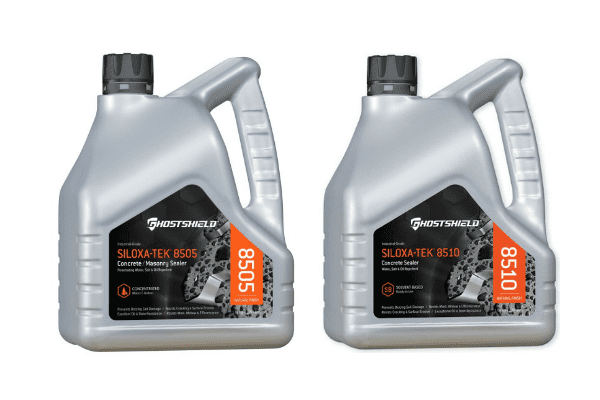
There are many penetrating concrete sealers on the market that are excellent at repelling water, deicing fluids, road salts, and preventing freeze-thaw damage. But what about resisting Oil? Imagine your surprise the first time you clean oil up from your garage floor or driveway and you are left with a nice stain? It is for this reason that GhostShield has introduced Siloxa-Tek 8505 and 8510 oil repelling concrete sealers.
As good as some penetrating concrete sealers work at protecting your garage floor and driveway from the elements, they are less than perfect for protecting your concrete from oil stains. If oil or other petroleum products from a leaky vehicle is allowed to sit for a while, chances are it will leave a light stain on your concrete after you clean it up.
There is a reason for this. Garage floor sealers consist of two basic categories; penetrating sealers and film-forming sealers. Unlike film-forming sealers that create a visible topical coating such as garage floor epoxy, penetrating sealers work by soaking into the concrete. They create a chemical reaction that forms a gel-like molecular barrier at the subsurface. Water and chemicals have a difficult time getting past this barrier, thus protecting the concrete from the elements.
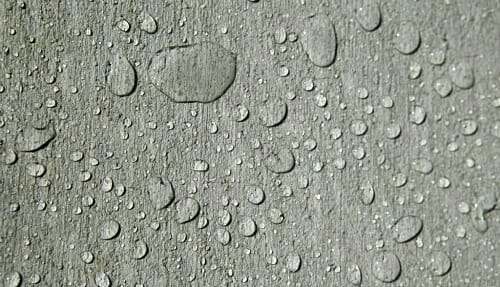
These sealers are very popular due to the fact that they don’t change the look of the concrete. They are relatively low cost, easy to apply, and they will not change the existing slip resistance of the bare concrete.
When the water eventually evaporates from the surface, it leaves behind the dirt, salts, and/or other residues that were carried by the water. These residues are generally easy to wash off.
Oil, on the other hand, does not evaporate. If left for very long on sealed concrete, it can penetrate and leave a residue on the surface that has the ability to stain. Up until now, siliconate penetrating sealers have been the best at reducing oil stains on concrete, but they are not an oil repelling sealer.
A concrete sealer that repels oil

Due to the increasing demands for concrete sealers that can resist oil staining, companies are now working to formulate sealers that do a good job of repelling oils.
Siloxa-Tek 8505 and 8510 by GhostShield is one such product that is leading this field. 8505 is water-based while 8510 is solvent-based.
They have been formulated particularly for use on garage floors, workshops, and driveways. Their unique blend of siloxane uses nanotechnology and fluorocarbons to create an oleophobic molecular barrier at the subsurface of concrete that repels oils in order to resist staining.
Fluorocarbons have non-stick and friction reducing properties which when used in a sealer, cause oil film to be repelled or not attracted. It is similar molecular technology that is used for non-stick cookware and friction-reducing parts in the automotive industry.
Besides repelling oil, Siloxa-Tek 8505 and 8510 protects your concrete similar to a siliconate sealer. It will protect your garage floor from mold and mildew, freeze/thaw damage, salt and chloride intrusion, reduce vapor transmission and efflorescence, and still remain breathable.
Of the two, our recommendation is the solvent-based 8510. The solvent-based carrier agents allow for a higher concentration of active ingredients for better protection and penetration of the concrete.
Benefits of siloxa-tek 8505 and 8510
- Provides excellent oil repellency and stain resistance
- Repels other automotive fluids
- Provides for easier cleanup of oil and grease from concrete
- Prevents winter freeze/thaw damage
- Prevents pitting and spalling from road salts and deicing fluids
- Resists mold and mildew
- Prevents Alkali-Silica reaction (ASR) which can cause concrete cracking
- Retains the same slip resistance as bare untreated concrete
- No change in the visual appearance of the concrete
- Reduces vapor transmission
- Less penetration of dirt for easier cleanup
- U.V. resistant
- Low VOC’s
- No harmful by-products
- Easy to apply
- 100-year warranty
GhostShield Application
Though Siloxa-Tek 8505 and 8510 can be applied as a stand-alone sealer, GhostShield recommends that a densifier be applied to the concrete first. Because the molecular structure of Siloxa-Tek 8505 and 8510 is so small, the densifier works by filling the larger, porous capillaries deeper within the concrete.
The resulting chemical reaction of the densifier creates a denser interior structure that helps to resist moisture and strengthen concrete. More importantly, it prevents the Siloxa-Tek from penetrating too deep into the concrete. The resulting treatment allows the small nanomolecular structure of Siloxa-Tek to fill the remaining voids and create a much denser, oil repellent barrier at the subsurface.
If you were to apply GhostShield 8505 or 8510 without a densifier, the sealer can easily penetrate too deep into the concrete. This can possibly require multiple saturated coats in order to build a layer up to the subsurface to be most effective. Applying it in this method would actually be much more expensive.
Note: Apply a straight densifier only without any added sealers
Only one application of the densifier is required. GhostShield Siloxa-Tek 8505 and 8510 require two applications. You can expect a coverage rate of approximately 250 ft² per gallon for a densifier. GhostShield 8505 has a coverage rate of up to 250 ft² while the 8510 has a higher coverage rate of up to 300 ft².
Update: If using 8510 and a densifier has been applied, GhostShield now recommends a single flood coat instead of two thinner coats in order to get the best results.
In most cases, the only preparation is a thorough cleaning of the concrete beforehand.
Application of the densifier and the Siloxa-Tek 8505 is easily done with a low-pressure pump-up garden sprayer. The solvent-based 8510 requires a chemical-resistant pump-up garden sprayer.
You need to wait approximately 7 days after applying the densifier before applying the Siloxa-Tek. This waiting period allows for the densifier to chemically react with the concrete to fill the larger voids. Applying the Siloxa-Tek beforehand will only reduce your coverage rates.
It’s OK to walk and drive on the densified concrete within a few hours of application. We just recommend that you keep the garage floor clean and park your car on some old cardboard or mats to prevent oils from the vehicle tires from being deposited on the concrete before application of the Siloxa-Tek 8505 or 8510.
This post may contain affiliate links. If you use these links to make a purchase, we may earn a small commission. As an Amazon Associate, All Garage Floors earns from qualifying purchases. You can read our full disclaimer here.
Where to purchase Siloxa-Tek 8505 and 8510
We recommend purchasing from a vendor with concrete sealer experience. Garage Flooring LLC is one such vendor and has become an authorized dealer for GhostShield.
They offer the best pricing we have found for GhostShield products and include free shipping as well as great customer service.
In addition, they carry the GhostShield Lithi-Tek 4100 densifier. You will find it on the same page.
Check here for GhostShield Siloxa-Tech 8505 & 8510 pricing
We recommend contacting them if you have any questions regarding quantity and application.
So, about this 100-year warranty
Though GhostShield will not guarantee against stains, they are the only company to provide a 100-year warranty that the product will remain effective during that time. Having never seen such a long warranty for a product, we did a little digging to see what the warranty actually covers. What we found was actually not too surprising.
GhostShield warranties Siloxa-Tek 8505 and 8510 Oil Repellent Sealers against flaking, chipping, fading, and delamination for 100 years under a host of conditions. One of those conditions is a reapplication once every 10 years.
While the 100-year warranty does sound impressive, we find it a bit gimmicky since penetrating sealers will not flake, chip, or delaminate. This is because they penetrate into the concrete. Essentially, only a film-forming sealer can suffer from these maladies.
This doesn’t take away from the fact that it’s an excellent product. However, we just think that it can be a bit misleading for someone who doesn’t know much about how sealers work.
Is an oil repelling sealer for you?
Siloxa-Tek 8505 and 8510 are outstanding sealers that will provide the best protection of bare untreated concrete for a high-duty garage floor, workshop, or driveway. It will not change the look of the surface and it will retain the same slip-resistant properties as bare untreated concrete.
8505 was first released first and then 8510 followed up approximately 1 year later. Since then, we have been receiving many reviews and comments from people who are extremely happy with their results so far. These reviews have ranged from people that just park their cars in the garage to those that rebuild tractors in their large shops.
If you don’t relish the labor, concrete preparation, and cost of a quality garage floor coating, but worry about oil and other automotive fluids in your garage or driveway, then Siloxa-Tek 8505 or 8510 makes for an excellent choice. Additionally, it is an easy DIY application and has a 100-year warranty to back it up.
However, if you want something that is stain proof, or you are one to let oil and other spills sit for long periods of time before cleaning them up, then you may need to reconsider a film-forming coating for your garage floor instead.
Thinking of sealing a shop floor with siloxa-tek 8505. Can I use ghostshield sila-tek 3500 as the densifier as the primer coat first?
Yes, you sure can Clay.
Thanks for an incredibly informative site! This looks like an ideal sealer for my new garage slab. What is your favorite densifier right now? I’ve been looking at colloidal silica based products like Lythic Densifier. I looked at the sila-tek 3500 mentioned above, but didn’t see what type of densifier it is.
Hello Neal. We recommend lithium based densifiers for most DIY projects. It’s easier to apply, it does not require scrubbing-in, and it has much less of a tendency to create a whitening of the surface as sodium silicate densifiers.
Thanks for you’re help! Since Siloxa-Tek 8505 is oleophobic, do you think it would it interfere with the adhesion of expansion joint sealers?
That’s a good question Neal. We would think not since those type of sealers do not rely so much on penetration into the substrate. You could always seal the joints first then apply it. We would recommend contacting Ghostshield to be sure. We’ve always found them helpful on the phone.
I just wanted to let you know how everything worked in the end in case you are interested. Ghoastshield did recommend putting down expansion joint sealer before applying Siloxa-Tek 8505. Since I might not be able to re-apply the joint sealer I needed something that would last so I went with Spal-Pro RS 65 polyurea joint sealer by Metzger. I applied this product followed by a densifier and then the Siloxa-Tek 8505 and everything seems to be working great! Thanks so much for your help!
Thanks for the update Neal. We’re glad it’s working great for you!
Has anyone used 8505 or solvent-based 8510 on polished concrete? The protection characteristics seem ideal, if it doesn’t white-out on the polished surface.
Note: I contacted GhostSheild and they recommend 8510 (solvent-based) for polished concrete, but I feel a bit of a guinea pig since I havent found any examples of application. I may use Ameripolish SR2, but it has a much shorter (2 year) reapplication requirement.
We wouldn’t recommend it DJ. What you need to use is a stain guard sealer for polished floors. These are formulated to penetrate into the very tight pores of polished concrete and provide a very thin protective film on top. They are then burnished with a high speed buffer in order to provide a glossy finish. Due to the solvent base, GhostShield 8510 penetrates better than 8505 and may provide some protection, but it does not provide a thin topical film. The bigger issue, however, is that polished concrete is not maintenance free. It requires the occasional rebuffing to keep the shine, especially for a garage floor (assuming this is your intention). The 8510 will not polish up well and may hinder any attempts to do so with another product afterwards. It may require re-polishing the surface with a fine grit stone to get the shine back.
Hello,
I built a concrete shower and am trying to decide how to finish it with a stain and sealer. What is your opinion on staining the concrete with an acrylic stain and then using Siloxa-Tek 8510 to seal it? I also noticed the article mentioned the densifier. Would I use the densifier first, stain second, and finish it off with two coats of Siloxa-Tek 8510?
Hello Jason. The problem with using a penetrating sealer such as GhostShield on stained concrete is that it will not enhance the stain color at all. Concrete stain looks very dull and boring once it has been applied to concrete and allowed to dry. However, when it is “wet out” by a topical sealer, the stain color pops with vibrancy and deep colors. Penetrating sealers will not do this. When first applied, the wet stain will come to life, but once the sealer penetrates and dries, the concrete will return to the original stained look before the sealer was applied. If you are looking to achieve a solid stain color with a dull, matte finish then a penetrating sealer will achieve that. If you want the typical look of vibrant stained concrete, you may want to apply a topical acrylic sealer instead. An MMA gloss acrylic would be a good choice.
Hello,
Just had a new home built. Can I put on PS104 Lithium Silicate Densifying WB Penetrating Sealer w/ Siliconate Repellent first? Wait 7 days, then put on Siloxa-Tek 8505? This is for our garage.
Thanks,
Roland
Hello Roland. You have the timing correct, but you need to use PS103 densifier and not PS104. The PS104 has siliconate sealer added which will block penetration of the Siloxa-Tek 8505. The PS103 is a straight densifier (which you want to use) without any added sealers.
I have a bare garage concrete floor I want to seal it and be oil resistant….what do I need to start this project?
Hello Hector. You just need to clean your concrete, make sure you don’t have a sealer on it already, and then apply the product as we discuss in the article. That’s all there really is to it.
GhostShield warranties Siloxa-Tek 8505 and 8510 Oil Repellent Sealers against flaking, chipping, fading, and delamination for 100 years under a host of conditions. One of those conditions is a reapplication once every 10 years.
It look like fraud need reapplication once every 10 years that mean seal can not protect floor after 10 year need reapplication once to keep protect it.
No, it’s not fraud, David. However, we did point out that it is deceptive because you are led to believe (until you read the fine print) that you will be warrantied for 100 years without having to doing anything afterwards. We also pointed out that penetrating sealers cannot peel, fade, delaminate, or chip either since they go into the surface of concrete. Only a topical sealer (coating) can chip, fade, peel, or delaminate. Regardless, it’s still an excellent product.
OK, I have a problem with moisture/condensation during weather changes, Efflorescence (dusty) , AND I have old junk that sits around and drips oil all day. My MAIN concern is the moister and the dust, I can stand with a few oil stains…. would this product cover me on all three, or should I go with a siliconet penetrating sealer?
Hello Bud. If you apply it as recommended you should be good. The most important product to put down for the moisture and dusting would be the densifier. So as long as you do that first followed a week later by the GhostShield, you will have oil stain resistance as well.
I have a sealer on drive now. can you apply siloxa-tek 8510 over it and do you have to use the tl37 densifier on it
Hi Richard. If you have a penetrating sealer on the driveway currently, you can apply the GhostShield 8510 over it without the densifier.
Great article. I was originally focused on an epoxy treatment for our old garage floor but the densifier/siliconate sealer combination is far superior for our purposes. My issue is I have a number of cracks in the concrete showing efflorescence. I understand I can remove this with muriatic acid but will this affect the application of densifier/siliconate sealer? Also what would be the best product to fix the cracks in conjunction with the Ghostshield products mentioned (Silica-Tek 8510 and PS103)?
Thank you.
Remove the efflorescence with a milder acid etch, Duncan, and you will be fine. Use a ratio of 6-7 parts water to 1 part acid. Scrub the solution over the affected areas with a stiff nylon brush, neutralize, then rinse real well. We have an article on crack repair here. We have a list of products there that work well. Repairs look best if you lightly grind them flush afterwards.
Thank you Shea. But would you not recommend a concrete based repair? Like the Quikrete Concrete Patching Compound or something similar? Maybe more of a slurry? I ask this because since I will be using a penetrating sealer and not an epoxy I want the sealer to also be able to penetrate the repaired cracks. And if I’ve repaired them with an epoxy or polyurethane or polyurea compound I don’t think the ghostshield sealer and densifier would penetrate. Thoughts?
I don’t think I explained this as well as I could have, Duncan. Epoxy and polyurea crack repair products are not only stronger than the surrounding concrete, they actually seal the crack as well. Very well in fact. They are non-breathable and physically block any and all penetration of liquid and air – just as an epoxy or polyurea coating of the entire floor would. They are a better sealer than any penetrating concrete sealer treatment ever could be. As a result, they will block any penetration sealer treatment at the repair, but it doesn’t matter since they are sealing the crack better anyways. In short, repairing your cracks with an epoxy or polyurea product and then applying a sealer treatment is the best course of action. Just make sure to lightly wipe up any of the sealer that has collected on top of the crack repairs (they will not penetrate) after the surrounding cement has begun to absorb the treatments. If you don’t, they will leave a white residue that needs aggressive scrubbing to remove.
Polymer-modified cement products, on the other hand, do not work as well for most crack repairs. This is due to the thin nature of cracks. They work better for repairing large holes, chunks, and spalling. They are also used as overlays. Additionally, penetrating sealers and densifiers do not work well on polymer-modified cement. The reason is that these type of sealers react with the different minerals in concrete to form a sealing barrier. Polymer-modified cements lack many of these minerals due to the use of polymers. The polymers are what help to provide much better bonding to cement (as well as strength) versus a standard cement product, which always crack and break away. Because the sealers do not react as much, they do not seal very well.
Great information Shea, thank you for going more in-depth, I’ll let you know how it goes!
I have a freshly poured concrete floor for a small shop that needs coating. I was hoping to use a densifier (Ghostshield 3500 or 4500), followed by a two part water based epoxy, then a clear coat (Ghostshield 645). Are there any concerns with the epoxy adhesion to either the 3500 or 4500 products? Which do you prefer? I am planning to wait 30 days for the concrete to cure, then start the process. Any other recommendations?
Hello Sean. Why do you want to apply a densifier? Applying the densifier will effectively block the epoxy from penetrating very well and will limit adhesion. You could end up with it peeling in places, particularly under tires. The concrete will need to be acid etched or grinded first to prep for the epoxy. It can affect the acid etching as well, but grinding would provide the correct profile.
Thanks for your article!
I went ahead and purchased Lithitek 4500 and Siloxatek 8510 for my 45 year old never before sealed exposed aggregate concrete driveway in an effort to extend its life. I know realize I purchased the product prematurely.
I underestimated the time and effort required to replace sections of slabs and to gear up on pressure washing equipment and supplies and clean existing stains off the old slabs. Its now September in the following year. I was pretty much ready for the application when I spilled an ample amount of transmission fluid on the surface. I’ve tried degreasers with limited success and find I get best results with an enzymatic cleaner. Unfortunately, these can take 2 weeks or more to work.
Leaves and acorns are falling and wherever they do, they leave tannin stains if they get wet. It seems to rain as many days as it doesn’t. Its hard to differentiate the oil stains from the tannin stains. Ghostshield recommends removing all stains before applying product. By the time the leaves stop falling, the temperatures will likely be too cold for application.
What I’d like to do is wait until next year to apply the product earlier in the season before the trees complicate the prep. Unfortunately, this will void warranty for more than one year will have passed between purchase and application.
How important do you think this is? Should I be concerned about deterioration of the product in the unopened containers? If not, as you point out, how important is the warranty anyway? Do you think it would be better to fight tree debris and apply now or wait for cleaner and better temperatures next season?
I’d be so grateful for your advice if you have any insights?
Hello William. We can appreciate your frustration when dealing with Mother Nature. Our only suggestion would be to use a pop up shade canopy large enough to do your driveway in sections from joint to joint if that is possible. Once the sealer has dried at the surface, you can move to the next section and so on. Otherwise, waiting until spring may be your best bet.
I wouldn’t worry about the 100 year warranty. As we stated in the article, it’s easy to warranty a product that does not peel or delaminate to begin with. What I would do, however, is contact the manufacturer and ask if waiting a year will cause the sealers to degrade in performance. That’s what you need to worry about if you wait.
i used 4500 over acid stain. the 4500 turned white. how do i remove it?
Hi Warren. The white residue is caused from over application. If it is not mopped up when it puddles, it will dry and leave a residue. It will require scrubbing to remove. I would suggest a soapy solution using laundry detergent to start. You don’t want to get too aggressive or it could cause the stain to fade with scrub marks.
With the new application guidelines for 8510, can I get a materials estimate for 850 sqft using 4500/8510?
Thank you.
Hi Dean. The best people to get the materials estimate and pricing would be Garage Flooring LLC. You can visit them here. You can use their live chat feature or give them a call. Just tell them we sent you.
I have purchased the 9500 product for my garage floor. After I do the recommended two quick coats can I wait a week and apply 8505 or 8510 for oil resistance? thanks
Hello Bill. No, you cannot use GhostShield 9500 if you plan on applying GhostShield 8505 or 8510. The 9500 is not a straight densifier only. It has a sealer added which will block penetration of the 8505 or 8510. You need to apply GhostShield 4500 which is a straight densifier only with no sealer added.
HI, I applied Ghostshield 4500 without incident, and followed with 8510. Used 2 gallons to do 2 coats of 460 sq ft, which is the recommended rate (I actually wound up returning a third gallon that I clearly didn’t nned). After a week, the floor is still tacky, though.
So yeah, I overapplied.
I asked technical support, and their answer was: “The tackiness is a common problem with over-application. It will wear off over time, but you can expedite it by mopping with a solution of 4 oz ammonia to 1 gallon of water. If that does not sufficiently remove the tackiness, you can gradually increase the amount of ammonia without causing damage to the sealer. ”
I gradually increased it until it was about a full bottle of ammonia in 1 gallon water, but it’s still not coming off. What do I do know? Agitate with a deck brush? Powerwash it again?
Hi Scott. Yes, we have heard of this problem when too much 8510 is used. An ammonia solution usually does the trick, but not always if the over application of 8510 was especially exorbitant. A strong solution of ammonia and agitating with a deck brush would be our recommendation. The good news is that the tackiness is not permanent. It will eventually go away, but hopefully the deck brush will rid you of that.
OK, I’ll try again with the brush. Hope full strength doesn’t damage the sealer. If that doesn’t work, I’m fine if it eventually goes away, unless it traps dirt inside there permanently.
What about gasoline? Will it repel that as well? And I want to get this straight, with 8510, I need a densifier and what is recommended for that? And if I use a densifier do I still need two coats of 8510?
Hello Aaron. Yes, gasoline will be repelled as well. Keep in mind though, penetrating sealers are not like coatings. Spills cannot sit indefinitely. They will only repel for so long before allowed to penetrate. What the various penetrating sealers do is do is buy you time to get messes and spills cleaned up. Up until this product and PS100 by Concrete Sealers USA, penetrating sealers did not do well against petroleum products.
As said in the article under UPDATE, 8510 is now applied in one flood coat if a densifier has been applied. You can get pricing and more information here from Garage Flooring LLC.
I want to repel oil, grease, and tire stains on machine finished cement located inside a pole barn workshop. I have applied Pentra-Hard Densifier (lithium based) made by Dayton Superior to the cement and would like to apply GhostShield 8505 7 days later. Are the Dayton Superior densifier and Siloxa-Tek 8505 repelling sealer compatible and will the combination provide good stain protection?
Hi Krista. Yes, GhostShield 8505 is compatible with Pentra-Hard Densifier. In fact, it is compatible with any brand of lithium-based densifier as long as no additional sealers are added to the densifier itself. If you want maximum protection, we recommend the solvent-based 8510 over the water-based 8505. The solvent-based version can be applied in one flood coat and has proven to provide slightly better protection.
Oil repelling penetrating sealers such as GhostShield 8505 – 8510 or PS100 by Concrete Sealers USA provide superior stain resistance compared to other penetrating sealers, but they are not stain proof. There are many great reviews for these type of sealers from people with realistic expectations. Just be aware that any petroleum or chemical spills should be cleaned within a reasonable time. Otherwise, they can still penetrate the surface of the concrete eventually and stain. It’s important to remember that these sealers are penetrating and not an actual coating.
Are the GhostShield or PS100 oil repelling sealers compatible with concrete previously treated with Intraguard penetrating sealer by WR meadows? Intraguard is a water based Siloxane sealer. My goal is to improve petroleum product stain and tire mark resistance, which I don’t think Intraguard is particularly effective at. Since a polyurea film forming sealer is not an option, I’m trying to decide what is the best course of action.
Hi Keith. Oil repelling sealers such as these will definitely help in that regard. However, we would recommend contacting each vendor to discuss. If the current sealer is repelling water, then chances are that it’s going to repel the additional sealer. It may require some small testing. Oil repelling sealers work well with densifiers since densifiers technically do not seal the concrete. However, it can be hit or miss when applied over another sealer.
Thank you Shea. I’ll check with with the manufacture before testing. Appreciate your willingness to share your knowledge and expertise with the garage/shop community!
Hi can I apply GhostShield 8505 on concrete slab who is densifier with colloidal silica (like product HYDRO-FORCE VIPER HYBRID DENSIFIER) ?
Thank’s
Etienne
Hello Etienne. We can’t answer that question because we could not find a data sheet on Hydro-Force Viper Hybrid Densifier that lists the ingredients. In other words, what is combined with the densifier that make it a hybrid mixture? If it’s any kind of a sealant, then GhostShield 8505 will be repelled and not work. We recommend contacting GhostShield to ask. Better yet, contact Hydro-Force to ask what the active ingredients are and then contact GhostShield with that information.