
Learning the best methods to clean a garage floor effectively is a DIY skill that is high on most home improvement lists. A dirty-looking garage floor can be an eyesore and it’s not always easy to clean due to the porous nature of concrete. Stains, rust, oil, and other contaminants can sometimes be hard to remove.
Properly cleaning the concrete is a critical step if you are prepping the garage floor for paint, epoxy, or sealers as well. As a result, we will discuss the leading techniques you can use to get your concrete garage floor clean.
The most effective low-budget method for cleaning a garage floor is to use a hose with a high-pressure nozzle, a concrete degreaser, a deck brush, and some good old-fashioned elbow grease.
In addition, we include our recommendations for the most effective degreasing solutions for concrete. We also discuss the use of pressure washers, which equipment is most effective for scrubbing dirty concrete, and how to remove mastic, old paint, and sealers from the garage floor.
If your goal is to eliminate pet urine odor and stains, then we have a separate article here that discusses how to do that.
This post may contain affiliate links. If you use these links to make a purchase, we may earn a small commission. As an Amazon Associate, All Garage Floors earns from qualifying purchases. You can read our full disclaimer here.
Steps for Cleaning Concrete Garage Floors
The required steps for cleaning garage floors are fairly straightforward. However, different scrubbing methods or particular cleaning solutions may be needed depending on how dirty the concrete is.
As a result, we discuss these steps in detail in order to achieve the best success.
1. Remove all items from the garage floor
The first thing you need to do is remove everything from the floor that is not anchored down. Next, sweep up all the heavy dirt and debris.
As obvious as this seems, taking shortcuts or eliminating steps only makes the job more difficult and less successful.
If you have drywall in the garage, you may want to cover the lower 3ft. with cheap plastic drop cloths. Just tape them in place. You can find them at your local home improvement center for just a few dollars. It’s also a good idea to cover up any low electrical outlets with tape if you are not using a drop cloth.
2. Soak the concrete with a degreaser/cleaning solution
It is important to soak the concrete with a cleaning solution or degreaser. This allows time for the solution to penetrate the concrete and go to work at loosening up dirt and oils.
The solution should dwell for a minimum of 5 minutes. Do not let it dry out. Use hot water if the cleaning solution allows for it. It’s best to work in 10’ square sections and not soak the entire floor at once. Otherwise, your solution may dry out.
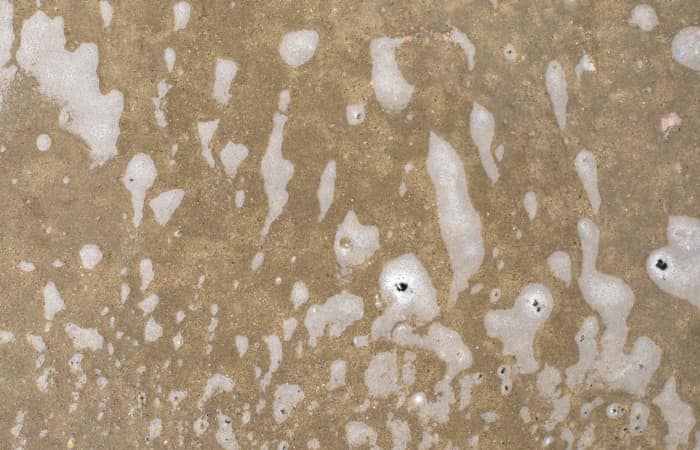
Some concrete surfaces can be more dense or smooth and it may take a few minutes for the solution to soak in. Unless the concrete is not very dirty, scrubbing immediately will not be as effective.
We list our recommended concrete cleaning solutions and degreasers here below.
3. Scrub or Pressure Wash the Concrete
Once the cleaning solution or degreaser has soaked, add a little more solution and begin scrubbing the concrete. The scrubbing action helps to dig the dirt and grease out of the concrete pores.
In addition, the scrubbing helps the cleaning solution to emulsify the contaminants and keep them in suspension before rinsing.

We recommend using a short bristled deck brush for scrubbing. They are very effective and the stiff bristles can withstand the pressure required.
You can find them here at Amazon or your local home improvement center.
Tip: Push brooms are a poor scrub brush. The bristles are too long and the surface area is too large to apply good pressure.
If you have a pressure washer, you can use it at this point instead of scrubbing. We discuss more the use of pressure washers in the Equipment section below.
Do not use a steel wire brush! The steel particles of the brush can transfer dark marks onto the concrete that are difficult to remove. In addition, the scrubbing action of the steel wire bristles will change the texture of the concrete surface and create a permanent blemish.
4. Rinse the Garage Floor
Do not let the solution you are scrubbing with dry out before you rinse it away. Otherwise, the dirt, grease, and other contaminants that are emulsified and lifted out with the cleaning solution will settle back into the concrete.
Use a high-pressure nozzle on your hose for rinsing if you can. The higher pressure does a good job of blasting out any dirt and debris that may have settled back into the pores of the concrete. It also aids in moving out the water faster.
You find high-pressure nozzles fairly inexpensively from your local home improvement center or here from Amazon.
Make sure to rinse the solution from the clean section out of the garage or off the concrete. If not, it can settle back into a dirty section of concrete and just make your work more difficult. Once it is rinsed out, move on to the next dirty section of concrete.
If you have a wet vac, they work very well for sucking the dirty water and debris out of the concrete pores. You still need to rinse afterward to remove any cleaning residue.
Once the floor dries you should have a very clean concrete surface. You can now inspect it for any areas that need to be spot cleaned.
Grease, oil stains, rust, or other contaminants are an example that we will discuss shortly.
Optional Cleaning Equipment for a Garage Floor
Concrete is porous and can become fairly embedded with dirt and grime over the years if it hasn’t been cleaned very often. If you are dealing with a floor such as this, then you do have some equipment options that can make the job easier and more effective.
The right concrete cleaning equipment can be successful at getting the dirtiest of garage floors clean.
The first of these is a pressure washer. Pressure washers can save time and labor in scrubbing and excel at cleaning concrete. Most will allow you to add a degreaser to a chemical tank for additional cleaning action.
They are not very expensive to rent from your local home improvement center or local equipment rental facility. For the most effective cleaning, a minimum 2800 – 3000 PSI pressure washer with a water flow rate of 3 gallons per minute or more works best.
Use a yellow 15-degree fan tip. For particularly stubborn areas such as stains, you can use the more powerful turbo tip.
Be careful not to linger too long in one area when using a good pressure washer and keep the tip moving. The water action is so abrasive you can actually etch the surface of the concrete if you are not careful.
Read: How to Clean Garage Floors with a Pressure Washer
The newer rotary surface cleaner attachments for pressure washers have become very popular due to how effective they can be. They keep overspray at a minimum and do a good job of cleaning the concrete.
It’s important to match the rotary attachment with the correct pressure requirements. Here is an excellent example from Amazon.
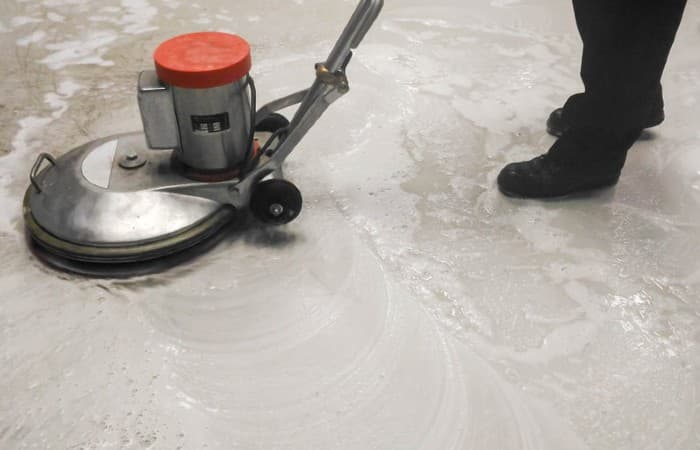
The second equipment option you can use is a floor maintainer with a nylon scrubbing head for concrete. You can rent these as well.
Be sure to tell the rental company that you will need a nylon brush attachment for cleaning concrete. They are sometimes called a Malish brush, referring to the brand name Malish.
Use the floor maintainer during the scrubbing step. Take your time as you go and let the machine do the work.
You may have to add a little water as you scrub to keep the solution wet and sudsy.
Both pressure washers and floor maintainers can do wonders. It’s not unusual for the concrete to turn a few shades lighter after using them.
Recommended Concrete Degreasers and Cleaning Solutions
For most concrete cleaning jobs, an alkaline soap or degreaser should be used. Alkaline cleaners work best for breaking down and emulsifying oils, grease, and other hydrocarbon-based contaminants and stains that are normally found in concrete.
Alkaline cleaners will range from 8 – 14 on the pH scale. Most concrete cleaners and degreasers will have a pH of 11 or greater.
Acidic-based concrete cleaners should not be used in most circumstances. They work poorly at removing grease, oils, and other hydrocarbons found on garage floors. Oil and acid are two dissimilar chemicals that will separate into layers, just as water and oil do.
Instead, acidic cleaners should be used for the removal of efflorescence, rust, and salts. We will discuss the specific use of acidic concrete cleaners shortly.
Alkaline Concrete Degreasers
TSP – Short for trisodium phosphate, TSP has a pH of 12 – 14. It is a strong alkaline cleaner that is extremely effective for cleaning dirty concrete. It performs fair on oil stains, but there are better alternatives for oil if that is your main goal.
Use 1/4 cup of TSP to one gallon of warm/hot water for light cleaning. Use 1/2 cup of TSP for heavy-duty cleaning.
Care should be taken when using TSP. It is exceptionally alkaline and can cause skin irritation and even burns. Gloves and eyewear are recommended.
Laundry detergent – That’s right, laundry detergent is alkaline and can be fairly effective. It typically performs well for concrete that is not extremely dirty and without moderate to heavy oil stains.
Avoid laundry detergents that have a pH below 10. Tide is one such example.
Our recommended laundry detergent is Arm & Hammer. It has a pH of 11.5 – 12.2. Any particular type will work. We recommend 1/3 cup of detergent to one gallon of hot water.
Concrete Degreasers – Degreasers for concrete and driveways are our top choice for cleaning a garage floor that has oil and grease stains. They range from 11 – 12 on the pH scale.
Unlike TSP or laundry detergents, concrete degreasers use various biodegradable solvents and alcohol to help break down and dissolve oil and other hydrocarbons in water. This includes keeping them in suspension longer so that they can be rinsed away.
Most concrete degreasers are concentrates so it’s important to follow the instructions. Warm water helps, but do not use hot water. It tends to make degreasers too foamy.
Oil Eater and Purple Power are our top 2 recommendations. These are always our “Go to” favorites when cleaning concrete. Both have excellent reviews. You can find Oil Eater here from Amazon and Purple Power here from Amazon.
Cleaning Oil Stains and Grease
With the heavy cleaning done, you can now spot-clean any remaining oil or grease stains that need more work. Concrete degreasers are what you should start with.
Wet the stain and surrounding area first. Apply the degreaser to the oil spot at full concentrated strength. The reason for wetting first is to prevent the contaminants in the stain from spreading to a clean dry area.
Scrub the degreaser into the concrete and let it dwell for 10 minutes. While it sits, prepare a strong solution of degreaser that is mixed at 3 parts degreaser to one part water. The water is required to help the solvents in the degreaser to dissolve and draw out the oils into suspension before rinsing.
When ready, add the strong 3 to 1 solution to the area and scrub again. Once done scrubbing, rinse the area well.
If you don’t have a concrete degreaser on hand or you are dealing with some particularly stubborn or old oil stains, then there are more advanced methods for removing oil stains.
Read: How to Remove Oil and Grease Stains from Concrete
Be advised that older stains that have been in the concrete for a long time may still have some discoloration, even after the oil is removed.
How to remove rust stains
There are a few effective ways to remove rust stains from your garage floor. This is one of the circumstances where an acidic-based cleaner works best.
For light rust spots, you can use either lemons or white vinegar. The acid-base in lemons and vinegar helps to dissolve the rust.
Squeeze the lemons or pour the white vinegar over the stain and let it sit for 5 minutes or so. Add some more lemon juice or vinegar and then scrub with a good stiff brush. Rinse well with water and repeat if necessary.
Oxalic acid is a product that works better on tougher rust stains. You can generally purchase it from your local home improvement center or here on Amazon.
Some concrete cleaners for rust stains have it as an ingredient. It may even come in a powder form which you mix with water to make a soupy paste.
Apply the Oxalic acid to the rust stain and let it sit for 5 minutes before scrubbing. Be sure to rinse well afterward. Again, repeat if necessary.
Another option is to use one of the concrete rust stain removers that are available over the counter. You can see a whole list of these products here at Amazon.
Tip: A brass wire brush is effective for scrubbing rust. It will not transfer metal marks to the concrete and is less aggressive than a steel wire brush. We like this one here.
For the toughest of rust stains, a mild solution of muriatic acid will work wonders. However, you need to be careful when using it. We suggest a ratio of 8 parts water to 1 part acid to start. More isn’t always better in this regard unless you are preparing your concrete for a floor coating.
Read: How to Acid Etch a Garage Floor
If you mix it too strong right away it will aggressively etch the concrete. This can make the area look different from the surrounding concrete. In addition, it makes the surface rougher by opening up the concrete pores. This will allow dirt to embed easier and make it harder to clean.
Danger: Do not pour water into acid – pour the acid into the water instead. Pouring water directly into acid can cause it to explode into a gas that can splash in your face. Wear gloves and eye protection when using acid.
How to remove efflorescence from your garage floor
Efflorescence consists of insoluble metallic salts that look like a white powdery substance or residue on the concrete surface of garage floors. It develops when moisture from below the concrete works its way to the surface.
The moisture picks up these salts and minerals along the way and deposits them on the surface when the moisture evaporates. Standard cleaning solutions are not effective.
Instead, an acidic-based cleaning solution needs to be used. The acidic cleaners react with the concrete minerals and salt to dissolve them.
There are nontoxic biodegradable efflorescence removers that can be used. We recommend trying them first. They are essentially mild citric acid etching solutions.
Once applied, let the solution dwell for the required time. Agitation or mild scrubbing with a nylon deck brush helps with the removal process.
Our favorite is Eco-Etch Pro. It is more aggressive at removing efflorescence. Plus, it’s safe to use and will not require that the concrete be neutralized when you are done.
If an efflorescence remover does not remove it all, then the next step is to use a muriatic acid etch. We recommend starting with a solution of 6 parts water to 1 part muriatic acid. Do not use anything stronger than a 3 to 1 ratio. Doing so will severely etch and change the look of the surface.
Important: If you are not using an Eco-safe acidic solution, then you need to neutralize the concrete afterward. This returns the concrete to its natural alkaline state.
An alkaline cleaning solution works well to neutralize concrete. Just apply it to the area, let it dwell for a few minutes with some light agitation, and then rinse off with clean water.
Removing old paint, mastic, and sealers
If you are applying a coating to your floor, you will need to remove any type of residue on the surface such as a topical sealer, old paint, or mastic. This needs to be done first before any attempt is made at cleaning. There are two different methods you can use depending upon what is on the concrete.
The first would be the use of a chemical stripper. We highly recommend a couple of products by Franmar. They are environmentally friendly and work exceedingly well.
For mastic removal, we recommend Blue Bear 500MR Mastic Remover. It is very effective as long as you give it the time it needs to work.
For removing coatings, paint, acrylics, and old sealers, we recommend Blue Bear 605 Pro Multipurpose Coating Remover.
Eco-friendly strippers like these are more expensive than solvent strippers. They also require more time to work (chemically, not physically). In addition, they are much safer for you and the environment.
The other method for removing mastic, paint, and sealers is to grind the concrete. Special grinding heads are available depending upon what needs to be removed.
This process does require less elbow grease than chemical strippers, but it is more expensive. You can read more about using floor grinders for concrete here.
Final Cleaning Tips
One tool that can come in handy for larger garages is a floor squeegee. These work great at moving large volumes of water out of the garage quickly. If you don’t have a squeegee, a push broom will work. You can find floor squeegees here at Amazon.
If you are acid etching your concrete in preparation for paint or an epoxy coating, then you still must clean your garage floor as described above. Acid works by breaking down the surface of the concrete to expose the pores. It is not effective at cleaning away dirt or removing oil as we explained earlier.
If you plan on grinding your garage floor, then you only need to clean heavily soiled areas and spot clean the oil stains. Any other light surface contaminants such as efflorescence or rust stains will clean up with the grinding.
If followed correctly, you will find that these methods for cleaning a garage floor are highly effective. We know this is generally thought of as the least desirable job of any flooring project. However, once done it will reward you with a nice clean concrete floor that is free of dirt and stains.
My golf cart leaked battery acid onto the cement floor. I now have a large red stain . How can I remove it.
Hello Robert. We always recommend neutralizing it first to see if it will rinse away. Mix a thin paste of baking soda and water together. Scrub it into the stain with a stiff brush and allow it to sit for about 10 minutes. Rinse it with fresh water while scrubbing with the brush. If this doesn’t remove it, then the method that works for sure is to use a a 4-1 solution of water and muriatic acid. Remember always add the acid to the water, not the other way around. Pour the solution onto the stain and agitate it with a brush. Let is sit there until it quits bubbling. When it quits, neutralize it first with some baking soda and water then rinse it away.
How do I clean newly-leaked car oil from a sealed concrete garage floor? We recently moved into the house, and I have no idea what kind of seal/cover was used, nor how long ago it was done, although it looks to be fairly recent. A car dripped oil for several days before I noticed, and now we have an oil spot about 4 ft square.
We can read about how to clean oil stains here Ted.
Hey I want to know the best solution to clean really dusty concrete floors and also there’s a lot of dust in the air how do I get rid of that
We have an article here.
Last night we used muriatic acid with water to scrub our floors with a deck brush. We scraped away all the paint spots. We assumed you just let it dry and we were going to sweep away the remaining paint pieces that were scraped up and then roll on a clear coating on top. Now after reading all this I see we were so wrong! What do I do now? We don’t have a pressure washer we can use. Walls are drywalled and painted.
Hello Gina. What does the concrete look like right now? Is all the paint up?
My garage floor is older with pits and cracks. I have previously filled the cracks. The floor is about 40 years old. Its not sealed and i want to extend the life of it as long as possible. What is my best steps of action, and yes give it to me step by step! Thanks! 🙂
Hello Dave. We suggest you read our section on garage floor repair and read this as well to get a better idea of the work and product required.
In the house we are buying the owner acid etched the bedroom floor and painted over it. The problem is, the acid smell is still there and smells like cat urine. How can I remove the smell.
We are guessing that he did that to try and hide the cat urine problem Mike. The problem with that, however, is that concrete paint breathes. If it was a male cat, you may want to check the walls as well. As far as the floor goes, you would need to remove the paint with a paint stripper or by grinding. After that, clean the concrete well and then use one of the special enzyme cleaners for pet urine. This article here does a good job of explaining how to use these type of cleaners on concrete.
How would one clean black soot off of a concrete floor? I’ve tried various soaps but there’s still some left.
Soot can be difficult Eric. Many times using a pressure washer is the best bet.
I had no clue that lemons or white vinegar could help remove rust stains on concrete. I can see why this would be important to be know if you think that rust might eventually get on the floor and will need to be cleaned. It might be a good idea to talk with the concrete installers about how to properly take care of it after they have put it in. They might have ideas that other people might not know.
I plan to paint the concrete floor in my newly erected garage. The floor was “power” floated, but not to a highly polished finish. If I key the floor with an electric sander using 150/180 grit sandpaper, is there any need to acid etch the floor before painting? I was also planning to use a universal concrete primer before painting it. Is this necessary, should I just “thin down” the first coat and then apply a second coat of paint?
Many thank.
Hello Phil. Sandpaper is not going to survive concrete. That is why diamond grinding wheels/disks are used. If you are going to “paint” the concrete and not epoxy coat it, then it’s recommended to use the manufacturer’s suggested concrete paint primer. If you are going to “epoxy coat” the concrete, then the use of a primer is determined by the type of product you are using.
Hello…..
I purchased the Rustoleum Garage Floor stripper, which I have used three times before this… I am thinking maybe I got a bad container? My porch is a mess….. I dont even know what to do? All glues together… cant even scrape it up???? HELP????????
Hello Sandra. This particular product has created a lot of unhappy customers. You have a couple of options. First, we recommend contacting Eco Building Products and talk to them about your issue. They have an excellent soy gel paint stripper by Franmar that is eco friendly and should work to fix your problem. The other solution would be to grind your concrete in order to remove the paint.
Hello, I have a garage that I have turned into a 2 bedroom, 1 bath rental property and I’m on a tight budget. The drywall is all done and I’m getting ready to prime and paint the walls . I have most of the drywall dust cleaned off of the concrete! The concrete floor had never been sealed. I can’t use a pressure washer. I would like to clean the concrete with something like lemon juice, baking soda or vinegar. I want to seal the concrete so what process can I use that would be cost efficient and easiest to accomplish? Help!
Hi Tina. When you say you want to seal the concrete, what type of product are you considering? What do you want it to do for you? How you clean the concrete depends on what you plan to seal the concrete with.
I wanted an answer just likeTina asked. Tell me a good idea as to give the floor a tint of color with a shine.. The floor is a 2 year old, clean, never sealed shop/ indoor floor.
Hello Joyce. You have a couple of options. The easiest is to use a tinted acrylic sealer. Tinted acrylics are translucent in color and can provide a glossy finish. The other option would be to dye the concrete to achieve a more solid color and then apply a clear acrylic sealer. This article talks about MMA acrylics which are the most durable. Legacy Industrial has their tinted HD6525 MMA acrylic here which is a good example.
Please help I spilled apple cider vinegar on the garage floor and has left a huge
white spot. How do I remove it.
Hello Saundra. Apple Cider vinegar is actually a mild acid and may slightly etch the concrete. It can make the concrete more white since it has exposed fresh concrete at the surface. Try a solution of baking powder and water to neutralize the reaction. Scrub it lightly with the solution then rinse it well. It may still look white, but that will fade as the concrete starts to get naturally dirty again.
My husband recently repaired the drywall in our ten year old garage, retaping almost every joint. He didn’t cover the floor and now there is joint compound all over the bare cement. We plan on painting the floor with an epoxy system (haven’t figured out which one yet). Can we wash the floor with a degreaser or tide as you outlined on this site or do we need to use something different? The joint compound is pretty ground into the floor at this point. Thanks for your help.
Jude
Yes, just scrub the floor well with a good cleaning solution and most of the joint compound will come out Jude. The concrete will need to be prepared properly by either grinding or acid etching before an epoxy system can be installed. This will remove any of the remaining joint compound in the process.
OK Shea, thanks, your are a great help. My main question, not well stated, is whether or not I need to do further dilution of the 31.45% Cleaner that I described from Lowes.
Since you said that one might start with a mix of 1 part acid per 5 parts of water, I assume that is equivalent to about 1/6 = 17% dilution. So I would need to add water to bring the as-purchased solution down from the 31.45% stated on the bottle to about 17% — before applying it to the concrete … am I looking at this correctly?
Yes, you have the right idea Bob, but it doesn’t need to be so complicated. The acid you can purchase from the home improvement centers needs to be diluted or you will damage your concrete. What most people do is mix a 3:1 ratio of water to acid to get the best etch. If you are concerned about using too much acid, you can test for results starting with a 5:1 ratio of water to acid and then examine the concrete. Also, to be safe always add the acid to the water – not the other way around.
Any tips for getting pet (rabbit) urine out of basement cement? It doesn’t smell, but it’s high in calcium so it’s kinda chalky white. Thanks!!
If you don’t have any odor Emily, TSP works very well at removing the bacteria and white residue. Mix 1/2 cup of TSP to 1 gallon of hot water. Pour it on the area and scrub with a short bristle brush. Let it sit for 5 to 10 minutes without drying out. Once you do that, pour some clean hot water on the area to rinse it and then vacuum it up with a wet vac. You will need to rinse it at least 2 or 3 times.
If I am planning to apply an epoxy coat to my garage floor, is this the correct sequence of prep tasks? Grind floor; repair spalled and pitted concrete; clean light stains with degreaser. Is it redundant to clean with a degreaser if I am grinding the floor? Thanks!
If you have any degreasing to do, Gary, you will want to get that done first. After that, you generally you do your repairs and then grind. That way all your repairs are flush and even with the rest of the floor. However, if you have pitted and spalled concrete, sometimes it’s best to hit that area with a grinder first to remove all the loose and damaged concrete, do the repairs, then grind the entire floor so everything is flush.
I am going to apply epoxy to a basement floor that is only 4-5 months old. I’ve power washed it with a TSP cleaner, it had no stains just some dirt. I am going to grind the floor now, after grinding is there any other treatment needed besides getting all the dust up before applying my 2 part epoxy?
Did you moisture test to make sure you don’t have any moisture issues with the concrete? If so, then everything else looks good, Mike.
Yes I did the moisture test in 3 different locations, no moisture at all in any of the locations. I ended up just doing using this Concrete Prep Tool from Home Depot. It seems to have done a good job, if I pour some water on it it dries up pretty quick. What is the best way to get up all the dust, shop vac, or is there any chemicals that prep the floor better before applying the epoxy?
Thanks,
Mike
Just use a good shop vac, Mike. You can always wipe the surface with denatured alcohol to get any remaining dust if necessary.
Hi, would like to know how to get rid of long white stains left by me forgetting that my car has evaporating problems from cars AéC system in the got summertime. They are two years old now. I used lacquer thinner but now I have a huge huge white area stain.
Al..
Hello Al. Try using a solution of 1 part vinegar to 3 parts warm water on the stain. Pour it on, scrub with a good brush, and then let it set for 5 minutes without drying out. Rinse afterwards and see how it looks after it dries.
We had a fire. Our garage burned to the ground. We are hoping to rebuild on the original concrete foundation. We have cleaned up the debris and are now left with nothing but a sooty, oily, black slab. How do we clean the concrete? What do we do? Can we bring the floor back enough to rebuild on it?
Hi Lisa. We are sorry to hear about the loss of your garage. Removing soot and the accompanying oils from concrete due to a fire is not easy. We suggest starting with a high alkaline concrete degreaser targeted towards oil removal. These here are all good examples. Use these in conjunction with a floor maintainer with Malish brush for concrete. A Malish brush has very stiff nylon bristles for cleaning. Soak an area of the concrete with a strong solution of the degreaser for a few minutes and then attack it with the floor maintainer. Rinsing with a high PSI power washer is ideal. Pressure washers use cold water where as power washers use hot water which will help to break down the oils. Hopefully that combination will get the majority of the concrete clean. We’ve seen this work before, but your results really are dependent upon how bad the concrete has been burnt. You may want to test in an area first to get an indication how it will work. Providing it works well, grinding the concrete surface with an aggressive grinder afterwards may help to remove most left over residue. After that we suggest sealing the concrete since the open pores from cleaning and grinding will act like a sponge for dirt, debris, oils, and ect.
I had someone stain our concrete in the living area of our home. The concrete was newly poured and had been there about 6 months. We were cleaning in corners and next to the wall and noticed that the stain was coming up when we had to scrape a little. Also, in one of the rooms the Tyvek covering had come up and there was a spot that got a lot of traffic and there was no stain just bare concrete. Is this normal or was there an issue when the floor was cleaned?
Hello Don. It sounds like they did not use a true stain. Acid stains, solvent based stains, and water based stains permanently stain the concrete. You can read more about stains here. Once the concrete is stained it requires that a clear coating be applied. This brings out the color and protects the concrete. If the coating was scratched down to the concrete for some reason, the stain would still be there because it is in the concrete and not the coating.
We would be willing to bet that a product like Behr concrete stain or something similar was used. They are essentially a low solids, thin acrylic coating with color added. They can peel right up if the concrete was not prepped properly. If they peel or get scratched they will reveal bare concrete underneath. Another clue is if the stain is fairly consistent looking throughout. It looks that way because the color is laying on top of the concrete. We have an issue with these companies calling these products stains because they really do not stain the concrete. True concrete stains create a mottled and variegated look throughout the concrete.
I am in the process of preparing my garage floor for epoxy. I have gone through with a degreaser and have good wet-ability now. But there are still stains and rust marks. Is it necessary to remove these in order to get a good bond with the epoxy? I will be grinding tomorrow as the final surface prep step, but I am trying to clean up any contaminants that grinding may not fully remove. Any insights would be much appreciated!
Hello Brock. Any heavy petroleum stains or rust should be cleaned as best as possible before grinding. Grinding will help remove much of this as well. Do a water drop test after grinding in those areas. If the concrete immediately turns a darker color and readily absorbs the water, then you will be good to go. If the water just sits there or even beads, then you will have more cleaning/grinding to do.
Any recommendations for removing rust spots and dirt build up and the base of the garage where cars drive in?
Hi Sher. There are a few things that will work on rust stains. A 3 to 1 water and vinegar mixture works on light rust. CLR is a little stronger and works as well. For heavy rust stains, an acid etch will almost always work. For dirt build up, the cleaning methods we mention in the article work well.
I just purchased a builders model home with no driveway and sales offices in the area where the 3 car gargage would be. The offices were just torn out and converted into the gargage. The top concrete layer of the garage floor sat on plastic sheeting. This top layer was removed to lower the floor level of the garage to that of the driveway that was newly installed at the time I purchased the home. I want to finish the garage floor – thinking about using a stain-sealer you recommended in a recent article. After I clean the garage floor with Tide and a deck brush, can I go ahead and begin the stain-sealer application? It is not necessary to acid etch this new concrete layer that has never been used is it?
Hello Gregg. When you say the top layer of the garage floor was on plastic sheeting, do you mean a floating floor was installed on top of the plastic sheeting and then removed? If so, you will still need to etch the concrete for most coatings. Whether concrete is new or not has no bearing on it requiring a proper profile (grinding or etching). It all depends on what type of products you intend to use.
We had a few issues when working with Rustoleum’s Rocksolid garage kit. I called the company and as a goodwill gesture, they will be sending us a primer. Although it sounds weird to me, it sounds like it is ok to put the primer on after the kit, yes? On the notes sent to me, they wrote, “The first coat of the primer will be completely cured and will be too smooth for the second coat to adhere to.” I don’t understand what this means. So my questions are:
1.) Are we to apply only one coat of Primer? I’ve read on several sites that you can do more.
2.) If we do a high gloss clear coat, can we still primer?
3.) What roller type is needed for the clear coat?
Hmmm…. primer coats are applied to bare concrete. Are you sure they were not referring to treating the first coat that you applied as essentially a primer coat? That would make sense to us. If you had some issues with the first coat it could act as the primer coat (AKA ugly coat). A second coat could then be applied on top to fix all cosmetic issues. If the first coat has been down more than a week it would not be able to achieve a chemical bond (too smooth) and would require roughing up the surface with 120 grit sandpaper first in order to achieve a mechanical bond. I’m willing to bet that what they are sending out to you is more of what you already applied. If that is not what you receive, I would give them a call to clarify. Once you apply your final color coat you can apply a subsequent clear top coat if you like. You should use the same type of roller that you used for the color coat.
I I’m leasing an old gas station, and the concrete floor in the garage area is extremely greasy and smelly. The property is Oceanfront I am concerned about environmental issues from the run off from power washing. Should I maybe call a professional or is there something I can use that is safe and effective?
Hello Pete. If environmental issues are a concern for your area, then calling in a professional is a good idea. You an at least get a quote and idea of how they want to tackle it. There are also bioremediation products that can work quite well, but they do take time. We discuss them in this article about oil stains. The nice thing about these type of products is that the left over residue is completely safe for the environment.