
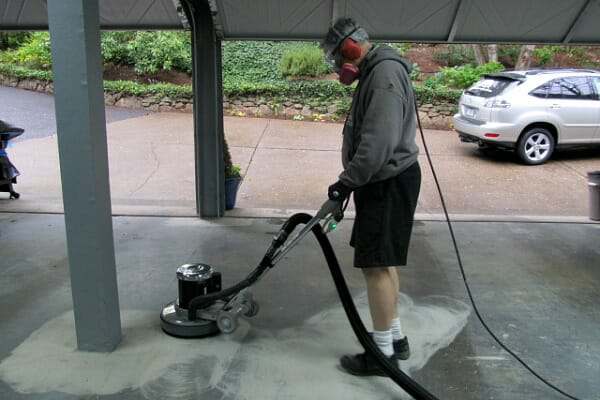
Learning how to grind a garage floor for an epoxy coating or paint hasn’t always been the easiest or most straight forward of projects for the average homeowner. It frequently raises more questions than answers and can lead to frustration when trying to figure out the best way to do it. Many of these questions relate to what type of grinding equipment to use.
While it is not the most difficult thing to do, trying to figure out the right tools to rent or buy can be daunting. Plus, dust control can be an issue unless you spend more money for the proper vacuum equipment. With so many choices, it can get plain confusing and even expensive.
Our objective here is to present to you an easier and more economical way to grind your garage floor. It can typically be accomplished in less than a day for most standard 2-3 car garages.
Besides helping to eliminate the confusion and questions that arise, it will also instruct you how to provide a nice profile for your coating of choice. It’s just one less thing to worry about when learning how to epoxy coat your own garage floor.
Diamabrush Concrete Grinding Tool
Fortunately, a company called Diamabrush has introduced a concrete prep tool that attaches to the bottom of a floor maintainer. It is available for use from a large assortment of rental companies. The Diamabrush is a great choice for garage floors that are in relatively good shape to begin with.
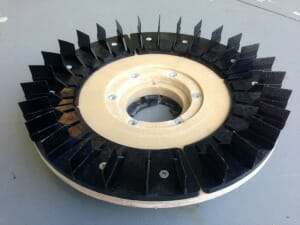
The Diamabrush consists of a series of diamond coated blades that are attached to a buffing wheel.
These blades abrade the surface of the concrete to provide the proper profile for an epoxy coating.
This process of grinding your garage floor is much easier to manage than the traditional 7″ angle grinder with a concrete turbo cup wheel. Plus, it keeps you off your knees.
In addition, the large size of the tool covers more area. Furthermore, the flexible blades prevent grooving or kiss marks that can happen when a turbo cup wheel is not held flat and goes up on edge.

Diamabrush also offers a separate removal tool that is used for removing old paint, thinset, mastic, or even thin epoxy coatings.
You can identify it by the smaller number of diamond blades compared to the prep tool.
If you use this tool to remove old paint or a thin coating down to bare concrete, it will prep the concrete surface at the same time. You will not require grinding with the prep tool afterward. Diamabrush does not recommend the prep tool for removing old paint and thin coatings.
The nice feature about both of these is that they can be used either on a wet surface to avoid concrete dust or you can attach a dust shroud with a shop vacuum to grind dry. Dry grinding with the proper attachments prevents the heavy concrete dust or messy cleanup of a wet slurry.
Note: The Diamabrush is not an aggressive concrete grinding tool that can remove heavy layers of concrete. For example, it will not level high spots or smooth out heavily repaired areas of concrete. You will need to use a turbo cup grinding wheel or a more aggressive grinding machine for that type of work.
This post may contain affiliate links. If you use these links to make a purchase, we may earn a small commission. As an Amazon Associate, All Garage Floors earns from qualifying purchases. You can read our full disclaimer here.
tools for grinding your garage floor
These are the basic tools that you will need to acquire before you start grinding your garage floor. It’s a bonus if you already have some of these or know of someone who can lend them to you. You can apply the cost savings to your garage project.
Harbor Freight has cheap angle grinders for under $20. Unless you plan on using it for other projects, we don’t recommend spending more money on a better grinder.
The dust shroud for the angle grinder is optional but highly recommended. These small grinders will eat up concrete and create a small dust storm. It will need to be attached to a shop vacuum in order to use it. Keep in mind that pricing may vary depending on your area.
- 4 ½” angle grinder – Harbor Freight Tools – $16.00
- 4″ diamond turbo cup wheel – Amazon
- Optional dust shroud for the angle grinder – Amazon
- Floor maintainer rental – Home Depot
- Diamabrush concrete prep tool rental – Home Depot
Some Home Depot stores carry the optional dust shroud attachment and some don’t. Make sure to ask for it. If they don’t have it, you will need to grind the floor wet if you want to avoid the dust. If you find a rental with the dust shroud attachment, you will need to rent a shop vacuum to go with it or use your own.
The small angle grinder and turbo cup wheel work well for grinding flush any garage floor repairs or crack repairs. In addition, it will cover the areas near walls, corners, and other objects that the Diamabrush attachment cannot reach.
The small grinder is also good for smoothing out the raised edges and materials if you are filling contraction joints for a seamless floor appearance. They also work well to grind down any unusual high spots.
If you will be grinding dry with your own shop vacuum, then one other tool we can highly recommend is a Dust Deputy. Concrete dust is very fine and will clog up the filtration system of a standard shop vacuum fairly quickly. It requires frequent stops to clean them out.
The Dust Deputy works by creating its own dust collection system that keeps the filters of the vacuum virtually dust free. You can find the Dust Deputy here at Amazon.
Heavier Duty Concrete Grinding Equipment
As we stated earlier, the Diamabrush is a good choice for grinding and prepping garage floor concrete that is in fairly good shape to begin. However, it is not aggressive enough for anything more than that.
If you have high spots to take down, multiple concrete repairs that need to be ground flush, broom finished concrete, or some other type of rough surface, then a heavier duty grinder will need to be used.
A good choice for that is the Edco 10” Concrete Grinder. It is a heavy machine (152lbs) that uses a 10” diamond impregnated grinding disc.
It can be plugged into a standard 110V outlet and has a vacuum attachment to keep down the dust.
We prefer a grinder such as this over the Diamabrush for removal of old paint and concrete coatings as well. It works much faster and does an excellent job at providing the correct surface profile for coatings.
These are fairly common and can be found at your local Home Depot and equipment rental centers. The rental costs vary from $150 – $175 per day. Be sure to check if there is an additional charge for the 10” diamond disc.
Grinding the Garage Floor
The first thing that needs to be done is to make any necessary repairs to your garage floor such as cracks, pitting, and other defects. It’s best to tackle these first before you rent any equipment. You don’t want to be making repairs while rental equipment sits.
After your repairs are complete, sweep the garage floor and clean any oil or grease spots from the surface. Grinding alone will not remove heavy oil stains and is why these need to be tackled first.
Next, if you have elected not to use a dust shroud and vacuum, prep yourself and the garage for the dust that will follow. While the Diamabrush does not create as much dust as a typical turbo cup concrete wheel, you will still have a small cloud of dust that will coat everything in your garage.
When dry grinding, make sure you wear an N95 dust mask or respirator approved for concrete dust. Concrete dust (crystalline silica) is considered a human lung carcinogen. Safety glasses and ear plugs are highly recommended for your own safety.
If grinding wet, start by wetting the surface of the concrete that you are going to grind. It’s best to work in sections when you do this. Using the floor maintainer with the Diamabrush attachment, start by slowly working the machine side by side and then a circular motion. It will only take a few minutes to figure out how long to work an area before you need to move on.
When grinding with the wet method, do not let the wet slurry dry out. It is a bear to clean out of the concrete properly if it dries. It can lead to a coating failure if it isn’t completely removed. Each time you finish a section, use your hose to blast the area clean while it’s still wet, and then move on to your next section.
To check your work, use the hose with a pressure nozzle to spray the area clean and then run your fingers across the surface. It should feel like fine to medium grit sandpaper and have a more granular look. Continue this way, grinding the garage floor one section at a time until you are done. Make sure to work the machine all the way up against the walls of the garage floor.
Because wet grinding can create quite the slurry, we recommend that before you blast a section clean, use a wet vac to suck up the majority of the slurry. This helps tremendously with keeping the amount of slurry that you hose out of your driveway down to a minimum.
Not counting the edge work or other hard to reach places, most people can grind a standard 2-car garage floor (approximately 400 ft²) in just over two hours or so when using this method.
Once done, this will leave a strip about 2″-3″ wide around the perimeter of the walls that the Diamabrush could not reach. There will be more in the corners. Use the small 4 ½” grinder with the diamond cup wheel to remove this remaining strip of concrete and the larger areas in the corners.
Be careful to keep the turbo cup wheel flat on the garage floor when grinding. If you apply too much pressure or angle it too much on the surface, it will leave “kiss marks”. These are small half-moon divots that can potentially show through your coating.
The concrete needs to be fairly dry or just damp when grinding with the turbo cup wheel. If it’s wet, you will need to use a ground fault circuit interrupter to prevent electrocuting yourself with the angle grinder. You can purchase these for about $25. Many times you can use the power cord extension that comes with the floor maintainers if you still have time on the rental. They usually have a GFCI built into the cord.
The other option which we prefer is to grind the edges first then follow up with the diamabrush. Just remember that if you are using a dust shroud on your grinder, a standard shop vacuum is not made to handle such fine dust and will clog up fast.
You may need to clean out the filter quite a few times while grinding the edges. Though you are not grinding a lot of concrete, if you elect not to use the shroud be prepared for the amount of dust this small grinder will put out.
Another Concrete Grinding Option
Another option for grinding your garage floor that is being used quite successfully is the 7” Diamabrush hand tool. This one is made to fit a 7” angle grinder and works fairly quick as well. You will need a dust shroud when using this tool and it works best with a variable speed grinder.
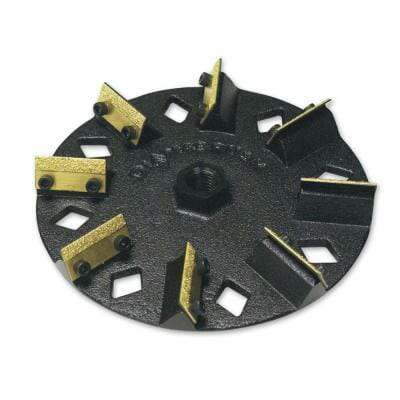
You can’t rent these, however. You will need to purchase them outright. Home Depot sells the 7″ version. You can also find them here on Amazon.
Diamabrush says that slower RPM’s are better. The high-speed grinders have a tendency of heating up and clogging the blades. If your only option is a single speed grinder, don’t use one that spins any faster than 6000 rpm’s. If you are worried about the speed, Diamabrush says grinding wet will keep the blades cool and prevent clogging or glazing.
Another tip is to keep it flat and do not lean into it in an effort to make it work harder. The weight of the grinder is enough to do the work.
Depending on how much suction your shop vacuum creates, you may need to shim the tool with a washer to raise the shroud off the floor to avoid suction lock. Some shrouds have a vent to adjust for this as well. Either way, these tools make quick work of the concrete.
Best Shop Vac for grinding concrete
If you are thinking of purchasing a new shop vac, we highly recommend that you look at this Dustless Wet/Dry shop vacuum at Amazon by Dustless Technologies. These are excellent vacuums that work extremely well when vacuuming up concrete dust, drywall dust, and variety of other fine dust particulates.
Professional installers are using these more and more as a backup or even as a replacement to the much higher priced specialized concrete dust vacuums. You can read the great reviews on these and find them here at Amazon.
They also offer an optional 25′ vacuum hose at Amazon that can reach twice as far as the original.
Final Cleaning
Once the grinding is done, it’s time to make sure the garage floor is clean of all the dust. If you ground the floor wet, then chances are the floor is clean.
To check, run your fingers across the surface when it has dried. If your fingers don’t have a lot of white residue on them, then you are good to go.
Another test is to press a strip of duct tape to the concrete and then pull it up. It should stick fairly well and come up fairly clean without too much dust. The floor will never be completely free of concrete dust, so don’t fret over small amounts on your fingers.
If you have a lot of white residue after a wet grind, then this is excess concrete dust that did not get hosed out well and will need to be cleaned. The best way to remove it is to mix up a solution of TSP (Trisodium phosphate) in a bucket, spread it out on the floor and lightly scrub it with a push broom or long handled scrub brush.
Using your high pressure nozzle, rinse the concrete real well making sure there is no more solution left behind. Work in sections if you need to so that the solution will not dry before you rinse it out. This will help lift any remaining slurry and dust that is in the pores of the concrete when you rinse.
If you did a dry grind, the easiest way to insure the concrete is clean and ready is to use the wide mouth attachment on your shop vacuum and just vacuum all the dust up. What’s nice about this method is you can start right away with applying your floor coating since there is no water on the floor that needs to fully dry.
Once the floor is done, test different areas by sprinkling water drops on the surface, paying particular attention to any areas that were coated in oil or grease or where you may have used a tire dressing that dripped onto your concrete. It should turn the concrete darker and absorb the water fairly quickly. If it just sits on the surface, then you may need to regrind and/or re-clean that spot before you apply your coating.
Grinding a garage floor with one of these easy methods will ensure the best profile for your garage floor coating to adhere to. It can be done in less than a day and is safer than using an acid etch.
Hi,
This is a great website, thank you for all the information.
I removed 600 sq ft of tile from my concrete with a demo hammer. I was think of renting the Diamabrush Coating Removal Tool that you suggest to get rid of the thinset.
The tile was inside and outside and i was a little concerned to read on the instruction that you should
“Use on interior, hard-troweled concrete only. Do not use on exterior concrete”
As far as I can tell my outside concrete was broomed before they put down the tile. Does this mean I have to use a different tool to get rid of the thinset?
If the thinset is not too heavy you can use it inside or outside Brian, it doesn’t really matter. If you have large chunks that need to be taken down then you would be better off with a concrete turbo cup wheel on an angle grinder.
Lots of great info here. I have a painted garage that I’m wanting to epoxy. Will the diamabrush work or should I go for the grinder in order to prepare the surface for the epoxy primer?
If it’s just paint Slomo, then the Diambrush removal tool will work for removing the paint and prepping the floor at the same time. It just takes a little longer since you are removing paint as well.
Question, and sorry if this was covered already, but if I dry grind and use a shop vac to ensure the dust is gone and past the dust test, I assume I do not need to acid wash at all afterwards. Is that correct?
You are correct Peter.
you folks are so great and detailed in your replies. Which tool is best for removing falling floor paint, (the old red paint look) and just going to bare concrete.,the concrete prep tool or the coating removal tool? are they interchangeable or is one more heavy duty? Can you use them with floor buffer or only the floor maintainer?
You want to use the removal tool Allison. It is the one with the fewer blades. They will work on a 17″ floor maintainer/buffer.
Hi, before I ask my question, I just want to thank you guys for all this information. It is a wonderful resource for a newbie like me.
Home Depot now has a 10″ Concrete Grinder for rental. If I were to rent this 10″ Concrete Grinder, do I need the other items that you listed in this article or is the 10″ Concrete Grinder all I need to prep my garage?
Thanks in advance!
We’re assuming it’s the 10″ Edco grinder that you are referring to Gary. It will get closer to the walls than the Diamabrush, but it will still leave an untouched strip along the wall and will not do corners well. That is why the cheap 4″ grinder works well to hit these areas. Plus, it comes in handy for any crack repairs or joint fillers that you want to grind smooth. Amazon even has the 4″ grinding cups for as little as $13 now. You can find them here. The Edco will not kick up as much dust as the Diamabrush, but we do recommend a vacuum attachment if they offer it. You can always grind without it, just be prepared to clean dust off the walls or anything not covered. Oh, and always wear a respirator around concrete dust.
Yes, I was referring to the 10″ Edco grinder. I will rent a vacuum attachment as well and I will make sure to get a 4″ grinder and a respirator! Thanks!
I have another question which is more related to quality/value. Would you recommend using the Diamabrush over the Edco? The difference seems to be about 50 bucks since you need to rent a floor buffer and the Diamabrush attachment.
It can depend on the floor Gary. The Diamabrush works great and fairly quick at prepping concrete that is in good condition to begin with. It does not do as well as the Edco in terms of aggressive grinding however. The Edco can smooth out broom finishes better, patched areas, and take down small high spots. It is generally a little slower though.
One tip with Home Depot – If you rent a tool after 6 PM and return it by 9 AM the next day, you will only be charged a 4 hour rate in most cases. So if your neighbors or significant other does not mind you working in the evening or early morning, check with HD about this lower rate option.
If you happen to rent a tool after 5 the day before a holiday HomeDepot is closed and you bring it back before 9am the next day they are open they will also only charge you for 4 hours.
Excellent!
Hello, I am planning on applying epoxy to my 1200 sq ft garage floor. Its new construction as of 45 days ago. I did not seal the concrete. My dilema is that the person I hired to prime and paint my ceiling and walls did not use a drop cloth and I have over spray all over my floor. He used a water based paint. Do I need to remove that? I have tried water and a stiff broom, it will remove it, but would take me forever to do. If you recommend that I remove it, can you give me some advise as to how to do so? Or can I just go over the top of it with the epoxy?
Hello Dave. Yes, it does need to be removed. However, you still need to prep the floor by either grinding or acid etching. If you grind, then the paint will come right up. If you decided to acid etch instead, you may need to strip the paint chemically first with a paint stripper. The acid will not work over paint as it needs to react with the concrete. The paint will block it from doing so.
I have a job 30’x 16′ we fiberglassed the floor with silica carbide powder and the top has some carbide in it,i need to scuff the wax coat off cause it’s too slippery,will this product work better then a diamond cup wheel.
Diamond cup wheels are more aggressive and easy to gouge the surface with if you aren’t careful Colin. The Diamabrush will not gouge and creates a more consistent look. It may be the better choice for what you want to do.
I have a 2-car garage 25×26. I covered the floor 4 years ago with the Rustolem Epoxy kit from Home Depot. I have a couple areas where the tires lifted/peeled the epoxy coating. NOW I want to remove the current epoxy coating and apply a new Grey epoxy covering.
Question: will I need to use the diamond edge brush to remove ALL the existing epoxy coating or just where the tires sit?
Thank You
If the new coating is a better quality than the current coating Joe, then you will want to remove the old coating entirely. The reason being is that how well a coating performs in terms of adhering to the concrete as well as avoiding hot tire pick up is dependent on what it is adhered to. If it is the same quality coating and you are satisfied with the way it has held up, then you can always prep the floor with this method instead.
Hi, I want to convert my garage in a wood shop, my first step is apply a epoxy cover but have some doubts. Actual floor is a concrete with exposing aggregate little black stone (grain #3), my idea is grinding the floor to obtain flat profile (more less) and remove the sealant remanent. After apply the epoxy material. Is possible to keep the actual appereance with any transparent epoxy? How many coat I must to apply to cover and try to obtain a hard surface?, please any recommendation.
Thanks.
Hello Hugo. Once you grind the concrete you will first need to apply a clear epoxy primer. The next coat would be a 100% solids epoxy clear. This is the build coat and depending on how rough the floor still is, it will need to be applied thickly with either a gauge rake or roller. Your top coat should be a clear polyurethane or polyurea. These are very resistant to scratching and chemicals and make for an excellent top coat.
Shea, just a 2 more questions:
Can you tell me specifications or brand for products to use according you recommendation?.
I´ve read about some process for remove concrete (grinding, shaving, scarify, etc) but due my floor have aggregate I don´t know which is best process (DIY); do you have any recommendation?
Thanks ¡¡¡
We really can’t tell you for sure what to do Hugo without being able to examine the floor. Aggregate showing is not a good sign. If you have many areas with pits that are 1/8″ deep or more, you are past the point where a standard epoxy system can be used and expect a smooth finish. Grinding is your best bet as it will help to smooth out the surface and reduce high spots. You will need to use an industrial type grinder like an Edco unit. Home Depot rents the 10″ Edco’s if you have one near you. Once you grind, you can get a better assessment of what you will need.
Before you start, we would recommend contacting a couple different vendors to discuss the shape of your floor first. Taking a few good pictures and sending them via email will really help them evaluate what you will need to do. It helps to put a coin in a closeup picture for reference. We recommend starting with Scotty from Legacy Industrial. He is real good at helping the DIY crowd and he can give you a real close idea of what it’s going to take and an approximate cost for materials. Many of our other sponsors will have the product you need as well. ArmorPoxy and Justin at Garage Flooring LLC come to mind, as well as GarageCoatings.com. These are all examples of companies that specialize in floor coatings and will have the product that would be required.
I want to refinish a concrete garage floor that someone previously epoxied (poorly). In some spots the epoxy is chipping and flaking, What would your recommend to prepare it for a new epoxy finish (Rustoleum epoxy paint)?
Thanks in advance – this site is great and incredibly informative!
Richard
Hello Richard. You will want to remove the previous coating before applying anything new. Since the bond of the old coating is suspect due to the flaking and chipping, you do not want to rely it by applying something else over it.
Hello! I’m so glad I found this blog. I need to remove old carpet glue from a concrete floor. Home Depot recommended the Floor Maintainer with a Diamond Blade, it didn’t work. Will the Concrete Grinder 10″ that they have to rent work better for this job? Any tips on getting the glue up, it’s pretty thick. Thanks!
Yes it will Kristen. Have you tried removing it chemically? Franmar Chemical makes a good product that is environmentally safe.
I have two questions regarding grinding my floor and prep for coating with higher humidity. I started grinding down my older brushed concrete garage floor and noticed that a wall was moved at one time and someone cut off the old concrete anchor bolts flush. I went over and around them with grinder. Can I vacuum the floor when done and just coat over them with the rocksolid? Also wondering if there would be any reason I couldn’t run a de humidifier in garage the day that I start coating floor next week since humity will be higher?
You can run the coating over the bolts if they are flush with the floor Zach. RockSolid is vague about actual humidity limitations, but they do say not to apply it if either floor temp or air temp are withing 5 degrees of the dew point. We do know that people who have applied it in high humidity have had issues with fish eyes. Anything higher than 80% and you should really hold off. A dehumidifier in the garage isn’t really going to help since the door will need to be opened at some point. The best thing you can do is run a fan in the garage to keep the air moving. Still humid air can form a very microscopic layer of moisture on the floor that you cannot see. Air movement in the garage goes a long way towards keeping that from happening.
I just poured a 18′ X 21″ floor in an outbuilding. The concrete set up more quickly than I had anticipated and I have some uneven spots/ridges left over. Its good enough, but I wonder if a floor can be “leveled” with a grinder, taking out some high spots. From what I’ve been reading, it sounds like the Edco grinder that Home Depot rents would be a possibility? If so, what type of medium would I use on the grinder?
Yes Robert, the 10″ Edco could do that. Home Depot’s charge for the grinder plus the 10″ diamond wheel that is specific to concrete grinding. If you aren’t doing the entire floor, a less expensive, quicker, and even more aggressive alternative would be a 7″ concrete diamond turbo cup wheel mounted on an angle grinder. It spins much faster and can make quick work of high spots and ridges.
Thank you!
I just poured a 28’x28′ floor for a shop and I’m thinking about grinding it to expose the rock then applying a clear coat. I’ve seen this done in the past and it’s a pretty nice touch. Any concerns or suggestions? What tools would be best? Thanks in advance.
Many times the floors that are prepped like that were heavy in aggregate to begin with. At issue is how much aggregate is in your slab and how far down under the surface is it? You may want to test an area that will be covered by something before you make a decision. Either way it takes a great deal of grinding with the proper equipment to take the upper layer of concrete down to the aggregate. You would first need to use a concrete scarifier. These are aggressive machines that work fast at removing layers of concrete. You also need the proper vacuum equipment to go with it since it produces heavy concrete dust. Once you reach the upper surface of the aggregate you would then grind with a more conventional grinder to produce the profile you are looking for. We agree that such a surface looks nice, but it does require time and expense to get that look.
I love this website! I have 1700 sq ft of garage to epoxy. This concrete is older than I am, but hasn’t had a ton of wear thankfully. I did acid etch and paint part of it about 5 years ago and the paint is all intact and looks good (but I think epoxy will look better).
I plan on renting the floor buffer and diamabrush prep tool and 4″ angle grinder. I have 3 questions
1) is there any reason to acid etch after grinding? Or is that completely unnecessary? I am going with a water based rustoleum epoxy (it is what my budget allows) so I know that floor prep is the key here.
2) Will the diamabrush prep tool effectively remove the floor paint I put down 5 years ago?
3) I know a lot of factors influence how long it could take to grind the floor with the home depot buffer/diamabrush- but do you think I can do all 1700 sq ft in a day? I am hoping I won’t have to rent the buffer/diamabrush too long! I will grind the corners and edges the day before I rent the equipment.
Thanks!
Hello Kristen, we are glad you like our site! There is no need to acid etch after grinding since grinding does a better job of prepping the concrete. Since you have paint on the floor, you will want to use the Diamabrush removal tool and not the prep tool. It will prep the concrete as it removes the paint. It’s hard to give an estimate on time for such a large floor that also requires removal of a paint. We suggest that you take advantage of Home Depot’s policy of allowing rental of the equipment after 6 PM the previous day. This will allow you to start grinding in the early evening hours and then all the next day if necessary before having to return the equipment. Unless the paint is particularly stubborn, you should be able to get it all done in that time frame.
Hello, I am working in my 2 car garage. The previous owner used interior paint to paint the floor. It’s coming up in my tires and chipping in general. I’ve rented a floor maintener and a concret prep tool, 25 gri from Home Depot. I started and so far it’s working ok…it’ll take some time. There’s a ton of dust which concerns me. But reading your site I believe I will begin doing this wet instead of dry to cut down on the dust. I’m going to also buy a respirator and some disposable coveralls.
My questions are about the dust already accumulated. It is lightly coated on everything. Is this a health issue? I was unaware of how serious dusty cement debris was until I decided to Google it.
And 2nd question, any further tips on keeping dust to a minimum and/or ways to keep this stuff out of my lungs!?
Thank you!
Hello Eli. As long as you wear an N95 rated respirator or dust mask while you grind and when you clean up the dust, you will not have to worry about the effects of dust in the lungs, also known as the disease Silicosis. We have some good tips in regards to dust control in the article. If you are using a floor maintainer with the optional dust shroud attachment, we suggest using a shop vac with a Dust Deputy. If you elect to grind wet, be sure not to let the wet slurry dry or you will have a tough time cleaning it from the surface. Also, be sure that the DiamaBrush that you use is the removal tool and not the prep tool. The removal tool has less blades and will actually do a better job of removing the old paint. The prep tool is best for bare concrete only.
Hello,
I was wondering why you need to clean oil and grease spots before grinding the floor. Won’t the grinding process remove the oil and grease spots and do it better than any degreaser could?
Thanks,
Tom
If they are light oil and grease spots it’s not a big deal Tom. However, if they are heavy spots, cleaning helps to draw the oils out of the concrete. Grinding only removes approximately 1/32″ of the surface. Oil and grease penetrates deeper than that. If the coating can’t get past the oil film it will not adhere.
Makes sense. Thank you Shea. How about rust stains? Would chemical cleaner need to also be applied before grinding?
Rust stains not so much Tom. The grinding tends to get the majority of the stain and it doesn’t really impede with the penetration of the epoxy.
I’m a little confused about choosing the correct 4″ diamond wheel. The manufacturer for my product says I need to have a 5-10 mil profile. But when I I follow your link for the 4″ diamond turbo cup wheel I don’t see any indication as to what type of profile this will give me. Are all 4″ diamond cup wheels the same in regards to what profile they will produce?
Thanks,
Tom
Tom, concrete surfaces need the correct CSP (concrete surface profile) for certain types of coatings. They are not referred to in millimeters. They are a measurement of the roughness of the surface. Thin coatings such as paint and some thin epoxy coatings need the minimum of a CSP 1. This is usually achieved by acid etching. A CSP 2 is typically achieved by grinding and is what is recommended for most thicker or commercial quality coatings. A CSP 2 profile is what grinding wheels will produce. I believe you may be getting confused with what the manufacture is stating about your coating thickness in terms of mils.
All of your standard turbo cup style grinding wheels are going to create the same CSP 2 profile and are usually a 30 or 40 grit unless marked. Less segments per wheel means it’s more aggressive. It still creates the same profile, however, it’s easier to create small gouges (kiss marks) if you are not careful.
We have 1400sf floor we will be installing Nor-S full flake polyurea with primer coating. The floor is in perfect shape with a concrete sealer. Would it be practical to grind the floor with a 7″ variable speed hand buffer and the 25 grit diamond brush wheel instead of using a floor buffer?
Hello Jeff. Unless you have titanium knees, the floor buffer with the Diamabrush attachment would be the preferred method simply because it’s easier on the body. Other than that, both will work well. If you have a good dust attachment for the 7″ grinder, it would be the less dusty method compared to the dust attachment for the floor buffer.
Thanks, we did purchase a 17″ Mercury sealed sander with the Diamabrush concrete prep tool along with the smaller grinder set up to do peremeters.
I recently rented the Diamond Brush Removal Tool from the home depot. I used it to clean up old carpet clue on a 500 sq ft room. It worked okay and created no dust. It took about 4 hours. Then I went around the edge with a 4″ angle grinder which created lots of dust. My question is, Do I need to acid etch now since I used the removal tool instead of the prep tool? Or did the removal tool prep the surface as well?
The removal tool will prep the concrete Jeff as long as it was applied to the concrete long enough to let it grind as well as remove the carpet glue. The 4″ grinder will typically kick up much more dust. To check your work, apply some water drops to various areas of the concrete. If the surface turns darker immediately and absorbs the water drops then you are ready to go. You can check the results with the edges that you ground as a comparison.
Hello,
After I wet grind the floor, how long do you recommend I wait to apply the 100% solid epoxy first coat? I don’t want the moisture from wet grinding to affect my epoxy down the road. Thanks
You need to wait a minimum of 24 hours Jake. If the humidity is up it may take longer. Be sure you don’t let the wet slurry dry on the concrete or it can be a bear to clean.
I am planning on doing a clear coating on my floor. Will the Diamabrush leave swirl marks on the concrete? I should expand a little. We have about a 700 sq. ft. floor in a tasting room. I will be wet grinding with the Diamabrush concrete prep tool. The owner wants to see the grit, from the rock and sand, in the concrete. Will the Diamabrush prep tool leave any swirl marks that will show through the clear finish? Thanks
Hello Steve. The Diamabrush is the most forgiving of concrete grinding tools due to the flexibility of the metal grinding tabs. You can get some swirl marks depending on how hard your concrete is. These marks, however, are not nearly as noticeable as the more aggressive methods such as turbo cup wheels and the diamond pads using on industrial grinders. They can leave gouges and deeper swirls if you are not careful. All concrete is different and never looks the same. This is true of grinding as well. The concrete will not have a nice even color and tone if that is what you are looking for. It will have a little bit of character with slightly different looking hues and textures. Applying a clear coating highlights these differences and is what gives concrete the attractive looking finish that most people are trying to achieve.
With all that said, the Diamabrush is not the tool to use if you want to remove the upper most layers of the concrete to get down to the aggregate. You will need the more aggressive industrial grinders in order to achieve that. You may need to remove 1/16″ to 1/8″ of concrete. This will definitely leave swirl marks. You will then need to use a less aggressive grind to remove these some of the swirl marks. It’s a lot of work and more in line with what concrete polishing contractors do.
I have a concrete pad that was poured level just outside my house, when it rains the water runs in under the garage door, the condrete pad is about 6ft by 6 ft, can a concrete grinder be used to slope the concrete pad to keep water from running in toward to house??
Technically you can Jay, but it would require a tremendous amount of grinding in order to accomplish that. A grinder typically only removes 1/64″ to 1/32″ of concrete from the surface at one time depending on the density and hardness of the concrete. A concrete scarifier is much more aggressive, but you cannot control the slope very well and the surface it leaves behind would require grinding to smooth it out. Plus, it may expose the aggregate just under the surface as you create the required slope. You may be better off grinding a small channel into the concrete to direct the water to flow to a different side.
Thank you very much for the information!
I have a 300 sqft screened in patio that was stained by the previous owner which I am trying to re-do. I have landed on going with a concrete dye as I like the look of these and there are some dyes and sealers out there which are UV resistant which I feel would hold up better to the very small amount of sunlight the concrete floor gets each day (about 2 hours in the mornings).
I started with a chemical strip to remove the old stain and it wasn’t very effective (removed less than half after two applications and worked better in some areas of the floor than in others), so I went with the diamabrush concrete prep tool to get the rest and was able to remove 99% of the old stain off of the floor. My question is should I sand the floor or do any other kind of prep (besides thoroughly cleaning) before applying the dye and sealer?
Since you prepped the concrete with a grinder Matthew, the only thing you really need to do is clean the floor of the remaining concrete dust. A shop vac works well. Once you do that you are ready to apply the dye.
After completing a dry grind of my garage floor with a dust shroud and then going over the floor with a 6hp shop vac with a dust deputy connected. How clean does the duct tape test really have to be? It seems that no matter how much effort I put into it, I’m always getting some residue pulled up by the gorilla duct tape I’m using. Any pictures of what it should look like? It’s possible that I may just be over critical.
No worries MrClean, based on your setup it sounds like you may be over critical. It’s fairly normal to get a little bit of white residue and grit when using good tape like that. What you don’t want is to remove the tape and have it look all white.