
For all the amazing looks, features, and benefits that interlocking garage floor tiles offer, one of the less common concerns is the noise they can make when walked on. How noisy can interlocking tiles be? Well, the answer is – it depends on the tile and the floor.
Most interlocking floor tiles are made of one of two materials. One is polyvinyl chloride (PVC), and the other is polypropylene, a hard thermoplastic polymer. Let’s take a look at both of these and discuss what noise, if any, they make and how to eliminate or at least reduce the noise of the tiles that do.
Which Interlocking Garage Floor Tiles make Noise?
As a general rule, most garage floor tiles do not make noise. The good news is that if you are interested in the more pliable PVC tiles, then you don’t have anything to worry about.
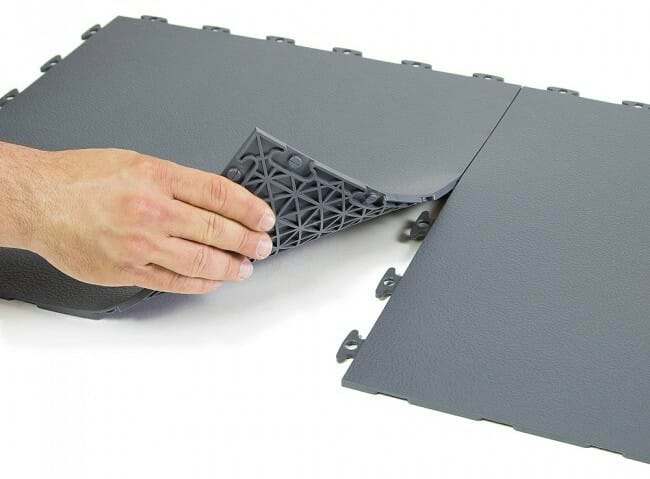
As a specialized garage floor tile, they have a rubber-like texture and are solid throughout. They fit together like puzzle pieces and tend to conform to the floor’s contours.
Due to their texture and relative pliability, they won’t click while walking or driving on them. They also tend to absorb and deaden sound rather than amplify it.
If your interest lies in interlocking garage floor tiles made of polypropylene (hard plastic), there is a chance your tiles will make some noise. How much noise they may make, if any, is dependent on a few factors.

The first concerns the style of hard plastic tile you choose. If you like the tile with the self-draining surface, then your chances of them making any noise are slim.
The reason is that this tile style has open venting on the top, which prevents sound from bouncing off the concrete surface and the underside of the tile.
As a result, you will not get any hollow-sounding clicks or clunks that are amplified by the hard surfaces.
If you choose a solid surface top, there’s a small risk that your interlocking tile will make noise.
The reason is that polypropylene tiles are rigid, unlike PVC tiles, which are flexible. They have a hard, textured surface with a hollow core underside. They snap together with a peg-and-loop system for a secure fit.
Due to the materials and construction, some tiles can make a click-clack or hollow footstep sound when driven or walked on. The sound is amplified due to the hollow substructure.
In addition, they can have a hollow and plastic “clunk” sound as you walk on them if your garage floor is not flat and has multiple low spots.
This is created because the rigid tile does not flex under its own weight and is not fully in contact with the concrete. When you walk in these areas, the tile flexes and contacts the ground, creating this sound. There are ways, however, to reduce the chances of having a noisy floor.
This post may contain affiliate links. If you use these links to make a purchase, we may earn a small commission. As an Amazon Associate, All Garage Floors earns from qualifying purchases. You can read our full disclaimer here.
Tips to prevent noisy interlocking tile
The first thing to consider when choosing an interlocking tile system is the quality of the tile. Higher-quality manufacturers of polypropylene tiles achieve a more snug fit when tiles are snapped together. This reduces the small movement of tiles against each other. It’s this movement that can make a clicking noise when they flex slightly under weight. It also reduces the chance of dirt getting underneath the tiles.
If your garage floor is uneven or has noticeable low spots, tile movement against each other increases as the tiles are forced to follow the floor contours as you walk or drive on it. You can help eliminate this by applying self-leveling polymer cement to the extreme low spots on your floor before installing the tiles.
Besides filling any low spots on your floor, the most effective thing you can do to reduce the chance of noisy tile is to lay synthetic landscaping cloth on the floor first. It acts as an underlayment. This helps to absorb the clicking sound made by the tile. This Reader’s Projects article is a good example of how synthetic landscape cloth is used.
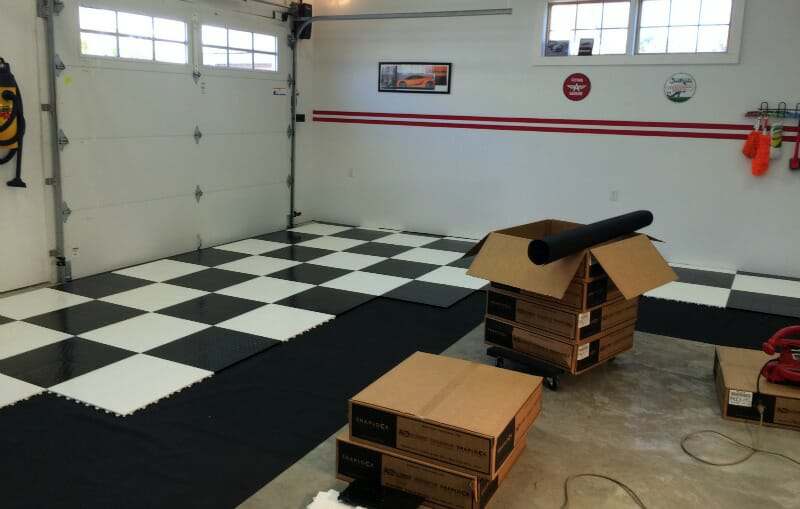
Since most polypropylene tiles have a hollow core underside, this creates a good environment for sound to bounce off the back of the tile and then off the hard concrete, amplifying the sound.
With the underlayment installed, the sound is deadened and reduces the noise. It also prevents any noise created by the tile when having to conform to low spots on your floor.
Synthetic landscape cloth is inexpensive and can usually be found at your local home improvement center. You can also find it here on Amazon.
Again, the underlayment helps absorb sound, thus reducing the tile’s amplifying effect. With a synthetic underlayment, you don’t have to worry about mold or mildew created by moisture if it gets wet. And because these tiles are designed to drain water and promote airflow, the underlayment will eventually dry.
Do not use rubber, cardboard, carpet, or any other material that can deteriorate, mold, mildew, or trap water.
Noisy tiles aren’t usually much of an issue, but it can happen. In most cases, it is preventable if you plan for it, install it on a clean, flat surface, and use a good, premium product.
My husband wants to install this kind of tile in our garage and I’m worried about it being real noisy. Can we put cardboard down underneath it?
If the interlocking tile your husband installs makes noise Cynthia, it’s not going to be real loud. It’s just loud enough for you to notice it. Most people don’t mind but for some who don’t like noise at all it might be an irritant. That’s why the synthetic underlayment works so well. Laying cardboard down is not a good idea. If it gets wet at all it will lose it’s integrity, and eventually mildew from not drying out very well.
Hi , I am wanting to put down a tile that is similar to a garage
Tile. Its made from polypropylene and is a deck tile used
For outdoors. I want to put these around my pool area ,but I live in Canada and it gets real cold here like -25 or so. I’m scared they will get brittle and break . Can you give me your insight on this ?
Hi Lorraine and thanks for the great question! We became very curious ourselves about this and put a call in to SwissTrax who happens to manufacture an outdoor polypropylene deck tile. They said their tile is rated down to -22 degrees F with a 2,500 lb load on the tile. If it’s just holding up people or furniture then there is little chance of problems at temperatures below that. We don’t know what brand you are looking into but according to SwissTrax, quality polypropylene can withstand some fairly cold temperatures without becoming brittle.
It sounds like some of these interlocking tiles would be great for our industrial warehouse! I would love to have something powerful and flexible, especially if it can act like rubber. When you’re working with electrical components, it is better to have more insulated flooring anyways. And if I follow this guide, I won’t have to worry about noisy tiles, either!
I’m looking to install these in my garage but I have a side entry garage which means tires are turned coming into & leaving the garage instead of being straight I’m concerned that the tiles will buckle or move ? Could this happen ?
No, not at all John. Once they are locked in place they will not buckle when turning your wheels. This video from RaceDeck gives a good demonstration.
Do I need to tape down the landscape fabric when I do this?
Hello Mike. No, you do not need to tape it down. The flooring will hold it in place without any issues.
Has anyone tried putting more than one layer of landscaping fabric underneath? Incremental improvement or not? Thanks!
Hi Daniel. We don’t know of anyone who has and we don’t think it would make that much of a difference. Maybe someone that has added an additional layer will read this and will let us know. However, landscape fabric is not expensive and won’t do any harm if you want to double it. We have a solid top interlocking floor in one of our garages and did not install the fabric. The floor is not real level in some spots and the tile does make a hollow-like clop noise when walking on it. It’s not an annoying noise though and it doesn’t bother us.