
Volatile Organic Compounds, otherwise known as VOCs, can understandably be disconcerting for floor coatings, paint, and sealers. We know that VOCs in general is not good, but what are they exactly? How do they factor into what type of garage floor coating or sealer to use? Are epoxy, floor coatings, or sealers that contain VOCs safe for use in a garage, basement, or in the home?
We feel that it is important for you to understand what VOCs are and their relationship to floor coatings and sealers in general. As a result, our goal is to remove any mystery surrounding VOC content. We will discuss how they are measured and where they are listed. In addition, we will explain what qualifies as no VOC and low VOC content.
Furthermore, we will cover safety precautions, regulations surrounding VOC content, and other factors to consider when selecting which paint, coating, or sealer to use for your garage, home floors, or basement.
What are VOCs and How Do they Contribute to Coatings and Sealers?
In short, Volatile Organic Compounds are potentially harmful carbon-containing materials that are released as gasses or vapors from specific solids or liquids. You can find the EPA explanation of VOCs here.
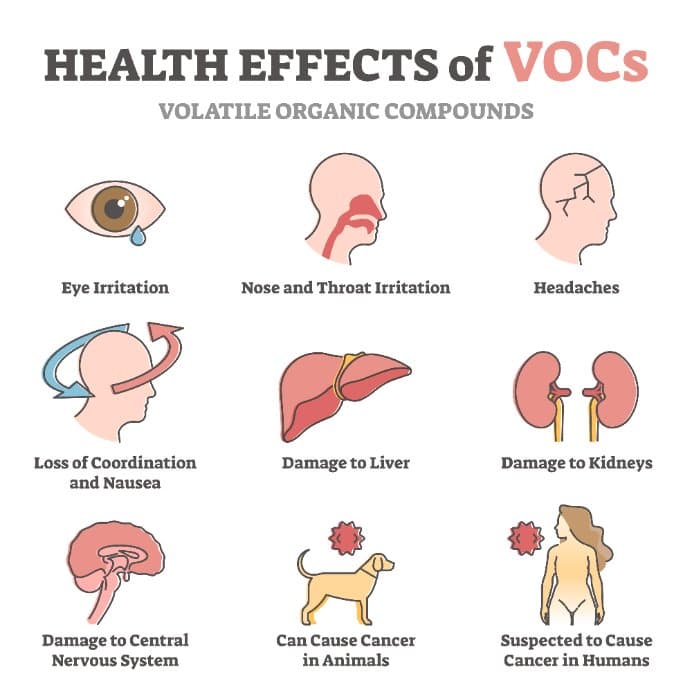
Severe exposure to VOCs can cause dizziness, headaches, eye, nose, and throat irritation, and worsening asthma symptoms. Long-term exposure can cause decreased lung function, cancer, kidney and liver disease, and central nervous system damage.
VOCs for garage floor coatings, paint, and sealers are found in solvents. When applied to the surface of concrete, these solvents evaporate at various rates depending on the room temperature.
Solvents play an important role in the performance of garage floor coatings and paint. They act as a carrier agent for resins, pigments, and curing agents. They provide lower viscosities for longer working times, better product penetration, and superior adhesion properties.
Furthermore, they allow for better-performing formulations and denser coatings. This results in superior abrasion resistance for longer wear, higher chemical and stain resistance, as well as glossier finishes.
Solvents in concrete sealers provide better penetration into the substrate. In addition, they can carry a high percentage of active ingredients and encourage a more consistent reaction with the minerals in concrete. This typically leads to better performance and longer-lasting results depending on the type of sealer being used.
Remember, there is a difference between concrete coatings and concrete sealers. If you are unsure, we suggest reading our article on garage floor sealers to learn the difference.
How VOC Content is Measured in Units for Coatings and Sealers
The number of VOCs contained in floor coatings, paint, and sealers is expressed as grams per liter or g/l. You can find the VOC content in the Technical Data Sheets (TDS or PDS) for the product. You can learn where to find this information in our article that explains how to review data sheets for coatings and sealers.

In addition, the Material Safety Data Sheet (MSDS) will list any hazards identified. Examples can include, but are not limited to, storing recommendations, skin contact or swallowing, and exposure.
The MSDS will also contain the Composition/Information of any hazardous ingredients. This includes VOCs. Non-hazardous ingredients are not required to be listed.
Regulations for VOC Content in Garage Floor Coatings and Sealers
Admittedly, regulations for the number of VOCs allowed for floor coatings and sealers can be confusing. You may have wondered why a certain garage floor coating or concrete sealer can be purchased in a particular state, but not another.
This begs the question; Who sets VOC content regulations for floor coatings and sealers and why do they vary?
In 1988, the EPA established the Architectural and Industrial Maintenance Coating rule. Otherwise known as the US National Aim Rule, it limits the allowable number of emissions from VOC content pursuant with the Clean Air Act.
The Act states that VOC content for floor coatings shall not exceed 400 g/l. Concrete sealers are limited to 700 g/l. It is the default rule that all states must follow if they don’t have their own set of rules. It seems simple enough. However, certain states and other multi-state organizations have set their own rules.
One multi-state organization created under the Clean Air Act is the Ozone Transport Commission or OTC. It established a stricter set of rules for the northeast based on coating categories. Another is the Lake Michigan Air Directors Consortium or LADCO. It comprises five states near the Great Lakes region including Michigan.
Then there is the California Air Resources Board or CARB. It limits VOC emissions content even further than the previous organizations. On top of that, there is a select region within the state of California called the South Coast Air Quality Management District or SCAMQD. It has the highest restrictions for VOCs than any other organization.
What are considered low VOCs for coatings, paint, and sealers?
Surprisingly, with the EPA, individual states, and other multi-state organizations involved in setting limits for VOC content, not one of them has established a ruling for what qualifies as low VOC.
However, many non-ruling bodies and organizations such as Green Seal have determined that any floor coating, paint, or sealer with a VOC content of less than 50 g/l is considered low VOC. Paints or coatings with less than 5 g/l are considered no VOC. Such paints, coatings, and sealers typically have a very low odor or no odor at all.
Unfortunately, almost all garage floor coatings, paints, and sealers that are considered low VOC are water-based. And most water-based floor coatings and paint (not sealers) are typically lower-performing products. They lack the solvents necessary to create a higher-performing formula – and that’s the tradeoff.
One exception to this is the commercial quality 100% solids coatings. Epoxy, polyurea, and polyaspartic coatings are an example.
100% solids content means that there are no solvents or water in the coating. 100% of the product is deposited onto the concrete to cure. None of it evaporates out into the atmosphere. As a result, 100% solids floor coatings are considered no VOC.
Lastly, some high-performing concrete sealers and densifiers are water-based and do not require solvents. Unlike coatings that are film-forming, they penetrate into the surface of the concrete to react with the minerals. As a result, they perform best without solvents.
Are Epoxy and Other Garage Floor Coatings and Sealers with VOCs Safe for the Home?
After learning about VOC content, it’s only natural to wonder if garage floor coatings and sealers are safe for home use. In short, yes! It all depends on where they are applied, any health considerations of the occupants, and if the correct product is being considered for use.
Coatings and sealers will never experience more traffic, chemical spills, and general abuse than a garage floor. This is where you want to use the best-performing products available that will fit your budget. Except for high solids epoxy and 100% solids coatings, most high-performing coatings can contain over 100 g/l and up to 250 g/l of VOCs.
However, the garage is typically a well-ventilated space with a large garage door/s, side door, and possible windows. Though a high VOC coating will off gas and create a smell during application, it typically dissipates at a high rate. This is because it is not trapped in an enclosed space like a basement or other room in the home.
The majority of VOCs usually evaporate within the first few hours or so after application. This is when a higher VOC coating will stink the most. Most of the remaining solvents will off gas within 24 – 48 hours as the coating cures. This is why you do not want to completely close up the garage during this time.
There may be a very small percentage of solvents left to off gas after this period. However, once a coating is fully cured, all solvents and VOCs will have been completely released and are considered VOC free. Depending on the coating/s applied, they can be fully cured within 2 – 7 days.
The solvents in penetrating concrete sealers will have evaporated out of the concrete as soon as the sealer has dried. This is typically 4-6 hours depending on the sealer. It may take a bit longer for any vapors lingering in the air to fully dissipate.
Use only low or no VOC coatings, paints, and sealers within the home. Any product with more than 50 g/l VOC content should not be used. This includes basements.
Enclosed spaces like these will not allow the VOC vapors to escape from the home fast enough. The EPA estimates that accumulated VOCs indoors can be 2 – 5x higher than outdoors or in well-ventilated areas. These vapors and odors can linger for days and quickly clear out the occupants of a home after application.
Even if the home is currently unoccupied, the lingering vapors can be absorbed by the walls, wood, and furniture within the home. They will slowly off gas for weeks or months making the home unlivable.
Most all paints for garage floors these days are water-based with low to no VOC content. Keep in mind though that garage floor paint is not a coating and will not perform well in a garage. If you are unsure of the difference, we suggest reading our article about the differences in coatings and paint.
Oil-based concrete paint used to be popular years ago. However, the amount of solvents used in oil-based paint has decreased tremendously due to the high VOC content they created. As a result, they do not perform as well as they used to and are much harder to find.
This post may contain affiliate links. If you use these links to make a purchase, we may earn a small commission. As an Amazon Associate, All Garage Floors earns from qualifying purchases. You can read our full disclaimer here.
VOC Safety Precautions when Applying Floor Coatings or Sealers
There are not any rules or regulations set forth by a governing body or organization that state at what point of VOC content an approved respirator should be worn when applying floor coatings, paint, or sealers.
However, if you are asthmatic, have respiratory issues, or are just sensitive to smells, then you should wear an approved respirator that protects against organic gasses when applying a coating or sealer that is not rated as no VOCs.
Furthermore, we recommend wearing a respirator when applying a garage floor coating or concrete sealer with more than 100 g/l VOC content if the former does not apply. Proper respirators are not expensive and should be considered to protect your health.
The most common type is Elastomeric Half Mask Respirators. Otherwise known as EHMR respirators, they are a half-mask design that features either one or two organic filter cartridge attachments.
This 3M Respirator from Amazon is a good example. Make sure to pay attention to the sizing. You will need to purchase the organic filter cartridges separately.
You can purchase a pair of the proper 3M filter cartridges here. Note that they help protect against organic vapors and acid gasses.
Do not use an N95 Respirator or mask to protect against VOCs. These masks will not filter organic vapors. They work for filtering microorganisms, body fluids, and particulate material such as concrete dust, pollens, etc.
In addition, it is recommended to shut off any open flames that may be present if applying a floor coating or sealer with a 100 g/l VOC content or greater. One example would be a furnace or gas water heater in the garage.
Though it’s a rare occurrence, a build-up of vapors could ignite if they come in contact with an open flame.
Final Thoughts on VOCs
VOCs are hazardous organic vapors that need to be taken seriously when introduced in the garage, workshop, or home environment. They can potentially cause long-term effects on your health with improper exposure.
However, the application of garage floor coatings and concrete sealers has proven to be VOC-safe when the proper precautions are taken. 100s of thousands of garage floors, basements, and floors in the home are treated with coatings, paint, and sealers every year. This includes commercial and DIY applications.
If you have any questions or concerns regarding VOCs for any particular floor coating or sealer, make sure to review the data sheets and MSDS. If you are hiring a commercial installer, ask questions and discuss any concerns with them.
If you are applying a coating, paint, or sealer yourself, make sure to discuss any concerns or questions with the retailer you are purchasing the product from. This is one reason we recommend purchasing floor coatings and sealers from concrete coating vendors. They are experts in their field and are up to date with the application, safety precautions, and VOC concerns.
Home improvement centers and hardware stores are not the best sources of this information. Typically, the only guidance they can provide is what’s printed in the sales literature or data sheets.
Understanding what VOCs are and their impact on the performance of garage floor coatings, paint, and sealers is essential. Once you learn how they are listed and the proper application precautions, you should be able to select the best-performing product for your needs without the worry of improper exposure to VOCs.
Leave a Reply