
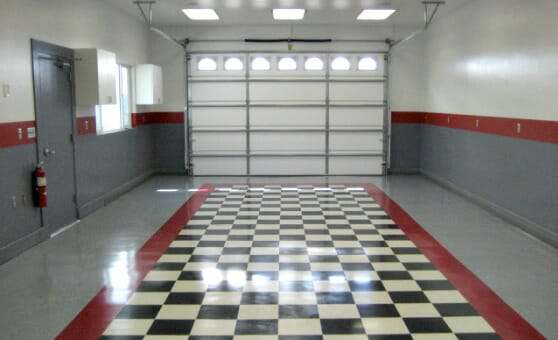
One of the more unique and retro looks for a garage is installing a vinyl composite tiled garage floor. This popular DIY installation is the same commercial-grade tile that you have seen in grocery stores, schools, shopping malls, and businesses. It can be installed in your garage and for a price that may surprise you. Waxed and buffed, this garage tile option will give you a showroom shine that your neighbors will envy.
*** UPDATE ***
We originally posted this article 10 years ago. Due to the continued popularity of VCT for a garage floor, we have taken the time to update this article with the latest information.
Benefits of VCT garage floors
Vinyl composite tiles, otherwise known as VCT, are 12” square tiles created with vinyl-colored chips. They are then combined with a filler of limestone that is heated and pressed into sheets. Glued to your floor, they are extremely durable, resilient to chipping, impacts, and fairly easy to keep clean.
Once the tiles are sealed and waxed properly, VCT will resist most automobile chemicals and other liquids that would otherwise stain a bare concrete floor. You need to be aware, however, that gasoline and strong solvents can soften or dull the wax fairly quickly if not wiped up right away.

In the event that a tile is stained, it can be lightly sanded to bring back the color. If damaged, they can easily be replaced and a new coat of wax applied.
Because the tiles are coated with multiple layers of wax after installation, they also do a good job of protecting the garage floor against road salts and deicing fluids. Additionally, the glossy finish provides for a brighter garage due to the overhead lights reflecting off the surface.
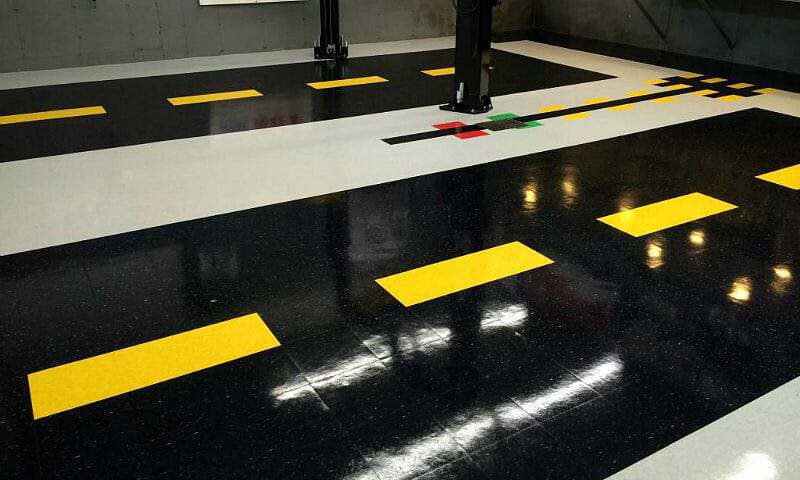
VCT being installed in a workshop
The most common choice is the black and white checkered motif, but you can design your floor with a variety of color options to choose from. Mixed colors of greys, reds, and blues are popular as well.
One of the most attractive benefits of VCT for a garage floor is the price. If you have some patience and shop around, deals can be found for less than $1 a square foot. Otherwise, you can easily spend $2 or more per square foot.
With a bit of shopping savvy, a vinyl composite floor can be one of the sharpest-looking and more economical garage flooring options that you can install in your garage today.
How to Install VCT tiles for the garage
Installation is somewhat labor intensive, but it can still be done in a long weekend (or longer if you like). Armstrong Flooring has good instructions for tile installation and layout as well.
The instructions below for laying VCT in a garage are general in nature and designed to give you an idea of what is required. Make sure to follow all manufacturer’s instructions.
This is a good overview of how VCT is installed in a garage
You need to start by thoroughly cleaning your floor with a good concrete floor cleaning solution. Make sure all oil stains are thoroughly cleaned or they will interfere with the adhesion of the glue.
Next, repair any larger cracks or small holes in the concrete with a good crack-filling compound and fill your contraction joints with a polymer cement repair mix or crack filler. If you have any areas of large pitting you may have to use a premixed polymer-based concrete topping or repair mix to fill in the pitted areas.
The reason for making these repairs and filling your contraction joints is that you can’t have any gaps or holes underneath the tile. If you do, it will cause the tile to crack or pull away from the seams of adjacent tiles. This happens because it tries to fill the depression under the pressure of foot or vehicle traffic.
Check if any of the floor’s contraction joints have high edges or if the troweled edges have curled up slightly. You will need to grind these down if they are. If not, these taller edges will telegraph through the surface of the tiles and stand out. Just place a straight edge or level across the joints if you are not sure.
Though long, this video has great tips and examples of how to glue and make various types of cuts.
Next, you will want to snap a line down the center of your garage floor front to back. This is for a reference to lay the first tiles.
It is important to measure out to the edges of the floor to ensure that you end up with close to an even amount of tile on either side. This helps to create balance in appearance. Move your line over the appropriate amount if necessary to make sure that you do.
Visually, it’s usually best to start the first row across the threshold of the garage door. You can then begin working up your centerline in a pyramid fashion. This will make certain that all your edges are square and you won’t have any misalignment issues. Any cuts to the tile can be made with a utility knife or heavy-duty paper cutter.
Do not make the rookie mistake of starting in a corner and working your way out from there. Rooms are almost never square and your pattern will start getting misaligned and forming gaps if you do this.
When you are ready to start, spread the glue with a 1/32” notched trowel on a large area of the concrete. When the glue turns color it has dried enough and is ready to accept the tile.
A great tool to rent for around $25 or so is a vinyl floor roller. After the tile is laid, use this roller to press out any trapped air under the tile for the best adhesion as you build the tile out. Once you are done, you are now ready to seal and wax the tile.
Drawbacks of a VCT garage floor
Though a VCT tiled garage floor can be fairly durable for the price, it does have some drawbacks you should be aware of.
VCT requires higher maintenance in order to keep a nice shine on the floor. You will need to mop the floor occasionally to keep the shine up. Busy floors may need to be scrubbed with a floor maintainer to remove embedded dirt in order to apply another coat of wax.
Depending on how much use your garage gets, the build-up of wax may need to be stripped and reapplied. This is usually required once a year or so in order to maintain a nice finish.
VCT floors can also be somewhat slippery when wet. You will want to take this into consideration if you live in a wet climate. There are slip-resistant floor cleaners available that can be buffed to a shine that you may want to consider using.
Something else to be aware of with vinyl composite tile is car tires. They can leave occasionally leave rubber marks on the surface which will need to be buffed out.
On some rare occasions, a tile can spin loose if you turn the front tires in place without moving. No worries though if this does happen. You can easily replace or re-glue a spun or damaged tile.
If using car jacks or jack stands, it’s best to place a spare tile or piece of wood down first to prevent any compression marks that may occur in the tile.
Additionally, solvents (such as gasoline) can soften the acrylic waxes fairly quickly if it’s not wiped up right away. If any petroleum products do make it past the wax and onto the tile, they will stain the surface of the tile. This usually requires sanding the tile to remove the stain or replacing it.
Is VCT warrantied for use in a garage?
Despite the fact that vinyl composite tile has been used in garage environments for decades, manufacturers will not warranty the tile for use in a garage. Some manufacturers even advise not to do it all and state that it’s not an approved flooring for a garage.
Most people who install it in the garage are aware of this. However, we want to point it out in the event it would influence your decision. And no, it does not need to be removed before selling your home.
With all this in mind, you can’t beat the durability and looks of a vinyl composite tiled garage floor. It can be an excellent choice if you are on a budget or want a cool retro look for the garage. VCT can be installed for much less money when compared to other types of floor tiles and the best part is that it looks like a million bucks!
I am going to install VCT in my 2700 sqft garage/workshop and having trouble getting the Armstrong adhesive (S-750 or S-515) locally and Amazon does not carry. Are there other adhesives that people have use with good results (like TEC, Henry 430, Roberts 2057 …etc)?
Thank You
Carl
Hi Carl. We’ve always liked Henry 430 if we could not source Armstrong at the time. It works very well.
Hello,
Is there any special treatment for the edge under the overhead door. Should the VCT be carried to the outer edge of the concrete slab which will expose it to the exterior elements?
Thank you,
Happy Thanksgiving!
Bob
Hi Bob and Happy Thanksgiving to you and your family. You should terminate the tile at the garage door and not carry it outside. If you like, some people will use a 1/8″ thick vinyl edge strip like this here to give a finished look to the edge. However, that is up to you.
You mentioned that VCT can be slippery when wet. I live in Michigan, and I wanted the tile, so I can squeegee out the snow and water that drips off the car. How can the tile be made less slippery? I am not interested in a shiny finish.
Hi Nicholas. What you need to do is use a slip resistant floor wax. There are many out there – here is an example. Also, if you apply the wax with a mop and don’t buff it to a shine, it will provide some slip resistance as well.
Has anyone had any issues with freezing temperatures? Good results or bad through freezing temps?
Hi Tracy. You will want to use an adhesive that is freeze-thaw stable. Armstrong 515 is an example. It performs well in temps down to 10 degrees.
Thank you! Have you had any problem with tiles cracking?
It can happen from time to time, but if installed correctly it’s rarely a problem. One example is bridging a gap or uneven surface. When the tile gets real cold and pressure is then applied, it can crack if it’s bridging a gap or low spot and not in full contact with the surface.
Like the idea of VCT in my garage but I have several questions not answered in the comments.
My 500sq ft. garage is heated in the winter to 65 degrees. Northern Ohio winters will bring slush and snow in and eventually melt off the cars. I also wash cars a couple times a week in the garage. It has a central located drain and good slope running to it. I have hot and cold water available on a hose reel and use this all time to rinse and clean.
Will I have issues with water getting under the tiles eventually and loosening them up?
Hi Tony. As long as there are not air pockets under the tiles or along their edges where the glue should be, then they will perform well against moisture. However, they were not designed with the volumes of water that they will repeatedly be subjected to from washing cars in mind. You may be fine, but we can’t tell you with certainty that you won’t get a tile or two that may eventually want to lift.
Thanks for your opinion, I may have to go with something else.
Have you considered a free-flow interlocking a garage floor tile? We know of several detailers and home owners who love this type of flooring for car washing. Here is an article about interlocking tiles and here is an article of a reader that installed free-flow tiles as an example of how it looks.
Looking into VCT, have 720sf garage, use occasionally with motorcycle repair but mainly wood projects. Dust, and wood chips. Would I have a scratching problem when I’m moving from area to area?
Hello Darryl. We can’t tell you for sure since we don’t know what you are moving or how.
Hello, I am planning to install VCT in my garage, does it go well with Texas heat which in summer goes up to 110degree?
Hello Fatima. The highest temp glue we are aware of is Armstrong S-515 VCT adhesive. It has a max sustained temperature of 100 degrees. A few days off and on may do much since it takes a while for the glue and concrete under the tile to reach that temperature. However, if you have sustained temps of over 100 degrees for many days, then VCT would not be the best choice for your area.
Hi, Guys from Montreal, Canada.
Here, we have had six months of snow and salt on the streets; therefore, our cards drop a lot of snow, salt, mood, etc., in our garage. What floor do you recommend? composite tiles look like, but I do not know if they will survive.
Hi Juan. We would not recommend a VCT garage floor for such conditions. It would require extensive maintenance during the winter season to keep it in good shape and looking good. If you like the tile look, a popular option for such climates are interlocking garage floor tiles. We have an article here that discusses it.
used this tile Armstrong Flooring Imperial Texture VCT 12 in. x 12 in. used this glue ROBERTS 4 Gal. (16 qt.) 24 Hour Dry Time Vinyl Composition Tile Floor Adhesive
in Creamy Tan 3/32 trowel on garage floor clean cement and it’s been 2 months tile peaks overnight by tires next morning glue is still tacky but no transfer to my fingers.
so tile glue still not totally dry sticky and I heat tile & put it back down did I use wrong glue? I never tur wheels on floor drive straight in i will take it up and replace what glue will lock them down as they are moving slightly. Others are having same issue live in Florida stays warm
Hi Donald. This VCT adhesive has a minimum application temperature of 65 degrees. If you applied it in a garage two months ago, our guess is that the temperature of the garage and particularly the concrete was below that temperature. The glue will remain tacky but never set. It might set once it warms up, but if it doesn’t, you will unfortunately need to remove it all and start again with new glue. You can find out for sure by contacting the company. Here is the link to that info.