
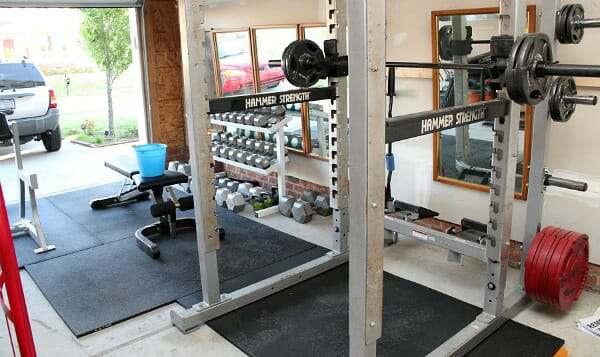
The garage has slowly become more than a place to park your car and store your stuff. For the exercise enthusiast, it’s also a great place to set up a home gym. And since hard concrete is not a good surface for exercise, it’s only natural to seek out the proper type of gym flooring or rubber mats. So what are the best gym flooring and mat options for a garage?
The answer depends on the type of workouts you perform and/or the equipment that you use. Weight lifting, powerlifting, and CrossFit training that may require workout benches, universal machines, and power cages will require much different gym flooring than someone doing mostly Pilates or yoga with lighter weights. Tumbling and gymnastics are another example.
The size of your workout area and your budget may also dictate which type is best suited to you. With this in mind, we will discuss the different garage gym flooring options available, based on the materials and workouts you plan to do.
Editor’s note: This article has been updated to reflect current changes and recommendations
Rubber gym flooring For a Garage or Basement
Rubber flooring is considered the best choice for most home gym applications. It is a multipurpose athletic-style flooring that is very durable and will support the weight of heavy equipment such as exercise machines, treadmills, and lifting cages.
Most rubber gym flooring is made of recycled rubber, ethylene propylene diene monomer (EPDM), or a combination of the two. EPDM is a synthetic rubber. The colored flecks you see in some options are an example of EPDM.
This type of construction is extremely tough and durable. It provides good traction, either wet or dry, and can absorb the shock of dropped weights (up to a point) especially well.
Higher-quality rubber flooring has a much denser surface structure, making it easy to clean with damp mopping using mild soap and water. However, some of the cheaper rubber mats have a much more porous surface that receives many complaints about holding dirt and grime.
Additionally, we recommend purchasing only American-made rubber rolls, tiles, or mats whenever possible. You know exactly what materials are used, and some even carry indoor air quality certification.
Rubber gym flooring products from outside the U.S. may contain foreign materials and chemicals that can produce odors. Additionally, many use fillers. This results in a less dense rubber surface that wears more quickly and may retain odors and bacteria.
Now that we know how they are constructed, you have three different rubber flooring options to choose from. They are interlocking rubber gym tiles, rubber gym flooring rolls, and rubber gym workout mats.
This post may contain affiliate links. If you use these links to make a purchase, we may earn a small commission. As an Amazon Associate, All Garage Floors earns from qualifying purchases. You can read our full disclaimer here.
Recommended Rubber gym flooring tiles For The Garage, workshop, or BAsement
Rubber flooring can be very heavy. As a result, interlocking rubber tiles are the easiest to work with and can be a good choice for home installations in garages or basements. They will allow you to decide the size of the workout area, and it can be finished off nicely with border edges.
The 8mm (5/16”) and 3/8” thick flooring are the most popular for home gym and commercial use. They are much less expensive than the thicker options and perform well for a wide variety of workouts. This includes weight lifting, Pilates, P90X programs, and CrossFit.

Rubber tiles can accommodate treadmills, universal machines, and weight lifting, as long as very heavy weights are not repeatedly dropped. Basic black is the standard, with the option of different-colored flecks to add a decorative appearance.
Rubber gym tiles rarely slip on concrete garage floors due to their weight and the grip they provide. However, you can use double-sided carpet tape to prevent movement if you desire.
Best Budget Tiles – IncStores 8mm Rubber Gym Tiles
The IncStores 8mm Rubber Gym Tiles are our top choice if you are on a budget. They are made from recycled tires and manufactured in the U.S.A. At 5/16” thick, they meet the requirements for standard commercial-grade gym flooring.
In addition, they are FloorScore certified. This is an indoor air quality certification which means they are free of harmful chemicals.
Each tile is 23”x23” square and locks together like a puzzle piece. They can be purchased as a system of tiles to create various gym floor sizing options or you can expand on the flooring sizes by purchasing additional tiles individually.
When purchasing individually, it’s important to choose the correct tile for the position it will take. There are 3 different options: Corner, Border, and Center. The image below highlights these differences. The tiles can also be trimmed for wall-to-wall installation.
IncStores tiles are extremely tough. They will handle the weight and abuse of various workouts and workout equipment, from treadmills to lifting cages.
A nice feature of the IncStores tiles is that they are cut to such precision that they can create an almost seamless appearance. Furthermore, the rubber construction makes them waterproof and easy to clean.
Best Commercial-Quality Tiles – American Floor Mats Fit-Lock
Our top choice for a heavy-duty interlocking rubber gym tile for the garage would be American Floor Mats Fit-Lock. These rubber tiles are 3/8” thick, which is the typical thickness of commercial gym flooring—treated with an anti-bacterial agent.
They are 24” x 24” squares and feature an interlocking puzzle system. The Fit-Lock tiles can be purchased as a ready-to-install system for a wide range of gym floor sizes. Or, you can purchase any number of pieces separately to create your own custom floor size.
They are available in solid black or four different colored speckled options. Furthermore, the tiles are treated with an anti-bacterial agent.
Like the IncStores tiles, the American Floor Mats Fit-Lock tiles are waterproof and easy to clean. Plus, the extra 1/16” thickness and extremely dense construction make them more resistant to the impact of dropped weights and heavy equipment.
Best Powerlifting Rubber Floor Tiles
If you are into CrossFit, plyometrics, or powerlifting with heavy weights dropped consistently, then IncStores Evolution Flooring Tiles should be high on your list.
At 5/8” thick, this tile comes in a 36”x36” size, not including the separate border pieces. It is ideal for high-impact training, including powerlifting. The underside of the tiles features multi-nib backing, which helps to reduce foot fatigue from high-impact exercises.
The Evolution tiles offer a much more attractive, professional-looking option than some other choices for thick gym flooring. The optional ramped border edges are also available and help to reduce trip hazards, which can be common with rubber flooring this thick.
One thing to be aware of is that this tile will show footprints, scuff marks, and scratches due to the all-natural rubber composition. This can be one of the drawbacks of gym flooring options made from natural rubber. It is easy to clean, though, with a damp mop and mild soap and water.
Rubber gym flooring rolls for the Garage or Basement
If you have a larger area to cover, say the entire garage floor or basement, then rubber rolls are the better home gym flooring option. The price per square foot is less than that of the interlocking rubber tiles, and they show fewer seams.
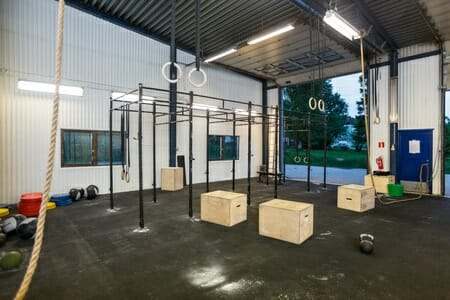
Though rubber rolls are very heavy, they are not mechanically connected to form a single large unit like their interlocking counterparts. It’s generally recommended to use double-sided carpet tape along the perimeter to prevent movement when constructing large workout pads with rubber rolls.
This tape here is a good example and works very well. For a complete wall-to-wall installation, using a rubber flooring adhesive is recommended.
When performing a wall-to-wall installation, it’s best to let the rolls acclimate for a couple of days in the room or garage where they are being installed. This will allow for better fitment due to temperature-induced expansion and contraction.
Best Rubber Gym Flooring Rolls for the garage or basement
If you aren’t going to be laying rubber gym flooring wall to wall, then our top recommended pick would be the IncStores 3/8” Heavy Duty Gym Rubber Rolls. Made of the same material as their interlocking line of rubber tiles, these are an excellent choice for the garage or basement.
All rolls are 4’x10’ and available in solid black or a variety of optional color flecks. The 10′ length is popular for constructing large workout pads. Like other IncStores rubber flooring, they are FloorScore certified for indoor air quality.
The 10ft rolls are not the best choice for a wall-to-wall application since most garages and basements are longer than that. You don’t want seams that butt up end-to-end.
If you want to cover the entire floor of your garage or basement, then we would recommend the IncStores custom length, 3/8″ thick Rubber Gym Flooring rolls.
Available in custom lengths from 15ft and up, they are available in up to 24 different color-flecked options. Like all IncStores rubber gym flooring, these rolls are made in the USA and are certified clean rubber.
Best Heavy Duty Rubber gym mats
Rubber mats are another gym flooring option for the garage. Most are constructed in a 4’x6’ size, with thicknesses ranging from 1/4” to 3/4”.
The thicker sizes of 1/2″ and up are the most popular since they work very well for power cages, squat racks, and lifting areas where very heavy weights are dropped.
Our first choice with a variety of thickness and size options is American Floor Mats Ultimate Stand-Alone Gym Mats.
These mats start at 3’x4′ and 1/4″ thick, and can go as large as 4’x10′ at 3/4″ thick. You can choose solid black or 7 different color flecked options. All American Floor Mats are made in the USA and meet the strictest safety regulations on raw components and indoor air quality.
The 4’x6’ sized mat at 1/2″ thick is the most popular option. The 1/2” thick size is excellent for deadlifts and other lifting movements requiring heavy weight that may be dropped.
These mats typically do not move when placed on the concrete in your garage or basement. No adhesive is necessary for installation, particularly if heavy equipment will be placed on it.
Rubber Horse Stall Mats
One of the cheapest options available for thick rubber gym flooring that you can install in your garage is rubber horse stall mats. These mats are 4’ x 6 ‘and 3/4″ thick. If you have a Tractor Supply Company nearby, you can usually pick these mats up for under $50 each.
These are a popular option for those on a budget looking for inexpensive and thick rubber gym flooring. Made from recycled rubber, these mats are very heavy, weighing approximately 95 lbs. each. Because these mats are too expensive to ship, you will need to pick them up directly from the source.
If you don’t have a Tractor Supply Company nearby, you can always check with your local feed store or farming supply store for rubber horse stall mats.
There are a few drawbacks to horse stall mats that you should be aware of. The quality of the cut and sizing is not nearly as good as standard rubber gym flooring. Common complaints are sides that are not square or straight, and sometimes one mat can be slightly thicker than its neighbor when lined up together.
They also tend to transfer black rubber to your hands, socks, or anything else that comes in contact with the mat. If you are on a budget and don’t mind these issues, then these could be a good choice for you.
Best Foam gym mats for the garage
Dense EVA foam can be the best gym flooring if your exercise routine consists of light weights, yoga, Pilates, or other light-to-medium-weight training programs like P90X. It absorbs impact well under feet, it’s soft enough to lie down on for stretching and other exercises, and it’s not very heavy. Most can be quite light.
It’s also much less expensive than rubber gym flooring. If you don’t need anything heavy-duty, then this can be a good budget alternative. It is also a popular choice if you want something you can set up and put away quickly.
It is not a good choice, however, for exercise equipment, cardio equipment, or heavy weights. The foam will deform and compress under the weight, creating deep indentations in the flooring. Under stress or vibration, this could cause the foam to tear and separate from the equipment or under the feet.
ProSource Puzzle Exercise Mat
Our first recommendation is the ProSource Puzzle Exercise Mat. Made of high-density EVA foam, this inexpensive interlocking gym mat will cover 24 square feet. It comes with six 24”x24” interlocking tiles at 1/2″ thick, including 12 border edge pieces.
Available in 5 different colors, these are a very popular choice for both in the home and the garage. Because they are so light, these mats can be disassembled and stacked on a garage shelf when not in use.
These exercise mats get high reviews for general multipurpose workouts from people who do not require a more permanent flooring solution.
One point we would like to make is that these are not the best choice for high-impact, high-movement exercises. Side lunges and exercises such as burpees may cause the tiles to separate from each other in a short time.
A large single-piece foam mat or heavy-duty foam tile would be a better option under these conditions.
Pogamat XXL
The PogoMat XXL one-piece exercise mat for yoga, Pilates, high-intensity P90X, and other training programs is a great choice and one we highly recommend.
The mat is 4’x6.5’ and approximately 5/16” thick. Made entirely of synthetic materials, this high-density workout mat is non-toxic, odor-free, and produced with Eco-friendly manufacturing techniques.
The Pogamat can be rolled up and stored away when not in use and the edges will not curl up. Though more expensive than traditional EVA foam mats, this high-quality mat has great reviews and will last for years.
It is a great workout mat for the garage, basement, or other rooms of the house, as it can easily be stored in a corner, acloset, or on a shelf when not in use.
One thing to keep in mind is that the mat comes with a protective coating that wears off during the break-in period. However, you can remove this protective coating first by scrubbing it with a nylon brush and pumice soap. Rinse with fresh water, let it dry logo-side up, and you are ready to go.
Inc.Stores Jumbo Soft Interlocking Foam Tiles
If you like the idea of an EVA foam tile but want something thicker, the IncStores Tatami Foam Tiles are an excellent choice. At 7/8” thick, these gym flooring tiles are available in large 2’x2′ and 3’x3′ sizes and are made of high-density, non-toxic, closed-cell EVA foam.
Unlike other foam tiles, this gym flooring is tough enough for high-impact, high-intensity training programs. This includes light martial arts, kickboxing, wrestling, and other programs that do not depend on heavy training equipment.
You have a choice of two reversible color pairs: black and grey, or red and blue. Each tile comes with two detachable edge pieces that allow it to serve as a border, corner, or center tile for your mat.
This is a great solution for someone looking for a heavy-duty foam tile that can be used as a more permanent option or as something that remains portable. Keep in mind that even though it is very thick, it is not designed to hold cardio equipment or heavy exercise equipment.
One question that has popped up with this type of tile is how durable it is on concrete. After contacting the manufacturer, we were assured that concrete in the garage or basement will not cause excessive wear on the tile unless it is extremely rough.
Home Gym Flooring Tips for the Garage
When installing gym flooring in the garage, make sure that the surface is clean and free of oils or other chemical residue. Petroleum products can cause rubber and foam to break down over time, leading to deterioration of the flooring.
If you are installing rubber gym mats, tiles, or rolls on bare concrete, it’s a good idea to seal the concrete first with a simple penetrating sealer. Since rubber flooring does not breathe, moisture from the concrete can collect beneath it, leading to mold and mildew if the concrete is not sealed.
All rubber gym flooring can easily be trimmed to fit, if necessary, with a sharp utility knife. A metal straight edge can be a big help to keep your cut edges straight and clean.
Finally, when choosing the best gym flooring for your garage, make sure it’s durable enough for the type of equipment you plan to use. If a cardio machine or weightlifting racks are in your future, then rubber flooring is what you should be looking for and not high-density foam.
I really appreciate that you took the time to go through all of the workout flooring types I might need. I will probably install the rubber interlocking tiles. They seem like the easiest to use, I just worry about a lot of dirt getting in between the tiles. Oh well, I do also appreciate you mentioning tumbling mats. My girls will love it and it should get them moving.
Great writeup. Let’s say that your garage has a high moisture content..after doing the plastic 2′ x 2′ square for 24hrs. Can I put these down indefinitely or will i have to remove periodically and hose down the side that could potentially grow mold?
You will need to remove them once in a while in order to let the underside dry out as well as the surface of the concrete. If you treat the concrete with a simple penetrating sealer first, however, you may not have the issue.
Thanks for the very thorough review of all the flooring options. As my garage is not that large, I’d like to install rubber tiles throughout to maximize my cross-fit workout space. As such, I will still need to pull my car into the garage and on top of the tiles from time to time. Which tiles can withstand constant car parking? Also, I sometimes get some water in the front of the garage during hard rains. My understanding is that rubber will not soak up the water, but I will just need to remove the tiles, dry the painted concrete floor underneath off and reassemble. Can you confirm that’s correct?
Hello Marty. Rubber tiles for gym use are not designed to be driven on and the manufacturer will not honor the warranty if you do. Car tires can leave dark marks that cannot be removed and any leaks of a petroleum related fluid will break down the rubber in the tile.
Regarding water when it rains, you are correct with the procedure. Just make sure the bottom of the tile drys thoroughly as well. They are porous and it’s important that all the water evaporates out of the bottom of the tile. You may want to install a garage floor door seal to help block the water intrusion.
I have a concrete garage floor with 1/2″ steel straps across with washers/bolts that stick up another 1″, so I need a total thickness of 2″ over the concrete to make the steel straps and bolts disappear for parking a car more comfortably. Rubber seems the best solution so I can cut around the steel elements, but what do you suggest for such a thick application and to be drivable? Thanks.
Garage flooring is not designed for such a layout Mike. The only solution that may work for you is to use rubber horse stall mats. They are not 2″ thick however. Also, keep in mind that rubber will deteriorate from petroleum products. So oil leaks or gasoline can cause the rubber to break down.
Excellent write up, thank you! I am looking to build a home gym in my one-car garage, but will still need to be able to pull my car in. I live in the northeast, so the car will have salt and snow on it frequently during the winter. If Im looking to be able to use the home gym without having standing water from the melted snow, what would be your recommendation? Thanks!
Hello Max. You may want to use a containment mat to park the car on. It will retain all the snow, salt, and water that comes off your car. You can read about them here.
Ok thanks. Then just remove the containment when i go to work out i guess? Cant get a terribly permanent one then probably
That’s the idea of a containment mat Max. Unless we are not understanding you correctly, you want it out of the way for the rest of the year and you need something that you can move in the winter time when you work out.
Well was mostly concerned about using the garage gym in the winter. For example if it snows on monday and i want to work out on Tuesday, seems like my options are:
-plain concrete floor, sweep/mop any remaining water from day before
-stall mats, sweep/mop any remaining water from day before
-roll out containment cover on Monday before putting my car in the garage. Take my car out of the garage on Tuesday, roll away containment cover to work out (like a tarp on a baseball field)
None of those seem terribly ideal, just wondering if there’s an option i haven’t considered.
I think you pretty much covered it Max. You don’t have many options if using your entire garage floor for both your workout area and parking your car during the winter. Instead of rolling up the containment mat, we recommend folding it over onto itself like a blanket. It’s quick and easy to do and will keep the underside of the mat clean and dry.
Very informative website. Thank you! My situation is, my home gym is inside the home. It’s adjacent to the garage, living room and outside. I do mostly cardio (rowing machine, treadmill, bike, etc) at home, weights with my trainer, at the gym. I have 3 elderly dogs, that go through this room, constantly. I live in Texas, so cold weather isn’t too much of a concern.
I need something easy to clean, looks Great & is skid resistant, for me & the equipment. I have mats already, for under the machines. It also must be quick drying, as the dogs need to go out. The floor, in my gym is concrete & not totally level. Any suggestions would be greatly appreciated!
Based on your info Joanna, the first line we discuss in the article, TrueLock rubber gym flooring, would make an excellent choice. It’s low odor, easy to put together, slip resistant, and it will dry quickly if it gets wet.
In reading the earlier comments, I understand the above gym flooring options are not meant to be driven on routinely. We plan to use our 2-car garage exclusively for our home gym/wood workshop area/storage. It sounds like rubber flooring would be appropriate for all of those activities? My only other question is whether there is anything one could buy to lay down on top of it and protect the rubber flooring adequately IF a car needed to be temporarily parked in the garage because of a major storm or something. Would laying something on top of the rubber flooring for temporary parking work, or would the rubber flooring have to be taken up first? Thanks so much for the info!
Yes, Jessica. Rubber gym flooring would work for want you want to use the garage for. If you need to pull a vehicle in on occasion due to nasty weather, we recommend that you purchase a containment mat. These can be easily rolled out on the occasion that you need to use them and easily stored afterwards. They are not designed as a permanent solution for flooring, but they would work real well for what you described.
Thanks so much, it is really helpful to know that is an option in extreme weather if we go with rubber flooring (we don’t get much extreme weather where we are, hence the mostly converting the garage to other uses!). Really appreciate your great article and comments.
Your welcome Jessica. We’re glad we could help!
Hello, I’m looking for some advice on the kind and thickness of flooring for a concrete surface on which I’m hoping to do cardio, aerobics or kickboxing—essentially, exercises which involve jumping, skipping or jogging in place. Thanks so much!
Hi Anna. For that type of exercise our first recommendation would be 1″ thick EVA flooring like this one here. It’s relatively inexpensive and available in a few different colors. Something that is even more tough and durable (think commercial use), but more expensive, would be 5/8″ thick rubber flooring with impact cushioning like this one here.
I have a building that i use for small classes if 4 people. The building is heated and it is similar to a garage because the base of the floor is concrete, then we put vapour barrier and then the horse stall mats. The problem i am having is that during some classes the mats become wet. I have put a sealant in the mats but that didnt seem to help. I know they are porous but it is ridiculous how wet they get. What is a better flooring option?
Hello Erin. Where did you put the vapor barrier? What kind is it? If moisture is collecting under a mat that is placed on bare concrete, then that is an indication that you have moisture vapor escaping up through the concrete. When the mat is placed over the concrete, the moisture vapor collects on the bottom of the mat and condenses. You can conduct a simple moisture test to verify this. Have you treated the concrete with a penetrating sealer?
Thanks, this is a great overview. There’s a lot of options out there for garage flooring. Have you heard of Gorilla Mats? Do you know they would compare to Pogamat? Thanks again!
Hello Claire. The Gorilla mats are very similar to the Pogamats. They would be a good option as well.
Great write up; hoping you can help with my (admittedly specific) design challenge. I have a garage gym that includes a halfpipe skate ramp.
I’d like to have a floor for the main gym area (22’x12′) that:
– Won’t pull apart at the seams when doing tension exercises (pushups, burpies, mountain climbers, etc), or when heavy lifting (bench presses off the rack, etc).
– Can handle loaded barbells being dropped on it.
– Provide cushioning for my (too rapidly) aging knees.
For the skate ramp, I’d like to have a 2’x20.5′ boarder on either side of cushioning foam to help protect against falls.
Last, my whole family uses the space, including my children, and it’s critical that the product(s) do not off-gas, and are made with products that are toxin free.
Any ideas of how to go about accomplishing this? Thanks!
Hello Nathan. You must be the house where all the kids in the neighborhood hang out. For lifting and dropping heavy weights, a thick natural rubber flooring is best to use and it’s also toxin free. The Inc Stores rubber mats are a good choice for that. They interlock so there is no worry about burpies, mountain climbers, and etc. Natural rubber horse stall mats are cheaper, but heavy as they are, they can migrate a little bit if a border is not erected for them.
For the skate ramp, you may want to consider a 3/4 -1″ thick foam tile. You can trim them as necessary and glue them to the ramp. Something like these here would work and they are toxin free as well. I hope these suggestions help and have fun with your project!
Thanks so much, Shea!
This is an awesome post, well worth the effort, thank you!
I gave Garage Flooring Inc. a call today for there interlocking rubber gym flooring you recommended – they no longer sell these! I was bummed out, seemed like a clear option for a basement home gym with power rack. Seems like your above recommendation IncStores Evolution Rubber floor tiles are a good match? I’ve got a 13×7 ft (awkward) space that is a little damp; something that can “breathe” or easy to clean would be ideal. Thoughts?
Hello Michael. Yes, we recently discovered this ourselves. Since their product was made in the U.S.A., they had a hard time competing with many of the flooring options made overseas. The IncStores tiles would be the closest match. However, if your floor is creating moisture from under the slab you don’t want to use rubber mat flooring. Rubber does not breathe and will collect water under the mat which can lead to mold and mildew issues. Do you plan to have any gym equipment on the floor?
Only thing planned on the floor would be the power rack and a dumbbell rack – no other machines.
We’ve been in the house for two weeks now with a few moderate storms and no water yet but it is definitely humid down there, we’ve had the dehumidifiers running.
OK then. We would recommend looking at an interlocking tile by SwissTrax called RubberTrax. You can see it here. It’s a tile made of recycled rubber and polypropylene plastic. It has give to it like a rubber mat and comes in a vented design so that moisture vapor can pass through and not collect under the tile. They hold thousands of pounds so your weight equipment would not be a problem. If you contact them, they will usually send out a free sample for you to examine yourself.
Hi I am located in Dallas TX and my garage has an epoxy coating and I had two questions about the gym set up
Which one of the above would be preferred for heavy lifting with equipments like squat stand, bench, bike etc ? I personally like the stall mats but would like your suggestions
Will the epoxy flooring peel off over time with heavy equipment set up? How to Prevent it
Hi Krithika. Stall mats will work fine assuming that you have a quality epoxy coating. As long as the mat is constructed of real rubber or recycled rubber they generally will not leave marks. Don’t use anything with a synthetic type of rubber or cheap foam.
I am planning on putting a mat down in my garage for my home gym. We a re planning on parking my fiancés car on the mat on a daily basis while using a drip pan under the car in case it leaks. What mat would you recommend that can take that kind of abuse?
Hi Shaun. We would recommend using the 3/8″ thick rubber gym tiles or rolls. They can handle the compressive weight of the tires. Just make sure that when you pull the car in the garage that you do not turn the tires much if at all. You will spin a tile or cause the mat to buckle if you do.
I have a polyaspartic epoxy garage floor. I was wondering what would be the best flooring between 100% real rubber vs 1 or 1.5 inch eva foam tiles for my gym set up. I’m using heavy weights ,dumbbells , treadmill and exercise bike. The company that did my floors recommend not to use non porous rubber back mats which may cause discoloration.
Hi Dewayne. We do not recommend using EVA foam tiles for that type of use. It does not respond well to heavy weights or the foot pads of gym equipment and exercise machines. Foam tiles are intended for floor exercises (pilates, yoga, etc) and light weight use. Your described use will require rubber gym flooring tiles or rolls, preferably 3/8″ thick or greater. Yes, this type of flooring can on occasion stain coated concrete floors. However, the easy solution to prevent that is to first lay down a layer of the heavy duty paper floor protection that is used in the construction industry to protect new flooring. Ram Board is an example. This will prevent any possible staining of the coating. Another option that more people are beginning to use is PVC garage floor tiles. These will not stain coatings and are tough since they are designed for cars. You read about them in second half of this article here.
Thank you for the feedback.
Hi, thank you so much for this article. The rubber mat we choose will be going on concrete floor in the basement. I do at home workouts, basically Beachbody’s workouts. My knees have been hurting lately so I want some cushion and shock absorption. – I don’t want foam or the interlocking tiles so I am thinking I’ll go with the IncStores 3/8″ Heavy 4×10 you recommended….I saw you made a comment on one of the comments that if going on concrete, it should be 5/8 or thicker? Just want to make sure I’m making the right choice.
Hi Becky. Unless you will be power lifting and dropping heavy weights, 3/8″ thickness will do just fine for beach body workouts. Keep in mind that rubber workout flooring is not going to feel soft. It’s a dense material that is designed to take the abuse of workouts and exercise equipment. However, it still reduces the impact of exercise on concrete. That is why it is the preferred flooring for commercial gyms.
Should I go with something a little thinner than like 1/4?
1/4″ will work, Becky. However, we feel that the 3/8″ is a better value based on the overall money spent if it’s in the budget.
Hello: Happy New Year!
I wanted advice on what flooring that i can use for a home gym that i want to set up in my one car garage….The flooring for the garage is epoxy. I intend to have weights, exercise cycle, power racks etc… I was hoping to be able to get something that i could put over the epoxy garage floor that can be cleaned and is non toxic and something that is DIY.
Any recommendations would be great.
Thank you
Varghese
Hi Varghese. Do you intend on parking your car on the gym flooring?
Hi – i do not intend to park a car in the garage. However, in case of extreme weather, would like to see if i could park a car, maybe 3-4 days a year. The garage will have gym equipment and so it may not be possible to park even if i could. So, what would you advise assuming that i will not be parking a car in the garage?.
Thank you very much for your help.
Regards
Varghese
In that case, we would recommend that you go with the IncStores or American Floor Mat Fit Lock tiles. They are commercial quality products that will take the abuse of gym equipment and can be tailored to fit your area how you wish. In addition, unlike some gym flooring you can park your car on it from time to time without issue. It won’t harm the epoxy, but if you want to be extra careful you can lay down some Ram Board paper first. This will prevent any type of marks or rubber transfer onto the epoxy. HomeDepot and other home improvement stores usually carry it. It looks like this.
Thank you for this descriptive run down.
We are insulating our garage and turning it into a home gym. It has a cement floor that will be sealed with epoxy. We currently have a spin bike that has a mat. I will likely also do yoga. My partner plans on doing weight with a bench, but I believe fairly light, certainly not intense. We may consider getting a treadmill down the line (but could buy it its own mat like the spin cycle). What mat do you recommend. He thinks the 3/4 in foam, which I think will be softer for yoga, but worry about moving the bench back and forth hurting the foam. I also worry about rubber being to firm for my aching joints if I were to do more activities such as jump rope or burpees.
What do you suggest?
We will not be parking a car inside.
Hi Amy. You are correct about the foam mat. Foam mats should only be used for activities that do not involve any type of equipment. They are for activities such as yoga and other workouts that may involve lighter dumbbell weights. Exercise equipment such as bench presses, squat racks, stationary bikes, and etc. will damage the foam as well as create permanent indentations. In addition, they don’t provide a stable platform for equipment. The more firm rubber gym mats are required if equipment is introduced. We would recommend that you find a rubber flooring solution that meets your budget and then use a large folding foam mat or equivalent when doing yoga, core workouts, and other exercises that will put your body on the floor.
Hi – I’m sure this question has been asked before, but having trouble finding the exact answer.
We are looking to use our garage as both a gym for high intensity type workouts (weights will be dropped often). In addition, we want to continue to use the space to park our car on a daily basis in the garage. Looking for something durable that can handle the weights as well as allowing us to do floor exercises like burpees and such, but also allow us to park a car on a daily basis.
Which tile or rolled mats would you recommend?
Appreciate your help.
Hi David. There are not any gym mats available that are rated for, nor that will withstand repeated use of a car parking on it. The most durable mats are the 3/8″ thick and up rubber mats that are available as interlocking sections or rolls. However, repeated use of a car rolling in and out will actually wear the mats down and they can buckle if the tires are turned much. In addition, if any petroleum based fluids leak from the car, it can potentially cause the mat to deteriorate. If you are dropping heavy weights, then we recommend the thicker 5/8″ heavy duty mats.
What you may want to look into is PVC interlocking garage floor tiles. These are flexible vinyl mats that run about 1/4″ thick. Many people have used these instead since they are an actual flooring that is designed for vehicles. Garage Flooring LLC has experience setting up garages that serve a dual purpose such as yours. You can see their PVC garage flooring here. Give them a call and ask for Justin. He is the owner and the one experienced with what you are looking for.
Sir, the article mentions that American Floor Mats Fit-Lock have an anti-bacterial agent, but I can’t find a mention of this on the company website: https://www.americanfloormats.com/garage-gym-flooring/. Maybe I overlooked it?
Does the IncStores 8mm interlocking Rubber Tiles also have an anti-bacterial agent and you just didn’t mention it?
Is there a real value to such an agent, or is it more or less, a marketing claim?
Thank you!!
Hello Ronnie. You can find the information about itright here. Fit-Lock is the only company that we know of that promotes this. From our experience, bacteria is not much of an issue if the mats are properly cleaned from time to time. It’s not a benefit that would factor into our decision in determining which mat would be best for our needs. Typically, anti-bacterial agents are used for specially designed antimicrobial floor mats in sterile working environments. These mats actually work at entrapping bacteria so that it can’t be transferred from room to room. The anti-bacterial agent is then supposed to kill off the bacteria. Gym flooring is not designed to trap bacteria in this way and is why it is rarely a problem if they are properly cleaned.