
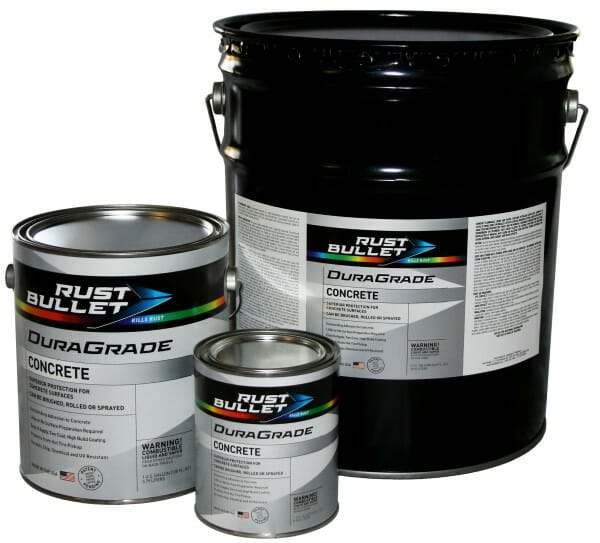
Our curiosity was certainly roused when Rust Bullet asked us to review their new DuraGrade Concrete floor coating. Having shaken the industry a few years ago with a durable garage floor coating that did not require acid etching or grinding of the concrete, we were interested to learn that this new coating would be no exception. After receiving a few samples and doing some of our own testing, we feel that DuraGrade Concrete is going to be a success in more ways than one.
Before we discuss why DuraGrade Coating is worth your consideration, it’s important to learn a little bit about how Rust Bullet became a noteworthy participant in the garage floor coating market originally.
Epoxy for garage floors is still the most popular product people are aware of. However, concrete coatings have gone through some significant changes in the last few years, much of it due to the fast-paced growth of the DIY garage floor coating segment of the industry.
Companies that only produced and/or sold products for commercial concrete coating applications or other industrial uses began to become aware of this fast-growing segment. Besides epoxy, they set out to provide additional high-performance coatings, all to the benefit of the DIY consumer.
Rust Bullet is one such company. They produce and sell a highly regarded single component polyurethane paint coating used to protect metal surfaces and inhibit rust under extreme conditions. It is used primarily for automotive, aircraft, and industrial use, including marine environments, farms, etc.
Their first true garage floor coating, Rust Bullet For Concrete, came about when an innovative engineer from Georgia was looking for a durable paint that he could apply to his garage floor. He wanted something that would not require acid etching of his concrete and it had to stand up to chemicals and the dreaded hot tire lift that traditional garage floor paint is known for.
Being an automotive enthusiast, he was aware of Rust Bullet and the fact that it could be applied to concrete. After reviewing the impressive data and testing for their paint, he thought it would be a good candidate for a garage floor coating.
After contacting him and learning that his Rust Bullet painted garage floor had been performing flawlessly for over two years, we decided to write an article about it. The article soon caught the attention of a well-respected garage flooring vendor, Garage Flooring LLC, who contacted Rust Bullet asking for more information. The rest, as they say, is history.
As a result, Rust Bullet For Concrete was formulated and has been a huge success. It has proven over the past few years to be an extremely durable and stain-resistant coating that stands up to the harshest of automotive chemicals. However, it hasn’t been without issues and is one of the reasons we feel that DuraGrade Concrete has come about.
For example, as tough as Rust Bullet has proven to be, the biggest drawback is that it’s only available in one color, semi-metallic gray. It also has to be applied fairly thin. As a result, a minimum of three coats is required for most applications in order to achieve a uniform appearance.
It also has a higher VOC content and produces a strong smell that requires good ventilation or a respirator when applying it.
Furthermore, Rust Bullet paint was not initially intended as a garage floor coating. And despite the improvement of the concrete formula, there are still some appearance issues with roller marks if not applied in a particular manner.
DuraGrade Concrete was developed to address these small application issues, but more importantly, to make available a concrete coating that fully focused on the garage flooring and concrete coating market.
What is DuraGrade Concrete?
Like its predecessor, DuraGrade Concrete is a high-performance single-part moisture-cured polyurethane coating. That means there is no mixing of two different components like epoxy requires. It is activated by reacting to the moisture in the air when applied.

It also has a higher solids content of 71% vs. 62.5%. This means it can be applied thicker, requiring a minimum of two coats for most applications vs. three. Expect an approximate coating thickness of 8 mils for two coats of DuraGrade vs. 5.5 mils for three coats of Rust Bullet for Concrete.
In addition, DuraGrade Concrete is available in 19 various colors plus clear. It is U.V. stable, which means that it will not get a yellow tint (amber) if exposed to sunlight. It has a glossy finish that stands alone brilliantly by itself or you can opt for color flakes and a coat or two of DuraGrade Concrete in clear. This will lock in the color flakes and add build.
Most importantly to the DIY consumer, however, is that DuraGrade Concrete does not require acid etching or grinding for most concrete surfaces and does not require a primer coat. It is also low in VOCs. This means no strong smell and it can be shipped to all 50 states.
This is a huge benefit for those interested in a true high-performance garage floor coating. The biggest anxiety that prevents people from applying their own coating in the first place is the etching or grinding of the concrete surface that is required.
To be clear, DuraGrade Concrete can be applied to concrete that has not been previously sealed, power troweled, or troweled extremely smooth. Most garage floors will not have this issue. However, if you do have any of these conditions, Rust Bullet recommends heavy sanding of the concrete surface.
Unlike epoxy and other coatings that require a porous surface for the coating to penetrate, DuraGrade just requires just enough profile (surface texture) for it to achieve a strong mechanical bond. Rust Bullet states that 80 grit sandpaper on a pole sander or 80 grit sanding screens on a floor maintainer will get the job done.
Etching is not recommended if it can be helped. The reason is that like all polyurethanes, DuraGrade is not very tolerant to moisture. If the concrete is not allowed to dry long enough, then delamination can become an issue.
Grinding of the concrete can be done, however, expect the coverage rate and dry film thickness for the first coat to decrease due to the more porous surface that grinding creates.
The expected coverage rate is approximately 300ft² per gallon. Keep in mind that this rate is dependent on the porosity of your concrete surface. The required two coats should provide a total thickness of up to 8 mils once cured.
In addition, if you are concerned about wet grip in your garage then an anti-slip media should be applied to the final coat.
CLICK HERE TO JUMP DOWN TO DURAGRADE PRICING
With a working pot life of approximately two hours once poured into your paint tray, you have plenty of time to apply it to your concrete.
Approved for outdoor use
Yes, that’s right; DuraGrade Concrete is one of the few DIY coatings that we are aware of that is approved for outdoor use as well as in the home and garage.
This means that it can be applied to outdoor patios, indoor patios, sunrooms, walkways, and more. With a large color selection that includes much more than your standard tans and grays, we see where this can become a popular coating for such projects.
We do advise you to consider a few conditions before you apply it outdoors though. DuraGrade is a coating that does not breathe. It is one of the features that make it a good sealer. The drawback to coatings that do not breathe, however, is that moisture can get trapped in the concrete under the coating.
If you have an outdoor concrete surface that shows signs of being wet from under slab moisture at various times of the year, you can run the risk of trapping that moisture. Over a period of time, this can cause the uppermost layer of concrete to deteriorate and the coating will eventually lose its bond.
In cold climates where freeze-thaw is an issue, trapped moisture under a nonbreathable coating can actually cause spalling. So make sure you are fairly confident that under slab moisture is not an issue.
Lastly, when used outdoors, we highly recommend using an anti-slip media in your final coat or the surface can be outright hazardous when wet. Wet tires on the garage floor, water dripping off the car, and spills can be avoided or easily cleaned up. However, the same can’t be said for outdoors.
DuraGrade Concrete Benefits
- Single-part coating that does not require mixing of additional components
- No acid etching or grinding required
- Low VOCs – no strong smell and is compliant in all 50 states
- U.V stable – no yellowing and is approved for outdoor use
- No primer or top coat required
- Excellent scratch and stain resistance
- Excellent chemical and road salt resistance
- Excellent adhesion with high resistance to peeling
- Easy to clean and maintain
- No hot tire lift
- Can be applied in temperatures as low as 35°
- Suitable for basements (moisture testing required) and in-home use
- DIY friendly – Easy to apply with 2-hour working pot life
For more information about testing and product benefits, you can view their engineering data sheets here.
As you can see, these are excellent benefits for a garage floor coating and far superior to any epoxy paint or garage floor coating kit that you will find in a home improvement center.
Our Review of DuraGrade Concrete
For our sample, we opted for Light Grey since it’s a very popular garage floor color. We had them send enough to cover approximately 10-12 square feet so we could conduct our testing.
We later received small samples of Lilac, Light Blue, Pistachio, and Clear which we used on a different area of the floor. We didn’t subject these to testing but instead used them to illustrate color and to demonstrate how Clear looks on bare concrete.
Our test area is a garage floor that is currently covered in RaceDeck interlocking tiles. The concrete would have required some cosmetic issues to be addressed as well as many small crack repairs if a coating had been applied. As a result, it has turned out to be a good test floor for us to review samples of concrete repair products, sealers, stains, and coatings.
We pulled up a small section of interlocking tile that would be exposed to the car tires on one side of a busy vehicle. We then cleaned the concrete in that section and allowed it to dry for approximately 36 hours. Since the concrete was not overly smooth, we were not concerned with acid etching or grinding.
Application of DuraGrade Concrete was fairly easy. You can find their application instructions here. You are required to mix the contents for approximately one minute. We did this using a paint stir stick. The key is to mix it somewhat carefully so as not to whip it up. If you do, it will introduce air that can create small bubbles in the coating when rolled out.
Once mixed, we poured enough Light Grey into a paint tray for our first coat. We then resealed the can according to the instructions. The first coat rolled out nicely even though darker areas of the concrete showed through.
This is completely normal. Being a polyurethane coating, DuraGrade goes on thinner than an equivalent solids epoxy coating would. It is also why a minimum of two coats is required.
Do not try to apply thicker coats. If you do, the coating will experience solvent flash. This produces an abundance of tiny bubbles over the entire coating which will have to be sanded out once it cures.
DuraGrade requires waiting 2-6 hours between recoats. It should feel dry to the touch and not transfer on a gloved hand. Since it’s a moisture-cured coating, the time you need to wait between recoats is dependent on the humidity.
For example, the humidity was only 24% when we applied the Light Grey coating that we used for our testing. We had to wait almost the full 6 hours before recoating it. When we later applied the other colors that we received, the humidity was 73% and we were able to recoat in just over 2 hours.
The second coat went on just as smoothly as the first coat and completely covered the darker-colored concrete that was bleeding through. If you have opted for color flakes, it would be at this point that you would toss the color flakes onto the floor.
Though DuraGrade Concrete is low in VOCs, that does not mean there is no odor. It does have a chemical smell, but it does not get nearly as intense as Rust Bullet for Concrete and it dissipates fairly quickly once it begins to cure on the floor.
Once cured, our test coating had a nice gloss finish with very consistent coloring. Duragrade Concrete requires 6-12 hours before walking on the floor, 24 hours of curing time before moving items back onto the floor, and 72 hours to cure fully. You can drive on it after that.
Something that we want to point out that will be quite evident in a few pictures is some of the cracks that run through the coating. We are always getting questions about the necessity to repair cracks before a coating is applied. Many assume that since a coating is self-leveling, small cracks should not need to be repaired.
As you can see, that is not the case and we wanted to use this chance to demonstrate that. The fact that you can clearly see the cracks has no bearing on the performance of Duragrade Concrete. All coatings will do that, some more than others.
We later applied the Lilac, Pistachio, Light Blue, and Clear in another area of the floor to get an idea of how these colors look and what effect Clear has if optioned as a top coat.
As you can see, the Clear on the bare concrete darkened it up and revealed all the different characteristics of the concrete. This is typical of a clear coating and why some people find it very attractive. DuraGrade Concrete in Clear would make an excellent option to apply over stained concrete.
We then applied Clear over the Light Blue and Pistachio colors. The result is a glossier finish that almost looks wet with a deeper look to the coating. Below is an example of what Pistachio looked like before and after Clear was applied. If you click on an image, you can note the difference in reflections.
DuraGrade Concrete testing
Once DuraGrade cured completely, we began to conduct some of our own tests. The first thing I want to state is that these tests are unscientific and your results may vary. All Garage Floors is not a testing lab. However, we are very familiar with the various chemicals and abuses that a typical busy garage floor coating can be subjected to, so we do our best to simulate some of that and give you our results.
The first thing we did was the chemical stain test. We subjected DuraGrade to a variety of chemicals and automotive fluids for 24 hours. Some of these chemicals include used motor oil, brake cleaner, brake fluid, automotive coolant, transmission fluid, gear oil, mineral spirits, etching solution, and more.
We then wiped them up using only Windex and a rag. Most everything came up clean with no evidence of it ever being there with the exception of two chemicals, one of which surprised us at first.
The first one was brake fluid. This was somewhat expected. Brake fluid, if left to sit, can dull or discolor all but the most chemical-resistant coatings to some degree. Still, it was not easy to detect.
The one that surprised us was the used motor oil. You can definitely see a stain in the first picture. It almost came completely clean when we wiped it again with some mineral spirits. You can click on the image to make it bigger.
We contacted Rust Bullet about this since motor oil should easily clean up with most coatings. They were just as surprised as us when we sent the pictures and said that they needed to talk with the product engineers.
Before Rust Bullet could get back to us with an answer, we soon discovered why this had happened. The used motor oil came from a 5-gallon container that we use for recycling oil and other automotive fluids. As it turns out, just over a quart of old brake fluid from a recent DOT 5 brake fluid flush had been deposited earlier into the container along with some brake cleaner and other various fluids.
Since the brake fluid test slightly discolored the coating, it soon became apparent why the oil with all the brake fluid in it left a slight stain. We immediately tested the coating again with used motor oil that was not contaminated with brake fluid. This time we left it on the coating for a few days. The result this time was no staining to the DuraGrade Coating and it retained a nice clean look.
This was a more realistic test since used motor oil from a vehicle will not contain brake fluid. We also felt that leaving it on for a few days was prudent as well. As a result, we feel that the previous stain should not have a negative bearing on the performance of DuraGrade in that respect.
We then subjected the coating to an 80lb steel wheeled floor jack and jack stands. We slid the jack back and forth on the coating trying to simulate typical use. We then lifted one side of a 3800lb vehicle a few times, placing it on each of the two different jack stands in the picture. We also leaned on the jack stands and slid them in circles on the coating.
The results were negligible. You could not see scarring or marks unless you got down at a certain angle in the light. You could then detect some slight marks on the floor from the floor jack wheels and jack stands sliding on it. This is typical for most performance coatings.
We then dropped various hand tools from approximately 3-4 ft. These included a combination wrench, screwdriver, pliers, and a tape measure. The results were no damage. One of the benefits of DuraGrade Concrete is that polyurethane is more flexible (relatively speaking) than epoxy and as a result, can be more impact resistant.
Next, we deliberately tried to scratch the coating. Putting some pressure on a screwdriver, we were able to leave some marks and light scratches, but it did not affect the integrity. However, when we tilted the three-legged jack stand onto a sharp edge of the steel pad, we were able to scratch through the coating with some effort.
Because DuraGrade Concrete is not the thickest of coatings, we would consider this fairly normal when allowing for the effort required to create this damage.
We left this small test section of the floor open for a couple of months in the winter. This allowed a busy car to park its left front wheel on the coating and drive back and forth on it as it came and went each day. We didn’t clean it all. At the end of two months and a few rainstorms, it easily cleaned up and looked like new again.
Lastly, we checked to see how slippery it may be when wet. Glossy polyurethane coatings are typically more slippery than epoxy and this one is no different. If wet slip resistance is a concern, then we recommend using an anti-slip media in the final coat.
If you are on the fence about using anti-slip media, one thing to consider is that coatings do gain some grip after they have been exposed to traffic for a while. They tend to develop an abundance of microscopic scratches on the surface that reduce some of the initial slipperiness of a new coating. However, it is not a replacement for anti-slip media in wet conditions.
Another consideration is that anti-slip media will lessen some of the gloss if that is a concern.
This post may contain affiliate links. If you use these links to make a purchase, we may earn a small commission. As an Amazon Associate, All Garage Floors earns from qualifying purchases. You can read our full disclaimer here.
Where to Purchase DuraGrade Concrete
DuraGrade Concrete is now available at Amazon in all colors, including clear.
Lastly, Rust Bullet has packs of optional colors flakes that you can purchase as well. There are 5 different color combinations. At the time of this article, they are only available for purchase from Amazon.
Currently, pricing for DuraGrade Concrete is just slightly more than the high-performance single-part polyurethane coatings. It’s a difference of fewer than 10 cents per square foot. However, for the additional pricing, you are gaining the benefit of application without concrete prep and a larger color selection to choose from.
Final Thoughts
To be frank, we feel that Rust Bullet gained a small niche in the garage floor coating market almost by accident. The introduction of the original no concrete prep coating created quite the stir among concrete coating vendors in the DIY coating industry. They felt that such a product surely would not adhere well or take much abuse.
Despite some of the drawbacks we listed, the doubters were proven wrong and it quickly became a popular option for those looking for a durable garage floor coating that required no acid etching or grinding.
We feel that DuraGrade Concrete fully launches Rust Bullet into the concrete coating market with a highly viable product. The advantage of not requiring acid etching or grinding and the multi-use feature of being approved for outdoors as well as garage floors, indoors, and basements, are great benefits that will attract a much larger audience.
Will it perform just as well as Rust Bullet for Concrete? In terms of overall chemical and abrasion resistance, we feel it will not, but that is not a bad thing. In order to provide a low VOC moisture-cured polyurethane that goes on thicker with high-quality cosmetic features, colors, and ease of application, solvents had to be reduced and compromises had to be made.
Overall though, we were impressed with how DuraGrade Concrete performed to our unscientific testing as well as how easy it was to apply. I would have to say that with some exceptions, it’s much like preparing and applying paint to a wall. If you can do that, then you can apply DuraGrade Concrete.
Because it is polyurethane, it still goes on thinner than other coatings and might be a deal breaker to someone with an older concrete floor that needs repairs or is rough in texture. The thin nature of the coating will not cover these cosmetic issues as nicely as a thicker coating would.
Thin does not mean it is not durable, however, and you can always disguise concrete irregularities with the addition of color flakes.
We feel that its direct competitor may very well end up being the newer single-part polyurea coatings. These we would rank as the next level up in terms of performance when compared to DuraGrade Concrete. However, DuraGrade Concrete gains the advantage of no concrete prep and a much larger selection of colors to choose from.
Do we recommend it? Yes! If you are looking for the easiest garage floor coating that you can apply that still performs as a high-performance coating should, then DuraGrade Concrete is definitely a great option to consider. It’s a good value that will return years of service for your time and investment.
Can you put this product over a floor that has previously been painted with epoxy ?
Hi Larry. Yes, you can if the current coating is sound and adhered well to the concrete. However, since this is not bare concrete, the surface will require proper prep first. Whenever a new coating is applied to an older coating, it will require degreasing the surface first and then roughing it up with 120 grit sandpaper. Otherwise, the new coating will not adhere well.
Can this coating take a full flake application to rejection, and do the flakes need to be scraped off afterwards as you would with epoxy?
Hi John. No, this coating is not designed for a full color flake application. Full flake color floors require a minimum of 5 mils dry film thickness for the coat the color flakes are tossed into. The flakes themselves are an average of 5 mils thick and each coat of DuraGrade is an average of 3 mils dry film thickness. As a result, it does not provide enough thickness for all those flakes that pile up on each other at different angles to adhere properly. This is why you don’t see full color flake applications for brands such as EpoxyShield or RockSolid for example. You would need a high-solids epoxy application or a single-part polyurea for full color flakes. This kit by Roll On Rock is an example of using high solids epoxy.Just as an FYI, all full flake applications require that you scrape and vacuum the color flakes well before applying the clear coat.
Our builder “gifted” us with an epoxy floor. It was easier than getting the rust stains out, I guess.
They put the epoxy down today.
Will I have to prep the surface (roughen it) if I put Rust Bullet clear on it tomorrow, before we’ve even used the epoxy floor? I understand that you need to do that for an older epoxy surface, but isn’t this similar to if I had used Rust Bullet for the color and then clear-coated with Rust Bullet?
I have the Rust Bullet because I bought it before they told us they would do the epoxy floor.
Hello Fred. Do you know the exact name of the product used? Are you 100% sure that it’s an actual epoxy coating and not paint or a 1-part epoxy paint? Builders and contractors are always “gifting” what they call “epoxy” garage floor finishes to resolve issues with the concrete finish. Many times, it’s not an actual coating. They are notorious for not following concrete prep instructions which results in peeling issues as well. We then get questions asking why the free “epoxy coating” that was applied is peeling or doesn’t have a glossy finish. If it’s an actual coating, you will need to let it cure for 48 hours and then rough up the finish with 120-150 grit sandpaper before applying the Rust Bullet clear coat. Feel free to let us know if you have any questions.
Thank you, Shea.
This is great information.
The installer came after I posted the prior message.
I doubt it is epoxy. The guy came by himself, said he would patch anything needed to be patched, blow out the dirt, and coat the floor (so, not the proper prep). If he was there two hours, it was a lot. He was gone before I went to check on him.
Based on the time and the appearance, I think it was a single coating, and I doubt it is epoxy. I don’t know how he got the paint flakes to stick on there, but it does not have the shiny topcoat that I’ve seen on real epoxy floors. I think the paint flakes will come up when I roughen the surface. We’ll see.
Had I known how they were doing it, I would have stuck with Rust Bullet and done it myself. As it is now, I only have clear. I will try to salvage it with a layer or two of clear Rust Bullet on top. We don’t plan on putting a car in the garage unless there’s a hurricane coming through, so maybe it will hold up well with the Rust Bullet on top.
Thank you again, Shea.
Well, dang. This is what we were afraid of. We can almost guarantee that what was applied is a 1-part epoxy paint with improper prep. This is the typical type of material and bad prep work that building contractors employ in these situations that gives true epoxy coatings a bad reputation. If the paint does not begin to peel at some point on its own, it will most certainly come up if a car is parked on it. The question to ask yourself is; is it worth it to apply a clear coat only to have it peel up with the paint? If you decide to apply the clear, make sure to test it first in an inconspicuous area. Rust Bullet does have some solvents in it that may soften the paint and cause it to bleed through. You don’t want to discover this midway through the application.
I have a RockSolid Polycuramine® Garage Floor Coating and clear coated. Of course it is starting to yellow around the garage door. Other than that it is bullet proof. First, if I sand the floor and degrease it, will DuraGrade stick? Second, Will DuraGrade yellow?
Hi Bob. Prep the floor by first degreasing, Next degloss it using 150-grit sandpaper. Sweep/vac and then wipe it down with denatured alcohol or equivalent applied to a microfiber mop pad. Once you do that, any coating including DuraGrade will adhere properly. DuraGrade is U.V. stable and will not yellow like polycuramine (RockSolid) and epoxy does.
I have an existing garage that was done using Rustoleum Rocksolid 2-Park Epoxy in Grey with a Matte Clear Coat. The interior of my garage is fine but the ‘driveway apron” is “yellowing” because I discovered Rocksolid is not “UV Stable”. I wish to “Recoat” just the Apron with a matching “Grey” colored product that won’t yellow and was hoping I could use one of the Rustbullet products. Could I “scuff-up” my driveway apron with Sandpaper and apply one of the Rustbullets over it ? Or do I need to get a grinder and grind down to the bare cement and apply over that? Looking for advice. Thanks. Michael
Hi Michael. Yes, you can do just that. Use 120-grit sandpaper. After you sweep/vac, wipe the surface with denatured alcohol or equivalent applied liberally to a microfiber mop pad. Give it 15 minutes to evaporate and you are ready to go.
Two questions:
1. Is regular sandpaper durable enough to have any effectiveness on concrete? Or is a special type required?
2. If a durability issue revolves around how thin the coats are, could a thicker clear polyurea product be used as the topcoat?
Hello Wally. If you have very smooth, unsealed concrete that does not absorb water droplets very well if at all, then 60-80 grit sandpaper is strong enough to break up the smoothness for DuraGrade to adhere properly. It will require regular changes of the sandpaper as you go. The thinness of a coating does not necessarily determine durability. Clear topcoats are typically not thick to begin with. What is important is their abrasion resistance and chemical resistance. There are very thick coatings that do not perform nearly as well as many clear coats in those categories.
Okay, thanks! My house is still under construction but they did a nice job of finishing the garage concrete. I haven’t tested porosity yet but I’ll definitely plan on sanding. My plans are for 2 coats of gray plus one of clear, so I’ll count on that being durable enough for a basic residential garage workshop.
Hi Shea. In the article you mention that DuraGrade Concrete is low in VOC and approved in all 50 states. In the engineering data sheet for the DuraGrade, it states 130-170 g/l for VOC content. I find these statements to be contradicting, don’t you think? I was hoping to use DuraGrade concrete for my basement floor, but I am now worried about the VOC content after looking at the engineering sheet.
Hi Adam. Technically, the industry considers those numbers as low for a high performance garage floor coating since most garages and indoor commercial spaces are well ventilated. However, anything less than 50 g/l’s is considered low enough for indoor use such as within the home, or a basement in your case. Rust Bullet offers DuraGrade Concrete Ultra Low VOC for those spaces. It is a Grey Aluminum color and contains 49 g/l VOC content. You can find it here.
Thank you for the response. I read the article countless times and overlooked the DuraGrade Concrete Ultra Low VOC. That is just what I’m looking for.
That now leads me to the topcoat question. I’m not a huge fan of the glossy finish. I did read another article on here (https://allgaragefloors.com/ts210-sealer-color-stain-basement/) with someone in a similar situation. They ended up using TS210 Concrete Sealer with a matte finish (although over a stain). After reading the Specs, it looks like I cannot use TS210 over coated concrete.
Do you believe I could use a product like Rust-Oleum® Low-VOC Concrete & Garage Clear Matte Finish Topcoat (https://www.menards.com/main/paint/interior-paint-stain/floor-coatings/rust-oleum-reg-low-voc-concrete-garage-clear-matte-finish-topcoat-1-gal/380895/p-1642874255214949-c-8022.htm)? Or do you think it’s better to play it safe and use the DuraGrade Clear as the topcoat? Since it’s a basement application, I’d like to add the anti-slip coating (looking at Tread-Tex) to the DuraGrade, but I’m not sure if it would be necessary on the Rust-Oleum topcoat since it’s already matte. Thoughts? Thanks!
Hi Adam. Do not use the Rust-Oleum product. It’s a low performing water-based acrylic clear coat. Water-based acrylics are the lowest performing clear coats you can apply. They should only be used on latex acrylic paint or 1-part epoxy (still paint). You would effectively be lowering the overall performance of your coating system. If you want to tone down the gloss, we would recommend a product by Legacy Industrial called Kera-Quartz. You can find it here. It’s a quartz-based clear sealer in a satin finish with anti-slip media already included. It’s a very thin, high wear, high stain resistant sealer that adheres to just about anything, including glass and porcelain tile. It’s not recommended if you plan on applying color flakes to the color coat. Kera-Quartz is not thick enough to get proper coverage of the flakes. Use the DuraGrade Clear instead if you plan on applying color flakes.
Based on your article I was going to go with Duragrade as I am looking to minimize prep time yet have a decently durable surface. I have a 1200 sq ft garage floor. cement is about 9 months old and no oils, but it was power troweled. I called Rust Bullet and they said sand, I sanded a small area but it did not seem to do much to the surface and water still was slow to absorb. They said I would need to grind. So if I grind it seems there is no point to putting Duragrade down as the whole point of that was to avoid labor yet still have a good surface quality. The 2 part epoxy’s that you recommend are way too expensive for me. Duragrade was going to be $1500 for me. Those seem to be way more. Is there something else you recommend for my situation? 1 part epoxy? But maybe those require the same labor? or just go with kit epoxy’s? Or something new out?
Hi Matt. Power troweled concrete requires prep for any colored coating you want to apply. Based on what you were calculating for DuraGrade, it sounds like you want to apply a colored coating without color flakes and a clear coat. If that’s the case, then we would recommend a product called Nohr-S by Legacy Industrial. You can price it here. It’s a single-part polyurea that’s even tougher than DuraGrade and is U.V. stable. You can get by with a single coat applied at no more than 225-250 sq. ft. per gallon. It will put you in the approximate price range of $1200 for 5 gallons of Nohr-S and 3 gallons of their HD357 concrete etch. Their anti-slip media is recommended or it will be slippery when wet. This is less money than what a Nohr-S kit would be that includes color flakes and a clear coat. We have an article on Nohr-S here to learn more about it.
What ever you do, don’t apply a 1-part epoxy (it’s latex paint) or a few budget home improvement center kits such as EpoxyShield, etc. These will not last long and 1200 square feet is a lot of concrete to have problems with peeling paint and cheap coatings. If you don’t mind applying a clear coat instead, then we would recommend a product called TS210 by Concrete Sealers USA. It’s a very durable acrylic-modified polyurethane clear coat sealer. You can read about it here. There is a link in the article to check pricing. This can be applied to power troweled concrete without further prep other than cleaning first. The first coat on power troweled concrete requires thinning with water. It acts as a primer coat. Two standard coats is recommended after the primer coat. It would require approximately 5 gallons and cost half that of Nohr-S.
Also, I read the article on the TS210. Can you ever epoxy or coat over the TS210 later or would it need to be ground first and would grinding be sufficient if later using another coating. thanks!
You would need to remove the TS210 via grinding before applying any other coating.
Thanks so much that is very helpful! If I went with the Nohr-S Would the concrete etch be sufficient prep or would it also need to be ground?
The etch will be sufficient. Just follow the directions and make sure it dwells long enough on the surface. Norh-S is solvent-based, so it has good penetration qualities once the surface is opened up a bit.
What type of preparations would be required for a 20 year old garage floor that has oil and gasoline stains ??
Hi Lloyd. It will require a thorough degreasing to remove the oil and gas residue. Otherwise, it will block proper adhesion. Make sure the concrete is completely dry (not just the surface) before applying. You can find their application instructions here.
Thanks for the Information, It will help me decide how to proceed in the future.