
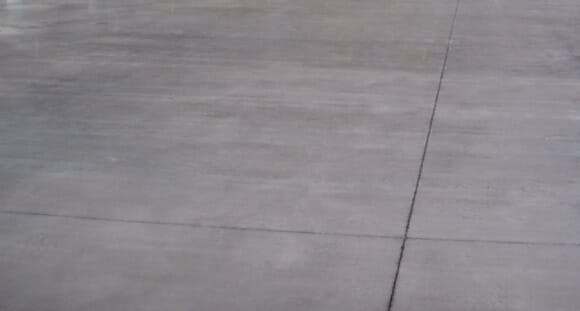
A new trend that has been finding its way onto the surface of garage floors and workshop floors is the use of a concrete densifier with an added sealer. Densifiers have been used on occasion in the garage for a variety of reasons, but rarely as a finished garage flooring treatment. So why has there been a gradual increase in its use and popularity for the garage floor?
The reason has to do with the addition of silicone and siliconate agents in some densifiers to act as a sealer. This helps to create not only a water repellent floor, but one that is resistant to liquids and chemicals in general.
In fact, this combination of a densifier and sealer has fast become one of the best values for a bare concrete sealer.
So let’s take a closer look at how a concrete densifier with sealer on your garage floor may be beneficial for you. In addition, we will discuss what product we highly recommend and why.
How a concrete densifier works on a garage floor
Concrete densifiers have been around for decades. They are a concrete hardener that has primarily been used for concrete floor polishing, increased abrasion resistance, anti-dusting, and moisture mitigation. They are typically applied to machine troweled, hard troweled, and smooth concrete.
In some cases, they are used to treat a soft concrete surface or as a treatment for dusting concrete.
When concrete cures, bleed water makes its way to the surface and increases the water to cement ratio. This process can help to make the surface of concrete smooth. However, it can also create a surface that is softer than the underlying cement. This is due to the increase in laitance content and fine aggregates that the bleed water carries to the surface.
When a densifier is introduced, a chemical reaction is created that can increase the surface strength of concrete from an average of 20% to 40% depending on the original pour and finish of the concrete. But, how is that done?
Densifiers are a water-based chemical solution that first works by penetrating into the surface of the concrete. They react with calcium hydroxide to produce calcium silicate hydrate (CSH). This is the substance that gives concrete its strength.
Next, the CSH that is produced fills the open pores and capillaries of the concrete. This is what increases the density and strength at the surface.
Lithium silicate densifiers are the most common choice used for garage floors and workshops. There are two chief reasons for this.
The first reason is due to the ease of application. Scrubbing in the densifier solution typically is not required like it is for the older sodium silicate densifiers.
The second reason is that lithium silicate has properties that are less reactive to carbon dioxide which can create a whitening effect on the floor. And unlike sodium silicate densifiers, lithium silicate densifiers also do a good job of repelling road salts. Once applied, the concrete retains its natural look.
It’s important to note that concrete densifiers are non-film forming, meaning that they don’t leave a topical film on the surface to protect from staining.
Additionally, densifiers technically are not water-repelling sealers either. They don’t form the same molecular membrane at the sub-surface to repel liquids as other non-densifying penetrating sealers do. This is why they had not been used much as a concrete protectant for garage floors – until recently.
With the addition of silicone and siliconate agents in densifiers, their use as a sealing agent and overall protectant for garage floors has dramatically changed this. These siliconates create a water-resisting agent right at the sub-surface of the concrete.
This addition allows the densifier to act as a sealer for your garage floor by repelling water, resisting oils, and resisting stains. Furthermore, it protects the concrete from chemicals such as road salts, and other fluids.
Lastly, densifiers with siliconate sealers added are environmentally safe. They are extremely low in VOCs and odorless.
Are they 100% impervious to stains and chemicals? No, but if you don’t allow spills to sit for a long period, they will generally wipe right up with little if any scrubbing necessary. However, you must be particularly careful with solvents that can stain, as their resistance to them is minimal.
The benefits of a concrete densifier with sealer added include:
- Added strength and abrasion resistance to the surface of a working garage
- Increases the compressive strength of concrete
- Repels liquids and other fluids which help to make your garage floor stain resistant
- Eliminates dusting and problems with efflorescence
- It doesn’t peel, leave tire prints, or turn yellow
- Helps act as a moisture barrier for your garage floor
- Improves weathering and resistance to freeze/thaw effects
- Non-slip surface
- Relatively inexpensive
- Lasts for years without need for reapplication
- Easy to apply and is ready for traffic within an hour or two
This post may contain affiliate links. If you use these links to make a purchase, we may earn a small commission. You can read our full disclaimer here.
Concrete densifier sealers we recommend
One particular densifier sealer that we highly recommend is PS104 by Concrete Sealers USA. Why?
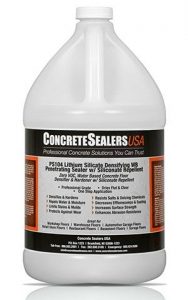
This is the same company that manufactures the very highly rated PS101 siliconate sealer which we have discussed before.
The same siliconate sealing agent that is used in the PS101 is added to the PS104 densifier. This is what makes PS104 such a high-performing concrete sealer and densifier. It’s all in one product.
In addition, with an average coverage rate of 200 – 300ft², it makes for a very affordable concrete sealing option. Concrete Sealers USA offers it in both 1-gallon and 5-gallon containers.
Check Price of PS104 – 1 Gallon
Check Price of PS104 – 5 Gallon
Furthermore, we also like the amount of lithium silicate (measured in solids content) that is used in PS104. Manufacturers generally have to perform a balancing act between how much lithium silicate can be included for densifying purposes and how much siliconate can be added for sealing the surface.
If too much lithium silicate is used, it makes it difficult to add the desired amount of siliconate for the best sealing performance. It also makes the product more expensive.
As a result, many of the densifiers with siliconate sealer added have a lower solids content of the lithium silicate in order to keep the price point down and manufacturing of the product easier. The results, however, are less effective densifying properties.
Concrete Sealers USA has found a way to use almost the same amount of lithium silicate in their PS104 as they do in their standard PS103 densifier. As a result, you can expect close to similar densifying performance as a straight densifier plus the added benefit of the siliconate sealer.
How to apply a densifier to a garage floor
The application of a densifier sealer for your garage floor couldn’t be much easier. You first need to make sure your garage floor is clean and free of all dust, oils, and foreign contaminants. Any stains that you have will essentially be locked in unless removed first. The surface must be completely dry before applying the product.
The easiest way to apply the densifier is to use a garden sprayer with a circular spray tip or a microfiber mop out of a paint tray. Work in sections making sure to keep a wet edge at all times.
You want to get the concrete wet with the product, but not so much that it puddles. If it does puddle, work it into the concrete with a short bristled deck brush or wipe up the excess. If you allow the puddles to dry, you will get a white residue that requires intense scrubbing to remove.
Once applied, you can return the floor to traffic within a couple of hours or so. One application is generally all that is required.
One note to make is that if you plan on adding a topical coating at some point in the future, you will need to grind the concrete in order to remove the sealer and provide a mechanical bond for the coating. Acid etching will not work because the etching solution will not be allowed to penetrate the surface sufficiently in order to react with the concrete.
If you like the look of bare concrete and have a working garage or shop floor that you want to protect without making a big project out of it, then a concrete densifier with sealer added can be a good solution for you. It’s easy to apply, relatively inexpensive, and will provide years of protection for your concrete. In short, it’s one of the best values in concrete sealers today.
Hi All,
Toronto, Canada. I have a new 18 x 24 garage poured and finished last summer. 3/4 clear Stone base with insulation board sealed with sealing tape. No moisture issues at all. It was hand troweled. It is not perfectly smooth and in places trowel marks were left behind. I’m looking for some direction. The floor was covered before interior finishing was started and remains covered. I would like to sand the floor to take down the high spots and to make it a little smoother. Then add a densifier/Sealer. I would like to keep it natural. There is no issue with the hardness as it was left to cure with only one pass with the hand trowel to finish leading to a very strong surface layer. Still looking to improve the strength and abrasion resistance as it will be a working garage. Also wanting some of the sealing qualities provided to allow for easy clean up and maintenance.
Thanks,
Fred
Hi Fred. You are on the right track according to your goals for the floor. Keep in mind that concrete will not respond to sanding well if you want to remove the trowel marks. It will require grinding in order to remove those marks. Most turbo cup concrete grinding wheels are 25 grit. This is great for applying coatings, but too coarse for applying densifiers. The concrete would absorb too much and it would not be as effective. We would recommend a 70-80 grit grinding wheel instead.
Thanks Shea!
Can I sand with diamond brush removal tool on a floor maintainer?
Also, can I add a penetrating sealer on top of the densifier/sealer?
Thanks,
Fred
Hi Fred. No, the Diamabrush uses 25 grit diamond impregnated blades. This is going to provide too coarse of a surface texture for a penetrating sealer to work effectively. In addition, because the blades flex, they will not do well at taking out high spots, ridges, and some marks. The Diamabrush is great for prepping concrete in relatively good shape for coatings, but it’s not the best at removing cosmetic issues. That is why we recommend a 70-80 grit turbo cup wheel on an angle grinder. Keep in mind that anything you grind is going to lighten the color tone of the concrete as well. If it’s just the ridges of trowel marks that you want to remove, you can try using a 20 grit masonry rubbing stone. If you use it just take out the ridges, then you will be fine.
If you want to apply a penetrating sealer over the densifier, then we would recommend a siliconate sealer. Some densifiers have this added. Unfortunately, we are not familiar with vendors in Canada that we can recommend. We do know, however, that GhostShield has distributors in Canada. You may be interested in this type of system here.
Thank you Shea for the great help and direction.
Hello, you guys are a life saver. Excellent tips. My question is the following:
I’m in Alberta, Canada, dry weather climate, not humid. I have a 6 month old concrete unheated garage floor poured in October 2020 (Fall), with a few small cracks 1/16” inch that just formed by Feb 2021 (Winter). No sealers nor coatings were applied throughout these last 4-5 months. Now that Spring is here, Do I first need to fill these cracks with some type of epoxy crack filler before applying a Lithium Densifier that includes Siliconate such as the PS104 so that I can strengthen the sub-surface of the concrete slab and enjoy all the benefits from such densifier? Thank you.
Hi Maurice. Yes, fill the cracks with an epoxy or polyurea crack repair product. This will prevent water and road salts from penetrating deep into the slab. Unfortunately, Concrete Sealers USA does not ship to Canada, but you should be able to find an equivalent product from a vendor there.
Thank you very much Shea and co. I’m thankful I found your site/blogs.
One last thing, if let’s say there is moisture coming up the concrete floor, do I need to apply a moisture sealer first, then apply the densifier seal?
Thanks again for your time.
Hi Maurice. Moisture sealers are densifiers. Other companies just market them differently.
I am hoping you will respond to this inquiry. Does the 104 densifier have an odor? If so, how long does it take to fade? Our bedroom is right above the garage.
Thanks!
Hi Michael. No, PS104 densifier with siliconate sealer added does not have an odor.
If we were to use this densifier/sealer on our small (80 sq ft) utility room’s concrete floor, but then wanted a glossier finish, are there products that could be added afterward to achieve that?
Hi Corinne. The short answer is no. The only thing that will provide a glossy finish is a coating and the siliconate in this penetrating sealer will effectively block the coating from adhering well. What is the reason for wanting to use a densifier sealer combo first? What is your end goal?
I have a garage with moisture issues. Water comes up through the concrete due to a high water table and unsealed garage floor. It is also an old ugly garage floor. Would this be a good option for sealing from water and then painting with latex concrete floor paint over the top?
Hi Lauren. Densifiers can help slow down moisture intrusion and sometimes even stop it if it was not too heavy to begin with. However, they do not completely seal off concrete and block it. Only the installation of a moisture vapor barrier (thick plastic) installed before the concrete was poured will completely block moisture when dealing with high water tables. We would recommend applying a densifier and then wait the full seven days for it to react to the concrete. If the concrete no longer turns dark from moisture after the densifier application, then you can try painting the garage floor with a concrete paint. Do not use an epoxy coating or equivalent. The reason is that coatings do not breath and moisture vapor that escapes up through the concrete will get trapped. Paint does breathe and will allow small amounts of moisture vapor to pass through.
Great info, I have a 24×24 garage floor with hand troweled stress relief grooves, I would like to fill in before applying PS100 or 104, they’re fairly large grooves. What would be the best filler? The concrete is a year old I”M wondering which product to use PS100 or PS104 it will be a working garage auto repair welding/fabricating?
Hi Mark. The PS100 and PS104 are both great sealers. The main difference is that PS100 is going to be better at repelling and resisting oils while the PS104 will densify the surface of the concrete and make it stronger. When using a penetrating sealer and not a coating, you will want to fill the troweled contraction joints with a self-leveling polyurethane sealant such as SikaFlex. We recommend filling the joints after application of the sealer. Otherwise, you risk spotting and discoloration of the joint filler. You would use a different type of filler if you were applying a coating to achieve the seamless look.
Hi, I just had a 6″ concrete floor poured in a 34’x28′ detached garage in West Virginia about a month ago. I’ve been pretty religious about watering it since it was poured. The floor was buffed, but not to a glossy coat. My original plan was to install an epoxy coating to the floor, but I’m now leaning toward putting on a densifier and sealer. Should I use a product that combines these two or do them seperately? I also put 10′ skirts on the outside. Since these are exposed to the exterior, do they a different process? Thanks for your advice. Who knew concrete was so complicated? 🙂
Hi Shane. If you use a penetrating sealer vs an actual coating (epoxy), then you can treat the any skirts or aprons outside in the same manner as inside. If your goal is to provide the best resistance to oils, then we would recommending using a product that provides actual oil repellency. There are two that we can recommend. The first is PS100 by Concrete Sealers USA. The second would be a two step process using GhostShield 8505. The GhostShield process requires using a straight densifier and not one with a siliconate sealer added.
Hi. I have a heated concrete main floor in my cottage. It is 2 years old and as it was not sealed or protected during construction it has many dark spot stains which have resisted all cleaning agents. I would like to prevent further staining now before deciding how to patch cover the stains and possibly either polish or burnish the floor. So I was thinking a sealer with hardener would be a good idea but I am concerned that it might limit future options for finishing the floor.
Also any opinion on colour matched patch/skim coat over resistant stains?
Thanks
Hi Jane. A densifier with sealer added effectively seals the surface and will inhibit any options that include a coating. Polishing concrete involves a series of multiple grinding passes using finer and finer grit diamond discs. This article here explains how it works. The beginning process would grind through the stains and sealer and remove them. Burnishing the surface requires a machine troweled concrete finish (very smooth). A stain guard sealer is applied and then burnished with a high-speed buffer. If the surface is not extremely smooth to begin with it will not work. A densifier with sealer added would not inhibit this process. Any skim coat patch you try to apply over discolored concrete will only stand out more. You can never get a good match that blends well. Even if you did get a good color match, the patch will still stand out like a sore thumb.
Could you acid stain the concrete first then apply this densifier?
Hello Alex. Yes, technically you can do that. However, densifiers and penetrating sealers are non-film forming and will not protect the surface of the stain. In addition, the stain color/s will not pop and be vibrant. They will have the same dull look as before the sealer is applied.
Can I use the PS104 in my dining room? I took up the tile 2 years ago and the cement was wet. I left it uncovered until now and the cement stayed dry. I had a leak test done before putting in new flooring which showed none. Put in new luxury vinyl in April and found the entire floor wet underneath yesterday. HELP!!
Hi Cindy. That water has to be coming from somewhere. Is the slab below grade? Is there higher ground next to the slab? Does water outside drain away from your slab or pool next to it? I’m asking these questions because you should not have water like that coming through the concrete and collecting underneath your flooring without good reason. The source needs to be found and properly dealt with.
The PS104 is a densifier and sealer. However, the siliconate sealer repels water at the surface and will have no effect for water coming up from below. A straight densifier without the sealer would be a little more effective to help with water from below. PS103 would be the product to use by Concrete Sealers USA. It may slow down the water intrusion, however, there is no guarantee that it will stop it since it’s very hard to block that much water with a surface treatment. Sealing against water intrusion is much more effective from the outside where it first comes in contact (underside of concrete). Something else to consider is that if it does work, the water may travel to a different part of the slab to get trapped under the flooring there.
I have a newly poured (6 months) 1,000 sf concrete garage floor that I’m looking to seal with a penetrating sealer. The space will be used primarily for parking cars (go figure) and storage. I’ve pretty much narrowed down my search to ConcretesealersUSA or Ghostsheild. My questions are:
1) do I need to apply an etcher first?
2) Should I go with a sealer/densifier such as the PS104 or just the PS101 or Ghostsheild 8500?
3) Do I need to fill the expansion cracks before, after, or not at all?
Thanks for your help. Such a great resource!!
Hi Matt. No, you do not need to etch when applying penetrating sealers. Penetrating sealers will not seal expansion joints, contraction joints, and general cracks in the concrete. We recommend filling any joints (if you so choose) with a self-leveling polyurethane sealant after the application.
Our overall favorite sealer is PS104 by Concrete Sealers USA. The reason for this is that it densifies the concrete surface and provides an additional level of protection with the added siliconate sealer. GhostShield 8500 is a silane/siloxane blend. It’s a fairly good sealer as well. However, silane and siloxanes have a smaller molecular structure that penetrates deeper into the concrete. As a result, GhostShield recommends two wet on wet applications for maximum performance. The second application is prohibited from penetrating as deeply and is more effective at the subsurface. This makes it a more expensive product to use.
I have 5 gallons of PS100 for a 1,500 sq ft home auto shop. The concrete is about 1 year old. I was thinking of also adding a densifier like PS104 to add strength to the concrete. Is that recommended or not? If I did add an densifier, what would be the proper order and/or instructions for the PS100 and PS104?
I thought last year I read where this could be done with the GhostShield products, but I haven’t found any guidelines for the Concrete Sealer products.
Thank you for all the great information.
Hi JP. PS104 would be the wrong product to use. The added siliconate sealer will effectively block the PS100 from penetrating the surface. Instead, you would need to use the PS103. It’s a straight densifier with no siliconate sealer added. We discussed with Concrete Sealers USA the potential advantages of applying a densifier first. They seemed to feel that they would be minimal. However, I would recommend giving them a call to discuss this. They are extremely informative when talking with customers and can further help you with your decision. GhostShield recommends using a densifier first with their 8505 and 8510 oil repelling sealers. The reason for this is that they are a siloxane blend that tends to penetrate deeper into the concrete. As a result, multiple coats need to be applied to be most effective unless a densifier is applied first.
Hi,
Thank you so much for this article, and for all of your detailed responses in the comments. I’ve learned a lot from reading your site.
We have a slab-on-grade foundation that is a year old which will be the main floor of our house. The floor was power-troweled and is quite smooth. Our plan is to apply a densifier and then a sealer (or a combo product like the PS104 but now that I’ve read this). We aren’t looking for a glossy finish, but will probably burnish it after. Three questions for you:
1) There are some small rust stains from nails that the framers left laying on the concrete. What’s the best way to remove these stains before we finish the floor?
2) Are these products ok to use on radiant heated floors?
3) We are not going to sand/polish the floor at all before application. Is that ok?
Thanks in advance for your assistance, it is much appreciated!
Hi Leslie. If you plan to burnish the floor at a later date, we would not recommend PS104. The siliconate sealer in PS104 does not burnish well. Instead, we would recommend applying a straight densifier (no sealant added) such as PS103. Wait 5-7 days for it to react with the concrete and then apply what is called a guard sealer for concrete. Guard sealers are typically used to protect polished concrete and are finished to a high gloss via buffing. They work well for power troweled floors as well since the finish is so smooth and not very porous. When applied, they have a satin to semi-gloss finish. However, they can be burnished to create a more glossy look. I will answer your questions by the number.
1) Take a look at our article on how to clean a garage floor. If you scroll down towards the bottom we have a section on removing rust stains from concrete. Start with the less aggressive method and work your way up as necessary. You don’t want to overdo it and etch the surface if you can help it.
2) Yes. All sealers and even coatings can be used with radiant heat.
3) Sanding or other concrete prep (other than cleaning) is not required for densifiers and guard sealers.
Wow, thanks so much for the super fast and detailed response!
I will look into the guard sealers – do you have a brand that you’d recommend?
Also, I live in Canada and so I’ve also been looking at GhostSheild. Do they make an equivalent product to the PS103 if I can’t find the PS103 in Canada?
Thanks for the article on the rust removal – super helpful!
Hi Leslie. GhostShield Siloxa-Tek 8500 would be the equivalent densifier to PS103. They do not manufacture a guard sealer though. Prosoco is another brand that now has distributors in Canada. You can purchase their Consolideck LS Densifier and pair it up with their PolishGuard. That would be our first recommendation.
Thanks so much! I’m looking into the Prosoco now – I used their R-Guard Joint and Seam Filler to seal around our sill plate, and was happy with the results.
Thanks again for the tips!
You are welcome, Leslie. You can help us by spreading the word!
How long before I can apply PS104 to a new garage floor please? Thanks
Hello Alan. You need to wait a minimum of 28 days for newly poured concrete before it can be applied.
Hi Shea…I just built a 40×40 shop and have settled on applying a dye then a densifier-sealer burnished to a slight sheen. Above you said that PS104 cannot be burnished however the application and finish process on the CSUSA website says it can be buffed for a more polished appearance.
Can you elaborate on whether or not a slight sheen can be achieved?
Is it ok to apply water or acetone dye prior to PS104?
I was also looking at Legacy Industrial’s HD40 Concrete Guard which can be applied to dyed concrete and burnished after the densifier. Do you have any experience or comments on this product?
Thanks!
Jeremiah
Hi Jeremiah. Technically, you can get a slight sheen when burnishing smooth power-troweled concrete that has been treated with a densifier – PS104 included. However, it does require a lot of burnishing passes with a high-speed buffer and the sheen is slight at best. If the concrete does not have a smooth power-troweled finish, you won’t get a sheen at all. Yes, you are fine applying a dye or stain to the concrete first. This is fairly common to do for polished concrete that is stained.
We have an article here about concrete sealers for workshops. We discuss HD40 in it and include a link to a Readers Projects article where HD40 was used. Just let us know if you have any questions.
Hi
We have infloor heated concrete floors throughout our 2 y.o. house. We wanted a natural no gloss look so wanted to avoid a shiny sealer. We ended up using a densifier but it didn’t have a sealant in it. We are now getting many oil/grease stains in the kitchen and BBQ area that we have tried treating with TSP and concrete degreasers with no improvement. We are not sure what we can do next to treat the stains but in order to prevent further stains, can we seal it now? What type of product would we use – we live in BC, Canada. Many thanks.
Hello Meggie. A densifier is a type of penetrating sealer. Penetrating sealers are non-film forming and can still allow concrete to stain since there is not a barrier between the concrete and liquid or food matter that can come in contact with it. This article about sealers explains more. We recommend that you apply an acrylic modified polyurethane sealer with a matte finish. This is a film forming coating with a natural finish that will not look glossy. It will prevent your concrete from staining since the coating is a sacrificial layer. Spills will clean up easily. The brand we can recommend that ships to Canada is by CoverTec. It’s called CoverShield U140. You can find it here.
I have a 6 month old steel troweled smooth garage floor, a 1 month old broom finished skirt on the detached garage and a 100 ft long broom finished sidewalk being poured next week. What are the best options for each? I live in snow country with road salt and deicing chemicals dripping off vehicles in the winter. The garage and skirt are fiberglass reinforced. The sidewalk won’t be. I want to protect the floor and skirt from salt damage and I am not that particular about what kind of appearance the floor has.
Hi Ronald. We would recommend a product called PS100 by Concrete Sealers USA. It’s a fantastic water, salt, and oil repellant for concrete. We did a review of it here. We also include links where you can purchase it. It is more expensive that a typical concrete sealer, but it will protect the concrete from freeze thaw damage and salt.
I have a 32 X 36 shop building with a recently poured (Dec 2021) 5″ hand troweled smooth finish slab with fiber in the concrete. It also has 36 X 6 entry apron (broom finish) that is part of the same pour.
The first heavy rain this year, I noticed what seems to be water vapor migrating up through the concrete. It’s not severe, but enough to make splotchy dark sections and a noticeable rise in humidity when entering the building from outside. What product would you recommend to slow down the vapor intrusion? I have no plans of painting or epoxy on the concrete.
Hi Jim. Did you verify that it’s not concrete sweating? If so, then a densifier is what you want to apply. It will slow down and sometimes complete stop moisture vapor intrusion depending on the circumstances. If the slab is above or on grade, there is a good chance it will stop it completely.
Hello. I have an issue with the slab in my garage. About a week after a good rain I get moisture coming up through the concrete, which will turn into effervescence if not mopped up. I know there is no guaranteed way to remedy this, and a vapor barrier is not an option. I am hoping that you can recommend a densifier/sealer that can at least help slow this process down a little bit.
My main goal in the end is to install a VCT tile floor in the garage. Can you also tell me if the densifier/sealer would cause any problems in adhesion between the concrete slab and the VCT adhesive for the tiles?
Hi Timothy. A densifier can certainly help and sometimes stop moisture intrusion if the slab is not below grade or up against a hill. If it is, then it typically is not very effective since you are dealing more with hydrostatic pressure and not moisture that is simply being absorbed at the bottom of the slab and then transferring to the top due to atmospheric imbalances. If it’s not below grade, then a lithium silicate densifier is the recommended type to use in most cases. PS103 by Concrete Sealers USA is a good choice as is L3000 Densifier by Foundation Armor. Neither should cause any problems with VCT glue providing that the densifier was not over applied and created a white powder residue. If it does, then you need to scrub and rinse the surface well to remove it. We would recommend waiting for the next good rain after the densifier is applied to see your results. If you still get some moisture, then you should do calcium chloride test to see how much moisture you get. Just keep in mind that not all VCT glues are the same. Some can withstand up to 8 lbs. of moisture before they delaminate.
Hello, we are looking to put the PS104 down on our garage floor and like all of its benefits, but still worry about oil/gas stains from leaking cars. Are there any easy to apply acrylic sealers that would work well on top of PS104 to repel oil and gas? What would be the pros and cons of trying this? We did consider the PS103 but would like more protection than just oil “resistance”. Thanks for your advice!
Hi Lindsay. You are talking apples and oranges 🙂 PS104 is a non-film forming penetrating sealer. Liquids and oils can still penetrate if allowed to sit long enough. What these sealers do is slow down the process and limit how much can penetrate the concrete. Acrylics sealers are film-forming topical coatings. Only coatings can completely stop oil and other liquids from penetrating the concrete. There is no need to apply a penetrating sealer if you apply an acrylic sealer. I would suggest reading our article here on garage floor sealers to get a better idea of the differences. Let me know what questions you have after that and I can make some suggestions to point you in the right direction based on your requirements.
will a topical acrylic sealer still bond to concrete that has been treated with a densifier. I remember in one of your videos you said U shouldn’t use a densifier if U plan to apply some type of coating. so I’m assuming acrylic film forming coatings would not be recommended on top of a densifier?
A water-based or solvent-based acrylic sealer can be applied to bare concrete treated with a standard densifier with no additional sealer added. However, epoxy, polyurea, and other higher performing coatings would require that the surface be treated via grinding first. It’s important to note that acrylic coatings do not perform well when petroleum products are introduced, particularly gas and solvents. Oil can rest for a while before staining. However, gas and solvents will soften acrylics and cause it to smear when cleaning. That is why they are not often recommended for garage environments.
Shea,
Have been reading all the information on “all garage floors”. I need your advice. I have a basement floor, poured approximately 1969 and did not include a vapor barrier. There is evidence of moisture vapor transmission. I would like to remediate this as much as possible. I have already re-routed the downspout extensions and addressed the outside situation as much as I can at this point and added de-humidifiers. In addition I have put in a radon system. From everything I’ve read, it seems that the best route might be to add a densifier and a breathable sealer – all leading me to PS104. Does that sound like the best route at this point considering that I would like to stud out and redo half the basement into a “man-cave”? If this is the best remediation, is there anything I can put on top of the breathable sealer that won’t impact the remediation of the moisture vapor transmission?
Hi Bruce. We would recommend PS103 if you want to install a flooring that won’t be affected by MVT. The reason is that you won’t need the benefits of the siliconate sealer added since the bare concrete will not be exposed. PS103 has more lithium content than PS104 because it doesn’t need to be mixed with the siliconate sealer.
For flooring, we would recommend interlocking floor tiles. It has channels underneath that allow air flow and the concrete to breathe. If you still have MVT after the densifier application, the air flow under the tiles will keep the concrete dry. We have an article about interlocking floor tiles here. These are a common solution for basements with MVT issues. Something else to consider is that though dehumidifiers keep the air dryer, they also create an atmosphere that MVT seeks out. You may want to run some tests of running it and not running about a week after the densifier is applied. This will give you a better idea if you should run it our not.