
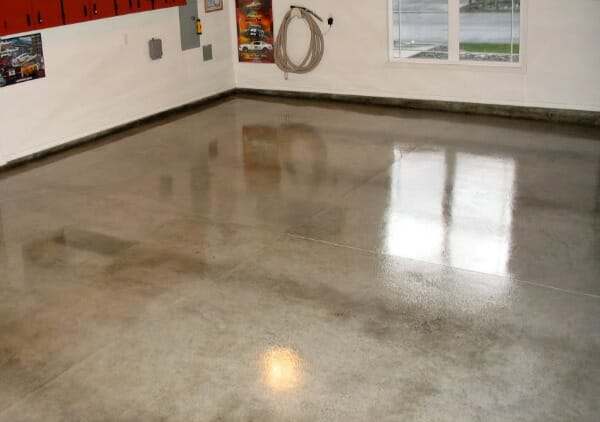
An acrylic garage floor sealer is one of the best answers to those who don’t want to spend much time with a floor covering. Some people just like the look of a bare concrete floor. It has a utilitarian quality that is somewhat conservative and simple. Or maybe it just means you never took the time to do anything with it.
Whatever the reason for going with a bare garage floor, you still need to seal it to protect it. A good acrylic sealer will give your garage floor a richer looking, protective finish and at a lower cost that fits most budgets.
As a concrete sealer, acrylic has many benefits. It’s a thin, topical protectant that is resistant to water, mild chemicals, some car fluids, chloride intrusion, and hot tire pick up. It’s breathable, which means if you have issues with ground water that makes some of your concrete damp, you don’t have to worry about it delaminating like paint or epoxy.
Another benefit is that it will render your concrete dustless. This means that you won’t have to deal with the powdery gray concrete dust that always appears after sweeping. If you live in a snow belt it will also help to protect your floor from road salts. Some caustic chemicals such as brake fluid and gasoline however do need to be cleaned up immediately or it can break down the sealer.
Just remember that since it is a clear sealer, its best used on a relatively unblemished surface. If you have many crack repairs and patches, it will highlight these areas when applied. It cannot be used over paint or any other coating such as epoxy, but it can be used to protect concrete that has been stained or dyed. Once applied it has a nice wet, glossy look unless you opt for a matte finish.
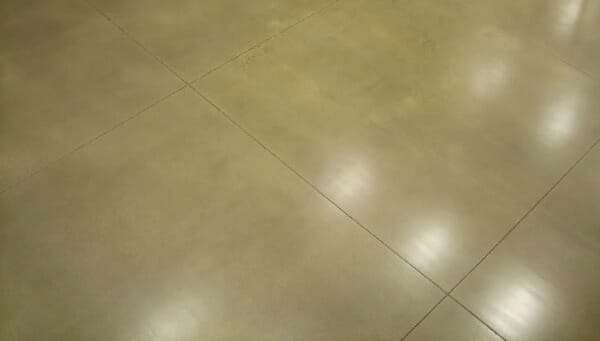
Because acrylic sealers are a topical film forming coating, the finish makes for easy cleanup and maintenance. Most spills will wipe right up. Just use a dust mop for regular maintenance and mild soap and water with a mop for the heavy stuff.
Acrylic sealers are not slippery when dry, but they can get slippery when wet depending on the finished condition of the concrete and whether you choose a glossy or matte finish sealer. For example, a broom finished concrete surface will be less slippery than a troweled finish surface once it is sealed. Also, a matte finish is less slippery than a glossy finish.
If you want a non-slip finish for your garage floor when it gets wet, then we recommend mixing in a polymer grit such as SharkGrip into the last coat. Just keep in mind that a non-slip additive can reduce some of the gloss in your finish. You can read about non-slip additives here.
When choosing an acrylic sealer for your garage, you will need to make a choice between a solvent based or water based product. The water or solvent acts as a carrier agent for the acrylic solids when it is applied to the concrete. When it evaporates, all that is left behind is the sealer.
A solvent based sealer will create a more darkened, wet look to the finish that is glossy in appearance. Water based sealers won’t darken the concrete much if at all and are available in glossy and matte finishes.
If your floor is exposed to sunlight, use a sealer that is resistant to UV rays so that it won’t yellow. Since these type of sealers are a thin protectant, they may need to be reapplied once every two years or so depending on how much traffic your garage gets.
A word of caution about solvent based sealers: they contain VOC’s (Volatile Organic Compounds) and are highly flammable. Precautions should be taken when using them and be sure to read the label thoroughly before use. This will include turning off all pilot lights or gas flames in the garage or basement as well as wearing a proper respirator.
In some states and counties, products containing higher levels of VOC’s are not allowed and may not be shipped to you from out of state. Be sure to check with the manufacturer and your local regulations before ordering.
Acrylic sealer application
Make sure your garage floor has been cleaned properly before application. All oils, stains, waxes, previous sealers, and paint need to be removed first. If the surface is extremely smooth or glossy, you may need to mildly acid etch the surface in order for the sealer to penetrate and adhere properly. Check with the manufacturer if in doubt.
Once the concrete has dried sufficiently, apply the sealer with a quality 1/4″ nap roller that is shed resistant. You don’t want fibers from the roller to be stuck in the sealer once it has dried. Another acceptable method is to spray the sealer on with a pump up garden sprayer. Make sure to use a nozzle that sprays in a circular pattern.
It dries to a light touch within a half hour or so and can handle foot traffic in 8 to 12 hours. If you happen to drop something on the cement that chips the finish or damages the concrete, it’s easy to just reapply.
The key to success when applying acrylic sealers is to use thin coats. If it goes on too thick it has a tendency to fracture, forming lines, and what looks like air bubbles. Two coats and a thin application of 1 to 2 mils is all that is needed in most circumstances.
Also, try to avoid any product that has a solids content of over 25%. Any higher than this and you will get a thicker coating that is hard to apply properly.
How much do they cost?
Most acrylic sealers can be purchased in the $40 to $80 dollar range per gallon. Usually two gallons is all that is required for a typical 2-car garage. We highly recommend that you stay away from the lower dollar sealers that can purchased from your local home improvement centers however.
Your best bet is to purchase the quality products that you can find online from concrete flooring vendors and manufacturers. For a few dollars more you are getting a much better product that will last longer and offer better protection over the long run.
For simple but effective protection, acrylic garage floor sealers will provide a nice glossy surface to your concrete and can be easily applied in a weekend. No experience necessary. It will make your floor easy to clean and give your garage floor an enhancement that can’t be missed.
When its time to take on this task make sure you’re cleaning and degreasing the concrete floor before putting the sealant on. You will not be happy with yourself if you dont.
Per your advice, I had my garage floor ground and I applied three applications of a deep penetrating sealer from Concrete Sealers USA.
I’m still having a bit of a dust issue, though. The floor has been powerwashed, mopped, and blown, and there is still a really fine dust over the whole surface. Would you just suggest applying an acrylic sealer on top of the deep penetrating sealer, or do you have another suggestion for how to solve the dust problem?
Thanks!
Wow AjGSyc, you do have a serious dusting problem. Yes, you can apply an acrylic sealer over the penetrating sealer and yes, it will stop the dusting completely. We suggest looking at this one here. The same company actually has two sealers like the one featured in the article. If you give them a call, they can recommend the best one depending on the type of weather you see in your area.
Thanks for the advice! I contacted the manufacturer of the acrylic sealer you recommend and, unfortunately, because I used a siliconate sealer that haven’t tested their product on (from ConcreteSealers USA) they do not recommend I use it.
Looks like ConcreteSealers USA makes a water-based low gloss acrylic that has some epoxy to improve its durability. Perhaps I’ll try that. Thanks again!
Sorry for the barrage. Just spoke to ConcreteSealers USA reps and they do not recommend their acrylic product given the particulars of my situation (especially the age of the floor I’m trying to salvage). Recommended course of action was to clean and clean again!
Thanks for the update. This is a great example of why it’s important to contact manufacturers about product compatibility. You must have had a real serious dusting problem before, but we are glad you have slowed it down. Good luck!
I have a 900sqft pole barn/garage concrete floor I need to seal. The floor does dampen from ground moisture from consistent rain storms however doesn’t puddle, so epoxies/paints are out. It will be for automotive hobby use so chemical resistance will be necessary.
I spray-stained the lumber structure and there is overspray that made its way onto the concrete. I took a palm sander with 40 grit to the smooth troweled areas and was successful in removing most of the overspray and I’d suspect it would take a sealant; however the broomed areas did not respond to TSP/power washing and cannot be sanded. I’m going to try another concrete cleaning agent but if unsuccessful, being an oil-based stain that was oversprayed can I apply an acrylic or penetrating sealant over top? Is either of those truly practical for my application?
I need something that won’t stain easily, can withstand oil/gas/brake fluid/etc for say at least 24 hours, will greatly lessen the moisture on the pad surface after rains, and is on the cheap side. I realize I’m asking a lot to go cheap but what is my best option here?
Hello Jesse. The oil-based stain needs to come up or off in order apply any type of sealer or coating. Penetrating sealers cannot penetrate through it and topical coatings like acrylic will not adhere to it. Any reason why you can’t take a floor buffer with an 80 grit sanding screen to it?
As far as inexpensive options go, cheap is relative and you have a lot of square footage. An acrylic coating is not going to stand up long to brake fluid and gasoline. It works better in a garage where you just park your cars or do light duty work. The least expensive option would be a siliconate penetrating sealer. What you have to remember with most penetrating sealers however is that they still can stain if left untreated. A step up from there would be a two step process such as this one here that uses a combination of a densifier and a new oil repelling sealer.
One other option which we are fascinated with ourselves is a new penetrating urethane sealer that actually leaves a topical coating to protect the concrete from chemicals and staining. Though it leaves a topical coating, it is breathable so you don’t have to worry about moisture. It’s called TrueLock PPC by Garage Flooring LLC. We suggest you contact Justin there if you have any questions about it.
Thank you for the very swift reply and recommendations.
The interior, smooth surface will be susceptible to automotive fluids. I took 40 grit to it and was able to remove ~80-90% of the stain. It looks close enough to its fresh state that I’d expect it could take a sealant. Water beads but is still able to penetrate the upper layer.
I’d prefer not to sand the broomed areas and take off the texture as those areas are exterior, but do I have a choice?
Unfortunately Jesse, if you can’t remove the overspray via chemical means then grinding it off is really your only option. You really didn’t mention how heavy the overspray is however. You may want to try some Oxalic acid as some people have had luck removing oil-based wood stain with that. If you can get the majority of it up and you get water penetration, then you most likely will be OK.
The overspray isn’t horrible. The gun was never aimed at the concrete itself, more so just fine droplets landed on the pad, tinting it. I will try my luck with oxalic.
Thanks for the help.
My garage floor already had a coat of paint, plus grease and other stains. What are your recommendations for cleaning the floor in preparation for the sealant? Thank you!!
Hello Steve. If you want to apply an acrylic sealer you will need to remove the paint, including all the oil and grease stains. You need a clean, bare concrete floor. Paint can sometimes be removed by pressure washing. If the paint is adhered well or you will need to grind it off instead.
I have a new 30’x50′ shop building/slab with a very smooth finish. I plan to power wash the slab before applying any product. What products are recommended for demulsifying agent followed with a sealer?
Purple Power, Simple Green Concrete and Driveway, and Oil Eater are all good example of popular degreasers that you can use GR. Since you want to just clean the concrete and seal it, we are assuming that you want to use a good penetrating sealer and not a coating. If that’s the case, siliconate sealers are an excellent choice. Here are some that are recommended for shop floors as well.
Curious if anyone has used this in a basement and what they went with. We have a new build and love the look of polished concrete but not the price. I would prefer more of a satin finish. Any suggestions for what to use exactly?
Hello Brittany. Acrylics are a good choice for basements since they will actually breathe and allow some moisture vapor to pass through. If you want a matte finish, we would recommend a product like this from Legacy Industrial. They actually provide an additive that you mix in to tone down the gloss. The reason is that acrylics designed with a matte finish are not as durable. The additive provides the look, but retains the durability of a gloss finish. MMA acrylics are very tough in general. We have an article about them here.
Why does water still penetrate in acrylic (water based) sealed garage floor? Is this normal? And if not, what can be done to fix this?
Hello Kevin. No, that is not normal. Water should not penetrate an acrylic sealer. If it is, then the sealer is most likely worn away in that area and would need to be reapplied.
I need help. I applied an acrylic sealer to my garage floor a week ago and even though we’ve kept the garage door open and are doing everything we can to get the awful chemical smell away, it’s still hanging around even inside the house. I can ‘taste’ it no matter what we do inside the house. We’ve tried everything, thank you for any suggestions you may have. I feel like we made a horrible mistake sealing it.
Hi Tony. What product did you use exactly? How did you prep the concrete? And lastly, what was the weather like (temp & humidity) when you applied it?
I used Eagle Gloss Coat Clear Wet Look Solvent-Based Acrylic Concrete Sealer from Home Depot. I put two thin layers on, the second with some ant slip grip (which is great!). I’m in Florida so it’s been humid and hot. I do have a mini split air conditioning in the garage to the the temperature and humidity down. I’ve been trying everything from air conditioning with low humidity to opening it all up for days. Nothing seems to really help. It’s a large 3 car garage that is going to be a recreational room along with a home gym. I feel like we’ve tried everything. Today I may keep the garage doors closed and turn on the dehumidifier so it’s hot with low humidity. Then air it out again tonight. Also, I fully pressure washed and scrubbed the concrete prior to application. Let it dry for 2 days before application. It’s frustrating, thank you for any suggestions.
We checked the technical data sheets for Eagle, Tony, but they do not list the application parameters for temperature and humidity. One possible reason for the smell would be from applying the second coat too soon. The first coat has to be completely tack free before application. The reason for this is that the first coat is releasing (evaporating) all of the solvents that were in it and leaving behind only the solids. This is how it works for all coatings that are not 100% solids. If the heat caused the surface to tack over before all the solvents had evaporated, the second coat would trap those solvents and only allow them to escape very slowly. This would create the constant strong solvent smell.
If the smell does not dissipate greatly by tomorrow, we suggest contacting Eagle and speak to their tech support. They should be able to help you find a resolution to the problem. Good luck and let us know how things turn out if you like.
I have an epoxy floor and applied Ace Professional High Gloss Floor Finish. I asked around, but no one could seem to advise on epoxy flooring. I see you don’t recommend it on epoxy; am I going to run into issues because I did this?
Hi Rebecca. Anytime a clear topcoat is applied to epoxy or a similar coating, the standard rule is that the clear coat should perform just as well as, or preferably better than, the color coat it is protecting. The reason for this is that the clear coat is the wear coat and the one that will receive all the abuse. Acrylic clear coats do not perform as well as epoxy and will wear quicker. In addition they can be affected more than epoxy by solvents, gas, and oils. If such a spill occurs, the clear can smear when trying to clean it up. Once the acrylic clear begins to wear into the epoxy coat, you can sand it off and apply a better clear coat.
Hi Shea, thoughts on BEHR’s Premium Wet-Look Sealer, its an acrylic type of sealer. I have a concrete dusting issue and decided to give this product.
Hi Alex. If the floor will only see foot traffic, then the water-based Behr Wet-Look Sealer will be adequate for your needs. However, if you will be parking vehicles in the garage and or performing other duties such as repairs, home improvement projects, etc. then we do not recommend it. If you check their literature and data sheets, it does not list for use on garage floors anywhere. It’s a decorative option for foot traffic only.
If you want to use an acrylic sealer, then we recommend using a solvent-based acrylic. MMA acrylic sealers are the best and do a much better job of handling car traffic. We have an article here about one such sealer. The article needs updating because Legacy Industrial changed the model numbers. The HD6525 is now the HD6500. You can view it here.
Thanks for the reply Shea. It’s a basement floor, so foot traffic only, but one section of the basement will be finished off and vinyl flooring will be installed once sealer is applied & dried off.
Ahh… OK, then. It will work fine for that.
What about not the floor of the garage but the ridge around it? After 40+ years it is deteriorating around the ridge so every few yrs its like sweeping up dust that can fill the dustpan. Most of the floor is fine in that regard, but the ridge is the part deteriorating and is starting to eat in under the walls and keeps making this buildup along it. So i just want to treat the ridge to stop the deterioration, with not much cost. What do you think?
Hello Andrew. Deterioration of the stem walls as you describe is generally an indicator of the outside wall being wet. Before you apply an acrylic coating, we first recommend cleaning and scrubbing the surface first with a very short bristled deck brush to remove loose material and residual dust. Let it dry for a day then apply a concrete densifier. We have an article here describing what it is and how it works. Give it a week to react and then you can apply an acrylic sealer if you like. It will slow the dusting down, but how well it works will depend on how bad the shape of the concrete is and how much moisture gets through.
Thanks. i dont know if its considered “stem wall” as I didnt know that term before and cant put photo here. basically its like 6 inches or so high around the 3 sides of the garage floor, 2 sides being house room sides and the other an outside wall, all 3 getting rather well deteriorated, forget about passing any screwdriver test, it crumbled chunks off.
But i will look into what you say. i see via google different ones penetrate less or more, like 1″ vs 4 inches. the one you show says 2 inches. maybe thats enough. but i dont need so much of it? ? i see a quart for a lot less money of one that says penetrates 4 inches but its not lithium based but the write-up sounds good. named Concrete Sealer X-1 $21.
i dont want to try to put a complicated job into it, grinding, or to wear away much more into the surface especially under a wall. i was hoping to be able to just clean it up some and coat a densifier on and improve it enough? what do you think of this product that says it penetrates further, but maybe that means pour more on and this would be a sideways application under a wall in some places.
Hi Andrew. It sounds much worse than what you were initially describing. Heavy dusting of the concrete is one thing. However, if the shape of the concrete is bad enough that it tends to crumble or scrape away easily, then a densifier is not going to help at all. Neither will an acrylic coating. You will just be throwing good money after bad. It will just peel right off sometime after it dries with a thick layer of concrete dust attached. You might be at the point where heavy grinding needs to be introduced and a polymer-modified concrete patch applied. We would recommend calling in a concrete expert to evaluate the condition of the walls before you do anything else.