
Sealers and coatings protect concrete surfaces from moisture, chlorides, staining, abrasion, and everyday wear. Whether you apply them to your garage floor, workshop, or driveway, their performance depends heavily on the concrete’s condition and characteristics.
Surface preparation is always important. However, one factor that has begun causing problems, particularly for DIY applications, is that modern concrete admixtures, finishing aids, and curing aids can impede the application and performance of sealers and coatings.
Proper testing is often not performed before application, and sealers and coatings are improperly blamed for poor or failed performance.
Today’s modern concrete can contain various chemical additives and mixtures designed to improve workability, control setting times, reduce water requirements, enhance strength, increase durability, and provide water repellency.
The problem is that they may also change surface characteristics or leave residues that affect or block subsequent sealers and coatings. In other words, they can effectively act as bond breakers. Coatings can peel, and sealers may not penetrate or react effectively with the minerals in the concrete.
As a result, if you don’t know your slab’s history, concrete ready-mix ingredients, or finishing procedures, testing the surface for these factors before applying a sealer or coating is vital to ensure success.
How to Test a Concrete Slab for Possible Admixtures, Finishing, and Curing Aids
Testing will indicate whether the concrete will accept a sealer or coating as-is or whether you need to investigate further. Ideally, test before you purchase.
If the results indicate you need to investigate further, identifying the concrete condition helps determine which sealer or coating will work best, if any. It will also help you determine what additional concrete prep may or may not be required.
Lastly, it will help you discuss options and solutions with the company or vendor for the coating or sealer you intend to use.
Perform a Water Drop Test
The easiest way to determine if an admixture or finishing aid was used on your concrete slab is to do a water drop test on a clean surface.
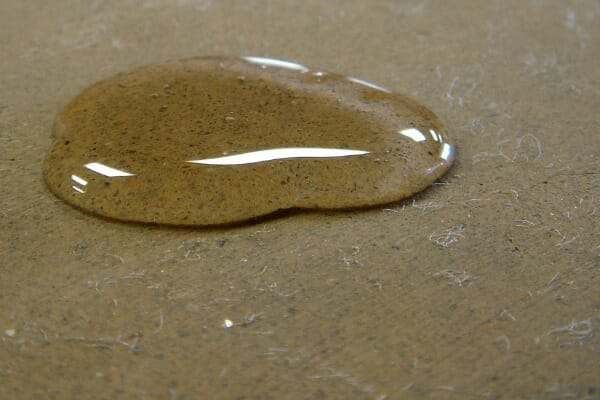
Pour a shot-glass amount of water in a few different areas of the slab, not just one. Increase the number of areas if it’s rather large. If the water immediately spreads slightly, darkens the concrete, and begins to be absorbed, it should accept a sealer or a coating.
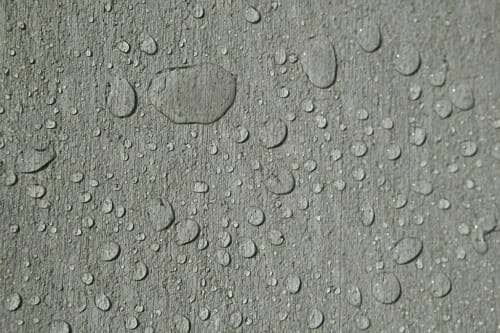
However, if the concrete doesn’t darken and water beads, or if it sits for a long time before absorption begins, this usually indicates one of four possibilities.
The first two are that the concrete may contain an admixture or finishing aid that restricts or repels water penetration. The third is that a curing aid may have been applied that blocks it.
The fourth may be an extremely smooth surface achieved through machine troweling and/or burnishing during the finishing process. Fortunately, this is the easiest to solve for.
For more information on the water drop test, read our article about testing for sealers in concrete.
Admixtures, Finishing, and Curing Aids that Interfere with Concrete Sealers and Coatings
To better understand your concrete’s condition, it’s important to know what admixtures, finishing aids, and curing aids are and what they do.
It will help you when inspecting a batch ticket or mix sheet from the concrete plant. It also helps when speaking with concrete contractors who have already placed your concrete, or when planning a new concrete project.
More importantly, it helps you choose the sealer or coating that best fits your needs based on your concrete’s condition.
Concrete Admixtures
Concrete admixtures are natural or manufactured chemical or mineral substances added to ready-mix concrete before or during mixing. In general, they strengthen, densify, and sometimes block moisture in the concrete.
There are four main types of concrete admixtures to be aware of:
- Water-reducing (WRA) and Superplasticizers – high-range water reducers (HRWR)
They reduce the water required in the concrete mix while keeping it highly flowable. As the concrete cures, tighter crystalline structures form and fill open capillaries, increasing density and strength fairly quickly.
- Mineral Pozzolans
These ultra-fine powders, consisting of silica fume or metakaolin, are added at the ready-mix plant to densify the mix. They chemically react with calcium hydroxide to form a bonding gel that fills gaps between microscopic cement grains, increasing density and reducing permeability.
- Crystalline Waterproofing Admixtures (PRAH)
These chemicals are added at the mixing plant and react with moisture to grow insoluble crystals inside the concrete pores. The crystals help densify the concrete and block moisture travel within the concrete after it has cured. PRAH admixtures are common for concrete exposed to hydrostatic pressure or below-grade slabs.
- Hydrophobic Liquid Admixtures
Also known as integral water-repelling admixtures, these are liquid admixtures that chemically react with cement to provide water repellency throughout the concrete. However, they do not increase concrete density or strength. They work well for outdoor concrete, such as driveways, patios, and walkways.
Finishing Aids
Finishing aids are liquid treatments that are applied and worked into the concrete surface during the finishing process. Applied via misting, they are colloidal silica formulations that improve workability during troweling.
They help in three ways:
- They limit rapid surface moisture loss, preventing premature drying.
- The colloidal silica chemically reacts with free lime in the concrete to densify and strengthen the surface.
- They lessen surface imperfections by decreasing shrinkage cracking, curling, crazing, and efflorescence.
Curing Aids
Curing aids, also known as cure-and-seals, are thin, film-forming sealers. They are applied immediately after finishing, once the concrete bleed water has evaporated and the surface can’t be marred by foot traffic.
Sometimes called a 2-in-1, they retain moisture in the concrete during curing, decreasing shrinkage cracking, curling, crazing, and efflorescence. They also provide topical film protection against dirt, mild chemicals, salts, moisture, foot traffic, and vehicles.
There are two types:
- Dissipating curing aids – Designed to deteriorate within three months when exposed to UV light, weather, and traffic, allowing you to apply a permanent sealer or coating thereafter. However, if applied indoors, such as on a garage floor or workshop, they can last longer and be semi-permanent.
- Semi-permanent curing aids – Thin, styrene-acrylic, film-forming sealers. They typically last 1-3 years before wearing out in high-traffic areas. They are generally not very durable.
Sealers and Coatings Compatible for Concrete with Admixtures, Finishing, and Curing Aids
Just because you have determined your concrete contains one of these, it doesn’t necessarily mean you can’t use a sealer or coating. That’s why testing matters.
We recommend discussing what product was used (if you know) with the concrete sealer vendor or manufacturer and sharing your test results. They will provide the best options.
However, we will discuss general sealer and coating options that may be compatible based on the admixture or finishing aid used.
Water reducers
Most sealers, such as silanes, siloxanes, siliconates, and fluorinated oil-repelling sealers, can be applied as long as the concrete absorbs water within a few minutes. Water reducers densify the concrete, but it still contains enough minerals for sealers to react with.
Coatings that do not require etching will work as well. However, we recommend testing the coating for proper adhesion in an inconspicuous area first.
You can also etch concrete that contains water-reducing admixtures for coatings that require it. However, mild etches such as citric acid are not strong enough. Muriatic or phosphoric acid solutions are much stronger. Grinding is the better option.
Mineral Pozzolans
The ultra-fine particles in mineral pozzolans fill microscopic voids in the concrete, making it harder for liquids and sealers to penetrate. As a result, a very small-molecule sealer, such as pure silane or fluorinated oil, and salt-repelling sealers are recommended.
Siliconate and siloxane sealers, with their larger molecular structure, will not penetrate the concrete well.
Coatings that do not require etching may adhere well, but test first to confirm. The denser surface may not allow enough penetration for proper adhesion.
Concrete with mineral pozzolans does not respond well to etching. Much of the calcium hydroxide and free lime that etching solutions react with has been consumed by the densifying process. Therefore, coatings that require a rougher surface profile will adhere only if the surface is mechanically profiled by grinding and not etching.
Hydrophobic Liquid Admixtures
Applying sealers to concrete with hydrophobic liquid admixtures is problematic because the concrete repels water. As a result, sealers may be repelled, and coatings will not adhere properly. Even if you grind the concrete, its integral water-repelling structure can prevent coatings from chemically crosslinking or mechanically bonding to the surface.
If the concrete passes a water drop test, you can apply a penetrating sealer. However, the performance may be limited. Included are silane, siloxane, and siliconate sealers. Fluorinated oil and salt-repelling sealers are also included.
Finishing Aids
Finishing aids densify the concrete surface and restrict liquid penetration. Apply sealers only if the concrete passes a water drop test. For coatings that do not require etching, test adhesion in an inconspicuous area before full application.
Grinding is required for coatings that require etching. Etching solutions are problematic because the surface lacks enough free lime and calcium hydroxide to react and work properly.
Curing aids
Do not apply sealers or coatings to concrete with a curing aid present. The topical film will block penetration into the concrete. Remove the curing aid first.
You can remove dissipating curing aids with a high-PSI pressure washer. Remove semi-permanent acrylic curing aids by grinding. Pressure washing will not work.
Final Tips
Test, test, test. The easiest way to avoid potential problems before applying a sealer or coating is to test your concrete first, especially if you don’t know its history. If you have any doubts or questions about what the testing revealed, consult with the vendor or manufacturer of the sealer you intend to use to discuss your results.
If you are planning a concrete slab for a garage, workshop, barn, driveway, etc., discuss the concrete ready-mix ingredients, finishing process, and curing plans ahead of time. Tell the contractor whether you plan to apply a concrete sealer or coating after the work is complete.
Lastly, discuss these details with the vendor or manufacturer of the sealer or coating you plan to use. If there are potential issues, now is the time to work them out with the concrete contractor. We have found that people are surprised to learn later that the contractor used an admixture or finishing aid that interferes with their sealing plans.

Leave a Reply