

Before you apply a coating, paint, sealer, or densifier to your garage floor or workshop, you need to determine whether the concrete has been sealed before or contains any other type of bond breaker. This helps you determine whether your concrete needs further prep and, if so, what type. Unless you know the slab’s history or how it was finished, you will not know for sure without testing.
Why test for sealed concrete or Bond Breakers?
Epoxy coatings, paints, and other topical film-forming sealers need to penetrate the surface to adhere properly. Concrete prep for most coatings requires etching at a minimum. This creates a surface profile that opens the concrete pores, allowing the coating to penetrate and achieve a mechanical bond.
If the concrete has been sealed, etching solutions (even muriatic acid) will be repelled and won’t penetrate. If they don’t penetrate the surface, they can’t react with the free lime and other minerals to dissolve the top layer of cement paste.
Coatings and concrete paint that don’t require etching also won’t adhere properly. Like etching solutions, they will be repelled and won’t bond, resulting in peeling.
Sealers must penetrate the concrete and react with the substrate to form a sealed barrier at the subsurface. Densifiers also need to penetrate and react with the substrate. If the concrete has been sealed before or contains a bond breaker, neither will be able to penetrate and react with the substrate’s minerals.
Examples of bond breakers include dirty concrete, grease, wax, oil stains, and tire dressing deposits. Sealers won’t penetrate, and coatings will not adhere if they are present.
Perform a Water Drop Test
So how do you check if your concrete has been sealed or contains bond breakers? You can perform a water drop test.
The test entails dripping small amounts of water over various areas of the concrete. A shot-glass amount works well. If the water beads up and the concrete doesn’t darken, like in the image below, you definitely have a sealer or another type of bond breaker.

However, if the concrete darkens and absorbs water within a few minutes, you don’t have a sealer or bond breaker.
The video above is an excellent example of how water reacts to sealed concrete versus unsealed concrete. The title is a bit misleading, however. Sealed concrete isn’t bad for epoxy or coatings. It just means that you have to grind the concrete to remove the sealer and prep it correctly.
Still not sure if you have sealed concrete?
In some circumstances, a water drop test may be inconclusive and leave you unsure whether your concrete has a sealer. It may have been treated with a curing aid. These are very thin-film coatings applied to the concrete during the finishing process. They retain moisture and control evaporation to reduce surface cracking and curling and achieve maximum strength.
Sometimes referred to as a cure-and-seal, there are two types. The first is dissipating, meaning it is designed to deteriorate on its own within a few months when exposed to UV light, weather, and traffic. However, on an indoor slab, it can remain semi-permanent.
The other type uses a styrene acrylic film and is considered semi-permanent. It typically lasts 1-3 years depending on surface traffic.
Additionally, hard-troweled or power-troweled concrete can create a smoother, less porous finish. Water on the surface may smear around a little bit and sit there for a while before eventually absorbing into the concrete.
An inconclusive water drop test, or one that works in some areas but not others, indicates the concrete may have a curing aid that has worn away or deteriorated in high-traffic areas.
If your concrete surface displays any of the above indicators, the next step is to test with a small solution of muriatic acid mixed at approximately 4 parts water to 1 part acid.
Apply a few drops of the acid solution to the areas you tested. Acid solutions work only when they react with free lime in concrete.
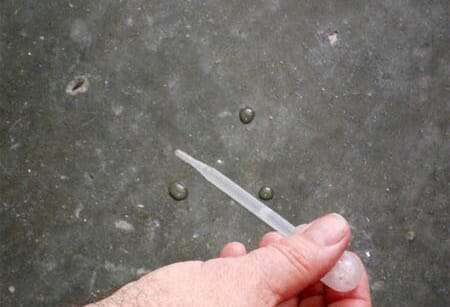
If the solution begins to bubble and fizz, then no sealer is present. If the acid solution just sits there without doing much, it is being repelled. This is definitive proof that a sealer, curing aid, or bond breaker is on the concrete.
Final tips
Before making a purchase, we highly recommend contacting the vendor or manufacturer for the sealer or coating if you are unsure about the current status of your concrete surface.
If you are applying a coating and testing indicates a sealer is present, it’s not necessarily a bad thing. It just means you will need to grind the concrete to remove it. Grinding removes the sealer and creates the proper profile for a coating at the same time.
If you don’t have a sealer or bond breaker, an etching solution will work if it’s required. Some sealers and floor coatings may not even require that, just a good concrete cleaning before application. Again, if you are ever in doubt, check with the vendor or manufacturer of your product before proceeding.

Thank you very much I have tested the floor I have put water on top it just rest on top and I put a sheet of plastic on it was dry next day thank you for your information