
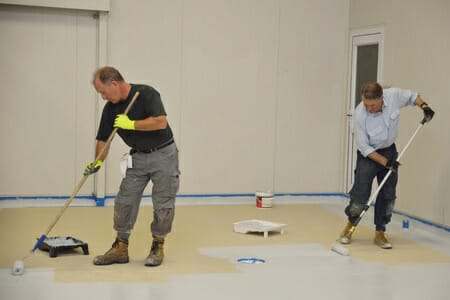
Are you planning a DIY garage floor epoxy installation? If so, consider this a “must read” if you want to avoid the most common errors that people make when applying a garage floor coating. From peeling epoxy floors to bad finishes, these 5 mistakes will cover 95% of all problems associated with either epoxy floor failure or appearance issues.
Day after day people install their own garage floor coatings and with great success. After the anticipation of creating a nicely coated garage floor however, nobody wants to go through the headaches and heartaches created when your floor doesn’t turn out like you expected.
So take a few moments to look over our list of common epoxy installation mistakes in order to insure a successful floor coating for your garage.
1. Poor floor preparation
This is the most common reason by far for epoxy floor failures and/or bad finishes. Many times when doing an epoxy garage floor coating for the first time, people underestimate how important it is to prep the concrete properly. It involves much more than making sure it is clean. Epoxy will not adhere to a smooth surface.
Not only does the surface have to be free of all oils, waxes, and other contaminants, the pores at the surface of the concrete need to be opened up properly. This usually involves acid etching at a minimum. Grinding the concrete in preparation for epoxy is even better, but it isn’t always feasible for the average homeowner. You can learn more about which method is best for you here.
The most common problem associated with poor floor prep is peeling or delamination of the epoxy.
Fisheyes is another problem. This is created by contaminants in the floor, such as grease or oil that causes the epoxy to pull away from the concrete while curing. It forms a circle in the finish resembling a fisheye.
2. Moisture in the concrete
This common mistake usually happens from not allowing the concrete to dry sufficiently after acid etching. Depending on temperature and humidity, you need to allow for a minimum of 24 hours, sometimes longer, for the concrete to dry. If not, moisture that is still trapped in the pores of the slab will rise to the surface and create bubbles in the finish.
Some water based epoxies and primers allow for application to concrete that may still be damp however. Contact the manufacturer for further information if you are unsure.
Not performing a moisture test is another mistake. Moisture under the slab can create hydrostatic pressure that will actually cause the epoxy to separate from the surface, sometimes taking pieces of concrete with it. You can avoid this problem by doing a simple moisture test first to determine if your floor is suitable or not for an epoxy coating.
3. Stretching out the epoxy
Stretching the epoxy out in order to cover the entire floor when you are running low will result in areas with a much less glossy surface and a distinct difference in color appearance. It also creates a weaker coating. This is a common mistake that is made with the single coat epoxy paint kits such as those from Rust-Oleum and Quikrete, but can also happen with premium epoxy products as well.
If you have a 400sf² garage floor for example and purchase a kit that has a coverage rate of 300-400sf², you will not have enough epoxy. A properly prepared floor is porous and will absorb some of the coating. You will run short.
Many manufacturers state in the fine print that you can expect up to a 15% material loss due to product left in the container and first coat applications. Most DIY installers are not aware of this. You can avoid this problem by making sure not to underestimate the amount of epoxy that you need.
Also, when pouring the freshly mixed batch of epoxy onto the floor or paint tray, do not scrape or try to get every last drop from the mixing container in an attempt to get the best coverage rate. The very bottom and sides of the container are never fully mixed properly. Doing so may result in spotty areas of the coating that will remain soft and not harden.
4. Faulty mixing of the epoxy
There are many problems associated with improper mixing. The most common of these issues is mixing too fast with a paddle mixer and trapping air in the epoxy. If this happens, you will get air bubbles in the surface during application. You can easily avoid this by not pumping the paddle mixer up and down or running the mixer too fast near the surface creating a vortex and sucking in air.
Other issues are not mixing the Part A resin and Part B hardener correctly or getting the ratios incorrect. Pay close attention to the mixing instructions. Some epoxies require the newly mixed batch to sit for a specific time before application. This is called induction time. If you don’t allow for this then the epoxy may not cure and harden properly.
5. Not following temperature and/or humidity restrictions
Be sure to follow the manufacturer’s recommended instructions for temperature and humidity. Epoxy applied at low temperatures or below those recommended may not cure and harden correctly.
If applying epoxy in high temperatures the pot life (time available to apply the epoxy) can be reduced by half or more. This can make the epoxy unworkable before you get it all applied as well as create bubbles from outgassing due to the warm temperatures.
High humidity levels can create a microscopic layer of moisture at the surface of the concrete that you cannot see. This will cause adhesion issues resulting in delamination or peeling of the epoxy. High humidity can cause some epoxies to blush at the surface as well.
Final thoughts
Achieving a successful floor coating isn’t that difficult. Many of these epoxy application errors can easily be avoided by thoroughly reading the manufacturer’s instructions. If ever you are in doubt, contact the manufacturer for clarification. Most problems could have been avoided this way. Also keep in mind that a bad batch of epoxy is extremely rare. The majority of problems associated with epoxy coated garage floors are due to these 5 common mistakes.
If you take the time to research your project, prepare your surface correctly, and make yourself familiar with the manufacturer’s instructions, you should be able to avoid these common mistakes and enjoy a successful garage floor coating that you can be proud of.

Just looking for some advice/help.
I have a 2 to 2.5 car garage (22’x22’). I got (2) of the 2 1/2 car epoxy shield rustoleum kits so I would have lots (after reading reviews this seemed like a good idea). My main question is. Should I mix all together and apply 1 coat generously to the space, or would i be better off to apply the one kit without the speckles, then let it cure (thumb print without leaving a dent as mentioned above) and apply the second coat/kit followed with speckles?
Also to note: I will be doing this on the lower end of the temperature spectrum. Highs here are 75 and Lows at night down to 55.
Thanks for the advice!
Hi Dan. You should only mix one kit at a time. Epoxy is exothermic. If you double the volume, the epoxy will get hot very quickly and the pot life will be very short. That is why you don’t see kits that allow you to mix larger batches. Pay close attention to your temperatures and try to apply each coat when the temps start climbing above 60 degrees. This will allow the epoxy stay above 60 for a much longer period of time. Once it drops below that, the curing process slows way down and may even stop. If you apply it too late in the day, the epoxy may stay tacky for too long of a period and not cure at all.
So I’m thinking I will mix the bases to make sure the color is consistent, then only apply 1 kit worth in the morning. No sprinkles let it cure all afternoon and repeat with the second kit the following morning finishing with the sprinkles.
Is propping a heater in the doorway a good idea to help with curing temp?
Thanks for quick response!
It looks good, Dan. Unless each kit consists of two separate batches to mix per kit, then there is no need to mix the color bases since one coat will go right on top of the other. If you were doing two mix batches side by side, then you would want to do that. Heaters will not do much unless it is large enough to heat the entire space. If so, start the heat before the temps begin to drop. Don’t use a kerosene heater though. The exhaust particles will cause issues with the finish.
We finished our garage floor earlier this year on new construction. We prepped it as instructed and covered it with two coats (and even put in some of chips and the additive to the paint to keep it a little rougher in case the floor got wet). It sat for at least a month or more. We find it gets scratched easily and we had a piece of tape that stuck to the floor pulled up a piece of paint when we tried to remove it. What did we do wrong or is there a hard coating we can put over top to prevent it from doing this? We used the Rustoleum expoxy.
Hello Sheryl. You most likely did nothing wrong if you followed the instructions. Unfortunately, things like this can happen with the home improvement store DIY epoxy kits. These are residential quality kits that do not provide for a thick, high performing coating. In addition, the provided etch has issues with not being strong enough at times to properly prep various concrete types. A clear epoxy coating by Rust-Oleum can be applied over the surface, but it will require prepping the current surface first. It will not prevent the current coating from further peeling though. If you don’t want these issues, your best bet is to completely replace it with a quality coating or live it out until you are ready to do so.
Thanks for the advice!
I just paid for a professional to epoxy my garage floor. When I’m open the garage door and the light enters – I can see the swirl marks of where the sander has dug in everywhere? It’s not a flat surface as I imagined it would be, is this right? Spent a lot of money on this 🙁
Hello Steve. No, this doesn’t sound right if it was a professional installation using commercial quality products. What coating products were used and how many coats were applied?
Thanks for the reply! Hmmm I didn’t get to see the product name, and they didn’t tell me. They put the flakes down one day, then came back the next morning and gave it one coat of epoxy. Later that day they came back and gave it a second (final) coat and that was it.
Unfortunately, we need more information than that, Steve. Was this a professional garage floor coating company or someone else you hired? A properly prepared concrete slab that was coated with commercial quality products would not look like that. If that is who you hired, you need them to come back and address the issue. If it was someone less than that, our guess is that they used a low quality coating product like something that you can purchase from your local home improvement center. The DIY coatings they sell are very thin and will not cover grinding marks.
How long will mix keep in a sealed container?
I may have to do 3/4 of floor one day then move some things over and finish remaining 1/4 next day
Hi Sean. There are a couple things here that you need to be aware of. Epoxy is not paint. It does not overlap and blend together well like paint on a wall does. When you come back later and pick up where you left off, there will be obvious overlap marks and there may even be difference in the color tone. You need a natural border to terminate a coating, such as a contraction joint.
In addition, epoxy is an exothermic coating that chemically cures to harden. It does not dry to hardness. When the two parts are mixed together, the resulting chemical reaction builds heat as it begins the hardening process. This is why a high solids epoxy has to be poured out onto the floor immediately after mixing and has a pot life on the floor of around 30 minutes or so. Low solids thin coatings (Rust-Oleum for example), require an induction time after mixing (short wait period depending on air temps) and then can be poured into a paint tray for a couple hours before it hardens up. If ANY mixed epoxy is left in a container for a short length of time (sealed lid or not) it will get extremely hot and start smoking. High solids epoxy will even melt buckets. This youtube video here explains the process and is a good example of what can happen.
I poured my garage floor yesterday using colored epoxy. 3/4 of the floor is gorgeous but unfortunately there is a large section that has hundreds of air bubbles. I read on your site that pouring in 2 separate sections will show overlapping and understand that it is not like overlapping paint. But cannot afford to do the entire floor again. If I do try to just do the section that did not turn out, is there a “ trick of the trade” that minimizes the overlap? By the way, there are no expansion joints. Any information would be greatly appreciated !’m
Hi Bee. Unfortunately there isn’t anything you can do to avoid seeing the difference. Our recommendation would be to tape off a line. At least this way it will have a defined edge to it. Don’t let the tape sit for too long afterwards as the coating begins to cure or it will be permanently stuck in it.
That is what I was afraid you would say ? I do thank you so much for your quick response! I appreciate your expertise!
I used Rustoleum Rock Solid (Polycuramine Metallic color coat & Polycuramine clear top coat) on my concrete garage floor. I acid etched the floor & power washed the floor several times since the floor was so old (1947) & greatly used. The floor has 3 sections (expansion joints cut into concrete). The color coat & clear top coat dried correctly & is not lifting. My problem is in one of the 3 sections there are what looks like oil spots seeping up through the concrete, color coat & clear top coat. This started to happen about 6 months after application. I can wipe the spots clean but they will resurface after a few days. What do you think is the cause? Is there a solution? Any suugestions would be greatly appreciated, Thank you.
Hello Paul. Most likely what you are seeing is a reaction to a certain mineral with moisture in the concrete. Minerals in concrete mixes are different all over the country due to the variations of soil for those areas. Some have more iron and magnesium than others. We’ve seen this before. Based on our experience, we are guessing that the concrete may not have had enough time to thoroughly dry all the way through. Pressure washers drive moisture deep into the concrete and it can take days for it all to evaporate out, sometimes longer depending on temps and humidity. The remaining moisture has activated with the iron or magnesium and has turned a reddish to oily dark brown in color. This moisture is being forced up through the coating. Once the moisture is completely gone, the oil brown spots will stop.
I have a
Coat of old epoxy already on the floor. Can I etch and go over it or does it need to be removed?
Hi Jason. Just as an FYI, you can’t etch coatings. Etches only work on bare concrete when they react with the minerals and free lime on the surface. If applied to a coating, it would just sit there and do nothing other than possibly discoloring the surface. This goes for acid as well. If the old coating is sound and adhered well, then it would require prepping by roughing up the surface with 120 grit sandpaper. We have an article about that here. If the coating is not sound and peeling in some areas, then we would recommend removing it entirely via grinding. A coating only as good as what it is adhered to.
Hi I applied coat on half of the garage yesterday . Now today when I planned to do other part my paint gone thick inside the pot. What should I do?
Hello Patel. What product exactly are you using?
Epoxy
The mistake you made is that epoxy is not paint. This article here explains more. Paint dries on a surface where as epoxy cures. When you mixed the two components together, you started a chemical reaction that begins the curing process. This curing process is limited by time and is what makes epoxy hard. Once epoxy is mixed, all of it needs to be applied or it will begin to harden. Depending on the type of epoxy you use, it can become too hard to apply in as little as 20 minutes or up to two hours. If you read the instructions, it will tell you what that time limit is.
You will love this. I applied 44 coats of Rust-oleum 2 Part Epoxy Shield to the master bathroom floor. It is about 150 sq ft. The underlayment is 3/8″ plywood. I should have used 3/4″ plywood, but as a novice DIY contractor building my own house, I thought I could scrimp a little and get away with it. 40 years later I decided to leave the shower and john in place, remove the remaining ceramic tile everywhere else, and use this product to increase floor thickness/structure and provide a newer, better surface.
Pot Life and Work Life both lasted for days. The floor is solid, looks fine (it is not shiny) and it is flush and level. Each coat added 3 mils or so depth and affixed nicely to the previous coat. Altogether it serves as a light weight continuous “carpet” of strong, attractive flooring.
I thought others might want to know that the characteristics of this epoxy mix , in terms of pot and work life, were much longer than advertised.
Hi Jack. 44 coats? That’s certainly a different way to go about it. Pot life if long because EpoxyShield is low solids water-based epoxy that uses older formulations. If the need comes about again, a 100% solids epoxy would be the way to go. You can lay it down 30-40 mils thick in one coat if you like.
Hi
New concrete floor with in floor heat. Air temp inside the garage is around 17 C(62 F). Air temp outside is ranging anywhere from 0-7 C. Purchased Rust-Oleum Epoxy Shield Garage Floor kit. Looking for tips and or comments. I’m worried it will dry very quickly with the in floor heat. Also concerned about the temperature variations inside the garage versus outside as I work closer to the garage door. Would it be best to wait until the outside temperature warms up? Should the floor heat itself be set at a certain temp? Also, what do I do at the actual garage door itself – do people raise the door and apply to the edge that is exposed to the outside?
Thank you
Hi Shelley. At what temperature is the surface of the concrete with the in-floor heat on? Do you have an inexpensive infrared thermometer to check?
i HAVE PAINTED THE TILES OF MY WET ROOM but THERE ARE SMALL AREA WHICH HAVRE NOT TAKEN THE PAINT. THE AREA FORM A LINE NEXT TO WALL, A FEW INCHES LON AND AROUND SIDE OF THE TOILET BOWL A WIDTH OF AN INCH AROUND THE SIDE AND FRONT.
ANY SUGGESTIONS – I SANDED FLOOR AND WASHED AND RINSED SO 99.9% OF FLOOR IS COVERED, NO PROBLEM??
Hello Clive. You did not state what product you used. Was it paint or epoxy? If it was epoxy, what was the solids content? Is the material not adhering or is it not filling in the areas you refer to?