
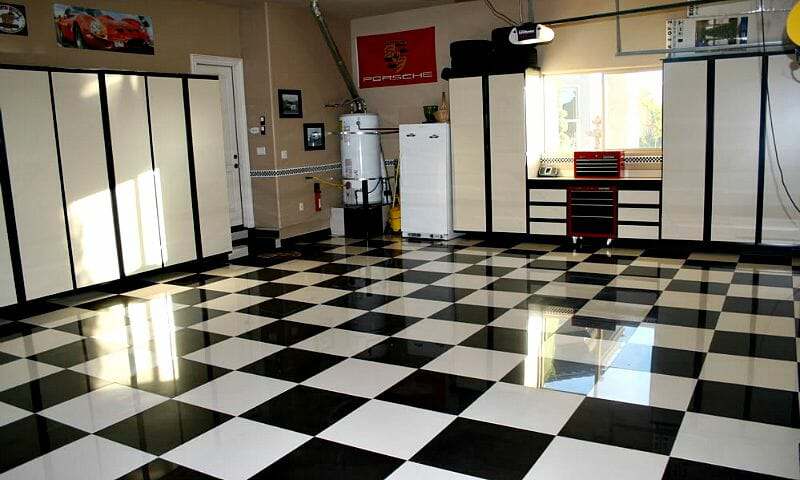
Porcelain tile for a garage floor generally isn’t the first thing that comes to mind when reviewing your garage flooring options. Besides, it’s only used inside the home and not in the garage, isn’t it? Or is it?
Well contrary to what you may have thought, more and more residential garages are being tiled with porcelain today. After all, it’s so durable that it is used quite often as showroom floors for auto dealerships, professional automotive mechanic garages, drive-through hotel porticos, and many other commercial applications that involve vehicles – so why not your own garage?
Benefits of Porcelain Garage Floors
The reason it is being used in these numerous applications are quite simple. Porcelain tile looks luxurious, it is extremely durable and is easy to maintain. It genuinely is the most durable and easy to clean of all garage floor tile options.
Because of its extreme high density when manufactured, porcelain absorbs very little moisture. This attribute makes it almost impervious to any kind of stains. The high density construction also makes it frost resistant (some say frost proof), scratch and chip resistant and resistant to impacts and heavy loads. It is also very resilient to abrasion which makes it hard to scratch. Additionally, porcelain tile is not affected by chemicals or cleaning agents and will not fade in sunlight.

Most porcelain is manufactured as a through-body tile. This means that the color and materials run through the thickness of the entire tile. If it does chip, the color won’t change and the area won’t be as noticeable. In the event that you do chip, crack, or break a tile, they can always be removed and replaced with a new one.
One ongoing myth about porcelain tile for a garage floor is that it will be too slippery. This actually isn’t true. With the correct rating, porcelain will not be any more slippery than standard concrete when wet and sometimes even less so. This is one reason why it is popular for entrances that are exposed to the weather.
Some nice features about porcelain are the abundance of nice colors and textures. Depending on how much you want to spend, you can install tile that looks like stone, marble, wood, travertine and an array of other materials.
It is also available in a variety of sizes so that you may get creative with the pattern on the floor. Most garage floors use a minimum size of 12”x12” and can go as large as 24”x24”. Smaller tiles can be used, but it will require more grout and can make a large floor look “busy” if you use too many.

How Porcelain Tiles are Rated
When shopping for porcelain tile for a garage floor, you need to be aware that they are rated for three different categories; hardness, slip resistance, and moisture.
The hardness rating is referred to as the PEI scale (Porcelain Enamel Institute). This helps to determine the durability of the tile in terms of how well the surface stands up to abrasion and traffic before the tile shows any sign of wear. For a garage you want a tile that is rated either a 4 or 5 on the PEI scale. A rating of 4 is for medium commercial use which is satisfactory for a garage floor. A rating of 5 is for heavy commercial use.
Slip resistance is measured as the coefficient of friction on a wet surface. The Ceramic Tile Institute has created three categories based on these ratings. Tile that is rated at 0.60 or greater is considered ‘slip resistant’ and meets or exceeds OSHA and ADA requirements for a wet surface. A rating of 0.50 to 0.59 is considered ‘conditionally slip resistant’ and meets or exceeds OSHA requirements. Any tile rated below 0.50 is considered ‘questionable’ for slip resistance.
Update:
A new dynamic coefficient of friction (DCOF) rating is now being used for porcelain tile, though some companies may still be using the older rating system. The American National Standards Institute (ANSI) states that tiles selected for level interior spaces expected to be walked upon when wet must have a minimum wet DCOF AcuTest value of 0.42.
The last rating is for moisture absorption. In order to be properly certified as porcelain tile, it must be rated at or below 0.5% for moisture. Such a rating is considered impervious to water. This is what makes it frost proof, stain proof, and water damage proof.
Most tiles should have these ratings displayed on the packaging somewhere for you to see. If you can’t find it, consult the manufacturer to determine its ratings.
Porcelain garage tile costs
The cost of porcelain tile varies depending on your choice of size, color, texture, and ratings. Though it can run as high as $5.00 per square foot or more for a boutique type of tile, many people have found porcelain tile on sale for just under $1.00 per square foot at their local home improvement centers. These tiles usually have a minimum PEI rating of 4 and a slip resistance greater than 0.50 wet.
You do need to consider the cost of other supplies that you will need when installing tile, such as grout, thinset mortar, trowels, and etc. Darker grout colors are preferred for their ability to hide dirt and depending on what type of grout you choose, you may have to seal it as well.
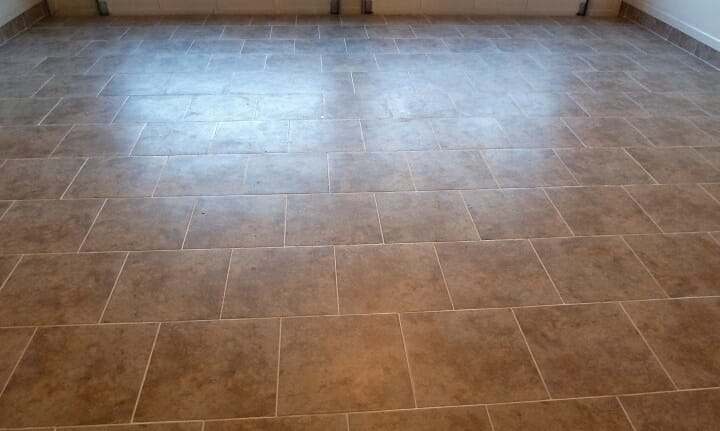
This is a great example of porcelain tile a homeowner purchased on sale and then hired a local tile setter to install it
Some preparation of your garage floor may be required beyond cleaning of the concrete. Contraction joints will need to be filled and it’s important to make sure you have a fairly even surface (no extreme high and low spots) before laying the tile. If you have experience with installing tile and choose to do it yourself, you can end up with a beautiful looking garage floor for a fraction of the cost. John Bridge has a great forum to get information about installing tiles and the Tile Council of North America has good information on thinset and grout.
For those of us who are not as skilled, installers can be found to do it for you. Costs for installation vary, but depending on what part of the country you live in people have been getting their tile installed for as little as $2.00 per square foot. Just remember to always ask for references before hiring someone.
If you want to have a tough and durable floor that will add a touch of class to your garage, then installing porcelain garage floor tile may be just what you need. It will last for years and years, it is very easy to clean, and it will give you one of the best returns on your dollar for the duration of the floor.
I just came onto your post and found it quite interesting. I am also associated with tiles in the uk, swimming pool tiles, tile suppliers, and love to enjoy the stuff on the same as its rarely found on internet. Thanks again for writing such a good post.
Thanks Jose, I’m glad you enjoyed it.
Thanks for the informative post. I am wondering how the tiles would fair if a jack was used to raise a car. Would the tiles crack?
Hi Vincent and thanks for the good question. Porcelain tile works quite well with jacks. We know of people who jack up one side of their cars with just one jack. Porcelain is extremely tough. As long as it is laid down correctly without air pockets underneath, it is very hard to crack.
Thanks Shea,
Any idea how porcelain tiles would handle winter conditions (cold temperatures, snow & salt)?
You’re welcome Vincent. The snow and salt will not affect the tile. Just make sure to seal the grout to make sure that you don’t get any salt residue left in the grout when you clean. Since you live in a snowy climate, we recommend using a tile with a minimum coefficient of friction of 0.55. That is about equivalent to bare concrete. 0.60 or higher is considered slip resistant.
Great article. What type of edge should I put on the tile where the car rolls up onto the floor? Also, what size grout lines do you recommend ?
Thank you.
Hi Nancy. 1/8″ to 3/16″ grout lines work best. Tool box wheels, rolling jacks, and creepers roll right over them with no issues. For the front edge you can use a Schluter Strip like this Reno Ramp if you like.
I’ve used Fusion grout from Home Depot (a blend of epoxy and acrylic base) with excellent results. Don’t spread this type of grout any more than necessary as it is very difficult to clean once dry on the top of the tiles. The price is worth the water and stain resistance. $50 per 1 gallon container.
Porcelain tiles that have NO JOINTS? Laid tightly together, can this be done?
No grout lines… No interlocking plastic tiles…
Technically it can be done Qbanchef if you use quality, rectified porcelain tiles. The problem however is that dirt and debris still work into the seams and are hard to clean. Also, tile butted up against each other tend to chip the edges during expansion and contraction over time. This is why you never see it done by professionals.
I cannot thank you enough for this reply…
Hi shea, interesting article and something I’m looking to do in my new place in the UK;
Not sure what its like in the US but garage floors here tend to have a rough concrete finish with slight stippling – wondering how much depth of mortar is realistic to allow for this, or would i really need to grind the floor down to something a bit smoother?
Hello Richard. Here in the U.S. a 1/2 by 1/2 notch trowel is common for tiles 12″ square or larger. It doesn’t create a 1/2″ thinset bed, but it should be enough to cover the depth of the stippled finish.
great article shea, i am about to do this to our lakehouse garage floor in the spring, we are using porcelin tile and i will be driving vehicles on it from time to time. do you recommend a ditra mat underlay or would that make it prone to cracking with the weight of a vehicle on it.
Hi Kirk. If you have large contraction joints in your slab, running large strips of Ditra over the joints may be fine. Other than that, we are not aware of a garage floor that has used Ditra matting. However, if you live in a cold weather climate, AquaDefense by Mapei has been used successfully on many garage floors to prevent cracks in the slab from telegraphing through to the tile.
Thanks for the great article. I have found some nice porcelain tiles for my new basement garage that are rated at 45N/mm do you think these would be strong enough. The basement is large should I add special expansion joints in the tiles and if so should these line up with the concrete expansion joints.
Hello Robert. We’re not sure how the 45N/mm converts to a PEI rating. This rating is what determines the how well the tile holds up in the environment it will be used. You want a PEI rating of 4 or 5. You may want to contact the manufacturer or vendor to get the answer for this.
Many people have chosen not to use expansion joints in the garage and with great success. However, the larger the area becomes, the more you increase the chance of issues without one. If you do, it’s usually best to run them atop the current contraction joints in the slab.
Thanks Shea.
The Vendor only knows the N/mm. I could not find out either how these compare.
I thought I would follow atop the current contraction joints also. I will check with Tiler though as contraction joints go diagonally across the area, so will not work.
Thanks for you article again and your response.
Hi Shea..i just installed porcelaine in my garage now i wonder how do i have to wait to park my car inside the garage,,,thanks for the great article……freddy
Hi Freddy. 72 hours to park cars on it.
Thanks
Hi Shea
This is Wilson from York in the UK.
What is the reason for PEI 4/5? Is it because lower PEI values would crack.
Also are you aware of the PSI applied by a tyre on a car, for example a 3 Series BM, and what impact does this have, i.e. does it spread the load sufficiently.
Regards
Wilson
Hello Wilson. Tile PEI ratings help to determine the density and hardness of tiles. A PEI rating of 1 for example is generally for wall tile and will not even accept foot traffic. You need a rating of 4 or 5 to accept car traffic. In order to determine the PSI applied by a car tire, you would need to divide the weight applied by that tire by the total square inches of the tire contact patch.
The most important part of a porcelain tile installation for a garage is sufficient PEI ratings and no air gaps in the mortar bed of the tile. We suggest you read this here to see how tough tile can be in a garage.
ok, I’m sold. Where is a good place to buy the tile ?
You have to shop around John. Home improvement centers sometimes have outstanding deals on properly rated porcelain tile as low as $1 a square foot. Some online vendors have deals on discontinued lines or inventory overstock as well.
If you use underfloor heating will the tiles crack?
No, not at all Michael. It’s very common in colder climates to use such heating with tile floors.
I had DIY’d 16″ porcelain onto 600sf of my residence, above a crawl space and with hydronic heat. Zero issues over twelve years except, of course, for keeping light colored grout looking clean. I had always planned to tile the garage and because of look and durability, porcelain was on my short list.
This article confirms that I’m not crazy and informs as to how, reducing procurement risks immensely. I can now set aside any ideas about using stone (slate, granite). I might add that mortar is important, with thin-set type having a much lower PSI rating than standard.
My greatest concern is not so much about supporting a car’s weight but rather impact resistance from say a one-pound tool dropped from say 3 feet and landing in just the wrong way. The solution would be to buy extra tile, then cut-and-paste.
That’s correct Hyper. Keep in mind that through-body porcelain tiles are the same color all the way through the tile. If you do chip one, it’s much less noticeable.
I’m thinking of putting porcelain tile in my pet grooming salon, which has been made out of my 2-car garage (1/2 of it). I’ve had paint-on flooring for the last several years, but I have to re-do it at least once a year. Is there any special considerations? I want something that will last more than a year, is moisture resistant (wet dogs & humidity), but will look nice. Although I live in Colorado, the salon never gets below 40 degrees F.
Porcelain tile is water proof vttk, so no worries there. It’s important to select a good grout however. Standard grout is a cementitious powder mix that will absorb water. That is why it stains so easily and requires sealing to help prevent water penetration and staining. We recommend using epoxy grout for your situation. It’s a mix of epoxy resins and colored filler powder that once cured, is water proof and very difficult to stain. SpectraLock Pro is a good example. It costs more than standard grout and is a little more difficult to work with, but the results and ease of maintenance are worth the effort.
HI, anything special need to be done to set porcelain tile in a garage that will house a 54,000 pound motor home, or just additional time to set, thanks Jim
Hello Jim. The most important part is making sure there are no air gaps when laying the tile. Each tile should have thinset applied to the back of the tile (back butter) as well as thinset applied to the concrete. This will insure no air gaps so the tile will not crack under load or impact.
Hi, am considering porcelain tiling our large garage in the UK as new paint has cracked/started to come off. The paint was applied over an old painted floor, so there are 2 layers of paint now. My query is, would a floor scarifier machine prepare the existing (painted) floor sufficiently to lay the tiles onto? If not, how can the 2 paint layers be removed & the floor prepared? Many thanks.
Yes it would Helz. As long as you expose the concrete with a scarifier, shot blaster, or grinder, you will be good to go.
Can you tile an outdoor carport? Most of it is covered but water and snow will get to part of it.
Thanks
Yes you can Troy. Tile is used outdoors as a driving surface all the time. It’s particularly popular with hotels.
Hello Shea,
Thank you for all your help. I would like recommendations on the transition between the porcelain tile in the garage to the outside concrete. I’m estimating an increase in height of about 1-1/4 inch due to the uneven floor after the tile installation.
The Reno Ramp by Schluter is very popular as a transition strip for the garage Francisco. An issue may be the 1-1/4″ height, however. That is a big transition and seems large considering that most porcelain tile is only 3/8″ thick with some larger 18″ sizes running up to 1/2″ thick. You may need to make an adjustment to the first row or two to bring that transition down to a more realistic height.
I am considering porcelain tile for my garage floor in MN. My question is that some of the floor is pitted up to 1/8″ from years of salt in MN winters. Can I deal with that by just using thicker thin set in those areas to compensate for the pitting?
Yes you can Rick. Just make sure that all the loose and weak material from the surface is removed first in order to provide a solid foundation for the thinset to adhere to. Also, be sure to use a good quality polymer-modified thinset mortar since it will be freeze thaw resistant and be sure to apply it to the back of the tile as well as the surface when laying the tile. This will prevent air gaps which you do not want.
When laying the tile by the garage door, should I bring the tile all the way to the edge of the garage floor (under the garage door) and then adhere the Reno Ramp by Schluter outside the garage door to transition from the tile to the driveway? Or should I stop the tile before it goes under the garage door and then place the Reno Ramp by Schluter under the garage door?
Hello Donna. Ideally you want the Reno Ramp on the inside of the door and right up against the bottom seal or at least close to it when it comes to a rest.
We are looking at options to cover our garage floor. After years of paint soils and stains it really needs some improvement. I would like to put in a porcelain tile floor however our garage slopes and my hubby says the tile will crack were it slopes. Do you have any answers in this situation
Thanks
Hello Angie. When you say the garage slopes, can you be a little more specific in how it slopes? In other words, is there a certain spot where the elevation changes by sloping up or down? Or is it something else?
Hi. Great info. I am leaning towards laying porcelain in my garage. I live in Alberta Canada so gets very cold in winters. You’ve already addressed the frost and slip issue so I’m convinced. My question is about temperature for laying tiles. It’s fall now and getting colder. What’s the lowest temp I can lay the tiles in?
Hi BC. The general rule of thumb is 50 degrees for a minimum of 3 days for cure. However, Laticrete has a thin set that can be used at temps down to 40 degrees if I remember correctly. We would recommend contacting Laticrete to ask.
Hello,
We are building a new house on a hillside in Los Angeles, and I am thinking about tile in the garage. The house is modern and we want a seamless look through out, and our garage will be finished and drywalled. The tiles we are installing throughout our home is 24″x48″ cement look tiles. Because the house is on a hillside, the top level is the garage, and the rest of the house is below. Since it is a new build, we will not have the cement on the ground already. Do the tiles have to be installed on cement in the garage? or can the installation be like regular tile, Subfloor (Wood) > Cement board > Tile? Can I still have 3/16th grout lines with this application?
The tile needs to be laid on concrete for a garage floor, Eddy. Wood sub-flooring will flex under the weight of a 3500 to 4000 lb car. This will cause the tile to crack since porcelain does not flex at all. If you pour concrete, you will need to wait a minimum of 28 days for the concrete to cure before you can lay the tile. 3/16″ grout lines work great for a garage floor. Just be sure to back butter the tiles well and use a 1/2″ x 1/2″ trowel for tile that size.
Great information!
I’ve purchased an old shop and am in the midst of redoing the entire thing inside and out. The garage areas is approximately 50 X 60. Since I’ll be finishing the garage interior with new wall and ceiling coverings, and since the theme will be petrolinia and housing of some fun cars, I’d like to put porcelain tile on the floor. In one of the stalls I plan on parking our 45 class A motorhome. We live in SW WI, so have winter weather to contend with also. Will the floor handle a very large motorhome, the weather, etc? Any suggestions you might have would be greatly appreciated.
Thanks,
Jim
Yes it will, Jim. The key is to add mortar to the back of the tiles (back butter) as well as the the floor. This eliminates any chances of developing a large air pocket or void. As long as you don’t have the air pockets, the tile remains extremely strong in terms of compressive strength and can take a tremendous amount of weight. Make sure to use a polymer-modified mortar that is approved for exterior applications. These have the additional flex needed for severe temperature changes. Also, honor and joints or be sure to use a crack isolation membrane over the joints. Have fun with your garage!
Many Thanks for such a great article and set of answered questions. My question is about porcelain tile as compared to marble tile. I like the look of the black and white diagonal marble tile floors of French Chateaus. Aside from the cost, is marble as hard and water resistant to support the weight of cars and rain and snow? If not, is there a type of porcelain tile that would have the look and feel of marble, woukd be available in black and white, and would have all the properties you outlined above? If so, where might I find such tile? My project is a beach house garage/pool house on the coast in North Carolina. Thanks!
Hello Rod. You don’t want to use marble tile for a garage floor. The two main reasons is that marble is porous and not nearly as dense and hard as porcelain. This means it would chip much easier and could possibly crack under weight. Marble tile also requires sealers and constant maintenance to prevent staining due to it’s porous nature. The sealers for marble are not very resistant to automotive chemicals as well. There are porcelain tiles that look like marble, but they are not so easily sourced. We suggest talking with some tile distributors in your area who are accustomed to special orders. They may be able to find what you are looking for.