
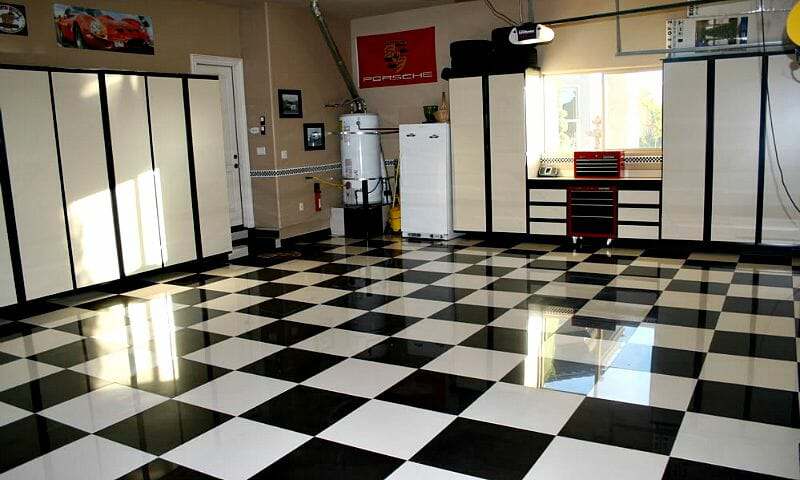
Porcelain tile for a garage floor generally isn’t the first thing that comes to mind when reviewing your garage flooring options. Besides, it’s only used inside the home and not in the garage, isn’t it? Or is it?
Well contrary to what you may have thought, more and more residential garages are being tiled with porcelain today. After all, it’s so durable that it is used quite often as showroom floors for auto dealerships, professional automotive mechanic garages, drive-through hotel porticos, and many other commercial applications that involve vehicles – so why not your own garage?
Benefits of Porcelain Garage Floors
The reason it is being used in these numerous applications are quite simple. Porcelain tile looks luxurious, it is extremely durable and is easy to maintain. It genuinely is the most durable and easy to clean of all garage floor tile options.
Because of its extreme high density when manufactured, porcelain absorbs very little moisture. This attribute makes it almost impervious to any kind of stains. The high density construction also makes it frost resistant (some say frost proof), scratch and chip resistant and resistant to impacts and heavy loads. It is also very resilient to abrasion which makes it hard to scratch. Additionally, porcelain tile is not affected by chemicals or cleaning agents and will not fade in sunlight.

Most porcelain is manufactured as a through-body tile. This means that the color and materials run through the thickness of the entire tile. If it does chip, the color won’t change and the area won’t be as noticeable. In the event that you do chip, crack, or break a tile, they can always be removed and replaced with a new one.
One ongoing myth about porcelain tile for a garage floor is that it will be too slippery. This actually isn’t true. With the correct rating, porcelain will not be any more slippery than standard concrete when wet and sometimes even less so. This is one reason why it is popular for entrances that are exposed to the weather.
Some nice features about porcelain are the abundance of nice colors and textures. Depending on how much you want to spend, you can install tile that looks like stone, marble, wood, travertine and an array of other materials.
It is also available in a variety of sizes so that you may get creative with the pattern on the floor. Most garage floors use a minimum size of 12”x12” and can go as large as 24”x24”. Smaller tiles can be used, but it will require more grout and can make a large floor look “busy” if you use too many.

How Porcelain Tiles are Rated
When shopping for porcelain tile for a garage floor, you need to be aware that they are rated for three different categories; hardness, slip resistance, and moisture.
The hardness rating is referred to as the PEI scale (Porcelain Enamel Institute). This helps to determine the durability of the tile in terms of how well the surface stands up to abrasion and traffic before the tile shows any sign of wear. For a garage you want a tile that is rated either a 4 or 5 on the PEI scale. A rating of 4 is for medium commercial use which is satisfactory for a garage floor. A rating of 5 is for heavy commercial use.
Slip resistance is measured as the coefficient of friction on a wet surface. The Ceramic Tile Institute has created three categories based on these ratings. Tile that is rated at 0.60 or greater is considered ‘slip resistant’ and meets or exceeds OSHA and ADA requirements for a wet surface. A rating of 0.50 to 0.59 is considered ‘conditionally slip resistant’ and meets or exceeds OSHA requirements. Any tile rated below 0.50 is considered ‘questionable’ for slip resistance.
Update:
A new dynamic coefficient of friction (DCOF) rating is now being used for porcelain tile, though some companies may still be using the older rating system. The American National Standards Institute (ANSI) states that tiles selected for level interior spaces expected to be walked upon when wet must have a minimum wet DCOF AcuTest value of 0.42.
The last rating is for moisture absorption. In order to be properly certified as porcelain tile, it must be rated at or below 0.5% for moisture. Such a rating is considered impervious to water. This is what makes it frost proof, stain proof, and water damage proof.
Most tiles should have these ratings displayed on the packaging somewhere for you to see. If you can’t find it, consult the manufacturer to determine its ratings.
Porcelain garage tile costs
The cost of porcelain tile varies depending on your choice of size, color, texture, and ratings. Though it can run as high as $5.00 per square foot or more for a boutique type of tile, many people have found porcelain tile on sale for just under $1.00 per square foot at their local home improvement centers. These tiles usually have a minimum PEI rating of 4 and a slip resistance greater than 0.50 wet.
You do need to consider the cost of other supplies that you will need when installing tile, such as grout, thinset mortar, trowels, and etc. Darker grout colors are preferred for their ability to hide dirt and depending on what type of grout you choose, you may have to seal it as well.
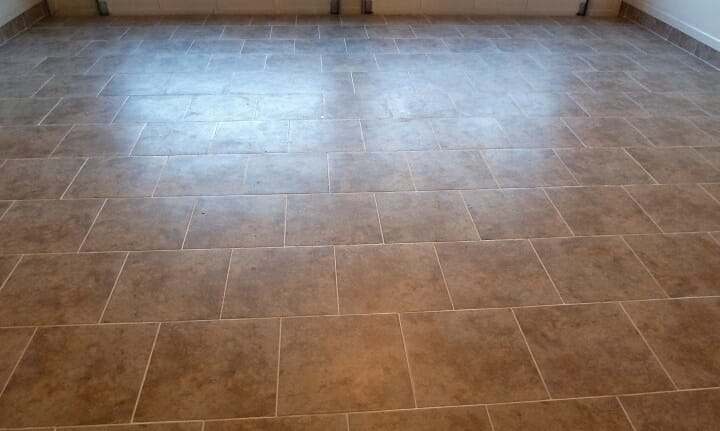
This is a great example of porcelain tile a homeowner purchased on sale and then hired a local tile setter to install it
Some preparation of your garage floor may be required beyond cleaning of the concrete. Contraction joints will need to be filled and it’s important to make sure you have a fairly even surface (no extreme high and low spots) before laying the tile. If you have experience with installing tile and choose to do it yourself, you can end up with a beautiful looking garage floor for a fraction of the cost. John Bridge has a great forum to get information about installing tiles and the Tile Council of North America has good information on thinset and grout.
For those of us who are not as skilled, installers can be found to do it for you. Costs for installation vary, but depending on what part of the country you live in people have been getting their tile installed for as little as $2.00 per square foot. Just remember to always ask for references before hiring someone.
If you want to have a tough and durable floor that will add a touch of class to your garage, then installing porcelain garage floor tile may be just what you need. It will last for years and years, it is very easy to clean, and it will give you one of the best returns on your dollar for the duration of the floor.
I’m thinking about laying tile on my carport floor and through the years it’s been painted several times and it always wears off from tires Would hot tires have any impact on the tile?
Hello Travis. No, tires will not have any impact on the tile in terms of wear. You may get the occasional tire tread mark, but these clean off real easy. This article here explains gives more examples of how tough porcelain tile can be.
Hello, my local tile supply house said I need to install ditra for the portion that ij would be driving on is this correct or can i just tile it all the same way without sites? What should i fill joints with? Thanks
Mike
No, ditra is not needed, Mike. Fill the joints ahead of time with either thinset or self-leveling underlayment. If you can, try to honor the joints or apply some Red Guard over them once they are filled.
I live in Minnesota cold! What type of grout should I be using on the tile?
Hello Judy. Any of the premium grout brands will work fine. Just be sure to seal the grout well or the chemicals from road salts and deicing fluids can damage the grout. We prefer epoxy grout since it does not require sealing and is highly resistant to staining. It is more expensive, however. Also, since your slab can get some contraction and expansion from the extreme temperature changes over a year, we would recommend a using polymer-modified thinset that is flexible. Applying a crack isolation membrane beforehand is a good idea as well. Red Guard is an example. It’s applied to the concrete on a roller just as paint would be. It’s easy to do and only one coat is required.
Thanks for the great info. On new garage construction in North Carolina how long should one wait to install porcelain tile? Second, please advise if you feel a coat of “Red Guard” is advised over the entire floor as one does in a shower install to help with cracking telegraphing through? I see where you mention using RG over the joints, but would just doing the whole floor be better?
Hi Dean. You need to wait a minimum of 28 days for concrete to cure enough before laying tile. Yes, RG (RedGard – I always misspell their trade name) can be applied to the entire floor. For new concrete it’s not a bad idea. Though a 4″ concrete slab cures in roughly 28 days, hydration, the chemical reaction that actually makes the concrete hard, can go on for months. It’s not uncommon for small surface cracks to appear during this phase.
I am installing porcelain tile in the garage of a new home. What is the best product to use at the leading edge where the car enters into the garage to protect the first row of tiles?
Hello Michael. The Schluter Reno Ramp works best. You can order it from most home improvement centers and tile stores.
The best option is to use Ditra for your tile installations.
Have a ceramic tile garage floor for years. Want to tile driveway also, over existing concrete. Is this practical in southern Florida?
Hi Martin. Yes, you can install porcelain tile on the driveway also. Just make sure to honor the expansion joints between slabs and use thinset that is approved for outdoor use.
Hi Shea, I am getting ridiculous quotes from local installers to tile a 480sqft garage in Seattle. So far the quotes are $9K to $11K which includes materials and labor but not the tile itself. This is a brand new home that has a brand new garage floor.
Something seems a bit off and wanted your advice on how else to approach this project. I have never installed a tile but I will learn how to do it before spending $15K. Do you have any recommendation for an installers in Washington State?
Hi TTG. Yes, those quotes are way off for you supplying the tile and the installer supplying the rest. We don’t have any recommendations for installers in your area, however, sometimes you can find good recommendations by asking the different tile stores in your area. Home improvement centers sometimes have leads on people installers as well. Many times it just involves asking around with people withing the construction industry. With the economy picking up, it might be harder to find a good deal. A few years ago you could find installers in our neck of the woods at $2-$3 per square foot.
Hi TTG…I’m in the Seattle area, wondering if you ever found an installer or did you do it yourself?
Hi Mary. Our comments section does not perform like a forum, so TTG would not be notified of your comment. We will post it though just in case TTG checks back.
I live in ottawa ontario. My garage is lower than the driveway by 2 inches so the water returns back when snow melts. How high are the tiles? Can we raise the underlying layer (cementing ) and in that case would it be durable enough or weakened?
Hi Neda. Porcelain tile is only 3/8″ thick on average. With the mortar base it would only raise the height of your garage floor by approximately 1/2″ or so. A 2″ overlay would be strong enough if applied with the correct polymer-modified cement. It’s not a one man job though and best performed by a contractor.
Hello,
Can you use any size tile in a garage? Would a longer tile be more prone to breaking? I have a client looking at wood look tile for their garage and she wants a larger tile.
Hello Cayla. Yes, you can use just about any size tile. We don’t recommend smaller sizes though (less than 12×12) since it requires more work, more grout, and tends to look busy. Properly rated tile that is long will not break if it is laid correctly. A 1/2″ notched trowel should be used, the tile should be back buttered and you should not have any air gaps under the tile, particularly the edges. Air gaps under weight of a vehicle is what can make tile crack.
One thing to be aware of after talking with many professional installers is that the wood planked tile can be a bear to work with sometimes. Due to the long and narrower shape, many tend to have a slight bow in the tile that can make the task of preventing lippage (one edge higher/lower than the other) challenging. A good tile setter can do it, but it can take time. They recommend laying the pattern out in thirds.
I currently have tile installed in my garage. The tiles that sit directly below the engines have buckled over the years. My theory is during the winter when the tiles are cold the mortar or adhesive lost integrity when the cars were parked with hot engines. Do you have a solution or suggestion for this. I can send you a picture of what I found beneath the tiles (doesn’t look very durable or permanent). I’m looking to have retile very soon!
Hi Anthony. It’s important to use a premium thinset that has the flexibility required for such conditions. Flexbond is an example. Also, make sure that you don’t have a moisture issue from under the slab as well. Moisture can cause the same problem. Additionally, applying a product such as RedGard to the concrete before you tile can help ensure that you don’t encounter those type of issues. Lastly, when you do tile it’s very important to back butter the tiles to make sure there are not air pockets between the tile and cement.
Silly question.
Have a garage thats more of a bar / added room.
Sometimes we do put our car in there.
Can we get away with PEI 3? Less concerned about slickness or scratching (barroom floor) more concerned about the tile cracking under weight of the car.
What do you guys think?
Hi Stephen. If you are just occasionally parking a car on the tile then you can get away with a PEI 3 rating. If it was more than that we would not recommend it. The key is to back butter the tiles during installation to make sure that there are no air pockets under the tiles, especially around the edges. That is where the tile will crack under the weight of a car. If they are installed with full thinset under the tile and edges, then you will be OK.
These floors are simply stunning! And oh to have that “Woody” stationwagon in my own garage.
I used epoxy paint and it wears. Just bought a new (to me) house I’m looking to do an amazing garage. A store I called said porcelain tiles will crack. True?
I want to do the best I can for looks and longevity. I’m outside Los Angeles. Ideas?
Hi Kevin. No, it’s not true. I’m guessing the person you spoke with was not that knowledgeable about porcelain tile and its uses. We give a few examples of how it is used in the article you just commented on. You can also find examples of it being used in garages in this article here and another example here. One of those article even has a video of a guy striking his floor multiple times with a 5lb. sledge hammer. The key is use the appropriate rating of PEI 4 or PEI 5 tile. Also, you cannot have any air gaps under the tile or the edges. It is considered a premium garage flooring option and one of the most durable or all.
Is it critical to remove old paint from the floor before tiling? Any recommendations on how to get the paint off and prep the surface for the tile?
Hello Steve. Yes, it’s important to remove any old paint. Paint does not adhere as well to concrete as thinset does and thinset does not adhere to paint well. You can either chemically strip the paint off or you can grind. As long as the concrete is clean and absorbs water after the paint is removed, then it should be fine for the thinset.
Great info. I am considering porcelain tile in our garage. Concrete was poured in 1988 and in 1989, I “sealed” the concrete with Thompsons water seal. Should I do any special prep due to the Thompsons or is regular cleaning enough prior to using RedGard and modified thinset?
Thanks much.
John
Hello John. You will need to do a water drop test in various areas. If the concrete immediately turns dark and begins to absorb the water, then you should be good. However, if the concrete does not turn dark and/or the water drops just sit there without doing much, then you will need to lightly grind the surface first to remove the sealer.
I would love this but my concern is with working in the garage on a porcelain floor. How would the tile hold up to hydraulic jack use and raising your car. I would think that the small wheels of the jack which are usually steel might be an issue. I often do my own work on a jeep and a Porsche. though these are not too heavy I am hesitant regarding the ability of the tile to hold up and of any safety issues this might introduce. What is your opinion?
Hi Mick. I think you may have missed the link in the article that takes you to this one. We actually address your concerns and more. There is even a short video of a man taking a sledge hammer to his tile with no breakage. When properly laid, nothing is more tough and resilient than porcelain.
What brand of porcelain black and white tiles were used on your display page?
Hi Larry. We don’t know the brand, but it was purchased 5 or 6 years ago from Build Direct.
Hello Shea, Our garage has a 20 year old asphalt 12×12 black & white checkered floor which failed in less the 2 years. It’s the same flooring that is used in big box grocery stores, the problem was, I didn’t keep up with the waxing that was required, so now it looks like crap ! My 1st question..can I install a high grade 24×24 porcelain tile directly over it ? The existing tiles were installed with a crazy strong adhesive that is rock solid ! I did removed one once, and it required a torch to remove ! 2nd question..your picture at the top of your site appears to be lacking grout lines? Thats the exact look I’m going for, and lastly.. What is the factory finish on that tile ? High Gloss, or is there a gloss sealer applied ? Again, that picture is the exact look I’m going for,.. No Grout Lines & a High Gloss Finish!?
Thank You.
Bill
Hello Bill. Technically, you can get thinset to adhere to vinyl composite tile if you strip the wax and rough up the surface enough via sanding with 60 grit. However, it is not recommended. VCT is flexible (relative to concrete) and can cause the tiles to crack if the VCT flexes too much under weight. Under foot it may be OK, but the weight of a car can cause some flex. It’s important to understand that porcelain does not flex at all or it will crack. Additionally, your entire project is dependent on how well the VCT stays adhered in the future. As for the finish on the tiles, it’s a high gloss finish with a very close joint that required very little grout. Unfortunately, we don’t have the information on the manufacturer of the tiles.
our home is 5 years old and has cracks in the concrete – do we need to take special precautions before doing the red guard then thinset then porcelain tile?
Hi Khuram. Fill any cracks with an epoxy or polyurea crack repair filler. You can generally find them at Home Depot or your local home improvement store.
Hi Shea,
Great article. I’m in the market right now to install a nice garage floor over an existing concrete floor. I was planning on doing an epoxy floor, however, I wasn’t satisfied with the color options nor was I satisfied with the lifespan of an epoxy floor.
I ran across your article about porcelain tiles for garages and love this!
How would I find an experienced contractor to do my floor? I live in Rochester (Pittsford), New York.
Best,
Kirk
Hi Kirk. Yes, porcelain tiled garage floors have become a valid option as people learn how durable they really are. The best way to find a contractor for the job is to visit some of your local tile stores and ask the sales people. They will almost always have recommendations for you.
Im in the process of tiling (porcelain) my 4 car garage, after grouting how long before I can park the cars on it.
Hi Ed. You can begin parking cars the next day.
I have a 900 sq ft fairly humid concrete garage floor (in the 80% humidity level with my detector). Living in the northern winter climate region. I am evaluating options, and with the professional floor products that I have received so far, I’m running close to $8-10k to get a polyuera coating done (and a 20yr warranty).
Looking at installing porcelain instead (by myself).
Quick questions:
1- Is the concrete humidity going to cause an issue?
2- I have two floor drains to collect water and melted snow. As such, the floor is slightly slanted to facilitate drainage. I would think that 12×12 tile size would be best appropriate to better follow the floor. Just want to be sure this wouldn’t be an issue.
Appreciate the wealth of information on this site!
Thanks
Hello Mark. We just want to make sure you are not confusing humidity with moisture vapor. Concrete is permeable and will allow moisture that is present in the air to pass in and out of the surface depending on conditions. This is what your gauge is reading and the amount of moisture is relative. Moisture vapor, on the other hand, is moisture that is being drawn from the ground below the slab. It’s measured in pounds of water vapor per 1000 square feet per 24 hours. We discuss more about moisture vapor and testing here. If all you have is higher humidity up to 80%, then we recommend you apply a waterproofing and crack prevention membrane such as RedGard or equivalent first.
If it’s humidity drawn by the concrete from underneath the slab, would it cause any problems when installing porcelain tiles? Is that when I should apply a waterproofing material?
And finally, the soft slope in the concrete wouldn’t be an issue if I go with 12×12 tiles?
Humidity is not drawn by the concrete from under the slab, Mark. That is moisture vapor and is much different. Moisture vapor is caused when there is actual moisture under the slab that the concrete absorbs and transfers to the surface in the form of a gas (water vapor). Examples of moisture under a slab are high water tables, broken water and drain pipes, water pooling against a slab due to poor landscape drainage, and below grade slabs. Many times, moisture vapor is not physically apparent. However, if enough moisture is absorbed, it will not evaporate fast enough when transferred to the surface and can create dark areas on the concrete or even slight puddling. Efflorescence becomes an issue as well. Is the gauge you are using an actual humidity probe that is inserted at an approximate 40% depth into the concrete or are you just using a standard humidity meter at the surface?
Just a standard humidity meter on the surface. It’s actually a tool used to detect humidity in wall and masonry, not the most scientific one, but it provides a level of evaluation. For example, when I put it on my main garage floor, I get readings between 80-87% humidity. but if I use it on my second garage floor, the reading is down to about 28-35%, same for the basement concrete floor.
So I don’t have a precise and exact level in the garage but I can easily conclude that it more humid than the other 2 floors I compare it with. The other 2 never get “dark” or have efflorescence (white foamy like residue) like my car garage gets.
Hence why the epoxy products or polyurea products are not an option I’d like to look at because I fear that over time, the coating will peel off or bubble.
So looking at porcelain tiles, to give me a clean, durable, easy to maintain surface. To be honest, I don’t really care much about the level of moisture that the floor will transmit into the garage, because I have a good desiccant dehumidifier to get the humidity out of the ambient air. I just want to make sure that applying tiles to the floor won’t be an issue because of the state of my floor!
The information you are analyzing by measuring humidity at the surface with a standard humidity meter is ineffective, Mark. It does not tell you the true moisture condition of your concrete and will only confuse the issue. You are working under an assumption that is incorrect. It’s only telling you what the relative moisture is in the air within the first few inches or so of the surface. To evaluate moisture correctly in concrete via humidity, it requires a special gauge that is inserted into the concrete via a hole that is drilled. Some are actually installed permanently after the pour during the finishing process. This type of moisture measuring process is typically only done with large commercial projects, warehouses, and etc.
Your assumption that high humidity means a coating will possibly delaminate is incorrect as well. Whether or not it’s a coating or porcelain tile, it does not matter how much moisture is at the surface. It will have no affect on the performance of the flooring. However, moisture that comes up through the concrete from below the slab will. As I stated earlier, don’t confuse high humidity at the surface (sometimes resulting in a sweating floor) with moisture vapor from below the slab. If you have enough moisture coming up from below the slab to possibly cause a coating to delaminate without performing moisture mitigation procedures, then the same holds true for laying tile. Respectfully, you need to put your humidity meter back in the tool box and measure any suspect moisture content in the slab correctly. Purchase two or three calcium chloride kits and place them randomly across the floor. Follow the directions to determine your true moisture content. Only then will you be able to determine what flooring can be installed and what (if any) procedures need to be used before installing such flooring.
Lastly, if you do have a moisture issue from within the slab, a dehumidifier creates a constant flow of that moisture through the concrete into the garage. The reason is that the slab is seeking a balance and the moisture vapor from within will always migrate to the drier and warmer air above. Yes, it helps to keep the humidity down, but it does not fix the moisture problem in the concrete. I hope this explanation will clear thing up for you.
how do I get in touch with a porcelain tile distributor?
Hi Debra. The internet is your friend for this. Just start a search for porcelain tile flooring. You will have all kinds of distributor options to follow up on.
How much weight can porcelain hold? I have a larger tractor I park in the barn and would be worried about cracking it. Thanks
Hi Keith. Properly installed, porcelain tile can withstand over 20,0000 lbs. per square inch of compressive weight. Your tractor should be fine. The key is to back butter the tiles with thinset to ensure that there are no voids or air pockets under the tile or the tile edges.
Hi Shea,
If the concrete has salt stains and is about 30 years old, do I need to apply any chemicals to eliminate the salts within the concrete before applying the crack isolation membrane?
Thanks
Hi Mel. Yes, you want to eliminate as much of the salt stains as you can. We have an article here about cleaning salt stains.
Hi Shea, thank you for the details, I will follow this procedure.
As regarding the tile breaking strength lbf, what would you suggest? Is 300lbf good enough?
Thanks,
Hi Mel. Most porcelain should have minimum breaking strength of 300 lbf. Keep in mind that this breaking strength has more to do with how well it resists chipping and does not reflect how durable porcelain actually is.