
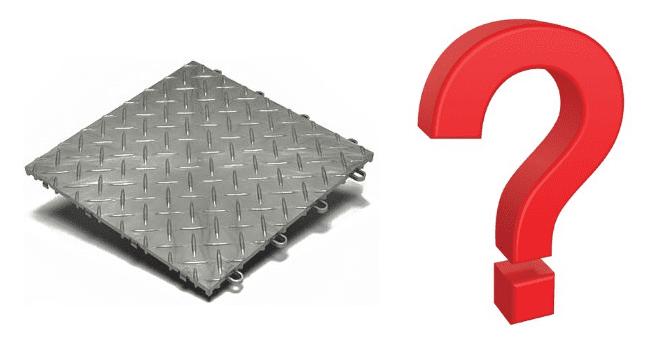
Interlocking garage floor tiles are fast becoming one of the more popular garage flooring options. You may have seen pictures of these tiled floors, but what do you actually know about them? After all, how durable can plastic garage tiles be? You may be surprised by the answer.
Available in either hard plastic or rubber-like PVC vinyl, interlocking tiles are extremely durable and easy to install. Installation can be done in less than a day by yourself and even quicker if you have a helper. Very little tools are required since the tiles interlock and snap in place. No experience is necessary.
What makes this type of garage floor tile so popular, however, is the ability to create a custom garage floor look with a variety of colors, textures, and functions. Undoubtedly, the most fun is creating your own unique design that matches your style and requirements.
Many garage tile vendors have floor designer pages on their websites that allow you to enter the exact size and parameters of your garage floor. You can then pick and choose colors and styles to insert into the design to create a custom-looking garage floor just for you.
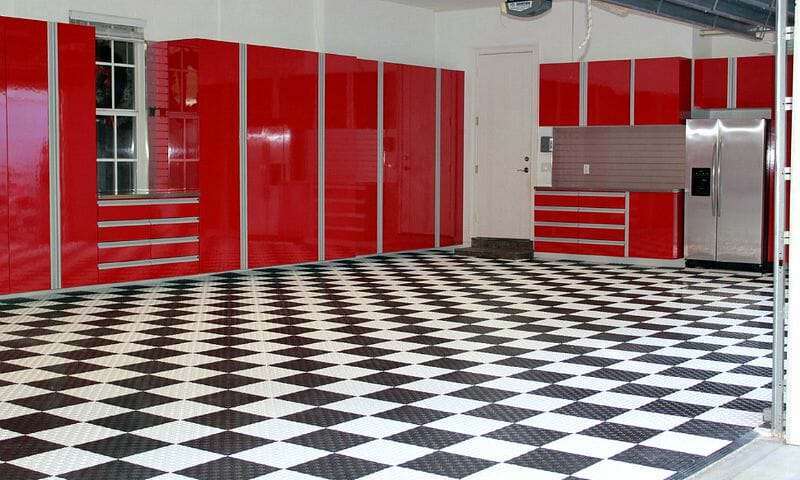
Despite how popular interlocking tiles have become, they do create quite a few questions and doubts among those interested in this type of garage flooring. Concerns range from durability, weight ratings, and slip resistance, to fluid spills, working on cars, and the use of floor jacks and jack stands.
As a result, we will discuss the two different types of tile materials, their construction, durability, and the pros and cons of each. It’s important to learn the facts about this popular garage flooring option before you make a purchase.
First published in 2015, we have since updated this article to reflect the latest technical information, styles, and trends for interlocking garage flooring.
What are Hard Plastic Garage Tiles?
Plastic garage tiles are constructed of high-impact polypropylene. And because polypropylene is a type of thermoplastic polymer, the raw material can be heated into molten form and then injected into a mold to create the tile.
Injection molding has allowed manufacturers to create extremely versatile garage tiles in a variety of styles, colors, and options. As a result, they are by far the most popular tile option.
Standard sizing for most interlocking plastic garage tiles is 12”x12” by 1/2″ thick. However, some manufacturers offer sizing as large as 18”x18” and 3/4″ thick.
The undersides of these tiles have a hollow core construction with a reinforced grid system that is very strong. This grid system is developed for a few distinct purposes.
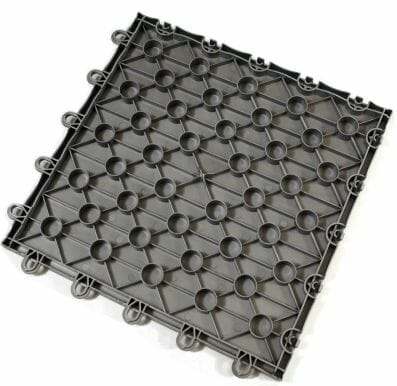
The first is that it reduces the amount of material to keep down costs. In addition, the design of this grid system and the amount of material used determines how much static and rolling weight a tile can endure.
The second reason for the grid system is that it allows for the circulation of air and water drainage underneath the tile.
This helps to dry out the concrete if it gets wet and prevents mold or mildew from developing underneath the tile.
Lastly, the grid system provides for anti-fatigue properties. Compared to concrete, they are much more comfortable on the feet and legs when standing for long periods.
Each tile connects via a peg and loop system that snaps into place. They are easily assembled with the tap of a rubber mallet, foot, or even by hand. The design structure and resulting strength of the various peg and loop systems is one of the parameters that can help determine the quality of one brand of tile over the other.
In addition, you have a choice of either a solid top construction or a ribbed structure that allows for surface drainage. At last count, there were up to 18 different colors of the various tiles to choose from.

Popular surface patterns for the solid top construction are coined or diamonds. Some manufacturers even offer a levant-style surface pattern or a carpet top surface.
The latest addition is the use of vinyl inserts. These inserts can replicate various wood flooring patterns and colors as well as carbon fiber patterns.
Most of these tile textures and patterns do create some added slip resistance. As a result, they do not create a hazard when tracking in water or snow from your vehicle. However, like any garage flooring, you should still use caution on wet surfaces and slippery substances such as oil.

The self-draining tiles are popular for garages with floor drains. In fact, some people wash their cars in the garage when choosing this style of tile. Furthermore, water and snowmelt from wet vehicles can pass through and eliminate the issue of standing water. As a result, they can be a good winter snow tile as well.
Read – Choosing Interlocking Floor Tiles for Snow and Winter
Lastly, all plastic interlocking tiles have ramp edges to finish off the tile at the garage door and door openings. This allows for a smooth transition of car tires and other items with wheels to make a smooth transition from the concrete up and onto the tile.
Now that we know the construction specifics of hard plastic garage tiles, let’s dive into the first question that pops up in everyone’s mind when they first encounter them.
This post may contain affiliate links. If you use these links to make a purchase, we may earn a small commission. You can read our full disclaimer here.
How durable are plastic interlocking garage tiles?
Yes, this was our primary question when we first heard of them years ago. How tough are they?
As it turns out, plastic garage tiles are plenty strong enough to stand up to the rigors of an active garage. They can withstand the loads and pressures of heavy vehicles and equipment, jack stands, heavy rolling toolboxes, floor jacks (we’ll discuss in more detail), and whatever else you may foresee in a busy garage.
Some of these tiles are rated for weight up to 2,500 pounds per square inch and a rolling weight rating for vehicles up to 80,000 pounds. The substructure and locking mechanism design is what helps to determine these ratings.
The finish and characteristics of the high-impact polypropylene construction do a great job of repelling spills and dirt. Nothing sticks to the tile and therefore makes them very hard to stain. Subsequently, this also makes them very easy to clean.
Read – Our Review of TrueLock HD Extreme Garage Tiles – Are These Tiles the Best Value?
Either way, interlocking garage floor tiles will provide an abundance of protection for your garage floor for years to come. They will also make your neighbors envious, so be prepared for the comments. And don’t forget, with proper planning you can have your entire flooring project completed in less than a day.
Besides looking good, there are several other benefits as well. They are resistant to chemicals, oils, grease, hydraulic fluid, road salts, acids, and other automotive fluids. If your vehicle springs a leak or you make a mess while working on your latest project, you can just wipe it right up with a rag and some cleaner.
Most tiles are also UV resistant and will not fade in sunlight. In addition, they are mold and mildew-resistant. This is good for those who live in a wet climate or have moisture issues in the garage.
In addition, they will withstand sub-freezing temperatures and floor temperatures up to 250 degrees. Indirect or radiant floor heating is not an issue.
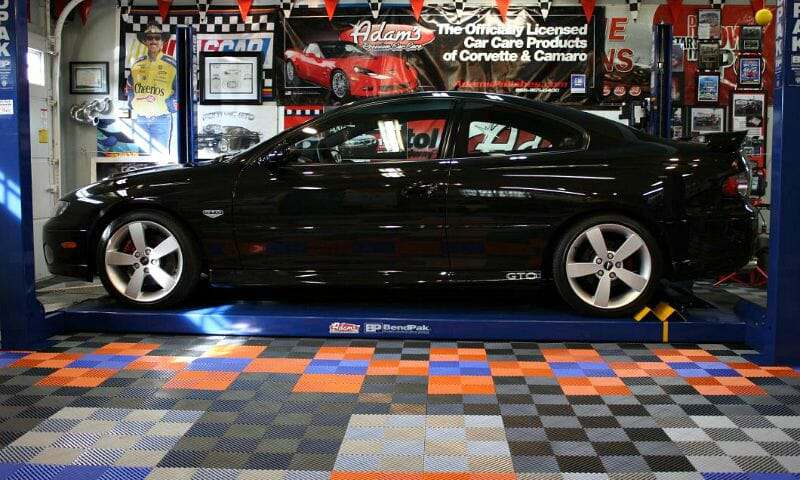
Floor lifts and car hoists can be bolted through the tile to the concrete below with no worries about deforming the tile. Storage racks and cabinets can sit on top of the tiles as long as they don’t have a very narrow or extremely small (less than 1 sq. inch) footpad.
Drawbacks to hard plastic garage tiles
As durable as these tiles can be, there are some drawbacks, considerations, and precautions that you need to be aware of.
Foremost of these is buckling or tenting of the tile floor when exposed to direct sunlight for a period of time. This is the one problem that gets the most attention, though occurrences are not very common. It is most conducive for solid top tiles in southward-facing garages when exposed to the sun at or near an open garage door.
This can happen because plastic garage tiles expand and contract with temperature. It is the primary reason manufacturers require a 1/2” gap between the tile and any wall or permanent structure.
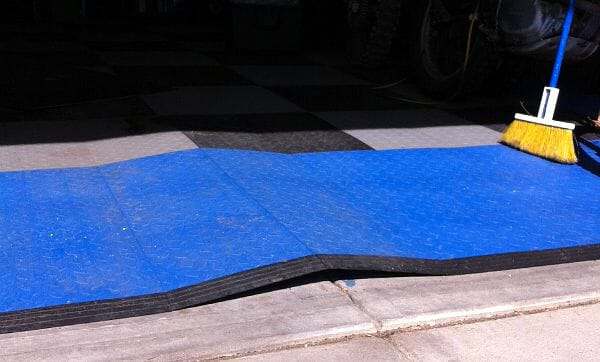
Solid top tiles exposed to direct sunlight will absorb the heat quickly and can expand faster than the rest of the floor. If they do not have enough clearance or they are in the sun long enough, the floor runs out of room for expansion and will buckle up.
On the other hand, self-draining garage tiles are not nearly as susceptible to heat expansion as solid top tiles. This is due to much less surface area to absorb heat. In addition, the tops of the ribs are curved with this style. As a result, only a small section of the curved rib is exposed to the most direct sunlight.
If you prefer the solid top tiles and are worried about buckling, we recommend installing a few rows of the self-draining tiles at the front of the garage.
If you weld or use cutting torches in your garage, it is recommended that you cover that part of the floor with a welding blanket to protect it. Sparks and slag can melt or permanently scar the tiles. Sharp metal objects dragged across the surface can gouge and scar the tiles as well.
When using floor jacks or jack stands, it’s important to take certain precautions. Make sure to use jack stands with flat bottom plates. If you use stands with the “L” shaped angled legs, the high load on such a narrow surface can deform and damage the tile. It’s best to set them on a piece of plywood if that is the case.
For floor jacks, we highly recommend placing them on a section of plywood or similar material to spread the weight. This will prevent deforming the tile surface.
Though the tiles can withstand very heavy loads, the curved area of the wheel does not flex like a tire to create a flat footprint. Instead, it places an enormous amount of weight in terms of PSI on that very small curved area. Remember the Stiletto heel and elephant footprint lesson from high school physics class?
If you do happen to damage a tile or two, you can easily replace them one at a time. This is one of the great advantages of this type of garage flooring system.
Other considerations are chemical or petroleum-based fluid spills that may occur with the self-draining garage tile. If this happens, you can unsnap and pull up the section affected to clean up the spill.
Solid top tiles are not watertight and can allow fluids to pass between the joints. However, the surface tension created by many fluids (especially water) can dramatically reduce the amount of fluid that gets through the joints.
Lastly, solid top plastic garage tiles are known to create some noise while walking on them. The hollow core underside construction can capture the sound that bounces off the hard concrete underneath when walking on it.
It can be more pronounced with uneven floors. If the tile is not laying fairly flat with the concrete, it will flex under weight before contacting the concrete surface. When it does, it can make a sound. The remedy for this is to lay down inexpensive landscape fabric prior to installation to help absorb the sound.
NOTE – Plastic garage tiles made overseas are not manufactured to the same standards as U.S.-made tiles. The thermoplastic polymers used are not as pure and may contain recycled materials. Furthermore, the thickness of the tiles is less than 1/2″. A key giveaway is when the thickness is expressed in millimeters. The average thickness of tiles made overseas is typically close to 3/8”.
Such tiles will have a weaker substructure, weaker connections, and lower weight ratings. Some have been known to break at connection points when tires are turned under load. In addition, the surface of these tiles is not as resistant to some chemicals, including tire marks, due to not using 100% virgin polypropylene.
Many vendors sell interlocking garage floor tiles. We have organized our top recommendations for high quality, pricing, budget values, and outstanding customer service.
We are an authorized affiliate for Swisstrax World Class Garage Tiles: Use code AGF24 to save 5%!
What are Rubber PVC interlocking Garage Tiles?
The other material of choice for interlocking garage tiles is polyvinyl chloride, otherwise known as PVC. Combined with plasticizers, these tiles are a very dense and more pliable type of synthetic rubber. They are sometimes referred to as rubber garage tiles or vinyl garage tiles.
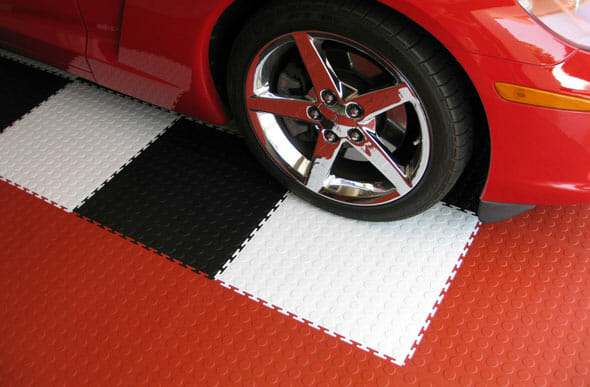
Sizes range from 12”x12” to 24”x24” and are 3/16” to 1/4” thick depending on the brand. The material and solid body construction make them heavier than the more rigid plastic tiles.
PVC tiles connect via a jigsaw-style pattern on the sides of the tile. Some manufacturers offer a locking system that hides the jigsaw pattern and creates a straight seam similar to their hard plastic cousins. The straight seam system is also known for being more watertight (not waterproof) and can be an advantage for keeping road salts and deicing fluids off of your concrete.
With few exceptions, most PVC garage tiles do not provide for air circulation under the tile. The reason is due to the very shallow grid structure on the underside. This shallow structure is required to avoid too much squirming and flexing when under load.
Unless you have serious issues with ground moisture coming up through the concrete in your garage floor, the lack of air circulation is not a concern. Little water gets past the puzzle lock connections and the tiles are highly resistant to mold or mildew.
Surface pattern options can be somewhat limited with PVC tile. Coined surfaces and the smoother levant style are the industry standard. Diamond and self-draining surface patterns are less common, but they are available.
The color selection used to be limited as well. However, in the last few years, some manufacturers have begun offering just as many color selections as their hard plastic cousins.
There are some advantages of PVC garage tiles over their rigid plastic counterparts. First, they are whisper quiet due to their rubber-like construction. They also do a great job of absorbing sound.
Another advantage is they provide a great flooring surface for garages that are used more for home gyms, play areas, and entertainment purposes. They are also a favored surface for woodworking shop floors and work areas.
Lastly, most PVC garage tile manufacturers offer an edge ramp to finish off the edges at the garage door and doorways. These ramps usually come as a long strip that is cut to fit and then glued to the edge of the tile.
How durable are vinyl PVC garage tiles?
PVC garage floor tiles are extremely durable – more so than hard plastic tiles in some cases.
Weight capacity for vinyl garage tile is usually not an issue. This is due to the very dense, rubber-like PVC material and shallow grid construction under the tile. The tile distorts very little before contacting the concrete under extreme weight.
Weight from toolboxes, floor jacks, heavy cabinets, car lifts, etc. will not damage the tile. Just like plastic garage tiles, the one exception is the thin, L-shaped metal legs that produce an extremely small contact patch.
PVC garage tiles are also resistant to many petroleum products, chemicals, salts, and acids. Though they can be very stain resistant, the surface does not have the glass-like surface feature of many hard plastic tiles. As a result, some petroleum chemicals, dirt, and road tar can impart a stain if allowed to sit.
It is not uncommon to see PVC tiles installed as industrial flooring for warehouses and firehouses. The thicker versions are known for performing well with forklifts, fire trucks, heavy equipment, and in high-traffic areas.
Drawbacks to Flexible PVC garage tiles
Price can be the first consideration. Entry-level PVC vinyl garage tiles can cost approximately 25% more per square foot than entry-level plastic polypropylene tiles. .
The one big drawback to PVC garage tiles that can be a deal breaker for some people is stains from car tires.
The various polymers and anti-oxidants that leach from the tires onto the tile surface cause a chemical reaction with the material. After some time, the tires leave a dark brown to yellow tinted tire mark on the surface that will not come out – even with the best of cleaning.
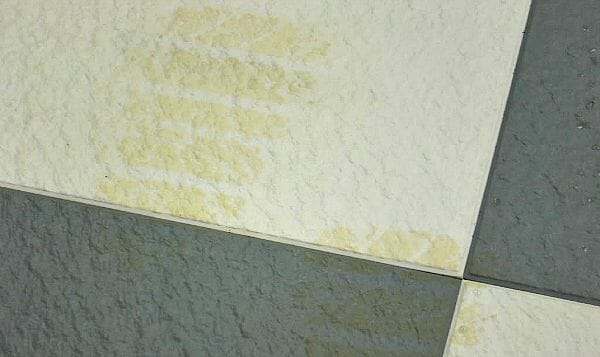
Black and dark gray are the best colors to use where cars may be parked. The tiles can still stain, but it’s more difficult to notice with the darker colors.
It is also recommended not to let liquids that can stain or clay-based mud sit for long periods. It is best to clean them up as soon as possible. The surface of some PVC tiles has a texture that tends to hold onto the offending liquid substance and requires some scrubbing to get out if left to sit.
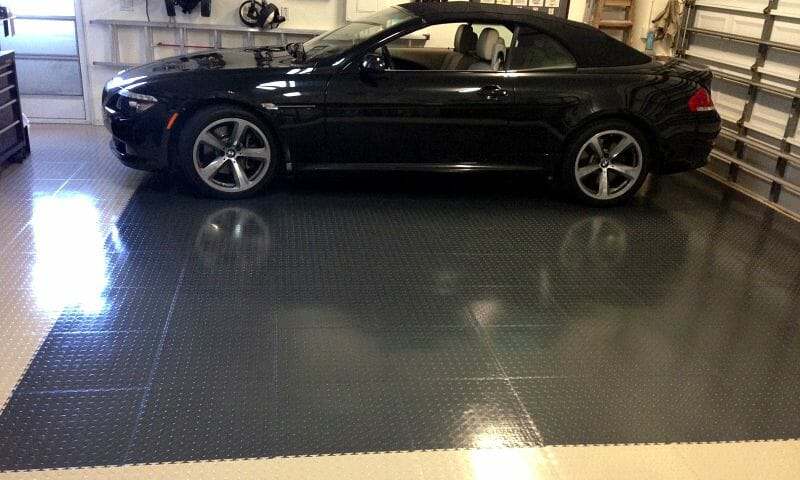
One answer to the staining issues with tires and rubber products is to apply an acrylic coating over the tiles. Most vendors will have a product they sell or recommend. Not only will it protect the tiles from car tire stains, but it will also give them a glossy finish.
Lastly, dragging sharp metal objects, welding, and heavy loads from extremely small surface areas can damage the tile.
How to install interlocking garage tiles
One big advantage of interlocking garage floor tiles over some flooring options is the free-floating design. This means that the tiles sit on top of the floor with nothing to affix them to. As a result, there is very little floor preparation required for installation other than possible cleaning of the garage floor.
Mildly pitted concrete, surface cracks, and other imperfections in the floor do not need to be repaired unless it is a structural issue that needs attention.
The only tools necessary are a tape measure and a proper cutting tool such as a saw or utility knife. A rubber mallet comes in handy for snapping in the tiles but is not required.
Read – Garage Floor Prep Tips for Interlocking Tiles
For cutting the hard plastic garage tiles, a circular saw, jig saw, or table saw with a fine-tooth blade works well. One tip we suggest is to cut the tiles with the underside facing up. This creates a cleaner edge on the surface in most cases. Regardless, a file will clean up the edges nicely.
For the PVC garage tiles, you can use the same type of saw as the plastic tiles or you can use a sharp utility knife.
All of the manufacturers provide easy installation instructions. Typically, the first row of tiles is assembled at the garage door entrance. A second attached row will go up one side of a wall to form an “L” shape. You then build your particular floor pattern out from there. You can save tiles that need to be cut or trimmed for last. This method allows for the least amount of trimming.
If you are installing plastic garage tiles and have a side door to the garage, sometimes it’s best to plan the layout with that door in mind. You want to be able to use the snap-in edge ramps for that entrance in most cases.
Remember, manufacturers require a minimum 1/2″ gap between the tile, walls, and permanent structures to allow for the expansion of the entire floor system.
Final thoughts
Still wondering which tile may be best for you?
If you are one who frequently works on cars or other projects in your garage, then the hard plastic interlocking garage tiles may be best for you. They provide the greatest options and specific functions over PVC rubber garage tiles.
In addition, they are the easiest to keep clean, they rarely incur tire stains, and they are highly resistant to stains from automotive fluids and other chemicals.
If you use your garage more for recreational activities, woodworking, a home gym, or light vehicle maintenance, then PVC garage tiles can have some nice advantages over rigid plastic tiles.
Lastly, don’t worry too much about damaging a tile or two. One of the greatest benefits is the ability to replace a tile anytime you need to with very little effort. It’s the easiest of all garage floor options to repair.
I am looking for something to use at my desk at work rather than ordering a chair mat. It is a large area and I thought maybe this would work better. Can you tell me which product would work best and if it would stand up to rolling a chair around on it daily?
Hi Lori. They all will stand up to a rolling chair just fine. Remember, these tiles are design to have cars, jacks, and heavy tool boxes rolling over them all the time. We would recommend a texture that would provide the smoothest rolling surface. The first that comes to mind is TrueLock HD Extreme. It’s coin style texture that is smooth to roll on. We talk about them here and include a link where they can be purchased.
Hello, I’m looking at flooring for a spa in my garage. It needs to be able to handle water and oils..what do you suggest?
Hello KeAundra. Interlocking garage floor tiles are designed for vehicles that track in water, snow, leak oil, gasoline, and other nasty chemicals. A spa is not going to be an issue. You just need to decide what type of tile you would like. Do you just need a tile pad for the spa or do you want to tile the entire garage?
I installed interlocking rubber tiles in my 2, 1 golf cart garage. When the sun is shining and one the doors is open, the tiles buckle. Even tho I left a 1/2 in around the edges. Is there a product that can be used to stick them down?
Hello Richard. Yes, if you have a solid top tile and enough are exposed to direct sun for long enough, they will still buckle since the tile expands out in four different directions. If the concrete underneath is clean, you can glue them down with some Gorilla Glue Construction Adhesive. Here is an example from Amazon. Only glue down what is necessary. It’s still very important for the floor to expand and contract as much as it can.
Can the open type flow through tiles be used on top of an existing wood deck 100% exposed to the elements?
Hi Steve. Yes, some manufacturers rate their self-draining tiles for outdoor use. SwissTrax is one we know of for sure.
Do either of these type of tiles emit an odor? I suspect the rubberized ones smell like tires. Do the hard plastic ones have an odor?
Hello Maggie. The hard plastic polypropylene tiles do not have an odor. The rubber-like tiles are PVC (polyvinyl chloride). However, they can have a slight odor for a few days to a week after installation.
Which tiles are best for traction when walking on ?
Hi Kevin. The Diamond designs tend to provide the best traction.
Is loose dirt/grass cuttings easily removed from under the tiles? It seems overtime that it would be unsightly.
Hi Chris. I assume you are referring to the open style, self-draining tiles? A shop vac will actually pull up any loose dirt, grass clippings, etc. that fall through the tile. The same goes for sawdust and other debris. Dirt and grass can’t get through the seams of the solid top tiles very well at all.
I have some uneven areas in my garage. Are PVC tiles preferred in this case?
Hello Joe. That depends on how uneven it is. Can you describe a bit better the floor condition?
Would the PVC tiles be better for an uneven concrete garage floor?
Hi Huja. What do you mean exactly by uneven? How would you describe the condition of the floor?
It’s got some cracks in it and the slop toward the drain in the middle of the garage isn’t a consistent pitch.
Hi Huja. The cracks typically are not an issue unless they are more than 1/2″ wide. Rigid tiles will bridge the gap, but the shape of wider cracks will telegraph through the flexible PVC tiles. PVC tiles will follow the contours of the slope toward the drain much better than the rigid polypropylene tiles. However, many people with drains in their garage use the self-draining rigid polypropylene tiles providing that the slope is gradual toward the drain.
So, I have the warping problem in my garage. South facing in the southwest = hot, hot, hot. I’ve left the 1/2” game at the walls all the way around but with Ben he h and cabinets sitting on the floor around the outside walls the tile isn’t really allowed to move with expansion.
Having said, I’m wondering, could I glue down the first few rows to prevent this? If you see that as a reasonable solution what would you recommend for adhesive?
Secondly, does putting the vented tiles on the front edge eliminate this problem? If so I’m willing to try it but I doubt want to spend the $$$ only to have the same issue I’m having with the solid RaceDeck tiles. Any advice appreciated.
Hello Jack. Gluing down only works for the flexible PVC tiles. They have much more surface area and shallow channels for the glue to adhere to. The rigid polypropylene tiles do not. Yes, using the Free-Flow tiles for the first few rows or so prevents this buckling 99% of the time. The image in the article above that shows a garage setup in this fashion belongs to one of our family members. The only buckling that occurs is with two edge ramps in the center. They lift up about 1/2″ where they meet (it’s insignificant) when the door is open for long periods. The tiles do not. Both RaceDeck and SwissTrax use the self-draining style of tiles for outdoor use in their promotions since they know expansion will not be an issue.
Before you purchase new Free-Flow tiles, one solution you can try that works on occasion to alleviate the issue is to load the tiles during expansion. If it’s feasible for you, remove the cabinets and heavy objects that are on the tile in the morning and then move them back in onto the tile after is has expanded. This can prevent buckling since the tiles are caught in their expanded state and will not expand any further.
Currently working on a Firehouse project and the Chief has requested interlocking PVC flooring. Some of the apparatus (trucks) are 60,00 pounds or more. Which manufacturers do you recommend for this application?
We have looked at Armor Tuff, are you aware of any “equals” to that product line?
Hello Tim. We recommend SupraTile by ArmorPoxy. You can find it here. Firehouse PVC flooring is one of their specialties. I would recommend giving them a call to discuss your options. You can tell them we sent you.
HI, good information in the article. You mention that the solid hard plastic tends to expand and may buckle. However, I didn’t see the issue with expansion mentioned with solid PVC. I have a south facing garage in Florida. I’m leaning toward the PVC over hard plastic because there is a hump at the seam of two concrete sections and think it will lay better, but I’m still concerned about the solid top and expansion.
Hello Bob. PVC tiles will expand in direct sunlight as well. I’m glad you asked because we failed to address this issue and will need to update the article. Some manufacturers recommend gluing down the first few rows of the tiles to prevent buckling from occurring if they will be exposed to sunlight. How large is the hump? Sometimes grinding a small section of concrete can make a world of difference. If that can be done, then the self-draining interlocking rigid tiles can be used. They rarely expand much in direct sunlight.
I am considering getting these tiles for my garage. I’m a little confused by what happens with snow, ice, water. We live in Iowa so lots of snow and ice melting in the garage. If we get vented tiles, water drains through – then what? we have puddles, etc. under the tiles? How are people managing this?
one more quick thing – unfortunately we don’t have a drain in our garage floor… so that’s even more reason why i’m concerned with the question i asked. thanks for any advice you might have…
Hi Tom. Many people without drains apply a penetrating sealer to seal the concrete before installing the tiles. A proper penetrating sealer will protect the concrete from deicing fluids, road salts, and freeze-thaw damage. Here is an example of one. The vented tiles allow water and melting snow to pass through and collect on the concrete below. This keeps the surface of the tile relatively dry. The tiles are vented underneath and allow for air circulation and evaporation of the water that collects there. If the car brought in a lot of dirt and debris over the winter that settled on the concrete below, people will either hose it out through the vents under the tiles or disconnect a section that the car sat on and sweep or vacuum it up.
If you really want to keep as much of the floor as clean and dry as possible, you could use winter containment mat over the tile or in place of the tile. These collect all the water, snow melt, and other debris that the car brings in. You can sweep or squeegee the water it collects right out the back of the mat and onto the driveway. Here is an example of contaiment mats we recommend.
Hi Shea. I have an unfinished cellar with a dirt floor. The floor gets damp Whit lots of rain and the water table is high. I’d like to install a plastic self draining tile. Can you make a recommendation?
Hi Molly. We would recommend TrueLock HD/HDXT Ribbed Flow tiles from Garage Flooring LLC. They are currently having a sale on these as well. You can price them here. We also have an article about these tiles from our Readers Projects page which you can read here.
My PVC garage flooring tiles looked great at first. And it’s a surprisingly warmer surface than cold concrete if you are on the floor working on your car.
However as soon as the seasons started to change, the frustration began. The floor lies flat during winter months, but starts buckling during the summer due to warmer weather. Very frustrating. It doesn’t matter whether the garage door is open or not, the floor is buckled in several spots for 4 – 5 months. North facing garage door, west coast of Canada, so its not like its subject to scorching Arizona heat around here. Its been 3 years of this, its become such an eyesore that i’m ready to toss the entire floor in the garbage.
I find it curious to read that the PVC flooring needs to be able to expand / contract, yet how’s it supposed to do that with a couple 3500 lb cars sitting on it ? Seems like the change in temperatures combined with all that weight on it is the cause of buckling. Disappointing.
Hello Don. When you installed the PVC tiles did you allow a minimum 1/2″ clearance from all walls and immovable objects (cabinets, support poles, etc.)? Secondly, did you install the tiles in the winter or cooler months? The tiles will expand and contract based on the overall difference in temperatures. How hot or cold it may get is not as important. If you allowed for the minimum 1/2″ clearance, then our guess is that the tiles were installed when it was much cooler. The initial clearance may have not been enough and the tiles are running out of room to expand.
The best way to fix the issue with buckling is to recheck the clearance of the tiles when the weather begins warming up just before you begin to encounter the buckling issue. Make sure there are not any vehicles or heavy objects on the tile at the time. If you are less than 1/2″ clearance required at that point, retrimming will generally fix the issue.
Loved your article. It was very helpful. My question is do these tiles scratch when patio furniture metal or plastic is dragged over it.
Hi Mary. You ask a great question! Typically, metal or plastic that is dragged across the tiles will not scratch them as long as they don’t have sharp edges.
Is Racedeck brand, a good floor tile?
Hi Gary. RaceDeck is one of the two most premiere manufacturers of interlocking tiles. SwissTrax is the other.