
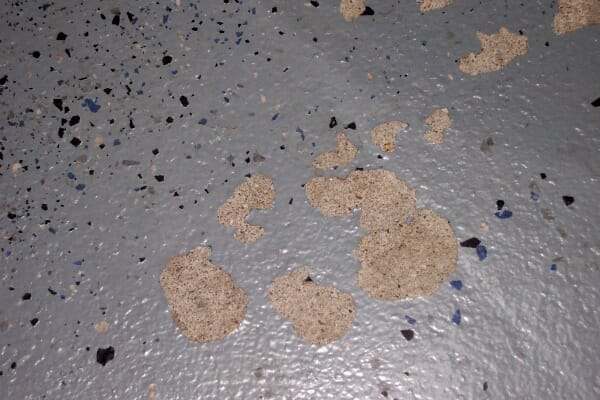
By far, the biggest complaint that people hear about epoxy is that it peels up off the garage floor soon after application or within a year of it being installed. What many who are interested in epoxy garage flooring do not realize is that well over 99% of all these complaints do not involve a defective epoxy product. If that’s the case, then what causes epoxy coated garage floors to peel up in the first place?
What’s interesting to note is that the majority of complaints about epoxy garage floors are from DIY applications. There is a valid reason for this. The average DIY installer usually isn’t that knowledgeable about how to apply garage floor epoxy to begin with. When you couple that with the fact that many of the inexpensive epoxy floor kits make application sound as easy as rolling paint on a floor; you now have the potential for failure.
I followed the instructions exactly and it still peeled up
Many of these complaints start with the statement, “I followed the instructions exactly and it still peeled up”. The sad part about this is that many did follow the instructions exactly as stated, but that does not mean that what they did actually prepped the concrete properly.
We will explain shortly.
The main culprit to garage floor epoxy peeling up is poor preparation of the concrete surface. This can be attributed to a variety of factors.
Epoxy needs a clean and porous surface in order to achieve a mechanical bond to the concrete. If you don’t have that, it’s almost guaranteed that your coating is going to fail at some point.
As an example, lesser expensive epoxy kits generally come with safe to use, biodegradable solutions that are supposed to clean and etch the concrete simultaneously in order to provide the proper surface profile for epoxy. In many cases however, these do not work well.
But how is the average DIY installer to know?
If you don’t know what the surface should look like when the concrete prep work is done, how it should feel, and how to test it, then it really is a gamble whether or not your epoxy coating is going to peel or not.
Why epoxy floors peel
Epoxy is a very tenacious and tough coating to remove when applied properly. That is why there are so many successful, long lasting epoxy garage floor coatings that people absolutely love. Just about every problem you may have heard about epoxy flooring can be avoided by paying attention to the details. With that in mind, we have listed the seven most common reasons for epoxy peeling up along with the solutions on how to avoid them.
1. Poor surface profile
As we stated earlier, a poorly prepared concrete surface is the main culprit to epoxy peeling. The number one problem associated with that is a bad surface profile. Surface profile is the roughness and porosity of the concrete that allows for the mechanical bond of the epoxy.
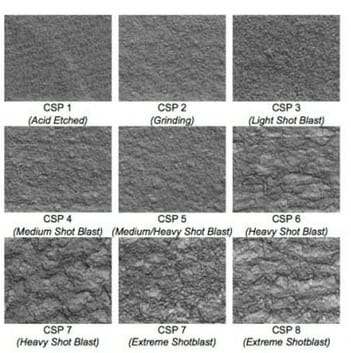
These are examples of concrete surface profiles. Most epoxy requires at least a CSP 1 or CSP 2 profile to achieve the proper mechanical bond.
In order to obtain the correct surface profile for epoxy, you need to acid etch the concrete at the very minimum. Grinding the concrete is the preferred method, but it’s not always feasible for the average DIY install. You can read more about acid etching versus grinding here.
Profiling the concrete exposes the pores so that the epoxy can sink in a little to get the bite it needs to adhere as well as it does. If not done correctly, the epoxy will not adhere well and can start to peel at some point after application.
Once the concrete is profiled correctly, it should have a lighter appearance and a rougher texture to it that is similar to 100 grit sandpaper. Test it by dripping some water onto the concrete in various areas. The surface should immediately turn dark and absorb the water in less than a minute.
Beware of the clean and etch solutions that come with the lesser expensive, single coat garage floor epoxy kits. Many times these solutions are not effective enough to create the proper surface profile.
The reason for this is that these solutions generally consist of citric acid crystals. The main reason for using citric acid by these manufacturers is that it is safe for the environment and it is much more difficult to harm yourself if used improperly. We have more info here if you are concerned about etching with safer alternatives.
The problem however is that citric acid is the weakest of the concrete acid etching solutions and it will not profile a hard troweled or machine troweled surface effectively. It does not work well on extremely dense concrete either.
Another problem with these citric acid products is that they are touted as a cleaning solution as well. If these solutions are applied to a dirty concrete surface, they do not work well at cleaning and etching the concrete at the same time.
When acid etching a garage floor, the concrete should always be cleaned thoroughly first before applying the acid etch.
Muriatic acid or phosphoric acid is the preferred acid to use for achieving the proper surface profile for an epoxy coating. You can read more about how to acid etch properly here.
2. Moisture
The second most common problem associated with the peeling of epoxy garage floors is moisture in the concrete.
Water vapor cannot pass through epoxy. If you have moisture under any part of your slab that is below grade, the hydrostatic pressure that is created from water vapor being trapped under the epoxy coating can create enough force to lift the epoxy right off the surface.
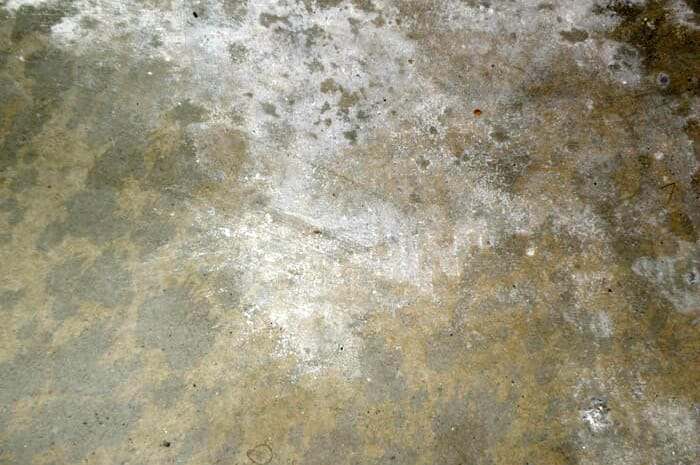
Inspect your floor for signs of moisture. Efflorescence is the very first sign that you may have a moisture problem. So are dark spots on the floor.
If your slab is below grade on any side then it’s imperative that you do a simple moisture test first before starting an epoxy floor project. You can learn more about moisture in concrete and how to test for it here.
3. Oil and contaminants
Once you have achieved the correct surface profile for epoxy, it’s important to check that any oil stained areas that were previously cleaned are absorbent and not repelling water. These are areas that you will want to check with the water drop test.
It’s not uncommon for a previously oil stained area to be darker in color than the surrounding concrete. As long as it absorbs water, then it will absorb epoxy and provide for good adhesion.
Other contaminants such as silicone from tire dressing products and polymer compounds that leach out of warm tires will not allow epoxy to adhere either. Be sure to perform a water drop test around the areas where the car tires sit as well.
Acid etching will not remove silicones and tire polymer residue. If you acid etched the concrete and these areas do not pass the water drop test, you will need to grind the concrete to remove the residue.
4. Acid etch residue on the surface
When you acid etch your garage floor the acid solution works by reacting with the free lime in the concrete. This causes a breakdown of the calcium at the surface which exposes the open pores of the concrete. This calcium is then deposited onto the surface in the form of a very fine white dust.
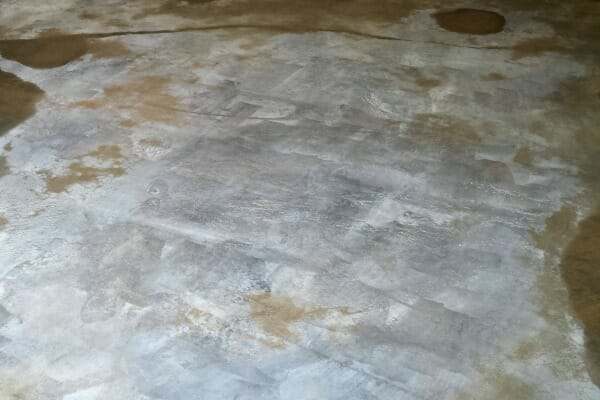
Many epoxy floors have peeled up because this fine white dust was not effectively removed before the epoxy was applied.
Because the dust is so fine, it likes to stick to the irregularities in the surface and can be difficult to remove. If epoxy is applied over concrete with this fine white dust, the epoxy sticks more to the dust and not the surface. It will eventually peel up exposing the white dust on the underside of the peeled epoxy coating.
The amount of dust left on the surface after acid etching is dependent on how much free lime was present in the surface of the concrete to begin with and how well the floor was neutralized and flushed afterwards.
Never let the floor start to dry during the acid etching process and use liberal amounts of water when flushing the surface. It helps to use a deck brush to lightly scrub the surface as it is being flushed. If you end up with this white residue it can be removed, but it may take multiple scrub downs to get it all off the surface.
A pressure washer works best. If you don’t have one available, wet the floor down in sections and use a solution of TSP and hot water to scrub the surface. Flush it well with a high pressure nozzle and move on to the next section. It will come off, but it may take a few tries.
5. Sealed concrete
Epoxy will not adhere to concrete that has been previously sealed and acid etching will not remove a sealer. As we have stated previously, acid only responds to the free lime in concrete. If the concrete is sealed, the acid etch solution will just sit on the surface and not do anything. More than one case of epoxy peeling has been from people attempting to acid etch a sealed garage floor.
The only way to profile a previously sealed garage floor correctly is to grind it. Grinding the floor will remove the sealer at the surface and profile it at the same time.
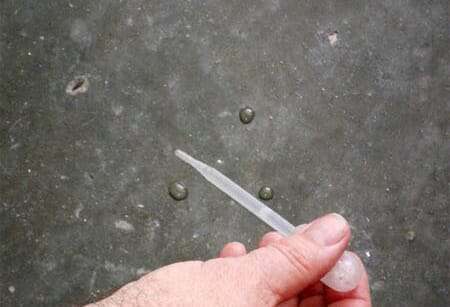
If you are not sure if your floor has a sealer, then you need to do a concrete sealer test. Do this by dripping water over various areas of the concrete. If the water immediately beads up or if it just sits there for a few minutes without being absorbed into the concrete, then you have a sealer on the garage floor.
If the concrete turns dark and the water is absorbed after a few minutes, then you don’t have a sealer on the floor.
If your tests are inconclusive, apply a few drops of diluted muriatic acid to the surface. If it starts to bubble and fizz, then no sealer is present. If it just sits there like a drop of water and does nothing, then the concrete is sealed.
6. Excess laitance
Laitance is a weaker top layer of cement. Sometimes it can have a crazed look to it with what appears to be very fine cracks. It consists of a fine cement paste top layer that is produced by excess bleed water when troweling the finish. It can also be caused by concrete finishers who spray water on the surface of the concrete to make it smoother.
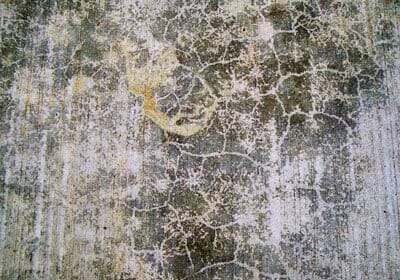
Grinding the concrete will remove this fine layer and prep the surface properly for epoxy. Acid etching on the other hand will not do this very well. It will only rough it up. What you end up with is a softer concrete surface that is not bonded well to the rest of the concrete.
When epoxy is applied to this type of surface, it creates a weak mechanical bond to the concrete that can eventually cause it to peel up at a later date. Concrete dusting is a sign of excess laitance and sure indication that you should grind the garage floor instead.
If you don’t have dusting, test the concrete for excess laitance by scraping the surface hard with the tip of a screw driver. It shouldn’t leave much of a mark if any at all. If it doesn’t, then you should be OK to acid etch.
7. Soft concrete surface
A soft concrete surface can be caused from poor concrete, bad finishing or a combination of both. Indications of soft concrete include heavy surface dusting, areas that are easily scarred or gouged, and crumbling concrete.
The only solution to a soft concrete surface is to grind it. It may also require application of a densifier to harden the surface. Sometimes even that will not prepare the concrete properly for epoxy.
This video is a great example of a floor that needed extensive repair before the epoxy was applied. Epoxy coatings will not fix a bad concrete surface.
If you have a soft concrete surface, we recommend contacting a professional floor coating company or installer to inspect the surface and do the job for you if they deem it feasible. If you are looking for a DIY garage flooring installation, then interlocking tiles or garage floor mats may be a better solution for you.
Final tips
One thing to remember is that the lesser expensive garage floor epoxy kits will eventually wear out in high traffic areas. This is not the same as peeling. You will notice that the floor in these areas will become dull and the concrete will start to show through. This is a result of abrasion at the surface of the coating and not from peeling.
Hot tire pickup is not necessarily a sign of bad floor prep either. Again, the lesser expensive epoxy products can be prone to this no matter how well the floor was prepared. The reason is due to the low solids content of the epoxy as well as the chemical makeup.
Applying a successful epoxy garage floor coating that does not peel truly is not that difficult. It just requires some attention to detail and knowledge of how your garage floor concrete should be prepared and tested before application.
With the exception of moisture issues, most of these common problems with epoxy peeling can easily be avoided just by grinding the garage floor.
However, whether grinding your floor or acid etching, if you pay close attention and follow these tips you should have a successful epoxy coating that will not peel after application.

While I agree completely that most failures are due to poor surface preparation, a good number of failures after the initial year or so is due to the nature of epoxies (they set hard and brittle and do not move naturally with the substrate, concrete, during thermal expansion/contraction that comes with the season). A better product would be polyurea, which always remains flexible, down to -20 degrees Fahrenheit and moves with the concrete. It is a far superior coating for garages, shop floors, pool decks, patios, etc…
Hi Joel. While we do agree that polyurea has it’s advantages in terms of top coats, U.V resistance, and flexibility, we have to respectfully disagree with your statement that polyurea is a far superior coating. Like any coating, it is superior when used in the proper environment and situations. It is not the “only” superior coating for every garage floor like some commercial markets want everyone to believe.
Polyurea has a fast return to service time which is a big marketing advantage to the commercial market. However,this fast return to service is because polyurea cures so fast. This makes for a very unfriendly DIY coating and it has also been responsible for some poor adhesion issues commercially for the simple fact that it does not have much time to penetrate and bond with the substrate. Depending on the area of country and substrate, some commercial installers are having better results thinning the first coat with a solvent in order to get better penetration. This thinner coat acts as a primer and a subsequent coat needs to be applied if the end user wants a full flake floor.
A typical polyurea coat has a much thinner dry film thickness than 100% solids epoxy as well. On a standard garage floor without irregularities this is not an issue. Thickness does not always dictate quality. However, if the floor needs a higher build for some irregularities, a polyurea coating is not a good choice because of the much higher expense to the consumer due to the amount of material required. More commercial installers are finding that a combination of an epoxy base followed by a polyurea top coat is providing for optimum results in the long run.
Also, the statement that epoxy fails because it is brittle is just plain false. Epoxy has been used in residential and industrial applications with thermal expansion of the concrete for decades without failure.
Thanks for the tips, I find them very helpful. My husband and I have just moved in into a townhouse, and the garage floor is in a very poor condition. I will show him this article to see if we can fix it by ourselves or if we need to hire a specialist.
Thank you for all the advice within your website. After reading a lot of your items I thought I could resurrect our garage floor myself. We bought an old house with a really gnarly old garage floor that seems to have all the damage indications that likely existed in that floor (before the failed applications of toppings) in your example video posted as “Epoxy Floor Screw up by Epoxi Floor Coating” (https://youtu.be/KZ3EsQaeS0c). There’s efflorescence, exposed aggregate (lots of it), low spots from years chipping or spalling, and really old oil stains. Now I’m wondering if I contact a professional to do the work – is it likely to end up like the video? Are floors in that condition too far gone for even professionals to bring back, even assuming they do all the prep work, moisture testing, and proper application you’ve suggested on your website?
Hello Tim. These are great questions. An actual professional floor coating company will not do the type of work you see in that video. Whoever did that floor was most likely a home contractor or handyman with little experience in floor coatings that thought they knew what they were doing.
A true professional floor coating contractor or company will tell you straight up if your floor can be repaired for a coating. Their reputation depends on it. We’ve seen some ugly floors that were resurrected to look like a showroom finish. Once any moisture issues are addressed, they usually will use an epoxy slurry or polymer-modified slurry to fix the floor before applying a coating. Though it will cost more money due to the required repairs first, it is still much less than replacing the floor. We suggest reading our article on how to choose a floor coating contractor to get a better idea on how to pick a qualified professional.
Can you recommend someone in the Sterling Heights MI area that could do my garage floor?
Hi Karen. We aren’t familiar with installers in your area. We suggest searching for “garage floor coating companies” in your area. Call a few to come by your house and get some free quotes. This article here will help to determine which is best for you.
How do I repair certain areas on an expoxy floor that are coming up.
Hi Kathy. It really depends on the type of epoxy coating system you have. If you have multiple coats with a clear coat, repairs can be extensive. It’s unusual for this type of system to come up however. If it’s just a single coat application you can clean the concrete and apply more epoxy. A coating that is peeling up though generally is a sign of bigger problems. It could be a moisture issue, bad concrete prep, or just a poor quality epoxy.
So, I get that muriatic acid reacts with the lime in concrete. But with a sealer, the acid will not react, and just sit there like water would, inert and inactive. In your advice, you state that “…apply a few drops of diluted muriatic acid to the surface. If it starts to bubble and fizz, then a sealer is present.” I thought the opposite was true, and that it would NOT react. Is this a misprint in your advice? Thanks!
Thanks for point that out Daniel. Yes, it’s a mistake and we just changed it. If the concrete bubbles and fizzes, then there is no sealer present.
I did the acid wash in my garage, but i didnt know about the neutralize, can i do it now?
Flood the floor with water first Kamil, then go ahead and neutralize it. You may want to work the solution into the concrete first with a broom or deck brush before rinsing it away.
Hi and thanks for a good breakdown on prep techniques. Im in the middle of prepping my floor and am faced with issue… I degreased one side of the floor yesterday , cleaned it up , etched that half , all good . Today i did the second half of the floor , degreased , probable a lot more than i should have.. , cleaned it up , etched and the floor continues to smell like degreaser and every time i pressure washed it , a white thin foam would keep appearing. about 5 hours have past and the floor has dried up a lot , and now there is a lot of white very fine dust on the top.. still smells like degreaser . I’m afraid to put the RockSolid product down in case it fails , any suggestions ?? help !
Hello Chris. If you can wipe your fingers across the floor and they turn white, then what you need to do is keep rinsing the floor. Wet it down first, lightly scrub it with a deck brush while wet, and then rinse. You may need to do this a few more times. Once you get to the point where you only get a light amount of dust on your fingers then you will be good to go. Be sure to give the floor at least 48 hours to dry once you get to the point where you believe the floor is ready. With the pressure washing and all the rinsing, there will be a lot of moisture within the concrete that needs to work its way out. Though the surface may be dry, if you apply the coating too soon the moisture vapor that is still escaping from within the concrete will create tiny bubbles in your coating as it tries to make its way to the surface.
We had a company do our garage floor. We picked lifetime guaranteed. They sent out a paint company to check to see if it was their product that failed. They said they never had any complaints. Well, they used a computer and checked it with a magnifying glass and checked because you cannot see it with a naked eye. They said it is cracking all over. Also a big piece was peeling and the paint comany pulled up the epoxy and I saw big pits in out cement. Now the company is coming out to check if it is warranted and thinks they are going to give us a quote to fix it. What the heck happened to our lifetime gaurantee?
Hello Mary. You didn’t exactly state what failed and what prompted the company to check the coating. You mention cracking and big pits in the cement. It may be a moisture issue but we just don’t know enough to give you an educated opinion. What we can tell you, however, is that just because a coating may be guaranteed for life, it doesn’t mean that it will not fail due to outside influences such as bad concrete, moisture issues, and etc. Most likely that is why the company is out inspecting the coating. They want to determine if it failed from a manufacturers defect or outside influences. For example, you may have a lifetime guarantee on the paint of your car, but it will not be covered if it’s ruined in a hail storm. In other words, it wasn’t a fault of the paint. The big question is going to be if the coating is guaranteed regardless of other mitigating circumstances or if it’s only guaranteed for life for manufacturers defects. We suggest reading the fine print closely in order to understand better what to expect.
This site gives some great advise. I have never done epoxy floors, but they seem to be a great flooring solution. I am a little confused with proper prep due to all the information available and differing opinions and approaches. I was wondering what the best prep method is for garage floors that are not sealed, but have paint and grease on them.
Hello Jasey. If you have paint on the floor then you will need to grind. An acid etch will not remove paint. Be sure to clean all the heavy grease areas best you can before you start. Once you are done, do a water drop test in those areas to make sure it will absorb water. If it doesn’t the epoxy will not adhere.
Hello. I’m a contractor who accidentally damaged a customer’s concrete floor while working at her home. I’m not sure if her floor is painted or has an epoxy coating (I believe it has flakes), but the masking tape I used to hold down painters plastic peeled up the coating down to the concrete when I removed the tape. The tape was on the floor for approximately 5-6 hours. The floor is in a bedroom (not a garage). I was wondering what would cause this to happen and if this is to be expected from a properly prepped floor / floor with no “issues”? Any information / help would be appreciated.
Thanks,
Adam
Hello Adam. From your description it sounds like it was paint that the tape pulled up and not epoxy. A solvent test would confirm this. Though concrete paint will not adhere as well as epoxy, it still will not peel up from painters tape if the surface was prepared properly. Since it was in the home, the applicator most likely assumed that it could be applied directly without the proper prep since the concrete looked new. New concrete still needs the surface prepped properly, more so even than older concrete. Excess laitance, a possible “cure and seal” concrete sealer, and other variables need to be accessed before application. If not, paint can be applied and look fine under foot traffic, but the minute it is put under any stress (tape for example) it comes right up.
Thank you for this step by step. My question is regarding a brand new construction home. We are moving in the middle of December. The garage floor is brand new concrete that was poured in several months ago but I’m sure the construction workers used as annex and whatever.
Is etching, grinding, or degreasing still required? I don’t want fancy multi coat, clear top coating. I just want something more than bare concrete so if I want to use DIY package for a single coating, how much time should I allocate for this project? Cleaning, etching, waiting for drying, and applying coating would take 12 hrs, 24 hrs, or 48 hrs? Thank you so much.
Hello Justin. New concrete requires the proper prep work even more than old concrete. The reason is that the troweling process effectively closes off pores and the surface can have excess laitance that has not worn off yet and will cause your coating to peel. You will need to etch at a minimum if you want your coating to adhere. If you etch, you will need to let the concrete dry for a minimum of 24 hours. If not, you run a high risk of getting bubbles in your coating from outgassing. Outgassing is moisture vapor that is still escaping from the concrete and gets caught in the coating as it cures. Figure a weekend to properly do a single coat job.
What latex paint removal chemicals demonstrate satisfactory results on garage floors.I see a variety of soy gel products marketed
The soy products work well Paul. You just have to let them set a little longer. The advantage is that they are eco friendly. Solvent paint strippers work faster, but you have to deal with the VOC’s. Either way, both are very messy. That is why we prefer grinding old paint off.
Great articles! I had a few questions though. I just moved into a ‘new to me’ house and they have some sort of an epoxy down. I believe it’s a epoxy paint because theres a part 2 Behr epoxy can in the garage unless that was just used as touchup since it was a flip. The garage floor is in so-so condition; if I wanted to redo this with a better epoxy what prep would be necessary since it already has something down? I also have one low spot near the edge of my wall where water pools when my car is wet. I assume I would use an epoxy slurry or polymer-modified slurry to level this, correct? Is there a particular brand you might recommend? Also I have a few very small cracks (1/4 inch deep). Could I use this same epoxy mixture to fix those as well and would prep be necessary to the repaired areas? There are also 4 spots where the epoxy is off the floor due to heat from my tires; is there any special prep needed for these areas? AND one final question, do you have a recommendation or article for a sub 300$ epoxy kit thats easy to work with for a first time DIYer. Im not looking for something to last 20 years but if it would last 10 years I’ll be happy.
Hello Dan. If you are unsure of what type of coating (epoxy or paint) and the quality of the coating that is on the floor currently, we recommend that you grind the concrete first in order to remove the old coating. This will prep the concrete at the same time. Your coating is only as good as what it is adhered to. If it’s an inferior product, it will only stay down as well as the inferior product it is adhered to. Low spots are tricky to fill correctly and not worth pursuing if they are not very deep. If they are deep, then an epoxy/sand slurry works well or polymer-modified cement. We have a couple of recommendations here. All cracks should be repaired with an epoxy or polyurea crack filler product and then ground flush with the concrete for the best appearance if you do not want it to show through the coating. You can read about crack repairs here.
Regarding epoxy, you did not state your square footage for your budget. If you want to avoid hot tire pickup and apply a coating that will last 10 years, your best bet would be a single coat high solid to 100% solids coating. The home improvement epoxy kits will not provide that kind of service. Here is one example of such a kit. Here is an example of a kit that comes with an epoxy primer as well.
hope someone can help me. i have a concrete balcony that has paint flakes as a finish. There are several areas that the flakes have chipped of and can see the concrete. I would need to know how can I repair these areas before they get worse. And also what to apply on the balance of the balcony so it wont repeat itself elsewhere.
Hello Tony. We can’t really offer a suggestion for repair without knowing what product and or type of flake was used. Garage floor coatings are not designed for use outdoors so you may have something completely different. If you like, you can try emailing us a few pictures of what you are dealing with. The email address is info@allgaragefloors.com
Hey Shea,
Thanks for all of the info. I’m using a primer base coat, then the epoxy followed by poly, all from Legacy. The specs say the recoat time is 7-10 hours for the rimer and 2 days for full cure. I know I can recoat in 7/10, but do I have until the full cure to get the next step done or do I need to start prior to 10 hours? Thanks…
You are welcome Eric. You need to get the next coat on within 24 hours. If you wait longer than that, you will not get a chemical bond and will need to rough up the surface with 100 grit sandpaper to achieve a mechanical bond. When the new coat still feels tacky but doesn’t leave a thumb print, it will be ready to recoat. That is usually in the 7-10 hour window.
Hi Everyone,
I have had my garage finished by a contractor. I have bubbles and a weird yellow goofy sticky stuff coming up from the floor like little cones. Once you touch it, it is sticky, yellow, goofy, and with crystals. Does anyone know what is happening. I have contacted my contractor for two weeks and no answers.
Thank you!
What exactly were the type of product/s that were used Maureen? What you describe sounds like solvent flash off, but we have know way to help without knowing what was installed.
“Mechanical bond to the concrete” What a crock of BS. I’m sure you ment chemical bond. Regardless the intent, to place the blame on the do it yourselfers when these kits are marketed for DYI applications is just plain wrong.
Hello Robert. No, we do mean “mechanical bond to the concrete”. Epoxy, as well as other coatings, only form a chemical bond to each other. In other words, when an additional coat is applied to a coat that has not cured yet, the two coating form a chemical bond as they cure together. Bare concrete needs to be profiled properly for the epoxy to penetrate the pores at the surface to achieve a mechanical bond with the concrete. The epoxy soaks into these pores and grips it since the pores are irregular and not smooth. Concrete and coatings are incompatible chemically and cannot form a “chemical bond”. There are newer commercial type coatings that can form a mechanical bond to concrete with less prep (see Rust Bullet), but epoxy is not one of them. Ask any professional installer and they will tell you that the success of their coating is dependent on the prep.
We are not placing blame on anyone. What we are doing, however, is pointing out the lack of knowledge that the general DIY public has about how coatings work and how they are applied. A little bit of knowledge can make the difference between a successful project and one with poor results. That is what has made our site so popular. If you want to point a finger at somebody, then point it at the large companies that manufacture and distribute these inexpensive (relative to high performance coatings) DIY kits and make is sound as easy as scrubbing some ECO safe etching solution on the concrete, roll on the coating, and then sit back and enjoy your beautiful floor. It’s not that simple and they know it, but smart marketing tactics sell hundreds of these kits everyday and a certain percentage of unhappy customers is worth it to them for the bottom line.
Shea –
When my house was built, the contractors applied a coating to the concrete that was nasty enough where they had to use masks and warned us not to go into the house for a day or so. After 17 years the coating is scratched from furniture and traffic. I’m wondering what you would suggest for re-coating the floor as this point. Also, some of the concrete has cracks in it now, so perhaps I should also try to fill in the cracks before re-finishing.
Hello Bill. More than likely the coating used was high in VOC’s (solvent based) and is why respirators were required for an enclosed space. Is the coating a clear over bare concrete or is it colored? Also, removing the coating via grinding may be required if you cannot identify what kind of coating it is. One thing you can do is test it with acetone. Pour a little bit on the floor and let it sit for a minute or two and then wipe it up with a rag. If it softens up and/or gets gooey, then it’s most likely an acrylic and will need to be removed first. If it doesn’t soften up and just looses some gloss or turns a bit cloudy, then there is a good chance you can just rough up the surface to apply a new coating.
Your article states “Epoxy will not adhere to concrete that has been previously sealed”. Does this mean you should not use an epoxy primer or moisture barrier if needed prior to the finish coat?
Hello Steve. An epoxy primer is part of an epoxy flooring system and is not considered a sealer in respect to previously sealed concrete. What we are referring to is bare concrete that has been treated with a penetrating sealer, concrete curing sealer, a moisture blocking penetrating sealer, and etc. If it has, the surface will need to grinded in order to open up the concrete pores and remove the sealer at the subsurface. You cannot etch since the sealer will prevent the etching solution from penetrating the concrete and working properly.
So if I grind the floor do I then also need to ech the floor. The floor is old and has some
Oil and paint spots.
No etching required if you grind, Ryan. The grinding should remove all the old paint and the upper layer of the oil spots. Just make sure to degrease the oil spots well before grinding.
We are getting ready to use Epoxy SHield on our garage floor and now I am worried that it will not work. We have a 12 year old home and the gargae floor is very smooth and probably sealed. Is there something better to use? We were just going to go with the kit – clean and etch product included, but it sounds like that may not be enough. What, product/process, should we use?
Hi Jennifer. If your garage floor is sealed, then no product will adhere unless you grind the concrete first. The first thing you should do is determine if your concrete is sealed or not. If the concrete is not sealed but is very smooth, then the citric acid etch and floor cleaner form these epoxy kits will not work very well. We suggest performing a standard muriatic acid etch to properly prep the surface. Keep in mind that even with a properly prepared surface, the inexpensive epoxy kits such as EpoxyShield will only look nice for a few years before it begins to wear. There are much better products available, but you will not find them in a home improvement center.
Hi, thank you for the article. I need your advice. My garage floor was grinned by non-professionals, then I used the Rost-Oleum Moisture Stop product that created a lot of excess laitance on the floor. I can scrape it by the screwdriver or picked it up by tape. I was planning to use the RockSolid coating product but I cannot get rid of laitance completely. So I decided to hire a contractor to delegate the job. He said he will be using the Sherwin-Williams GP4850 polyaspartic. He is going to put 2 coats one under flakes and another one clear on the top. Would you please comment on that product? Also, will another grinding help with excess laitence? Please advice.
Thank you.
Hi Luba. Why are you applying Rust-Oleum Moisture Stop to begin with? If you have moisture issues, then proper moisture testing with a calcium chloride kit should be done to determine how much moisture you have. There is a high probability of having to use an epoxy moisture vapor blocking primer before application of any other coating. The product that you used is basically a densifier. When using a densifier before application of a coating, it generally requires applying the densifier first and then grinding second. Densifiers cannot produce laitance. What they can do, however, is produce excess efflorescence that will inhibit a coating from adhering properly. If you have professionals coming in to do your coating, they should know that the floor needs to be reground to remove the excess efflorescence and to provide the proper profile for the coating to adhere. If they aren’t going to do that, then we question how professional they really are. In terms of the polyaspartic they want to use, it seems to be a decent product, but SW does not provide any information on chemical testing for stains.
Rust-Oleum suggested in the multiple phone conversations to use the Moisture Stop after grinding and before coating with RockSolid product. So I followed their instructions. I regret it so much now! I need to fix that mess correctly! At first I was thinking that white stuff on my floor after application of the Moisture Stop is an efflorescence, but Efflorescence Remover (Rust-Oleum’s hosphoric acid product) did not help to remove it. I did test: collected small amount of white substance from the floor and tried to dissolve in the citric and phosphoric acids. It was not dissolving. I was assuming that efflorescence should dissolve in acid. Its it correct? It is a sticky white powder that is all over my garage and driveway. Couple questions:
at this point do I still need to do moisture test with a calcium chloride? Or it will be useless after Moisture Stop application? Will reground remove that white substance whether it is efflorescence or laitance? Also from the GP 4850 performance tips: “This coating though resistant, is not a guarantee against
tire staining. Vehicular tires from cars and trucks to tractors
and boat trailers are varied and have the potential to
leave a stain under certain conditions. Place rubber mats
or carpet pieces under the tires to avoid the issue.” Should I be concern about tire staining? Or is it better to use a different product?
Thank you for your help!
A calcium chloride test can still be performed. Keep in mind that it only represents the current conditions. It may be different during the wet months. The white sticky powder you refer to sounds like a reaction from the Moisture Stop being applied to heavily and then not rinsed well. Grinding should remove it. The only thing we can say about the SW polyaspartic GP4850 is that if they have all kinds of warnings about tire marks, chances are you will get them. There are not any products available that guarantee not to get tire marks, however, there are many products available that get few or allow you to clean the marks off.
I just built a shop. I put a coat of Thompson weather seal on the concrete just a couple days after the concrete was poured thinking I could just wash it off and put another clear sealer on it later. The concrete ended up staining with red dirt. I want to just cover it all up. I’ve pressure washed it, degreased it, and acid cleaned it. If you pour a water bottle cap full of water on the concrete it will soak up with in 10-20 seconds. If you drench it will take hours to full soak or evaporate.
It’s just Thompson weather seal. Will tile clad adhere?
Hello Robert. A bottle cap full of water should absorb fast on properly prepped concrete. Thompsons is a water sealer treatment and is not something that just washes off. It wouldn’t be a water sealer if it did. Sealers on concrete can effectively block etching. When you acid etched the concrete, did it bubble and fizz real good? Was there a lot of white powder that had to be rinsed away after you neutralized the concrete? If not, that’s a big indication that the Thompsons sealer was blocking the etch. I wouldn’t take the chance and would grind the concrete instead.
Ok, so suppose black epoxy was applied to a cement floor (properly by professionals), yet it peeled up with tape (stage tape, as it’s for a theatre stage). What would be your opinion about the reason it may have peeled up/what to do to avoid that in the future?
Hello Nicole. There can be multiple reasons for an epoxy coating to peel. However, are you sure that it is epoxy and not paint? Can you bend the parts that peel up or is brittle and breaks when you try to bend it? If it bends, then it’s paint and not epoxy. Epoxy cures extremely hard and is much thicker than paint. It doesn’t usually peel up from tape. Regardless, the the number one reason for epoxy or even paint for that matter peeling up from concrete is poor surface prep. The concrete needs to be etched properly or preferably grinded in order for the epoxy to penetrate the surface and achieve a sound mechanical bond. You can’t just clean the concrete then apply it.