

RaceDeck and Swisstrax are the two undisputed titans in the industry for manufacturing premium interlocking garage floor tiles. In addition to their stellar reputations, both companies partner with many high-profile car events and automotive-related T.V. shows. Furthermore, they each provide interlocking tile flooring for some of the largest automotive industries in the world.
This naturally leads many prospective buyers to try and determine which garage tile is better – RaceDeck or Swisstrax. We can tell you right now that they both produce high-quality, well-manufactured, garage tile and flooring products.
If you are one of those who need the answer straight away, we will get right to the point. SwissTrax holds an edge over RaceDeck for the vented, self-draining tile styles. Conversely, RaceDeck holds the edge over SwissTrax for the solid top style of tiles.
However, we don’t recommend getting too caught up in the minor details of our comparisons. Instead, you may want to focus on which of these two companies makes the best garage floor tiles that fit your style, budget, and requirements.
Our comparisons will include size differences, construction, strength, and finish. Some of these differences may or may not be a factor when determining which brand of garage tile is best for your needs. Plus, we will show you how to get a discount on one of these brands when we’re done.
As a reference, we have years of experience with various brands of interlocking garage tiles, including 8 years with RaceDeck in one of our garages. In addition, we have installed Swisstrax tiles and various other brands in other people’s garages.
There have been big changes for both companies since this article was first published in 2013. We have updated it to reflect the most current information.
The History of RaceDeck and Swisstrax
When researching and comparing products, it sometimes helps to know the story behind the companies.
RaceDeck
SnapLock Industries is the parent company of RaceDeck and has been in business for close to 40 years. They claim to be the creator of the modular snap-together floor tile. In addition, they have been producing garage tiles under the RaceDeck name for over 20 years.
In April of 2023, Gerflor acquired SnapLock Industries. To the best of our knowledge, this acquisition has not impacted the manufacturing of RaceDeck garage tiles.
RaceDeck produces 10 styles of interlocking tiles in up to 14 basic colors. Custom colors are available upon request. All tiles have a 15-year limited warranty and are made in the U.S.A., with operations based out of Salt Lake City, Utah.
Swisstrax
Swisstrax was first established and manufactured by then-President, Randy Nelson, in Switzerland over 25 years ago. Hence, the name. In 2004 they opened their first sales office in southern California, and a year later began production there.
Their reputation for producing quality garage tiles quickly grew within the automotive and garage flooring industry. Due to rapidly growing global recognition, in 2015 they opened a production facility in France to better serve the European market.
In 2019 the Recreational Group acquired Swisstrax and moved their headquarters and domestic production to Dalton, Georgia. They state that they manufacture and distribute “The world’s finest modular flooring”.
Swisstrax produces 8 styles of interlocking tiles in up to 18 color choices. The Ribtrax Pro Series tiles have a lifetime limited warranty, Vinyltrax Pro has a 15-year limited warranty, and the 12-Series Diamondtrax tiles have a 20-year limited warranty.
RaceDeck vs Swisstrax Garage Tiles – Construction, Strength, and Finish
RaceDeck and Swisstrax manufacture rigid plastic, interlocking polypropylene tiles with similar flooring style options. There are only a couple of differences in tile options/styles which we won’t discuss here.
In addition, they both use the highest quality polypropylene plastic for their materials. Though each company has an excellent reputation for quality, there are some differences in tile specifications between the two brands.
For the sake of simplicity, we will compare the flagship vented top tiles, the popular diamond pattern solid top design, and the vinyl top tiles.
All other tile options in each manufacturer’s line are built to the same specifications. The only differences are aesthetics in the surface patterns.
RaceDeck Free-Flow® and Swisstrax Ribtrax™ Pro Comparison
Comparing these two tiles used to be fairly simple. However, changes by both companies over the past years have muddied the waters a bit.
The RaceDeck Free-Flow® tile is manufactured using single-point injection molding. It has a nice satin finish, is available in the industry standard 12” x 12” size, and is 1/2” thick.
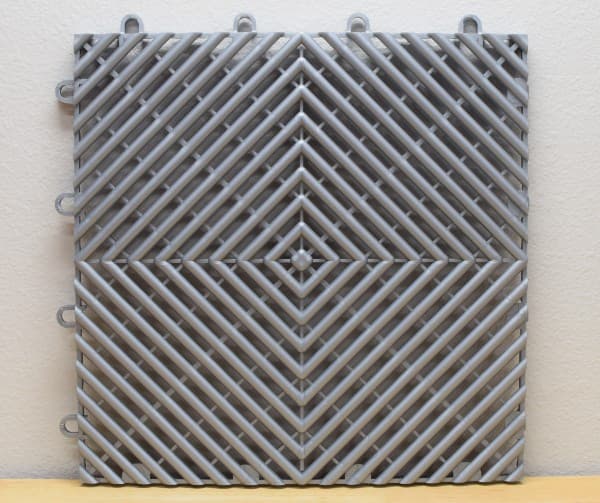
Each tile has four peg and loop connections per side using their patented PowerLock® technology. The rolling weight rating for Free-Flow® is 80,000 pounds.
Swisstrax Ribtrax™ Pro is manufactured using 4-point injection molding. It has a very nice satin finish as well. Sizing is 15.75” x 15.75” and is 3/4″ thick.

Each tile has six peg and loop connections per side with a rolling weight rating of 70,000 lbs. In addition, Ribtrax lists a compressive strength of 3120 PSI. RaceDeck does not list a compressive strength and could not provide one when we called them.
Both garage tiles are the vented, self-draining style. They provide the attractive two-tone color appearance that makes this style of tile so popular.
The two-tone look is due to how light reflects off the rounded ribs positioned 90° opposite each other in each of the four sections. The supporting substructure on the underside of both tiles is very similar as well.
Though these tiles look very similar, the larger and thicker size of the Swisstrax Ribtrax™ Pro, plus the 4-point injection molding makes it a slightly better tile than the RaceDeck Free-Flow in our opinion. Plus, the larger size means fewer tiles to assemble and fewer seams for the same square footage.
The rolling weight ratings of both tiles are so high that a 10,000 lb. difference doesn’t mean much. Unless you plan on parking a small bulldozer in your garage, both ratings are far more than adequate.
These were the only self-draining tiles available from both companies since their inception. However, in 2021 Swisstrax created an additional style called Ribtrax Pro Smooth. RaceDeck also countered with an additional design called Free-Flow XLC™.
RaceDeck introduced the Free-Flow XLC™ to combat the larger Ribtrax™ tile. It is 18” x 18” in size and .625” thick. .625” is equivalent to 5/8” for reference.
Unlike the standard Free-Flow® design, the top ribs of the XLC tile have a thin, flat surface. They call it their Dual-Traction Tread™. It is designed to provide more surface area for better slip resistance and a smoother ride for rolling toolboxes, chairs, creepers, etc.
The Ribtrax™ Pro Smooth has the same size and build specifications as the Ribtrax™ Pro. Technically, the thickness is approximately a millimeter less due to the flat surface. However, the difference is hard to notice when the two tiles are connected with each other.
The primary difference of the Ribtrax Smooth Pro is the flat surface. The flat surface promotes better traction and a very smooth rolling surface.
The Ribtrax™ Pro Smooth has the same finish as the Ribtrax™ Pro. However, it looks slightly less satin to the eye and it doesn’t have as strong of a two-tone appearance. This difference is due to how light reflects off the flat surfaced ribs compared to the rounded ribs.
The Free-Flow XLC™ looks similar to the Ribtrax™ Pro when comparing the two tiles side by side. Other than the larger size of the XLC, we would call this a close tie if we had to pick a winner.
The one odd factor of the XLC is the .625” thickness. Only the Charred and Smoked Oak simulated wood grain tiles (which we will discuss shortly) have the same thickness. The rest of RaceDeck’s entire line of tiles is 1/2″ thick.
Though the Free-Flow XLC™ can physically connect to the other tiles, it’s noticeably taller and may create a trip hazard. As a result, we recommend sticking with the XLC tile throughout your garage floor unless you plan on implementing one of the simulated wood grain tiles.
The RibTrax™ Pro tile used to have this same issue a few years ago. However, you now have more options with the addition of the Ribtrax™ Pro Smooth and Vinyltrax™ Pro line.
RaceDeck Diamond™ and Swisstrax Diamondtrax™ Tile Comparison
Like the Free-Flow® tile, RaceDeck Diamond™ is manufactured using single-point injection molding. It is available in the industry standard 12” x 12” size and is 1/2” thick.
Each tile has four peg and loop connections per side using their patented PowerLock® technology. The rolling weight rating is 80,000 pounds.
The Swisstrax Diamondtrax™ tile is from their 12-Series line. It is manufactured using single-point injection molding.
Sizing is the industry standard 12” x 12” and is 1/2″ thick. Hence, the 12-Series designation. Tile construction is the same throughout the entire Swisstrax 12-Series line.
Each tile has six peg and loop connections per side. The rolling weight rating of the Diamondtrax is 25,000 lbs.
Though RaceDeck and Swisstrax incorporate a raised diamond top design, they are different. Diamondtrax™ uses the more traditional raised diamond plate pattern, while RaceDeck uses a more subtle or softer-looking diamond shape.
In addition, the top of the raised diamond on the Diamondtrax™ tile has a polished-looking finish that reflects light. The remaining surface of the tile has a slightly textured scuff-resistant surface with a satin finish. This contrast makes the diamond shape stand out.
RaceDeck Diamond™ has a satin finish throughout the surface, including the raised diamond pattern. As a result, the diamond shape is not as bold as the Diamondtrax™.
Neither of these designs is necessarily better than the other. They are just different. The only factor we can attest to is that the Diamondtrax™ design provided more grip in our informal testing.
Something interesting to note is that RaceDeck has just introduced an additional diamond top design called RaceDeck Max™. It looks just like Diamondtrax™. They state it provides the best grip and maximum toughness. Based on that statement, the Diamondtrax tile design may provide better performance over the RaceDeck Diamond™ after all.
However, it’s the substructure on the underside of these two tiles that reveals the strongest overall construction.
When you compare the two, it’s obvious why the RaceDeck Diamond™ has a rolling weight rating over 3x greater than Diamondtrax™. It’s noticeably stronger looking and has thicker bracing.
We give the nod to RaceDeck’s thicker-looking PowerLock® peg and loop connections too. As a result, the RaceDeck Diamond™ tile is the stronger tile in terms of construction.
Woodgrain Vinyl Top Tile Comparison
One other design we want to compare between RaceDeck and Swisstrax is the simulated woodgrain tiles. Both companies use commercial vinyl inserts that replicate woodgrain or wood-like flooring. These inserts are glued to the substructure of the tile.
The RaceDeck versions are Smoked Oak and Charred Oak. Both are the color representations of the simulated wood grain.
The structure and size of the RaceDeck version are the same as the Free-Flow XLC™. This includes the .625” thickness. In addition, they are introducing a massive 36” x 36” size at the time of this publication.
Swisstrax provides two options. First is the Vinyltrax™ Pro. This is the same size and structure as the 15.75” x 15.75” Ribtrax™ tiles and is available in four woodgrain colors.
In addition, they have a simulated carbon fiber vinyl insert option. It can provide an accentuated style to your floor that looks racey and chic.
The second option is the Vinyltrax™ 12-Series tiles. These are the same 12” x 12” size and structure as the Diamontrax™ tiles. There are three simulated wood styles to choose from.
Remember, the specifications, strength, and construction of the RaceDeck woodgrain and Vinyltrax™ Pro are similar. However, SwissTrax provides double the woodgrain options, plus a carbon fiber look. You also have the 12-Series Vinyltrax™ option to match up with other 12-Series tiles.
For these reasons, SwissTrax is the best option if you want to incorporate a wood grain finish into your garage design.
One important note: RaceDeck and SwissTrax both have received complaints of car tires staining the vinyl inserts where they park. This is not uncommon with vinyl materials. The same thing happens with polyvinyl garage floor mats.
As a result, Swisstrax does not recommend using them where vehicles park for extended periods. Instead, they are best used for the perimeter of where a vehicle will be parked or other areas of the garage floor.
RaceDeck has not made this recommendation – yet. We would not be surprised if they do sometime in the future. We give kudos to Swisstrax for being transparent about tire staining.
Other Considerations When Comparing RaceDeck and Swisstrax
One nice feature about RaceDeck is that every tile in their line can be connected with each other. As we mentioned, the XLC and simulated wood tiles are taller. It’s not recommended to connect them with the 1/2” thick tiles, especially for those with visual OCD.
Swisstrax, on the other hand, has two different groups of floor tiles in their lineup. Their flagship tiles are the larger 15.75” x 15.75” Pro line which consists of the Ribtrax™ Pro, Ribtrax™ Smooth Pro, and Vinyltrax™ Pro. These are referred to as commercial-quality garage tiles.
The second line is the 12-Series. These include Diamondtrax™, Ribtrax Smooth™, and Vinyltrax™. These are referred to as residential tiles. Important to note is that the 12-Series and Ribtrax™ Pro line of tiles cannot be connected with each other.
Interlocking Connection Strength and Fitment
The strength (or lack thereof) of the interlocking connections and how tightly garage tiles fit together was a factor when comparing tiles 20 years ago. Big gaps in the seams were common as well.
There were more garage tile manufacturers in the market back then with inferior tiles, particularly from overseas. So, it wasn’t uncommon to hear stories of interlocking connections breaking and other issues.
This has never been a problem with RaceDeck and Swisstrax. It is one of the many distinguishing factors that set these two companies apart from the rest of the competition.
Yes, RaceDeck has a more robust single interlocking connection. However, Swisstrax uses more connections per side. It’s rare to hear of broken connections or tiles from either company.
Does that make one tile better than the other? It’s hard to say since it’s rare to hear from consumers complaining about poor connections with these tiles. These are not budget garage floor tiles.
You can find people who say that one is better than the other based on trying to break the connections over their knee or some sort, but that just isn’t how these tiles work in the real world.
What we can say, is that Swisstrax tiles are easier to snap together. They are also easier to separate when you need to pull one or more up from the floor. This can be a big bonus.
We had a RaceDeck floor for 8 years. We can attest that they require more effort to snap together. It was also a bit of a pain to pull one or more tiles up since the connection was so tight.
The seams for RaceDeck and Swisstrax Pro tiles are both snug and do not have large gaps. The Swisstrax 12-Series tiles do not fit quite as snugly. However, it’s hard to notice the difference unless comparing them to the other tiles.
Function, Stain Resistance, and Cleaning
RaceDeck and Swisstrax each allow maximum air circulation and water drainage underneath the tiles through a series of cutouts in the substructure. This prevents odors as well as mold and mildew problems.
In addition, they both do an excellent job of resisting stains and damage from a variety of harsh chemicals. It is hard to stain polypropylene plastic with petroleum. The one chemical that can cause damage to polypropylene though is acid.
RaceDeck and Swisstrax claim that their tiles work well with heavy rolling toolboxes, car lifts, rolling jacks, and a host of other heavy-duty garage equipment. Furthermore, both companies have similar claims for U.V. resistance which prevents fading in the sun.
Lastly, RaceDeck and Swisstrax are known for great customer service.
Final Conclusions
If we had to judge these tiles based on structural design alone, then we have to give RaceDeck the edge. Their entire line of tiles is rated at 80,000 lbs. rolling weight.
Though we feel that the larger Swisstrax Pro line of tiles is slightly better, you can’t help but notice the beefier-looking construction of RaceDeck’s solid top tiles compared to the Swisstrax 12-Series line.
Nevertheless, the 12-Series tiles cost less than the same-sized tiles by RaceDeck. As a result, they may be a better value for many people.
So that begs the question, how strong do these tiles need to be? After all, when was the last time you parked something in your garage that had a rolling weight of over 25,000 pounds? This is one reason why getting caught up in the specifications is not always necessary.
Something else to consider is that Swisstrax uses 4-point injection molding for their Pro line of tiles vs single-point injection molding for RaceDeck. Multi-point injection molding ensures better material distribution, and consistency in finish, size, and quality.
That said, both tile companies make extremely durable tiles that have achieved a reputation for standing up to some very tough garage environments.
So, if that is the case; which is the best interlocking garage floor tile – RaceDeck or Swisstrax?
The best choice of garage tiles from these two brands is the one that will fit your budget and style. The next considerations are the quality of workmanship, and the best finish that will stand up to stains, and chemicals and is easy to clean.
Both of these tile companies have succeeded in that regard. That is why they have earned the reputation as the two biggest names in the interlocking garage floor tile industry today.
You will come out as a winner no matter which you choose, RaceDeck or Swisstrax.
This post may contain affiliate links. If you use these links to make a purchase, we may earn a small commission. You can read our full disclaimer here.
Save Money on Swisstrax Tiles!
We are happy to announce that All Garage Floor is an authorized affiliate of Swisstrax. You can save 5% on Swisstrax tiles when you use promo code AGF24 at checkout.
Thanks for this great write up, it’s exactly what I’ve been looking for. I want this kind of tile in my garage and I’ve been struggling over which brand I should use. I really like the diamond pattern tiles but I’m undecided because I like the fact that the Swisstrax style is different. Which design do you think is better for a garage environment?
Your welcome Richard. Either design works well in a garage environment, it’s just a matter of taste. We recommend that you take advantage of the free sample program that both RaceDeck and Swisstrax offer to help you determine which diamond pattern you like best.
I had Racedeck in my last house. It was 5 years old when we sold it and I was very satisfied with it. There were a few dirty tiles that I had to replace, mostly my fault for waiting to clean them, though I admit it was easy to just replace the tile. I recently put down Swisstrax in my new home because it seemed like it was popular with all the shows you see it on. It seems to being doing fine so far, but I think I might have gone with Racedeck again after seeing the differences in the two.
Do any of you have feedback on whether these garage tiles make a “clacking noise”? I just started researching the different options for my garage, and I came across this article complaining about the noise the polypropylene tiles can make:
https://allgaragefloors.com/oh-my-noisy-tile/
If the link doesn’t come through, google “Noisy garage floor tile” and you’ll see what I mean…
Thanks for any feedback.
– Mike
Hello Mike, the link is good. Usually this article about RaceDeck and Swisstrax is read before people make a purchase, but hopefully some readers who have had this type of flooring will see your question and relay their experience.
Yes, interlocking polypropylene tiles do run a small risk of making some noise when walking or driving on them, but millions of square feet of this tile has been installed with noise being a very small issue. They are not whisper quite, but most people don’t notice it or are not bothered by it. We wrote the article for the few people who do experience the noise or who have very sensitive ears and are looking for a solution.
I just came across this article because I’m looking to put interlocking tile on the floor of my new garage. I had RaceDeck in my previous garage and wanted to see how Swisstrax compares. It didn’t make any noise at all in my old garage.
Great article and thanks for taking the time to review both products. What about static electricity being generated when you walk on the tiles and touch your vehicle? Anyone had any experience with either brand and static concerns?
Great question Paul and thanks for the kudos. Static electricity is rarely a big problem with these tiles but it can build up in low humidity conditions. One of the easiest ways to ensure you don’t have a problem is to attach a fabric softener dryer sheet to the end of an old mop and wipe the floor with it once in a while.
I was wondering if the reason for Swisstrax 13″ (33 cm) tiles are due to being a product of an European country and building is done on the metric system. One may assume that since most of the world uses metric they would also sell in the manner.
Jim, you would be correct in that assessment! Their 15.75″ RibTrax tile converts to 40 centimeters as well.
I have had race deck in my garage for over 13 years and it still looks as good now as it did then. I have a question….can race deck be used in community halls or is it only recommended for garages?
Hi Laurie, it’s nice to hear how well your RaceDeck flooring has held up. RaceDeck does not have to be contained to just the garage. You can use it indoors for a variety of functions. We recommend that you take a look here at SnapLock Industries. They are the manufacturer of RaceDeck tile and they make a variety of flooring options from sports, to dance halls, and events flooring.
Laurie,
Racedeck floor tiles are LOUD! They click against the concrete floor. I just installed 1300 sq ft of Circletrac and Diamond in an industrial classroom.
I am considering tiles vs epoxy. My interest in Swisstrax leans toward their smooth surface tile, it doesn’t seem that race deck has that option. Just wondering if race deck owners find it a hassle to roll floor jacks or tool cabinets over the ridged pattern of the race deck tiles?
Hello Chris, very few people complain about rolling cabinets, creepers, and tool boxes over interlocking floor tiles whether it be RaceDeck or SwissTrax. These types of tiles are actually used in a variety of working garages. The RibTrax by SwissTrax and Free Flow by RaceDeck provide even less rolling resistance over their surface.
Thanks for the reply. So, and not sure if you can answer, but if you were doing a garage, what would your choice be?
Honestly Chris, it would depend on which floor style we would want and the price we could get at the time. Both companies make a great product. They are kind of like the Ford and Chevy of interlocking garage floor tiles!
Great article. I would like to recommend one more comparison.
How easy are they to clean?
Have been selling and installing garage floor system for about a decade and have used both brands in extensively. About 8 years ago, I switched from RaceDeck to SwissTrax. I used the SwissTrax tile for about two or three years. After a rough winter here in Cincinnati, I began to receive multiple calls from clients who could not get their “ribtrax” floor clean. I personally went out to several garages and had great difficulty getting the floors clean. After talking to Randy Nelson, I had SOME success with a cleaner, called “Greased Lightning”.
I soon switched back to the RaceDeck brand. Problem solved!
SwissTrax “RibTrax” has a small texture and RaceDeck “FreeFlow” tiles are smooth.
Hands Down, The RaceDeck “FreeFlow” tile are Much easier to clean.
Hello Jeff. You raise a great point. Trying to determine which tile cleans up the best can be somewhat subjective due to the various conditions that a garage floor can be exposed to. For general purposes, we haven’t found a big difference between the two. However, information on long term exposure to both brands under more severe conditions like those you mentioned is invaluable. Thanks for the input on your personal experience and hopefully it will help our readers who live in snowy climates make a more informed decision.
Can anyone speak to how slippery these tiles are when walking on them in the wet? I live in a rainy climate and am trying to decide between the RaceDeck Free-Flow system and the Swisstrax Ribtrax design. Both allow for drainage, but what about traction for walking? My garage floor is currently painted with an epoxy coating and when it gets wet it becomes a major safety hazard.
Good question Emil. The Free-Flow by RaceDeck and RibTrax by SwissTrax are both very good anti-slip surfaces. The coined design is the one that can sometimes be slippery.
A more specific question about how these tiles do in cold snowy climates: cars drop a lot of salt picked up from the treated roads. The salt makes a mess and attacks any finish. Any experience and advice specific to this issue?
Hi Doru and great question. Because these tiles are made of high impact non-porous polymers, salt and deicing fluids do not have an effect on the finish. You can read our latest article about using these tiles in a snowy climate here. We also just published an article on how to clean interlocking tiles as well.
Thanks for the prompt reply Shea. It adddesses all my concerns.
Has anyone ever tried to use pex tubing for a hydronic radiant heating system UNDER these tiles but ABOVE the underlying concrete? Does the pattern under the tiles allow for this tubing which is .375 to .500″ thick? Thanks
Hey Steve. The majority of all interlocking tiles are only 1/2″ thick with the exception being the 3/4″ thick RibTrax design by SwissTrax. The tile is also a free floating floor system which can move slightly as it expands and contracts with heat. That alone is not the best environment for pex tubing. We aren’t sure how well the heat would radiate within the tiles as well. If you are still interested, we recommend that you give either of these companies a call and talk to them. They both have good customer service and like to hear from prospective customers.
I am planning to cover an existing vinyl tile floor in a 60’X200′ building that we use to display collectible cars – some of these cars will be stored long term without moving and some will see an occasional venture to the streets – do either of these tiles suffer a permanent dent under the tires over time? – would it be smart to lay down a hard surface “parking puck” under each tire on top of the tiles? – also, do either of these tiles curl up under turning wheels (not stopped, but slowly moving)? – when cleaning these tiles with water can you successfully vacuum up the water through the tiles when done? – should we fasten the wall edges of the tile system to the concrete to prevent creeping? – THANKS for a response!
Hi Chuck. Great questions and thanks for stopping by. These tiles will not dent at all from car tires, even if sitting for long periods of time. In fact, car museums and many a car collector use these tiles for their vehicles. The only time polypropylene tiles suffer dents is when a high load is applied by a very small surface, such as a jack stand with thin metal legs under load. The locking system prevents the tiles from curling and buckling from turning tires, even when moving slow or not at all.
A strong shop vac can suck up some water through the FreeFlow or RibTrax tile, but not all. For that, it’s as simple as finding the low spot and popping a tile up with a paint can opener or flat head screw driver and then sucking the water up from there. Keep in mind that the underside of the tiles to a good job of circulating air to help with evaporation.
As far as installation is concerned, do not anchor the floor to the wall. The tiles will expand and contract slightly from temperature and is why it needs to be installed 1/2 inch away from the walls. The weight of the floor itself along with parked cars will keep it from moving.
Hi,
This is a wonderful article. Very straightforward in presenting the facts, pros, cons and differences between these two major players.
I am looking for solutions to fix my garage floor, 20’X20′, about 400 sqft, two car. I have an home built in the 50s and am not sure when the current garage floor was laid. It is concrete. But it is chipped and broken in the middle and other areas of the floor. I would say about 50% of the floor is this way. So it is pretty bad. I have spoken to epoxy and concrete contractors. Epoxy guys says that they will fix my floor by smoothening it and applying epoxy but cannot guarantee the work since it might start peeling off in a few years because floor is bad right now. Concrete guys are saying that the solution is to rip off the entire floor and replace with new concrete which is REALLY expensive solution. So I have been looking into modular tiles. One of the installers who works with swisstrax guarantees that Ribtax will work very well for me and that we can lay it right on top of the floor. He says he has seen worse floors and that Ribtrax will cover up, protect and make the floor beautiful and usable. I am not very convinced. I am worried how these tiles will sit evenly on top of a floor when some of the areas of the floor in chipped and broken underneath. I live in southern california so weather is not a big concern. Is there anyone who had a similar situation or known someone who did and installed modular tiles that worked? Your guidance will be very helpful. Thanks in advance!
Hey Garage Guru!
Tysm for review- ok now bear with me- building a storage shed / garage for my Harley , equipment, etc 12×12 feet on an existing well supported deck – gonna treat floor boards with industrial strength paint sealant and want to cover with rib tiles – floor is flat but not flat like concrete – will tile system buckle or move with bike pulling in and out?
Hey there Mike. An interlocking tile floor should work just fine for what you want to do. The only reason it would buckle is if it wasn’t cut to fit with 1/2″ clearance from the edges of the shed to allow for expansion if exposed to direct sunlight for long periods.
looking to use the ribtrax or free flow on the outdoor deck anyone know if they get too warm for the bare feet in the hot sun..good old fashioned wood seems to stay fairly cool ???
Great question David. We know that SwissTrax markets their Ribtrax for outdoor use. We suggest giving their customer service line a call if you don’t get a response here. They are good people to talk to and very helpful. RaceDeck offer tiles for outdoor use as well, but only in limited colors. They have great customer service as well and should be able to answer your question.
I’m looking forward to put one of the two system in my garage. My garage will have a four post lift in it. Do you know if Swisstrax or Racedeck can withstand the four post lift with the car on top and car park beneath it? I saw pictures of both brands with the four post lift on it, but want to know more about the affect over years.
thank you much,
Hello Sang. We know of both two post and 4 post lifts that have been installed on RaceDeck and SwissTrax tiles for years without failure. The reason it works so well is that the posts have a large enough footprint that really reduces the PSI over the area of tile affected. If it still worries you, you can always affix the lift directly to the concrete and then cut the tiles to fit around the post.
Interested in the recycled rubber under-mat for the Swisstrax flooring. While I can appreciate the sound deadening properties, I am concerned about how water drainage reacts with the rubber. I am concerned that the mat would become a sponge and hold water and eventually start to smell or mold. Any info here, greatly appreciated. Thanks, Bill
Hi Bill. We agree with your concerns. We have noticed a few tile vendors recommending this setup and do not agree it’s a good fit for all floors. If you live in the desert southwest or areas where you encounter less rainfall it would work fine. However, for most other areas it would not. Particularly if you use a self-draining tile design.
Synthetic landscape cloth is a much better choice (and cheaper too). While the sound deadening properties are not as good as recycled rubber, the cloth allows for air circulation and fast evaporation. It will not mold or mildew and does not deteriorate.
All these are great information except none of them answer my questions about either of the tiles. I am a Harley rider and a work on my cars with floor jacks. Both of which put a large load on small areas. Will either of them stand up the weight loading of the jacks or side stand of the bike?
The floor jack has small wheels and with the loading of the jacks up to 5000 lbs
Thanks
Hello Doug. The tiles hold up well to standard car jacks with the wider wheels. If your jack has the narrow 1″ wide wheels, it’s best to have a dedicated pad to place the front wheels on – particularly if the jack will be supporting the motorcycle for a while. The wheels won’t break the tile, but they may leave an impression that may or may not heal itself due to the extremely small surface area of wheels. Most people will use a small piece of 3/8″ plywood or 1/8 inch metal plate. It doesn’t have to be big. 12 square inches (6×2 for example) is more than adequate.
It’s the same issue with side stands. If they have a flat surface area a couple inches square, then you are fine. If it’s a real small surface area, as some of these side stands can be, then you will want to use a pad. RaceDeck actually makes polished metal diamond plate tiles that are popular for side stands.
Both brands of these tiles are extremely strong when it comes to weight. Many people have double wide 4 post car lifts mounted on top of the tile with no issues. The key is how flat the surface area is.
Hi Shea! Given that the use of plywood to protect the floor is not an option, are there heavier-duty flooring tiles? Such as those used is a professional shop.
Hi Tonosity. What do you mean exactly when you refer to plywood for protection? Tiles by both RaceDeck and SwissTrax are used in industrial applications for businesses like custom car manufacturers, repair shops and more. In fact, they are even used in airplane hangers to support the weight of large business jets. They are as heavy-duty as they come.
If you are referring to using plywood to protect the tile from the sharp edges of concentrated loads, such as an angle iron leg that supports a very heavy load, then no, no one makes such a tile. As long as the contact point provides a couple of square inches, then the tile can support quite a bit without damage. One exception to that is RaceDeck Pro tiles. They are polished aluminum diamond plate interlocking tiles used for displaying show cars, supporting kick stands of heavy motorcycles, and other custom touches.
I’m concerned about the use in hot climates. Besides the 1/2″ spacing are there other recommendations? I have a west facing garage in Florida. Thank you.
Interlocking tile garage floors are a common installation in Florida Tracy. Heat is not an issue unless you have sun that shines directly on the tiles. If you expect that, then the Free-Flow or RibTrax self-draining tiles are recommended. They have much less surface exposed to the sun and expand very little. Just make sure to lay the tiles during the warmest part of the day so that they are fully expanded. Transfer any heavy objects to the new floor while they are expanded and it effectively catches the floor at its largest size.
Race deck screwed up our order three times. Don’t buy direct from race deck! Overall product is great! By the way, 2 car garage supposedly take 2-4 hours. NOT TRUE!!! Many with 12 people but with 2 it took 14-16 hours due to the pattern and CUTTING the tiles.
How do you cut the Racedeck Tiles?
Hi Tony. You can use a jigsaw, circular saw, or a table saw to cut the tiles. One trick is to cut them upside down. This creates a smoother edge on the surface of the tile.
I have been looking into purchasing Swisstrax Ribtrax but then I came across Vented XL Grid-Loc tiles by Garage Flooring Inc. Both of these look identical, however, my quote from Garage Flooring Inc is a bit cheaper. Do you know if these two products are identical or what the difference might be?
I also am going to be butting this flooring up against rubber gym flooring that is 1.25″ thick (I have a 3 car garage and use the third bay as a gym). In order for there not to be trip hazard I was thinking of using a rubber subfloor leveler. This is basically a long strip of rubber 12″ to 18″ wide that ramps from very thin to 0.5″ thick across its width. This would create a flush fit but I’m concerned how the tiles would handle this. Do you think this would cause the tiles to raise off the floor or create any issues?
Hello Neal. The Vented XL Grid-Loc tiles are a private label version of the SwissTrax. As far as we know, there are no differences between the two. If you haven’t already, get a free sample of each to compare. The rubber subfloor leveler will work OK. We would recommend the 18″ width. It might create a very small gap where the tile bridges the rubber strip, but it should not affect the performance of the tile other than making that section flex more when walking on it.
looking to install in a woodworking shop was wondering if sawdust collects in the seams where they snap together?
Sawdust doesn’t jam up in the seams if that is what you are asking Scott. Sawdust is real easy to sweep up or vacuum actually.
I’m wondering your thoughts on the 1/2″ thickness in the Free Flow vs the 3/4″ in the RibTrax would make a difference in your mind in a snowy climate? I’m wonder whether that quarter inch makes a difference with allowing the snow to more easy fall/melt through and also give you more clearance over some of the puddling of the water. I guess the obvious answer would be “yes, taller is better”, but at 1/2″ it may still not make that much difference.
It really doesn’t make any difference Ed. They both work real well in snowy climates. Besides, if you have a 1/2″ or more of standing water in your garage from snow melt, then you have other issues that you need to take care of first…. lol.