

There is nothing worse than trying to get rid of the foul urine smell from pets, dogs, and cats out of the concrete of your garage floor or basement. It seems like no matter how much you clean, the smell won’t go away. This is particularly true for cat urine.
We will cover the best methods for removing cat and pet urine odor from your concrete. In addition, we will include instructions on how to seal your garage floor or basement to block any odors that may persist from concrete, especially with particularly heavy urine issues.
Most concrete with pet urine odor must be treated in a two-stage process. Sometimes it may even require an additional stage, depending on the type of urine odor remover or pet enzymatic product used.
In addition, it helps to use a wet vac if you have one. It is most helpful if you have a basement with urine odors and no drain available. The wet vac helps draw bacteria out of the concrete during cleaning. Carpet cleaners can work in a pinch for vacuuming up liquids as well.
Pet urine odor and stains won’t go away with normal cleaning
We guess you may have already tried cleaning the urine stains to remove the odor from the concrete without good results. The stain may or may not be gone, but the smell remains. Because of this, it’s important to learn why the urine odor still exists and why conventional cleaning methods do not work. Doing so can save you some time and expense.
Concrete is actually porous like a sponge. It will absorb almost any liquid if allowed to sit for a while. This is why it’s hard to remove stains from concrete.
When urine is introduced to concrete and allowed to dry, the uric acid crystals present in the urine bond tightly to the concrete. Unfortunately, these crystals form deep within the pores and capillaries of the concrete since the urine was allowed to soak – sometimes multiple times, for days or even months.
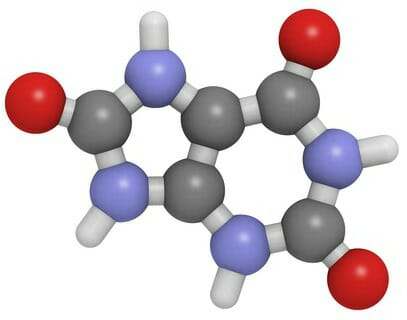
Despite numerous cleanings, uric acid crystals are insoluble and will not bind with regular soaps and other cleaning agents. Thus, the crystals stay attached to the concrete and the smell remains.
The smell may dissipate temporarily after a good cleaning, but as soon as any moisture or moisture vapor is introduced again, it can come back just as strong as before. Basements can be particularly susceptible to this.
The reason the smell returns is that uric acid salts allow crystals to reform as soon as moisture (humidity, for example) is introduced. This releases a gas that has a pungently strong odor.
The best way to stop the smell is to use an enzymatic cleaner. Enzymatic cleaners attack and break down the uric acid crystals and separate them from the concrete. Rocco & Roxie is our #1 recommended enzymatic cleaner to use on concrete to remove pet urine smell.
Steps for removing Cat and pet urine odors from concrete
- Identify urine areas in concrete using a UV light or black light
- Clean the affected areas with a proper cleaner to remove bacteria
- Let the affected area dry throughout – not just the surface
- Treat the affected areas with an enzymatic pet odor remover
- Do not skip any steps or take shortcuts

- Certified Gentle & Safe Pet Carpet Cleaner Solution: Chlorine free, color safe, no hazardous propellants or residue; safe to use around pets and children; certified safe for all carpets with a Seal of Approval by the Carpet and Rug Institute (CRI)
- Pet Enzyme Carpet Cleaner for Stains, Odors, Residue: If it’s gross, it’s gone; the stain and the stink; from stinky yellow pet urine, feces to vomit or other organic spills, Rocco & Roxie professional strength stain & odor eliminator tackles it all
- Cat & Dog Urine Enzyme Cleaner for Every Surface, Every Time: For use on carpets, floors, furniture, clothing, litter boxes, kennels, carriers, all pet living and sleeping areas—anywhere stains happen enzyme cleaner for dog urine
- Cat & Dog Urine Enzyme Cleaner for Every Surface, Every Time: For use on carpets, floors, furniture, clothing, litter boxes, kennels, carriers, all pet living and sleeping areas—anywhere stains happen enzyme cleaner for dog urine
- Buy With Confidence: You want the best for your best friend; we do, too; if you are not satisfied with the performance of this Rocco & Roxie stain & odor eliminator, contact us; we are determined to make it right
This post may contain affiliate links. If you use these links to make a purchase, we may earn a small commission. As an Amazon Associate, All Garage Floors earns from qualifying purchases. You can read our full disclaimer here.
How to identify urine odor stains in concrete
To get the best results from an enzymatic pet urine cleaner, you must first identify the exact areas in the concrete affected by the urine.
Many times, the source of pet urine odor can easily be identified. Areas where pets were kept in a pen are an example. However, sometimes it may not be so easy to detect.
This is often the case for people who have moved into a home that previously had pets, only to find that the garage floor reeks of a foul urine smell. Stains may have previously been cleaned, thus hiding the source of the odor.
One tool that does a good job of identifying pet urine is a UV light or black light. These from Amazon do a good job.
Close the doors and then turn on the black light. Hold it no more than three feet off the concrete as you scan the floor in sections. Old urine stains will stand out as blue, green, or yellow markings on the concrete.
We like to encircle the far outside area with arrows pointing toward the urine stain. Chalk works well for this, provided you don’t get it wet. Be sure to check the first two feet of your walls from the floor up as well. Sometimes cats will spray urine on the walls. This requires removing and replacing the affected section of drywall to get rid of the smell.
If, for some reason, the UV light does not reveal any stains, the old standby that will work is your nose. This takes longer, but it is effective. Open the doors to air out the garage and get rid of the immediate smell. After that, get down on your hands and knees and start sniffing. Trust us; you will know when you find it!
Clean the pet urine stains with TSP
After you have identified where the urine is located, it’s important to properly clean the area to rid the concrete of bacteria and other residual urine elements. Contrary to popular belief, most enzymatic cleaners do not remove bacteria.
Once you know where the urine stains are, the first step is to scrub the area with a strong solution of ½ cup TSP (Trisodium Phosphate) to 1 gallon of hot water. TSP mixed at this ratio is very strong. Gloves and eye protection should be worn for safety.
What the TSP does is remove all the bacteria, most if not all of the stains, as well as remove other residue left from the urine. It will leave only the uric acid crystals behind. This will allow the enzymatic pet urine cleaner to work faster and more efficiently at removing the uric acid crystals.
Pour the hot TSP solution onto the urine stain or identified area and scrub it with a short-bristled nylon brush. A deck brush works well for this. Make sure that you keep the area wet for at least 10 minutes or more to allow it to soak into the concrete. The solution will follow the same paths as the urine did and will need some time to work its way down into the concrete.
Do not be surprised if the smell increases as you soak the concrete. It is a combination of urine residue and uric acid crystals reacting and releasing gas from contact with the water.
Once the area has been scrubbed and allowed to soak long enough, pour clean hot water over the treated area again and then vacuum up the water with the wet/vac. Carpet cleaners will work for this as well. You will want to do this at least twice. For heavily treated and soiled areas, three times would be better.
This hot water rinsing will remove the TSP solution and help to suck up any remaining urine residue that is in the concrete. Treat any additional areas in the same fashion (scrub, soak, rinse), and then allow the concrete to dry at least overnight. 24 hours or more is best. Pet urine enzymatic cleaners work best when the concrete is completely dry before treatment.
As a note, the TSP may create a whiter-looking area on your garage floor since it is getting the concrete very clean. If that is the case, you may want to scrub the rest of your concrete after you are done with the same TSP solution. This will achieve a more consistent (and clean) look on the floor.
Using a hose with a high-pressure nozzle works fine for this to speed up the rinsing process. You are just removing dirt at this point and not sucking up urine residue. We have more tips for cleaning a garage floor here.
Apply pet urine enzymatic cleaner to concrete
Pet enzymatic cleaners work by using bacteria (the good kind) to digest malodors, waste, and stains. These bacteria produce enzymes that break down the molecules of the uric acid crystals into smaller bits. This allows the bacteria to digest the smaller bits and break them down into the two basic components of carbon dioxide and water. They are the best product for removing the smell of cat urine.
Because you are working with concrete and not carpet, we suggest using a product that is available in concentrate or gallon jugs and not something that comes in a spray bottle. Unlike carpet, you will need to use liberal amounts of the enzymatic cleaner.
The reason for this is that most enzymatic products need some sort of exchange with air. Since most of the uric acid crystals are deep in the concrete, it takes more time for the required air exchange. It will also take time for the concrete to absorb the enzymatic cleaner. Since some of the cleaner will evaporate on the surface as it soaks in, more will need to be used.
One of the best products for removing cat, dog, and pet urine odor is Rocco & Roxie Professional Strength Stain and Odor Eliminator. It has worked wonders for us, and we highly recommend it.
It has stellar reviews, and we know of more than one kennel that uses this as its go-to odor eliminator. Furthermore, it’s available in gallon jugs and does an excellent job when given time to work. You can find it here on Amazon.
There are many other products with good reviews that you can shop for here if you prefer. We recommend staying away from the products that require mixing with carpet shampoo, as these will not be as effective on concrete.
Be sure to follow the directions for the product you choose. Pour it onto the stained area and then start scrubbing it in with a deck brush. Keep it wet for at least 10 minutes or more. You want the concrete to absorb as much of the solution as possible.
For the best results, temporarily cover the wet area with a cheap painter’s tarp to help avoid evaporation of the solution. This will give it more time to soak into the concrete. Rinsing is not required. The enzymatic cleaner will break down the uric acid crystals into carbon dioxide and water, which will dissipate on its own.
Particularly bad-smelling areas may require multiple treatments. This is because it will take time and more enzymatic cleaner to soak into the concrete and do its work. Remember, you may be dealing with an area that allowed the concrete to soak in urine for weeks or months.
DO NOT RUSH THE PROCESS! This is the biggest mistake people make. As we stated, enzymatic urine odor removers require time for the good bacteria to digest the uric acid crystals. If you rush the job, you will not be successful.
Sealing concrete from pet urine odors
On rare occasions, it may require sealing the concrete to prevent any residual pet urine odor from working its way back to the surface. Sometimes people want to do this even though the odor is gone. They just don’t want to take the chance of it returning.
The only type of sealer that will work is a non-breathable, topical concrete coating. Garage floor coatings are a great example. Garage floor coatings are film-forming and do not breathe. They will block odor molecules from transferring through the coating. Acrylic sealers and penetrating sealers will not work. They are breathable and will allow the odor molecules to pass through.
The least expensive to apply is EpoxyShield by Rust-Oleum. You can find it here on Amazon. Do not use 1-part epoxy paint. 1-part epoxy paint is paint and not a true 2-part epoxy coating. Paint breathes and will not seal out the urine odor.
Applying a garage floor coating requires grinding or etching the concrete before application. If you know that you will be applying a coating before you treat your garage for pet urine odor, we recommend treating the concrete after you grind or acid etch.
The concrete prep process will open the pores of the concrete and allow the pet enzymatic cleaners to be absorbed into the concrete more easily. It will allow slightly more air transfer as well. The result will be a quicker and more effective use of the cleaner.
Once the coating is applied and has fully cured, it should effectively block any odors that remain in the concrete.
How do you treat a wall-to-wall carpet with padding over concrete slab in the primary living space of your home?
Hi Pamela. Our knowledge is much more proficient in removing the odors from concrete. Carpet is not a subject we specialize in. However, we can tell you that if the urine penetrated the pad to the concrete below, then the carpet and pad will need to be pulled up to clean the concrete first. If not, the odor will persist even if you replace the carpet and pad.
Hello! Would you have to clean/sanitize after you use the enzymatic cleaner to make it safe for cats to walk on afterwards?
Hi Sam. No, that is not necessary. It will not leave a residue on the concrete.
I’m always cautious when using cleaners. The tsp powder solution and following it with the enzyme cleaner won’t create a bad fume to be around. I will wear a mask, just don’t want to pass out 🙂
Hi Gina. No, there are no worries about fumes. Also, the TSP solution is rinsed and then allowed to completely dry. The concrete needs to be dry before introducing the enzymatic cleaner in order to be most effective.
Hey guys!! Thanks so much! I’ve bought a house where the owners were breeding dogs in the garage.. it’s overwhelming. If we’re going to grind and apply the enzymatic cleaner AND then do an single component epoxy coating.. do we need to do the TSP step first?? I’m fine doing the TSP step but time-wise it would help not to.. Thanks!!!
Hi Dustin. Clean and degrease the concrete first, grind, then apply a liberal dose of the TSP solution. The open concrete pores from the grinding will allow the TSP to soak in further. It helps to use a brush to agitate it a bit and work it into the concrete. We would recommend using a wet vac to suck up the solution after it has had time to dwell. Rinse liberally afterwards. You will need to wait at least 24 hours for the concrete to dry before applying the enzymatic cleaner. Preferably 48. The enzymatic cleaner needs time to work after applying it. At least a few days. With all those dogs, it may require additional doses. Make sure to check the walls for urine as well.
1-part epoxy is not a coating and will not block any remaining odors (if any). It just paint with 3-4% epoxy resin added. You need to use an actual 2-part epoxy coating or polyurea coating to seal the concrete and help block remaining odors. We can makes suggestions if you are not sure what to use.
Wow thanks!! I did mean single-component polyurea.. and found ArmorPoxy SPGX Polyurea Coating, which appears correct. In addition to TSP and the R&R enzymatic cleaner a UV flashlight is arriving tomorrow to scan all surfaces. I’ve got 4-days set aside for cleaning, grinding, TSP and the R&R applications, as it needs to be done correctly, I will give it enough time between the last two.
OK, I thought you may have meant polyurea when you said single component, but I was not sure. SPGX is an excellent product and easy to work with.
Good to hear! Cancelled and re-ordered my products from Amazon starting by linking through the R&R add in this post.. hope you got affiliate-recognition for the whole order! Any ads for that brand or similar polyurea I can click through when I’m ready to order that? I can get it through Lowes if not. Thanks again!
Thanks, Dustin. We appreciate that! No, we don’t have any affiliate links for the SPGX (yet). However, I would recommend contacting ArmorPoxy directly to purchase. Many times they will provide a 5% discount or more for signing up to their email list. If not, call them and tell them we sent you and that they may offer a discount. Shipping should be free. Plus, they can help you with any application questions you may have. It’s always best to buy directly from the source if can. Lowes know next to nothing about applying commercial quality concrete coatings.
Hello! Thanks for all the valuable informations your sharing on this site!
Treatment with two different enzyme cleaners, after the required TSP cleaning step, did not reduce nor eliminate the smell I have on my basement floor. It looks like I’ll have to seal the floor. I’d like to know if you think the Rust Bullet Duragrade Concrete product would achieve that goal. I think it should, being a film forming polyurethane product, but I’d like to be sure before buying and importing such an expensive product in Canada from the USA!
Thanks again!
Hi Eric. Have you moisture tested the concrete in your basement? Basements are notorious for having moisture vapor issues and coatings do not adhere well if that is the case. It may also explain why you are having a hard time with the odor. Assuming your basement concrete does not emit moisture, DuraGrade Concrete will seal the concrete properly and help to block out the odor.
I am trying to clean cat urine from a 3 x 5 foot area of a concrete floor in my storage room but am having trouble locating TSP other than in large quantities. Will Tsp substitute or TSP with out Phospate still work the same? I also have a couple of other questions , it’s in a storage room off my living room. I am not sure if I am going to be able to grind the floor before sealing it. I don’t even know how to grind it. Is there any other way? There are also some cracks that I need to fill so I picked up a tube of Quikrete Concrete Repair. Are you familiar with this product?
Thanks,
Kym
Hello Kym. If you can’t source TSP, then we recommend using a product such as Clorox Urine Remover. It will kill the bacteria that you need to get out first. Here is an example from Amazon. Use a wet/vac to remove any residue and rinse water unless you have a drain. Grinding is not mandatory, but etching is in most cases. Many kits come with an Eco safe etch solution. Again, use a wet/vac to remove all rinse water. You will need to give the concrete a few days or so to complete dry since it’s in an enclosed area before you apply the enzymatic cleaner. What coating product where you planning on using?
The Quikrete Concrete Repair (despite the misleading name) is not a crack repair product. It’s a flexible crack filler that generally cannot be painted or coated over. You need to use a 100% solids epoxy or polyurea crack repair product to actually fill and repair the crack. These cure to become extremely hard and have a bond and strength greater than concrete. Rust-Oleum concrete repair is an example. You can find it here on Amazon. You mix the 2-parts together on a piece of cardboard or wood and then use a putty knife to work it into the cracks.
Hello again! I did the moisture test and no condensation appeared after over two weeks. This floor has never shown signs of underground moisture. The watertable is somewhat high in the spring time, but I guess the house footing drainage was installed correctly and is working fine!
That’s good. DuraGrade Concrete should work fine then.
What type of garage floor coating do you recommend?
Can it be used in a basement if we moisture test?
Hi Catherine. You need to use a low to no VOCs coating product when applied in a basement. These would include water-based epoxy and the much better quality 100% solids epoxy (no water or solvents). Yes, a moisture test should most definitely be performed. Basements are notorious for moisture issues and coatings do not do well in such circumstances. The time to moisture test is shortly after a wet spell. If testing is done during a dry period, you can get a false indication of no moisture.
Hi! I’ve been using tsp for the past two years to remove urine from concrete, but have recently run out of my supply. Apparently there has been a TSP ban in most states as of this year. Many products sold are now “TSP substitutes”. I was wondering if you had any knowledge of these substitutes will work just as well? Or if you had any other suggestions for concrete cleaners?
Hi Aly. At last count, I believe 16 or so states have banned the sale of TSP. White distilled vinegar and water mixed at a one to one ratio is an alternative for cleaning the concrete. This is due to the acid base of the white vinegar. However, it’s not always effective at killing all the bacteria. We suggest following up with 70% isopropyl alcohol after rinsing the vinegar solution. Vinegar and 70% isopropyl alcohol are safe if they come in contact with each other, so no worries there. We’ve had some readers email that this worked for them.
Hi! First off, I want to give my most sincere thanks for this thorough explanation and guide! I’ve been scouring the internet trying to find solutions and you’ve covered it all. I’ve experienced everything you outlined with the smell of pet urine (deep cleaning, scrubbing it, using enzymes, commercial vinegar etc) and each time the odor has returned. I’m going to follow the guide you’ve outlined in hopes of getting rid of the odor once and for all.
The only difference for me is that my floor is brick not concrete. I assume everything will work the same in terms of cleaning and deodorizing, but I’m unsure about sealing it with epoxy. Will using an epoxy on brick to seal the odor produce the same result or do I need to find another product?
Hi Kirk. As an FYI, brick is more porous than concrete. Therefore, the contaminants may have soaked further into the brick and require more than one treatment. Is the brick outside or inside? Is it below grade or on grade? This can determine what type of coating to use.
When you say more than one treatment; Do you mean the whole process including etching and tsp? or just the enzyme cleaning portion?
The brick is inside the house. It’s in my living room. It’s an older house, possibly dating back to the late 1800’s. I wasn’t really able to determine the grade of the brick. It’s well placed and uniform in color, so my guess is that it’s on grade.
Hi Kirk. You don’t need to do the whole process twice. It just may require more than one cleaning with the TSP and/or enzyme treatment. Your nose will let you know. It just all depends on how much urine you are dealing with since brick can be very porous. Makes sure to let the TSP soak for a few minutes or more on the brick without drying out. This will hopefully allow it to penetrate deep enough. On grade means the bricks are sitting at ground level and not below, such as a basement or up against a hillside. Below grade flooring can experience issues with moisture from below that coatings don’t deal with very well. Since it is inside, epoxy will work just fine. Make sure you use a water-based epoxy or 100% solids epoxy since they are very low in VOCs.
Thank you! Any recommendations on water based epoxy’s?
Assuming it’s a small area that is subject to foot traffic only, one of the lesser expensive options such as EpoxyShield Clear Coating would be a good option. Just don’t put it on too thick if it’s a small area or you will experience cosmetic and curing issues. You can also opt for two coats in a small area by mixing smaller quantities using the correct ratios of part-A and part-B.
What garage floor coating do you recommend? And can I skip the etching/grinding? I don’t have any help and need something quick to seal the concrete after cleaning it the way you instructed. My flooring guy is willing to apply the sealer. I just need to know what to buy. Thank you so much!
Hello Heidi. Where is the coating going to be applied? No, you cannot skip proper concrete preparation. It is the most important part of the application process.
It will be applied in my dining room. I guess I’m wondering if there’s a quick dry sealant that will work effectively in my dining room. Need something safe and preferably with low odor. Any ideas?
Hi Heidi. No, there are no quick dry sealers that will not smell or can be applied DIY or by a person who is not a concrete coating professional. We would recommend applying EpoxyShield Premium Clear Coating. It’s a no VOC (low odor) epoxy coating that is not breathable and will block odors. It comes with an Eco friendly etching solution that can be applied to the concrete. Once the solution is applied, agitated, and allowed to sit the required amount of time, you can add water to rinse / dilute it and then mop it up or use a wet vac. After it has completely dried, you can apply the 2-part epoxy. You can’t walk on it for at least 12 hours and you can’t install anything over it for 24 hours. Unfortunately, there are no quick and easy remedies.
Hi Shea!
I have read and follows this tutorial a number of times – it’s really thorough and pretty darn effective! I haven’t taken the plunge to seal before now, but I plan to as soon as I can.
I’m cleaning cat urine out of concrete in a basement and I have done the TSP step with a substitute and used Rocco and Roxie (great stuff). I’m seeing comments that TSP substitutes might not be as effective so I’m willing to do the process all over again, but since I want to do a sealant, it sounds like I should do etching very first thing, and then the TSP (or vinegar/alcohol) clean, and then the enzyme clean , is that right ?
For the sealant I think I’ll do EpoxyShield Clear Coating …. but this is the step I’m most nervous about as I don’t want too pick something that will let odor through. If there’s a better fit for a small basement space I’m all ears. I’ll do a moisture test once my faux tsp clean has dried out, but I think that’ll turn out okay.
You’re such a great help!
We are glad to hear it, Nicole. You are correct on both counts. Etch before you begin the cleaning process. This will open up the concrete pores more to make removing the urine more effective. EpoxyShield Clear Coat is 100% solids with no VOCs (good for basements) and is non breathable so that odors can’t pass through.
Sounds perfect, thank you!
Are there any options to seal your basement floor if you do have moisture issues? Or does some sort of basement waterproofing need to be done in order for one to be able to properly seal the floor?
Hi Mary. It’s difficult and expensive to waterproof a basement after it is built. There are special moisture vapor blocking epoxy primers that can be applied depending on the amount of moisture vapor present in the floor. A few calcium chloride tests need to be performed to see if the amount of moisture falls within the specs of the epoxy primers. Application requires aggressive grinding of the concrete surface before a moisture blocking primer can be applied.
For our cement basement floor, we are at the stage of using the enzymatic cleaner and are thinking ahead to buying the products for sealing it. I notice a difference in the color of the floor where I’ve used the enzyme cleaner versus where I haven’t so far. The color (and the strong smell of the cleaner) makes me think we should wash the cement again before painting. Is the cleaner going to disturb the paint (or crack filler) or prevent it from adhering?
Hi Christie. No, the enzymatic cleaner will not affect the adhesion of any sealers. Just make sure to allow enough time for it to work properly before you do anything in regards to properly prepping the concrete for a proper sealer (etching, etc.).
Thanks for the great article! This was specifically written about garages. Is this process safe for indoors? Can these enzymatic cleaners be safely used on concrete floor (carpet/pad removed) of a bedroom? No residue or off-gas concerns?
Hi Doc. Enzymatic cleaners are Eco friendly with no off gassing or environmental concerns. This same process has been successfully used in basements and other areas of the home. TSP does not contain any fumes or VOCs. However, it can have possible reactions with skin if not using gloves and is harmful if swallowed.
Hello, how long do you let the tsp solution sit before sucking it up with shop vac? Sorry if I missed it.
Hi Brenda. It doesn’t have to sit too long. Just long enough to soak in without it drying out.
Hello. I have a garage that was used as a kennel. I desperately need to get rid of the odor before it gets hot. Do I need to use a TSP cleaner as well as the Rocco & Roxie product that you recommended? And can you please explain grinding?
Hello April. Yes, you need to follow all of the steps closely. Do not skip steps or take shortcuts. This is particularly true if your garage was used as a kennel. It may require multiple treatments of the enzymatic cleaner. As we point out, enzymatic cleaners require time to work. The good bacteria they use have to break down the uric acid crystals and digest them. If you plan to apply a 2-part epoxy coating or similar (not 1-part epoxy paint), we have an article about grinding here. We also have an article about acid etching here. If you are going to do either one of these, we recommend doing them first before treating the concrete. The open pores at the surface resulting from the concrete prep will allow the TSP cleaner and enzymatic cleaner (Rocco & Roxie) to penetrate deeper and work even better.
Hey there: When we moved to a new house, our cats became very stressed and used a corner in the living room as their litterbox (on the carpet). The smell is overpowering with urine. I have removed the carpet and the tac strips. The urine has soaked the concrete. It is a very difficult area to treat because it is in the corner of the living room, and I believe the drywall is also affected. I first tried spraying the area with 50:50 vinegar and water but the urine smell is still there. Next, I tried pouring hydrogen peroxide on it and let it dry but that hasn’t worked either. There is also baseboard trim in the way. Should I use the TSP even though I won’t be able to do any etching to the concrete? Thanks for all your help!
Hello Jill. Home remedies that include vinegar or hydrogen peroxide is not going to fix a badly contaminated area. You will need to clean the concrete with TSP and then treat the surface with a quality enzymatic odor remover. We recommend Rocco & Roxie. The only way to get the odor out of the drywall is to cut out the affected area of the drywall and replace it.
Hello! Like many others I have a cat pee issue in my basement. In the past I have used Zinsser Odor Killing primer on my upstairs OSB subfloor. It worked well. Do you know if this product can be used on the concrete? We are having floating LVP installed soon and need to prep the floor first. We do not have moisture issues. Thank you for your time and the great article!
Hi Lori. The Zinsser Odor Killing Primer can be applied to concrete. However, it is still extremely important to clean the concrete first as we outline in our article.
I went through the steps to treat the concrete slab in my master bedroom. My house is slab on grade. The spot I was trying to treat was large (3′ x 6′) and was really bad. The lady who lived in the house before me was elderly and not able to get the dog out to go to the bathroom so it repeatedly used the spot over along period of time.
After grinding down the floor with a diamond carbide disc, cleaning multiple times with trisodium phosphate, and 2 gallons of Rocco & Roxie Professional, the smell was still there although I can’t say for sure if it was as bad because the enzyme cleaner was a potent smell itself. I then put down the rustoleum epoxy. In the end it probably got rid of 90% of the smell. I will probably do multiple coats of epoxy. Long story short, aside from completely removing the source you may never get the smell out completely, And you may never be able to completely seal it in. I will say that these instructions were very helpful though. If it gets 95% of the smell out, I consider that a win.
Hi Stephen. Unfortunately, concrete that has been soaked with urine like that can require multiple applications (plus allowing time to work) of an enzymatic cleaner to get rid of 100% of the smell. We are glad to hear it is greatly reduced though. Did you use a black light to check the walls? Many times residual odor comes from urine being sprayed or splashed on the surrounding walls.
Thanks for your response! I tried a black light. I do see blue but no yellow. That was after I treated it with the enzyme stuff.
Maybe on the second spot I am working on I’ll do four treatments with the enzyme (instead of two) before I epoxy the floor.
Hello,
I’m just starting this protocol and wanted to clarify, when doing multiple TSP treatments – should they be done back to back in the same day when possible, or should it be done once at a time, left to fully dry for 24-48 hrs in between each treatment? The previous resident in my rental home let his dog urinate there and I believe it could be a couple years worth of settling in. :\ I know this will be a lengthy process so just want to ensure I’m attacking it as efficiently as possible and not wasting my efforts. Thanks!
Hi Elizabeth. Don’t do them immediately back to back. Allow the concrete to dry for a few hours before the next treatment. The concrete needs to dry completely before you treat it with Rocco & Roxie or similar enzymatic cleaner. These need time to work, so patience is the key. If it was a male dog, don’t forget to check the walls.
Be careful about sealing your concrete floor as you can form a vapour barrier at the top of your slab.
Hi Tim. That’s the entire point. Creating a non-breathable barrier at the surface blocks the transmission of odor molecules. The only possible problem is if there is a moisture issue from below the slab. It will eventually cause a coating to peel.
I was more referring to water vapour from the soil under the slab which may or may not, largely due to soil type, become and issue in its own. I do take your point however about locking out the odor molecules. Rock and a hard place I guess.
Hi – I have a dark brick render front wall of my house where neighbourhood cats have been peeing/spraying to mark territory (my cats are inside cats) and I am planning on using this method to remove their pee on my wall that is clearly visible to the naked eye, before I install a cat deterring garden bed in front of the wall. My main concern is the treatment will destroy the colour of the render although I can probably test this on an inconspicuous part first. Just wondering if you have any comments about this process on rendering on the front wall of a house please, and also any tips on how to stop this reoccurring again, other than my attempts at a garden bed? Many thanks!
Hi Nic. Unfortunately, we don’t have any feedback from anyone using this treatment on a cementitious rendering. Testing in an inconspicuous area as you mentioned is the smart thing to do. Assuming it does not alter the cosmetics, once the treatment is complete we recommend applying a cat spray repellent to the wall and garden area. There are many available. Amazon has quite the selection here.
Thankyou for your quick reply! I will take it easy with the process & see how it goes. Thanks for the advice on a repellent also!
Hi there, I’m just wondering if this will work on concrete floors that have already been sealed? We have persistent issues with cat urine odour, we cleaned and cleaned and then sealed the floor about a year ago, but the smell is STILL very strong! Would your method here work or would I need to remove the sealant?
Hi Miss Rebecca. The treatment won’t work on concrete that has already been sealed. The job of a sealer is to block liquids from penetrating or slow them down from penetrating very fast so that they will hopefully evaporate first. This allows time for them to get cleaned up. What type of sealer was used?
How many gallons of enzymatic cleaner do you need for about 800 ft.² of a painted basement floor and the walls abutting? Thx!
Hi Carolyn. You would need a minimum of 3 gallons for that amount of square footage, not counting the walls. Assuming the walls are concrete or block, I’m not sure how high you need to apply it. The bigger issue, however, is the paint. In order for proper bio cleaners and enzymatic odor removers to work, they need to come in direct contact with the concrete. The paint will effectively block them from penetrating into the concrete to do their job. The paint will need to be removed before you begin. Grinding is the best method to remove paint from concrete. We have an article here that explains how it works.