

There is nothing worse than trying to get rid of the foul urine smell from pets, dogs, and cats out of the concrete of your garage floor or basement. It seems like no matter how much you clean, the smell won’t go away. This is particularly true for cat urine.
We will cover the best methods for removing cat and pet urine odor from your concrete. In addition, we will include instructions on how to seal your garage floor or basement to block any odors that may persist from concrete, especially with particularly heavy urine issues.
Most concrete with pet urine odor must be treated in a two-stage process. Sometimes it may even require an additional stage, depending on the type of urine odor remover or pet enzymatic product used.
In addition, it helps to use a wet vac if you have one. It is most helpful if you have a basement with urine odors and no drain available. The wet vac helps draw bacteria out of the concrete during cleaning. Carpet cleaners can work in a pinch for vacuuming up liquids as well.
Pet urine odor and stains won’t go away with normal cleaning
We guess you may have already tried cleaning the urine stains to remove the odor from the concrete without good results. The stain may or may not be gone, but the smell remains. Because of this, it’s important to learn why the urine odor still exists and why conventional cleaning methods do not work. Doing so can save you some time and expense.
Concrete is actually porous like a sponge. It will absorb almost any liquid if allowed to sit for a while. This is why it’s hard to remove stains from concrete.
When urine is introduced to concrete and allowed to dry, the uric acid crystals present in the urine bond tightly to the concrete. Unfortunately, these crystals form deep within the pores and capillaries of the concrete since the urine was allowed to soak – sometimes multiple times, for days or even months.
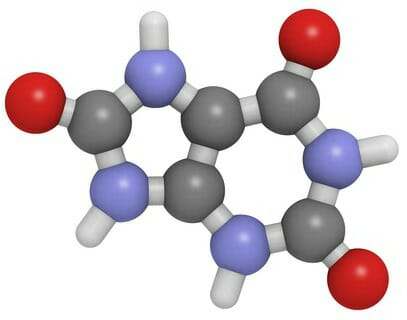
Despite numerous cleanings, uric acid crystals are insoluble and will not bind with regular soaps and other cleaning agents. Thus, the crystals stay attached to the concrete and the smell remains.
The smell may dissipate temporarily after a good cleaning, but as soon as any moisture or moisture vapor is introduced again, it can come back just as strong as before. Basements can be particularly susceptible to this.
The reason the smell returns is that uric acid salts allow crystals to reform as soon as moisture (humidity, for example) is introduced. This releases a gas that has a pungently strong odor.
The best way to stop the smell is to use an enzymatic cleaner. Enzymatic cleaners attack and break down the uric acid crystals and separate them from the concrete. Rocco & Roxie is our #1 recommended enzymatic cleaner to use on concrete to remove pet urine smell.
Steps for removing Cat and pet urine odors from concrete
- Identify urine areas in concrete using a UV light or black light
- Clean the affected areas with a proper cleaner to remove bacteria
- Let the affected area dry throughout – not just the surface
- Treat the affected areas with an enzymatic pet odor remover
- Do not skip any steps or take shortcuts

- Certified Gentle & Safe Pet Carpet Cleaner Solution: Chlorine free, color safe, no hazardous propellants or residue; safe to use around pets and children; certified safe for all carpets with a Seal of Approval by the Carpet and Rug Institute (CRI)
- Pet Enzyme Carpet Cleaner for Stains, Odors, Residue: If it’s gross, it’s gone; the stain and the stink; from stinky yellow pet urine, feces to vomit or other organic spills, Rocco & Roxie professional strength stain & odor eliminator tackles it all
- Cat & Dog Urine Enzyme Cleaner for Every Surface, Every Time: For use on carpets, floors, furniture, clothing, litter boxes, kennels, carriers, all pet living and sleeping areas—anywhere stains happen enzyme cleaner for dog urine
- Cat & Dog Urine Enzyme Cleaner for Every Surface, Every Time: For use on carpets, floors, furniture, clothing, litter boxes, kennels, carriers, all pet living and sleeping areas—anywhere stains happen enzyme cleaner for dog urine
- Buy With Confidence: You want the best for your best friend; we do, too; if you are not satisfied with the performance of this Rocco & Roxie stain & odor eliminator, contact us; we are determined to make it right
This post may contain affiliate links. If you use these links to make a purchase, we may earn a small commission. As an Amazon Associate, All Garage Floors earns from qualifying purchases. You can read our full disclaimer here.
How to identify urine odor stains in concrete
To get the best results from an enzymatic pet urine cleaner, you must first identify the exact areas in the concrete affected by the urine.
Many times, the source of pet urine odor can easily be identified. Areas where pets were kept in a pen are an example. However, sometimes it may not be so easy to detect.
This is often the case for people who have moved into a home that previously had pets, only to find that the garage floor reeks of a foul urine smell. Stains may have previously been cleaned, thus hiding the source of the odor.
One tool that does a good job of identifying pet urine is a UV light or black light. These from Amazon do a good job.
Close the doors and then turn on the black light. Hold it no more than three feet off the concrete as you scan the floor in sections. Old urine stains will stand out as blue, green, or yellow markings on the concrete.
We like to encircle the far outside area with arrows pointing toward the urine stain. Chalk works well for this, provided you don’t get it wet. Be sure to check the first two feet of your walls from the floor up as well. Sometimes cats will spray urine on the walls. This requires removing and replacing the affected section of drywall to get rid of the smell.
If, for some reason, the UV light does not reveal any stains, the old standby that will work is your nose. This takes longer, but it is effective. Open the doors to air out the garage and get rid of the immediate smell. After that, get down on your hands and knees and start sniffing. Trust us; you will know when you find it!
Clean the pet urine stains with TSP
After you have identified where the urine is located, it’s important to properly clean the area to rid the concrete of bacteria and other residual urine elements. Contrary to popular belief, most enzymatic cleaners do not remove bacteria.
Once you know where the urine stains are, the first step is to scrub the area with a strong solution of ½ cup TSP (Trisodium Phosphate) to 1 gallon of hot water. TSP mixed at this ratio is very strong. Gloves and eye protection should be worn for safety.
What the TSP does is remove all the bacteria, most if not all of the stains, as well as remove other residue left from the urine. It will leave only the uric acid crystals behind. This will allow the enzymatic pet urine cleaner to work faster and more efficiently at removing the uric acid crystals.
Pour the hot TSP solution onto the urine stain or identified area and scrub it with a short-bristled nylon brush. A deck brush works well for this. Make sure that you keep the area wet for at least 10 minutes or more to allow it to soak into the concrete. The solution will follow the same paths as the urine did and will need some time to work its way down into the concrete.
Do not be surprised if the smell increases as you soak the concrete. It is a combination of urine residue and uric acid crystals reacting and releasing gas from contact with the water.
Once the area has been scrubbed and allowed to soak long enough, pour clean hot water over the treated area again and then vacuum up the water with the wet/vac. Carpet cleaners will work for this as well. You will want to do this at least twice. For heavily treated and soiled areas, three times would be better.
This hot water rinsing will remove the TSP solution and help to suck up any remaining urine residue that is in the concrete. Treat any additional areas in the same fashion (scrub, soak, rinse), and then allow the concrete to dry at least overnight. 24 hours or more is best. Pet urine enzymatic cleaners work best when the concrete is completely dry before treatment.
As a note, the TSP may create a whiter-looking area on your garage floor since it is getting the concrete very clean. If that is the case, you may want to scrub the rest of your concrete after you are done with the same TSP solution. This will achieve a more consistent (and clean) look on the floor.
Using a hose with a high-pressure nozzle works fine for this to speed up the rinsing process. You are just removing dirt at this point and not sucking up urine residue. We have more tips for cleaning a garage floor here.
Apply pet urine enzymatic cleaner to concrete
Pet enzymatic cleaners work by using bacteria (the good kind) to digest malodors, waste, and stains. These bacteria produce enzymes that break down the molecules of the uric acid crystals into smaller bits. This allows the bacteria to digest the smaller bits and break them down into the two basic components of carbon dioxide and water. They are the best product for removing the smell of cat urine.
Because you are working with concrete and not carpet, we suggest using a product that is available in concentrate or gallon jugs and not something that comes in a spray bottle. Unlike carpet, you will need to use liberal amounts of the enzymatic cleaner.
The reason for this is that most enzymatic products need some sort of exchange with air. Since most of the uric acid crystals are deep in the concrete, it takes more time for the required air exchange. It will also take time for the concrete to absorb the enzymatic cleaner. Since some of the cleaner will evaporate on the surface as it soaks in, more will need to be used.
One of the best products for removing cat, dog, and pet urine odor is Rocco & Roxie Professional Strength Stain and Odor Eliminator. It has worked wonders for us, and we highly recommend it.
It has stellar reviews, and we know of more than one kennel that uses this as its go-to odor eliminator. Furthermore, it’s available in gallon jugs and does an excellent job when given time to work. You can find it here on Amazon.
There are many other products with good reviews that you can shop for here if you prefer. We recommend staying away from the products that require mixing with carpet shampoo, as these will not be as effective on concrete.
Be sure to follow the directions for the product you choose. Pour it onto the stained area and then start scrubbing it in with a deck brush. Keep it wet for at least 10 minutes or more. You want the concrete to absorb as much of the solution as possible.
For the best results, temporarily cover the wet area with a cheap painter’s tarp to help avoid evaporation of the solution. This will give it more time to soak into the concrete. Rinsing is not required. The enzymatic cleaner will break down the uric acid crystals into carbon dioxide and water, which will dissipate on its own.
Particularly bad-smelling areas may require multiple treatments. This is because it will take time and more enzymatic cleaner to soak into the concrete and do its work. Remember, you may be dealing with an area that allowed the concrete to soak in urine for weeks or months.
DO NOT RUSH THE PROCESS! This is the biggest mistake people make. As we stated, enzymatic urine odor removers require time for the good bacteria to digest the uric acid crystals. If you rush the job, you will not be successful.
Sealing concrete from pet urine odors
On rare occasions, it may require sealing the concrete to prevent any residual pet urine odor from working its way back to the surface. Sometimes people want to do this even though the odor is gone. They just don’t want to take the chance of it returning.
The only type of sealer that will work is a non-breathable, topical concrete coating. Garage floor coatings are a great example. Garage floor coatings are film-forming and do not breathe. They will block odor molecules from transferring through the coating. Acrylic sealers and penetrating sealers will not work. They are breathable and will allow the odor molecules to pass through.
The least expensive to apply is EpoxyShield by Rust-Oleum. You can find it here on Amazon. Do not use 1-part epoxy paint. 1-part epoxy paint is paint and not a true 2-part epoxy coating. Paint breathes and will not seal out the urine odor.
Applying a garage floor coating requires grinding or etching the concrete before application. If you know that you will be applying a coating before you treat your garage for pet urine odor, we recommend treating the concrete after you grind or acid etch.
The concrete prep process will open the pores of the concrete and allow the pet enzymatic cleaners to be absorbed into the concrete more easily. It will allow slightly more air transfer as well. The result will be a quicker and more effective use of the cleaner.
Once the coating is applied and has fully cured, it should effectively block any odors that remain in the concrete.
This thread is amazing! I have been searching for something this thorough for years. We have a similar story, but with a twist. Aging cat struggled in his final years. Basement floor paid the price. We have tried every enzymatic cleaner on the market over the last 6 years since he has been gone. The smell only comes out when it rains now, but it’s still disturbing. We wish to treat 1,000 square feet following your steps and then seel it with epoxy. We would like to cover the epoxy with ceramic tile. Is this possible? If so, which epoxy should we go with? Will there be any odors when it rains or will this nightmare finally be over? Is there anything to watch out for or extra steps to take since the concrete has already been exposed to so many other enzymatic cleaners?
Hi Felicity. The reason for the smell coming back is that there are still uric acid crystals within the concrete. When it rains, moisture vapor from below the slab makes its way to the surface and activates the uric acid crystals along the way emitting the smell. The potential problem in your case is that basements floors that do not have a vapor barrier are poor substrates for epoxy. Moisture vapor that gets trapped under epoxy can cause the concrete it is attached with to deteriorate and the epoxy peels. A proper moisture test during the rainy season should be conducted to see if your floor can receive a coating. In addition, it is not recommended to tile over epoxy. It’s a poor surface for thinset to adhere to. Most tile manufacturers recommend removing any coatings first.
In the meantime, we suggest treating the concrete as described in the article. It most likely will require more than one application. Hopefully it will eliminate the odor completely and you can tile over the bare concrete.
to add, the tiles on concrete would provide a pretty good seal, with an epoxy grout like what you would use in a shower recess
This is a great article! We have concrete floor inside that has been stained and appears to have a clear coat (shiny) applied on top (by previous owners). I’m trying to clean up after a rescue dog who urinated frequently in this room. Will the approach you described work?
Hi Summer. It won’t work if the urine was able to get under the coating and penetrate the concrete. We can’t tell you for sure without knowing exactly what type of coating was applied. We would recommend cleaning as instructed in the article and then trying the enzymatic cleaner. If that does not remove the odor, then the urine got into the concrete underneath the coating. If that is the case, it will require removing the coating first to get to the bare concrete in order to clean it and remove the odor.
Similar to Summar, we had a senior foster dog who developed a habit of going into our walk-in closet at night to pee. We have had the carpet cleaned many times and the smell comes back within days. We have decided to replace the carpet with Vinyl plank. I’m sure the urine has gone through the carpet and pad to the concrete. Someone had recommended to just put down a coat of kilz or concrete sealer, but the company installing the flooring said the leveling compound would not work with a sealant on the concrete. Will this work to remove those odors? We asked the flooring company to do the work over two days to give us time to work on the odors after they remove the carpet. will a day be enough time for this to dry so they can lay the VLP over it?
Hi Clay. A day is not enough time. The concrete needs to be completely dry after cleaning with TSP before you can apply the enzymatic cleaner. That usually takes a full day. Then you need a few days or so for the enzymatic cleaner to work and do its job before you cover it up. Enzymatic cleaners are not fast workers. We would recommend asking the flooring company to come back a week later to finish laying the vinyl plank in the closet. Either that or just pull up the carpet in the closet yourself first. It’s not hard. You can then work on eliminating the smell before the flooring company comes to do the floor.
Here’s one you probably haven’t heard. We are renovating our basement. The floors, which are unsealed concrete, needed to be leveled before installing our laminate flooring. The flooring company used a self leveler called Planipatch. Instead of mixing it with clean water, they decided to use lake water because our house water is shut off. The stench is unbearable. We tried vinegar, then baking soda but nothing has worked. The flooring company now wants to try odoban.
Hi Lisa. Wow… We can’t believe a company would use lake water. The problem here is that the lake water was filled with all sorts of microorganisms and who knows what. When the moisture evaporated out of the Planipatch, it left behind these odor producing elements that are embedded throughout the self-leveler that was applied. Nowhere in the Odoban technical data sheets does it recommend the use of it on concrete or modified concrete products. In addition, it does not list what possible “lake water” organisms it would remove or kill. Lastly, we do not know of a product that would do so.
Important to note is that whatever was in the lake water that has caused the problem is dispersed evenly throughout the entire patch that was used. This makes it extremely difficult in and of itself. Even if the odor was temporarily eliminated, there is a good chance it will come back as soon as wet weather moves in and moisture vapor from the soil is transmitted through the concrete. We would highly recommend that the company remove the self-leveling compound first. Then, you need to verify that the underlying concrete was not affected. It most certainly absorbed some of the moisture from the Planipatch when it was first applied. Once that is verified, then a new self-leveler can be reapplied properly. We would also suggest contacting a professional odor removing company that specializes in dealing with concrete to get a second opinion.
Thanks so much for your reply. We souldn’t believe they did that either. We decided to consult with a company who specializes in flood restoration. We also asked the contractor to grind and remove the self leveler. Do you think applying a liquid sealer such as epoxy might help with any residual odor we might have?
Hi Lisa. Unfortunately, epoxy will not stay adhered due to the occasional moisture you get in the concrete. The build-up of moisture that the epoxy traps tend to deteriorate the concrete where the coating is attached. There are special coatings that breathe and tolerate moisture, but the fact that they breathe will allow the odor molecules to travel through the coating. Hopefully, the odor remediation by the flood restorators will get rid of it.
I am now researching RadonSeal plus Concrete Sealer vs Drilok Extreme Masonry Waterproofing.
Hi Lisa. RadonSeal is a penetrating sealer (non-film forming) that acts like a densifier. It breathes and will allow odor molecules to pass right through. Drylok Extreme Masonry Waterproofing is a paint that blocks actual moisture intrusion, but it breathes as well. The only way to try and trap odors with a floor treatment is to use a non-breathable product (coating). As we explained earlier, the problem with that is that the moisture that collects underneath will cause the coating to peel.
One option you have is to do a proper moisture test with a few calcium chloride kits during periods when moisture is most prevalent in order to get accurate readings. It does no good if conditions that produce the most moisture are not currently present. There are special moisture vapor epoxy primers available that block moisture intrusion and moisture vapor (to a point, thus the testing required). These are expensive coatings and require very aggressive grinding of the concrete before application. Once applied, a standard epoxy coating can be applied over it. There are companies that specialize in this type of work, but it can get expensive quick.
Thank you for the useful information..I have five cats that I have let run rampant in the garage for the past four years..need I say more? Anyway, I am now starting to clean up that garage and I think your method is perfect..gonna start as soon as I get the supplies. Once again thanks for the great article!
We are glad it will help you out, Tina. Good luck!
Can I go straight to epoxy or sealing a basement concrete floor, or is the etching, TSP, and Rocco absolutely necessary steps. Its a lot of steps! Long story short, water in basement, previous owners had dogs. Had no idea they used the basement as their yard! The odor is awful…Still drying out. Haven’t done the black light yet to learn the extent of it. Its a big basement, so all of those steps seem so overwhelming!
Hi Margaret. No, you can’t just try to hide the problem, you need to take the appropriate steps to remove or mostly reduce what is causing the odor first. There are only 4 main steps, two of which are very easy :). Also, why was there water in the basement? The proper coating that can prevent any residual odor from getting through cannot be applied to concrete with moisture issues. Basements are notorious for allowing water vapor and moisture through the slab from underneath. Coatings will not properly adhere to such concrete. In addition, it’s this moisture that activates the uric acid crystals in the concrete that creates the moisture. All the more reason to take the appropriate steps to properly remove them. You can do it by just tackling the project one step at a time.
My sump pump failed and I got about 2 inches of water in the whole basement last week betweens raining and snow melting. I have been in the house for 5 years and have not had water before.
The previous owner had dogs. I never noticed stains or orders prior to the water damage. But now the stench is unbearable. I did check the concrete with the black light tonight and I cannot find the spots. I have found spots in carpet with a black light before when I had a old dog having accidents in a previous home. So not sure what to make of nothing “lighting up”. Does this mean I just am not seeing it, or that the urine was contained in the carpet and did not sink down to the concrete. Which kind of seems unlikely but maybe? There was padding.
Before I put new carpet and padding down, I want to make sure there will be no residual smell. Thanks for all your very helpful information on this post.
Hi Margaret. Yes, it’s possible that it was mostly concentrated in the carpet and padding. When the flood happened it would have activated the uric acid crystals and caused the stench. As the water receded, it most likely dispersed a large but diluted amount throughout the concrete. If you clean with the TSP, let the concrete dry and then use an enzymatic cleaner, our guess is that your odor problem will go away. Once you clean with the TSP it’s going to take a few days for the concrete to dry since it’s indoors. A dehumidifier will help. Also, it takes a few days for enzymatic cleaners to do their job and eat away at the crystals.
I have only had my puppy )only 2 1/2 pounds) for 2 weeks. I have covered a small concrete patio to protect it from rain (so puppy and I don’t get wet during the housetraining process). The amount of urine so far is very small and there is no smell, but I am thinking longer term that this could become a problem even though he won’t get past 10 pounds . If I wash it down each time he goes, would this prevent the problem? Or should I try sealing the cement to prevent any further urine soaking into it? I don’t want to have to do the whole process you described here if I can avoid it.
Hello Ada-Lou. If the urine puddles without soaking in right away, then washing it down immediately thereafter will prevent the problem of it penetrating and smelling at a later date.
The detail in this article is excellent, thank you so much. Here is my little twist on this issue: the wall to wall carpet in our rental apartment is being removed to be replaced by laminate flooring. A few months ago, In his final weeks our cat peed regularly in an area in our living/dining room that is about 4 feet by 20 feet. Before the workers come to do the flooring, I have already pulled out the bad section of the carpeting and underpad (plus a little more), and have been working on the concrete. I will try your described method, but am wondering what would be an efficient way keep the liquids in the problem area so they don’t just flow away into the surrounding carpet? Thought about just rolling up towels around the edges but that would absorb the liquid. Any suggestions?
Hi Sue. Sorry for the late reply. We’ve been extremely busy answering questions. We would just recommend using the rolled-up towels. Yes, they will absorb some liquid, but it’s not that big of a deal. There are products you can purchase that would act as a water dam, but the cost is far greater than having to wash a few towels. Good luck!
My back garden is a popular spot for all the neighbourhood pets to come and have a pee party. They pee all over the concrete and the stench is awful, I can’t even leave the patio doors open on a nice day. So, I would like to use your method and clean it up, but I can’t keep the cats away whilst doing it.
But let’s pretend I can clean it. Once done, can I paint something over it to at least seal the concrete so I can just put the garden hose on it, instead of it soaking in and stinking the place out?
Oh and secondly, what can I use on my tiled floors inside the house to stop accidents of my own cats soaking into the grouting? The tiles are glazed but the grouting stinks…. What can I use to seal them after having cleaned them thoroughly? Thanks.
Hi Jaime. You would need to apply a non-breathable coating that will not allow the urine to eventually penetrate if it sits for a while. DuraGrade concrete is one that is easy to apply and does not require the etching of the concrete. One coat of clear would do it. In terms of the grout, we recommend cleaning it as described above and then applying a good grout sealer.
the area i am doing is in my living room by my backdoor, we pulled our carpet up and have bare (unsealed) concrete that our dog has had accidents there which has made a few of our cats also go there.
my question is after i do the TSP scrub, the hot water rinse and the enzymatic cleaner is there a concrete paint i can paint that area of the concrete with, or does it have to be a sealer.
eventually i want to get wood floors put in but i am going to do this for the time being.
Hello Jen. Kilz Restoration Paint is touted as a stain and odor blocker. It tends to have mixed results with pet urine. However, if you properly clean and give the enzymatic cleaner enough time to work, you most likely will not have to worry about it.
We have just removed old indoor outdoor carpet that was glued down. Carpet is gone but glue residue remains along with all the old dog and/or cat spots. Do we need to remove all of the glue left behind before we start the cleanup of the urine spots? We are talking 450 square feet so a big project for us.
Hi LA. You didn’t mention what you intended to do with the surface once the carpet was removed. As a result, we are not sure if the glue should or can remain to begin with. There is a good chance that the urine is impregnated within the glue as well as the concrete depending on how thick the glue is and how long the urine issue went unchecked. If there is no need to remove the glue for future flooring, we would recommend doing a test cleaning and odor remediation on a 3’x3′ section that you know has an odor problem and see what the results are.
Hi! We have a bedroom where cats have peed on the carpet (probably for years – we suspect our cat started peeing there bc the prior owner’s cat had peed there before) and are attempting to clean the slab floor underneath before installing laminate. I found another article that said we could use TSP or very strong hydrogen peroxide solution. I tried the peroxide because I had it already. Do you think I need to redo it with TSP? There is still a smell although it is much less than before we started. Also, we used Anti Icky Poo as the enzyme cleaner because it came highly recommended and they have an unscented version (we are sensitive to perfumes and chemical smells). Do you know anything about this enzyme cleaner, or should I just start over with Rocco and Roxie (we used them once and found the smell pretty strong). Thanks for your awesome article!
Hi Alex. If you still have the smell, then we would recommend using the TSP. Flush with warm water and use a wet vac if you have one to draw the water out of the concrete. We are not as familiar with Anti Icky Poo. It’s a name we would not forget. However, feel free to try it again if the smell of that cleaner is better for you. Remember, enzymatic cleaners need a few days or more to work. Many times, people think that it should instantly stop odors. They are microorganisms that need to time to digest the uric acid crystals. If it doesn’t do the job, then you can put the Rocco and Roxie to work.
Hi! Thanks for the great information! We recently moved into a house and we discovered a section in our crawl space exactly under the fireplace that was left with cat poop and pee. I think the previous renters were not happy and just kept dumping all the poop and pee there. It is all in an ‘alcove’ which makes it easy to locate where the problem is. We pulled out 5 garbage bags of poop and have tried vinegar, baking soda, bleach, kitty litter but nothing works to fully remove the smell from the exposed concrete. I randomly walked into a pet store and found “ez-clean concentrate bioenzyme” and then did some search online and found this great article. We are going to start the process as soon as possible, we recently had a ton of rain and what we had managed to calm down came stinking powerfully back up. I saw another article that mentioned step 2 doing with vinegar. As we have a ton of vinegar right now, would you agree? Would it be okay to clean with vinegar first or do you recommend starting with TSP right off the bat? Do you also have any suggestion what to do when there are feces involved?
Hi Cristina. There is a good chance that the offending uric acid crystals are deep down in the concrete. If you have an abundant supply of vinegar, go ahead and soak the area with it and use a wet vac to pull any remaining vinegar out. If the concrete absorbs it right away, add more as you wait. We feel that TSP works better, but it’s not always available, and precautions must be taken when using it. Make sure the concrete has time to completely dry throughout. Not just on the surface. Running a fan to keep the air moving will help with the evaporation process from within the concrete. Once you are sure the concrete is dry, apply the enzymatic cleaner. Don’t bother with something you spray on. It needs to be a liquid that you can pour onto the concrete so that it can soak in and reach the crystals deep down in the concrete. Make sure you are having a dry spell before you do start the process. If moisture is reintroduced anytime during this you will need to start over. Remember that enzymatic cleaners need time to work. Especially with concrete. You may need more than one application as well.
We are having this trouble on our covered patio with our golden retriever puppy. Live in Texas. Plan on getting the prep done for coating and doing the steps you outline in the post but I have a question. Can we use Polyurea coating instead of epoxy on the concrete? From what I can see, it’s also not breathable which is what we need to be going for, correct? Is there a worry with it being outside, most of it is covered under a partial roof awning. Thanks very much.
Hi Delle. Yes, polyurea would be preferred over epoxy. Epoxy is an indoor coating only and not U.V. stable. If it gets direct sunlight every day for a period of time, it will amber (yellow) and can even begin to chalk. Polyurea is U.V. stable. Another product you may want to look at is DuraGrade Concrete. We did a review of DuraGrade Concrete here. It is a single-part polyurethane that is U.V. stable as well. DuraGrade has a much larger color selection that people with patios tend to favor.
Thank you for your reply! A follow up, with the Duragrade it doesn’t look like they grind or etch to prepare the concrete for the coat, so we would have to make sure the method above got rid of the smell completely without that added step that might help remove it for efficiently, correct? And with either the polyurea or duragrade, any urine after that is done shouldn’t seep into anything and cause odors?
Hi Delle. DuraGrade does not require additional concrete prep in most cases. However, it can be applied to etched concrete. You just need to factor in a lower coverage rate for the first coat since some will get absorbed into the concrete. This helps to ensure a minimum thickness. Both DuraGrade and Polyurea are not breathable and completely seal the concrete at the surface. This means liquids (water, urine, etc.) cannot penetrate the coating. Nor can odor molecules penetrate from below to reach the surface.
This discussion is so valuable. Thanks to all. I have a 700 sq. ft. guest house that was uninhabitable due to cat urine smell. We knew this before buying and were committed to the guest-house concept even if we had to tear it down and rebuild.
Naturally, we wanted to start with baby steps and see if we could succeed short of major renovation. We hired a professional firm who scrubbed and processed the air for several days and that knocked it down by about half. He was so disappointed that he didn’t charge us and said it was the worst case he’d ever encountered.
Of course he wouldn’t even have treated it if we hadn’t first removed all flooring down to the slab. That was about 500 sq ft. of laminate and 200 sq ft. of tile. Repeat: If you’re not willing to tear up your floors, you can probably forget about solving the problem.
I then started treating the floor and lower walls day after day. First I used “30 Second Outdoor Cleaner” which was recommended by another pro. It has a very strong bleach smell and I had to use a respirator. Then, 2 coats of TSP- the entire surface – as described in this post. And finally, 4 treatments of “Stain and Odor Eliminator.”
Better…but after a few days of heat there was still an odor. (SAD!) I told our contractor to gut the kitchen (which we were going to do anyway) and guess what? A huge wave of urine smell came up when he tore out a ground level kitchen cabinet. Who knew?
After all of this, including expert opinions, I became convinced it was solely a problem with the floors. So, just as expressed in this thread, I hired a concrete firm to grind, prep, epoxy and finish the entire house. I picked the color as a dark red like the Saltillo tile I had first wanted. It looks great!
And while I am still a bit nervous about declaring victory too soon, it’s been several weeks (of 100-degree heat and high humidity) and we seem to have prevailed.
Not everyone may have this budget, but the big take-away here is that nothing worked completely until we sealed the floor with epoxy, a non-porous material.
Good luck!
Hi David. Wow, that was quite the project! We are glad to hear though that the smell is gone. Thanks for posting up your experience and the steps you had to take. I’m sure it will help others.
How can I prevent a dog from continuing to urinate on concrete? My parents have a small dog run in their garage and their dog like to go inside instead of outside especially when it’s raining. Is there something I can use to deter the dog from wanting to go inside on the concrete and use the outdoor run?
Hi Sean. I would recommend contacting a dog trainer or joining a dog training forum. There is not anything we are aware of that you can put on the concrete to deter animals from urinating on it.
Hi Shea,
Thank you for the info about the garage.
What step-by-step process do you recommend for removing dog urine odor from the walls inside a house?
What about from carpets (assuming the odor hasn’t already ruined the carpet pad)? I want to exhaust all my options before having to buy new carpet and pads.
Thank you!
He Jeremy. When urine gets into the wall, it is very important to identify how far it has gone. Typically, a line is cut just above the highest spot, and that section of sheetrock is removed. If it has gotten into any of the wood studs, treat those areas by soaking them with hydrogen peroxide. A spray bottle works well for that. After it has dried, paint the wood with Kilz Odor Blocking Primer, and then replace the sheetrock. Carpet can be more difficult if it has gotten into the pad. We don’t consider ourselves experts with carpet, but we do know that Rocco and Roxie works well on carpet.
Thank you for the reply!
When it comes to the garage, is it vital that a wet vac is used after scrubbing with TSP? Or can I rinse with a water hose instead? I ask because my garage is slightly sloped so the water is naturally flowing down into the driveway. It’s difficult to suck the water up with a wet vac.
No, the wet vac is not mandatory. It just works better at extracting all the bacteria if there was a lot of urine. Rinsing will work.
Fantastic article, thank you. I’ve recently moved into a home where the former cat must have liked to use the internal front step (which is concrete) to do its business. I came across your article in the hopes of getting rid of the smell. However, as I am in the UK I cannot seem to locate a lot of the products you have mentioned. I have been able to find “Zinsser BIN Shellac-Based Primer Sealer” which claims to prevent odors. I was curious if this would be suitable for sealing it (once I’ve done the previous steps with TSP etc.). Many thanks in advance!
Hi John. If you still have a faint smell after proper treatments and giving an enzymatic cleaner time to work, then a coating is the next step. If the Shellac is not breathable, then it will block odors. Just remember that a coating can get slippery when wet. You may want to mix in an anti-slip media in the final coat if you are not going to be covering the steps with carpet or a runner.
We bought a house knowing the prior owner had cats that left a strong urine odor in the basement. We tried a few things, including professional odor remediation, which they warned might not work. It didn’t.
Then I read your article, bought the TSP, a wet-dry vac and enzymatic cleaner, and am now enjoying an odor-free basement. Thank you!
Hi Sue. That’s fantastic! It definitely works well if you follow all the steps. Thanks for reporting your results.
I have just done 2 applications of TSP as directed in the blog. Currently waiting for it to dry out (24hrs minimum). Should I go back over the area again with the black light before proceeding to step 2, ENZYMATIC CLEANER. Before TSP application, urine spots were showing up bright green under the black light. I am assuming that these should go away after TSP application. Is that correct? Thanks much!
Hi Ben. The TSP removes the bacteria and some phosphorus, but not the uric acid crystals which are protein-based. The phosphorus and the proteins in uric acid crystals are what show in the black light. Once you effectively use an enzymatic cleaner, most of the crystals and phosphorus should be removed and show little evidence under a black light.
I’m in humid Florida. Previous homeowners had cats and the back porch is awful. It has a glue down carpet that will be going away as soon as we figure out what to do about the smell. The glue is ancient and we will have to grind that away. I have tried multiple applications of Anti Icky Poo but the smell is just as strong as before treatment.
The cats also urinated on the carpet for years. Once we tear out the carpet we hopefully be ok with the leveling compound alone and We will be putting LVP flooring down eventually.
My question is for the porch area. The porch is screened but rain can come in, plus it’s just humid. After cleaning, what product would be best for the floor on the porch? I would love to seal any residue in but With it being exposed to the elements I don’t think that will work due to the constant moisture exposure.
Hi Steph. Urine has most likely penetrated through the glued-down carpet and into the concrete. That is why Anti Icky Poo is not working. Once you get the carpet pulled up and grind away the glue, we recommend treating the area as we describe above. It should get rid of most if not all of the smell. Because it’s a porch that is susceptible to strong indirect or direct U.V. light, you can’t use an epoxy coating to seal the concrete. It will turn yellow and eventually begin to chalk. Instead, you need to use a coating that is U.V. stable. In this case, we would recommend DuraGrade Concrete. It’s easy to apply and is available in a variety of colors other than tan and gray. You can read about it here.
We’re moving out of our loft condo. We have a small crawl space area that we keep out cat litter boxes in. Not sure if it’s age or now out of habit, our cats urinate on the floor. But it’s not all the time they also use the litter boxes as well. But now we have some urine stains that are older and I’d like to know if I can use the method in the article. The crawl space is maybe about 8 x 8 feet, can’t recall exact measurements. I don’t want to leave the stains for the new owners. Thanks
Hi Connie. If it’s a concrete floor, then the methods we outline above should work well.
We are going through this process now, and we are going to apply a primer, and then two polyurea coats. We have already use a diamond grinder on the concrete surface to remove old epoxy and provide a better mechanical bond. This article suggested etching and then applying TSP then Enzymatic cleaners so that they get deeper into the concrete. My question is: should we acid etch again after cleaning in order to ensure that the surface is clean for the polyurea primer? I’m worried to go through the whole process, and then find that the cleaners left a residue which didn’t allow the primer to bond, but I also don’t know if acid etching again after cleaning presents any unforeseen problems either.
Hi Paul. Etching is not necessary. The grinding performed all the work that etching will do, only better. Our concern is what type of primer are you planning to apply before the polyurea coating? Hopefully, it’s an actual epoxy coating primer and not a concrete bonding primer or latex paint odor-killing primer. Paints such as these are not compatible with coatings and will not allow proper adhesion of the polyurea.
Hi, I’m wanting to open a dog boarding business and I’m so confused by all the concrete sealing options on the market. If I seal the concrete floor with ‘garage sealer,’ do you think I will avoid the horrendous smell that one encounters in dog facilities? I am thinking a pitched channel in the concrete at the back of pens and play space will work to move urine away, with a powerful extractor fan is a good idea..but I am confused on the right choice for concrete. Kindly advise; this is by far the best resource I’ve found so far regarding sealing concrete. Thank you very much.
Hi Kathleen. Sorry for the late reply. Garage sealer can mean many things – are you referring to a coating? If so, does any of the concrete see full sun exposure?
Outstanding article! Have patio in 3 story condo, owners on floors 2 and 3 have Trex decking on balcony (gaps between Trex). Owner on 3rd floor allows dog to urinate on deck, which flows down to my concrete patio (has caused green mold stains). What is best cleaning method for my patio and best sealer after patio is clean and dry? Live in DE, so need to know outside temperature requirements for cleanup and sealant. Are there any recommendations regarding contractors to do this kind of work? Thank you so much!
Hi Suzanne. All cleanup and any possible odor removal methods should be done when temperatures are no longer below freezing throughout the day and night. We recommend using the cleaning methods outlined in the article. Most floor coatings and sealants should not be applied when outside temperatures will be below 50 degrees during the curing process. However, there are exceptions such as polyurea and polyaspartic coatings. These are typically approved for outdoor use. Epoxy is not. We would recommend searching for floor coating specialists in your area. Just type in “floor coatings ‘your area'” to find them. Most will come to your residence to inspect and give a free quote. You may need to clean and remove any possible odors first before a coating is applied.
Thank you so much! Great info here. I have a large basement with concrete flooring that has old dog urine in it. The smell can take over the house on a humid day. Are there any machines you can recommend I use while following these steps to make it easier?
Hi Joel. For general cleaning with the TSP solution, you could use a floor maintainer with a green scrub pad for cleaning larger areas. If you don’t have a floor drain you will need to use a shop vac to remove the solution and rinse water. We highly recommend trying to source the smell with a black light first. You may find that most of the smell is concentrated in a smaller area.