
Acid etching the garage floor is sometimes the only viable alternative for many DIY home owners when prepping concrete correctly to accept a coating. It isn’t hard to do, but certain safety precautions and steps need to be taken to insure a successful and safe outcome. Potentially dangerous if not done correctly, it can not only damage your concrete, it can cause serious bodily harm as well. So please take the time to learn how to acid etch your garage floor or concrete safely before jumping into your project head first.
Muriatic acid, also known as hydrochloric acid, is the typical acid of choice when etching concrete. It is inexpensive and a dangerous chemical that can damage almost anything it comes in contact with. It will eat through clothes, metal, skin, and creates a noxious vapor that can cause surrounding metals to rust as well as burn the lining in your nose and lungs. You can purchase it from your local home improvement center for less than $10 a gallon at a strength of 31.45%.
Phosphoric acid is a mineral acid that works almost as well and isn’t as dangerous to work with, but it is harder to find and more expensive. It also works at emulsifying oils – something that muriatic acid will not do. Both will remove rust from your concrete.
If you don’t like the idea of working with acid, you can read about some safer alternatives to acid etching here.
Supplies and protective gear for acid etching
- Hose with adjustable spray nozzle
- 5 gallon plastic bucket
- Plastic 2 gallon watering can
- Acid
- Baking soda
- Stir stick – wood paint stick works fine
- Push broom or long handled scrub brush
- Rubber gloves
- Rubber boots
- Splash safety eye goggles
- Approved respirator for working with acid fumes
- pH paper test strips
 Acid is generally mixed at a ratio of 3 parts water to 1 part acid for sufficient strength to etch properly. Ideally you want to test the strength needed first before doing the entire floor. You can do this by first mixing a small solution in your watering can starting at a 5:1 ratio. Apply it to a small area of wet concrete. It should begin bubbling and fizzing immediately. If not then you will want to increase the strength accordingly. Sometimes a ratio stronger than 3:1 may be needed for particularly dense concrete or a smooth power troweled floor.
Caution! Always add acid to water, not water to acid. If you pour water into acid it can cause an explosive reaction that can spray you with the mixture and burn your skin!
Before acid etching, make sure the garage floor is cleaned properly of all oil, contaminants, grease, and dirt. Contrary to what many people think, acid will not clean grease and oil spots. In fact, if these areas have not been cleaned and degreased properly, the acid solution will just sit on top and not react with the concrete.
1 – Dampen the concrete:
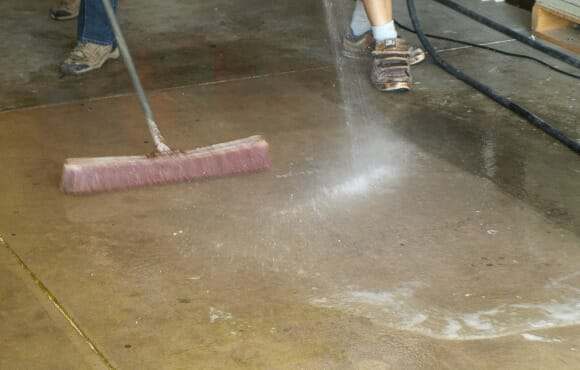
Use your hose to lightly spray down the concrete in your garage so that the concrete is wet but not puddling water. If you have a large garage floor, you may want to acid etch in sections. Do not let the concrete dry out before or during application of the acid solution.
2 – Apply the acid solution:
Use the 2 gallon plastic watering container to sprinkle the acid solution on the concrete. This will spread the solution evenly without much splashing. Do not just pour it on the concrete. This will create an inconsistent spread of the acid solution and will not provide for a uniform result. The 2 gallon container works well because you can mix 1.5 gallons of water to .5 gallons of acid for a 3:1 ratio. However, you can use any size you like as long as you mix the ratio of acid to water correctly. 1 gallon of a 3:1 acid solution will cover approximately 50 – 70 square feet of garage floor.
3 – Scrub the acid solution:
Once the solution is applied, lightly scrub it into the concrete with a push broom or long handled scrub brush. This helps to create a uniform etch of the concrete. Let the solution sit for 10 – 15 minutes while it continues to fizz and bubble. Do not let the floor dry out during this process. Add more solution if necessary.
4 – Neutralize:
Mix 1 cup of baking soda to 1 gallon of water in your large 5 gallon bucket and pour it into the now empty watering container. Sprinkle your neutralizing solution over the part of garage floor that was acid etched and let it sit for a minimum of 10 minutes. When time is up, rinse the neutralized solution with your hose into a drain or out the garage (if local water codes allow it). Another method is to use a wet vac and then dispose of the solution according to your local codes.
Check the surface of the concrete at this time. It should feel similar to medium grit sand paper with a uniform texture. If not, you will need to repeat the process again.
5 – Final rinse:
Once the initial neutralizing solution is cleaned up, it is important to thoroughly flush and rinse the remaining solution out of the concrete. You may need to do this multiple times. It will leave a white powdery residue (calcium carbonate) on your garage floor once dried if you do not do this. This is a fine white dust that will not allow your coating to adhere properly. Use a high pressure nozzle while thoroughly scrubbing the concrete with your scrub brush. You can introduce a mild solution of Simple Green at this point if you like. Just make sure it is thoroughly rinsed.
Using a pressure washer for this process works well also. Do not use a pressure washer to rinse off the initial neutralizing solution. It can drive any acid solution that had not been neutralized deeper into the concrete and cause problems later.
6 – pH test your rinse water:
After your final rinse, dab a pH test strip like these at Amazon onto the still wet garage floor to check the pH. Anything between 6.0 and 9.0 will work for most coatings with 7.0 (neutral) being ideal. If it’s below 6.0 then the water is indicating that acid residue is still in the pores of the concrete. Rinse some more and repeat the test until you get the results you want.
Further Tips for Acid Etching Concrete
It’s a good idea to cover anything in your garage that you don’t want to get splashed with a plastic drop cloth. Another recommendation is to mix some neutralizing solution up ahead of time and spread it out liberally on your driveway. That way any acid solution that is hosed out will not mildly etch or discolor your driveway. Don’t acid etch the concrete if the temps are below 50 degrees as the acid will not be as effective with the cooler temperatures.
Also, make sure your garage floor has dried thoroughly before applying epoxy coatings. Fans will help. Give it at least two days with warm weather and longer if it’s humid or cooler. Though the surface may be dry, the pores of the concrete can still contain moisture and escape through outgassing when the temperatures rise during the day. This will cause your coating to form bubbles. You can always do a quick moisture test with plastic if you are not sure.
Learning how to acid etch your garage floor isn’t hard, but it’s very important to follow the proper steps. When done correctly, the chances of having your coating fail due to improper preparation of the concrete is reduced significantly.
Hello,
I am looking to eliminate heavy dog urine odor from the garage floor. I have attempted to eliminate the odor by heavily utilizing enzymatic cleaners and 50% dilute bleach solutions to no avail. From my research, at this point, I believe that sealing the concrete is the best solution. I would greatly appreciate any advice on the proper steps that should be taken from here.
From my basic understanding, I will need to clean the garage floor the best I can (there are currently some black and white-ish discolorations and stains), then etch the concrete with 1-10 or 1-5 ratio muriatic acid solution for 10-15min, neutralize the acid with a dilute solution of baking soda & water, rinse and allow to dry. Once prepped, I was thinking of applying 1-2 coats of Kilz Max water-based primer (due to concrete surface), allow ample time to dry, then applying 1-2 coats of KILZ 1-PART EPOXY ACRYLIC CONCRETE & GARAGE FLOOR PAINT over top.
My questions were 1) is it okay to apply the water-based primer on a garage floor 2) is it okay to apply a 1-part epoxy acrylic over a water-based primer 3) am I completely off the mark in terms of what I should be doing to seal the garage floor with the aim to seal the odor?
I greatly appreciate any assistance in advance!
Hello Yuta. We actually have an article that discusses how to get rid of urine smells in concrete. You can read it here. The Kilz primer and 1-part epoxy paint are the wrong products to use. It’s a latex acrylic paint with epoxy resin added. Such a paint breathes and will allow odor molecules from within the concrete to escape through the paint. What you need to use is a true 2-part epoxy coating and not paint. Epoxy coatings do not breath and will seal the concrete. This prevents the odor molecules or anything else from permeating through the coating.
Shea,
Thank you so much for your response! I have read through the other pet urine elimination and epoxy application articles and found them to be very insightful. With regards to a “true” 2-part epoxy coating, will a 2-part epoxy water-based coating, such as the Rust-oleum epoxyshield be sufficient for preventing permeation of the odor molecules? Or will it absolutely need to be a 100% solids formulation?
Ultimately, my only goal really is to seal the odor with a long-lasting solution for as minimal a cost as I can manage. I read your article on exactly this question regarding the bad rap of epoxy paint kits, and noticed the Rust-Oleum Professional kit which seems to ride in the middle between cost and quality. Based on your experience, do you believe this product may be enough to sufficiently contain the odor?
I really appreciate your assistance with this matter!
You are welcome, Yuta. No, it does not have to be a 100% solids epoxy. As long as it’s a resinous coating and not paint, it will do a good job of blocking the odor. The Rust-Oleum Professional EpoxyShield would be sufficient and provide a better value over the less expensive water-based version.
Any recommendations for completing a garage that slopes to a paver driveway? Do I need to wet vac the garage to protect the pavers? Will neutralizing the pavers work alone? Combo of wet vac and paver neutralizing?
Hi Sarah. Sometimes decorative driveways can create a bit of an obstacle, but with the proper precautions you can avoid any issues. The amount of the acid solution should not be so much that it is running out the garage. It just needs to get the surface wet and remain wet while it does it’s job. That said, you can put up a small sand damn immediately in front of your pavers. It will hold back any acid solution that may want to run out and allow you to properly apply the neutralizing solution as well. We recommend a heavier application of the neutralizing solution. The reason for a heavier application is that it will allow you time to wet vac the floor. Neutralized rinse water will have a fine white powder (calcium carbonate) in it as a result of the etching. If you rinse that out the door it can get caught up in the large open pores of the pavers. The wet vac with the proper attachment should pic most of the white powder up.
Once you do that, you can break down one small side of your sand damn and rinse the rest of the floor out through that. That will direct most of the rinse water away from the pavers (hopefully). This rinse water will have been properly neutralized and there is no worry of it discoloring the pavers. It is very important not to let any of your concrete dry at all during the entire process or you will end up with the white powder (calcium carbonate) on the surface of the concrete and that takes some scrubbing to remove. If you need to wet the concrete with fresh water behind you as you wet vac that is OK.
If you do get calcium carbonate on paved driveway is there something you can do to clean it up?
Hello Linds. It can be difficult to get out of a paved surface, particularly with all the nooks and crannies. A pressure washer with a wider 25 degree nozzle would be the best bet. You don’t want anything much narrower as it has the tendency to tear up pavement.
“Do as you oughtta, add acid to wautta” Safety slogan in public high school, 1960’s I still remember it!
I have to say that we haven’t heard that one before. It’s good though!
Does old clean concrete need acid etching before painting?
Hi Chris. Yes, even old concrete requires the proper prep. The only exception would be if you were just applying an acrylic latex concrete paint and not a true coating.
Unfortunately I power washed immediately after allowing the baking soda to neutralize the acid. Is there any way to reverse the possible issues that coulf arise?
Hi Adam. If the acid was neutralized first, then you are OK. Just give the concrete an additional 12-24 hours to dry since the pressure washer drives moisture deeper into the concrete.
Thanks! If I didn’t leave the baking soda to neutralize long enough what are the possible outcomes?
Acid has a high pH. If it’s not neutralized properly, it can remain active in the concrete and the resulting high pH can cause coating failure.
I’m doing my garage with a friend, but he is suggesting renting a grinder and grinding down the floor in preparation, and not using acid at all? What do you think of that?
Thanks,
Kline
Hi Kline. Grinding is the preferred method of concrete prep for coatings. It provides a more consistent and porous profile over acid etching. However, if you are applying a single coat thin mil coating such as the inexpensive DIY home improvement store kits, then acid etching is advised in most cases. The reason is that these thin mil kits will be absorbed more by the concrete when grinding and they will take on a patchy, matte finish unless another coat is applied.
grinding down the floor. not drinking! sorry!
No worries, we figured it out and fixed it. We don’t advise drinking and grinding 🙂
Did the 3 to 1 muriatic acid wash on tinted (red/pinkish color) cement. Did not know to neutralize, so we just power washed (water only). Now the color is all uneven. What can I do? Can I re-etch to correct? Please help!!!
Hi Susan. Was the concrete originally colored from the concrete plant? Acid etching does not provide an even and consistent looking finish. The reason for this is that the density of the concrete surface, as well as the free lime that the acid reacts with, varies throughout the surface of a concrete slab. The pressure washer didn’t help either as it drives the acid solution deeper into the concrete where it still may keep reacting for a while since it was not neutralized. This is one of the reasons that professional concrete coating contractors grind the surface instead of etching. It provides a much more consistent profile for coatings. You can try etching again with slightly more diluted mix of 4 or 5 to 1 water to acid. Scrub the surface as it works and do not let the solution dry at any time from the moment you start to the moment you neutralize and rinse. Is it a clear coat you want to apply and if so, what product exactly?
Thank you for your feedback! Yes, the concrete was colored. The surface after etching is still colored. I’m getting a grainy look on some areas and a bright smooth look on patches. We wanted a wet-look (I wanted it to look as if I just hosed it down, the deeper color). We bought the Behr wet-look sealer from Home Depot. It is clear looking. We have not applied it yet. Is there another sealer we should be using?
The Behr Wet-Look is a water-based acrylic topical coating/sealer. There are much better available, but if it’s just for foot traffic it will do OK for a couple years before it has to be reapplied. We prefer the commercially available sealers that last much longer, such as an MMA acrylic. This is a good example here.
Again, thank you. We did another round of acid washing and then neutralizing and it looks much better. I will surely look into buying a better sealer for longevity. I really appreciate your website and awesome team ready to respond promptly to any questions or comments!
Good to hear! We are glad it has turned out better, Susan.
Hello, please help as I’m a dope. We had some tough stains in our garage and for some reason had some concrete cleaner/etching acid. I diluted it and used it on the stains, then rinsed by pouring water and mopping up. Worked like a charm. Unfortunately, the smell in my garage is noxious. I have continued to pour water and mop and will also try baking soda, per this article. Had I fully understood the potency of this cleaner I never would’ve used it, yet here we are. Any other advice beyond baking soda? Thanks in advance!
Hello Carrie. Yes, neutralize as we state in the article and then rinse. If that doesn’t work, then we suggest contacting the manufacturer of the product you used. They should have a 1-800 customer service number to help with such issues.
Thank you! I ended up calling them and they recommended baking soda as well. Did one treatment today to no avail. I think this is going to require a ton of baking soda and time. Regrettable decision on my part to use muriatic acid. Thanks for your time!
Hi I’m wonder if you have any advice to get rid of very old oil stains throughout the entire 2 car garage floor
before applying the Professional EpoxyShield rust oleum solvents base. (After reading your article, That’s what I think It’ll be better product)
I’m thinking of doing this in phases:
1-some sort of degreaser (this is the part that I’m more concerned)
2-etching
3-patching cracks
4-the epoxy (2 coats right)
5- clear
I think is more than just one question,
I’ll definitely appreciate your help.
Hi Tony. You have the phases correct. Getting rid of the oil residue is going to require some scrubbing and degreaser – maybe more. We have an article here on how to clean your garage floor. It also has a link in the article for tackling tough oil stains as well. Just remember that even though you remove the oil, the concrete may have a permanent (lighter) stain. That’s OK as long as it does not bead water and will absorb it.
Hi Shea
Thanks a lot for the help,
But sorry
Can you explain a little more about :
“As long as it does not bead water and will absorb it”
I did not quite understand that ,
Thanks a lot!
After the oil stains are cleaned, the concrete needs to be able to absorb water, even if it’s slow. It cannot bead water. If it does, that means that oil is still embedded and it will not accept an acid etch.
Thanks a lot for your help Shea
You are Awesome!
I just prepped my garage floor for painting. But unsure if the acid etch worked correctly.
Some parts are nicely opened up and others still have a smooth finish ontop. Do i have to acid etch it again?
I also degresed the oil stains and there was no water beading but the acid etching appears to go around the stain.
I was looking at the white knight ultra pave water based paint is that a decent product?
Hi Brett. Acid will not etch concrete that is still saturated with oil. The oil acts as a repellent and will not let the acid react with the concrete in order to etch it. You need to do more to remove the oil from the concrete. This article may help. Keep in mind that once the oil is removed, the concrete may still have a slight permanent stain (which is OK), but it’s not from being oil saturated. If the spots with the smoother finish still absorb water well then they are good to go. However, if the water just sits there or takes more than a few minutes to be absorbed, then you need to etch again and or use a stronger solution.
Regarding your paint choice; White Night Ultra is just an acrylic concrete paint. It’s not even a 1-part epoxy paint. As a result, it will last about a year or so in a garage environment before needing touch up and it’s going to suffer peeling from hot tires. It doesn’t matter how good the manufacturer states the product is – it’s still just paint and not a true epoxy coating. As long as you are OK with the expected performance, then that is fine.
Hello, Thanks for all your help on here. Just had a question about patching scaled concrete. I plan to use muriatic acid to etch before i patch but im wondering what concrete you recommend for that.
Thanks!
Hi Heidi. We have an article here that discusses that.
Thanks for the great site! I just etched the garage floor with gel tek (cool stuff!) how long do i need to wait before i can walk on it? Im giving it a couple days to dry before i paint… thanks!
Hi Heidi. As soon as it is removed from the floor you can walk on it. 48 hours to dry is a good decision.
Awesome thanks again. Another question. When I wipe my finger on the concrete i can see a bit of white residue. I power washed it and I can definitely tell the difference but of course its blotchy. Is it really important to get all of it off? I should also mention that i re-etched most of it, to no effect. It happens to be an old slab..maybe poured in the 70’s. Appreciate any advice!! Thanks!
If you are only getting a little bit of white residue on your fingers then you will be fine, Heidi. The time to get concerned is if wipe your fingers across the surface and the tips are all white. As much as you clean a good concrete slab, it will always have a little bit of fine powder.
Is it possible to speed up the drying time after etching (and coating later) by using industrial fans? Thank you so much for the info
Fans will help initially with drying the concrete, but they will not help with coatings. Coatings are not like paint that physically dries as a result of evaporation. Coatings cure to get hard due to a chemical reaction from a catalyst. Moving air across them will have no effect.
Hello,
After acid etching, I let the garage floor to dry off for 72 hrs, and after that noticed some white spots at few places in garage.
Is it possible that these white spots are actually calcium carbonate.
Do you recommend pouring solution of baking soda with water now and rub off with deck brush? Please advise. Thanks.
Hi Rock. Yes, the white residue is calcium carbonate that was left behind from not rinsing well enough while the concrete was still wet. Baking soda won’t help. Usually pressure washing or scrubbing with a deck brush using lots of water will take care of it. If it still remains, you can scrub it with a light acid solution (8 parts water to 1 part acid), neutralize, and then rinse real well. Just make sure the concrete never dries during any part of the process.
I found the tutorial very helpful but have a couple of questions. I have a dog kennel where the concrete floor has been painted multiple times with the epoxy paint from hardware stores and the paint does not hold up. Prior to painting I did not acid etch because I did not realize that it was required. I would like to buy a higher quality epoxy paint but not sure the best brand. I power washed most of the prior coats of paint off but it was not totally removed. Will the acid etching help to remove these built up coats of paint? I have a 16 foot floor drain that goes to a septic tank. Once the acid is neutralized will it hurt to rinse down the drain into the septic tank?
Hello Michael. Is the dog kennel indoors?
The concrete section is indoors
OK, that’s good to know as epoxy cannot be used outdoors. If you want to apply a much better coating, then it’s going to require that you get all the paint up first. Acid will not remove paint. You will need to use a chemical paint stripper instead. A more effective way of removing the paint is to grind. Grinding not only removes the paint, it will also properly prep the concrete surface at the same time. The home improvement stores are not going to have the quality epoxy that you need for a kennel floor. We would recommend purchasing a high solids epoxy from one of our sponsors or other vendors that sell such product. We created a list of our sponsors with links to their websites in this article here. Most epoxy from concrete coating vendors are going to high solids (>85%) commercial quality.
Hello,
Will acid etching remove an existing concrete sealer?
I want to epoxy-coat my floor and have done a lot of prep work. The slab is in great shape but as I clean it I’m noticing that there are a few particular areas where the water rolls off the concrete like it would on glass. I can only guess that there might be some sort of existing sealer over these scattered small areas. Would an etching solution work in this situation? If not, might you have any other suggestions?
Hi Jonas. No, acid etching will not remove sealers, coatings, oils, and etc. The reason is that the acid solution needs to come in contact with the minerals of the bare concrete. If a sealer, coating, oil, or some other contaminant is blocking it, then it will just sit there and do nothing. You need to grind the concrete in order to remove it. By any chance are these spots where tires might sit? We’ve come across garage floors where people would soak their clean tires with tire dressing and the excess would drip on the concrete. Tire dressing has silicone in it. When it soaks into the concrete it becomes an effective sealer.
I acid etched my 2 car garage floor after cleaning with degreaser, washing with a stiff brush and hose attachment. That part worked reasonably well. Then I used phosphoric acid solution in a 1 to 2 dilution with water to etch the floor. I did one section at a time. I had more reaction in some places than others but all seemed to bubble up immediately. I scrubbed and washed the floor with the same brush/water hose attachment. It seems I now have what appears to be the dusting problem. I tried washing again but did not work. I rented a good pressure washer and it did not remove it. I can take a wire wheel on my drill and it comes off after some amount of motion back and forth. I am wondering why the dust did not come off and what to do next. I have a picture of the floor after the pressure wash and after the concrete dried out. The pressure wash was done after the last washing with the brush and after the concrete had already dried.
Hi Anthony. Wow, that was a lot of etching that you did. The white powdery residue is a combination of cement particles and insoluble calcium phosphate that results from inadequate rinsing before the concrete surface dries. It can take quite a bit of scrubbing to remove it. Sometimes a weak etching solution applied to the concrete with some scrubbing and rinsing will remove most of it. DO NOT let any of the concrete start to get dry during the process. If you still have some residue left, run your fingers over the surface and see how much comes up. If your fingers are only slightly white with residue, then you will be OK.
Hello Shea,
I washed the entire floor with a weak solution of Phosphoric acid and nuetralized with baking soda. Kept the floor wet all the time and several washes and stiff brooming. I do not believe it took much of the residue off the floor. It is pretty dry now and I do not get any residue on my fingers by rubbing on the floor in any of the areas. It seems pretty tenacious. The floor is pretty rough to the feel and noticeably rough when I pull the squeegee across it. I am going to let the floor dry one more day and fill some spots with polyurea epoxy caulk. Hopefully I am ready to start the coating this week. Would you agree?
Thanks so much for your advice.
Anthony
If the residue is not coming up on your fingers, then you are good to go.
Hello again Shea,
I thought I would give one last water bead test around the garage floor before going ahead with caulking and doing the epoxy coating. I find that water drop absorption is very spotty. Even on parts of the floor that are not stained with rust or detergent washed oil stains (these areas absorb water well). If I do a light grind with my grinder just removing a surface layer, the water absorbs much better and starts dispersing immediately. Do you recommend I just go ahead and rent a floor grinder and get it over with? Thanks, Anthony
You may want to do that, Anthony. From the description of what you are going through and the spotty water absorption with all the etching you have done, it sounds like there may have been remnants of a previous sealer on the concrete. The grinding would definitely take care of that.
How can i tell if the etching was done well enough to receive the epoxy? When applying the acid, the cement bubbled, but fairly quickly after immediate application, the bubbling stops. I left it on for 25 minutes or so and then did the neutralized rinse, but the cement doesn’t seem very sandpapery to me. I am in a new condo development and the concrete slab was poured about 10 months ago, so its new and didn’t have a ton of things to clean before acid etching. Any help would be great!
Hi Ryan. Etched concrete rarely feels like concrete that was treated to grinding. We suggest you do the water drop test. This involves placing a few drops of water in various areas of the slab. If the concrete immediately turns darker and absorbs the water fairly quickly then you are good to go. If the the concrete does not turn darker or the water just tends to sit for a while, then you have more etching to do.
Hi. I have 90m2 or 960ft2 of new concrete to etch before sealing. I intend on using a 3:1 mix. How much Hydrochloric acid do I need to purchase?
Thanks in advance
Andy
Hi Andy. Your garage floor will require approximately 12 gallons (+/- 1 gal.) to etch the concrete. Based on that, 3 gallons of acid will be enough to create your etching solution and get the job done.
Hello Shea, if I clean / degrease the garage floor, etch and neutralize it, then do epoxy patch repairs and crack repairs, do I need to re-etch the epoxy patch repairs before applying the EpoxyShield coating? If I don’t have to re-etch, how long do I have before applying the coating without any additional prep to the patched areas? Thanks
Hi Rob. You can’t etch epoxy coatings, epoxy patch repairs, or any other concrete repairs for that matter unless standard concrete was used. Etching solutions only work when they react with the various minerals in actual concrete. If you are only repairing small cracks that are less than 1/8″ wide, then you will be OK. However, if the cracks are wider than that or you’ve done repairs for pitting, spalling, divots or etc, then those areas need to be sanded with 100 grit sandpaper in order for the epoxy coating to mechanically adhere properly. Ideally, repairs should be grinded to create a smooth transition that does not telegraph through the coating. Once the concrete has been etched it is permanent. Nothing changes. As a result, you can wait as long as you want before applying a coating as long as the concrete is kept clean and not cars drive on it. If cars drive on it, then you need to scrub clean the areas where the tires drove and sat on the concrete.
I am planning to use the etching product that comes with Rust-o-leum EpoxyShield kit.
1. I already cleaned up the old epoxy pain with a Diamabrush paint removal tool. 90% of pain is gone, excep the garage sides connecting to walls. I am hoping with ethcing, rest of paint will be gone too. Is this too much to expect from Etching?
2. Is the etching from kit enough or should I also do a separate acid wash (with Muriatic Acid)
Hi Rahul. If you removed the old epoxy down to the bare concrete using a Diamabrush, then there is no need to etch the concrete as the grinding of the bare concrete preps the concrete as well (better than etching). Etching solutions, including acid solutions, will not remove or prep old epoxy for a new coating. Etching solutions need to react with the minerals on bare concrete in order to work. You will need to sand the old epoxy with 120 grit sandpaper if you want the new coating to stick. Or, you can remove it with a small angle grinding. We have links in this article here that will point you to a $15 grinder and $10 turbo cup grinding wheel.
If I powerwash using a floor scrubber do i still need to do the etching in order to do the epoxy garage floor paint coating? Sorry, I’m a newbie at this, or is renting a grinder the better option?
Hi Tony. Power washing only cleans the concrete. You still need to etch the concrete at minimum for a coating. The coating breaks down the pores in the concrete at the surface and opens them up. If you are applying a lower quality DIY home improvement store coating, then etching is preferred. However, if you are applying a higher quality coating, then grinding is the better of the two choices, but it’s not a requirement.