
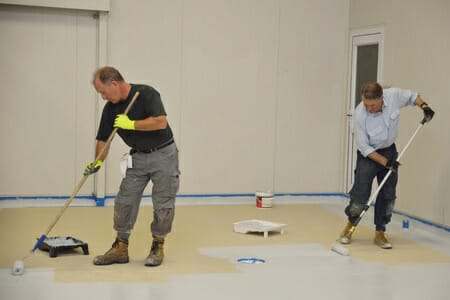
Are you planning a DIY garage floor epoxy installation? If so, consider this a “must read” if you want to avoid the most common errors that people make when applying a garage floor coating. From peeling epoxy floors to bad finishes, these 5 mistakes will cover 95% of all problems associated with either epoxy floor failure or appearance issues.
Day after day people install their own garage floor coatings and with great success. After the anticipation of creating a nicely coated garage floor however, nobody wants to go through the headaches and heartaches created when your floor doesn’t turn out like you expected.
So take a few moments to look over our list of common epoxy installation mistakes in order to insure a successful floor coating for your garage.
1. Poor floor preparation
This is the most common reason by far for epoxy floor failures and/or bad finishes. Many times when doing an epoxy garage floor coating for the first time, people underestimate how important it is to prep the concrete properly. It involves much more than making sure it is clean. Epoxy will not adhere to a smooth surface.
Not only does the surface have to be free of all oils, waxes, and other contaminants, the pores at the surface of the concrete need to be opened up properly. This usually involves acid etching at a minimum. Grinding the concrete in preparation for epoxy is even better, but it isn’t always feasible for the average homeowner. You can learn more about which method is best for you here.
The most common problem associated with poor floor prep is peeling or delamination of the epoxy.
Fisheyes is another problem. This is created by contaminants in the floor, such as grease or oil that causes the epoxy to pull away from the concrete while curing. It forms a circle in the finish resembling a fisheye.
2. Moisture in the concrete
This common mistake usually happens from not allowing the concrete to dry sufficiently after acid etching. Depending on temperature and humidity, you need to allow for a minimum of 24 hours, sometimes longer, for the concrete to dry. If not, moisture that is still trapped in the pores of the slab will rise to the surface and create bubbles in the finish.
Some water based epoxies and primers allow for application to concrete that may still be damp however. Contact the manufacturer for further information if you are unsure.
Not performing a moisture test is another mistake. Moisture under the slab can create hydrostatic pressure that will actually cause the epoxy to separate from the surface, sometimes taking pieces of concrete with it. You can avoid this problem by doing a simple moisture test first to determine if your floor is suitable or not for an epoxy coating.
3. Stretching out the epoxy
Stretching the epoxy out in order to cover the entire floor when you are running low will result in areas with a much less glossy surface and a distinct difference in color appearance. It also creates a weaker coating. This is a common mistake that is made with the single coat epoxy paint kits such as those from Rust-Oleum and Quikrete, but can also happen with premium epoxy products as well.
If you have a 400sf² garage floor for example and purchase a kit that has a coverage rate of 300-400sf², you will not have enough epoxy. A properly prepared floor is porous and will absorb some of the coating. You will run short.
Many manufacturers state in the fine print that you can expect up to a 15% material loss due to product left in the container and first coat applications. Most DIY installers are not aware of this. You can avoid this problem by making sure not to underestimate the amount of epoxy that you need.
Also, when pouring the freshly mixed batch of epoxy onto the floor or paint tray, do not scrape or try to get every last drop from the mixing container in an attempt to get the best coverage rate. The very bottom and sides of the container are never fully mixed properly. Doing so may result in spotty areas of the coating that will remain soft and not harden.
4. Faulty mixing of the epoxy
There are many problems associated with improper mixing. The most common of these issues is mixing too fast with a paddle mixer and trapping air in the epoxy. If this happens, you will get air bubbles in the surface during application. You can easily avoid this by not pumping the paddle mixer up and down or running the mixer too fast near the surface creating a vortex and sucking in air.
Other issues are not mixing the Part A resin and Part B hardener correctly or getting the ratios incorrect. Pay close attention to the mixing instructions. Some epoxies require the newly mixed batch to sit for a specific time before application. This is called induction time. If you don’t allow for this then the epoxy may not cure and harden properly.
5. Not following temperature and/or humidity restrictions
Be sure to follow the manufacturer’s recommended instructions for temperature and humidity. Epoxy applied at low temperatures or below those recommended may not cure and harden correctly.
If applying epoxy in high temperatures the pot life (time available to apply the epoxy) can be reduced by half or more. This can make the epoxy unworkable before you get it all applied as well as create bubbles from outgassing due to the warm temperatures.
High humidity levels can create a microscopic layer of moisture at the surface of the concrete that you cannot see. This will cause adhesion issues resulting in delamination or peeling of the epoxy. High humidity can cause some epoxies to blush at the surface as well.
Final thoughts
Achieving a successful floor coating isn’t that difficult. Many of these epoxy application errors can easily be avoided by thoroughly reading the manufacturer’s instructions. If ever you are in doubt, contact the manufacturer for clarification. Most problems could have been avoided this way. Also keep in mind that a bad batch of epoxy is extremely rare. The majority of problems associated with epoxy coated garage floors are due to these 5 common mistakes.
If you take the time to research your project, prepare your surface correctly, and make yourself familiar with the manufacturer’s instructions, you should be able to avoid these common mistakes and enjoy a successful garage floor coating that you can be proud of.

Earlier this week I purchased your Rust-Oleum Epoxy Shield garage floor product at Home Depot. My goal was to paint my mother-in-laws garage floor. Two years ago I painted my own garage floor with your product and it worked out beautifully. Her floor was previously painted about 10 years ago with something called – H&C Concrete Sealer, Solid Color Solvent Based, I got this from the label on the old can. I had some peeling paint and I used a paint stripper specifically for concrete. I then used a degreaser and followed that up with the etcher provided in the kit. I waited two and half days to ensure complete dryness. This morning I painted her floor. Some areas covered beautify however in several areas the paint did not adhere to the surface and immediately peeled up as I rolled an area. Can you tell me what is going on and how do I fix it?
Hello Philip. Just to clear up any confusion, we are not Rust-Oleum and we do not sell product. We are an informational website only about garage flooring. That said, you have a couple of things going on here. The H&C product is basically a colored acrylic sealer. It is not paint. It is also not compatible with epoxy and will peel if you apply epoxy over it. If the surface was roughed up with sandpaper, it may adhere for a while, but it would eventually come up.
Another issue is the etching. Acid etching and etching solutions that come in a kit will only work on bare concrete. You cannot etch paint or a coating. Acids and etching ingredients react with the free lime in a concrete surface to open the pores. The areas that are peeling were most likely where the previous acrylic sealer was applied or was not stripped from the concrete sufficiently. It you were applying the product to an actual paint and not an acrylic sealer, you can get the epoxy to adhere by roughing up the surface with sandpaper. Most of these kits mention that. We don’t recommend it, however, because the overall adhesion of the epoxy is only as good as what it is adhered to. At this point, unfortunately, your best option is to grind the surface to expose the bare concrete and apply a new coating.
Where can we find professions that are guaranteeing garage floor covering in Idaho
Hi Betty. The best way to find garage floor coating contractors and companies is to search for them online. Do a search for “garage floor coatings’your city'” and you should have few to choose from. This article here will help you with how to choose one that is best for you.
I had a contractor apply the Rust-Oleum garage epoxy and a section of the area did not dry. How do I fix this ? Please advise.
Hi Teresa. It’s possible that the epoxy was not mixed correctly if it did not cure. Sometimes applying a new coat will cause the tacky section to activate and cure, but we recommend contacting Rust-Oleum Customer Support first before you do that. The only other option is to scrape it up and apply a new coat.
I hired a contractor to apply garage epoxy for almost a month and many spots are still very sticky. Is there any solution to make it dry quick? Thanks
Hi p.do. Epoxy actually cures due to the chemical process it goes through when the two parts are mixed together. It does not dry like paint. If there are sections that are still tacky after a month they will never harden at this point. It’s a sign of improper mixing and/or application error. Sometimes applying another coat will activate the tacky areas enough to harden, but it will require prepping the rest of the surface first. What product was used exactly?
Hi, Shea.
They used Rocksolid product from Home Depot store. They came to fix the sticky spots twice and the problem still. I contacted another contractor and they asked for $1000 for just removing the epoxy and put my car garage floor back to the original. Thanks
Hi Paul. I can’t tell you for sure what is going on. Was Rust-Oleum contacted about the issue before they applied more? Unfortunately, this is an example of why regular contractors should not be hired to apply concrete floor coatings. Most assume it’s just like applying paint and mistakes are often made.
Hello. I just applied epoxy to my small garage last night, and now the floor appears to be bubbling in areas while in other areas almost looking really rough, like it’s showing the rough impurities of the original garage floor. Is this normal 12 hours after application? I’m assuming not. What’s the cause of this and how can I fix it? Thank you for any assistance.
Hello Rich. Did you acid etch your concrete or use some type of solution that introduced water? If so, you most likely did not wait long enough for the moisture in the concrete to completely dry. Once the epoxy is applied, the rising water vapor from within the concrete gets trapped by the coating and forms bubbles as it cures. Some areas may have blisters where the water vapor was able to escape. Areas that look rough (providing your concrete was not rough to begin with) are a sign that the coating was stretched out past the recommended coverage rates. Epoxy is not paint and cannot be stretched. Your only recourse at this point is to apply another coat. It will require sanding out the entire floor to smooth out the bubbles and remove any sharp edges from blisters. We recommend using 60-80 grit sandpaper for the best results. A pole sander will work well, but it will require some effort and time. A floor maintainer with an 80 grit sanding screen would be much quicker.
I was helping someone epoxy their new garage floor and instead of mixing part A with part B, they accidentally mixed part A with the topcoat. About 200 sq/ft of garage floor was coated. Any ideas on how to remove it?
Hi Stacy. What products were used exactly?
I have a lot of stuff in my garage and was wondering if I can do half the floor let it dry and come back move everything to the dry side and finish the floor? I know that I can’t use the same batch. I will buy another single car kit to finish the other side.
Hello Albert. If you have contraction joints that will act as a natural border between halves for your garage floor, then you can do that without anyone being the wiser. However, if you don’t have any joints, the area where the second half overlaps the first will be very obvious. Coatings do not blend well together like paint on a wall. You will clearly see where one coating overlaps another.
Hello I was wondering how to un solidify 2 part polycuramine. I mixed the contaminants together yet forgot to mix it for 2 minutes any suggestions on how to mix it or is it just useless?
Hello Lil.
If I am understanding you correctly, you want to un-solidify polycuramine that you mixed? Once it goes to a solid state there is nothing you can do. Or do you mean something else?
Hi, I have just applied the Rust-Oleum RockSolid Porous Concrete Floor Primer, and it has now fish eyed. I etched the concrete with their etching product. But it looks like the garage hadn’t dried out sufficiently. Am I able to apply the finish coat on top of this, after an extra day of drying, or is it best to apply another primer coat, or start all over. I intend to apply the finish coat, with flecks and then Clear Coat.
Hello Shane. The fish eyes will telegraph through your coating. The best way to handle it is to let the coating cure for 24 hours and then smooth out the fish eyes via some aggressive sanding with 100 grit sandpaper. If you get a smooth finish without pits from the fish eyes, then you can apply your color coat next. Rust-Oleum gives you up to 48 hours for recoating the primer.
Hi. My contractor has just recently finished my epoxy floor in the garage. Today, while moving in, I noticed a large crack going from front to back. My contractor says because there is no expansion joints in the concrete, so epoxy will crack as well. Floor was literally done a few days ago. Was the crack in the concrete something that can be/should have been fixed prior epoxy application? Is the crack repair necessary? Would there be any future problems if the crack is left alone? Are epoxy floor dull looking? I thought they all look glossy.
Thank you for any input.
Hello Christine. I’m assuming that a general contractor applied the epoxy and not a concrete floor coating company or contractor? If so, this is typical as they don’t know much about concrete coatings. Cracks in concrete are not unusual, however, not repairing said cracks before applying a coating is. If you live in snow country, road salts and deicing fluids can find their way into the cracks causing some pitting and efflorescence migration along the crack. What type of coating system was applied? How many coats? Commercial quality coating systems are always high in gloss unless requested otherwise. My guess is that an inexpensive DIY type of coating was applied.
Hi, please help me!!! We applied rust-oleum to our patio cement floor a week an a half ago. Half of the floor has set wonderfully the other half is tacky. I’m guessing we did not mix that lot sufficiently. The problem is what to do now…… can we reapply straight over the top?? Sounds a lot less drama than scraping it all off???????????
Hello Karen. Sometimes you can fix the issue by applying a new and properly mixed coat over the older coat as it can help to activate the curing process of the coat still tacky. Before you do this, however, I suggest giving Rust-Oleum a call (877-385-8155) and talk with them about it. Their customer service is good and they can tell you if it is advisable or not based on the questions they will ask you.
Hello! I’ve just had my garage floors done with epoxy flake. Unfortunately, a few cracks have appeared through the flake surface, and there are a lot of rough patches in the finish. I spoke to the company, they came back and applied another coat, but the cracks still have come through, the finish is better, but only in the middle of the floor. The edges are still very rough.I was told to wait for 6 days until the urethane cured, and if the cracks where still visible, to call them back. I have a feeling the prep phase was done in a hurry as in 3hrs, they acid washed the area(small 2 car garage), filled cracks, applied epoxy coat, then flakes. After reading your blog i’m wondering if tis is the case. Any advice would be helpful.
Hello Effe. Are the cracks just in the clear top coat over the flakes or are they all the way through the coating? Or do you mean that you can see through the coating where cracks were repaired? Also, what do you mean by a rough finish? Was it a full flake floor or a partial flake floor? Photos would help. You can send photos to our email address: info@allgaragefloors.com
Hello Shea!
No they’ve come through the coating. They stated that they did attempt to fill them but by looking I don’t think that’s the case.
In an attempt to “fix” the cracks he came out and put more flakes over the dry first top coat (over the visible cracks). He then put another coat on. The flakes did not settle and some dried in to top coat sticking up. When you go barefoot it’s like stepping on sharp thorns. I’ll send you pics.
Hi Effe. Yikes, this can really create some issues for you. After viewing the pics you sent it’s very obvious to us that the cracks were not repaired at all. This should have been done during the concrete prep process. They just tried to cover them up with the coating and flakes which does not work. The only way to make this right is to grind off the coating over the cracks and repair them properly. Doing this is going to create another issue though. The coating will have to be reapplied where the grinding occurred and it’s going to show. Coatings do not blend like paint on a wall and the areas where it has been recoated is going to be obvious. This doesn’t look like the work of a professional concrete coating company. Was it done by a painter or handyman?
It was done by a coating company. I did jump onto their facebook page and in their reviews another lady experienced the same issue. But unfortunately I looked them up on Facebook after the job.
I am building a new home and the concrete in my garage was just poured recently. How long do you recommend waiting for the concrete to cure before applying an epoxy coating?
Hello G. You need to wait a minimum of 30 days before you apply a coating of any type. This allows for most of the moisture in the concrete to escape. Additionally, you still need to properly prep the concrete via acid etching or grinding as well.
Hi,
I just started the epoxy project to my garage, as per the manufactures directions, i did the concrere etching with citric acid. After, scraping and rinsing off, i can see that some areas on the floor are white. Is that acide residue? Do i have to remove it before painting? If so, how to do it?
Hi Liyo. Etched concrete commonly will turn a lighter color – sometimes almost white. However, if it’s a white powder that comes up easily on your fingers, then you need to clean the surface better to remove it or lightly etch again. If you etch again, make sure none of the solution drys on the concrete before rinsing or you will have the same problem.
Hi Shea,
Thanks for the reply.
The floor is white only in patches but it has definitely changed in colour to greyish. I etched my double garage with citric acid for 3 hours, so i am concerned whethwer it has dried up in the areas where i first started etching by the time i rinsed the whole area. I can see the white powder stuff that you have mentioned in some areas, so do you think i should pressure wash and etch again in those areas
Three hours is far too long to leave the etch lingering, Liyo. I’m sure it dried up in multiple areas by that time. You can try pressure washing it first. If that doesn’t remove the white residue it will require doing an etch again. You may have to agitate those areas with deck brush as well. Etching should not take much more than ten to 15 minutes per section.
I have a garage that I need to do in two sections. There is no line between the sections. Recommendations?
Hello Greg. There are no real options in terms of getting two coating systems to blend nicely since they do not overlap like paint on a wall. The area where they overlap will be noticeable regardless of how you try to overlap them. One option to do the floor properly would be to rent a $19.99 per day U-Haul truck to store your garage items. They make their money on the mileage and if the truck is just sitting in your driveway, it makes for a cheap storage container. The other option would be to cut a 1/2 deep contraction joint down the center of the floor using a concrete cutting wheel on a good circular saw. You can then tape off one side of each joint as you do the floor as it will act like a natural separation joint between the two coating systems.
I just used the Rust-Oleum epoxy kit. Finished the floor with the flakes, looked outside and found that I only mixed one can of activater to two cans of Base. The floor looks great, but not sure if it will dry. I also have the clear epoxy shield to go over that. Thinking maybe going over with this will dry the other coat. Maybe add some ofv the activater from other kit will help? Also, this is on primed wood
Hello Paul. There is a good chance that the floor will not cure and will remain tacky, requiring that you scrape it all up. I suggest you contact Rust-Oleum and let them know what happened. Sometimes applying a second color coat will help it cure properly, but it depends on the situation. Rust-Oleum can advise you.
I guess I got lucky! Rust-Oleum said I would have to scrape it up. It’s only been 4 hours and has dried hard with no tack anywhere. Looks great too
That’s great news, Paul. Most often than not it never cures and requires removal.
I had a professional do the epoxy coating on my garage floor. I have several small areas that are tacky after 72 hours. It is summer in Florida with temps around 90 F and high humidity. Do I have a chance these spots will dry with more time or is this an indication of failure?
Hello Gary. High temps cause coating to cure much faster. Plus, it all depends on the type of material used on the final coat. Was it epoxy, polyurethane, polyurea, or something else? Assuming the material was mixed correctly, high humidity after application can cause a condition known as amine blush. This can create a tacky residue or cloudy finish – sometimes both. The general solution is to wash the residue off, but that is not always the case. We highly recommend that you contact the company first to come have a look. Any reputable floor coating company is going to make sure the floor cures like it should.
It was Epoxy. I have contacted him to see what he used and a possible remedy. From what I’ve read, it will need to be completely removed and reapplied.
I am preparing my garage floor for the Rust-Oleum Epoxyshield. After degreasing the floor twice, I can still see water retreating back off the surface in many areas when I pour water on the surface. Is this normal? The floor was fairly clean before I began with very few oil spots on it. Will this be okay to etch now and then apply the epoxy?
Hi Mike. Yes, that can be fairly normal and is a good example as to why concrete needs to be etched at a minimum. If it’s not etched, the concrete can repel water (coatings) or not absorb liquids very well. The etching opens up the pores of the concrete so that the coating can penetrate the surface and create a good mechanical bond.
I surface washed my garage and removed all loose cement paint. I can’t get the rest of the paint off. Can you move forward with the application?
Hi Randy. What do you mean exactly when you refer to cement paint? Is there old paint on the surface? Also, which epoxy product are you planning to apply?
Hello Shea,
I purchased polyurea coating (single component) for my garage floor and was wondering What is the ideal outside temperature For application. Gonna be a high of 57 degrees with low humidity when I was planning on application. Is that ok?
Hello Jeff. The most important temp is the slab temp. However, most single-part polyureas can be applied at temps down to 50 degrees and some even down to 35. It depends on the manufacturer. If you check the data sheets for the product, it should tell you.
I applied epoxy topcoat on concrete and 30 minutes later I see white roller marks. Did I do something wrong? Or does it need more time to dry?
Hello Maria. What product did you use exactly and what was the humidity and temperature when applied?
I used EC -11 clear (98)
water-based epoxy…The temperature was around 60 F
Some lower solids water-based clear coats can have a whitish appearance during application that goes away as it cures. Your temperature is above the minimum of 50 degrees that EC-11 requires. However, you did not list the humidity. If the humidity is high (>75%), epoxy will whiten with an amine blush due to the moisture in the air that comes in contact with the surface as it cures. If this is the case, it can usually be lightly scrubbed away with warm soapy water.
I am planning on laying a dual color metallic floor in one of my trailers that i recently stripped flooring out of. I have been preping the plywood floor removing staples filling holes with epoxy based pak. I have spent months pouring metallic colors over canvass & plywood. I have 71 gallons of Glazecoat epoxy remaing from impulsivly buying pallets from HD. I bought 6 kits of the metallic rocksolid Rusto & 3 EP SHIELD floor finnish today bc the Glazecoat says not recomended for high traffic floors. Is there a strenghtening agent i can add to the Glaze like an Aluminum oxide. Plan now to use two coats of primer 6 hours apart. Then opening two Rustoleum metallic kits and mixing the two different pigments and applying them at the same time with a few ppl helping . The space im covering is only 96 sq ft so i not worried about the pot time. Let Cure 3 days then begin Rustoleum shield finnish coat application. A day later applying another application. Do you have a suggestion for what brand primer i should use for this project. This will be my first floor applicaion and im not entirely sure that polycuramine has a very promising life in a RV. I would appreciate any suggestions.
Thanks Daniel.s
Hello Daniel. The first thing you need to be aware of is that metallic coatings tend to highlight and show small scratches and imperfections in the finish. They also highlight dust, footprints, tire prints from dirty tires, and etc. This is due to their darker colors and very glossy looking finish. That is why lighter colors like gray and beige are so common. Many people are very disappointed when they discover this with a high traffic surface for vehicles and projects. Regarding GlazeCoat, it cannot be strengthened much via an additive. It’s a 100% solids epoxy designed to be used on wood furniture, crafts, and etc. It’s not a wear surface designed for traffic. To give an example, according to GlazeCoat’s data sheets it has a compressive strength of 800 PSI, where as a 100% solids epoxy floor coating has a typical compressive strength of 9100 PSI. The EpoxyShield solvent based clear coat is a much better choices over GlazeCoat.
In terms of a primer for RockSolid, we would recommend applying a coat of their Black polycuramine garage floor coating. Metallic colors are most effective when applied to a black or dark colored coating. Also, keep in mind that RockSolid will not have the same effect when different colors are mixed together on the floor as a true 100% solid epoxy metallic coating. The coating lacks the thickness required to provide the depth that metallics need to flow properly. This is one of the reasons that RockSolid requires that you run the roller in circles over the coating after it is applied.
Hi
I am worried about the temp in the garage. Temps will be 58 deg today and itmay go into the high 30s tonight. This maybe the warmed day I get for awhile. Will it still work? Using Rust-oleam Exoxyshield.
Thanks
Mark
Hi Mark. No, we do not recommend applying it right now. Rust-Oleum EpoxyShield should not be applied in temps below 60 degrees. In addition, it needs to stay at 60 and above for the first few days or it will not cure. Epoxy does not dry like paint. It hardens due to the chemical reaction it has when mixed together. If the temps are too low, this reaction can be slowed down or stop completely and all you will have is a soft gooey floor coating.
My floor is turning white where water hits the floor. I used the rock hard product what do I do now
Hello Don. What is the exact name of the product you used? Has it been down on the floor for a while or was it just applied?
I had previously used rustoleum twice on my garage floor. This time I decided to use Rustoleum Rocksolid. I took my belt sander and roughed up the old epoxy. I sanded the places where I had hot tire removed areas really well. I applied the Rocksolid as instructed. A week later most of the floor is still tacky and some still wet. I have had 70 to 80 degree days but no results. The places I had sanded the most came up just by touching with a rag. Rustoleum is sending another box. I have been trying to lightly spread acetone with some results. What can I do to make the floor ready for next coat, especially the area that is back to bare concrete?
Hello Kerry. I know this may seem like a silly question, but did you mix the two pouches together as required? If the coating is still wet and wipes up with a rag, then it did not and will not cure. Unfortunately, you need to get as much of the coating as you can off the entire floor. I would recommend using a a wide blade paint scrapper. You will then need to wipe the entire surface with acetone to remove the remaining residue. After that, you should be good to go.
I followed the instructions to mix to A’s together seperate in two equal amounts then add B to one of A’s and after you run out do second set. This was to be sure of tent. I am in the process of stripping the floor. I will then use the acetone. My question is, is there anything that I should do in floor prep after the acetone?
That should do it, Kerry. If you have any areas that actually cured and it’s been longer than 7 days, then you will need to sand those areas.