
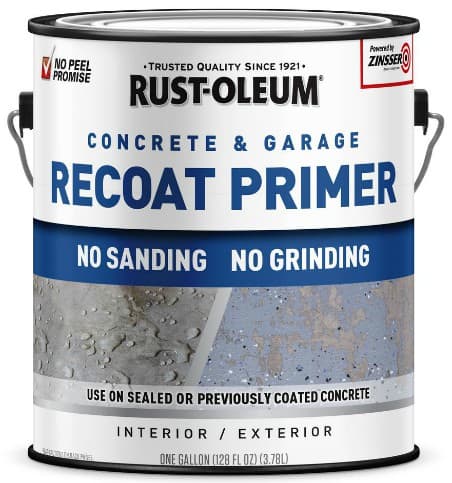
Is your sealed bare concrete or older garage floor coating giving you second thoughts about recoating or applying new epoxy? If so, Rust-Oleum Garage and Interior Floor Primer may be the solution you are looking for. Introduced to make recoats easier, Rust-Oleum’s new garage floor primer is designed to take some of the labor out of the prep work that may be required for your floor coating project.
Surface prep is the most important part of any DIY garage floor coating. This is particularly true for recoating older epoxy floors as well. Until now, recoats have required sanding and a solvent wipe to the old coating to provide the proper surface profile.
Additionally, you need to grind the concrete surface if you want to apply a coating to bare concrete that has been sealed. The grinding removes the sealer.
If the sealer on the concrete is not removed, it effectively blocks the etching solution from doing its job. This is more work than many are prepared to do for an otherwise easy-to-apply DIY garage floor coating project.
Fortunately, Rust-Oleum has found a way to eliminate the sanding of older coatings or grinding concrete. You can now use Rust-Oleum Garage and Interior Floor Primer instead.
The specially formulated water-based acrylic coating is designed to act as a primer and adhere to older epoxy coatings without sanding. Furthermore, it can be applied to previously sealed bare concrete without the need to grind. Once the primer has been applied, you can topcoat it with any concrete paint, 1-part epoxy paint, or 2-part Rust-Oleum epoxy coating.
When Should I Use Rust-Oleum Concrete & Garage Recoat Primer?
We actually had a few questions about the intended purpose and performance of the Concrete and Garage Recoat Primer when we first read about its release. As a result, we were put in touch with Jeff Svihra, brand manager at Rust-Oleum.
Our primer makes painting concrete floors easy
We first wanted to determine the primary use for Rust-Oleum’s new primer. According to Jeff, the intended purpose of the primer is to promote adhesion on previously coated or sealed concrete.
In other words, if you have an older coating that is still sound and adhered well, you can apply the new primer to the surface and then top coat right over it with new epoxy. This eliminates sanding the old surface first. For those with sealed bare concrete, you can apply the primer instead of grinding.
Essentially, Concrete and Garage Floor Primer alleviates the additional labor typically required for recoats to older coatings or previously sealed bare concrete. Or, as Jeff stated in Rust-Oleum’s press release, “Our primer makes painting concrete easy.”
This sounds great, but we are always skeptical about products that seem too good to be true. So, we wanted to know more about the performance characteristics. How well does it actually adhere?
We asked if Rust-Oleum Concrete and Garage Recoat Primer will retain the same adhesion performance to older coatings and bare sealed concrete, as a new epoxy garage floor coating that would otherwise require proper surface preparation.
The short answer is, yes. Jeff stated that they tested the primer on many surfaces and conditions to ensure it would have the same bonding and adhesion as a new epoxy coating.
That’s fairly impressive, especially for sealed concrete. This opens the door to many homeowners who want to apply a DIY garage floor coating, but otherwise wouldn’t due to the labor required to remove a sealer from their garage floor first.
We were also curious if Rust-Oleum recommends using the garage primer on unsealed bare concrete before applying an epoxy coating. Using a proper primer will ensure good coverage rates and color uniformity of new coatings.
Furthermore, we wanted to learn if the primer would help increase resistance to hot tire pickup and increase the adhesion performance of Rust-Oleum coatings.
According to Jeff, Rust-Oleum does not recommend using the primer on bare unsealed concrete. Though it will adhere well, it is not required and ultimately unnecessary. Additionally, it will not improve the adhesion of Rust-Oleum coatings to bare concrete or increase resistance to hot tire pickup.
This answer was not a surprise at first. There is plenty of competition for easy-to-apply, DIY garage floor coating kits marketed toward the general public. Additionally, these companies don’t want to recommend or require a product that will only add to the overall cost.
Furthermore, we don’t know of a company that will admit that their coating needs additional help to prevent hot tire pickup either.
However, why would you not recommend a primer as an option to increase adhesion, ensure good coverage rates, and improve the color uniformity of an epoxy coating over bare concrete?
After reflecting on this, we think we know why. We believe that the answer lies with the next question that we know is on everyone’s mind at this point.
Is etching not required for a new coating if using Recoat primer?
Nobody wants to etch their concrete if they don’t have to. So, the question we are sure everyone wants to know is; can you use Rust-Oleum Garage and Interior Floor primer instead of etching?
The answer is no. It will not adhere well if you don’t etch. In fact, Rust-Oleum states in the data sheets under surface preparation that the primer requires etching for application to bare unsealed concrete.
We believe the reason for this has to do with the fact that this is an acrylic coating that is formulated to adhere specifically to older coatings and water-repellant concrete surfaces. Though it may adhere well to etched concrete as Jeff had stated, it will not adhere as well as an epoxy coating. You would be limiting the adhesion performance of your new coating.
This is why using Concrete and Garage Recoat Primer on bare unsealed concrete is not recommended. Instead, you should apply a new epoxy coating to a properly prepared concrete surface to provide the best results for adhesion and hot tire pickup resistance.
One important note to make is that Rust-Oleum states it should not be used as a final wear surface. Nor should a clear coat be applied over it. Though it is a gray color, you need to apply a base color coat of epoxy or similar coating over the primer after application.
This post may contain affiliate links. If you use these links to make a purchase, we may earn a small commission. As an Amazon Associate, All Garage Floors earns from qualifying purchases. You can read our full disclaimer here.
Where to purchase Rust-Oleum Recoat Primer
We have updated this section since you had to special order it online when we first published information about the primer.
You can now purchase Concrete and Garage Recoat Primer from most major home improvement centers. You can also find it find it here on Amazon. Reviews of the primer are beginning to come in at Amazon as well.
How to Apply Rust-Oleum Recoat Primer
Application is as easy as Rust-Oleum states. First, you need to determine that the old epoxy coating is sound. Scrape or wire brush any loose coating, color flakes, or sealer from the surface.
Next, clean the surface of the coating or sealed concrete. Rust-Oleum Cleaner and Degreaser is recommended. 
After the surface has dried completely, apply the Garage and Interior Floor Primer. One gallon will cover up to 400 square feet.
Once applied, you need to wait a minimum of 6 hours and up to 48 hours to apply your new epoxy coating over the primer. This is the recoat window. If you wait longer than that, it will require another application of primer or sanding of the surface.
Final thoughts
Rust-Oleum Concrete and Garage Recoat Primer is a remarkable product that has the potential to fill a must-needed niche for recoating older DIY garage floor epoxy coatings. We know most homeowners would much rather apply this primer than go through the normal process of roughing up the surface first. Moreover, it can be a game changer for those with sealed concrete garage floors.
If it works as well as Rust-Oleum states, we can see how this new primer will help to increase sales as potential customers turn to Rust-Oleum to help fill their needs.
One key point we want to make. This product is best used with the Rust-Oleum line of floor coatings found at your local home improvement centers or other online retailers such as Amazon. Rust-Oleum EpoxyShield and RockSolid are good examples.
We do not recommend using this primer for high-solids commercial quality garage floor coating systems. Such coatings adhere much better to concrete than the recoat primer and require proper concrete prep.
So, if you have an aging epoxy garage floor coating that you want to recoat with a Rust-Oleum product, we suggest you consider Rust-Oleum Concrete and Garage Recoat Primer. It can’t get much easier than this.

Rust oleum needs to give up on concrete coatings! After ruining millions of garage floors in America with their products they need to give it a rest-just stop!!!
Quality garage floors are installed by professionals.
Hi John! Yes, we can understand the frustration from professional garage floor coating installers such as yourself. However, as long as there is a market for the relatively inexpensive DIY garage floor coating kits, these type of products are not going to go away.
Is this product better/worse than the previous solvent-based product (Rustoleum Garage and Concrete)? I realize it will coat sealed concrete, unlike the solvent based, but I’m asking règarding its’ abilities over previous coatings/oil based paints/etc. I know thart Rustoleum’s solvent-based epoxy (Professional) is regarded as a better product than their water-based epoxy….
Hello James. We actually asked this same question. What we were told is that the water-based version performed just as well as the solvent-based during testing. Their ultimate goal was to eliminate VOC’s and to develop a water-based product that performed just as well. That is why they have plans to discontinue the solvent-based version.
I read an earlier post about applying EpoxyShield in two stages to garage floor. Do one half, let it dry – move contents to other side and repeat. Advice was to do so only if expansion joints allow for natural break as epoxy won’t blend like paint. Read that post too late – I’ve already completed one half of the garage with feathering at the edge. Will this primer solve the problem and hide the join area?
Hello Fred. No, the primer product is not going hide the problem. You are still going to have overlapping coats. Our recommendation is to run painters tape over the good edge of the coating half that was already applied. Remove the tape as soon as you get the edge section done and then apply your color flake. Hopefully with the straight line and color flakes it will not be as noticeable.
Thanks for this quick response, Shea. I am less concerned with the aesthetics as opposed to whether the coating on the second half will adhere properly to the feathered edge from the first half (or should I try to remove that feathering?). And while I have the benefit of your advice, I mixed two Part B’s and activated only one. Does the second Part B have a reduced shelf life before it must be activated?
No, you are fine with the second part-B as long as you aren’t waiting for more than a month or so. Rust-Oleum allows for a 48-72 hour recoat window for their EpoxyShield products and 7 days for RockSolid. If you are outside the recoat window, just rough up the surface that you plan to coat over with 120 grit sandpaper. Wipe it down will denatured alcohol on a microfiber pad and then you are ready to go.
Can you install any of the Rust-Oleum colors over the gray primer?
Yes you can, Tim.
So I am doing the rock solid metallic in my home. I am turning one of my rooms into a hobby room. I have etched the floors but could not get the carpet glue lines to go way. I was going to use this primer to help hide the glue lines. What do you think?
Hi Peter. Assuming the glue has been properly cleaned and removed, the primer will work fine to help hide the lines in order to prevent it from ghosting through the metallic coating.
Thank you for the response. So I scrapped the floor with the razor scrapper till I could not get any more up then I etched the floor. Hopefully it turns out!
Do you know if the Rust-Oleum clear with the non skid is soft to bare feet? I will be doing a clear coat just not sure if I should add the non skid.
Hi Peter. Yes, it’s fine with bare feet. In fact, the literature even states “barefoot-grade texture”. Good luck!
I am coating a previously coated floor. In my prep work I used several boxes of Rust-Oleum concrete patch and repair. Where I have used the patch and repair product the concrete appears smooth. Do I need to preform any further prep on those areas before I place the primer down?
Hello Thomas. We recommend that you rough up the surface with 40-60 sandpaper first.
Thanks for the write up, this sounds like exactly the product I need for my garage. Do you have a recommendation for what sort of epoxy to put on top of the primer — I am looking at either the Rustoleum garage, Rustoleum Professional, or the RockSolid epoxy (leaning towards the Professional). Do one of those adhere better to this sort of primer than the orhers? Does the primer help with coverage? One of the reasons I am shying away from the RockSolid is the coverage issues and concern that I would spread it too thin.
Thanks very much!
Rust-Oleum recommends staying within their own lineup of products when using their primer. We prefer the Rust-Oleum Professional since it does not have the coverage issues of RockSolid. However, if you reduce the coverage rate of RockSolid by 10-15% when using the primer, you should be OK.
So my garage floor was previously coated with an epoxy paint. I ultimately ended up grinding my entire floor and now is bare and ready for the epoxy. I was planning on putting down the professional grade rustoleum epoxy kits but would like to put down the rustoleum primer first. Do you have any recommendations or advice? Is it even worth putting the primer down on my freshly grinded bare concrete or is it a waste? Will the epoxy adhere any better? if you could help me out I would appreciate it. thanks
Hi Michael. We do not recommend the Rust-Oleum primer after grinding the concrete. The epoxy is going to adhere much better to a properly profiled surface than the primer will. Because the concrete will absorb the epoxy well, we recommend lowering the stated coverage rates by 15-20%. This will allow for the coating to be applied just a little bit thicker so that it won’t appear to be applied too thinly when the concrete absorbs it more in some areas.
Alright great thank you. After i grinded the floor, it’s extremely porous and absorbs water very quickly. This is a good sign right ? I also used rustoleum patch and repair on some cracks that were in the concrete. Will this show through the epoxy once it dries up? Another reason i wanted to use a primer so the color would be the same throughout. Thanks for your help !
Yes, that is exactly what you want. If the coating is not too thin, the concrete crack repairs should not show if they were ground smooth with the surrounding surface. If you are worried about color uniformity, you are much better off going with two coats of the epoxy and not using the primer. Keep in mind, the Rust-Oleum primer is not an epoxy primer. It’s a latex acrylic paint that is designed to work with Rust-Oleum products. It’s main purpose is to help with coating on previously sealed concrete and older coatings. Of course the other option would be to use a higher quality coating than what Rust-Oleum offers that provides a thicker dry film thickness.
I used a scrape-away tool to remove failing coating on garage floor. I now have roughed up coated surfaces and bare concrete. Is applying Rustoleum’s primer appropriate in this situation?
Hi Ken. The intended purpose of the Rust-Oleum Primer is to avoid having to rough up the surface in order to make recoats easier. However, it will work just fine on a roughed up surface. Why did the epoxy fail in those areas? This is generally a sign of poor concrete prep or possible surface contamination (oil and etc.). Do a water drop test on a few spots of the bare concrete. Drops of water should immediately turn the concrete dark and be absorbed in less than a minute. If not, you will need to etch those areas. The Rust-Oleum Primer will not work well on bare concrete that is not etched or hasn’t passed a water drop test for etched concrete.
I have a clear coat on my garage floor with rustoleum epoxy shield clear coat that is over rustoleum epoxy shield paint.
Can I use this rustoleum primer on top of the rustoleum clear coat?
Thanks
Hi Gary. Yes, you can.
I’m in the process of a DIY garage floor, with the goal of using Rust-Oleum Rock Solid polycuramin floor coating. I am using Rust-Oleum Clean and Etch to prep. I have used about double what they say I should need for my size of garage and still more than half of the garage floor does not pass the water absorption test. The floor was power troweled when installed in 1993, but has never been coated. I scrubbed 2x with simple green and then 2x with the clean and etch. I talked to their technical support this morning and they recommended this product rather than continue etching. After reading this article that doesn’t seem like the ideal solution. Masks and/or respirators of any kind are pretty much non-existent right now so I’m hesitant to use a more serious acid or rent a grinder and deal with all of the silica dust. I’m leaning towards just returning everything that I can and throwing in the towel on this project. Any advice?
Hi Shad. Your instincts are correct. We would not recommend the floor primer for your situation. The Rust-Oleum Clean and Etch is a citric-based acid etch. Citric-based etches are some of the less effective etching solutions available. We recommend using Acid Magic. It’s a buffered solution that contains 90% less fumes than traditional muriatic acid. You can find it here at Amazon. If they can’t deliver it soon enough, you may want to try and source it locally. This is a product that vendors who sell quality commercial coatings like their DIY customer’s to use. It should do a much better job.
I have a left over gallon of part B base and a can of part A activator from a garage floor coating kit (rust-oleum). It is several years old.Can I cover the old floor with Rust-oleum garage and interior floor primer and then use the old floor coating kit over the primer?
Hi Brian. No, you definitely do not want to use it. Coatings have a shelf life of approximately 1 year.
I own a standard size double car garage, I used the tan Rustoleum Tan with specs about 13 years ago and it has held up VERY WELL but is starting to show a lot of stains so I want to repaint.
1) Will the chips cause problems when I repaint?
2) Is this the primer I want to use before repainting?
3) I don’t know exactly what I bought the first time around but DO know it was your brand. What would be the best epoxy to use (you have so many different model/types out there now). I live in wisconsin so we have nasty winters, we DONT do any mechanic work in our garage.
Wow, that is very good indeed for that type of coating, Veronica. Just to avoid some confusion, All Garage Floors is an informational website only. We do not sell garage flooring products. That said, the Rust-Oleum Garage Floor Primer can only be used if you intend to apply another Rust-Oleum product. It is not intended for, nor is it compatible with any other brand of coatings. If you want to use any other product, it will require grinding the concrete to remove the old coating and prep the bare concrete at the same time. There are many quality products that you can choose from. One the most popular right now are the newer single-part polyurea coatings. You can read about them here.
We have a garage floor that was previously painted (not sure if it was an epoxy paint or not). Before using the Rust-Oleum EpoxyShield Garage Kit do we have to remove the floor paint through the grinding process or can the Rust-Oleum Garage Floor Primer be applied over the paint instead.
Hello Gregory. Yes, you can use the Rust-Oleum Primer in lieu of removing the paint. However, we never recommend applying epoxy over paint. The reason is that paint does not adhere nearly as well as epoxy does. When you apply epoxy to paint, the weakest link is the paint and the entire coating is subject to how well the paint stays adhered. If you decide you want to use the primer in this matter, make sure to scrape the paint hard to ensure it won’t peel anywhere or the project will be destined to failure before it begins. If you are not sure whether or not it is paint or epoxy, apply a liberal amount of acetone to the surface and let it set for a a few minutes. Don’t let it evaporate. Next, take a putty knife to the surface and see if you can scrape it up. If it begins to soften up or scrape up, then it’s paint. However, if it remains hard and only slightly scratches, then it’s epoxy.
Like many, starting the process of DIY RockSolid chip my garage floor. The number of bad experiences and confusing information makes it very difficult to continue down this path. I agree with the first comment, leave it to the pros, but at their cost it’s not an option. Soooooo, this is what I am going to do. Am I going down the right path?
I’ve purchased the kits and an extra cleaner/etcher solution / crack patch kit all rustoleum brand.
First I will clean the concrete with the degreased/tech solution that I purchased separate from the kit and wait to dry
Second, use the etch solution that comes in the kit and wait to dry
Third, fill in the hairline cracks with the repair kit I purchased (rustoleum brand) and then lightly sand 80 grit I guess
Fourth, finally apply the rocksolid product (I’ll purchase 2×2.5 car garage kits so I make sure I have enough product for my 3 car garage and follow a process of covering a 5×5 ft area and toss chips to cover a 4×4 area by leaving a wet edge…
Does this all sound good? I think I got it.
Note: our garage floor has not been treated and is only about 1.5 years old so it doesn’t have a lot of debris on it.
Thank you!!
Hi Zachary. You pretty much have the process down. Our only recommendation is to get all repairs done first. The etching solution will not affect them. If you don’t have a small grinder with concrete turbo cup wheel, then use the roughest sandpaper you can to sand the repairs flush with the surface. The Rust-Oleum Concrete Patch Repair is 100% solids epoxy. Once cured, it’s stronger than concrete. Also, figure out how many areas that you will have for tossing the color flakes and then divide them up accordingly. In other words, if you have 8 areas, divide the flakes up into 8 equal amounts. This will ensure that you don’t run out or make one area heavier than another with flakes.
Hi:
I just had a french drain system put in my basement and I need to repaint a floor that has has both existing paint (2 different paintings the original green from the 1940’s and the more recent grey) and a new concrete border (about 14 inches wide) covering the waterproofing drains. I have cleaned the whole floor with a degreaser and then etched the new concrete with Rust-Oleum cleaner and etcher’ I purchased this primer to use on both the painted and new concrete. after that I plan to use a single epoxy basement floor paint 2 coats. Will I be OK?
Hi Richard. As long as you checked to make sure that the old paint is adhered very well, you should be fine with that plan.
I had previously stained my garage concrete floor with a water based stain manufactured by H&C Concrete and sold at Sherwood Williams paint stores. Most of the stain has adhered well but there are a few spots where the stain has come off and bare kind of powdery concrete is showing. I have been interested in re coating the floor with an Epoxy but know that I could not do that unless I used a grinder on the entire floor( something I am not interested in doing) I just found out about your new Recoat primer and am hopeful I could use it and then use a Rust Oleum Epoxy to overcoat it. My question is can the recoat primer be applied directly to the bare concrete. From some of the answers it doesn’t appear I can. These are relatively small bare concrete spots. Does Rust oleum sell a small amount of export that can be applied to the bare concrete as it doesn’t appear I can do these small spots without mixing an entire Rust Oleum Epoxy kit.
Hello John. Yes, you can use the Rust-Oleum floor primer on this type of surface. The few bare spots won’t affect it much. It will just require that you clean those spots and rough them up with some 60 grit sandpaper first. However, here are some things to consider. The H&C product that you applied technically is not a stain. It’s a very thin acrylic coating that is tinted to create a stained look. We talk about this marketed type of stain product here and explain more. That is why you have bare spots that show the concrete. Real concrete stain cannot peel or “come off” the concrete because it permanently stains it. In addition, acrylics do not adhere to concrete nearly as well as epoxy does. If you apply the primer over the thin acrylic and then the epoxy over that, the entire coating system will be dependent upon the acrylic coating that is adhered to the concrete. You will not be gaining the benefit of the strong adherence to concrete that epoxy provides. Lastly, we recommend doing a simple moisture test over those bare spots. When a coating peels up and exposes powdery concrete it’s a strong sign that moisture is present. If enough builds up under a coating it will cause it to delaminate and reveal the powdery remnants of the concrete it was adhered to.
Thanks for the reply. I am slightly confused however. At the beginning of your response you indicate that I can use the primer but later on you indicate that the adherence of the primer and epoxy depends on the the previous acrylic coating. Also you advise to rough up the concrete with sandpaper but not sure how that works. Should I etch the concrete spots and bottom line do you think I should go ahead and try the primer and epoxy topcoat. I don’t appear to have a moisture issue with the location of the concrete.
That’s correct, John. You can use the primer. However, what we are saying essentially is that your entire coating system is only as good as what is adhered to the concrete. In very basic terms, think of it as building a nice house on a poor foundation. In your case, it’s the thin acrylic stain coating. Acrylic is inferior to epoxy and does not adhere nearly as well. This is evident from the areas that have already peeled up. If more of the acrylic begins to peel at a later date, it will take the epoxy and Rust-Oleum primer with it since it is applied on top of the acrylic coating. We just want to make sure you are clear on that point.
The bare spots need to be roughed up with a bit of sanding in order to remove the powdery looking surface. Vacuum the surface after sanding and then wipe it down with denatured alcohol or MEK. The concrete surface has to be clean and bare in order for anything to adhere properly. Etching does not remove powdery concrete. Powdery concrete under a coating can be a bit concerning and why we recommend doing a moisture test. It’s generally caused by one of two things. Either the original surface had a dusting issue to begin with (thin layer of soft concrete) or moisture was starting to collect under the coating. When moisture collects, it slowly breaks down the concrete directly under the coating. This eventually causes the coating to delaminate and expose the powdery looking concrete underneath. The other possibility is that the concrete was not properly cleaned and prepped before the acrylic stain coating was applied. If that is the case, then you definitely do not want to apply anything else over it. I hope this provides a better explanation for you.
I performed a moisture test on the bare concrete spots by taping plastic over them and no moisture is present. After roughing up and etching the bare concrete spots can I then apply your recoat primer to the bare concrete spots.
Excellent. You can apply the Rust-Oleum primer over those spots. Just to avoid any confusion, we do not sell the primer nor are we affiliated with Rust-Oleum in any way.
Shea, should I etch those spots.
You can, but it’s not necessary with the Rust-Oleum primer. As discussed previously, the most important part is to remove the powdery surface via very rough sanding (60 grit) or light grinding and then cleaning. Etching will not remove the powdered surface.
Hello, I think I may be a little confused about this product. My 2 car garage floor when I started, was a poor paint covering over the floor, with bare spots. I believe the concrete that is exposed is sealed. I rented a floor maintainer with the scrubbing head attachment and the Diamabrush concrete grinding tool. I first cleaned it with the Rustoleum Degreaser. It cleaned the floor well, but I noticed the old paint was peeling up in multiple places from the agitation of the scrubber attachment. I turned to the Diamabrush tool and made about 8 passes in 2 different sessions over the entire floor. I didn’t take it down to bare concrete, but did smooth out the floor significantly, also roughed up the surface well.
My question is, is this Rustoleum Concrete and Garage Recoat primer, a good candidate to put down and then an epoxy coating over it? Home Depot paint department, also suggested the Behr Concrete bonding product.
How shall I proceed?
Thanks, Mike in FL
Hi Mike. We are glad you reached out. One of the first rules of recoating is that if the surface you want to coat over shows signs of not being adhered well, then you remove it down to the bare concrete. It is an obvious sign that the current coating or paint is not adhered well when it comes up during cleaning. In addition, a coating is only as good as what it is adhered to. There is nothing worse than spending good money on a coating and then have it peel up with the bad coating underneath.
Another rule about coatings is not to get advice from home improvement centers. They have proven over and over that they don’t have a clue about how coatings work and just assume it’s the same as paint. It’s not. The worst thing that could have happened would have been to apply the Behr Concrete Bonding Primer. It’s a latex paint and is not compatible with a epoxy. The Rust-Oleum Primer for recoats works when applied over a sound (well adhered) coating or bare concrete that has been sealed.
We highly recommend that you remove the remaining paint / coating before you go any further. Did Home Depot give you the Diamabrush removal tool or the prep tool?
Thanks for the reply. They rented me the Diamabrush removal tool. I made multiple passes in different directions all over that floor with that tool. It didn’t all come up with those 8 passes, but it scoured the crap out of that floor. From an examination of the floor after that, I didn’t see any more peeling. Are you suggesting that I go back and grind it down to the bare uncoated concrete? Even if there’s no visible signs of more peeling?
We can’t tell you what do for sure, Mike. We base our response the best we can on what we learn from you. If you were installing a high performance coating system, then we would say to remove it all down to the bare concrete. However, if it’s going to be a Rust-Oleum DIY kit and you are confident that the surface is now sound, then most likely you will be OK.
As much as I don’t want to grind it more, even more so I don’t want what I put down to flake back off due to poor preparation. It’s a house my wife and I just bought and moving into in about 2 weeks and along with a massive amount of to-do’s, I’m trying to get this floor done before anything is in there. Thank you for the input. Seems like you all are pretty knowledgeable about this stuff. ??
Hi Mike,
I recently rented a floor maintainer with the diamond wheel to remove old vct glue in my basement in preparation for RockSolid polycuramine coating. I clearly didn’t do a good enough job in some places and in those spots it doesn’t pass a water test. I’ve used a scraper and this old glue is not coming off. I really don’t want to go back and re grind. I’m wondering if I can spot prime those areas with this product. 80% of my basement floor is cleared of this glue. If this primer would work should I prime there my whole basement or just the parts with glue? I appreciate your thoughts.
Thanks,
Tom
Hi Tom. No, you can’t use this product to spot prime. It’s only for old Rust-Oleum coatings or bare concrete that was treated with a sealer. Coatings and proper concrete coating primers do not adhere to mastic and it has to be removed. You can try chemically stripping it with an Eco friendly mastic remover. Blue Bear is one such product. If that works, then you can etch the areas where the mastic was removed. The rest of the concrete will be good to go from the grinding. The alternative would be to use a more aggressive grinder. The 10″ Edco unit that Home Depot rents is an example.
Just an FYI. RockSolid is a thin coating. When the surface has been prepped via grinding, it almost always requires two color coats to get a good finish that is thick enough to provide proper color uniformity and gloss.
Am confused. I have a one car garage with paint on it. Can i paint with the rustoleum primer right over it or do i have to etch concrete first then primer and then epoxy?
Hello Matthew. If the paint is sound and not peeling, then you can use the Rust-Oleum Primer as long as you are using a Rust-Oleum product. It will require degreasing of the current paint before you begin. However, nothing will substitute for the adhesion and performance that you get with epoxy applied to bare concrete. Just as an FYI, etching will not remove or prep paint for a coating. Etching only works on bare unsealed concrete.
Would like to hear How this is holding up for those that have just cleaned and applied to sealed concrete. Then using the Rock Solid Poly coating.
Hello Ed. We haven’t received much feedback on this product. As usual, there are reviews out there where people use it inappropriately or believe that it is a polycurmine coating (it isn’t). The most reviews we have been able to find is here on Amazon. Some used in preparation for RockSolid.
Do you know if this can be used for a previously painted and sealed outdoor concrete patio?
Hello Kevin. No, it can’t be used for such a circumstance since Rust-Oleum does not make a U.V. stable coating that can be applied over it for outdoors. If it was indoors, then yes, it could be used for that as long as you were using a Rust-Oleum coating to apply over it.
Thank you for all the great info. So i have a older painted concrete floor that is missing some paint is a few places. I really want to do the polyurea coating as i use my garage for a workshop. Could i use this product to go over that painted for, then do the polyurea coating?
Hi Matt. No, the Rust-Oleum Primer is only compatible with Rust-Oleum products. In addition, you do not want to apply a high performance polyurea coating to paint. It needs to be applied to bare concrete in order adhere properly and avoid hot tire pickup. We would recommend grinding the garage floor in order to remove the paint. Doing so will also properly prep the surface for polyurea.
Thank you!
I appreciate the sage advice. There is alot to learn with all of this.
Thanks for the info here, it is so clear and well-articulated. Quick question about one point in the review. You say:
“We do not recommend using this primer for high solids commercial quality garage floor coating systems that you would purchase from specialty concrete coating vendors.”
Why is that, exactly? Thinking of using this as a primer to redo an old metallic epoxy floor with a new 100% solids metallic commercial-grade epoxy.
Hello Jon. This product was developed to work with Rust-Oleum products. In addition, it’s an acrylic formula (not epoxy) that does not adhere nearly as well as commercial products such as 100% solids epoxy. It’s designed to work with lesser performing residential quality coatings such as EpoxyShield. You would essentially be applying a weaker link right in the middle of your coating system.
Got it, thanks for the quick response. Do you think the bond would be weaker than sanding the old metallic floor?
Sanding the older surface creates a much stronger bond and is the standard recoat method used by professionals. We have an article here that discusses how it is done.
Reading between the lines of some of the previous Q and As, I believe I know the answer, but just to make sure, can EpoxyShield be applied over Rust-Oleum concrete and garage Recoat Primer?
Hello John. That is correct, you can apply EpoxyShield over the garage recoat primer.
Thank you for your most promp response… much appreciated. I am glad I asked the question. From one of the earlier customer exchanges I got the misimpression that applying EpoxyShield over Rust-Olem’s Recoat Primer might not be addvisable. Again, many thanks.
Hi Shea,
I was going to apply a PolyUrea product. I did a diamondgrind on my 25 year old epoxy garage floor. But it left patches of epoxy that is not coming off after 12 hours of grinding. The floor is about 60% bare concrete diamond ground, but another 40% of patch work like old epoxy (must be well scuffed up though). I am trying to avoid another 24 hours of grinding the floor. Would the Recoat Primer be a way for me to cover the whole floor before I apply a PolyUrea product? I need something to cover both the old epoxy and the bare concrete.
Hello Kelashik. Do not use the Rust-Oleum primer. It’s intended for use with Rust-Oleum DIY coatings and has not been tested with other products. Also, it is not for bare concrete that has been profiled. Lastly, it will not have the same tenacious bond as polyurea. You will effectively be limiting the performance of the polyurea coating if you try to use it. If the thin patchy areas of epoxy are sound and roughed up, then apply the polyurea directly over it.