
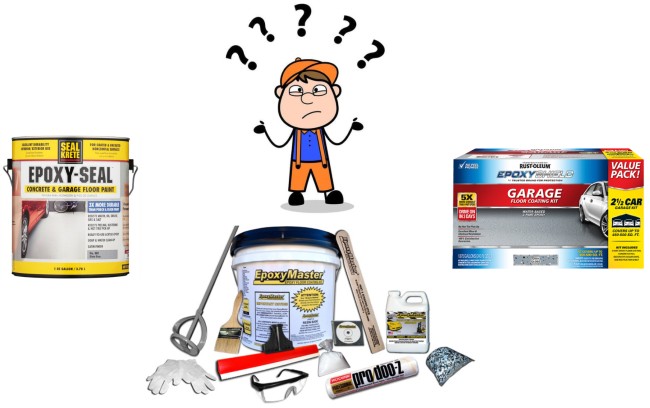
There is an abundance of confusion today among homeowners looking to apply paint or a coating to their garage floor. Should it be epoxy paint or an epoxy coating? Is there a difference? If so, which is best? It’s not always easy to tell since many of the DIY garage floor kits available today use these terms interchangeably.
As a result, it is very important to learn the distinction between paint, epoxy paint, and epoxy coatings. Doing so will eliminate confusion and enable you to make an informed decision. This is vital if you want to obtain the expected looks and performance for your garage floor.
We are the first to acknowledge that the marketing for DIY paint and epoxy can be misleading. If you don’t know EXACTLY what type of product you are purchasing, then you may end up being one of the unhappy consumers with ruined expectations for epoxy flooring.
What is Epoxy Paint?
The term “epoxy paint” came about years ago when paint and coating manufacturers took notice of the terminology that the DIY public was using when searching for epoxy garage floor coatings. They were intermixing “paint” with “coating” without knowing the difference.
As a result, marketing decisions were made and many well-known DIY epoxy floor coating companies decided to brand their products as “epoxy paint” since that is what consumers seemed to be calling it.
Unfortunately, it has only made things more confusing for the consumer. Chances are that when you see something advertised as epoxy paint for your garage, it could be 1-part epoxy paint or it could be an epoxy coating.
This has led to many people buying paint for their garage floor when what they thought they were purchasing was an epoxy coating. This is why it’s so important to learn what epoxy paint and epoxy coatings are.
Commercial quality DIY epoxy kits available from concrete coating vendors online are called coatings. As a result, there is no confusion.
Epoxy Coatings are not Paint
The first misnomer that we want to address is that an epoxy coating is not paint. The two are not chemically compatible and should not be used together whenever possible.
Paint consists of 4 basic ingredients. The first three are pigments, binders, and additives. The fourth is a carrier agent that these ingredients are suspended in. This will be primarily water or solvents.
Once applied, the pigments, binders, and some additives are deposited onto the concrete as the carrier agent evaporates out during the drying process.
The binders are what provide performance, support, and adhesion for the pigments. They bind or hold them together in a thin film on the concrete surface. Most garage floor paints are water-based and use latex acrylic polymers to bind the pigments together.
Typical additives include thickening agents and surfactants. They provide for easier application and prevent pigments from separating.
The amount of pigment, binders, and additives that are left on the surface after drying is referred to as the solids content. It is measured by weight and volume.
Volume is what determines how thick the paint will be and how much material is left on the concrete after evaporation when applied at the recommended coverage rate. Most concrete paint has a solids content of 29-33%. The rest is water and some solvents.
This means that once applied, the wet film thickness (WFT) of the paint shrinks approximately 67-71% as the water evaporates out. What you are left with is a very thin dry film thickness (DFT) of approximately 1.0 mils. A sheet of paper is roughly 3 mils thick for reference.
Garage floor paint is the least expensive option and the poorest performing. Most standard concrete paints for porches, patios, and garages use a latex acrylic binder. Though latex may work well for walls, it’s not a good match for garage traffic.
Paint does not seal the concrete. It will peel up from hot car tires. Solvents, brake fluid, gas, and other harsh chemicals will discolor and many times soften the paint. This can cause it to smear or delaminate when cleaning up.
In addition, it is only available in a satin finish and is not intended for clear coats. We get many questions about clear coats for paint which we discuss here.
The primary benefits of concrete paint are that it’s cheap and fairly easy to touch up. In essence, paint is a short-lived and budget-minded option.
What is 1-Part Epoxy Paint?
1-Part epoxy garage floor paint uses modified latex acrylic binders as well. However, it also includes a small amount of epoxy ester resin as an additive. The epoxy resin helps the acrylic binders to create a more durable paint film with better adhesion properties. However, it is not an epoxy coating.
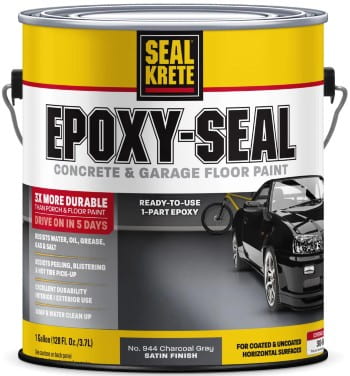
The amount of epoxy resin is not included in the technical data sheets. This is because listing the exact additives is not required. However, it is not much since the average solids content is only 1-4% greater than standard concrete paint. As a result, the DFT is only slightly thicker at 1 – 1.5 mils.
Like standard latex acrylic garage floor paint, 1-Part epoxy paint is not a sealer, it is only available in a satin finish, and is not intended to be clear coated. Some may be marketed as paint and primer in one.
And no matter how big or bold the print on the can states that it is “hot tire resistant”, it WILL peel up from hot tires at some point. Just not as fast as standard concrete paint.
It will resist some automotive chemicals, salt, and grease better than standard concrete paint, but the increase in resistance is not substantial.
It does wear a little longer, particularly under foot traffic. If vehicle traffic will not be introduced, then 1-Part epoxy paint can be a good budget option for a garage or workshop that won’t see heavy use or exposure to strong chemicals.
See our Recommended Picks for 1-Part Epoxy Paint
If paint is the only option in the budget, then spending a few dollars more per gallon for 1-Part epoxy paint over standard concrete paint is worth the investment.
What Makes an Epoxy Coating Different than 1-Part Epoxy Paint?
An epoxy coating is a two-component thermosetting polymer. It consists of one part epoxy resin and one part polyamine hardener. The hardener acts as a catalyst. When the two parts are mixed before application, a chemical reaction is started that results in an exothermic or heat-generating process.

Once the two parts are mixed, you are limited by time and temperature as to how long you have to apply it. This is referred to as the pot life.
The resin component is tinted to give the epoxy color. The hardener component is always clear. If the resin component is not tinted, then it is considered a clear epoxy.
Unlike paint that binds into a thin film while it dries, epoxy chemically cures. The chemical reaction creates a tight cross-linking of the two components. This forms an extremely hard and durable coated surface that seals the concrete and can be highly stain and chemical resistant.
In addition, it achieves a much stronger bond than paint when applied to a properly prepared concrete surface. Epoxy requires etching the concrete at the minimum (as do most coatings) before application.
Furthermore, subsequent coats that are applied during the recoat window will achieve an extremely strong chemical bond with each other. Paint cannot do this.
How thick and how well an epoxy coating performs is determined by the quality of the epoxy resin, formula, and most importantly, the solids content. Generally, the higher the solids content, the better performing epoxy will be.
Epoxy coatings for concrete and garage floors can have a solids content that ranges from 42% – 100%. The solids content will also determine the length of the pot life and ease of application.
Low solids epoxy can have a pot life of up to two hours. It is usually applied with a roller out of a paint tray. Rust-Oleum EpoxyShield is an example.
High solids epoxy can have a pot life as short as 30 minutes and needs to be poured out onto the concrete in ribbons immediately after mixing. It is then spread around by a squeegee or roller and then back rolled to finish. If left in the bucket, it will get hot and be unusable within minutes.
The less expensive DIY epoxy paint kits that you can buy at your local home improvement center or hardware store are water-based and have a semi-gloss finish. Colors are typically limited to Tan/Beige and Gray. They have an average solids content by volume of 42-53%.
When applied at the recommended coverage rate, they will achieve a dry film thickness of 2.5 – 3.5 mils. This type of epoxy is easier to apply as well as cheaper to buy. It goes on the floor almost as easily as paint does.
Easy application is one of the primary marketing points that makes these kits so popular to purchase. They can be applied to your garage floor more easily compared to premium high solids epoxy.
Read: Learn What to Expect with Inexpensive DIY Epoxy Kits
Commercial quality epoxy kits can have a solids content ranging from 80-100% and typically have a very glossy finish. In addition, they are available in a large range of colors other than tan and gray.
The dry film thickness for commercial quality, high solids epoxy can range from 8 – 12 mils when applied with a roller. 100% solids epoxy can be applied even thicker in one application.
High solids epoxy is more durable, it hides imperfections in the concrete better, it does not experience hot tire pickup, and lasts years longer. In addition, it is more stain and chemical resistant than lower solids epoxy.
Read: Learn the Basics of How to Compare Epoxy Coatings
The pot life for high solids epoxy can range from 30 – 50 minutes depending on the temperature and solids content. It can be a little more difficult to work with during application because of the thicker viscosity and limited time to apply it.
Though the pot life is limited, it can still be easily applied in the required amount of time as long as you plan your application steps out ahead of time. Our article on garage floor coating application explains this in detail.
Final Thoughts
Whenever in doubt about what you are purchasing, always review the technical data sheets. These will detail exactly what type of product you are purchasing. In addition, they provide very important information regarding application and durability.
So don’t fall for the epoxy marketing name game when deciding on what you want to apply to your garage floor. As you can see, epoxy paint and epoxy coating may or may not mean the same thing. Do your research first, as this will help you to understand the type of epoxy you are purchasing and what kind of results to expect.
Shea,
Thank you for all the help. A question you asked before that I forgot to answer was, Yes, I have done the moisture test and we don’t have any.
I’m off to get my etching product.
I am going to epoxy my concrete shower floor. I believe you’d call it fresh concrete ..The tiles were removed , the concrete ground or sanded , and new concrete added in order to create a smooth properly sloped floor. I want to use white epoxy . My plan is to have white with silver glitter. I also want to add shark grip so the finished floor won’t be too slippery. I don’t know if I should prime the concrete before applying the epoxy . Also when & what should I add both the shark grip and the glitter to? Perhaps adding it to a clear top coat would be correct.
Also is the re an epoxy specifically for shower floors? Or which would be the best?
I thank you in advance for any advice. No one seems to know much in stores.
Kathy
Hi Kathryn. You are correct about the home improvement stores. In fact, we explain why they can do more harm than good here. No, there is not an epoxy for shower floors. However, it doesn’t mean it can’t be done. Assuming this is indoors, you will need to use a 100% solids epoxy since there are not any solvents to create VOC’s and stink up the house. A primer is not necessary since this will only see foot traffic. However, it will require two coats since the concrete color can bleed through the first coat when using white. The first coat will act as the primer coat. It will also allow you sand it smooth for the second coat if you get any bubbles or other cosmetic defects that can happen from not using a primer with 100% solids epoxy. The glitter gets broadcast into the final color coat and then a clear coat is applied to lock in and protect the glitter. You definitely will need to add an anti-slip additive into the clear coat or it will be more slippery than ice when wet with bare feet. We recommend using a water-based polyurethane clear coat. Polyurethane is thin and makes for a good coat to mix in the anti-slip media. Being water-based, it will not stick up the house. We recommend giving Legacy Industrial a call. They carry 100% solids epoxy in quarts and they have the water-based polyurethane. Tell them about your project and they will help you out with material selection and installation instructions.
OMG Thank you so much. I’m going to follow your advice. You have gone the extra mile by giving me all this information.
Thank you so much . I have a call in to Legacy who sell the epoxy coating. It seems that you have given me the best & most comprehensive advice that I could wish for.
Is there a preferred coating for outdoor patios? It’s in pretty good condition and fairly rough textured.
Hi James. Acrylic coatings are preferred for outdoors. They are U.V. stable and breathe to allow light moisture vapor to escape if the ground under the concrete gets damp from rain and absorbs moisture. Most acrylics are clear, but some do come tinted and produce a translucent color. Some people like to stain the concrete and then apply an acrylic clear. Just keep in mind that coatings can be slippery when wet.
I have fallen into the marketing trap of 1 part epoxy paint for my garage floor. I thought I could put a protective coat over it like polyurethane or epoxy but after reading this article looks like I can’t.
Should I start over with epoxy kit or is there something that will seal this epoxy paint.
Thank you!
Kris
Hi Kris. It will require using a water-based clear epoxy (hard to find in clear) or 100% solids clear epoxy. We explain why in this article. Don’t use an acrylic clear. Rust-Oleum 100% solids clear epoxy is the least expensive that we are aware of. The paint will need to be scuffed up with 120 grit sandpaper before application. Though the epoxy will provide much better protection in terms of wear and staining than the paint, the one thing it will not prevent is hot tire pickup due to paint being the base coat.
Shea,
We have an outdoor workshop in an area of high humidity and seasonal rainfall (definite rain and dry seasons). The previous owner used it as a computer shop and had vinyl planks down, but water easily got under the planks (in part due to a now-repaired ceiling leak), dissolved the glue, and created a lot of mold. We have pulled the floor out and have a dehumidifier running to dry out the room (without the dehumidifier, ambient humidity is easily 75-80% in rainy season). Debating on what would work best to seal the concrete floor – tile, paint or 1-part epoxy paint (limited local options). Was leaning towards the epoxy paint, but now I’m not so sure. Is there one that would be better than the others in this type of setting?
Thanks in advance for the information.
Jeff
Hello Jeff. Paint and 1-part epoxy paint do not seal the concrete. Only a true coating can do that. Is the slab below grade or suffer from moisture coming from the ground below? Or was the moisture just from the roof leak? Is the ultimate sealing goal decorative in nature of just functional?
Hi Shea –
Functional. We will be using it mostly for storage. The workshop is on a slope – a cut was made into the slope to make it flat, so lots of water running down underneath the slab. Most of the moisture was from the roof, but not all. We currently run a dehumidifier in there 8hrs a day to control the mold, even after the roof fix. Looking for a way to help control the mold and not run the dehumidifier as much. I covered a garage floor years ago with the epoxy resin kit, but that is excessive for this space. Was hoping epoxy paint would work – sounds like it might not.
Thanks
Jeff
Hi Jeff. That’s correct about the paint. Paint and 1-part epoxy paint is not a sealer like coatings are. However, if you have moisture that is coming up from under the slab, then neither is a good candidate. Moisture can get trapped under the coating and cause the uppermost layer where the coating is attached to the concrete to deteriorate and turn into a fine powder. It then peels up with the fine dust attached to the bottom. There are special coatings that can be applied to rectify moisture issues from under a slab, but they are expensive and require grinding the concrete surface before application.
If the glue residue has all been removed from the bare concrete, then we would recommend applying a concrete densifier. They work by reacting with the concrete to produce calcium silicate hydrate. The CHS will fill many of the open pores and capillaries in the concrete upper surface. This will slow down and sometimes even stop moisture intrusion. It takes approximately 7 days for the densifier to fully react. Lithium silicate densifiers tend to be the most effective and the easiest to apply. Cost is relatively inexpensive as well. Here is one of our articles on densifiers that explains how they work. If the moisture intrusion stops, then can apply some 1-part epoxy to the floor to spruce it up and not worry about it peeling.
Hi Shae-
Thanks for the additional information. Everything sounds good and makes sense. We will look to see if we can find the densifier in the area and put that down as a pretreatment before painting the floor (probably with the 1-part epoxy).
I appreciate the help.
Jeff
Aloha,
I live in an unusual, massive home, a 6500 sq. ft. Quonset Hut. It has a 5 car garage also under roof.
The concrete floor throughout is ummmm…. well to put it nicely, the Hut was constructed originally to be used as a ‘grow house’ by people who obviously partook of their own product. Translation; marijuana was grown here and the growers had to be stoned when the concrete was poured and finished lol! It is poorly finished, uneven and has cat paw prints throughout.
So I have been applying the Rustoleum 2-part covering over the concrete after I have sanded and filled for the past 6 years that I have owned my Hut.
I am reasonably satisfied with the 2-part epoxy, but I would like to add a high gloss top coat to help preserve it and I also just like that very glossy look.
What are your suggestions for a top coat? Is the Rustoleum floor epoxy shield a good product? They do carry this at my local Home Depot. As I live in Hawaii, my options are limited to what is sold in stores as shipping many things are prohibited.
This is for the living area only.
Mahalo (thank you) for sharing your knowledge and experience with epoxies and concrete floor coverings?
Hi Mindy. Yes, Hawaii has strict regulations on VOCs for coatings and paint. We would recommend the Rust-Oleum EpoxyShield Clear. It is a 100% solids clear coat that is very low in VOCs. You should be able to order it from your local home depot if they don’t have it in stock. Amazon has it here as well if you can get it from them. You will need to prep the current coating by deglossing with 150 grit sandpaper before you apply it.
I’ve sealed my basement floor twice and it still gets dusty. What can I do to stop this ? Thanks for your help !
Hello Rick. What have you sealed the concrete with?
So what do you recommend for a new shop floor that will have a wide variety of uses..? Maybe some occasional welding, oil changes etc
Hi Dwight. We have an article right here that covers just that topic.
Supremely impressed by the wealth of knowledge and responses shared by you. I’m in the midst of a utility room project (furnace, water heater and softener, washer/dryer, and adding a utility sink) and I have minor concerns for moisture due to runoff from the A/C unit over summer into the nearby drain that I’ll remedy during this project.
I’m currently in between using the Rustoleum Concrete/Garage Paint and Primer 1 part Epoxy with the addition of their available topcoat for added durability (and possibly the color chips if it works with the 1 part system) or their Epoxyshield 2 part basement system with the topcoat again for durability. This is a very light foot track area (only 90 sqft) with the exception of moving the washer/dryer back in. I’m liking the 1 part epoxy system as I can touch up if needed be and it is cost effective and seems like a perfect application for this use. Thoughts?
Hi Gerry. The 1-part epoxy works fine for foot traffic. Just keep in mind that it can only be easily touched up if the clear coat is not added. If the clear coat is applied and something happens that damages the clear coat and the painted coat, then it’s a bear to touch up since you are dealing with two different products.