
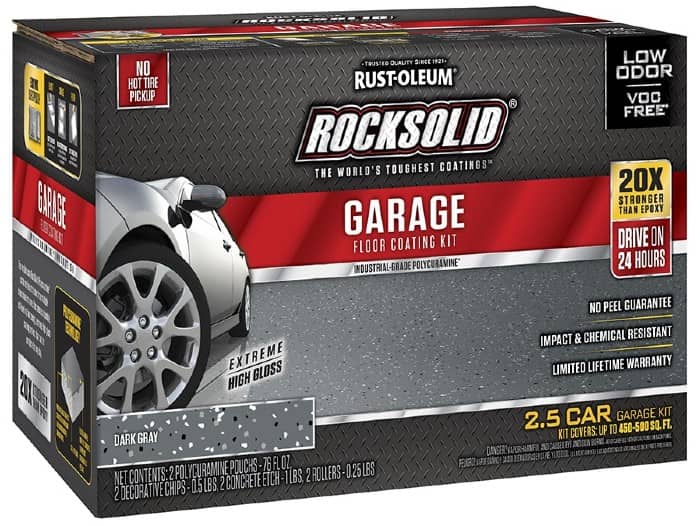
When RockSolid introduced its new line of Polycuramine garage floor and interior coatings, we were left scratching our heads at first. After all, what in the heck is Polycuramine? We admit we had never heard of it before. Moreover, what happened to the old RockSolid Polyurea garage floor coating, and why the change? Furthermore, why is Rust-Oleum’s name on RockSolid’s product?
After being asked by more than one reader, we decided it was time to see what the Polycuramine fuss was about. We wanted to know if it’s better than garage floor epoxy as RockSolid claims. In addition, we wanted to know why Rust-Oleum is involved.
Lastly, we wanted to determine if the Polycuramine garage floor coating is better than the older Polyurea coating that it has replaced. As a result, we have done a deep dive into RockSolid to get a better understanding of what this coating is and if we recommend it.
This article was first published in July 2014 and has been updated to reflect the latest information. Please read the latest update near the end. It reveals the most common complaints and issues over the years that you need to be aware of.
What is Polycuramine?
To best describe what Polycuramine is, we need a brief history of RockSolid Floors. This will help explain why Polycuramine was developed and how Rust-Oleum became involved.
RockSolid Floors was established in 2007 as an affiliate of Citadel Floor Finishing Systems. Citadel is a well-established, 40-year-old plus industrial floor finishing manufacturer that specializes in polyaspartic and polyurea technologies.
Realizing that there was a DIY demand for polyurea coatings, RockSolid Floors was born to provide a friendlier DIY version of the commercial quality Citadel polyurea. The RockSolid brand is probably best known for providing the A and B components in ready-to-mix sealed burst pouches that do not require a mixing bucket.
In January 2014, Rust-Oleum acquired Citadel and thus inherited the RockSolid line of floor coating products. As a result, all RockSolid products now come with Rust-Oleum branding. All customer service inquiries for RockSolid go directly to Rust-Oleum as well.
Polycuramine is a newly trademarked product that was developed the previous year by Citadel and found its way into the RockSolid lineup. It’s a proprietary blend that is alleged to combine the best benefits of Polyurea, Polyurethane, and Epoxy.
The following is a quote from a RockSolid sales page:
RockSolid Polycuramine™ is the best of Polyurea, Urethane, and Epoxy chemistries. It combines these three chemistries and their key attributes into ONE indestructible, self-leveling, flexible, fast curing, high gloss coating system.
RockSolid states that its Polycuramine garage floor coating is 20 times stronger than epoxy paint. It has a 96% solids content, a high gloss finish, and is impervious to all chemicals. The coating can be installed in one day, walked on in 8 – 10 hours, and driven on within 24 hours.
It also has the added advantage of an installation temperature range of 40°F – 90°F. In addition, RockSolid has a low VOC content with minimal odor and a limited lifetime warranty as well.
Each Polycuramine Garage Floor Coating kit consists of one burst pouch of colored Polycuramine to cover up to 250 ft². Included are decorative color flakes, the required foam roller, concrete etch solution, and of course instructions. There are six colors to choose from as well – Black, Dark Grey, Grey, Tan, Mocha, and Modern Griege.
You can view their information page and color chart here.
Our evaluation of RockSolid Polycuramine Garage Floor Coating
We feel that this new lineup for RockSolid couldn’t have come at a better time. Though the Polyurea garage coat kit that it replaced was a fairly good product, many of the reviews for it by the average DIY installer were less than great.
There are many benefits to a polyurea garage floor coating, but the pitfalls for the old RockSolid polyurea DIY coating was is in the installation. As a result, there were numerous complaints about delamination and finish issues.
Many if not most of these issues were due in part to the limited application time available. Polyurea cures fairly quickly. If it wasn’t applied in 20 to 30 minutes, it would begin to thicken up and problems ensued. It just wasn’t that DIY-friendly.
For example, it would not have enough time to seep into the pores of dense concrete that was prepped by etching and not by grinding. This led to delamination issues of the coating. Secondly, if you didn’t get the product down fast enough, the finish would not be very glossy and could get bumpy or lose its smooth texture among other issues.
After doing a bit of research, we learned that these problems should be solved with the new RockSolid Polycuramine coating.
First, we called the Rust-Oleum tech line. They stated that the new RockSolid Polycuramine formula has superior wetting characteristics (similar to epoxy). As a result, it allows the coating to penetrate the concrete much better for superior adhesion. This is a big help for concrete that is etched instead of prepped by grinding.
In addition, we learned that you have 45 minutes to one hour to apply the Polycuramine. This should be more than enough time to apply up to 250 ft² of product. The longer pot life should alleviate many of the finish issues that resulted from the short installation window of before.
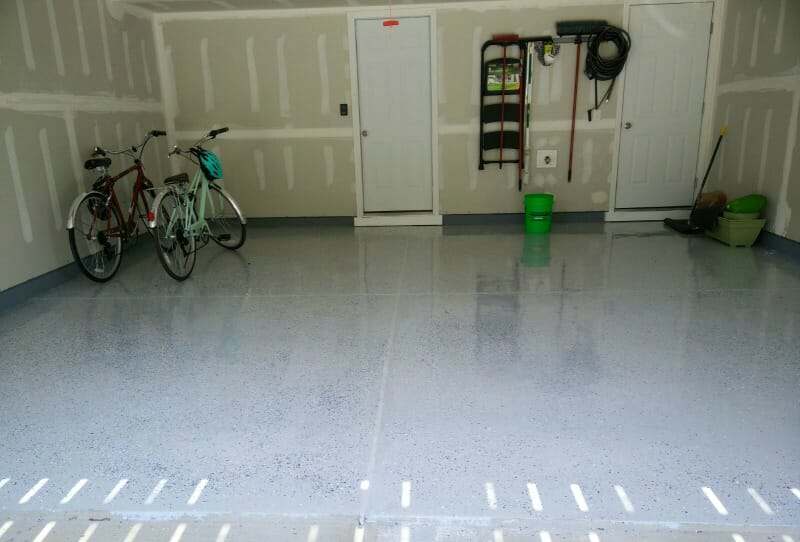
However, we do have to question some of RockSolid’s marketing methods. They claim that their new Polycuramine formulation is 20 times stronger than epoxy paint. Really? Their older polyurea product claimed it was only 4 times stronger.
Try as we might, we could not find an actual 2-part epoxy floor coating with only a 33% solids content as RockSolid compares it to. After digging a bit deeper, we discovered that what they are comparing it to is paint – 1 part epoxy paint that is (link). That is like comparing apples to oranges.
1-part epoxy paint is not an epoxy coating and the only product available with such a low solids content. We feel that this is misleading if not deceiving. They should be comparing it to a true 2-part epoxy. It’s tactics like this that create ruined expectations of garage floor coatings.
They also claim that the new Polycuramine blend combines the best of Polyurea, Polyurethane, and Epoxy. That isn’t necessarily true either. History has shown time and again for sealers and coatings that by combining the best of everything you will not get the best attributes of each ingredient.
Polyurethane for example is known for being very resistant to chemicals, has high abrasion resistance, and is U.V. stable. Though RockSolid Polycuramine has good chemical resistance, it is not U.V. stable and can yellow if exposed to direct sunlight for lengths of time – just as epoxy does.
It’s also not nearly as resistant to abrasion as most polyurethane or polyurea coatings. For example, the abrasion rate for Polycuramine is 40 mg. That’s about equivalent to a high solids epoxy and better than the inexpensive epoxy garage kits. However, a typical abrasion rating for polyurea is approximately 8 – 12 mg. You can find the RockSolid datasheets here.
This means that a polyurea coating would last much longer or wear many times slower than Polycuramine. We suggest reviewing how to read datasheets for coatings to learn more.
Another concern is that RockSolid Polycuramine is a thin coating. It has a dry film thickness of only 3 mils. That’s about half as thick as a typical polyurea coating. A high solids epoxy is approximately 8 – 10 mils thick for a DIY kit. Our guess is they need the coating to be thinner to get the coverage rate they require to keep the price point competitive.
As a result of the thin mil color coat, we recommend a second coat of clear Polycuramine to provide for an overall thicker coating. This will protect the color coat, and provide a deeper glossy look.
Would we recommend RockSolid Polycuramine?
With all that said, initial responses from consumers have been positive. Reports are that the new RockSolid Polycuramine garage coating formula is easier to apply DIY than the previous polyurea formula.
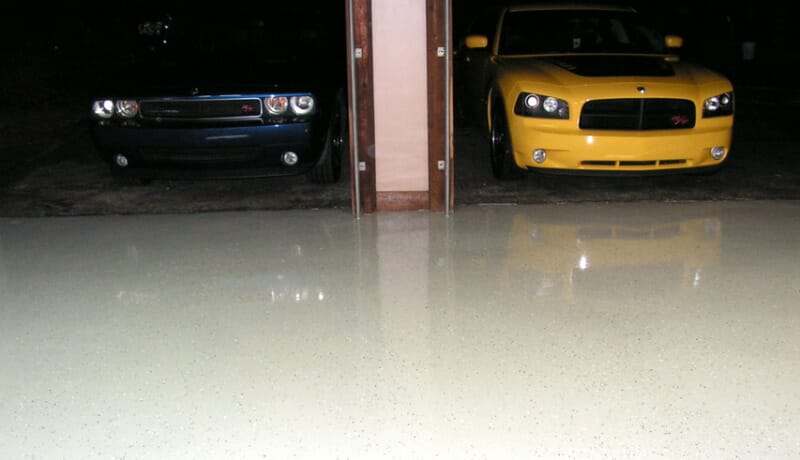
Few issues about the finish have been raised so far that we are aware of. In fact, it’s one of the most glossy coatings you can apply. Plus, the added benefit of being able to apply it in a wider range of temperature extremes is something you cannot do with epoxy garage floor coatings.
One nice advantage to the Polycuramine garage coat that we failed to mention is that it has a 7-day recoat window. This means that you can wait up to 7 days to apply another coat to the floor without having to prep it first. All that is required is to make sure it is clean.
This can be a great advantage to the average DIY installer who may only have a limited time to work on their floor. Most coating products have a recoat window of 24 hours or less.
Though the new RockSolid Polycuramine Garage Coat is only 3 mils thick, we feel this formulation is superior to that of comparable DIY coatings such as Rust-Oleum’s 2-part EpoxyShield product, Quikrete Epoxy garage floor coatings, or Valspar Epoxy Coatings as an example.
Yes, RockSolid Polycuramine is more expensive than these traditional DIY garage coat kits. However, the warranty is much better. Plus, it fills a void for the consumer who wants a quality DIY product that is easy to apply but may be intimidated by the cost and application of the thicker and more expensive multi-coat garage floor coatings.
RockSolid also has an easy-to-apply metallic garage floor coating which is now gaining some attention. It goes down twice as thick and has a very nice appearance.
This post may contain affiliate links. If you use these links to make a purchase, we may earn a small commission. As an Amazon Associate, All Garage Floors earns from qualifying purchases. You can read our full disclaimer here.
Where to purchase RockSolid Polycuramine products
We’ve had to update this section on multiple occasions since we first posted this article in early 2014. Rust-Oleum has since expanded the distribution of RockSolid and it is now available from most home improvement centers and online.


If you don’t have one of these stores near you, we suggest purchasing RockSolid Garage Floor Coatings here at Amazon. We have found that on many occasions it is available at a cheaper price.
In addition, you can find the optional RockSolid Clear Coat here.
Final thoughts
It’s too soon to know if RockSolid Polycuramine is the DIY wave of the future in garage floor coatings. However, it does appear to have much better performance and wear than the traditional DIY epoxy garage floor kits found at your local home improvement centers and auto stores.
Reviews so far have been positive and you can bet we will be keeping a close eye on the developments of this new product.
———- 2023 UPDATE ———-
It’s been over 8 years now since we first evaluated and wrote about the new RockSolid Polycuramine garage floor coating. To date, we have heard very few issues relating to the actual performance of the coating in terms of adhesion, hot tire pickup, and wear.
This is a strong indicator that it performs and lasts longer than the traditional low solids DIY garage floor coating kits such as EpoxyShield.
However, we have found that there is one primary flaw with RockSolid. Simply put, RockSolid does not provide enough coating material for the coverage rates they list. And this creates a couple of irritating issues that people are not happy about. The first is color uniformity and finish.
If you scroll down you will see that we have well over 900 comments for this article. A good percentage of these are questions or complaints regarding cosmetic problems with single-color coat applications.
These people have been reporting patchy areas or sections of the coating that appear less glossy and/or slightly different in color. Some have also complained about small spider cracks showing through.
The source of these issues is due to the coating being too thin in those areas. As with all coatings, if a single coat application on bare concrete is too thin, the appearance of the coating will not be good. The color tone and finish will change and lose gloss. It can even look slightly transparent with the concrete color showing through.
There is a reason why this happens with RockSolid.
As we originally stated, Polycuramine penetrates properly prepared concrete well – as it should. In addition, the density and porosity of a concrete slab can vary. This means that some areas of the concrete will absorb more coating than others. This is normal.
When RockSolid Polycuramine is applied to slabs that are less dense and/or more porous in areas, the limited amount of material (90 oz) provided in one burst pouch mix does not provide enough thickness at the recommended coverage rates to counteract the additional penetration and absorption of the material. As a result, the coating is too thin in those areas after it cures.
This isn’t necessarily a bad thing in terms of performance. You achieve a very good bond when the concrete absorbs the coating. However, this means you need to purchase and apply a second color coat to achieve the rich color, glossy finish, and durability that it should have. The first coat essentially acts as a primer coat.
The reason spider cracks tend to show through is due to the good penetration qualities of Polycuramine. It allows the thin cracks to absorb more material as it cures. As a result, the cracks show through and look dark. This can be avoided by properly filling spider cracks in the concrete (link) beforehand or by the application of a second coat.
The 250 ft² maximum coverage rate is only possible under ideal conditions consisting of newer concrete that is smooth, consistently dense throughout, and with no cosmetic defects. It can be obtained, however, when being applied as a second coat or over a previously coated floor that will not absorb the Polycuramine.
If you purchase RockSolid, we recommend a maximum coverage rate of no more than 200 ft² when applied to bare concrete. Slightly less is preferable. This should help provide for a thicker application. When it cures, it should be thick enough to provide a consistent color and glossy finish.
If you prep your garage floor concrete via grinding, then you will require a minimum of two color coats – period. The first acts as the primer coat and the second provides the required thickness to obtain the proper color and gloss.
There is something else to be aware of as well. RockSolid Clear Coat states that a single-car kit can be applied over the color coat of a 2.5-car kit – up to 500 ft². This makes the clear coat especially thin. Though consumers like the way the clear coat performs and looks, the number one complaint is that you need to use more than what Rust-Oleum RockSolid recommends.
The second big issue with RockSolid Polycuramine garage floor coatings is that it is more expensive than epoxy, particularly for what you get. And this is why we believe that Rust-Oleum RockSolid recommends the overly generous coverage rates. We are guessing that this was a decision that was made to try and keep the cost down to compete against epoxy kits.
To make things worse, Polycuramine has become even more expensive in the past few years. At the time of this update, you can purchase a much better commercial-quality single-part polyurea floor coating with the same coverage rates for less money.
These polyurea coatings are almost twice as thick as RockSolid. They have a very long pot life for easy application, they are U.V. stable, and have far superior abrasion ratings. Here is an example of a single color coat of AWF Polyurea that costs less for the same coverage.
The one consideration with these commercial quality polyurea coatings is that they are not low VOC coatings as RockSolid is. They should only be applied in a garage or similar environment and not inside a home such as a basement.
Our goal with this update is not to talk you out of purchasing a RockSolid Garage Floor Coating kit. However, what we are trying to do is inform and educate you about the issues you need to be aware of before making that decision.
Do we still think RockSolid is a good-performing DIY garage floor coating? Yes – if you follow our recommendations about coverage rates. However, there are now better performing easy-to-apply commercial-quality polyurea coatings that can be purchased for similar pricing.

If I have a ground concrete prepped floor, it looks like your recommendation on this material is 2 coats of color. Do you then still need a top clear coat also?? (Seeing your 2023 update after I already bought one kit of this floor coating and it’s not returnable 🙁 … so im trying to see if i spend the additional to get the correct quantity of this or if i cut my losses and get the polyurea kit)
Hi Jen. If you prepped the concrete by grinding, then you are definitely going to need two color coats. The clear coat is highly recommended, but not mandatory. It locks in and protects the color flakes as well as the color coat. The clear coat acts as the “wear coat” and takes the abuse. What is the square footage of your project?
200sf for a woodshop. I don’t expect a ton of wear and tear, but it’s also not heated and I’m in Michigan.. Will thickness of coating affect the freeze/thaw durability at all?
No, the thickness won’t be affected by freeze thaw. At this point, your best strategy may be to apply the single coat of RockSolid and see how it looks after it has cured a couple of days. If the color is not rich and glossy, then you can apply a second coat. RockSolid allows up to 7 days to recoat without further prep needed. Amazon usually has the best price on RockSolid. You can find it here. If you can’t get it delivered within the seven days, you may need to source it locally. A 250 square foot polyurea kit with the base color coat, color flakes, and clear coat costs less than two coats of Rocksolid color coat and a clear coat. It will also perform even better. However, for a wood shop without a lot wear and tear, and the fact that you can’t return the RockSolid single kit you currently have, I think it makes more sense to stay with RockSolid in this case and just see how the first color coat turn out.
I applied Rustoleum Polycuramine to my 2-car garage last August, and followed the directions carefully, degreasing, etching, washing, rewashing, drying, patching etc. and because the floor had been coated 20 years previously with one-part epoxy, which failed the tape test, took Rustoleum’s advice and coated the floor with their Recoat Primer. We stayed off it for many days. I was delighted with the result, until a couple of months later, when 7 of the 8 spots under the tires pulled up, leaving bare concrete. Rustoleum sent me a “touch up kit” with more epoxy and chips. I’ve waited until now to apply it, needing dry and warmer days.
So today I worked hard on scraping and cleaning the tire spots, and I have questions about how to proceed. Four of the tire spots are small and the surrounding surface seems tight. Three, when scraped, got much bigger; one of them by peeling large sections, suggesting a serious bonding problem not related to hot tires. The pieces that came off have removed both the polycuramine and the primer, but the color suggests that a fine layer of concrete dust came up, too, so I’m left unsure if it was a failure of primer or some other problem. The remaining concrete is very hard and smooth, with no visible signs of any previous coating. The water drop test suggests it’s somewhat sealed; the drops stick stay on the surface for a few minutes.
The touch up kit directions say to sand, vacuum, and wipe with acetone, then apply the polycuramine. Primer is not mentioned.
This leaves me with a question. Your advice would be appreciated. Should I again use primer before applying the polycuramine? If I do, why would I not expect the same unsatisfactory result again? If I don’t, isn’t there a problem applying polycuramine to a previously sealed surface?
Thanks!
Hi F. Rustrated. Clever name 🙂 Unfortunately, the primary issue that is responsible for the peeling is that you applied a coating over a 1-part epoxy paint. 1-part epoxy paint peels from hot tire pickup – period. When polycuramine is applied to properly prepared bare concrete, it forms a tenacious bond that rarely peels from hot tires. Hot tires can form a strong grip over any coating as the tire cools. If a quality coating is applied to bare concrete, the tire looses the grip battle every time and releases when the car moves. If the coating is applied to a paint base, the tire wins the grip battle since it’s the paint that is adhered to the concrete and not the coating. It’s similar to building a beautiful house on a sand foundation. This is why we are not a fan of Rust-Oleum Recoat Primer. It tends to work OK when applied over older coatings that are sound. However, when applied over paint, this is the problem you get.
Our guess is that the concrete was very smooth troweled to begin with. That is why it takes a few minutes for the water to absorb. In addition, it may not have been etched very well (if at all) before it was applied. This would explain the other areas where it is easily scraped up. If the concrete had been sealed previously, the 1-part epoxy paint would not have stayed adhered as long as it has up to this point. You have two basic options. The first is to make the repairs. However, we would recommend etching all the bare spots and apply the polycuramine directly to the concrete. You will get a better bond. Don’t use the Recoat Primer. You will still run the risk of other areas pulling up at some point. The second is to remove all the coating and paint via grinding and then apply a quality coating to the bare concrete. I hope that helps.
What the best chemical cleaner to use for some overspill on my driveway? Muriatic acid and a wire brush? Thanks
Hi Larry. We are assuming it was RockSolid? If so, muriatic acid will do nothing with a coating. The most it will do is discolor it as it sits there. It needs to react with the minerals in concrete to work. Your best bet at removing it is aggressive sanding with 40-grit sandpaper. A rotary sander will work well. Wire brushes won’t work very well on coatings and they can leave black metal marks on the concrete that is hard to remove.
Hi! I have an ~18x18ft garage (~apx 350Sqft when including 3″ side walls). I am planning on using the Black High Gloss Polycuramine 2.5 car garage kit. The current garage floor is in good shape (only a few insignificant hairline cracks), but does have an existing light blue concrete paint that was done about 5 years back, as well as some other random paint stains. I was only planning on thoroughly cleaning and then etching before applying the product. Do you recommend any other prep/pre-treatment? Based on the above I feel like this one kit should allow sufficient coverage but am open to suggestions. Please let me know if there is anything else I should consider!
Hi John. Yes, this amount will allow you to apply it slightly thicker to help avoid the cosmetic issues that can occur from being too thin. However, if the garage floor currently has concrete paint on the surface, it needs to be completely removed before applying RockSolid if you want to avoid hot tire pickup and other peeling issues. Coatings that are known to achieve a good mechanical bond to properly prepared bare concrete (RockSolid) rarely suffer from hot tire pickup. However, if same coating is applied to paint, it will pull the paint up off the concrete due to hot tires since the coating is adhered to the paint and not the concrete. The paint is the weak link. It does not create the same tenacious bond to concrete as a good coating will. It’s like building a nice home on a sand foundation. As an FYI, etching does nothing on paint. Etches work by reacting with the minerals and free lime in concrete to provide a proper bare concrete profile. If you still want to apply the RockSolid to paint, you will need to scuff up the surface with 120-grit sandpaper first. Rust-Oleum also sells their Garage Floor Recoat Primer. We wrote an article on it here. However, you will still have the same problem since it’s paint that is adhered to the bare concrete and not RockSolid.
Good morning, I purchased a 2.5 car polycuramine kit for a room in my basement. I grinded the floor down and it soaked it up and wasn’t uniform across the whole floor. I purchased another kit, this time just a one care kit to coat the spots to make it uniform across it. I already purchased a 2.5 car kit of clear for it, do you recommend another kit of it as well to add an additional layer of clear coat to it. By the way I went heavy on flakes for it also. Not full broadcast but maybe 80% of it.
Hi Adam. The clear coat coverage rates for Polycuramine are very thin. It may feel rough and require another coat with all those flakes. Apply the first coat and then determine if it’s smooth enough for you. If not, it will require another coat.
Hi there, I just applied the Rocksolid grey to my garage floor yesterday and everything looks great. I had previously purchased a box of the Epoxyshield Clear Coat from the local hardware store to use, as I wasn’t aware that there was a Rocksolid version of the clear coat (and they didnt stock it). Is there enough difference or added benefit for the Rocksolid version that I should return the Epoxyshield and get Rocksolid? There is def a cost difference, and given all the comments about running short, I will need an extra box so it will get much more expensive, but if it is significantly better or performs better with the Rocksolid base, then I will make the switch.
Thanks in advance for your help!
Hi Jeremy. Rust-Oleum does not endorse combining the two products. EpoxyShield and RockSolid are not compatible coatings and will not chemically adhere to each other properly during the recoat window. You would need to let RockSolid cure for a few days and then rough it up with 150 grit sandpaper before applying the EpoxyShield. The RockSolid clear coat has a better abrasion rating for longer wear. In addition, you have 7 days to apply it to the color coat before further prep is required (sanding).
Hi Shea, Thanks so much for the quick response and info! I’ll return Epoxyshield and move forward with the RockSolid.
I’ve seen many people use Rustoleum Rocksolid on enclosed trailers with wood floors. Would a specific primer help with the coverage/absorption issues?
Hi Nate. Primers are not available for RockSolid. We have an article here that discusses the subject further. Enclosed trailers typically do not have a lot of square footage like a garage. What we recommend for most cases is cutting the corners of each burst pouch and pouring the part-A and part-B into separate measurement containers/paint buckets. Contents can settle in each burst pouch, so make sure to mix each bucket after you pour them in. Then, divide the contents of each part-A and part-B in half. This allows you to mix together in a bucket 1/2 of the appropriate part-A and part-B burst pouch contents to apply to the trailer floor. Once it has cured long enough, mix the second batch. This way, you are not wasting product by mixing one burst pouch and having a lot of material left over that can’t be applied. Just determine the amount of square footage your trailer is and double it. That is how much material you will need overall.
Hi, I am planning to seal my garage with Rock Solid polycuramine in the next few weeks. I live in Minnesota and I am wondering what preparation you recommend for a concrete floor that has significant damage from salt/sand/snow. There are large patches of spalling and cracks. Should I use concrete patch and repair before applying the Rock Solid, or just plan on at least 2 coatings? Thanks for your advice.
Hi Jeremy. You need to properly repair and fill those areas before applying a coating. We have an article on how to repair pitting and spalling here. RockSolid is a thin concrete coating and will not fill small cracks, divots, pitting, or uneven spots. They all need to be repaired if you don’t want them to be obvious after the coating is applied. Also, keep track of your temps. RockSolid cannot be applied when the concrete and ambient air temperatures are below 40 degrees.
I messed up and applied a Rust-oleum EpoxyShield clear topcoat over top of Rust-oleum RockSolid. How big of an issues is this and do you have any recommendations on how to fix?
Hello Don. When was it applied?
Yesterday afternoon for the epoxyshield top coat. Wenesday afternoon for the RockSolid.
OK. I was hoping it was in the past couple hours or so. Unfortunately, what’s done is done now. Rust-Oleum states that the two are incompatible, so what you may encounter are adhesion issues. At this point, we recommend that you leave it as is and see what happens over the next few months. If it does not start to peel up where you park your vehicles by that time, then you may be OK. However, if it does start to peel in areas, the only solution is to remove the clear coat via sanding with a 60 grit sanding screen on a floor maintainer. It would need to be removed down to the RockSolid color coat. It’s OK that the RockSolid coat gets scratched up. Once you you apply a new clear coat, all the scratches disappear and the floor will look like new again.
Hello, I am about to apply the rocksolid to my garage floor. I am also going to go heavy on the flakes. My question is; can I topcoat with a polyurea clear coat over the polycuramine?
Hi Stephanie. Rust-Oleum states that Polycuramine is not chemically compatible with other coatings. If you would like to apply a polyurea clear coat, or any other coating for that matter, it will first require that you wait 48 hours after application for the RockSolid coat to cure enough. After that, you need to rough up the surface with 120-150 grit sandpaper. Vac/sweep and then wipe the surface down with denatured alcohol or equivalent before applying any other coating. Keep in mind that you will lose some of the color flakes during this process. You are best to stay with the RockSolid clear coat to avoid all the other prep, even though it’s thinner than the color coat.
Something to keep in mind is that RockSolid is a thin coating at approximately 3 mils dry film thickness. Such coatings do not accept heavy flake well and will not accept a full broadcast application. You need a minimum 6-7 mils wet film thickness and 5 mils dry film thickness for heavy flake applications. The flakes themselves are approximately 5 mils thick. If you have flakes that overlap each other, a thin mil coating will not hold them very well. That is why RockSolid, EpoxyShield, and other thin mil coatings only come with a enough color flakes for a light broadcast. They are not acceptable for heavy broadcasts.
If you are going to spend the money on RockSolid and a polyurea clear coat, then we highly recommend that you take a look at single-part polyurea coating systems. They are not priced that much more and they are many time better than RockSolid. You can read about them here.
I just coated my 2 car garage with the 2.5 car garage kit. I felt like I followed the directions to a T. I could not get Rustoleum’s degreaser cleaner, as Home Depot said they don’t carry it anymore as it is being transitioned into a new product. I used an industrial degreaser made by DEP/ Purple. My garage floor is very old and it was pretty greasy and dirty. Although it had never been coated. I believe I may have put the coating on a little too thin in the first area I worked. But over the entire garage, there is a bluish haze that has come up to the surface of the coating and I suspect that that means it is pulling oil out of the concrete into solution or perhaps I did not rinse it well enough, which is hard to believe how much time I spent rinsing it. I am just not satisfied with the results. I am hoping that a second coat of color will solve the problem. One issue is that we have already put down chips. I would say it’s more of a light application of chips. We are thinking about recoating with another application of color and not using any chips. The surface will look bumpy, but may act as a slip resistant. Could you share your thoughts please? Many thanks.
Hello Scott. A bluish haze indicates a contaminate and may interfere with the adhesion. Applying a another coat over it won’t make it better. It might hide the bluish haze, but the coating will still peel if that is the case. Did you etch the concrete surface at all or just attempt to clean it well?
I etched the concrete after degreasing using the etch contained in the kit. The blue haze is not over the entire area, just in patches here and there. What are my options?
Hi Scott. Unfortunately, the blue spots indicate a contaminate, most likely oil from the concrete. The coating is not going to adhere to those spots very well in the long term if at all. If you don’t want deal with those areas pulling up, it will require that you remove the coating in those areas via grinding. The open pores in the concrete created by the grinding will make it easier to remove the oil. We would recommend starting with a good degreaser. Once the concrete dries, test the surface by applying a few water drops. If the concrete readily absorbs the water, then you are good. If it doesn’t absorb the water or the water turn a rainbow color, then there is still oil to be removed. We would recommend using an enzymatic oil cleaner like this one here from Amazon. These take time to work, so don’t rush it. Once you use this, the concrete should be able to absorb water. After that, you can apply a second coat of RockSolid, just apply it a bit more heavy over the bare spots. Since you will be past the 7 day recoat window for RockSolid, it will require that you scuff the surface of the current coating with 10-150 grit sandpaper before applying the second coat.
Proper concrete preparation is the most important part to achieving a successful outcome for coatings. Unfortunately, the home improvement store DIY coating companies do not stress this enough. They focus more on marketing “easy application” to get sales and don’t do a good job of educating the consumer on this topic.
Shea, thank you for the comments and advice. For the time being, I decided to put a second color coat on the floor and did not use the color chips. The floor looks 100% better. If I start having adhesion problems in later months, then I think I will just have to redo the whole floor. I’m gonna take a chance for now and keep moving forward.
I would like to use this product for my garage and driveway areas. The concrete is approximately 3 years old and has very few problems with oil or stains. I am worried about the exterior driveway. Let me know what to do. I’m a contractor who builds homes and would like to use this all the time. This is my house, and I am going to try it out.
Hi Tom. RockSolid would not be our first choice to use on clients homes. It’s a residential quality coating that is pricey for the volume of material you get. The coverage rates make for a thin layer that sometimes requires a second coat due to cosmetic issues caused from it being too thin. This alone can cause unexpected material and labor costs. I recommend reading our update near the bottom of the article where you posted your questions. Professional coating contractors do not use it either for a variety of reasons other than the previous mentioned. You would be much better suited using commercial quality coatings available from online coating vendors. Many supply garage floor coating companies and contractors. If you decide to use RockSolid, we highly recommend reducing the coverage rates by 15-20% to help avoid cosmetic issues and problems with it being to thin. You may also want to research proper concrete preparation methods for coatings if you have not done so already. With all respect, we have found that many of the problems readers contact us regarding coatings in their homes are due to painters and home builders who incorrectly assume that applying concrete coatings is like applying paint. We have found over the years that many think proper concrete preparation is over rated and don’t do it to save time.
With exception to very thin mil clear acrylics used over stamped or decorative colored concrete inlayss, coatings in general do not do well on driveways and pose many problems. Most are not U.V. resistant or will not tolerate constant U.V. exposure well and will amber (yellow tint). Epoxy (and RockSolid) in particular will amber badly and begin to oxidize. That is why epoxy and polycuramine are indoor coating only. They also become slippery when wet and would require a heavy application of anti-slip media in the final coat. There are coatings that can be used outdoors, but rarely are they used on driveways.
Can I spray isopropyl alcohol (with a metallic color mixed in) on top of your Rock Solid epoxy product after application while it is still wet?
Hi Kevin. Isopropyl alcohol will not have the same effect as it does with true metallic epoxy coatings. The floors you see with swirls, rivers, and volcanic looking effects in the coating are very thick 100% solids epoxy coatings. They are 3-4x thicker than RockSolid. The thickness and epoxy resin allow the metallic pigments to move around within the coating before it begins to cure. Isopropyl alcohol creates a reaction with those pigments and the epoxy resin that creates these effects. RockSolid is a very thin polycuramine coating. It’s a proprietary blend of epoxy, polyurethane, and polyurea. It will not allow the metallic pigments to swirl and travel around in the coating. That is why RockSolid requires swirling the coating around with the roller while it is being applied. It’s also why you don’t see metallic pigment in polyurethane and polyurea.
Hi, I’ve decided to use RockSolid for my 30-year-old untreated 525 sq. ft. garage floor. I plan to do the normal prep work to get it as clean as possible and to fill cracks before coating the floor. Based on what I’ve read about coverage rates and such, I plan to get two 2.5-garage kits for the main coating, and one more 2.5-garage kit for the clear top-coat. I plan to use one of the kits as a “primer” coat, and assume it will be pretty thin since it will cover 525 sq. ft. But then I’ll put another coat on with the second kit which hopefully should be enough to get the recommended thickness. Finally I will put one coat of the top-coat on.
I’d appreciate your opinion on whether this plan should be adequate? Thanks.
Hello Dan. 525 square feet puts you in what we call no-mans-land for Rust-Oleum coatings. It’s a risky plan that we wouldn’t endorse. The first coat will be very thin and act like a primer coat as you mentioned. However, the second coat will only go 500 square feet under the best of circumstances. You still risk developing patchy areas with less color tone that are not glossy with pushing it to 525 square feet. The 500 square feet clear coat is only a single 90 ounce pouch of clear. It is spread at half the thickness as a single color coat (approximately 1.25 mils) and will be lucky to reach close to 500 square feet.
You can apply a commercial quality single-part polyurea system that will be twice as thick for only $50-$100 more than what you would pay for your planned RockSolid application. Legacy Industrial has the best price with their 600 square feet Nohr-S Aegis Kit. You can view it here and get pricing. We also have an article here explaining what single-part polyurea is and why it’s one of the best DIY kits available today. It does a comparison to Rust-Oleum as well. I hope that helps.
I originally bought a couple of the RockSolid polycuramine systems, but when I read the instructions it said do not use on the concrete control joints. As I investigated further I found that the hardness of polycuramine could undermine the control joints and may lead to slab cracks. Polyurea is much more flexible, so control joints are not a problem. But I can’t find polyurea at the same prices as RockSolid… but that’s okay… I want my control joints covered so I returned the RockSolid systems.
Hi Dan. You can coat down into the joint, but you can’t fill the joint with a coating. This is true for all coatings. If you want to fill the joint to create a seamless look, you need to to fill it with a joint filler then grind it flush. Coatings won’t cause slabs to crack, but slabs can make the coating crack if the slab cracks at some point later. If you want a polyurea coating kit, I suggest you check our purchase recommendation page here. We have single-part polyurea coatings available from three different vendors that we highly recommend. These are commercial-quality coatings used by the pros and are much better than RockSolid.
Hi I applied the Rock Solid 2 Part Polyacuramin 9 days ago and then applied the epoxysheild 2 part the next day with anti skid not realizing the two werent the same product. Since 5 days passed I sanded the epoxysheild and applied the rock solid top coat with half a bag of anti skid this time since there was still some antiskid from the first epoxysheild clear topcoat. Rustoleum said it was okay to use the rock solid on top of the epoxysheild and I did sand. Its drying now and looks glossy but there are some rough spots yet those spots are still glossy. Is that normal and is that from the ant skid? Should I apply another layer of rock solid topcoat? Please advise
Hi Matt. It sounds like you have some areas where the anti-slip is more concentrated. That will make the surface feel rougher. This typically happens when the anti-skid sinks to the bottom of the paint tray and the roller picks up more. It can also happen if it wasn’t completely dispersed in the RockSolid Clear Coat before you poured it out onto the floor. It’s strictly a cosmetic issue and nothing else.
Hopefully your clear coats don’t peel up off the color coat. I’m afraid you missed my point when I explained that EpoxyShield and RockSolid are not chemically compatible. Because the EpoxyShield Clear Coat was applied over the RockSolid Color Coat within the recoat window, it may not adhere sufficiently. The reason Rust-Oleum said you could apply the RockSolid Clear Coat over the EpoxyShield Clear Coat is because the recoat window for the EpoxyShield had expired (76 hours). After that you can apply RockSolid or any other thermosetting resinouss coating over the EpoxyShield coating as long as you prep it as they had instructed.
I’ve just purchased a new 12′ X 20′ single car garage / shed with a pressure treated wood floor. I will be storing an antique car which is seldom used in the garage. Is this a good product for this application? One of my concerns is oil or coolant leaks from the car and this product could make for an easy cleanup.
Hi David. Yes, RockSolid would make such cleanups much easier. It can be applied to a pressure-treated wood floor with proper preparation. It will require sanding the surface first with 80-grit sandpaper to remove the chemicals and waxes that are used on the wood surface to help preserve it. If this step is not followed, the coating will not adhere properly. The wood will absorb more of the product than concrete will, so two coats will be required. A 2.5 car kit is the least expensive option, as it includes two burst pouch kits that each cover up to 250 square feet.