
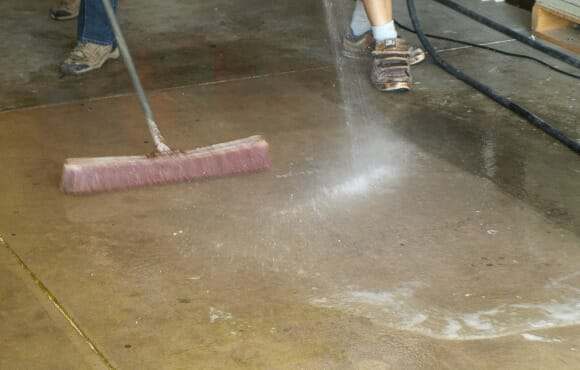
Acid etching the garage floor is sometimes the only viable alternative for many DIY home owners when prepping concrete correctly to accept a coating. It isn’t hard to do, but certain safety precautions and steps need to be taken to insure a successful and safe outcome. Potentially dangerous if not done correctly, it can not only damage your concrete, it can cause serious bodily harm as well. So please take the time to learn how to acid etch your garage floor or concrete safely before jumping into your project head first.
Muriatic acid, also known as hydrochloric acid, is the typical acid of choice when etching concrete. It is inexpensive and a dangerous chemical that can damage almost anything it comes in contact with. It will eat through clothes, metal, skin, and creates a noxious vapor that can cause surrounding metals to rust as well as burn the lining in your nose and lungs. You can purchase it from your local home improvement center for less than $10 a gallon at a strength of 31.45%.
Phosphoric acid is a mineral acid that works almost as well and isn’t as dangerous to work with, but it is harder to find and more expensive. It also works at emulsifying oils – something that muriatic acid will not do. Both will remove rust from your concrete.
If you don’t like the idea of working with acid, you can read about some safer alternatives to acid etching here.
Supplies and protective gear for acid etching
- Hose with adjustable spray nozzle
- 5 gallon plastic bucket
- Plastic 2 gallon watering can
- Acid
- Baking soda
- Stir stick – wood paint stick works fine
- Push broom or long handled scrub brush
- Rubber gloves
- Rubber boots
- Splash safety eye goggles
- Approved respirator for working with acid fumes
- pH paper test strips
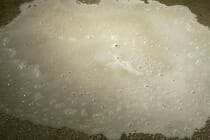 Acid is generally mixed at a ratio of 3 parts water to 1 part acid for sufficient strength to etch properly. Ideally you want to test the strength needed first before doing the entire floor. You can do this by first mixing a small solution in your watering can starting at a 5:1 ratio. Apply it to a small area of wet concrete. It should begin bubbling and fizzing immediately. If not then you will want to increase the strength accordingly. Sometimes a ratio stronger than 3:1 may be needed for particularly dense concrete or a smooth power troweled floor.
Caution! Always add acid to water, not water to acid. If you pour water into acid it can cause an explosive reaction that can spray you with the mixture and burn your skin!
Before acid etching, make sure the garage floor is cleaned properly of all oil, contaminants, grease, and dirt. Contrary to what many people think, acid will not clean grease and oil spots. In fact, if these areas have not been cleaned and degreased properly, the acid solution will just sit on top and not react with the concrete.
1 – Dampen the concrete:
Use your hose to lightly spray down the concrete in your garage so that the concrete is wet but not puddling water. If you have a large garage floor, you may want to acid etch in sections. Do not let the concrete dry out before or during application of the acid solution.
2 – Apply the acid solution:
Use the 2 gallon plastic watering container to sprinkle the acid solution on the concrete. This will spread the solution evenly without much splashing. Do not just pour it on the concrete. This will create an inconsistent spread of the acid solution and will not provide for a uniform result. The 2 gallon container works well because you can mix 1.5 gallons of water to .5 gallons of acid for a 3:1 ratio. However, you can use any size you like as long as you mix the ratio of acid to water correctly. 1 gallon of a 3:1 acid solution will cover approximately 50 – 70 square feet of garage floor.
3 – Scrub the acid solution:
Once the solution is applied, lightly scrub it into the concrete with a push broom or long handled scrub brush. This helps to create a uniform etch of the concrete. Let the solution sit for 10 – 15 minutes while it continues to fizz and bubble. Do not let the floor dry out during this process. Add more solution if necessary.
4 – Neutralize:
Mix 1 cup of baking soda to 1 gallon of water in your large 5 gallon bucket and pour it into the now empty watering container. Sprinkle your neutralizing solution over the part of garage floor that was acid etched and let it sit for a minimum of 10 minutes. When time is up, rinse the neutralized solution with your hose into a drain or out the garage (if local water codes allow it). Another method is to use a wet vac and then dispose of the solution according to your local codes.
Check the surface of the concrete at this time. It should feel similar to medium grit sand paper with a uniform texture. If not, you will need to repeat the process again.
5 – Final rinse:
Once the initial neutralizing solution is cleaned up, it is important to thoroughly flush and rinse the remaining solution out of the concrete. You may need to do this multiple times. It will leave a white powdery residue (calcium carbonate) on your garage floor once dried if you do not do this. This is a fine white dust that will not allow your coating to adhere properly. Use a high pressure nozzle while thoroughly scrubbing the concrete with your scrub brush. You can introduce a mild solution of Simple Green at this point if you like. Just make sure it is thoroughly rinsed.
Using a pressure washer for this process works well also. Do not use a pressure washer to rinse off the initial neutralizing solution. It can drive any acid solution that had not been neutralized deeper into the concrete and cause problems later.
6 – pH test your rinse water:
After your final rinse, dab a pH test strip like these at Amazon onto the still wet garage floor to check the pH. Anything between 6.0 and 9.0 will work for most coatings with 7.0 (neutral) being ideal. If it’s below 6.0 then the water is indicating that acid residue is still in the pores of the concrete. Rinse some more and repeat the test until you get the results you want.
Further Tips for Acid Etching Concrete
It’s a good idea to cover anything in your garage that you don’t want to get splashed with a plastic drop cloth. Another recommendation is to mix some neutralizing solution up ahead of time and spread it out liberally on your driveway. That way any acid solution that is hosed out will not mildly etch or discolor your driveway. Don’t acid etch the concrete if the temps are below 50 degrees as the acid will not be as effective with the cooler temperatures.
Also, make sure your garage floor has dried thoroughly before applying epoxy coatings. Fans will help. Give it at least two days with warm weather and longer if it’s humid or cooler. Though the surface may be dry, the pores of the concrete can still contain moisture and escape through outgassing when the temperatures rise during the day. This will cause your coating to form bubbles. You can always do a quick moisture test with plastic if you are not sure.
Learning how to acid etch your garage floor isn’t hard, but it’s very important to follow the proper steps. When done correctly, the chances of having your coating fail due to improper preparation of the concrete is reduced significantly.
It seems using the grinder is the better option, if I Understand it right if I use the grinder then I dont need to do the etching is that correct?
Thanks,
Tony
Yes, that is correct.
I acid etched my floor. Used the baking soda to neutralize it, rinsed thoroughly and then power washed it. The next day floor is covered in white dust. What can I do to remove dust?
Hello Tim. The white dust is all the fine concrete that was deteriorated by the acid solution. It settles in the pores of the concrete when the solution is allowed to sit too long and begin to dry on the surface before and/or after being neutralized. It’s important to always keep the concrete very wet when etching. It will require some strong scrubbing and rinsing to get the white powder up. Sometimes re-etching with a milder solution will help to remove the white residue from the pores.
I’m getting ready to etch a garage floor again. The last time I did it, I had a hard time keeping the floor from drying while spraying the solution. The garage I’m about to do is significantly larger than the last one. Any tips on keeping it wet while etching?
Hi Aaron. Just do one half of the floor at a time. Also, you should not be using a sprayer. You do not want to possibly atomize an acid etch solution. Plus, it will not deposit enough solution on the floor. Make sure you wet the floor first and use the watering can method for dispersing the etch solution. That should be enough to keep a good section of the floor wet. If it looks like it’s even coming close to drying a bit, sprinkle some water on it.
Hello! I need to etch and coat a 4” line only. Do you have any suggestions of how to keep the etching with a sharp edge. Is there a tape that will hold up to the muratic acid mixture that I could use to line the edge of the 4” line?
Hi Dan. What is it you are going to apply that requires just a 4″ wide strip?
I need to paint a hatch area next to a handicap stall in a garage on concrete that is very smooth.
I see. Containing an acid etch within a small boundary like that is difficult. The etching solution can still migrate some under the tape. In addition, the tape will not hold the solution back unless you are taping down heavy plastic around the perimeter to prevent the solution from running over the tape. You would be better off using 40 or 60 grit diamond paper sanding block or sanding wheel. That should be able to scuff up the concrete enough for your application.
You can also use gel acid etch for that purpose
Hi Ryan. Yes, a gel etch works great. We discuss them here.
Hi,
Basement crawl space has no way of etching with lots of water use as there is no drainage, so I washed & scrubbed with pure white vinegar which dried relatively quickly and then I covered the floor with dry B Soda & left it for 2 days to absorb any smells. I then swept it up but now I need to seal the floor to stop future smell & mold. The B. Soda is virtually gone but there may be fine dust from it remaining. Can I paint it with Acrylic sealer now or should I do something prior to sealing?
Thank You
Derek
Hi Derek. We recommend that you use a shop vac to get all that dust up. It will impair how well the acrylic sealer will adhere. Once you do that you can apply the sealer.
I used a 1:4 solution of muriatic acid to etch a new pour of concrete . Three weeks old. Upon applying the solution to the concrete, the concrete turned brown. Can you tell me why and if I can remove the brown stain and how?
Hello Wes. You really should wait a minimum of 28 days before etching concrete. I’m assuming that that solution was 1 part acid to 4 parts water? What you left out was the process you used. Was the concrete damp or wet before the solution was applied? How long was it left on the concrete and did it dry out at all? Was it properly neutralized or was it just rinsed with water? Unfortunately, most stains caused by acid are permanent. Sometimes a mild acid etch (properly done) will bring some of the natural color back. Grinding is the usual method to remove the color change, providing it did not go too deep. What was your goal for etching the concrete to begin with?
I have an issue, we moved into our new home and found that laundry (10×10) attached to garage was a living quarters for cats, also leaks that led us to remove drywall and insulation.
We have tried distilled vinegar for about 1 week on concrete and one of the walls that seems to have no damage.
We have put the room back together with new insulation and drywall but there is still the smell that lingers. Now of the first smell plus the vinegar.
Picked up muriatic acid and I was going to get epoxy as well, after reading comments not sure if I should use acid since there are some copper pipes I can see and the pressure treated 2×4 exposed.
What should I do to get rid of smell. We do want to put tile on the floor.
Some contractors tell me to seal it with epoxy or even coat of killz on the floor.
Too many different directions, I am inclined to do the acid wash but do not want to hurt the existing pipes and structure.
Should I just seal it
Hello Marco. First, we highly recommend that you read our post on eliminating pet urine odors in concrete. Follow the steps and see what you have in terms of odor (if any) afterwards. After that, you can determine better what to do with the floor. Where are these copper pipes at in relation to the concrete floor?
I just got done painting my garage walls. I also pressure washed concrete and could not get off all the over spray paint. Will etching help dissolve a lot of that overspray paint?
Hi Scott. This is a common misconception with acid solutions. Acid etching works by reacting with the minerals in concrete. It will not do much with paint. You will need to scrape, sand, or grind the paint to remove it.
I’m taking out old flooring and can’t get all the glue off can I use acid to remove the glue
Hi Anthony. No, acid only works on bare concrete. The glue will effectively block the acid and not react much. You need to either grind the glue off or use a chemical stripper for mastic or carpet glue. Blue Bear by Franmar Chemical is a popular product.
I have a garage floor that has 15 year old epoxy on it. It’s in decent shape but I want to put new epoxy (Rust-Oleum Rock Solid) on it to freshen it up. How should I prepare the floor to ensure good adhesion of new epoxy? Thanks!
Hi Steve. We have an article here that discusses how to recoat old epoxy.
Hi – I see that a minimum amount of time is needed between etching and painting/sealing a concrete garage floor so that it dries, but is there a maximum time? If I etch now and don’t paint/seal until potentially weeks or even a month+ later, is that a problem? It is old concrete. Trying to plan around potentially colder weather. If it makes a difference, am using an eco etch product instead of acid and sealing with a polyeruthane. Thank you!
Hi Sara. Once you etch it is permanent. The concrete does not change back to its original state. The only problem with waiting after etching is that the open pores in the concrete will easily collect dirt and debris and get dirty quickly. It will need to be properly cleaned and scrubbed first when the time comes to apply your coating.
Great, thank you!!
Do i need to degrease if i am using a concrete grinder?
Hi Maggie. Only if your floor is real dirty or greasy. If it’s fairly clean as is, then it’s not necessary.
We sanded the concrete floor to a medium grit sandpaper finish. Do we still need to Acid Etch? We also have pressure washed the floor but there is a tiny bit of fine concrete dust in places. Will this cause problems?
Hi Misha. Did you grind with a proper diamond impregnated concrete grinding tool or did you sand?
Yes we used the diamond impregnated grinder.
OK, good. No you don’t acid etch. Grinding is the preferred method and supersedes acid etching. Also, you should not introduce water to the concrete after dry grinding – especially a pressure washer. It drives water deep into the concrete through the freshly opened pores. Make sure to let the concrete dry for a few days at least before applying a coating or you will get bubbles from water vapor that is still trying to escape. A small bit of concrete dust is fine. We always recommend wiping the surface down with denatured alcohol on a microfiber mop pad if you are worried about dust after clean up.
hi, i have an indoor garage with a light-rough broom finish. We have a basketball hoop on the inside and play on it weekly. It tears up our shoes pretty bad because it’s rough. I want to fix that by priming and coating it and then using recreation finisher to give some bounce/ a surface that won’t mess our shoes up. I’ve read that etching/ grinding is primarily for already smooth concrete floors. Is that accurate? I’d love to not need to grind or etch but i’m also committed to doing it correctly. Thank you for answering so many of our questions!
Hi Tony. What do you want to coat the concrete with? Also, what are you referring to as a “recreation finisher”?
I was looking at Plush 5 gallon tournament recreation coating: https://www.homedepot.com/p/Plush-5-gal-Tournament-Blue-Recreational-Surface-Coating-32002/204871114. I’m in the beginning of my planning process and I’m open to other products or ideas. I just want something that will have an ever so slight give when we fall and a material that will allow for basketball bounce and that won’t tear the tread off of our shoes.
We just read through the instructions for this product, Tony. It plainly states that you will need to properly prep the surface of bare concrete by acid etching first and then apply the required PT-Primer X Urethane before application of the Plush coating. A broom finish does not qualify as an etch. This article here explains why etching is a necessity. It’s not just for smooth concrete. Etching opens up the pores of the concrete so that it can better absorb the coating. Have considered Sport Court tiles?
We rented a grinder and ground our garage floor. However now there are multiple low spots that didn’t get grinded down. Seems like will take forever to do with a hand grinder. Would it be quicker to acid etch on top of the concrete that was already grinded in order to get the low spots? We are planning on putting down some very expensive $600 epoxy so I want it to be perfect!
Hi Brandy. Are you saying that the grinder did not touch the low spots? What type of grinder did you use? Have you done a water drop test yet in the low spots to check how well it absorbs water?
Hi Shea
Thanks for concrete prep tips. Can you tell me the best tools to use for the grinding method?
Hi Cliff. We have an article here about how to grind.
Immediately after our new driveway was poured, we noticed uneven brooming and smooth borders along where a trowel was used. The surface has uneven texture that is undesirable. I understand we should wait at least 28 days prior to etching concrete. We are curious if any of the so-called eco-etch products touted as eco-friendly substitutes for muriatic acid are effective materials for concrete etching. Our new driveway is outside adjacent to plants that could be damaged by the muriatic acid. Thanks.
Hello Mark. Eco Etch Pro is a strong etch, but it’s not as strong as acid can be. Keep in mind that etching the concrete is not going to even out the look of the concrete if that is what you are looking to achieve. If you do etch, you should seriously consider sealing the concrete with a penetrating sealer afterwards. Etching opens the pores of the concrete and will make keeping it clean much harder and the concrete will stain easier.
Interesting. Our primary concern is to roughen the surface because of existing shiny, smooth areas. Our primary concern is to etch to eliminate the smooth concrete areas. If our concern is to increase traction for foot traffic, should the concrete be sealed? Will the sealer defeat the purpose of etching? Do you have a page on applying sealers? Thank you.
The etching will make the surface texture feel rougher than current and it will also create more grip when wet. However, it’s not going to make a smooth troweled surface look like a surface that was not smooth troweled. The type of sealer you want to apply is a penetrating sealer. These types of sealers form a barrier just at the subsurface and do leave a film on the surface. They will not change how grippy the concrete is, particularly when wet. Coatings are film forming sealers and can be slippery when wet. We would recommend a siliconate sealer for your purpose. For rougher concrete or concrete that has been etched, we really like PS102 from Concrete Sealers USA. You can learn about siliconate sealers here.
Thank you…. This was exactly what I was looking to learn…
Lots of detail with even reasons why things are done correctly and what safety matter to watch for.
You are welcome, Ross. You would be surprised how many people etch incorrectly.
Hello, we need to etch the concrete on our front porch and bought the etch and clean product from Rust-oleum (we’ll be painting with Stone Effects from Rust-oleum paint concrete paint). We used concrete patch to fill in some uneven areas on the porch and in reading your info, it sounds like we need to let this thin patching concrete cure for 30 days before we etch and paint? Also, will the etch process potentially harm the house vinyl siding that butts right up against the concrete porch surface? What do you recommend for protecting the house siding from these chemicals as the porch is etched, rinsed? Thank you.
Hi Katie. The etch product from Rust-Oleum is Eco safe, so it’s not as caustic as a true acid etch can be on some surfaces. Buy a cheap plastic painters drop cloth from your local home improvement store and tape it across the lower 24″ – 30″ of the vinyl siding and you will be fine. Check the technical data sheets for the patch repair product you used. It should state the cure times. Most products can be coated over within seven days if it’s less than 1/4″ thick. Also, the etch will not work on the patch repair product due to the fact that the polymers replace much of the minerals and lime in standard concrete that the etch reacts with. Sand the surface of those areas with 60 grit sandpaper to provide the needed profile for the paint.
Hello, I recently painted my garage floor with 3 coats of epoxy and 3 coats of sealer bought from Home Depot. It is holding up rather nicely with the exception of where my car tires rest overnight, it is peeling. I am considering etching or grinding just these small areas. What is the best solution for my problem.
Hello Steve. If bought from Home Depot, then the problem is most likely the product used and possibly the prep. What coating did you use exactly and what did you do to prep the surface?
Thanks for response. Power wash prep and then applied 1 part epoxy 3x then 3 coats of behr wet look sealer.
Hi Steve. Unfortunately, the biggest issue is with the product. Large companies such as Behr have a huge marketing campaign and create the impression that you are getting a great epoxy. 1-part epoxy paint is not an epoxy coating. It’s an acrylic latex concrete paint with a little bit of epoxy resin added to create more durability than what standard paint offers. This article here explains more. What you have experienced is hot tire pickup. Despite all the marketing claims of “resisting hot tire pickup”, paint is always going to experience it at some point – period. It’s usually sooner than later. Also, 1-part epoxy paint is a “one and done” product. It is not designed for nor intended for a clear coat. They work best as a budget paint option for the garage floor that will require touching up once or twice a year. Also, the Wet Look Sealer is not intended for garage floors. It’s a water-based clear acrylic sealer that works best for foot traffic only. It does say it can be applied over paint, but it does not say that it’s approved for garage floors.
The other issue is the concrete prep. If you check the instructions in the data sheets, it states that bare concrete requires a muriatic acid etch. Pressure washing is not enough. Hopefully you won’t have issues later down the road with other sections of the paint. If you etch the current bare spots the paint will adhere better, but it’s still going to experience hot tire pickup. If you don’t want this to happen, then we would recommend covering the areas where tires will sit with a piece of old carpet or vinyl mat.
Hi! Can someone tell me if I need to acid etch garage floor for a brand new build house before applying epoxy?
Thanks
Hello Karla. Yes, you will need to properly profile new concrete before applying epoxy. This article here explains why.
20 years ago after my concrete was poured and dried I put 2 Coats of some sealer on the cement. Will grinding adequately remove the sealer or should I etch it with acid?
Hello Trapper. Yes, grinding will effectively remove the sealer and is the preferred method. Acid etching will not work anywhere the sealer is still present. It works by reacting with the minerals in bare concrete. If a sealer is present, then the acid just sits there.
Excellent article. I was specifically looking for how much muriatic acid I need to purchase for my project. I have a large, newly poured (30days old), floor of a multipurpose building that we will be applying a 2 part epoxy to.
Approximately how much area will one gallon of muriatic acid mixed 3:1 etch?
Hello Tamar. 2 gallons of etching solution can cover up to 100 square feet.
Are you recommending a watering pot like you use to water potted plants to spread the acid/water mix?
Hi Charles. Yes, use a cheap plastic water can with shower spout. The type you use for watering plants.