
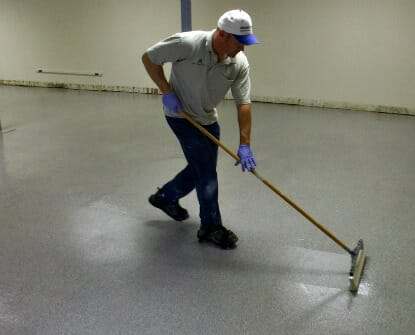
Should I apply a clear top coat to my epoxy garage floor coating? This is a reasonable question that pops up from time to time for the average DIY’er looking to save some money. The real question, however, is why wouldn’t you apply a clear coat? After all, there are many benefits to adding a clear top coat over the color coat for a garage floor.
Anyone who has installed a garage floor coating properly will tell you that the hardest and most time-consuming part is prepping the floor for the epoxy. Applying the epoxy goes fast. For many, it is the fun part of the job. So after all that work of getting the concrete ready, you should consider spending a little more time and money to ensure a longer-lasting and even more beautiful floor coating.
There are various clear coating options to choose from. However, the one rule to keep in mind is that the clear coat should perform just as well if not better than the color coat. With this in mind, let’s take a look at the top 10 reasons why you should apply a clear topcoat to your epoxy garage floor.
1. Adds durability and wear
A proper clear coat will extend the life and add durability to your garage floor coating. Depending on the type of clear used, it can provide better stain and chemical resistance than the color coat. Lastly, the additional coat adds thickness to the floor coating to absorb impacts better and reduce any chance of hot tire pickup.
2. Protects the color coat
A clear coat acts as a sacrificial layer to protect the epoxy color coat. Without it, the color coat can lose its luster from wear. Though resistant to most chemicals, some oil spills or leaks allowed to sit for long periods can discolor the coating depending on the quality of the color coat applied.
3. Protects the color flakes
If you apply paint chips or color flakes to your floor, the clear coat will lock them in and protect them from peeling up and collecting dirt at the edges. Cleaning the floor and other activities can cause color flakes to pull up or chip away. When a clear coat is added, the color flakes are protected by the clear coat layer.
4. It is easier to clean
A clear coat makes a garage floor coating easier to clean. Dust mops and microfiber mop pads can glide over the floor coating without catching color flakes. This is especially true if you have a heavy flake coverage on your floor. It also allows for scrubbing without the worry of losing color flakes or dulling the color coat.
5. A Clear topcoat Adds depth to the floor coating
The additional layer of a clear topcoat adds depth to the look of the garage floor coating. This creates a richer-looking surface that appears more luxurious and thicker than it is.
6. It Creates a glossier looking finish
A clear coat will add a glossy shine to the floor coating and reflect light better than the color coat.
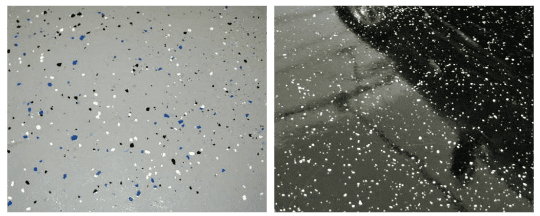
This is a great benefit when working on projects in the garage or automotive maintenance. The additional light reflection will brighten up your garage space. You may not need to purchase more overhead lighting or as much as you thought you might need.
7. A Clear Coat hides scratches better
All garage floor coatings will develop microscopic and sometimes larger scratches on the surface. A clear top coat helps to hide or camouflage these scratches so they are less noticeable and do not detract from the coating’s appearance. It does this by effectively acting as the sacrificial layer to prevent the color coat from being scratched which is much more obvious.
8. It’s a good medium for anti-slip additives
Anti-slip additives are hidden much better in a clear coat. Because most anti-slip media is translucent in color they will not stand out. Without a clear topcoat, they are added to the color coat instead. This makes the anti-slip granules much more visible as little bumps resembling sandpaper on the garage floor.
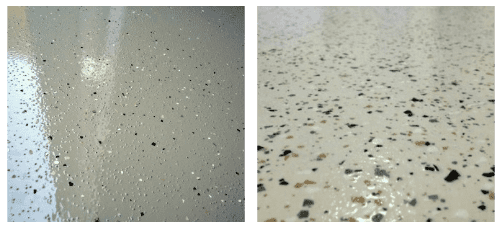
Furthermore, anti-slip media is more effective in clear coats. This is because many clear coat options are thinner in dry film thickness which allows the anti-slip media to protrude more. When used in thicker color coats, it does not protrude as much and is less effective.
9. Can be recoated to look new again
After many years of use, an epoxy garage floor coating can start to show its age depending on how much activity it has seen. If it has a clear topcoat, it can easily be roughed up with sandpaper to have a new coat of clear applied.
The sanding of the old top coat removes any blemishes, scratches, and other imperfections that the clear coating acquired over the years. Once the new clear coat is applied, your garage floor coating will look brand new again.
10. Clear topcoats just look awesome!
When you compare an epoxy floor coating with a clear coat to one that does not, there is no question about which looks better. The clear coat gives the garage floor that extra depth and showroom shine that screams “Look at me!”
If you’re on the fence about whether or not to add a clear topcoat to your garage floor coating, think about all the benefits it will provide in the long term. Yes, it will cost a little more money and yes, it may mean one more day of being without your garage. However, once you add a clear coat, you will be rewarded with a garage floor to be proud of for years to come. You will be glad you did it!
Update – Please read
Clear coats are designed for application over 2-part resinous coatings and single-part thermosetting resinous coatings. Do not confuse garage floor paint or 1-part epoxy paint as a garage floor coating. These are very thin acrylic latex paints that will not form a chemical bond with a resinous coating. Please read our article about applying clear coats over paint if this is your plan.
Hello,
I recently used Sherwin Williams Epoxy and Hardener two piece set to cover my garage floor. Now I would like to cover the flakes with a top clear coat and of course protect the epoxy. My question is now will Seal Krete Clear Seal or Rustoleum 6711 polyurethane be acceptable as a clear coat for my garage floor? It’s kinda difficult to find places that understand what clear coat would work best for me. I’m not sure if the two I’ve narrowed down to will be acceptable either. Sherwin Williams also recommended using the product they sell to clear coat which is H&C Shield Crete Acrylic Clear Glaze Coat ($75). Of these 3 options would you recommend any or would you lead me to another product?
Hello Eric. We do not recommend the Seal-Krete Clear Seal or the H&C Shield Crete Acrylic Clear Glaze Coat. These are both water based acrylic sealers that are much less durable than the epoxy you put down. They will scratch easily and soften if oil, gas, or other chemicals come in contact with it. They are not a good clear coat for garage floor applications. The Rust-Oleum 6711 is only slightly better as it is a water based polyurethane which is inferior to it’s solvent based counter parts. If you have a Sherwin-Williams near you, we would recommend the ArmorSeal HS Polyurethane. It is the appropriate clear coat for you application. You will need to discuss the recoat window for application. I believe Sherwin-Williams allows up to 5 days before you would have to rough up the surface of your epoxy coat, but you should check with them to verify.
It has now been 8 days since the epoxy has been put in. Am I too late to be applying a top clear coat? I hope not.
You are definitely outside the window to apply another coat without surface prep Eric. You will need to degloss the surface by roughing it up with 120 grit sandpaper and then wipe it down with denatured alcohol in order to apply a clear coat.
Okay thank you for the information. I appreciate the help.
You’re welcome Eric.
Hello,
When is a good time to apply a clear coat on epoxy floor? It has been 2 days since we applied a color epoxy and flakes.
Thank tou
Hello Zina. It depends on the manufacturer and product used. Many high performance coatings allow for just a 24 hour recoat window. Some of the residential quality home improvement store kits allow anywhere from 76 hours to 7 days. We recommend calling the customer service line for the product that you used. If you are past the recoat window then you lose the chemical bond that is provided. It will require deglossing the surface with 120 grit sandpaper in order to provide a mechanical bond before applying the clear.
I applied epoxy on my garage floor and you can see some roller marks and it has some places where it has more shine, will a clear coat help elimate this problem. Thanks.
Hello David. It would help to know what product you applied. We are guessing it’s a low solids DIY coating of some type. Low solids coatings go on thin to begin with. If they are absorbed in more porous areas of the concrete surface they will obtain a matte finish and not be as glossy. The only way to fix that is with another color coat. The previous coat acts as a primer coat and will allow the second coat to go on thicker and provide for a nice consistent finish. A clear coat will highlight roller marks and the inconsistent gloss of the finish. If you have ridges where the roller marks are, you should sand those out before applying another coat.
I painted a previously painted garage floor with a water based part epoxy. Waited 2 weeks before parking in the garage. Tires picked up the paint the next morning. Can I now clear coat the floor with a sealer to prevent this problem?
Thank You…
No, that will not prevent the problem, Ralph. The problem is that a superior 2-part epoxy coating has been applied to an inferior painted surface. The paint is what is adhered to the concrete, not the 2-part epoxy that you applied over it. As long as the paint is there, the coating will continue to peel no matter what you apply over it. Also, the 2-part epoxy coating IS a sealer. You don’t need to apply a clear coat to seal the coating.
The only way to fix the problem is to remove the coating via grinding in order to expose the bare concrete. The grinding will prep the concrete surface for a coating at the same time. You can then apply a 2-part epoxy or similar coating. It will now penetrate into the surface of the concrete and achieve a much superior bond than the paint. This article about avoiding hot tire pick up will explain even more.
Hello guys I’m in a pickle. I went down to Home Depot or Lowe’s bought the rest Oleum homekit and applied that two-part epoxy over garage floor. However I etch the concrete very well by using a buffer with hard bristles on it and then extracted out using my truck mount on my van to suck out all the water to get it bone dry got all the calcium and hard water deposits up. I applied the part (A) gray paint Down a day before we Epoxy for garage floors. We also let the floors dry for 24 hours. Before we applied the Rustoleum part A & B epoxy. Now my customer wants to know can you put a polyurethane top coat over it safely without damaging the floors and flakes. Will I still have a good bond to it? Thank you
Hello Brantley. What do you mean that you put down the part-A a day before? Part-A never goes down by itself and will not cure if that is what was done. If the epoxy was put down correctly, you can apply a polyurethane concrete coating to the Rust-Oleum within 24 hours without having to rough up the finish first.
Yesterday I added epoxy to a bar top. It needs to cure for 72
Hours and then I’m planning to add a few coats of polyurethane to the epoxy for increased durability and uv protection. What poly do you recommend for this application? Want it to remain clear and glossy and not tacky to the touch
Hello Bob. Did you use Bar Top epoxy or something similar? Most people are not aware, but standard clear epoxy is not water clear. Once any type of coating cures, it will not remain tacky unless it was mixed incorrectly before application. A single-part moisture cured polyurethane is very clear and glossy. Legacy Industrial has their HD356 which is available in quart sizes. Remember that unlike epoxy for a bar top, polyurethane goes down very thin for the best results.
I just recently used the rust-oleum garage floor epoxy kit and am looking to add a clear coat for more depth. What product would you recommend? Thank you?
Hello Jason. Rust-Oleum sells a clear coat epoxy as well. You generally can’t find it at your local home improvement centers, however, you can purchase it online here from Amazon. You have a 72 hour recoat window with Rust-oleum epoxy. If it’s been longer than that, you will need to degloss the surface by roughing it up with 120 grit sandpaper before you apply the clear coat.
Hello, can i use Polycuramine (Rust Oleum product) as a shield or scratch proof for my epoxy floor after applying final clear coat? Thanks
Hello Solomon. The clear coat you apply to your color coat serves that purpose. There is generally no need to apply additional clear coats from another brand. What products are you using?
I used the rustoleum clear coat and it looks great but saw a few areas missed I don’t want to do the entire garage over but want to do just the area I missed. Is there anything I can use in a smaller amount?
Hi Linda. Rust-Oleum doesn’t sell touch up kits or anything smaller. Also, you can’t just hit the spots you missed. It will be very obvious as you can see overlap roller and paint brush marks where the new coating meets the old. Garage floor coatings do not blend well with touch ups like paint on a wall. Unless you have contraction joints that act like a natural border, you would need to do the entire floor for it not to be noticeable.
Hi, my husband recently applied 1part epoxy Berh colored paint to our basement floor. After etching, priming and adding to coats of the satin 1part epoxy, the sheen I had hoped for is not apparent. All steps were done in proper order and the last coat was just applied this morning. Can a sealer or gloss type polyurea be applied to achieve this effect? If so, what product should be used? Thanks.
Hello Emily. The lack of a glossy sheen has to do with the fact that a paint was used and not a true coating. This article explains the difference. Paint will provide a satin sheen at best while true coatings can give you that nice sheen and high gloss you were hoping for. Unfortunately paint is stand alone product and cannot have a clear coat applied without a lot of effort and expense. This article explains why you can’t clear coat paint.
Hi I am planning to epoxy my garage with EPOXYSHIELD Professional Floor Coating Kit 238466. Also planning to add the clear coating on it to increase thickness and durability. Any recommendation on clear coating will be very helpful. Forgot to add that its a Rust-Oleum product.
Hi Shekhar. You can always use the Rust-Oleum Epoxyshield clear epoxy. For even better protection, a single-part polyurea clear coat or a polyurethane clear coat would give even better protection. We have an article on clear coat selection here.
Hello. I applied 1 coat epoxy by Coloredepoxy. I plan on applying a clear coat of rock solid polycuramine within 24 hours to increase the thickness and protect it. I’m assuming that since they both have some epoxy compounds they should bond together nicely. Is my assumption correct?
Thanks
Hello Stephen. We can’t tell you for sure if polycuramine is going to be compatible with epoxy or not. Our guess is that it would be, but it’s only a guess. Polycuramine is a unique formula and Rust-Oleum will not warranty it if used with any other coating. You would be better served to use the the MCU Super UV clear coat that Colored Epoxies offers. It’s a moisture cured polyurethane that is a tougher coating than polycuramine. Plus, it comes from Colored Epoxies own lineup which means it is compatible.
I recently applied rustoluem epoxy shield gray on my garage floor. I added a metallic pigment to the the color and it made no difference. I will be putting a clear coat on it next. I wanted to add a platinum silver metallic pigment to the clear coat try to get a metallic tint to the floor. Would that be Alright?
Hi Ruben. Just adding a metallic pigment will not product the look of metallic epoxy. You may end up with a cloudy looking clear coat with some metallic in it. We would recommend applying the Rust-Oleum metallic polycuramine or the RockSolid metallic over the gray instead. They are both the same product. You will also need to rough up the current gray epoxy with 120 grit sandpaper in order to achieve a mechanical before applying any additional coats since you are past the recoat window.
Hello!
Approximately 1 month ago, a colleague and I applied an epoxy floor coating over a fairly new concrete floor at our place of work.
We prepped the floor and applied a coat of Krylon Industrial Dura-Top epoxy floor coating. We are now looking to apply a polyurethane clear coat on top with an addition of some type of clear aggregrate to act as an anti-slip. (I am aware that I will need to sand the floor to 120 before clear coating because it has been a month since the epoxy went down)
Could you please recommend a polyurethane clear coat product that would suit our needs, as well as a compatible non-slip aggregate additive?
Thanks a lot!
Hello Scott. There are a lot of companies that offer good polyurethane clear coats. Providing you don’t live in California, Legacy Industrial has a an excellent single-part moisture cured polyurethane called HD356. They also have the optional soft-skid that you would mix into the final coat. You can find their products here. They can advise you on what grit soft-skid to use depending on your requirements. If you live in California, their single-part polyurea (Nohr-S) is excellent as well.
What exactly is a “moisture cured” polyurethane? Thanks in advance!
Hello Scott. All resinous coatings need a catalyst to start the chemical reaction that causes a coating to cure and harden. Many times it is provided by a hardener that is mixed into the resin. Two part coatings are a great example. The part-A is the resin while the part-B is the hardener. Moisture cured coating actually react to moisture in the air. They are also referred to as single-part moisture cured coatings. Polyureas are a good example. When a moisture cured polyurethane is rolled out onto the surface it immediately begins to react to the moisture in the air. This reaction is what causes the coating to cure and harden.
I installed Rust-Oleium Rocksolid clear garage coating. I have finished all but a 2′ x 2′ area over new garage floor paint. Is there a small quantity product which will be a clear gloss coating compatible with this product? Please advise
Hello Steven. We recommend staying with the same product. RockSolid is a proprietary formula and not quite the same as epoxy or polyurethane. Keep in mind as well that coatings (clear or colored) do not blend well like paint on a wall. When you finally finish that small area you will be able to see the lap marks where the newer coating overlaps the older coating. That is why it’s always important to complete the entire floor with a new coat or terminate at a natural border such as a contraction joint.
Hello – My painter recently applied a color coat of Sherwin Williams ArmorSeal HS color coat and then a top coat of Sherwin WIlliams ArmorSeal clear. The clear coat came out very splotchy where some of the the floor is glossy but other areas are still a bit cloudy. Our Sherwin Williams paint rep is recommending that run fans in the garage for the next few days to let it to continue to cure and maybe the cloudy areas will become a bit more clear.
Assuming that this happens, could I have the painter sand the clear with 120 grit sandpaper, rub the area down with alcohol in order to put down another very thin layer of the ArmorSeal clear to provide a more uniform appearance.
The SH rep is thinking the clear coat was put down too thick in some areas and that is why those areas are still cloudy but my painter, who has done about 30 garage floors says he was very careful in the application mil thickness as specified on the label of the can.
Any suggestions you might have would be greatly appreciated.
Hello Jeff. It does sound like the clear was put down too thin in those areas. If they are not tacky, then they will not clear up any more. You have the right idea to rough up the surface and apply another coat.
This all sounds perfect, but I like to check the one-star Amazon reviews before I commit. They say that the clear coat will yellow with sunlight exposure, and then it’s tough to fix. Even a five-star review says this:
“TIP: DO NOT USE WHERE SUNLIGHT WILL HIT. The warnings are on the box or manual, but I didn’t notice that on the first install just like a lot of the reviewers that gave 1 star. If this product is exposed to sunlight it will turn yellow. There is no way around that, all of them do. So make sure that you only put the clear up to the edge of where your door comes down. If you always leave your garage open then I would skip this product as it will turn yellow and it’s epoxy, so you’re stuck with it forever.”
My garage gets a lot of sun and I will have the door open a lot when I finally use it as a wood shop.
What do you think about this? Thanks.
Hi Bart. That is correct. If epoxy is exposed to direct sunlight or even strong indirect sunlight it will amber (yellow tint) over a period of time. How fast it ambers depends on the amount of sun it is exposed to. Our recommendation would be to apply one coat of epoxy followed by a coat of polyurethane tinted the same color. Polyurethane concrete coatings are U.V. stable and will not amber. If you have it available to you where you live, an even better choice would be the newer single-part polyurea coatings.
Hello, I used epoxyshield 2 part garage floor coating on brand new 9 month old concrete floor for my BASEMENT. I did follow all the steps of powerwash, etching, making it dust free etc. And then did painting. After 96 hours I still feel my legs are little bit sticky when I walk barefoot there. Paint is not coming on my foot and neither my footprints are marked on floor. But while walking it sticks little bit. Is that normal? I found that if you dont mix properly then also this wetness can be felt but I did mixing 100% correctly and as per direction.
I put bounty tissue on floor, tried to stick it but it did not stick and neither the paint came on the tissue. So is that normal? Then why little bit of stickyness? How to cure it without redoing the whole work?? Can I apply clear coat on top of this kind of surface??
Hi Nick. Epoxy actually takes a full 7 days to cure completely, but you can walk on it after 24 hours and move things onto it after 48. What you are feeling is fairly normal. If it still feels that way after a week then you might have an issue. Did you wait the appropriate amount of time (based on current temperatures) after mixing before you applied it?
You can certainly apply a clear coat, but the 72 hour window for EpoxyShield which allows you to apply it without additional prep has since passed. You will need to rough up the surface with 120 grit sandpaper first in order to achieve a mechanical bond.
Hi Nick I applied the Rust-Oleium epoxy Shield 2 car garage kit in my basement and I applied when temp around 75 F but its been a week and i am felling same exp what u felt and not sure i missed any steps before we apply epoxy …I power washed 2-3 times and also etched the floor before applying the epoxy ..how many days did you felt that is that normal for all the basement floors.
Any suggestions would be greatly appreciated
Hi Ram. If you are experiencing the same thing as Nick, we suggest contacting Rust-Oleum and talk with their customer service tech line. You can find it here.
Is it ok to apply a poly clear coat over a stained concrete garage floor?
Thank you
Hi Stephen. Most polyurethane clear coatings will not adhere well to bare concrete. An epoxy clear would need to be applied first. Our suggestion would be one of the single-part polyurea clears that are available now. We have an article about them here which includes clear. They are U.V. resistant just as polyurethane is and would be a thicker coat as well. The big question is the type of prep that was done to your concrete before the stain was applied. That is what will determine what you can apply.
Hi Shea,
You guys are awesome!!! I had recently applied Armorpoxy products. Grinded,primed, 100% solid epoxy with chips. I understand im outside time limit to apply top coat. I just purchased military grade 2 part top coat,clear,from Armorpoxy.Been informed i will have to gently sand surface. Will this effect the sheen on my epoxy ? Also not sure what sand gently means? Lol. Mechanical? Hand? Hoping you might be able to explain the process alittle more. Love your articles,awesome work . Thank you for your time Jared
Hi Jared. You will need to degloss the surface by sanding it with 120-150 grit sandpaper. Since you have color flakes, a pole sander is the best method since it’s the least aggressive. You will lose some color flakes in the process, but it shouldn’t be too much if they are attached well. Once you sand the surface, sweep and vacuum up the loose dust and then wipe the surface with denatured alcohol on a lint free towel. Once you do that the surface should look dull. No worries though, once you apply the military grade polyurethane top coat it will gloss right back up. Make sure to call ArmorPoxy if you have any further questions. Their customer service is good and they want you to have a successful outcome.
Hi, we recently acid stained concrete and sealed with two coats of Sherwin-Williams Williams Armorseal 1000HS. The finish is super high glossy and scratches easily. I like how the epoxy will protect the floor, but I’m looking for something to put over it that will be more of a semi-gloss finish. The Sherwin-Williams Williams rep gave us several options but they all cure to a high gloss finish. Any suggestions? Thanks!
Hello Christopher. One option that some people like to do to reduce high gloss is to wax the surface. However, it does require some maintenance from time to time. The other option would be to apply a water-based polyurethane like this one here from Legacy Industrial that comes in a matte finish. You will first need to degloss the surface of your coating by roughing it up with 120 grit sandpaper before applying another coating.
Hello Shea, I just completed rustoleum epoxy gray with lots of flakes. When can I put high gloss top coat? Should I add antinskid in it? Which brand and type would you suggest to get a premium look and high durability? Thanks a lot in advance!
Ro
Hi Ro. I sent you an email yesterday, but I guess you didn’t get it. Subsequent applications for most coatings need to be applied within 24 hours or you will need to rough up and degloss the surface with 120 grit sandpaper before applying additional coats. Rust-Oleum products allow for up to 72 hours to recoat when using their own product line. You won’t be able to get a high quality clear in time if you don’t want to go through the process of roughing up the floor. We would suggest Rust-Oleum Professional Clear Coat since you have three days to obtain it. You can add anti-slip media to the clear if you are worried about it being too slippery if the floor is wet a lot. Just keep in mind that it will cut down on some of the gloss if you do.
After putting down 2 coats of water based rustoleum epoxy with flakes on 2nd coat I notice a few areas I could have put more flakes down. I am about to put down a clear coat. Can i lay the clear down and add some additional chips to cover my missed area or is that a bad idea overall? Or lay clear..put down chips and lay another coat of clear?
Hi David. The second option you mention is the way it is done. Apply the clear, add the color flakes as needed, then clear coat over that.
Hi,
I recently applied H&C Shield-Crete Glaze on my floor. What I didn’t do before that is scrape any flakes which were sticking up, so after applying the glaze, I could see a lot of flakes sticking up. I scraped the floor and got rid of them and it feels and looks great, but my question is, do I need to put another coat of glaze on the floor? Just wondering since my thought is that the parts of the flakes which remain after breaking off the upper ones, may not be covered and possibly should be.
Hopefully I don’t have to worry about adding another coat, but I want to make sure I do this correctly 🙂 Thanks!
Chris
Hello Chris. Technically you do not have to apply another glaze coat, but it would help to lock in an protect the flakes where they were sticking up if did. It should not affect the performance of the floor if you don’t.
Hi Shea,
Thanks for the quick reply! A couple of other questions.
– I believe I read that you should apply a new top coat after a certain amount of time (1 year or 3 years maybe?). I don’t see that on the information for the shield-crete so wanted to know if you had a recommendation.
– If/when a new glaze coat is applied, it was mentioned on one of the comment replies here that you should lightly sand the floor with 120 grit sandpaper and wipe down with denatured alcohol. Will the sanding affect the flakes that are already on the floor?
– I saw a previous comment about the glaze coat and it was recommended to not use the H&C Shield-Crete, but rather use ArmorSeal HS Polyurethane. I assume that after I sand and wipe down the floor, I can use this polyurethane as my top coat? (I used the Shield-Crete water-based epoxy garage floor coating)
Thanks again!
Just to prevent some confusion, Chris, the H&C Glaze coat is not an epoxy. It’s actually a water-based acrylic sealer. Though it clearly states that on the product, the literature is misleading with epoxy in the title. Acrylic sealers are not as durable as epoxy and may need recoating every 1-3 years depending on how much use it gets. Because it’s an acrylic, the only prep necessary is to clean the surface well before applying it. If you have some ground in dirt, you can always sand that out first.
You cannot recoat with anything other than a water-based acrylic clear. Epoxy is not compatible and polyurethane has solvents in it which will soften and pull up the acrylic as you roll it on.
Hi,
Just to be clear, when I said I was using h&c epoxy, I meant under my glaze coat. So I used the h&c 2-part water based epoxy on my prepped concrete floor. After that dried, per instructions, I used the h&c glaze coat. So my question was if when I recoat in 1-3 years, can I light my sand the glaze coat and then apply the armorseal hs polyurethane?
And, if I can do that, will sanding affect the flecks I broadcasted (full broadcast) when I applied the epoxy?
Hopefully this makes sense – thanks again!
That is correct, Chris. As we understand, your base color coat is the H&C Shield-Crete Epoxy with color flakes added after it was applied. Your clear coat is what H&C calls their Glaze Coat. The Glaze Coat is not epoxy. It is a very thin, low solids water-based sealer and coating. It is not compatible with epoxy or polyurethane for the reasons we stated above. The only way you could apply a polyurethane clear coat would be to remove the Glaze Coat completely – not light sand. This would require heavy sanding to get down to the epoxy color coat, which would damage or remove the majority of your color flakes in the process. H&C is one of the few manufacturers who sells an acrylic coating for a clear top coat. Acrylics are not as durable as epoxy (or other coatings) and we feel that it is misleading for them to title the literature for the product as “SHIELD-CRETE® EPOXY WATER-BASED CLEAR GLAZE”. Though the label on the can states “acrylic clear glaze coat”, the title for the clear coat suggests that it is a water-based epoxy clear when it isn’t an epoxy at all.
Ah, ok – thanks, Shea. So having the coat I have is fine, just not as durable and I’ll need to replace it every 1-3 years or so. I guess it’s good I won’t have to sand it down when applying a new coat.
One thing I’m confused on is that you mention that epoxy and polyurethane is not compatible with the acrylic glaze coat I have, however, I have this acrylic glaze coat on top of epoxy – so it’s ok to put acrylic on epoxy but not epoxy on acrylic?
Thanks again,
Chris
Yep, you are correct on both counts, Chris.