
Grinding a garage floor versus acid etching is a topic of much discussion when it comes to preparing concrete for epoxy or other garage floor coatings. Also known as profiling, concrete surface prep sometimes comes as a surprise to people when they find out that you just can’t paint or coat over the concrete and expect it to adhere properly.
Typical questions asked are “Why do I need to grind or etch my concrete?”, “Which method is better?” or “Why do I have to etch new concrete?” With these questions in mind, let’s look at why concrete has to be prepared properly for a coating and which method may be best for you to achieve the results that you need.
Why Do I Need to Etch or Grind my Concrete?
Unlike applying paint, garage floor coatings need to penetrate and bond mechanically to concrete in order to adhere properly.
The problem, however, is that concrete for a garage is almost always finished to provide a smooth and even surface. This finishing process reduces the porosity of the concrete. As a result, the thick and viscous nature of coatings cannot penetrate and soak into the surface very well.
Profiling the concrete exposes the pores so that the epoxy coating can penetrate into the surface much better in order to get the best bond. It also creates a rougher surface for the coating to mechanically adhere to. This is typically done by either grinding the surface or by acid etching in order to expose these pores. Poor profiling/concrete surface prep, or lack thereof, is the number one reason why floor coatings fail and peel up.
Contrary to what some DIY installers assume, newly poured concrete or concrete from a new home still needs the proper concrete surface prep. Though it is fresh and clean without any stains, the surface needs to be roughed up and the pores exposed in order for the epoxy to penetrate and bond to it.
Which is best, grinding or acid etching?
When it comes to preparing concrete for a garage floor coating, the best method is to grind the garage floor.
The reason for this is that the profile of the surface can be controlled to provide the desired outcome. It provides a rougher and more porous surface that is considered ideal. It will also remove excess laitance that acid etching doesn’t always remove.
 Concrete laitance is a very thin and weak layer of concrete at the surface which can be a result of the finishing process.
If a garage floor coating attaches to this weak layer, it can easily chip from impacts or eventually peel up, exposing a fine layer of concrete on the underside of the coating.
In addition, if you have any garage floor repairs that need to be made first, grinding will smooth out those repairs so that they don’t telegraph through the coating.
Professional garage floor coating contractors who warranty their work will always grind the concrete knowing that their floors will not fail due to insufficient concrete prep.
The problem with grinding your garage floor, however, is that it’s not always feasible for the average person to do so. There is the question of where to rent the equipment, how to control the dust, gouging of the surface due to inexperience, and finally cost. Sometimes it’s just not in the budget.
This is why acid etching is still a popular practice. If done properly, acid etching can provide a satisfactory surface for an epoxy coating to adhere to. It is fairly easy to do as long as you are safe.
It provides a better alternative to grinding for many and can be downright cheap in terms of cost.
The problem with etching is that the uniformity cannot be controlled like it can be with grinding. Because the density and finishing process of a concrete surface can vary, so can the effectiveness of the etching. This is why it is important to test multiple areas of the surface for porosity and texture once you have etched.
A simple method for testing is the water drop test. If the concrete immediately turns dark and absorbs the water, then that area is good. If it doesn’t, then you will need to etch those areas again. If you don’t test the concrete after etching, you run the risk of having areas of your coating that can fail.
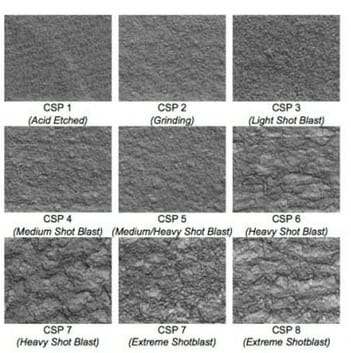
The before and after images below are a great example of the differences between acid etching and grinding. This was an excellent demonstration that Epoxy Floor Co out of Australia did to show their customers.
The difference between the two prep methods is obvious. While the acid etched surface lightened the concrete slightly to expose the pores, the grinding removed the top layer of concrete, exposing the lighter color underneath and providing a rougher surface.
Note: If you have a sealer or coating on the concrete, acid etching will not work. You will have to grind the floor to remove it.
Additional Tips
If you are going to hire a floor coating contractor to install an epoxy coating in your garage, make sure that they grind the concrete. Any contractor that wants to acid etch is just cutting corners to reduce costs and should be suspect of providing a good quality floor.
If this is a DIY installation and you are fairly confident with your abilities, you can rent or purchase the proper grinding equipment necessary for the job. In most cases you should be able to grind a two or three car garage in less than a day. There is also the option of hiring someone to do it for you.
If grinding is not in the budget or you are not comfortable with doing it, then acid etching is your answer. If you are uncomfortable with using muriatic acid, there are a few commercially available products other than muriatic acid that can etch your floor safely as well.
Remember, acid etching will not remove dirt and oil from your concrete floor. It still needs to be cleaned first. Etching works by reacting with the free lime in concrete. If the concrete is coated in oil or grime, the acid will not be very effective.
Whether grinding or acid etching, if not done properly, your coating is destined for failure. It is the most important part of applying a garage floor coating and crucial that you do it correctly.
There is nothing worse than spending the time to apply a beautiful epoxy floor coating only to have it fail due to the improper profiling of your concrete. If you take the time to do it correctly, you will be rewarded with a coating that will adhere like it should.
Note: Shot blasting is another form of mechanically profiling your concrete that is widely acceptable to grinding and is used by some professional installers. Due to the cost of renting these machines and the experience required to shot blast effectively, we did not discuss this option here.
First off, bravo for a wonderful source of information.
I’ve got a brand new slab poured for a 30’x50′ garage (literally poured 3 days ago). The concrete guys power troweled it but didn’t seal it at my request, due to my desire to finish it in a different manner.
Tomorrow the framers will be coming over. I live in an area with a lot of red clay, and the concrete guys warned that red clay would stain the heck out of the brand new, unsealed concrete.
So, I have a few concerns:
1) If I leave the concrete uncovered and the rest of the crew gets a bunch of red clay on the concrete, is grinding usually sufficient to remove the stains while simultaneously prepping it for epoxy?
2) I bought enough 6mil plastic to cover the entire floor and started taping it down before two other thoughts popped into my head: a) Will I stain or discolor the concrete my leaving plastic on it when it’s only 3 days old, ie, through moisture being unable to escape, and b) will using masking tape or duct tape to hold the plastic down mess up the concrete even worse than the clay stains I’m trying to prevent.
So, basically, am I overreacting trying to protect the concrete when it will end up being ground and epoxied in the end? I’m trying to find the most economical approach without blowing the bank on expensive temporary floor coverings that might not even be necessary.
Thanks for the kudos Michael. Protecting the concrete is a good idea. As long as you aren’t going to be applying an all clear epoxy system then the plastic will be fine. In fact, it will help with the curing process of the concrete. One thing that can occasionally happen when covering a new slab with plastic is water condensing underneath. If this happens it can give the surface a splotchy look while it cures depending on if there are wrinkles or air pockets under the plastic. Grinding for epoxy will remove some of the splotchyness but it doesn’t matter if you are going with a colored epoxy base or a full chip system. You won’t see it. Don’t worry about the tape, it is concrete after all.
Thanks for the advice Shea. We had a cold night and a frosty but sunny morning. It’s really wet underneath the plastic from condensation. Is there such a thing as too wet, or is whatever splotchyness that results correctable with grinding or colored epoxy?
Not to worry Michael. The grinding will remove most of the splotchyness and the epoxy will cover over any that remains. It’s no worse that an older garage floor that has darker shadows from oil stains being removed. The epoxy will take care of the rest.
Shea,
Thanks for all this wonderful information, I know that knowledge is key to a successful end result. With everything I’ve read here, I’m sure my floor will be a success ( but ).
After my slab was poured ( 24 X 16 ), I asked the contractor why he didn’t do a better job to make it smoother, he said he’ll take care of it.
Granted it looks much better now, but I’m concerned of how he accomplished it. He used bricks to basically sand it down,
( no biggie ) it seems he also used some liquid concrete adhesive additive and powdered concrete. I’m just not sure how.
So am I correct in assuming I should rent a concrete grinder to prep the floor, or do you think the muriatic acid etch would do the trick?
Hi Leo. Yeah, it sounds like he used an old trick to smooth it out using Portland cement. You will definitely want to grind the floor to make sure you remove any excess laitance or sealer that he may have applied.
I am buying a 6K sq ft building that was previously a glass shop, and who knows what else. The building is likely more than 50yrs old. The concrete floors have been painted black with some kind of glossy finish paint that is coming up in places.
I am planning to refinish the concrete in white or gray to increase light reflection, as it is fairly dark inside with the lights on.
I am hoping pressure washing the old paint will remove most of it. Is grinding the best option here?
Hi David. Because the concrete has paint on it you will need to grind the surface to prep it properly for what ever product you plan to refinish it with. However, if the paint is already lifting in places the job might go quicker if you try blasting the paint off with a pressure washer first then grind. It always takes longer grinding when you have to get through a coating first.
I own and operate a small commercial and residential floor and carpet cleaning service with a few trucks and several hard working employees. I have a client that builds heavy duty trailers and they want there shop floor power washed and sealed. What would you suggest as the strongest hardest water based product I could mop down? Or if you suggest another option and method that a layman could do please elaborate. This is a hard working cement floor area with lots of work benches and steal shavings on the floor, assembly lines and main throughways with lots of foot , forklift and other wheeled traffic running 3 shifts 5 days a week.
Thanks for any help
Hi GD. Shop floors such as these do best with a good densifier followed up with a stain guard penetrating sealer. Both are easy to apply, they just take an hour or two between coats. They are not stain proof, but they will harden the surface and make clean-ups much easier. You can read more about them here. There is a lot of good product out there. If you have more questions about application and product, Legacy Industrial is a great source with free shipping. Ask for Scotty and he can answer all your questions.
“How a siliconate penetrating sealer works on a concrete garage floor
Once applied, the sealer dries to a natural looking finish without any sheen to it. Because a penetrating sealer is non film forming, it allows for the same anti-slip protection as bare concrete. ”
What does a natural looking finish look like? Will it show a coating on or will it not change the look very much? My client wants to see something on there, make the area look better , cleaner but have as much strength as possible for dragging and dropping heavy steel items to grinding in dirt with foot traffic daily.
A natural looking finish means it looks almost as if nothing has been applied at all. If the concrete is fairly smooth, you can actually buff the HD40 Stain Guard to bring out a semi-glossy sheen. To actually change the look you would need to go with a topical coating and that would require a mulit-coat industrial epoxy slurry with a quartz broadcast to stand up to that type of abuse. That type of flooring is more common on factory floors and is very expensive. One option would be an acetone dye or acid dye applied to the floor to change the color. You apply it after the floor is cleaned and then apply the sealers.
I sealed my garage floor several years ago with Rust-oleum epoxy shield. It has pealed and is coming loose in several places. I plan on going over it with Rust-oleum Rock Solid coating. To prep the surface, is grinding the best method to get the new coating to stick? Thanks
Yes David. Grinding will not only give you the best surface profile, it will also make it much easier to remove the remaining epoxy on the floor.
Hi Shea,
Thank you for all your hard work. Much appreciated. I am epoxy flooring my garage. Mine is only a 2 yr old garage and no oil marks and not much of stains, but see some stains here and there. Also I see cracks at the contraction joins, but not thinking of leveling it using epoxy filler, but don’t want to see the cracks. I am going to apply 100% solids base coat with full broadcast (rejection) of flakes and Polyurea clear top coat. So I need to know how to fill those cracks and steps for cleaning the garage before grinding. Meaning should I use degreaser and clean the garage with water before grinding? Also how to fill the cracks in contraction joins..? Could you please let me know..?
Hello Sam. There is usually no need to clean the concrete beforehand when you have a garage floor such as yours without oil stains and is fairly clean to begin with. The grinding will take care of the rest. If you do have any stains that concern you, just treat the individual stain first then grind. Do any needed repairs to the floor after grinding. Unless the cracks within your contraction joints are large (1/4″ or greater), do not worry about those. The 100% solids epoxy followed up with color flakes to full refusal will cover those cracks right up – even after you clean out the excess flake from within the joint before you apply the polyurea top coat.
I have new concrete floors since April of 2015……in my new garage……the floor is pretty smooth…..I know I have to grind the floor but can it be done without making all the dust……is there a way to grind it wet???
Hi Michael. We talk about how to grind a garage floor here. It can be done both wet and dry. Dry is the easiest if you use a vacuum recovery system. No messy dust and no sludgy mess from water.
Out of the box question kind of, but basically i degreased and then acid etched my 25 yr old garage. After acid etching white powdery calcium came up. I then proceeded to pressure wash, and i got all of it off so i thought. Well the,next day i took a look and in some areas a more of a blueish color of spots appeared. I tried pressure washing,but this stuff will not come up at all. I then belt sanded an area an it appears to have came off which leads me to believe that whatever this blueish residue is, is sitting on top. So if i grind the floors i should be good to go correct? Seems to be my only option.
Hi Eddy. We can’t say what the bluish spots are. If they aren’t powdery and don’t leave residue on your hand, and they absorb water, then you should be good to go as is. If they prohibit absorption of water, then they will prevent any type of coating to penetrate as well. In that case you will want to grind those areas.
Question about removing a previous floor coating & preping the surface for new coating application.
I have already grinded the entire floor; however I need to remove old coating and prep the concrete seams (Not the fiber ones between seperate concrete slabs; but the small seam/dip that forms a grid pattern over the entire floor). How can I effectivly clean and prep it?
All the flat survfaces are prepped, just can’t seem to get in the grove. I have tried a hand grinder with 4″ concrete wheel, but that cuts into concrete as well as leaves areas of the old coating. Also tried a few different wire brush wheels, while that removes most of the coating, it leaves the concrete with a shinny/buffed/ appearance, that looks sealed ie-no pores for caoting to adhear to. Any ideas are welcome, Thank You in Advance.
Hello Bri. You don’t need to be overly concerned about the contraction joints being prepped like the rest of the floor. Just make sure they are real clean and grease free. The groove is not a surface that will receive traffic and the epoxy will adhere without lifting if it is clean.
Shea,
I apprecaite the reply. The previous coating in the joints is mostly solid/good condition. There are areas though, that have failed as they can be ‘flecked off’ ie- some type of contamination under them. My thinking was to strip/prep ALL of the joints, the good n bad, to have everything starting fresh. Wasn’t too keen on mixing some good with areas that need to be prepped. (that was my earlier question about how to remove that coating in the joint).
What do you think?
Will epoxy adhere to old epoxy?, what about the meeting of the two – old epoxy thats still a good coating & a freshly prepped area? since the grinder can’t grind inside the edge, I was gonna acid etch it, though, acid wont work on a previous coating? Can i grind all the old coating off – leaving that ‘polished look’ and then acid etch it? (BTW whats the best method for doing that – in the joint?) – will that work good?
Thank You.
Bri, take a large screw driver or chisel and scrape the grooves well to remove any old epoxy that wants to peel or pop off. After that, you can use a rubber backed sanding disc to grind the side of the grooves. These will conform better to the irregularities of the groove and will not cut grooves in the concrete. This one from Amazon is a good example. It will fit your 4″ grinder and you can purchase the 36 grit pads to go with it.
It will prep the bare cement as well as any old epoxy that could not be removed by scraping. The new epoxy will adhere well to old epoxy that has been roughed up by sanding.
I applied Rustoleum Epoxy Shield and clear coat to my garage nearly 10 years ago, which is now degrading due to peeling of clear and base coating in high traffic areas. I plan to remove old coating using Dimabrush and rotary floor polisher prior to applying RockSolid Polyurea garage floor coating. Should I used the etch solution supplied with the kit or is the grinding described adequate to avoid etching?
Removing the old coating via grinding will prep the concrete as well Larry. There’s no need to acid etch after you grind.
Can I use acid etch around the perimeter of the garage after grinding so that I don’t need to use the hand grinder? The kit I am buying comes with the acid etch anyways.
Hello Seth. Yes you can. Just be sure to give your floor 24-48 hours to dry properly since it will be getting wet. Though the surface may be dry, water still drying within the concrete can cause moisture vapor to rise and create bubbles in your epoxy if you don’t wait long enough.
Hi Shea,
Would there ever be a circumstance to grind and then do an acid etch afterward? Would the additional acid just ensure that the garage floor is completely clean before epoxy coat?
Ericj
Hi Eric. If you grind then there is no reason to etch at all. Grinding creates the best results and is much more controllable than acid etching.
Hi can someone help ! I have ground a concrete floor using a diamond cup wheel and filled the expansion joints with sikaflex pro I have now mixed a small amount of my 2 pack epoxy solvent base gloss black and performed patch tests in various spots over the sikaflex and bare ground slab but after visually inspecting these test spots it appears that the epoxy paint has not adhered well on the bare slab spots but is fine over th surface of the sikaflex, can it be that the ground surface is too smooth as its polished surface feels more smooth than before it was ground off can I now acid etch the floor or use a universal primer to improve adhesion?
Hello Barbie. SikaFlex Pro is not the correct joint filler to use if you want to epoxy over the joints for a seamless look. Epoxy is not flexible at all and the SikaFlex is. Because it’s so flexible, it will cause the epoxy to crack once you walk or drive over it since the epoxy will not flex without cracking. Read this to learn about the correct filler to use.
As far as the concrete surface goes, if you apply a few drops of water does the concrete absorb it quickly? If so, then the surface is good. If not, then you need to grind more. Diamond cup wheels are extremely aggressive and work well. It’s much more effective than acid etching. In rare cases it’s possible for the diamond cup wheel to get clogged and start polishing parts of the concrete, but that is usually noticeable by the lack of concrete dust produced and the shiny surface it creates. It usually only happens with extremely hard concrete.
Ok I work in a building that has title floors in on of our showrooms. The title is coming up, the title is probably around 20 plus years old. My question is would you recommend grinding before applying the Rust-Oleum Epoxy?
Hello Juan. Yes, grinding is highly recommended for such a situation. Whether the tile was glued down (VCT) or thinset was used (ceramic, porcelain, etc), the residue on the surface needs to be removed. The epoxy needs to penetrate into the pores of the concrete in order to adhere properly. Whichever method was used to adhere the tiles will block this. Acid etching will not work on glue or thinset since acid etching works by reacting with lime that concrete contains.
I am planning on refinishing the 30+ year old garage floor in my house. I was just planning on using a Rustoleum epoxy kit. I am almost completely positive the floor is sealed as water will just pool in places. I don’t really have the ability to grind it, will etching work? What should I use? I also read that an option would be to get an orbital sander and some 40 grit paper and just sand down to get a bondable surface. Any advice for me?
Hi Taylor. The etching solution needs to react with the free lime in the concrete in order to work. A sealer effectively blocks the etch solution and it just sits there doing nothing. An orbital sander with 40 grit sandpaper will not work as it has to remove a small layer of the concrete. Plus, you would go through sandpaper fast and it would take hours. Unfortunately grinding really is the only solution when you have a sealer on the floor.
I epoxy coated my garage floor years ago, started to chip, it annoyed me so I rented a grinder and got busy. Now that the old epoxy is all removed I thought my next step would be to etch with muriatic acid, which I did. Then went and bought the Rust-Oleum Rocksolid polycuramine and found in the directions that you should not etch with muriatic acid. What is the reason behind this? Can I still apply the Rocksolid product even after etching with muriatic acid? Should I use the acid mix provided in the Rocksolid kit?
Hi Heath. The main reason RockSolid does not recommend acid etching is because it works too well for their product. RockSolid goes on fairly thin to begin with and does a good job at penetrating the concrete. We’ve discovered that people who had fairly porous concrete to begin with or had acid etched or ground their concrete have issues with the polycuramine penetrating the concrete real well and creating patchy areas of thin spots. These thin spots look dull and a different color tone due to the simple fact that the coating is not thick enough in these areas to block out the concrete color underneath and create a consistent color. It’s not good for durability to have these thin spots either. The etching compound that comes with the kit is a citrus etch of some type which is safe for the environment, plants, and etc. It’s not as strong and the lawyers don’t have to worry about law suits.
As long as you neutralized the muriatic acid and rinsed the floor real well, you will not have issues with the coating adhering well – quite the contrary. Since you ground the concrete and acid etched (not necessary if grinding), you will most likely need to apply two coats for good color uniformity, gloss, and durability. The first coat is essentially acting as a primer. Ultimately you will have a more durable floor as a result.
Hello and thanks for all the excellent info Shea. It is much appreciated.
I’m going to be sealing a garage floor with a clear coat (Seal-Krete Clear Seal Concrete Protective Sealer) as part of a garage conversion to living space because my wife and I couldn’t find an acid stain that we like better than regular concrete grey. So I’m going to grind the floor in order to remove stains, prep the surface for the sealer and hopefully make the floor appear generally more consistent and clean. My plan is to use a 7″ diamond cup on an angle grinder because this isn’t a huge garage and I don’t know of any place that rents floor grinders locally and I’d really prefer to avoid renting a one anyways. My question is – in order to take out these garage stains should I use a degreaser cleaner prior to grinding? after grinding? or is it likely not even necessary because the grinding will take care of the stains? I’d like to avoid the cleaning step, especially if it comes after the grinding, because I would like to seal the floor soon after grinding and get back home. This garage is some distance from where a live and having to make a second trip out just to let the floor dry after cleaning and before sealing would be a drag.
Hi David. Cleaning with water after grinding is only required if you have stains that will not absorb water. If they won’t absorb water, they will not let decorative stain penetrate or allow sealers to adhere. If the stains are heavy, then yes, you will need to treat them first. Pour-N-Restore works real well at removing stains without using water. Grinding helps as well, but you need to realize that it only removes about 1/32″ of the concrete surface on average depending on the equipment. That’s why it’s important to treat heavy stains first. A 7″ diamond cup is fairly aggressive however. Just be sure to keep it flat or you will introduce “kiss marks” (half moon divots) into the concrete.
I have a floor that is already stained. We have to wax it and clean it all the time. My question is is there anything that I can put on it to keep from having to do this.. And if we decide to put an epoxy on the floor do I have to grind stain off. Or can I just etch it…
Hello Brian. Rust Bullet makes an excellent coating that does not require the same prep as epoxy. The wax would have to be completely removed from the bare concrete in order to apply it however. You would need the Clear Shot coating. You can read about it here.
Hello,
Im having some difficulty with my concrete floors. I have a large 3car garage i have commented about before. I started to acid etch in the 1car bay side of the garage, and i was not very pleased with the result. I think it came down to not really knowing what results to expect. The floor felt slightly rough, maybe like a smooth’ish pumice stone.
So figuring i had extremely dense concrete, i went the mechanical route and rented a diamabrush wheel and grinded the rest of the garage. That gave even less of an effect. In most areas it only took the glaze off the floor and scuffed it up. 90% of the result still feels fairly smooth, with visible scratch/scuff marks. I spent a considerable amount of time on each small area i worked on with the machine, and the results were painfully slow to see.
Are the pores of the concrete opened at this point, or should i stil be going for the rough “medium grit sandpaper” feel? Am i expecting too rough compared to what is actually needed? It almost feels like the acid did more work than the grinding disk.
Are there any repercussions for acid etching after grinding? Im thinking of doing that on the rest of the garage just to get more effect. I really want this epoxy to last.
Thanks, this Q and A stuff has been extremely helpful!
Kyle
Hello Kyle. Many times people who have never ground a garage floor have a certain perception of what the floor should feel and look like. And granted, it’s not easy to illustrate. It’s also possible that you do have a very dense concrete surface. That does happen on occasion, but it’s not common for a garage floor. The best way to tell if the floor is ground properly is to do a water drip test. When you drip water on a floor that has been prepped by grinding or acid etch, the concrete should immediately turn dark and start to absorb the water. If it does, then you are good to go. If the water just sits there for a minute and slowly gets absorbed into the concrete, then you have more work to do. It’s also important to check the blades of the Diamabrush from rentals. Sometimes the blades are not in the best of shape and need to be replaced. If not, they don’t work nearly as well. There is no repercussion from acid etching after grinding either, but it should not be necessary.
I have 2.5 car garage that was built 15 years ago. The top layer/ cream of concrete has deteriorated and appears to be slightly pitted. I am going to rent a floor grinder and go over the surface to make sure everything is prepped good, prior to putting on Rock Solid polycuramine product. Question I have is: There are a few “oil marks” throughout the floor. My plan is to put degreaser on those areas, and then scrub them in, and wash the stains out. I will then do my surface grind. I am planning on grinding the floor dry, assuming there isn’t too much dust to handle. My question is, how long will I need to wait for the floor to dry out after my degreasing operation? I assume that the moisture may soak into the concrete and I should wait a while, is that correct? I am planning on putting a layer of polycuramine on, then a layer of their top coat. It states that I have 7 days to install clear coat without prep, do you know how quickly I can put that clear coat on? How many hours do I have to wait?
Hi Mitch. If you use a lot of water on the floor getting the oil stains clean, you may want to wait 24 hours before grinding. If you have some pitting that you are looking to smooth out, we don’t recommend using the Diamabrush. It works great at prepping normal surfaces, but it’s not made for taking down concrete to remove pitting, high spots, and etc. A 7″ turbo cup wheel on an angle grinder or 10″ industrial grinder like an Edco unit is much better for that.
Just a tip; The RockSolid polycuramine is a thinner coating that gets good penetration. We have found that many of those who have had to grind their concrete before applying Rocksolid get better results with two base color coats instead of one. The first coat can look patchy with areas of less gloss due to the coating penetrating into the concrete and leaving a much thinner dry film thickness. A second coat adds to the thickness and provides good color uniformity and gloss. You can apply additional coats, including a clear, as soon as 8-10 hours.
I just resurfaced my garage floor using a rustoleum epoxy shield product. I am thinking about now using an epoxy floor coating kit on top of it. Good idea? Is etching ok to do on the newly resurfaced surface? Thanks.
Hello Leann. What product did you use exactly? And when you say “resurfaced”, do you mean filling in pits and spalling in the concrete?
Grinding my concrete floor looks like the best way to go for prepping. My question regards defects in the concrete floor. There are some lumps and some divots (all within +/- 1″ and just a few inches length or width). Will the mechanical grinder take down these high points? What’s the best way to fill in the low spots?
Hello Nelson. A diamond cup wheel attached to an angle grinder are the best way to take down these small high points. The Diamabrush is not designed for that. Divots and defects can be filled with epoxy, an epoxy sand slurry, or polymer-modified cement. You read more about that here.
Hey Shea!! Great answers!! My question…I have grinded my garage floor and have swept and vacuumed the floor intently but if you run your hand over the floor there is a powdery film still on the concrete! Does this need to be washed off before the epoxy?? I will be using Armorseal 1000hs from Sherwin Williams. Thank you!!
If you are just getting a light dusting on your fingers Dennis then you are good to go. It doesn’t have to be perfect. If it turns your fingers completely white, however, then you do need to get it cleaned up more. If you are unsure, run a damp mop over the surface. A damp mop can pick up the excess and it doesn’t soak the concrete requiring you to wait 24 hours or more before applying your coating.
Thank you so much for sharing your expertise. I bought a 10 year old house in Florida. The garage floor had epoxy on it that was flaking in spots. I was advised to use Jasco Paint Stripper to remove the Paint. A week and 4 jugs later, some of the paint will not come off. I have scraped it and used a wire brush. Most of the floor has a white powder surface. Where do I go from here? My budget is a bit limited. I bought 2 of the Rustoleum Epoxy Garage Floor Covering Kits (garage is 1 and 1/2 car). Is grinding my only option? Is there a better product to cover the floor due to the white powder? Thank you for your help.
Sometimes issues such as yours is not as easy to evaluate without seeing it Kelly. The white powder may be efflorescence. That would explain why the floor was flaking. Efflorescence can be caused by moisture coming up through the concrete. What you need to do at this point s perform a simple moisture test with a piece of plastic sheeting taped down. You can read about it here. If you have moisture, then you have other issues and will need to treat the concrete with a penetrating sealer at the minimum.
If the test comes out negative, then the source of the white powder could be from concrete dusting. Dusting is usually caused from a weaker layer of concrete at the surface and should be prepped by grinding before applying a coating.
My husband and I are grinding our 5 year old garage floor to prep for Rock Solid floor epoxy. It certainly takes longer than one would think. We have been working many hours/days to make sure to get all of the surface coating/sealant off. What is the best way to get the edges?
Hello Sue. We have an article here about grinding. You can purchase a 4″ angle grinder from Harbor Freight for about $15 and 4″ concrete turbo cup wheel from Amazon for $13.