
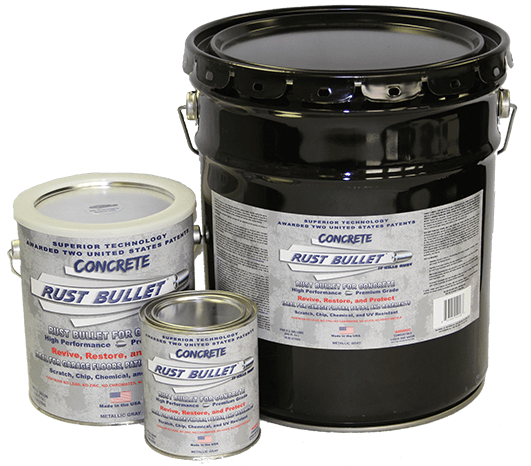
The quest to find a long-lasting garage floor paint that will stand up to use and abuse may finally be over. That’s right, we said it. There really is a durable concrete floor paint available that will last for years, not peel, and not develop the dreaded hot tire lift problems associated with paint.
One of the reasons painting a garage floor is still popular is due to the fact that it’s much easier to apply to concrete than an epoxy coating. It goes down easier, it doesn’t require all the surface preparation that epoxy does, and it appeals to the DIY crowd.
The problem, however, is that paint is not very durable. It will only last a year or two at best before it needs to be touched up or repainted altogether.
An epoxy coating is far superior to paint and can last for years, but it requires that you acid etch or grind the garage floor first before application. This process causes many of the DIY crowd to shy away from the benefits of epoxy.
There just hasn’t been a manufacturer that makes a concrete paint/coating with similar benefits to epoxy that doesn’t require acid etching or grinding of the garage floor first.
That is until now.
What is Rust Bullet?
Known to some automotive restoration enthusiasts, a fairly new company called Rust Bullet developed and then introduced in 2003 a 1-Part moisture cured polyurethane paint coating to stop rust and corrosion in metal.
It soon became apparent, however, that this paint had many other capabilities as well. One of which is protecting concrete under extreme conditions.
It wasn’t until recently, however, that Rust Bullet eventually found its way onto the garage floor as a long-lasting, tough, and durable garage floor paint. Here is a quote from them.
Rust Bullet, with its Superior Patented Technology for rust and corrosion control provides outstanding protection to many surfaces, including concrete. Rust Bullet not only improves the appearance of concrete, it provides an impervious shield allowing easy cleanup of oil, grease and chemical spills along with strong protection against impact and abrasives.
You will be hard-pressed to find a statement like that from any other manufacturer of a single-part concrete paint for a garage floor.
A durable garage floor paint
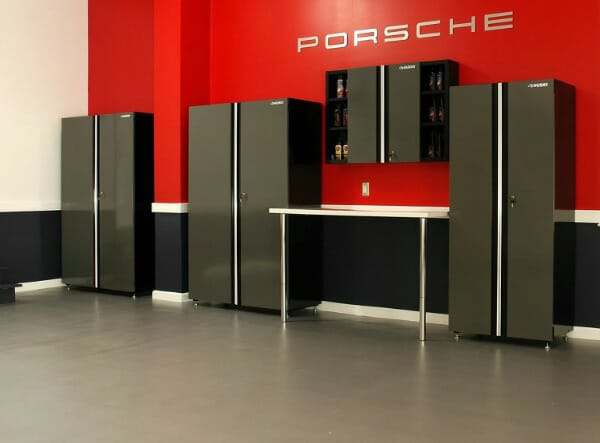
So what makes this paint better? Well to start with, Rust Bullet technically is not traditional paint as we know it. It’s marketed that way because like paint, it’s a single-part coating that doesn’t require a second component to mix in. It is also easy to apply like paint. And because it is thinner than most coatings, it can also be applied to other surfaces with the use of a spray gun.
Most concrete garage floor paints are either latex acrylic or a blend of latex acrylic with small amounts of epoxy resin added to increase durability – also known as 1-Part epoxy paint. Rust Bullet, however, is a moisture-cured urethane (polyurethane) coating that is applied like paint.
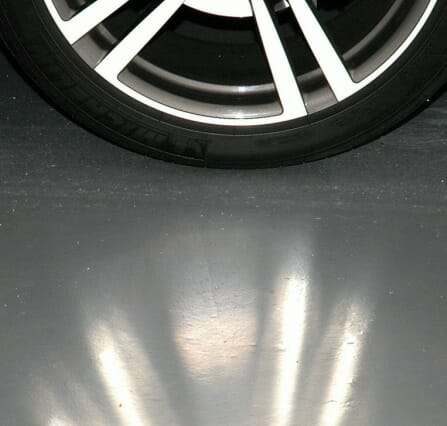
The curing process allows the coating to crosslink – similar to epoxy. This develops a much denser and tougher coating than regular paint. It also makes the properties and benefits of Rust Bullet to a lesser degree, similar to a high-performance polyurethane coating. Unlike epoxy and traditional polyurethane coatings, Rust Bullet can be applied in temperatures as low as 35°f.
Rust Bullet also has a solids content of over 62% compared to the 36% solids of the leading 1-Part epoxy garage floor paint. This means that less than 38% of the product evaporates into the air during the curing process, compared to 64% with the leading floor paint.
What this translates to is a coating whose dry film thickness (DFT) is almost twice as thick as 1-Part epoxy paint – 2.5 mils vs. 1.4 mils. This additional thickness contributes to its long-lasting durability as a garage floor paint.
No more hot tire lift
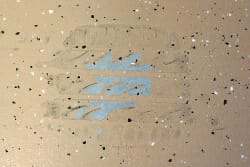
Paint does not respond well to heat (neither do cheap epoxy coatings for that matter) and is the number one enemy that contributes to hot tire lift.
As hot car tires sit on the painted surface over time, the heat from the tires causes paint and low-quality coatings to soften under the tire. This relaxing of paint and coatings, combined with the contraction and grip of the tire footprint as it cools, causes the paint to delaminate and pull up with the tire when it is moved.
Rust Bullet combats this with a sustained thermal ability of 314°F and will withstand heat upwards of 625°F for up to 72 hours. Your tires would melt before they ever got that hot. This feature was one of the primary reasons that Rust Bullet was first used as a garage floor paint. As a result, hot tires will not affect the coating which means that there is no hot tire lift – period.
No Grinding or Acid Etching Required
One of the greatest benefits of Rust Bullet as a garage floor coating is that it does not require acid etching or grinding of your garage floor before application.
That’s right… As long as the concrete of your garage floor has not been previously sealed, the only required floor prep is to clean the concrete prior to application and Rust Bullet will provide a tenacious bond.
This is a huge benefit to the average DIY installer. Many times people shy away when they discover the amount of preparation that is required for a premium garage floor coating. Rust Bullet literally removes the fears of having to acid etch or grind the concrete before installation.
As long as your garage floor has not been previously sealed or is not extremely smooth, all that is required is a good cleaning of the concrete beforehand.
To verify that your garage floor will accept Rust Bullet for Concrete without further prep, you need to do a water drop test in various areas of the concrete. Drip small amounts of water onto the surface. If it does not bead up and is absorbed within a minute or so, then your concrete will accept the coating.
If the water does bead or it takes much longer to be absorbed, then Rust Bullet states you will need to lightly etch the concrete or sand the surface with 120 grit sandpaper first.
Benefits of Rust Bullet Concrete for a Garage Floor
Now that we know the differences between Rust Bullet and typical garage floor paint, let’s examine the actual benefits of Rust Bullet as a concrete garage floor coating. Many of these benefits are similar to some quality epoxy and polyurethane coatings and far superior to the top garage floor paints and inexpensive garage floor epoxy kits.
- U.V. resistant – will not yellow or chalk when exposed to the sun
- Excellent Scratch resistance
- No hot tire lift
- Excellent oil resistance
- Excellent chemical resistance
- Good impact resistance due to its flexibility
- Waterproof
- Protects concrete from road salts and deicing fluids
- Standard base coat is not as slippery as epoxy when wet
- Easy to clean and maintain
- Better adhesion qualities than paint
- Does not require the same floor prep as epoxy coatings
- Can be applied in temperatures down to 35°f
- Long-lasting and durable – up to 10 years
Click here to jump down to Rust Bullet Pricing
As you can see, Rust Bullet has similar benefits as some premium garage floor epoxy coatings. And unlike concrete paint and low-cost epoxy flooring products, Rust Bullet also has a very high tolerance to chemicals.
It is highly resistant to oil stains and automotive chemicals such as anti-freeze, brake fluid, and battery acids. It has also been subjected to numerous tests of magnesium chloride which is a prime ingredient in deicing fluids – the same stuff that does extensive damage to concrete garage floors during the winter.
There is not one manufacturer of DIY concrete floor paint that can stand up to all of that. In fact, low-cost epoxy garage floor kits do not rate nearly as well either.
For more information, you can review their data sheets here.
Rust Bullet Colors and Top Coats
When it comes to color selection, not everything comes up roses for Rust Bullet. Unfortunately, you are limited to color selection in terms of the traditional choices for garage floor coatings.
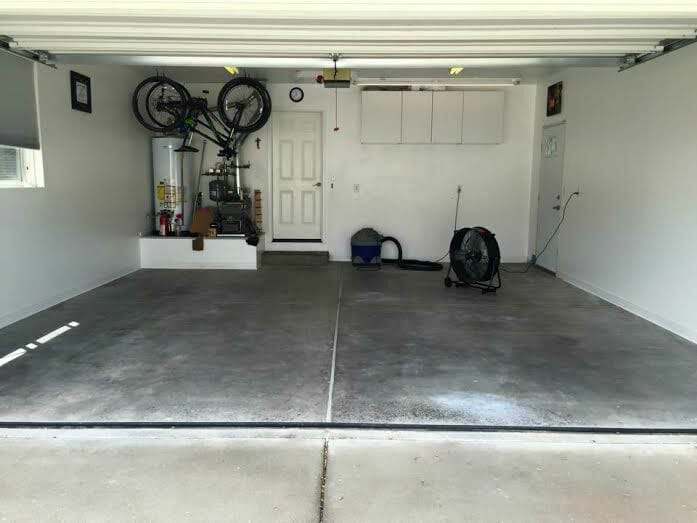
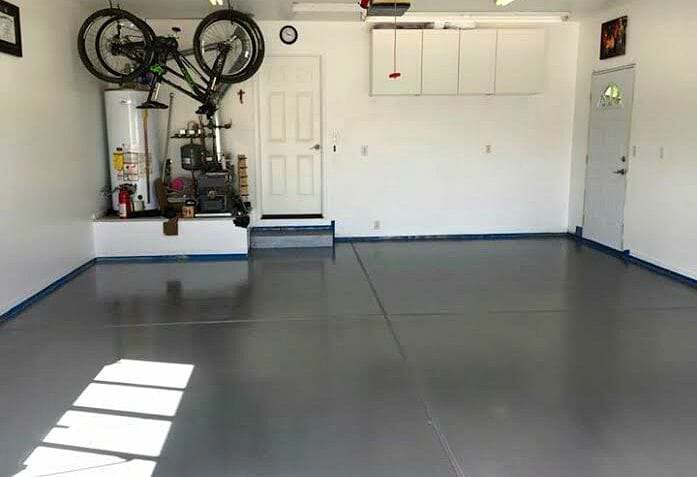
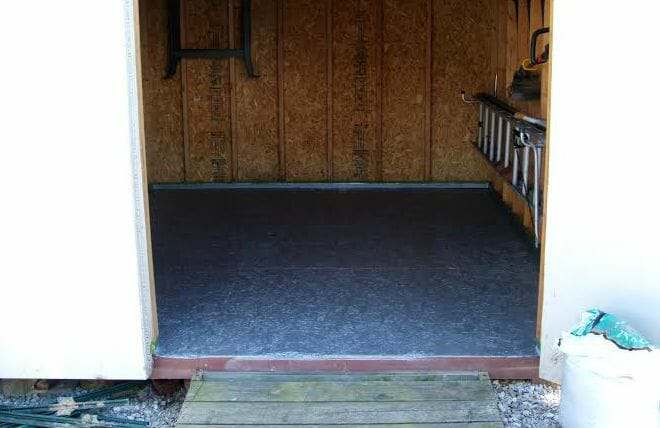
Metallic Gray in a semi-gloss finish is the only color available. If you want beige, tan, or a darker gray then you are out of luck.
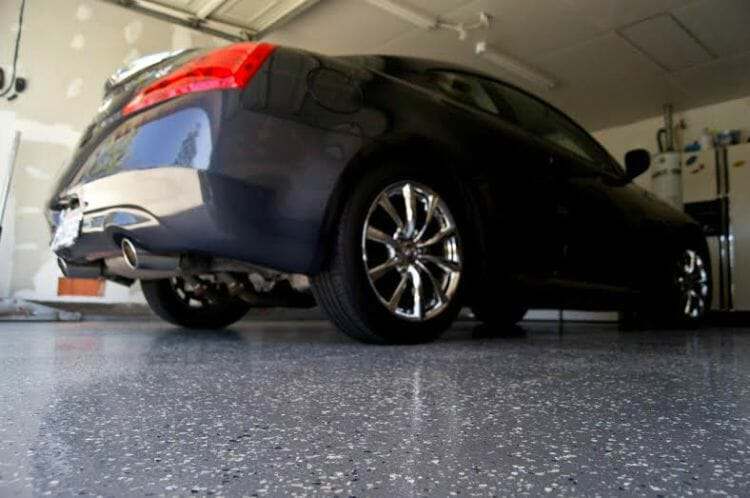
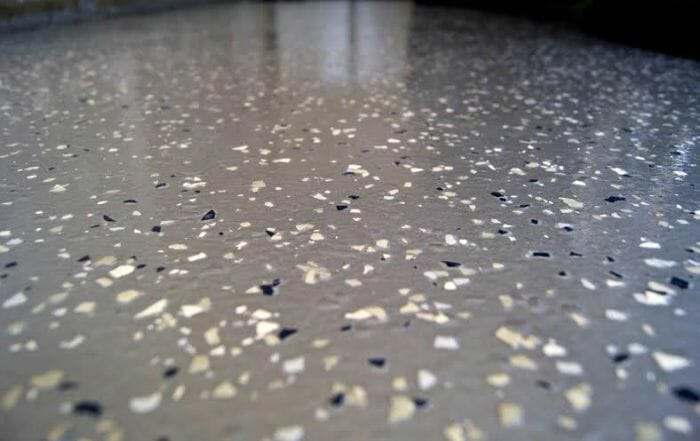
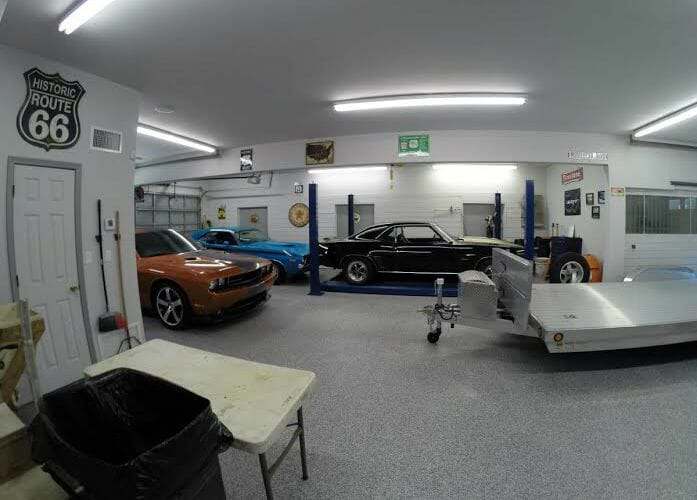
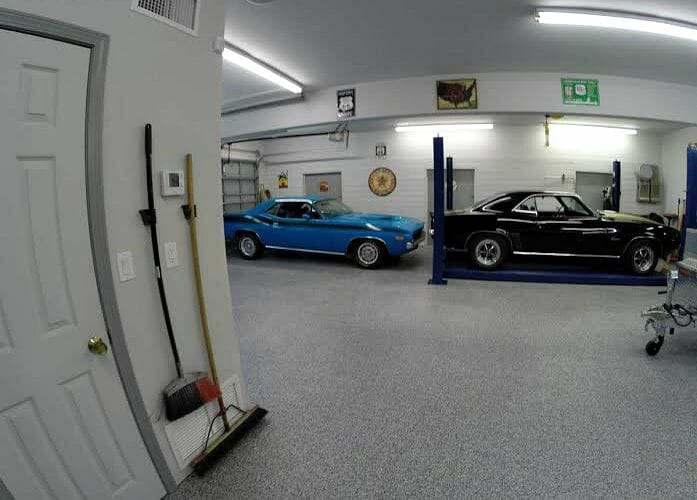
There is a solution to the limited color choice. though. Rust Bullet can be installed as a typical multi-coat garage floor epoxy system with the use of color flakes. Just broadcast the color flake of choice into the metallic grey coat to produce the desired effect. You can then apply a top coat DuraGrade Clear.


*** Update ***
Rust Bullet has since replaced the Rust Bullet Clear Coat for Concrete with their new DuraGrade Concrete clear coat. Testing has shown that it is more durable in all categories including impact resistance and abrasion resistance.
How Slippery is Rust Bullet?
According to Rust Bullet, the metallic gray provides almost the same non-slip protection as bare concrete. However, the DuraGrade Clear Coat can be very slippery when wet.
You will want to mix in an anti-slip additive to provide non-slip protection when using a clear top coat.
Rust Bullet Coverage Rates
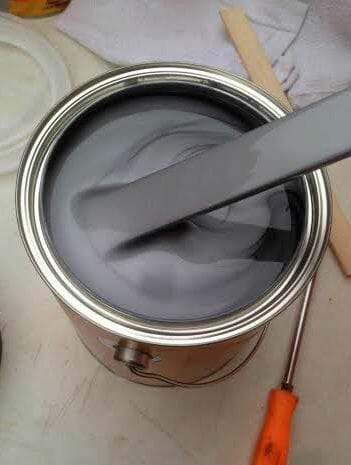
One gallon will cover 300 – 400ft², which is enough for most standard 2-car garages. Rust Bullet recommends a minimum of two to four coats on a garage floor, depending on porosity, in order to achieve the recommended dry film thickness for the best performance.
One nice option is that Rust Bullet is also available in smaller 1-quart and 1-pint sizes as well. This comes in handy and can actually save you a lot of money if you have a slightly larger garage floor that may require a little more than one gallon.
Many of your typical garage floor coating kits do not offer amounts less than a gallon. This can require you to purchase an additional gallon to meet your square footage requirements. This can create a greater expense than anticipated.
A long lasting paint, but not perfect
As good as Rust Bullet is as a long-lasting and very tough garage floor paint, there are some factors to consider. The first is that it lacks the more traditional garage floor coating colors. Are you listening Rust Bullet? The standard semi-metallic gray is the only base coat color available.
*** Update ***
Rust Bullet did listen and has now released a new concrete coating called DuraGrade that is available in multiple colors. We did a complete review including testing. It performs well as a garage floor coating. You can read about it here.
The gray color is also a monochromatic paint. It doesn’t create a nice glossy and colorful finish like epoxy can unless you apply the DuraGrade clear top coat. It will, however, produce a nice semi-gloss metallic gray finish that is easy to maintain. Plus, it provides for a very clean look.
Another issue is that the monochromatic color of the metallic gray tends to show the defects and poor patch repairs in the concrete more than a thicker epoxy coating would. Additional coats or the application of color flakes can help to alleviate this.
Additionally, Rust Bullet is a solvent-based coating and produces strong fumes. You will need to wear a respirator or have good ventilation during application and turn off all flame and ignition sources in the garage before you start.
Price is something to consider as well. Rust Bullet is more expensive than the leading 1-Part epoxy garage floor paint and almost 2 times more expensive than the traditional garage floor epoxy kits. This includes manufacturers such as EpoxyShield or Quikrete, as an example.
Though more expensive, the initial cost will actually save you time and money in the long run due to the fact that it’s such a long-lasting floor paint. In all fairness, it really should not be compared to these lesser quality products because, in essence, Rust Bullet is a high-quality floor coating system unto itself.
Rust Bullet Garage Floor paint application
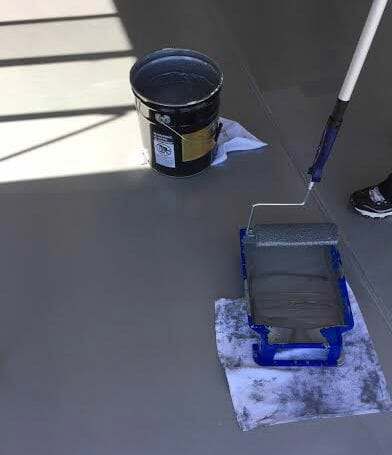
Ease of application is one of the big benefits of Rust Bullet that will attract the attention of many DIY enthusiasts.
As we stated earlier, it does not require the same concrete preparation as epoxy and most paint products. According to Rust Bullet, acid etching or grinding of the concrete is not required.
The key is to clean the concrete thoroughly and remove any oil spots or grease on the floor. Pressure washing is a recommended method as well. If you have any concrete repairs that need to be done, do them first.
One point to be aware of is that like epoxy coatings, a moisture test should be conducted before application. If any moisture is present, Rust Bullet recommends applying a penetrating sealer to the concrete before application.
If you have any stubborn oil stains remaining after cleaning your garage floor, Rust Bullet recommends applying their Metal Blast product to the stain. Metal Blast will enhance the adhesive qualities of the concrete surface where the stain is located. What it does is create an anchor pattern for the paint to adhere to.
It’s extremely important to make sure the floor is dry before application. Because Rust Bullet is moisture-cured, any amount of water it comes in contact with during this process can have an adverse effect on the coating. They even make the point not to let sweat come in contact with the coating while it is being applied.
Roll on your first coat with a quality lint-free 3/8” nap roller. Make sure to cut in the edges with a chip brush. Depending on temperature and humidity, the second coat can be applied between 6-24 hours after the first coat, humidity dependent.
If applying the second coat on the same day, Rust Bullet recommends not standing in one spot too long. And do not wear spiked shoes to prevent damage to the coating.
One note to make: Rust Bullet lists a much shorter re-coat time in their application guide. After further consultation, they recommend a longer wait period due to the fact that you will be walking on the floor in order to apply additional coats.
Once you are done, the garage floor can accept regular foot traffic in 24 hours. You can move things back into the garage after 48 hours, even vehicles. Just be careful not to turn the wheels in place and park the tires on a piece of cardboard or old carpet for a couple of days to avoid tire marks
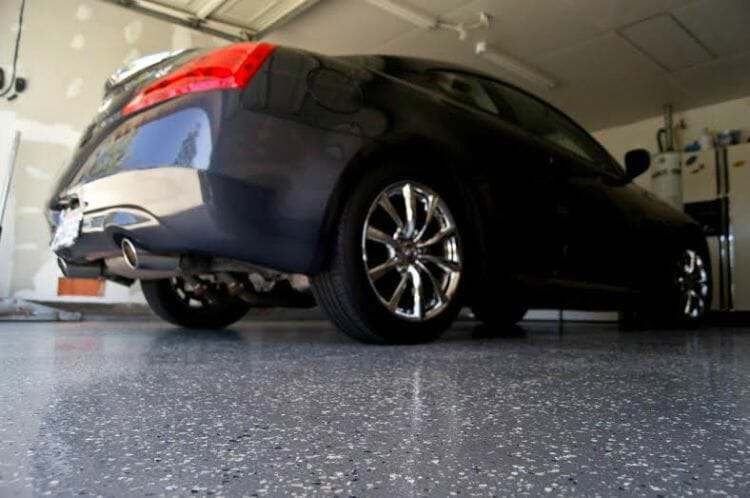
In 5 days the floor is fully cured and you can remove the cardboard without the worry of tire marks, hot tire lift, or any other damage from your vehicles.
This post may contain affiliate links. If you use these links to make a purchase, we may earn a small commission. As an Amazon Associate, All Garage Floors earns from qualifying purchases. You can read our full disclaimer here.
Where to buy Rust Bullet Garage Floor Paint
One of the more popular places to purchase Rust Bullet for Concrete is Amazon. Pricing can often be a few percentage points less than buying direct.

Click here for Rust Bullet Concrete Pricing
The solid metallic gray color in a semi-gloss is a no-nonsense, traditional-looking floor paint color for automotive enthusiasts. It has proven to be very resistant to a variety of automotive fluids including acids. However, you can decorate the coating with color flakes if you like.
Click here for Color Flake Pricing
If you apply the color flakes you will need to apply a coat of Rust Bullet DuraGrade Clear to lock them in. Not only does this protect the color flakes, it will also provide a high gloss finish.
Click here for Duragrade Clear Coat Pricing
Lastly, if you have any stubborn stains that may interfere with proper adhesion, Rust Bullet recommends spraying the area with their optional Metal Blast.
Click here for Metal Blast Pricing
Final thoughts
We first published this article in the fall of 2014. At that time Rust Bullet was aware that some people were using their Standard formula as a garage floor coating – and with good success. However, they didn’t realize the potential of the market since garage floors were not the reason Rust Bullet was developed in the first place.
A few months later Garage Flooring LLC, a very reputable and respected national garage flooring vendor, contacted Rust Bullet with great interest after reading our article. Working with Rust Bullet, they soon began testing the various Rust Bullet concrete coating products to see how they would perform. Needless to say, the testing went well.
As a result of this testing, interest in Rust Bullet as a tough and durable garage floor coating has garnered national attention as a viable alternative to epoxy coatings and concrete paint. Though fairly new to the garage flooring market, it truly is a long-lasting floor paint for your garage that will provide years of service without issue when applied correctly.
In our estimation, this product provides a great compromise for those who want much more protection and durability than what a typical garage floor paint can provide, yet don’t want the expense and additional labor involved for a good epoxy coated garage floor system.
If you are in search of a long-lasting and durable floor paint for your garage that doesn’t require acid etching or grinding of your garage floor, then Rust Bullet for Concrete just may be the compromise you have been looking for.
This is an excellent article and inspired extensive conversation between myself and the manufacturer. There is one thing you should update though: Although their base coat is only available in one color they do have very nice top coats. The top coats are high gloss and will require the addition of an anti-skid.
We will be bringing in the product.
Thanks for the kudos and stopping by Justin. We’re glad to hear that you will be bringing in the product as we feel this could be a great compromise between the typical budget epoxy paint kits that don’t last very long and the complete multi-coat epoxy systems that can be more than what the average person feels confident in installing for themselves.
We are aware of the top coats and held off writing about them with one of the reasons being that they are more slippery than a typical epoxy or polyurethane top coat and would require anti-skid as you said. The other reason was due to the bold color selection that you don’t typically see in a garage, though we are interested in the clear shot. Due to the large interest this article has received and a couple of emails from people who have since installed Rust Bullet in their garage and really like it, we just may have to do an update about their top coat product as you said.
They did mention that the top coat was slick and suggested using an anti skid. Makes sense. I think the color selection issue will sort itself through. If the business is there, we should be able to work with them to get the necessary colors.
So would the recommendation be for a 2 car 480 sqft garage be 1 gallon (1 coat) of rust bullet base and 1 gallon (1 coat) of the rust bullet rustbullet white shell?
Hi Phil. 1 gallon of Rust Bullet will cover up to 400 sq. ft. depending on how porous your concrete is. Since your floor is 480 sq. ft. you would need an additional quart. Rust Bullet recommends a minimum of two coats grey. If you want to add a color coat, then one coat is usually all that is needed. Their color shell coat is very glossy and very slippery when it gets wet. It’s highly recommended to add an anti-slip additive like SharkGrip or something equivalent to the color coat before you apply it.
Hi, can we add a clear coat as protective finish with Rust Bullet?
Hi Frederic. As a matter of fact you can. We are going to be doing an article on just that shortly. Meanwhile, you can find it here at Amazon . Apply it just as you would an additional coat. RustBullet highly recommends using an anti-slip additive in the final clear coat because it can get fairly slippery when it gets wet if you don’t.
Can this product be applied over previously painted concrete floor? If so, is there any special preparation that has to be considered?
Thanks!
Hello Ed. Yes it can, it just requires that the floor be clean. However, how well it stays down is dependent upon the material it adheres to. Standard paint does not usually bond for a long period of time to concrete. If you want it to stay down for years, we suggest removing the paint so that it can bond to the concrete. The easiest way is via grinding or you can strip it via chemical means and scraping, but it is more messy.
I’ll be painting my cement basement floor with Rust Bullet standard. I can’t move out the heavy washer and dryer, so I’ll have to do the job one half at a time.
When doing the second half, is it OK to paint a little bit over the dried edge of the first half surface? Should I sand that dried edge first?
Any advice you can give on how to avoid a seam from showing would be helpful!
Hi Bifford. Yes, you can paint over the dried edge of the second half with a light sanding of the edge. You may develop a noticeable line where you do however. You can help to make it less noticeable by making sure you don’t leave a heavy paint edge.
Thanks for the speedy and helpful reply, Shea!
I’m planning to fill the expansion joints with a flexible filler (Rustoleum EpoxyShield Concrete Repair), paint two coats on one half of the floor, let it dry, move the appliances, then do the second half. It sounds like if I am careful with the edges I can keep,the seam less visible, per your advice.
Perhaps another alternative is not to fill the expansion joints and paint each half of the floor up to and in the joints. It might look more natural. But then I’d have the same old maintenance problem of dirt collecting in the joints.
Any thoughts on which solution would look better?
And by the way, am I right that additional Rust Bullet painted over two cured coats of it won’t adhere properly unless sanded? Otherwise, eliminating the sanding might lessen the visibility of the seam?
Since you have contraction joints in your floor, the easiest way is just as you said. Do one half of the floor using the joint as your border. Once the coating cures, move things over and do the other half. Once done, you can fill the joint with a self-leveling polyurethane filler such as SikaFlex. It cures to a firm but flexible sealer which is good for joints. It is not paintable, but it will prevent debris from falling in the joint and for easy cleanup and sweeping.
You are right about the sanding. Rust Bullet that has cured more than 24 hours needs to be lightly roughed up with 150 grit sandpaper.
One thing to keep in mind is that Rust Bullet is not the best coating when it comes to hiding irregularities in cement. High solids epoxy is much better for that. If your idea was to create a seamless looking floor, it’s very hard to do that with Rust Bullet because the contraction joints would have to filled and ground very flush with the concrete to prevent the fix from telegraphing through. Just FYI, the EpoxyShield Concrete Patch Repair is very good for filling holes and cracks in the cement, but it should not be used for filling joints. It has an extremely low elongation rate (not flexible) and would crack in the joint if there was any movement in the slab. You can learn about the best fillers for joints here.
My primary reason for using Rust Bullet is to have a clean-looking low-maintenace surface and to avoid any mechanical grinding or acid etching. The basement floor will be lightly used for doing laundry and storage.
A seamless look is indeed a secondary goal though not fully achievable with some previous ugly concrete repairs, concrete seams along the four walls where a french drain was recently installed (contraction joints being partially cemented over in the process!).
Your explanations have been very helpful, Shea, and I have now ordered some Legacy Gel Crack Filler to fill in the contraction joints. A gallon is more than I will need for 55 linear feet, so this leads to one final question:
Which would be a better filler for the pits and cracks in my concrete floor prior to a Rust Bullet application: Rustoleum EpoxyShield Concrete Patch or Legacy Gel Crack Filler? Perhaps Legacy is more sandable and thus will allow a better chance to achieve that seamless look?
Use the Legacy Gel and Crack Filler. It’s a great product that can be used for joints, cracks, and the occasional pits and holes in the concrete. Both products are going to cure extremely hard, so sanding them flush will not be much different.
A few application tips for Rust Bullet. Use a 3M Respirator with P100 filters . Be sure to keep a wet edge at all times and do not over roll or try to spread it too thin. You may encounter roller marks. Also pay close attention to the mixing instructions. Mix for 3 minutes, pour some in your paint tray and then put the lid back on.
Hi Shea…I have been researching garage floor products for months and Rust Bullet sounds like the answer to my needs. I have purchased two gallons and am in the process of cleaning my floor. My question is I had applied rustoleum epoxy several years ago and it started to peel, hot tire, etc. I must have applied it very well because after trying chemical stripping and a grinding machine I still couldn’t get it completely off. Can I apply Rust Bullet over the areas I couldn’t get off ?…will it cover them adequately and could it eventually peel. Thank you…John
Hi John. If you did some grinding on the surface along with cleaning, the Rust Bullet will stick to the epoxy without a problem. The key is the roughed up surface. Just keep in mind, ultimate adhesion is as good as what it adheres to. In other words, if it peels in those area it would be from the epoxy not sticking to the concrete, not the Rust Bullet peeling from the epoxy. Rust Bullet isn’t a real thick coating like a high solids epoxy can be. As a result it has a tendency to telegraph inconsistencies in the surface through the coating. So we can’t tell you for sure whether or not the areas with remaining epoxy can be identified through the coating or not.
Rust Bullet has really been catching on as a garage floor coating. We recently spoke with a vendor who has picked up the line and they haven’t had one issue yet with the coating peeling up from the concrete.
Thank you Shea for your prompt response. I appreciate that information and will test a section where I will paint Rust Bullet over spots I couldn’t remove. Over the winter I was researching the new aspartic coatings and came upon your Rust Bullet product. I was looking for a long lasting product that would be easy to apply and I think I found it in Rust Bullet. I will take before and after pictures and let you know how it went.. Recovering from knee replacement but hope to have it done in August. Thanks again…John
You’re welcome John and good luck with the new knee!
Thank you Shea. I did a small test strip over an area I couldn’t get the old epoxy up and I believe Rust Bullet is definitely the answer to my problem. I plan on doing the entire garage floor before the end of August…after my knee and the temperatures in PA calm down. I’ll be in touch. Is it possible to post pictures on this comment site?
Thanks,
John
We’re glad that Rust Bullet looks like the answer for you John. At this time we don’t have a way of posting pictures to comments. You can however sent pictures to us through our “Contact” link. We are putting a gallery together and we can include them in that. Also, we are always looking for project stories to post in our “Reader’s Projects” section which we just started as well. If your project qualifies and you have some good before and after photos, we may want to do a separate article on your experience.
Thanks Shea….I’ll take before and after and we’ll see how it turns out. I’ll be in touch. John
I am getting ready to apply the Rust Arrest that I purchased. I have a fair amount of pitting and low spots that I am going to correct first. I bought Sakrete Flo Coat at a home center, I believe it is a a polymer modified cement product similar to the product that you recommend. I want to do a skim coat over the entire 300 square foot garage floor.
Will the Rust Arrest adhere to the Sakrete material ?
I’ve grinder the floor with a diamond grinder,treated one 2 foot sq. Min Wax stain with Behr oil stain cleaner and power washed the floor twice.
Hello Greg. We are assuming you are referring to Rust Bullet and not Rust Arrest? Rust Bullet will adhere to the Flo Coat. Make sure that the skim coat finish is to your satisfaction before you apply the Rust Bullet. We recommend smoothing out any trowel marks or ridges with a grinder so that they don’t telegraph through the coating.
We have a two car garage that we applied a floor stain to nine years ago. It has held up remarkably well. No chipping. It does of course show the hot tire marks. We want to of course have a much cleaner look. Can we apply your product on top of our floor. If so, what preparations do we need to do and do you recommend sealing it?
Hello Chuck. Stained concrete does not chip unless you chip the concrete. The reason is because stain is not a coating. The color of the substrate is changed through the staining process. Did you apply a clear coating over the stain? If not, then the only floor prep needed before applying Rust Bullet is to clean the concrete real well, including where the tires have left their marks. If you have applied a clear coat (sealer), then you will need to remove the coating first by grinding before applying Rust Bullet. You don’t need to seal Rust Bullet because it is a coating. Topical coatings are sealers.
FYI, Rust Bullet is not our own product. It is manufactured by Rust Bullet and sold and distributed as a concrete floor coating by Garage Flooring LLC.
Help for slippery carport floor 20 yrs old. No concern about appearance. What is easiest and most durable? Concrete skim coat? Glue down mats? Rust bullet with anti skid pellets? I am lost. Thanks
Hello Joyce. We need a little more information. Since a carport is outdoors, what condition is the concrete currently in? When is it slippery – rain? Snow? or just in general?
Hi Shea,
This stuff sounds great! I have a troublesome garage floor that I would like to do an aesthetic update to. I am looking for something that is durable, but that I also can keep on hand to re-coat as needed if I get chips or issues over the years. This stuff sounds like it fits that bill! I assume that any future issues can be patched with the same product, after only sanding and doing a couple of re-coats? Would this be your top recommendation for that situation?
You mentioned using a penetrating sealer to prepare the concrete if it has potential moisture issues. Could you recommend a good one to use with this as the topcoat?
Thanks so much!
Hi Lee. Yes, Rust Bullet is turning out to fill a nice niche in the garage flooring market. Once opened up it will not keep for months like paint can, but it is available in small pint and quart size cans should you need to touch something up.
In terms of moisture and penetrating sealers, I recommend that you contact Justin from Garage Flooring LLC. He has been working very closely with Rust Bullet on this topic and he carries quite a few sealers, one of which I’m sure will be compatible.
I just had a brand new garage floor put in. Is there a certain amount of time I would need to wait, to allow the new concrete to dry, before applying Rust Bullet?
Hi Mary. You need to wait a minimum of 30 days before applying a topical coating. The reason for this is that the concrete is still curing and releasing moisture vapor during this process. We recommend doing the simple plastic sheet moisture test after 30 days before applying a coating.
Shea… I have a concrete floor that has moisture, so I can’t use an epoxy finish. Rust Bullet seems a good alternative. It was recommended that a sealer be applied over the concrete with moisture before applying Rust Bullet (See Sept 20th note). However, in your reply of Sept 6th, you recommended that the sealer be removed (grind it off) before applying Rust Bullet. How should a floor be prepared that has moisture so that it can “breath”? Perhaps your recommendation to remove old sealer was to avoid a potential compatibility issue?
Hi Barry. It depends on what type of sealer is applied. There are sealers that seal at the surface and you will need to grind first. Then there are sealers that penetrate much deeper and will not need to be ground. Rust Bullet however is a coating just like epoxy. It does not breath like and acrylic sealer for example. Your moisture issue would need to be remedied first before you apply it. We recommend that you contact Justin at Garage Flooring LLC to see what your options would be.
Hi Shea,
Thanks so much for all the information. This site rocks for geeks like me who like to research the heck out of everything. 2 Questions:
1) It would seem that I could apply the base coat of Rust Bullet, and then at a future point in time come back and apply either the clear top coat or a colored top coat. Would you anticipate any problems there?
2) For winter climates, if I was not going to do a top coat at this point, would you recommend the anti-skid additive in the base coat? Or is it truly non-skid as long as you don’t put the top coat down.
Thanks!
One more question – would there be anything wrong with coating ~500 sq. ft where we would park the cars, and then leaving the remaining 250 sq. ft uncoated, where rubber mats would be for a home-gym area? And would there be any problems with returning to coat the remaining section later?
Thanks in advance. I apologize for peppering you with questions, but this seems like the best place for answers!
No problems with doing your garage in sections. It’s ideal to use the contraction joints as borders. Be aware that some rubber mats can leave a residue on concrete that could hinder the application of Rust Bullet and may require a more extensive prep process if it does. Talk to the manufacturer of the mats you choose to see if that will be an issue or not.
Hello Bennett and thanks for the kind words. Yes, you can apply the base metallic silver and then then apply additional coats later. All that is required is to rough up the surface with 150 grit sandpaper, sweep and vacuum up the dust, and then wipe down with denatured alcohol. It’s fairly easy to do with a pole sander. You are just roughing up the coating and not trying to remove any of it.
If you think you will be doing a top coat later we don’t recommend putting down a non-slip additive yet. It will hinder the process of prepping for additional coats later. The standard coat retains close to the same slip resistance as bare concrete. It’s not a true non-slip surface, but it’s much better than other coatings.
As an entry-level (or just above) solution, which would you recommends more, Rocksolid or Rust Bullet? In other words, is the Rust Bullet “paint” better than the Rocksolid 2-part polycuramine?
Hello Brad. You ask a good question. Rust Bullet is going to be the easiest to prep for and apply. RockSolid still requires a minimum of etching the concrete for prep and mixing of Part A and B together, though they do make the mixing easier with their burst pouches. RockSolid has more of the traditional garage floor coating look as well compared to Rust Bullet’s semi-metallic gray.
For protection and durability however, Rust Bullet is a much better coating and you will never have issues with hot tire lift.
Shea,
Thanks for the great info! I’ve been reading many of your articles as I get ready to put down a garage coating. I’m planning on using Rust Bullet with color flakes and Rust Bullet Clear Coat.
My question is – do I only add the color flakes after putting down the second coat of Rust Bullet?
Thanks!
Hello Rodney and thanks for the kudos. The color flakes get applied to the coat that precedes the clear coat. The clear locks in and protects the flakes.
After reading about Rust Bullet I would consider using your product on my new construction home w/2 car garage. As the home is not yet in construction, are there any recommendations for pre-Bullet garage floor slab preparation, other than a standard contractor pour?
There would be at least a 30-day time period between slab pour and move in, with no traffic/use.
Thank you.
Hello Rich. We don’t manufacture or sell Rust Bullet. We were the first to report on how well it does as a garage floor coating and its popularity has soared from there. As far as the new pour goes, just make sure they don’t apply a “cure & seal” to the freshly poured concrete. Some contractors will do this to help the curing process of the slab. Since it’s a type of sealer, you would have to grind to remove it before applying Rust Bullet. Other than that, just clean it real well before application and allow enough time for it to completely dry.
I have a 35 year old garage floor that I ground and then sealed with a deep penetrating siliconate sealer. I was hoping that would resolve major dusting issues, but it has not at all.
So now I’m considering applying Rust Bullet, but the Garage Flooring LLC folks (via online chat) said I’d have to remove the sealer first. Is that true? And, if so, do I need to re-grind the floor or can I use an acid etch?
I forgot to mention that I used Concrete Sealers USA siliconate sealer, and their website says siliconate makes an excellent primer for painting concrete.
Who’s wrong?
Hello Anthony. It sounds like you have a serious dusting issue if you have ground the surface first before applying the siliconate sealer. You may have a very soft concrete surface. One way to check is to see if you can you easily score it by dragging a sharp bladed screwdriver over the surface under pressure. Hard concrete will rarely leave a mark if any. If your surface is very soft, it may require some serious grinding before you apply any coatings.
Before you do anything, we suggest calling Concrete Sealers USA and ask to speak to Michael. He is extremely knowledgeable and may be able to help you solve your issue. Neither company is necessarily wrong either. Rust Bullet technically is not a paint. It’s considered a coating. And like most coatings, it is not compatible with most sealers. Latex concrete paint can usually be used on siliconate sealers, but paint is not a coating.
If your concrete is not soft, it may require testing Rust-Bullet first in an inconspicuous area for proper adhesion. Justin from Garage Flooring LLC may be able to send you a sample to test. Coatings and sealers are not always compatible and sometimes require coordination with different people in order to solve a more complex issue such as yours.
Thanks so much for your thoughtful response. As always, your advice is super helpful and carries much weight.
I’ll contact Michael and Justin as you suggested and hope there’s a relatively simple solution. If not, in the end I may just go with some roll-out vinyl!
Thanks again.
Once I open the 5 gallon bucket of rust bullet, How long will it last after I put the lid back on?
Hello Derk. If the can is properly closed it will keep quite a while, but how long it will keep we don’t know. We suggest contacting Rust Bullet and ask them. Their tech line is great and they should be happy to answer that for you.
Shea Thank you for the response!
You’re welcome Derk
Good evening , I have a crazy question for you. How would rust bullet stick to / wear on the side of a fiberglass RV ??? I have a 96 36′ class a appears to be fiberglass with a clearcoat over it and a trim of peeling (decals) any thoughts or ideasor should I just step away from the paint brush. Thanks Bill
Hello Bill. You ask a good question in terms of how well it sticks to fiberglass. We really don’t know. We suggest contacting Rust Bullet themselves to ask.
The cement floor in my workshop has been painted with an oil based paint,twice over a period of 20 years. It needs to be freshened up. Will Rust Bullet do the job and if so what steps need to been followed in applying? Is Rust Bullet available in Canada?
Thank you
Hello Duff. Rust Bullet is solvent based and may have an effect on the oil based paint. We recommend contacting Justin from Garage Flooring LLC. He has been working directly with Rust-Bullet on these issues and can better answer that question. He has also been working with someone else in about supplying Rust-Bullet to Canada as well.
My garage opens to a southern sun exposure. Can Rust bullet be applied to this floor with doors open or do i need to close garage or apply after sun has gone down? This is a coastal So. Cal location so temp won’t be a sundown problem.
Mike
It’s best to apply the coating out of direct sun Mike. If not, the sun can cause blistering and/or bubbles in the coating while it cures. You can always close the garage door, just keep in mind that Rust Bullet has strong VOC’s and a respirator should be worn for sure if the door is closed.
My garage currently has a two-part epoxy coating that is five years old. There are some spots of hot tire lift and I’d like to redo the entire surface. Are there any special preparations for applying Rust Bullet over a two-part epoxy? Would a different product be better to coat over a two-part epoxy covering?
Hello Blane. You need to make sure the remaining epoxy is down good. It doesn’t hurt to take a scraper to it or pressure washer to make sure more of it does not come up. The ultimate adhesion of the floor coating is dependent on the first coat adhered to the concrete. In this case it’s the old epoxy. You will need to clean the floor then rough up the surface with 150 grit sandpaper before applying the Rust Bullet.
How much area does a gallon cover? I have a two car garage with a three foot bump out on one side.
One gallon covers up to 400 square feet Blane. Coverage rate of the first coat depends on how rough or porous the concrete surface is.
Hello, I apologize if this question may have been addressed, but there are a ton of questions/replys already listed, and halfway through I figured it easier just to ask. As noted, there is now a Rust Bullet for concrete. Although, the cost difference between the concrete treatment and the standard treatment are quite considerable. Can the standard treatment be used over the the treatment especially for concrete? Also are there any advantages or disadvantages to using one over the other?
Hello Marcus. You might want to check those prices again. Rust Bullet for concrete averages almost $25 a gallon less than the standard RB14 Rust Bullet. Here is an example of the standard RB14 pricing and here is the RB for concrete pricing. You can even find it cheaper here from Garage Flooring LLC, including discounts for larger purchases and great customer service. The RB14 can be used on concrete, it just lacks some solvents that have been introduced in order to provide an easier application experience.