

There is nothing worse than trying to get rid of the foul urine smell from pets, dogs, and cats out of the concrete of your garage floor or basement. It seems like no matter how much you clean, the smell won’t go away. This is particularly true for cat urine.
We will cover the best methods for removing cat and pet urine odor from your concrete. In addition, we will include instructions on how to seal your garage floor or basement to block any odors that may persist from concrete, especially with particularly heavy urine issues.
Most concrete with pet urine odor must be treated in a two-stage process. Sometimes it may even require an additional stage, depending on the type of urine odor remover or pet enzymatic product used.
In addition, it helps to use a wet vac if you have one. It is most helpful if you have a basement with urine odors and no drain available. The wet vac helps draw bacteria out of the concrete during cleaning. Carpet cleaners can work in a pinch for vacuuming up liquids as well.
Pet urine odor and stains won’t go away with normal cleaning
We guess you may have already tried cleaning the urine stains to remove the odor from the concrete without good results. The stain may or may not be gone, but the smell remains. Because of this, it’s important to learn why the urine odor still exists and why conventional cleaning methods do not work. Doing so can save you some time and expense.
Concrete is actually porous like a sponge. It will absorb almost any liquid if allowed to sit for a while. This is why it’s hard to remove stains from concrete.
When urine is introduced to concrete and allowed to dry, the uric acid crystals present in the urine bond tightly to the concrete. Unfortunately, these crystals form deep within the pores and capillaries of the concrete since the urine was allowed to soak – sometimes multiple times, for days or even months.
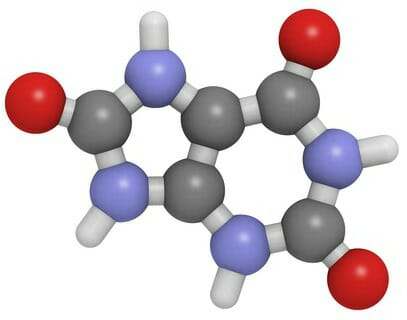
Despite numerous cleanings, uric acid crystals are insoluble and will not bind with regular soaps and other cleaning agents. Thus, the crystals stay attached to the concrete and the smell remains.
The smell may dissipate temporarily after a good cleaning, but as soon as any moisture or moisture vapor is introduced again, it can come back just as strong as before. Basements can be particularly susceptible to this.
The reason the smell returns is that uric acid salts allow crystals to reform as soon as moisture (humidity, for example) is introduced. This releases a gas that has a pungently strong odor.
The best way to stop the smell is to use an enzymatic cleaner. Enzymatic cleaners attack and break down the uric acid crystals and separate them from the concrete. Rocco & Roxie is our #1 recommended enzymatic cleaner to use on concrete to remove pet urine smell.
Steps for removing Cat and pet urine odors from concrete
- Identify urine areas in concrete using a UV light or black light
- Clean the affected areas with a proper cleaner to remove bacteria
- Let the affected area dry throughout – not just the surface
- Treat the affected areas with an enzymatic pet odor remover
- Do not skip any steps or take shortcuts

- Certified Gentle & Safe Pet Carpet Cleaner Solution: Chlorine free, color safe, no hazardous propellants or residue; safe to use around pets and children; certified safe for all carpets with a Seal of Approval by the Carpet and Rug Institute (CRI)
- Pet Enzyme Carpet Cleaner for Stains, Odors, Residue: If it’s gross, it’s gone; the stain and the stink; from stinky yellow pet urine, feces to vomit or other organic spills, Rocco & Roxie professional strength stain & odor eliminator tackles it all
- Cat & Dog Urine Enzyme Cleaner for Every Surface, Every Time: For use on carpets, floors, furniture, clothing, litter boxes, kennels, carriers, all pet living and sleeping areas—anywhere stains happen enzyme cleaner for dog urine
- Cat & Dog Urine Enzyme Cleaner for Every Surface, Every Time: For use on carpets, floors, furniture, clothing, litter boxes, kennels, carriers, all pet living and sleeping areas—anywhere stains happen enzyme cleaner for dog urine
- Buy With Confidence: You want the best for your best friend; we do, too; if you are not satisfied with the performance of this Rocco & Roxie stain & odor eliminator, contact us; we are determined to make it right
This post may contain affiliate links. If you use these links to make a purchase, we may earn a small commission. As an Amazon Associate, All Garage Floors earns from qualifying purchases. You can read our full disclaimer here.
How to identify urine odor stains in concrete
To get the best results from an enzymatic pet urine cleaner, you must first identify the exact areas in the concrete affected by the urine.
Many times, the source of pet urine odor can easily be identified. Areas where pets were kept in a pen are an example. However, sometimes it may not be so easy to detect.
This is often the case for people who have moved into a home that previously had pets, only to find that the garage floor reeks of a foul urine smell. Stains may have previously been cleaned, thus hiding the source of the odor.
One tool that does a good job of identifying pet urine is a UV light or black light. These from Amazon do a good job.
Close the doors and then turn on the black light. Hold it no more than three feet off the concrete as you scan the floor in sections. Old urine stains will stand out as blue, green, or yellow markings on the concrete.
We like to encircle the far outside area with arrows pointing toward the urine stain. Chalk works well for this, provided you don’t get it wet. Be sure to check the first two feet of your walls from the floor up as well. Sometimes cats will spray urine on the walls. This requires removing and replacing the affected section of drywall to get rid of the smell.
If, for some reason, the UV light does not reveal any stains, the old standby that will work is your nose. This takes longer, but it is effective. Open the doors to air out the garage and get rid of the immediate smell. After that, get down on your hands and knees and start sniffing. Trust us; you will know when you find it!
Clean the pet urine stains with TSP
After you have identified where the urine is located, it’s important to properly clean the area to rid the concrete of bacteria and other residual urine elements. Contrary to popular belief, most enzymatic cleaners do not remove bacteria.
Once you know where the urine stains are, the first step is to scrub the area with a strong solution of ½ cup TSP (Trisodium Phosphate) to 1 gallon of hot water. TSP mixed at this ratio is very strong. Gloves and eye protection should be worn for safety.
What the TSP does is remove all the bacteria, most if not all of the stains, as well as remove other residue left from the urine. It will leave only the uric acid crystals behind. This will allow the enzymatic pet urine cleaner to work faster and more efficiently at removing the uric acid crystals.
Pour the hot TSP solution onto the urine stain or identified area and scrub it with a short-bristled nylon brush. A deck brush works well for this. Make sure that you keep the area wet for at least 10 minutes or more to allow it to soak into the concrete. The solution will follow the same paths as the urine did and will need some time to work its way down into the concrete.
Do not be surprised if the smell increases as you soak the concrete. It is a combination of urine residue and uric acid crystals reacting and releasing gas from contact with the water.
Once the area has been scrubbed and allowed to soak long enough, pour clean hot water over the treated area again and then vacuum up the water with the wet/vac. Carpet cleaners will work for this as well. You will want to do this at least twice. For heavily treated and soiled areas, three times would be better.
This hot water rinsing will remove the TSP solution and help to suck up any remaining urine residue that is in the concrete. Treat any additional areas in the same fashion (scrub, soak, rinse), and then allow the concrete to dry at least overnight. 24 hours or more is best. Pet urine enzymatic cleaners work best when the concrete is completely dry before treatment.
As a note, the TSP may create a whiter-looking area on your garage floor since it is getting the concrete very clean. If that is the case, you may want to scrub the rest of your concrete after you are done with the same TSP solution. This will achieve a more consistent (and clean) look on the floor.
Using a hose with a high-pressure nozzle works fine for this to speed up the rinsing process. You are just removing dirt at this point and not sucking up urine residue. We have more tips for cleaning a garage floor here.
Apply pet urine enzymatic cleaner to concrete
Pet enzymatic cleaners work by using bacteria (the good kind) to digest malodors, waste, and stains. These bacteria produce enzymes that break down the molecules of the uric acid crystals into smaller bits. This allows the bacteria to digest the smaller bits and break them down into the two basic components of carbon dioxide and water. They are the best product for removing the smell of cat urine.
Because you are working with concrete and not carpet, we suggest using a product that is available in concentrate or gallon jugs and not something that comes in a spray bottle. Unlike carpet, you will need to use liberal amounts of the enzymatic cleaner.
The reason for this is that most enzymatic products need some sort of exchange with air. Since most of the uric acid crystals are deep in the concrete, it takes more time for the required air exchange. It will also take time for the concrete to absorb the enzymatic cleaner. Since some of the cleaner will evaporate on the surface as it soaks in, more will need to be used.
One of the best products for removing cat, dog, and pet urine odor is Rocco & Roxie Professional Strength Stain and Odor Eliminator. It has worked wonders for us, and we highly recommend it.
It has stellar reviews, and we know of more than one kennel that uses this as its go-to odor eliminator. Furthermore, it’s available in gallon jugs and does an excellent job when given time to work. You can find it here on Amazon.
There are many other products with good reviews that you can shop for here if you prefer. We recommend staying away from the products that require mixing with carpet shampoo, as these will not be as effective on concrete.
Be sure to follow the directions for the product you choose. Pour it onto the stained area and then start scrubbing it in with a deck brush. Keep it wet for at least 10 minutes or more. You want the concrete to absorb as much of the solution as possible.
For the best results, temporarily cover the wet area with a cheap painter’s tarp to help avoid evaporation of the solution. This will give it more time to soak into the concrete. Rinsing is not required. The enzymatic cleaner will break down the uric acid crystals into carbon dioxide and water, which will dissipate on its own.
Particularly bad-smelling areas may require multiple treatments. This is because it will take time and more enzymatic cleaner to soak into the concrete and do its work. Remember, you may be dealing with an area that allowed the concrete to soak in urine for weeks or months.
DO NOT RUSH THE PROCESS! This is the biggest mistake people make. As we stated, enzymatic urine odor removers require time for the good bacteria to digest the uric acid crystals. If you rush the job, you will not be successful.
Sealing concrete from pet urine odors
On rare occasions, it may require sealing the concrete to prevent any residual pet urine odor from working its way back to the surface. Sometimes people want to do this even though the odor is gone. They just don’t want to take the chance of it returning.
The only type of sealer that will work is a non-breathable, topical concrete coating. Garage floor coatings are a great example. Garage floor coatings are film-forming and do not breathe. They will block odor molecules from transferring through the coating. Acrylic sealers and penetrating sealers will not work. They are breathable and will allow the odor molecules to pass through.
The least expensive to apply is EpoxyShield by Rust-Oleum. You can find it here on Amazon. Do not use 1-part epoxy paint. 1-part epoxy paint is paint and not a true 2-part epoxy coating. Paint breathes and will not seal out the urine odor.
Applying a garage floor coating requires grinding or etching the concrete before application. If you know that you will be applying a coating before you treat your garage for pet urine odor, we recommend treating the concrete after you grind or acid etch.
The concrete prep process will open the pores of the concrete and allow the pet enzymatic cleaners to be absorbed into the concrete more easily. It will allow slightly more air transfer as well. The result will be a quicker and more effective use of the cleaner.
Once the coating is applied and has fully cured, it should effectively block any odors that remain in the concrete.
Hi,
We purchased an 850+ sq. foot old home (1930s), with a concrete basement floor. It’s a small space. When it rains, it smells terribly of pet urine from the previous owners’ pets. I’ve read many of your very insightful articles, and given that our floor can be damp in spots during a heavy rain, I’m considering applying a concrete densifier, grinding, then applying an epoxy sealer. I’m pretty certain no previous sealers, paints/coatings have been used based on the test suggested in previous articles.
Does this seem like a good route to take? Your feedback to everyone’s questions has been beyond wonderful, so thank you for taking the time.
Hello T. Old basements such as yours can be difficult. Moisture vapor barriers as well as general moisture mitigation was not as much of a concern back then. Epoxy coatings cannot be applied to concrete with heavy moisture issues. I suggest you read this article on moisture testing. I’m guessing you have some knowledge about this because of your desire to use a densifier. If your moisture levels are not too great, then a densifier may help to stop it. However, it requires applying the densifier first, testing for moisture again during wet weather, and then grinding assuming the moisture levels are good. If you apply a densifier to concrete that has already been treated by grinding, it will effectively reduce the ability of the epoxy to penetrate the concrete to adhere properly. There are special moisture vapor blocking epoxy primers that can be use, but they are pricey and require a very aggressive grind for application.
Is it really necessary to grind the concrete floor to seal it? We have a nice smooth concrete floor surface and id hate to grind it up to seal it as it will no longer have that nice smooth surface appearance.
Hi K. If your goal is to seal the concrete in order to prevent any lingering pet urine odors from within, then it requires a non-breathing topical coating such as epoxy, polyurea, and etc. These type of coatings require an acid etch or grinding of the concrete in order for them to adhere properly. Otherwise, they will peel up due to poor concrete prep. While etching or grinding does rough up the surface texture, a clear coat of such coatings retains the smooth look and provides a glossy appearance.
Yep thats the goal. Thank you so much for your helpful info! And for reassuring me that i can still achieve that smooth look after grinding for the sealing of the floor.
Hi Shea.
Help! I just purchased a house that previously had dogs that used the basement as their bathroom. The urine smell was covered up by recent floor painting or sealing by the seller. Now that the new paint/sealer smell is gone, all I can smell is dog urine. What can I do to eliminate or at least reduce the smell? I don’t know if the floor was painted with garage floor paint, or if a cheap DIY epoxy sealer was used. Also, the poured concrete walls have a clear sealant on them. Any suggestions on what I can do?
Hello Sandy. Basements can be tough since they are prone to moisture issues. Moisture is what will reactivate the attached urine crystals. I suggest you follow the procedures we outline in this article. Our guess is that a floor paint was used. Paint breathes and will allow odors to permeate, where as true coatings do not breathe and will block odors. You will first need to remove the paint to get to the bare concrete in order to treat the floor properly with a pet urine odor product such as the Rocco & Roxie product that we like. If that doesn’t completely remove the odor, then you will need to apply a non-breathable coating such as epoxy or similar product. However, one issue may be moisture as we mentioned. You will need to perform a moisture test first since your slab is below grade. If you don’t have moisture, then you can apply an epoxy. If you do have moisture, then it may require a special moisture blocking epoxy primer. This type of product requires aggressive grinding and may be best for a professional to install unless you are very confident in your DIY skills.
Our renters took up carpet, untrained dogs peed everywhere. I have washed with vinegar, enzamatic gallon cleaners, yet the smell remains although not quite as bad as it first was. What to do next. Thanks for any help. …. I forgot to mention that it is a concrete floor over radiant heating.
Hello Carole. Did you let the concrete thoroughly dry for a couple days after cleaning with vinegar and before applying the enzymatic product like we state in the article? If this is not done, the product will not work very well. Which product did you use?
Thank you for your article. I had carpet in my living room and every animal that came into my home used it as their bathroom. I have since pulled up the carpet and there is a concrete floor. My dog has had a few accidents on the concrete floor, but it’s rare. I’d like to put carpet back down, but I’m concerned that the problem will re-occur. I don’t smell urine, but I think animals can. There are no pet stains, should I still use TSP? Also, what kind of cleaner and sealant do you recommend?
Hello Kari. Yes, you should clean with the TSP in the manner we advise in the article. This will remove the bacteria that is present in the concrete. After it has fully dried, we recommend using Rocco & Roxie to break down any uric acid crystals that can cause an odor. You can review the article for further explanation. The only way to seal the concrete to prevent any possible odor issues from occurring due to the previous problem would be to apply a 2-part epoxy coating.
Hello,
I have a concrete walkway with a drain and hose accessible I intend to put a dog potty on. It has never been used for this purpose before so it does not smell, but I don’t want it to. What do I have to do to seal it so it will not longer be porous? I don’t have the capability to grind it down. Is there a heavy duty sealant I can use that is virtually impenetrable? Or do you have another suggestion for what I can do to cover/protect the concrete from the urine exposure when I hose off the grass dog potty?
Thank you.
Jen
Hi Jen. In order to fully seal it so as not to be porous, you would need to use a film forming topical coating. There are two issues to consider. The first and primary issue is that it will change the look of the concrete. Even a clear sealer will darken the color of the concrete. Second, it needs to be U.V. stable. For a clear sealer we would recommend an MMA acrylic like this one here. Other than cleaning the concrete well before application, you would not need to etch or grind. A topical sealer like this will make the surface somewhat slippery when wet, so an anti-slip additive would be recommended for the final coat. Keep in mind that bigger dogs can scratch the coating with their nails if there is enough room to run around.
The other option in a penetrating sealer. These don’t change the look of the concrete and it retains the same slip resistance when wet. These type of sealers resist moisture penetration, but they are not moisture proof. If you clean the concrete daily from urine, you should not have a problem. This is an example of such a product. This type of sealer is more common for outdoor concrete kennels that are maintained on a regular basis.
Hi, I recently purchased a house with water issues(has since been resolved) but the basement still smells, possibly due to animal urine. The concrete floor was painted and after attempting to remove the paint we noticed that there is also a sealant on the concrete. Is it possible that the smells are coming from the concrete through the sealant? Or could the smell be between the paint and the sealant? Just wondering if I should be removing the paint and then treating the outside of the sealant for possible urine spots? Thank you.
Hi Tamara. I would recommend using a black light like that discussed in the article to determine if urine is the issue and where it resides if it is. You can begin the cleaning and deodorizing from there. If the sealant under the concrete is a penetrating sealer, then it’s possible that the smell is coming through that since these type of sealers are not impervious to moisture and also breathe.
Just to confirm, the recommendation would be to remove the paint, then clean and deodorize on top of the sealant using the black light method?
Yes. The black light is used to find the areas that need cleaning. As a note; the concrete sealer may be problematic. If the cleaning and deodorizing is unsuccessful, it may require removing that sealer in those areas via grinding and then clean and deodorize again.
My basement floor has been soaked with cat urine for years. It is also very un-level. What would be the order of the steps to seal? Grinding, then leveling, then sealing?
Hi Laronda. Basements can be tricky and a big problem for urine odor, particularly if there is moisture in the slab since this tends to activate the smell. Basement flooring cannot be sealed with non a breathable coating unless there is no moisture vapor that comes up from below the slab. Has it been tested for moisture yet during the wet months of the year?
This was so helpful! The most convincing article I read on the topic. We moved into a home with an outdoor, attached laundry room with a concrete floor. It was clearly used by animals in the past. Tomorrow it will be dry enough to apply the sealant and then our plan is to put vinyl plank flooring in. I’m assuming it will be okay to do that, even though it was moist just last week? I’ve had a heater set to 90 in there and it seems pretty dry…
Hi Sarah. To be sure, you can cut a piece of 12″ square plastic and tape it on all edges over the concrete. Let it sit for 12-24 hours. If moisture does not collect under the plastic or the concrete does not get darker underneath, then it is dry.
great!
December 28
The Rocco & Roxie product did NOT work on my garage floor. The best product I have found is Chomps Pull It Out. Note: it does leave a whitish result but it does remove over 90% of the stain. I have tried 7 products — none have done an acceptable job. Next on my list is the TSP/water.
Hi Rene and thanks for the input. One thing to remember, however, is that the TSP solution needs to be used first and allowed to dry before using a stain and odor removing enzyme cleaner. The TSP removes the bacteria and leaves behind only the uric acid crystals. This is what allows the cleaners to work more efficiently at removing the odor.
I found your article very helpful. Thank you. My issue however is layered and I am unsure of the order of the steps to take in order to give us the best chance of success. Basement of the home has a lot of moisture, which I’m guessing is why the smell seems constant! Dogs both recently started treating it as their bathroom, (they are both healthy so not sure whats going on there) but now the home is starting to smell like a bad animal shelter. When we first started trying to get it clean (months ago) we used a variety of products from bleach to vinegar to Natures Miracle. I think we are only making it worse. We live in the Chicagoland area so it’s the middle of winter, but I don’t think we can wait until summer to get this taken care of. Steps to follow: 1. Find the affected areas with a blacklight 2. TSP and hot water scrub 3. Hot water rinse 4. Soak with R&R enzymatic cleaner covered with a tarp so as to limit evaporation time and just let dry. Does this all sound accurate? Would like to coat the basement floor but not sure that will work for us. Any advice is appreciated! We love our pets dearly, this situation is making it very difficult to like them very much right now 🙁 Happy New Year
Hi Connie. You have the order correct. Just make sure that the floor is completely dry first before applying the Rocco and Roxie. Run a fan to help with the drying process. Also, is the moisture in the basement coming from the walls, cement floor, or both? You can check if it’s coming from the floor by doing a simple moisture test with a square piece of plastic like we illustrate here. This will help to determine if moisture in the floor is an issue. If you have moisture in the concrete floor, you can’t apply a topical coating to seal out the smell since such coatings can delaminate due to the moisture. However, you can apply a densifier to the concrete to help slow down (and sometimes stop) the moisture intrusion. If the smell has stopped after that, then you could apply a water-based clear acrylic sealer to the concrete floor. Acrylic sealers are breathable and will allow moisture vapor to escape and thus will not delaminate. They will not seal out odors (since they breathe), but they will also prevent anymore accidents from the dogs from getting into the concrete.
Hi, I have 8 rescue dogs from abroad , most of them have never been in a home and will freely wee on my kitchen /dining room floor .
I was previously laminated wood , but because the dog wee soaked into the wood and into the concrete the stench is unbearable.
It is now back to bare concrete and i was goin to have it retiled , which is going to be costly, but after reading your article I’ve decided to just use an epoxy floor sealant instead.
What product would you advise for this big job, it would need to be anti slip as the dogs run in and out into the garden n kitchen allday.
Many thanks Lisa
Hi Lisa. You will want to use commercial quality products and stay away from the inexpensive epoxy kits that you can purchase from your local home improvement centers (Rust-Oleum, Valspar, RockSolid, etc.). These are thin mil coatings that will wear under constant use, particularly due to the dogs nails. We recommend a high solids epoxy (>90%) with a high performance clear or tinted top coat such as polyurethane or polyurea. You can add an anti-slip additive to the final coat. It will require etching or grinding of the concrete before application. Many of our sponsors offer such systems. Epoxy-Coat, ArmorPoxy, Garage Flooring LLC, Legacy Industrial, Versatile, and EpoxyMaster. Rust Bullet DuraGrade is another option.
We purchased a house that we found, but had a cat urine issue… however, the place we are dealing with is under a window ledge that is now a door wall area. This 10 foot area is under the door wall in a 1/2 inch space that is difficult to get to. We have tried all of the cleaners and scrubbed with tiny brushes etc. Some of the smell has gone away, but I am wondering if we can seal this now? I am unable to grind the surface like you suggested. We are looking at installing laminate flooring as well and I am at a loss of what we should do. I actually spoke to a company who can come out with a product like 80% hydrogen peroxide they use in crime scene cleaning. I just need this taken care of.
Hi Tina. I’m having a hard time visualizing the area you describe. You can also use a concrete etch to prep the area for an epoxy coating. We would recommend using one of the Eco friendly products when etching in the home. It will still require proper rinsing and then drying before applying a 2-part epoxy coating. Before you do that, however, I would have the company you spoke to come take a look and see what they can do for dealing with such a tight area.
Hi, can I use Natures Miracle instead of the Rocco & Roxie in the exact same way outlined in your article with all of the included steps? Will it be effective enough? It gets very good reviews. It is for a very smelly single car garage from past tenants from many cats. Btw I’m refering to “Nature’s Miracle Urine Destroyer 946mL”. Its meant to be very good and its very expensive compared to the others too.
Hi Dan. We don’t have experience with it, but it’s an enzymatic cleaner just as Rocco & Roxie is. You can give it a try if you like and feel free to let us know how it worked. Just make sure it stays wet for a while and does not dry out too fast.
ok cheers
Can I clean it with the TSP and do the Urine Enzyme stuff a couple of weeks later when the stuff gets delivered? Is that too long of a gap? Also can I pressure clean the TSP solution off with a Gurney instead of using a Wet/Vac as its a garage I can just spray it out the end?
Hi Dan. Yes, you can wait. The concrete has to be dry before using an enzymatic solution anyways. The reason we recommend using a wet vac is that it works to suck up or extract the bacteria residue from the concrete, whereas pressure washers tend to drive some of it deeper into the pores of the concrete. You would be better off rinsing with a hose and squeegee if you don’t have a wet vac.
Hi Shea,
My cat has been urinating in my basement for several months. (Our basement is finished with carpeting. We have bought flooring and plan to replace the carpeting.) I have tried other enzymatic cleaners, all promising to permanently remove odor. None have worked.
Before we had finished our basement, my husband sealed the concrete floor (not sure which type of sealer he used, all I know is that it’s a sealer, not a paint).
You recommend using TSP prior to using enzymes. I am not comfortable with this inorganic compound that requires protection because it’s so toxic. I researched and found Borax as an alternative. Is this something you can recommend? Or is there another substance that will work just as well as TSP but maybe not so toxic?
Thank you for your help!
Hello Tracey. We recommend TSP because we found it to be very effective. However, it does not mean that it’s the only product that will work. You can most certainly try using Borax first as it has been known to work for some people. You may have issues regardless due to the concrete being sealed previously. If it wasn’t a true film forming coating (we don’t mean paint) that your husband had applied previous to the issues with the cat, then we are assuming he used a penetrating sealer (non film forming). This in itself may provide some problems since the sealer is going to effectively prohibit the Borax solution from immediately soaking into the concrete. It may take multiple applications to work. In addition, it will most likely take multiple application of an enzymatic odor remover as well. One key would be to soak the floor and then cover it with cheap painters plastic to prevent any evaporation so it will slowly soak into the concrete to go to work.
Thank you for your response Shea! Does it matter that the floor was sealed 16 years ago? (I don’t know how long the sealers last). Unfortunately, he doesn’t remember which type of sealer he used.
If it’s somehow still working 16 years later, wouldn’t the sealer protect the floor from the urine? (Depending on the sealer he used) wouldn’t it prevent the urine from seeping into the concrete? (Forgive me, I’m just learning about this stuff!)
We’re getting ready to rip up the basement carpeting and I’m trying to figure out what to do from there. Originally I was going to use enzymes right away, but after reading your article, I see I need to do some work prior to that.
Also, what about a product called Kilz? (I know this is not non-toxic, but we replaced the floor in our living room, and it seemed to eliminate the smell). I’d love your thoughts.
As far as Borax, or TSP, how do we know when it’s working and time to clean it up? (And time to treat with enzymes). Thank you for your patience and help!!
Unlike coatings such as epoxy, penetrating sealers do not leave a topical film on the surface of the concrete. Instead, they form a molecular barrier at the subsurface than can block most surface moisture for a period of time. However, these type of sealers are breathable and will allow moisture vapors and moisture itself to penetrate if left to sit for long periods. That is why the urine can penetrate and cause the problems it has. Remember that a black light will highlight where the bacteria is. When cleaning to remove the bacteria, use a black light to first determine where it is at. Go through a round of cleaning and let the concrete thoroughly dry. Then check with the black light again to see how much has been removed.
Kilz has been known to work with minor odors that are cleaned properly, but does not do as well with damp basements and other concrete areas that have a serious urine odor issue.
Hi again Shea,
We treated our concrete basement floor with TSP and an enzyme cleaner. The smell is drastically reduced! (Thank you!)
Now we want to seal it up with Kilz (since the smell is barely detectable, would you recommend Kilz? – We had good luck with it in our living room subfloor. But you did mention a concern with concrete). Someone I consulted with recommended ‘basement floor paint’. Thoughts?
Also, before our new floor goes down, the installer will lay a layer of plastic on the concrete, and lay the floor over that. Do you think this will cause a problem with moisture in the floor? I was told plastic NEEDS to go down beneath the floor because of the concrete and how it would interact with the vinyl flooring. I just worry about resurrecting smells!
Hi Tracey. We’re glad it has helped! Regarding your question; Did you conduct any type of moisture test to the concrete? The reason is that if the concrete does have moisture, it can resurrect the smell when enough of the moisture comes in contact with any remaining uric acid crystals if the enzymatic cleaner did not remove all of them. The plastic sheeting you mentioned will effectively allow moisture levels to build since it will block most of the moisture vapor. One product that would help is DryLok Extreme. It’s not designed as a wear surface, however, since plastic is going down with flooring over that, it will not be hindered by foot traffic on the paint.
Hi Shea, we’re going to be ripping carpeting out today and getting started with treating the concrete. You said you anticipate that if a non film forming sealer was used, then the TSP will not be able to immediately soak into the concrete. And it may take multiple applications. I’m assuming this means apply TSP, scrub, let dry completely, repeat. Is this correct?
Then you said to apply enzymes, and apply plastic to prevent evaporation. The only way to know if these methods worked is to wait for the floor to dry completely, correct?
If we are successful in getting rid of the smell, then do you recommend an epoxy sealer? Or the breathable one? (And would Kilz be useful at this point?)
One last thing, our basement usually seems pretty dry. We have an inexpensive humidistat down there and it registers normal moisture or dry (on colder days). Could it ‘seem’ dry down there, but there’s still moisture in the concrete?
-Tracey
Hi Tracey. Unless you find the concrete readily absorbs the TSP solution, we recommend that you keep the floor wet with multiple applications of TSP in order to allow enough to soak into the concrete. You don’t want it to just evaporate while sitting there. The entire goal is to get penetration into the concrete to reach the urine crystals. You are correct about applying the plastic over the enzymes to prevent evaporation. It may take more than one application. Remember that the concrete has to be completely dry before applying the enzymes.
If the smell is eliminated and you want to apply epoxy, you will first need to do a moisture test. You can still have moisture vapor coming from below the concrete, though the basement seems dry. A breathable sealer is fine, just keep in mind that breathable sealers will not block out odor molecules.
Thank you so much for such amazing help and information. Question – can I just go straight to sealing the cement floor? We are contemplating buying a house from a friend — when I went to see it, I could smell the basement cat pee and when I asked, she said “oh no, you can smell it? I had it cleaned. i can’t smell it.” It turns out she had terrible dog/cat urine issues in the carpeted basement and in the nice living room. In the nice living room, she put in a new subfloor and carpet. In the basement she just had carpet cleaners come. I read your instructions and I’m wondering if I can just get the carpet ripped out and seal the basement floor right away? I don’t care about stains. Will that not work? Do I have to do that exhaustive cleaning and enzyming first? (I have successfully gotten rid of cat pee in my own carpet using enzymes, it took like 3-4 times, so I can only imagine what it would be if I have to get it out of the tiny pores of concrete (it’s at least 700 sq)
Hi Michelle. No, we do not recommend skipping the steps of removing the bacteria first as well as attempting to remove as much of the odor as you can. Basements are tricky when it comes to using a non-breathable coating to seal the concrete. The reason is that many are moisture producers. Concrete is like a sponge and being below ground, the concrete absorbs moisture from the soil and transmits it through the concrete unless moisture mitigation procedures were performed (vapor barrier for the floor for example) before the concrete was poured. Coatings can peel if the concrete it is applied to has moisture coming from below. That is why moisture testing first before applying a coating in a basement is so important. If you were to skip the steps to remove the bacteria and most of the odor and then apply a coating without first knowing if the basement has moisture, you could be creating a big and expensive project in the future. The coating could possibly peel and expel an odor stronger than it had before. You would then need to go through the process of grinding the surface to remove the coating in order to go through the process of eliminating the bacteria and odor as outlined above which should have been done first.
Thank you. Sigh. I need a very trustworthy contractor who will do this. Or else do the cleaning part myself. One bit missed and the whole thing is undone (as I know). It’s definitely a damp space — there are two dehumidifiers running at all times in the finished part of the basement (the hangout room and the bedroom). Thank you. Are there businesses that do this kind of work? I’m married to a guy who wants to hike, not tend to a house. And I have a permanent injury that limits use of my dominant arm. Dang. Perfect house except for pet urine….
Most urban counties have odor remediation companies that specialize in removing urine and other odors, Michelle. In addition, there are plenty of professional floor coating companies as well. You can start by doing a search for them in your area. Give them a call and have them start by taking a look and giving a free estimate.
Our carpets were taken out years ago, and I’ve had trouble off and on with urine/fecal odors that I can’t seem to get rid of. Our dogs think it’s ok to use my front hall as a bathroom because of this. Despite them being fully potty trained, that’s the one place they just keep using in the middle of the night! Everything you’ve said up to this point has me hopeful that following your suggestions will fix the problem, however; I have 2 children under 1, and my father has respiratory problems, so I’m concerned that the cleaners and etching could be dangerous for them to be around. Should I be worried about the toxicity of the chemicals in your suggestions? Also, since I would have to be doing all this right in the middle of the house, where people have to walk multiple times a day, as well as having 5 dogs and 3 cats, is there any way the tsp, enzymes, etch and sealant could be done in patches, or would I need to make alternative temporary living arrangements, and if so, how long would you estimate it would take to do all 4 steps? I appreciate any advice you can offer!
Hi Kandi. TSP does not produce any toxic fumes. You just want to be careful about skin contact and use gloves when handling it. In addition, there are citrus based concrete etching products that are Eco friendly and will not create toxic fumes either. This is an example here. When etching indoors, it will require the use of a wet vac to remove the rinse water.
Our suggestion is to block off the hallway and use an alternative entry/exit point if you can. It will take a few days or more since you want the concrete completely dry after removing the bacteria before you apply the enzymatic odor remover/cleaner. In addition, it takes some time for the enzymatic cleaner to work and it may require a couple applications of it to remove the odor.
Thank you for all the help, it’s greatly appreciated!
Hi
My cat and dog have both been using the basement as their bathroom. Better than in our main living area, but still annoying and smelly! Our basement is only 5 years young and we have a geothermal system which runs under the basement floor. Just checking to see that the procedure you’ve recommended won’t cause any damage to the system underneath the floor. Thank you for your help!
Hi Gayla. The only procedure to keep a close eye on is etching the concrete surface. If you elect to etch, just make sure to neutralize the solution properly before you rinse. Other than that, there are no worries with a geothermal system.
I purchased a home where the previous owners allowed rescue dogs to pee in a basement mud room area in a closet. There were two layers of stick-on linoleum tile and black mastic adhesive with gooey glue remaining on the concrete floor after I removed the tiles. I had previously used bleach, vinegar, urine odor products before the floor demo. Nothing worked, of course. What can I do to remove the black mastic and glue residue before I tackle this per you tsp/enzymatic process? I am replacing the floor with porcelain 12” x 24” tiles and I am keeping my fingers crossed the odor does not remain. Can I seal the specific area after the suggested process and before the tile is installed?
Hi Strata. You have two options. The first is to use an Eco friendly stripper (messy to clean up) for the mastic such as this one from Blue Bear. The other option is to grind that area with a small 4″ angle grinder and turbo cup wheel (extremely dusty unless you use a shroud). We have an article here with links where to purchase such items inexpensively. The advantage to grinding is that it will open up the pores in the concrete and allow much better penetration of the TSP and enzymatic odor remover. Sealing the area with a coating could be problematic since you will need the thinset for the tile to adhere properly to the coating. It would require very rough sanding of the coating with 60 grit sandpaper, applying a skim coat of thinset to dry, and then tile as normal over that.
Thank you! I’m applying the enzymatic treatment today, and it will likely require several apps. I’ll keep you posted!
Sounds good!
It worked!!!! Thank you, THANK YOU! Several applications (in many days) with TSP and a gallon of Rocco & Roxie did the trick! I could not remove a lot of the mastic or seal it, and R&R made it a little sticky as it was drying, but the intense odor is gone and I’m tiling over it all right now. I can’t smell it all! I tried everything until I found your website and this post, oceans of thanks!
Fantastic! We are glad it worked well for you.
Hi Shea I have a concrete driveway with dog urine stains and smell. Here is my plan – use TSP to clean it. Use Rocco & Roxie Professional Strength Stain and Odor Eliminator. Then, I’m going to use a penetrating sealer to shield the concrete from further urine stains (and walk the dog). From what I understand, the penetrating sealer won’t stop any remaining urine smell from seeping out of the concrete but at least this will give the concrete some time to disipate remaining urine smell. After a few weeks, strip the concrete with muriatic acid, then paint the concrete with Kilz one part epoxy cement paint (which has UV protection to protect the epoxy) to seal in any remaining urine smell. WHat do you think of that approach? THanks! David
Hi David. The first part of your plan sounds good. However, you may want to rethink the second part. Muriatic acid will not work very well on concrete that has been treated with a penetrating sealer. The acid needs to penetrate the concrete and react with the free lime and minerals in order to work. It can’t do this if it’s blocked by a penetrating sealer. Second, 1-part epoxy paint is not a sealer like a regular coating. It still breathes and can allow odor molecules to escape. Lastly, paint or coatings on driveways can get slippery when wet.
Thanks! So after I clean the concrete driveway with TSP and Odor Eliminator, if some smell is still there, is there something I can use on an outdoor driveway to “seal it in”? Otherwise, I suppose I’ll put on the penetrating sealer to keep out any more urine and live with the remaining smell?
Anything that actually seals to prevent molecules from escaping is going to be an actual coating / film forming sealer of some type. I would go through the cleaning process first to see how the odor is afterwards before you make a decision.
I have a 12′ x 25′ garage in which the previous owners let their dogs freely urinate. Someone attempted to clean the floor before it sold. I checked the floor with a UV light and located some urine around the edges. The middle of the floor didn’t show much, but the smell is overwhelming. I cleaned it with TSP as recommended. I mixed 3 gallons initially, but as soon as I got it spread out, it soaked in and I had to mix 3 more gallons to finally have enough solution where it would sit on top and I had solution to scrub. If it took 6 gallons of TSP solution to saturate the floor, will I need 6 gallons of enzymatic cleaner as well? I only bought 2 gallons when planning this.
If the concrete soaked up 3 gallons of the TSP quickly, you may need an extra gallon of the enzymatic cleaner. Apply just enough for the concrete to get nice an wet with it and then cover it with a cheap plastic drop cloth in those areas. This will keep it from evaporating too quickly. Work in sections. If you come up short, then you can order more and you will know what section did not get an application.
I’m embarrassed to update this, but after cleaning the floor with TSP, I saw that I had some oily spots. I sprayed those places with Engine Brite and rinsed with water. This was a mistake. The whole floor looked like I had treated it with a silicone water repellent . I immediately tried scrubbing the floor with a purple cleaner degreaser at a 2:1 ratio. It didn’t seem to help. I’m concerned that this will prevent the enzymatic cleaner from penetrating and any subsequent coating from binding properly. Should I try scrubbing it something like Dawn dish detergent or some other cleaner?
Use a hot soapy solution of Dawn, Jonathan. If that doesn’t quite do it, you can always clean again with the TSP.
It is forbidden to sell TSP in my locality. Is there something else I can use instead?
Hi Dawn. If you can find it, Simple Green Pro3 Plus is a good antibacterial concrete cleaner. Antibacterial cleaners for concrete are harder to find right now due to Covid-19.