
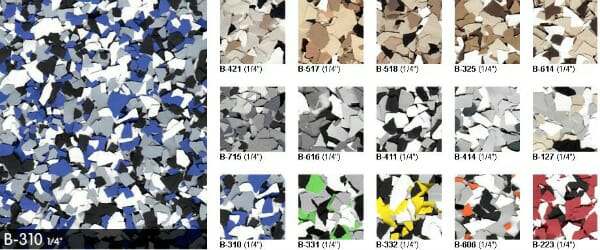
Often referred to as color flakes, color chips, or epoxy paint chips, these little explosions of color can help create some beautiful custom garage floor coatings with just a little creativity. Besides some distinct advantages to using them, they also tend to create a lot of questions about color combinations, floor coverage rates, the size of the flakes, and how to apply them.
Editor’s note: This article was originally published in June, 2013. We have updated it for accuracy and to reflect current trends.
In order to avoid some of the typical confusion that occurs with this topic, we discuss what color flakes are made of and answer some of the more common questions that you may have. In addition, we specify when you may not want to use color flakes at all.
What are Vinyl Color Flakes
Known in the industry as decorative vinyl color flakes, they are actually polymer paint aggregates made up of a combination of acrylic and vinyl resins. This combination creates a thin flake that is 4 – 5 mils in thickness. They are U.V. stable and are available in over 150 custom colors. They can even be custom color matched.
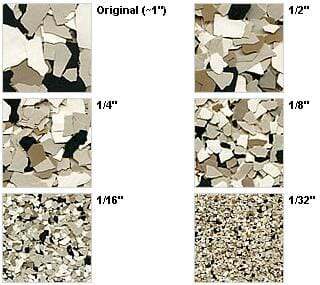 The shape of the flake is random and is available in sizes from 1” in diameter all the way down to 1/32”. The 1/4” flake is the most common size used in garage floor coatings.
Colors are blended together to create a particular look and then applied at a coverage rate that is determined by you. Typical coverage rates are light, medium, heavy, and full refusal.
Full refusal is when you apply the color flakes until the entire floor is covered and they will not stick anymore. One advantage to full refusal color flakes is that you can custom design your garage floor to almost any color combination you like.
As a tip, it’s always wise to err on the side of caution and get a little more flakes than what you think you may need when purchasing them.
One thing to keep in mind when determining your color choices is the base color coat of your floor. Grays and tans are the most common base floor colors, but you can do off whites and other colors as well. If you are doing a garage floor to full refusal, it’s still important to keep the base color coat in the same color tone range as the color flakes.
- Light coverage – requires .002 lbs per sf.
- Medium coverage – requires .01 lbs per sf.
- Heavy coverage – requires .04 lbs per sf.
- Full coverage – requires .15 lbs per sf.
Keep in mind these industry numbers are approximate and results can vary with application. We always recommend having extra on hand in case you run short.
Besides the obvious advantages of custom color combinations, color flakes also provide some sound deadening qualities and hide sub-surface imperfections in your concrete depending on how much flakes are applied. This means spider cracks and concrete patch work are less likely to show through the epoxy coating when using a heavy application.
In addition, vinyl color flakes are also flexible and strong. When applied to full refusal, they will add a minimum of 5 mils of thickness to your floor, improving both the durability and impact resistance of the surface.
Lastly, unlike epoxy they are U.V. stable. If you apply them to full refusal on an epoxy coating and then clear coat with a U.V. stable polyurea or polyurethene, you will never experience ambering (yellow tint) from exposure to direct or strong indirect sunlight.
There are some examples where you may not want to use color flakes. If your garage is used primarily for working on cars or other projects that may involve smaller parts such as nuts, screws, springs, cotter pins and etc, a coating without flakes is the preferred option.
The reason for this is that all those flakes tend to camouflage and hide these small parts. When dropped on the floor, you can spend quite a bit of time hunting the part down among the background of flakes. A garage floor coating with no flakes provides a solid color that makes it easy to find small parts.
Torginol is one of the leading manufacturers and distributors of color flakes. They can be purchased directly or through most garage floor coating companies and vendors. They offer an overwhelming selection of colors and sizes to choose from. Our recommendation is to view their Signature Collection to get a good idea of what color combination you may like.
Most of their selections are a three or four color blend. This has proven to be the optimal number of colors that provide the best combinations that are pleasing to the eye. With so many combinations to choose from, it’s generally easiest to choose a predetermined blend. However, you can experiment with your own custom color blends if you like.
Torginol actually has very cool custom color designer. Just click on the garage floor image you like and then click “Color Flakes”. You can then choose to design your own blend on the right. They even offer the option to upload your own image of your garage floor to experiment with.
When doing your own blend, we recommend picking a dark color and then a light color to start with. Black and white is a good example. Pick a medium color for the third or forth option and then experiment with the blend ratios.
Just remember that flakes blend well when looking at them from a height of 5′ – 6′ instead of less than 2′ from your computer monitor or cell phone.
How to Apply Vinyl Color Flakes
When applying a garage floor coating yourself, the color flakes are always applied immediately after the application of the base color coat of your epoxy coating. You want to start application within 10 minutes of the final back roll while the coating is still soft and tacky. This allows the flakes to slightly sink into the coating in order to achieve a good bond.
Once the flakes have been applied, it’s very important to apply a clear top coat. The top coat is what locks in the color flakes and protects the color coat. A thinner top coat will provide some texture to a heavily flaked garage floor while a thicker top coat will create a smoother surface without as much texture.
One thing to keep in mind: though you may have some surface texture from a thinner top coat, it will not increase the anti-slip properties much more than what a smooth surface provides.
Additionally, home improvement store DIY garage floor kits only provide enough color flakes for a light coverage rate. This is because they do not include a clear top coat in their kits. Anything more than a light coverage results in flakes peeling up in high traffic areas when a clear coat is not used. If you want more flakes, you will need to purchase them separately along with the proper clear coat.
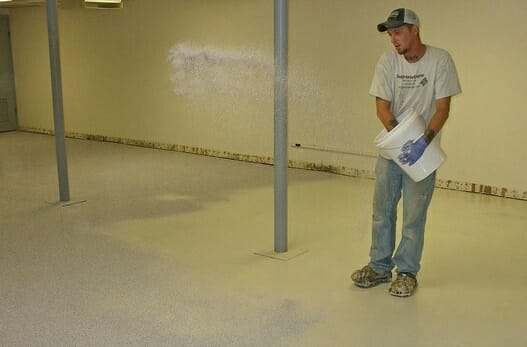 Color flakes being applied to full refusal – Photo courtesy of Supreme Crete
The most common question that people ask is; “What is the best method for applying color flakes”?
The most effective method is to place them in an empty bucket and then grab a small hand full at a time and toss them high into the air like you are feeding chickens. They should be close to bouncing off the ceiling. This allows for the flakes to disperse much better as they arc up into the air and then land back down on the coating in a nice and even dispersal.
The best way to practice your particular coverage rate is to toss them onto your clean concrete floor before you apply the epoxy. Do a small section to get the hang of it and then sweep them back up.
If doing your garage in sections, we highly recommend dividing your flakes up into equal amounts for each section. This will prevent over application of the first sections without enough left over for the remaining sections.
Do not toss the flakes directly at the floor! This will create dense areas of flakes that spread out in a “V” shaped pattern and are very hard to correct for.
If you are applying the flakes to full refusal, use a slightly modified method of not tossing them as high, but with larger handfuls of chips. You can work rather fast this way making sure you cover the entire floor.
If applying flakes to full refusal, you will need to remove all loose flakes that did not adhere to the floor. You should have quite a bit that were not able to reach the coating to stick. If you don’t, there will be problems with bare spots. Once done, sweep and then vacuum up the loose flakes. After that you will need to scrape the surface to break off flakes that are clumping in piles or sticking straight up in the air.
The easiest way to do this is to tape a 10” steel drywall taping knife to the end of an extension pole used for rolling. Keep the angle fairly shallow and push the scraper like you are sweeping a floor. You will not scrape the coating if enough flakes were applied. Once you are done, sweep again and then use a shop vac over the surface.
Because the surface is rough and irregular, the shop vac does a good job of pulling up any remaining loose color flakes. We even recommend using the plastic floor attachment of the shop vac as a final scraping tool as you go. Don’t fret about getting every last color flake. What you don’t get will become part of the top coat.
If not applying flakes to full refusal, you will still need to lightly scrape the flakes in order to break off any that are sticking up in the air at funny angles.
We like using a 10″ plastic drywall taping knife instead of a metal one like the full flake floors. In addition, apply a strip of duct tape across the edge as extra precaution to prevent scratching since the epoxy will not have fully cured yet.
Once the flakes have been scraped and cleaned up, you are now ready to apply the clear coat.
Now that you know how to use color flakes for an epoxy floor, have fun choosing your colors and the desired affect that you want. Whether you are applying your garage floor coating yourself or hiring a contractor to do it, you can feel confident in knowing that you chose the right color flakes and coverage rates for your taste.

I just completed an application of RockSolid Mocha polycuramine with an uneven broadcast of chips. One area is too heavy and looks terrible. Unfortunately, I hired a painter to help and he applied the RockSolid Clear coat over the top while I was out of town. Can I correct the small section of healy chips by putting a fresh coat of Mocha, broadcast chips, and clear coat? Can you coat over the clear? I am within the 7 day window. I just don’t see any info on coating over clear. Thanks!
Hi Brain. If you asking if you can do that to the entire floor, then yes, you can do exactly that if you are within the 7 day window. Just makes sure the surface is clean and free of dust. You may want to wipe it down first with denatured alcohol on a microfiber pad to ensure that, but that is it. However, if you just want to do the one area and not the whole floor, the answer is no. The reason is because coatings do not blend together like paint when you apply over them. It will create overlap marks in both the color and clear. The small area that you redo in this way will stand out more than it does currently. Tip – when applying color flakes, toss them high towards the ceiling – not at the floor. They will provide a much more random and even pattern as they fall when you do it this way.
Thanks Shea. It may be that overlap marks will look better than the really bad area this guy made. I may see how the patch approach looks and if bad redo then entire floor. Thanks again
I failed to vacuum and scrape after I applied the flakes. There are some areas where the metallic gold is protruding out. It’s been 9 days. Can I take a tapers knife and scrape, then apply a 3rd coat? If i leave it, it’s okay too. It actually came out really nice but i see what u mean.
Hi Pomai. Sorry to hear you forgot that step. You can apply another coat of clear, but at this point it would require roughing up and deglossing the surface first. 120 grit sandpaper on a pole sander or a black cleaning pad on a floor maintainer will do the job. It will also knock down any protruding chips. Once the floor is deglossed, wipe it down with denatured alcohol on a microfiber pad and then apply the clear.
I am planning to resurface the porch with sakrete/quickcrete – its a new house, but the exterior porch concrete is brushed finish. I am planning to smoothen it out with sakrete/flo-coat and was wondering if I can add the flakes on it?
also any suggestions to smoothen it or paint it is welcome. Its only a 100 sq ft, so renting a concrete grinder is too prohibitive as there are no nearby rentals available.
Hello Prasanna. You can’t add color flakes to concrete overlays. The material is far too viscous and thick to allow the color flakes to settle into it. Plus, they will not adhere well like they do with paints and epoxy coatings. Before applying an overlay, I would suggest trying a 20 grit rub brick on it to knock down the broom finish. It will require some elbow grease, but for 100 sq ft it may be worth it. Just keep in mind that if you apply a paint or coating, it will get slick if wet unless you apply an anti-slip additive with it.
Thank you so much Shea
After I flake a garage floor instead of scraping the excess flake off can I sand it with a sander using 120 grit sandpaper or higher?
Hello Robert. We are assuming you are referring to flakes applied to full refusal since that is the only application that requires scraping. The reason they need to be scraped is that after sweeping up all the loose excess, there will be many flakes pointing up at odd angles. The scraping knocks down these flakes and all the rough edges to provide a surface that is much more flat. If the scraping is not done correctly, you will end up with a floor that is uneven with many sharp edged flakes poking out of the surface of the coating. Sanding does not knock down the flakes very well. Some professional installers with much experience use a floor maintainer with a green or black scrub pad. They swing the machine side to side real fast over the surface to knock down the flakes without ripping them up. They do this more for expediency than anything else in order to get the job done quicker. It’s not recommended for a novice to try it though.
Just wanted to say that I really appreciate your willingness to help us DIYers out. Most Pros feel like it could cost them business to share “secrets of the trade” but I would say that it ultimately will help you guys out. I finished my garage with some help from your site and I’ve already had two different friends have their garages done professionally because they like the way mine turned out, but didn’t want to tackle the job themselves. Kudos to you for your professionalism and willingness to share. Wished more were like you. Thanks again from Atlanta, Georgia.
Thanks for the kind words!
Thank you.
A couple of things we like to reinforce with our customers:
1. It is our opinion that flake in excess of 1#/100 Sq. Ft. should have two coats of clear.
2. New products like Glitter Flake have special concerns and require two coats of clear — and particular attention to scraping.
3. All flake floors should be ‘scraped’ using a scraper or a wet dry vac (cover the plastic with duct tape so ti does nto mark your floor). Angular and flake that did not stick must be removed
Thanks for your input, Justin, you bring up some great points. In the update we deleted the paragraph about scraping all flakes and missed updating it 🙂
As a note to our readers, Justin is from Garage Flooring LLC and is one of our highly valued sponsors that is known for providing excellent customer service.
Hi there,
The coverage of paint chips on my garage floor improved as I went along. Because of this, the first half of my garage I feel isn’t covered enough in the paint chips in the way the second half is.
Can I lay down additional paint chips in those areas before applying the clear coat layer to my entire garage floor? Or must the clear coat be applied on its own with no loose chips?
I’m hoping that will even the look out.
Hi Ross. No, you can’t do that. The loose color flakes on the floor will just ball up and collect on the roller making a mess. There is a remedy, however, that involves two clear coats. Apply the first clear coat to the entire floor, taking care to add the color flakes where you like. Remember to toss them high in the air and use small pinches when doing this to fix an area. These color flakes will adhere to the clear coat. When it has cured long enough, apply a second coat of clear to the entire floor to lock everything in.
Hello, is there a time limit to the remedy? I put my floor down about 4 or 5 years ago, with no clear coat.
Thanks!
Hello Richard. There is not a time limit as long as the coating is in good shape. Assuming that you have color flakes in the color coat, it will require that you degrease the surface and then rough it up with 120 grit sandpaper. You can then apply the clear coat. We have a more detailed article on how to recoat a floor here.
I would say it’s in good shape with the exception of 4 or 5 small patches where it came off. There are flakes in the color coat.
Just keep in mind that the delamination of the coating in those areas can spread. A coating delaminating is a sign that it was not prepped as it should or there are other issues going on. A clear coat will not fix those issues.
I did a 3-coat polyurea floor with full broadcast flakes. After the base coat and flakes I scraped with a sharp flat shovel. Then I applied 2 top coats. Unfortunately there is still some sharp edges throughout. So clearly I didn’t scrape vigorously enough. What should be done at this point? Can you scrape after applying top coats and if so do you need another topcoat to protect? Or do I need to sand any sharp areas down and apply another top coat? If so what is the most effective sanding method?
Hello John. You will need to knock down the sharp edges as flush with the coating as you can and then sand the surface with 100 grit sandpaper. Vacuum, wipe down with denatured alcohol on a microfiber mop pad, and then apply another coat of clear. The idea of the sanding is to rough up and degloss, not remove. The easiest method is to use a floor maintainer with a 100 grit sanding screen. Home Depot usually has everything you need. A two car garage should take less than two hours, not counting sanding the edges and corners that the machine won’t reach. The new coat will make everything look as it should.
Hi, we have just done a very decent size kitchen and two very large bathrooms with an epoxy flaked floor. We were trying to get the full coverage look. We did this yesterday and came back today. We scraped everything and vacuumed the excess. After this process we noticed that it’s very blotchy where some area took or had more flake than the rest. What steps can we do to fix this?
Hello Sydney. This is usually caused from one or more of three things. Not applying enough flakes, not using a high solids coating (thicker), or applying the flakes when the coating has already begun to cure (too late). Fortunately, it’s not that hard to fix. Mix up some of the clear coating that you plan to use and apply it to the areas where there is not enough flakes, then toss more flakes into that. Re-scrape those areas after 12 hours or so and you should be good to go for a complete clear coat.
Is the clear coat good for that long. We have an issue with a spot we had to touch up with second coat of epoxy. We didn’t blend the flakes well enough so the spot is a big blotch. Can we put on some clear coat, sprinkle the flakes on the top coat, finish the Top coat on the rest of the floor and then give that coat a second coat while the top coat is still good or can the top coat be stored over night after mixed?
Hi Susan. What product are you using and how long has it been down? Has clear been applied at all yet?
We put. Epoxy down 2 days ago And want to put the clearcoat down today but I really wanted to fix a blotchy Spot that has to few flakes
Again, what product are you using exactly? Recoat times vary per manufacturer and makes a difference on how you go about fixing your issue.
Something I forgot to mention, Susan. Do not mix the epoxy and let it sit to use later. Epoxy is exothermic and will begin heating up. This is how it cures. It will actually get hot enough to start smoking and will melt a plastic container.
It is rustoleum 2 part epoxy
OK, that helps. Rust-Oleum EpoxyShield has a 4 day recoat window. Any longer than that and you will have to sand the floor first with 120 grit sandpaper before applying an additional coat. As long as you are in within the recoat window you can do what you were suggesting. Apply the first coat of clear while making sure to add the color flakes to the one area that needs it. Wait a minimum of 12 hours and then apply the second coat of clear. You should not be able to tell where the flakes were added. Just to reiterate in case you missed it – do not mix any epoxy up to set for application later. It will get real hot and cure in the bucket. As a tip when applying color flakes, always toss then high into the air so that they fall down in a nice random pattern. When they are tossed more directly at the floor they tend to land in clumps or lines that do not look random.
I’m getting my garage floor epoxied with grey, black and blue decorative chip flakes. I’m debating whether to go standard or heavy with the flakes. We have a huge snake problem where we live and I want to make sure I’m able to identify if a snake comes in and that the chip flakes don’t make it difficult for us to identify one if it ever gets in. what do you think? (I do like the look with the decorative chip though so not having them isn’t an option)
Hi Hanna. My guess is it would all depend on the color of the snakes! The black and blue flakes will tend to create a darker background if you go heavy. If the snakes are dark in color, then they may not be quite as visible if the floor is not well lit.
Can flakes be used with Rustoleum garage and basement paint primer?
Hello John. You can technically apply color flakes to just about any type of paint or coating. However, Rust-Oleum garage primer is not to be used as a wear surface, nor is it to be clear coated according to their data sheets. It’s to be used only as a primer for the subsequent application of a color coat of paint or a true coating. It is the paint or epoxy coating that you would apply the color flakes.
I bought a house with the epoxy and flakes. It’s sort of a blue tint and I think they didn’t do the clear coat so it’s dull and peeling. I wanted to do it over with a grey/metallic epoxy and white/black/grey flakes. Is this possible to do over a floor with flakes already on it?
Hi Leena. Yes, you can do that, but we always recommend removing any old coatings that are suspect or if you don’t know if it was applied correctly. Just a word of warning; coatings that are peeling are an indication that it did not adhere well for various reasons. If you apply a new coating over the old, chances are it will peel up with the old coating underneath. We recommend scraping all of the old coating real well first to remove any of that shows signs of peeling. We have an article here about how to apply new coatings over old ones.
Good to hear! Thank you! I will check out the article now!
How long does it take for the flakes to completely go away?
How soon can you mop over the finished floor?
Is it ok to shampoo area carpets on the finished floor?
Hi Jan. What do you mean about the flakes to completely go away? Give epoxy floors a full week before doing any mopping or cleaning. Shampooing area carpets on is fine as long as you rinse away the residue.
I used Behr concrete paint and laid down a mild set of flakes down on top of the paint. I haven’t applied epoxy yet. There were some spots that came out with less paint. So wanting to repaint the whole garage and re-flake it.
So is it okay to re-paint the whole garage over the flakes? Or will this creat a long term paint peeling problem?
Hi Niraj. Yes, you can do that. However, paint cannot have epoxy applied on top of it if that is what you are thinking. Paint and epoxy are completely different and not compatible.
It’s the epoxy shield. Can we use Epoxy shield over the paint?
Or what do you recommend
Want a clear finish
400sq ft
What you used is an acrylic latex paint with some epoxy resin in it – AKA 1-part epoxy paint. It is not designed nor intended to have a clear coating applied over it. EpoxyShield is a true two part epoxy coating that is dissimilar to paint. It will not chemically bond to paint. Technically, the only way to apply epoxy over paint is to rough up the surface of the paint with 120 grit sandpaper in order for the epoxy to adhere via a mechanical bond. Also, you cannot use the EpoxyShield Clear that is solvent-based. It will soften the paint and cause it to bleed and smear. It has to be a water-based clear. I suggest you read this first.
Hello and thank for the previous help! My wife is wanting some glitter effect on a basement floor. We are looking at an “artglitter” product but not sure what size to buy. We are going with a very light application.
Hi Brian. We are not the experts when it comes to glitter floors. However, we know that Justin from Garage Flooring LLC has much experience with it. I suggest you contact him via email or a phone call. He would be happy to help and may even have a glitter recommendation or some available from his company.
How long Should I wait to scrape excess flakes after I applied them?
Hi Yuki. You need to wait 10-12 hours before scraping the flakes.
Thank you so much!
I am doing a 550 sf garage. I ground it yesterday with a 300 lb rental grinder. Used a 600 grit diamond. Now color is uniformly light gray. Got rid of all the stains. Will that be rough enough to take epoxy? I am planning to use versatile 4195, flake, then 5805 top coat.
Hello Bob. No, that is not rough enough for epoxy. You are basically honing the concrete smooth with a 600 grit disc. You need a minimum of a 70-80 grit diamond disc to achieve a CSP-1 profile (the minimum for concrete coatings). Most grinding is done with a 25 grit diamond disc.
applied rocksolid epoxy and flakes on garage floor 24 hours ago. floor is dry to walk on. have several areas that the epoxy had absorbed into the concrete and no shine is apparent. can I re-coat over the areas without problems.
Hi Thomas. Yes, you can do that. What you have experienced is a common complaint. RockSolid allows up to 7 days for a recoat without further prep.
I coated my garage with the Rustoleum Polycuramine industrial dark grey stuff… with some red/black/white flakes. I tried to get “Full broadcast” however looking at what full broadcast should have looked like, I didn’t quite get there. It may be Medium/Heavy broadcast at best. Although, it doesn’t look bad.
That being said… I have some Rustoleum clear to put over top of the grey and flake coating. I also have red and silver glitter to potentially mix in with the clear. Any thought’s on how this would look? And how well it would work?
Hello Clay. RockSolid is far too thin of a coating for a full broadcast. You need a single coat dry film thickness of close to 6 mils so that the coating can absorb and properly grab hold of the color flakes. RockSolid is barely 3 mils if the concrete does not absorb too much. Make sure to lightly scrape the floor to knock down high spots and flakes sticking up instead of laying flat. Then sweep real well. A shop vac with that has duct tape around the floor attachment to prevent scratching works well. If you don’t do this step, you have sharp coated points sticking up in the coating.
The look of glitter floors is dependent upon the eye of the beholder 🙂 That said, glitter can be a tricky substance to work with and it does need mixing it in with the clear coat. However, what it requires is cutting the corner of the clear resin side of the RockSolid pouch and pouring it into a bucket first. You then mix in the glitter with the resin using a jiffy mixer. Once you get the glitter to resin distribution the way you like it, you can then cut the corner of the hardener pouch and mix that in with the glittered resin. Mix for approximately a minute or so. At no time should the Jiffy Mixer be going so fast to introduce air. Don’t pump it up and down aggressively either. If you do, you will have bubbles in your coating. After that, apply according to the RockSolid directions.
Shea-I’m planning on installing a medium/heavy coverage of flake in my second coat of Rustoleum Professional two part epoxy. I’m leaning toward a WB urethane clear coat. Do you think I should apply two coats of clear?
Thanks
BTW-I’m planning to use a Scotts Wizz spreader to uniformly disperse my flake since I’ve never done this before.
Hi Dave. Yes, if you are applying a polyurethane to heavy flakes then two coats are recommended.
When applying clear top coat is it advisable to add a slip resistant sand to the top coat? Will it make the surface to rough for mopping during cleaning?
Hi Jay. No, you do not want to use sand. Instead, you should use an anti-slip media that consists of micro polymer beads made for applications into floor coatings. These will provide anti-slip resistance, yet be soft on bare feet and won’t snag mops. We have an article about anti-slip additives here.
I plan on doing a basement floor using seal krete epoxy seal (dark grey) I’m not overly concerned with the finished look it will not be a showcase floor. Do I have to put a top coat (clear coat) ? Can I just toss some of the flake to the base coat and call it a day?
Hi Kevin. Seal Krete Epoxy-Seal is a 1-part epoxy paint. It’s essentially a latex acrylic concrete paint with some epoxy resin added to increase durability. They are not compatible with most clear coats and not designed for clear coat use. Just tossing a few flakes in the still wet paint and calling it day is exactly what these type of paints are designed for.
We used Behr garage etching primer. We then applied Behr epoxy floor and Rustoleum chips. Do we seal it with clear? When do we apply the clear? How many layers of clear? How long to cure? We need to empty our pods into the garage.
Sorry it was rustoleum concrete and garage repost primer. We used muratic acid prior as well.
Hi Tracy. What you used was Behr 1-part epoxy paint. 1-part epoxy paint is latex acrylic concrete paint that has little bit of epoxy resin added to help increase durability. It is not compatible with true clear coatings nor is the product intended for one. This article here explains the differences between paint and epoxy. This article here explains why 1-part epoxy is not a good candidates for a clear coat.
Ugh. Will what we used hold up? We did a heavy coat of chips. Will they stay? How long does it take to cure? Before we can move items in.
Behr 1-part epoxy paint is a paint and does not cure chemically like a coating. It dries just as paint on a wall does. According to Behr, you need to wait 24 hours for foot traffic, 72 hours before moving items in, and 7 days before vehicle traffic. If heavy flakes were applied, then you are going to have issues with flakes coming loose. 1-part epoxy paints are thin and can only accept a light application of flakes. I would suggest to start sweeping with a stiff bristled push broom to gather up the flakes that will easily come loose. They will continue to loosen over time until only the more permanent remain. You will more than likely experience hot tire pickup within 6 months to a year. These type of paints will generally last for 1-3 years depending on use and the areas of the country you live in. Harsh winters are harsh on concrete paint where vehicles are parked. I would suggest leaving it as is until you don’t like the looks anymore and then remove it entirely to apply a proper DIY garage floor coating that will last years. FYI, Behr suggests to use their Wet Look Sealer for a clear coat. DON’T USE IT. It’s a very thin water-based clear acrylic coating that does horribly in a garage environment and only makes things worse if you ever want to try to touch up or patch an area.
Unfortunately, we get many readers like yourself that find our website once they start to have questions about what they installed. It’s understandably easy to fall prey to the marketing hype that these companies use for their easy to apply DIY paints. We have an article here about best garage floor paints, but we address the issues and short life spans of these products. Hopefully you will get some life out of what you have now before it needs replacement.
Hello,
What drawbacks can you advise on for using flake flooring as a design finish for the interior of a small apartment?
I want a light/medium flake finish but have been advised this ‘compromises the product’ and ‘opens up the finish to yellowing’. Some people have advised they use a different coat to the epoxy to avoid yellowing.
Any help would be appreciated!
Hi Madeleine. An epoxy coated floor with color flakes is not common for an apartment due to the more industrial look, but it can certainly be done. Ambering (yellow) of the epoxy will only happen if there will be areas of the floor that are exposed to direct sunlight. If that is the case, then what you would need to do is apply a coat of polyurethane that is tinted the same color over the epoxy color coat. You can then apply your flakes to that. Polyurethane is U.V. stable and will not yellow. It does not adhere to bare concrete very well and is why it has to be applied over the epoxy.
Hi Shea,
Thanks for all the useful information we’ve been able to read before doing our garage floors with the rustoleum 2-part epoxy with their paint chips. Both in the articles and scouring the helpful comments.
We were able to get our prepainted garage floors prepped correctly and the epoxy is curing nicely. However, we ran out of chips (used the 2 from the kit and an extra bag) on the very last little square of the garage and the store wasn’t open last night for another 8 hours, so we couldn’t grab more. I’ve seen your advice for adding some to the clear coat, however we are using polyurethane.
Per your articles, we opted for a water-based flooring polyurethane for the clear coat (in gloss) over the epoxy because the benefits long term seem to beat the epoxy clear option… by a long shot! We are planning to do this tomorrow night (about 48 hours from finishing the epoxy) and do as many coats as 2 gallons will cover (in 510sq ft.)
My question is, would we be able add color chips to the first coat of polyurethane and then coat over that once it’s dried to lock them in? Will you be able to notice the different layers of chips? Do you recommend adding chips in other sparse spots within the clear coat as well?
Also, the floor is still kind of wet now (it’s been 8 hours). Could I sprinkle the chips on the patch now?
Thank you in advance!
Hi Kristin. We are glad all the tips and comments have helped. That is why we started this website. Because you are going to apply two coats of polyurethane, apply any additional color flakes immediately after the first coat. Make sure use small pinches and toss them high. If you try to be more direct with your application you will end up with heavier concentrations in a not so random look and it will be noticeable. Polyurethane goes on thin, so you won’t really notice any difference in the way the color flakes look after you apply the second coat. Also, try to get the polyurethane coat down sooner if you can. Rust-Oleum allows for a longer recoat window when using only Rust-Oleum products. When using something different you should try and stay within the standard 24 hour recoat window. Out of curiosity, what water-based polyurethane are you planning on using? We just want to make sure that you did not purchase a polyurethane from a home improvement center that is intended for wood floors and furniture. We’ve had more than one reader make that unfortunate mistake.
Hi! Thanks for the quick response. I’m not sure what it is called, but my partner ordered it online after we read your articles. It’s not the type you can buy in stores. It will be here tomorrow which is why we’d be doing it then. Is that too late?
Also, out of curiosity and doing our research, there’s not much info on the difference between the polyurethanes like from varathane, etc and the kind you recommend on the website. Could you share the differences? ? it was definitely more expensive to buy this kind online!
Thank you!
Kristin
If you bought it online from a concrete coating vendor then it will be the right kind. It’s not inexpensive. Polyurethanes like Varathane are for wood floors and furniture. It’s and apples and oranges comparison. They are not compatible with concrete coatings (will not adhere), they have a yellow tint, and they won’t tolerate the type of automotive chemicals that polyurethane for concrete coatings will. You most likely will be OK applying it if it will be under 48 hours, but there is no guarantee. If you don’t want to take the chance, then it will require that you let the epoxy cure for another day and then degloss the surface with 120 grit sandpaper before you apply it.