
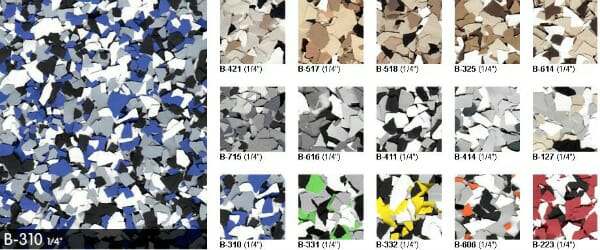
Often referred to as color flakes, color chips, or epoxy paint chips, these little explosions of color can help create some beautiful custom garage floor coatings with just a little creativity. Besides some distinct advantages to using them, they also tend to create a lot of questions about color combinations, floor coverage rates, the size of the flakes, and how to apply them.
Editor’s note: This article was originally published in June, 2013. We have updated it for accuracy and to reflect current trends.
In order to avoid some of the typical confusion that occurs with this topic, we discuss what color flakes are made of and answer some of the more common questions that you may have. In addition, we specify when you may not want to use color flakes at all.
What are Vinyl Color Flakes
Known in the industry as decorative vinyl color flakes, they are actually polymer paint aggregates made up of a combination of acrylic and vinyl resins. This combination creates a thin flake that is 4 – 5 mils in thickness. They are U.V. stable and are available in over 150 custom colors. They can even be custom color matched.
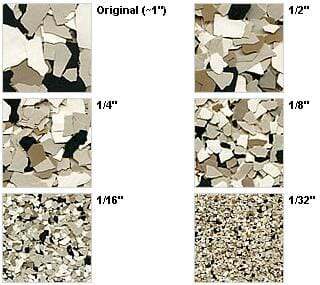 The shape of the flake is random and is available in sizes from 1” in diameter all the way down to 1/32”. The 1/4” flake is the most common size used in garage floor coatings.
Colors are blended together to create a particular look and then applied at a coverage rate that is determined by you. Typical coverage rates are light, medium, heavy, and full refusal.
Full refusal is when you apply the color flakes until the entire floor is covered and they will not stick anymore. One advantage to full refusal color flakes is that you can custom design your garage floor to almost any color combination you like.
As a tip, it’s always wise to err on the side of caution and get a little more flakes than what you think you may need when purchasing them.
One thing to keep in mind when determining your color choices is the base color coat of your floor. Grays and tans are the most common base floor colors, but you can do off whites and other colors as well. If you are doing a garage floor to full refusal, it’s still important to keep the base color coat in the same color tone range as the color flakes.
- Light coverage – requires .002 lbs per sf.
- Medium coverage – requires .01 lbs per sf.
- Heavy coverage – requires .04 lbs per sf.
- Full coverage – requires .15 lbs per sf.
Keep in mind these industry numbers are approximate and results can vary with application. We always recommend having extra on hand in case you run short.
Besides the obvious advantages of custom color combinations, color flakes also provide some sound deadening qualities and hide sub-surface imperfections in your concrete depending on how much flakes are applied. This means spider cracks and concrete patch work are less likely to show through the epoxy coating when using a heavy application.
In addition, vinyl color flakes are also flexible and strong. When applied to full refusal, they will add a minimum of 5 mils of thickness to your floor, improving both the durability and impact resistance of the surface.
Lastly, unlike epoxy they are U.V. stable. If you apply them to full refusal on an epoxy coating and then clear coat with a U.V. stable polyurea or polyurethene, you will never experience ambering (yellow tint) from exposure to direct or strong indirect sunlight.
There are some examples where you may not want to use color flakes. If your garage is used primarily for working on cars or other projects that may involve smaller parts such as nuts, screws, springs, cotter pins and etc, a coating without flakes is the preferred option.
The reason for this is that all those flakes tend to camouflage and hide these small parts. When dropped on the floor, you can spend quite a bit of time hunting the part down among the background of flakes. A garage floor coating with no flakes provides a solid color that makes it easy to find small parts.
Torginol is one of the leading manufacturers and distributors of color flakes. They can be purchased directly or through most garage floor coating companies and vendors. They offer an overwhelming selection of colors and sizes to choose from. Our recommendation is to view their Signature Collection to get a good idea of what color combination you may like.
Most of their selections are a three or four color blend. This has proven to be the optimal number of colors that provide the best combinations that are pleasing to the eye. With so many combinations to choose from, it’s generally easiest to choose a predetermined blend. However, you can experiment with your own custom color blends if you like.
Torginol actually has very cool custom color designer. Just click on the garage floor image you like and then click “Color Flakes”. You can then choose to design your own blend on the right. They even offer the option to upload your own image of your garage floor to experiment with.
When doing your own blend, we recommend picking a dark color and then a light color to start with. Black and white is a good example. Pick a medium color for the third or forth option and then experiment with the blend ratios.
Just remember that flakes blend well when looking at them from a height of 5′ – 6′ instead of less than 2′ from your computer monitor or cell phone.
How to Apply Vinyl Color Flakes
When applying a garage floor coating yourself, the color flakes are always applied immediately after the application of the base color coat of your epoxy coating. You want to start application within 10 minutes of the final back roll while the coating is still soft and tacky. This allows the flakes to slightly sink into the coating in order to achieve a good bond.
Once the flakes have been applied, it’s very important to apply a clear top coat. The top coat is what locks in the color flakes and protects the color coat. A thinner top coat will provide some texture to a heavily flaked garage floor while a thicker top coat will create a smoother surface without as much texture.
One thing to keep in mind: though you may have some surface texture from a thinner top coat, it will not increase the anti-slip properties much more than what a smooth surface provides.
Additionally, home improvement store DIY garage floor kits only provide enough color flakes for a light coverage rate. This is because they do not include a clear top coat in their kits. Anything more than a light coverage results in flakes peeling up in high traffic areas when a clear coat is not used. If you want more flakes, you will need to purchase them separately along with the proper clear coat.
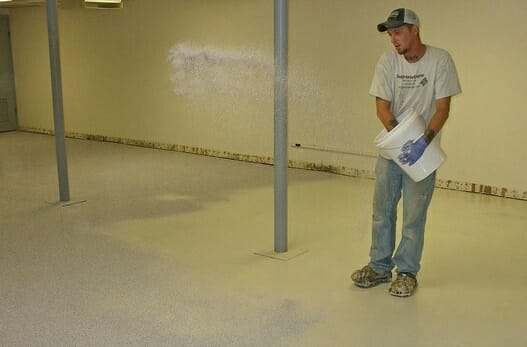 Color flakes being applied to full refusal – Photo courtesy of Supreme Crete
The most common question that people ask is; “What is the best method for applying color flakes”?
The most effective method is to place them in an empty bucket and then grab a small hand full at a time and toss them high into the air like you are feeding chickens. They should be close to bouncing off the ceiling. This allows for the flakes to disperse much better as they arc up into the air and then land back down on the coating in a nice and even dispersal.
The best way to practice your particular coverage rate is to toss them onto your clean concrete floor before you apply the epoxy. Do a small section to get the hang of it and then sweep them back up.
If doing your garage in sections, we highly recommend dividing your flakes up into equal amounts for each section. This will prevent over application of the first sections without enough left over for the remaining sections.
Do not toss the flakes directly at the floor! This will create dense areas of flakes that spread out in a “V” shaped pattern and are very hard to correct for.
If you are applying the flakes to full refusal, use a slightly modified method of not tossing them as high, but with larger handfuls of chips. You can work rather fast this way making sure you cover the entire floor.
If applying flakes to full refusal, you will need to remove all loose flakes that did not adhere to the floor. You should have quite a bit that were not able to reach the coating to stick. If you don’t, there will be problems with bare spots. Once done, sweep and then vacuum up the loose flakes. After that you will need to scrape the surface to break off flakes that are clumping in piles or sticking straight up in the air.
The easiest way to do this is to tape a 10” steel drywall taping knife to the end of an extension pole used for rolling. Keep the angle fairly shallow and push the scraper like you are sweeping a floor. You will not scrape the coating if enough flakes were applied. Once you are done, sweep again and then use a shop vac over the surface.
Because the surface is rough and irregular, the shop vac does a good job of pulling up any remaining loose color flakes. We even recommend using the plastic floor attachment of the shop vac as a final scraping tool as you go. Don’t fret about getting every last color flake. What you don’t get will become part of the top coat.
If not applying flakes to full refusal, you will still need to lightly scrape the flakes in order to break off any that are sticking up in the air at funny angles.
We like using a 10″ plastic drywall taping knife instead of a metal one like the full flake floors. In addition, apply a strip of duct tape across the edge as extra precaution to prevent scratching since the epoxy will not have fully cured yet.
Once the flakes have been scraped and cleaned up, you are now ready to apply the clear coat.
Now that you know how to use color flakes for an epoxy floor, have fun choosing your colors and the desired affect that you want. Whether you are applying your garage floor coating yourself or hiring a contractor to do it, you can feel confident in knowing that you chose the right color flakes and coverage rates for your taste.

I had my painter apply Rust-Oleum RockSolid 152 oz. Dark Gray Polycuramine 2.5 Car Garage Floor Kit to my garage and he applied some decorative chips but not a lot. My question is it ok to now add the Rust-Oleum RockSolid 90 oz. Clear Top Coat Garage Floor Kit as long as within 7 days and no cars have been driven into garage yet? Also, can I add more decorative chips when applying the clear top coat? Thanks!
Yes you can Brett. One of the many advantages of applying a clear is that it locks in the color flakes and makes for easier clean up. You can add more color flakes to the top of the clear coat if you want, but they won’t be locked in like the ones attached to the color coat.
Can I apply flakes to Dryloc without a clear top coat? That is, will they sort of emulsify into the paint? I know that thhis won’t give me as good a job as a two-part with a clear coat, but job time is critical for me and I am willing to live with the less endurance of the Drylok.
Thanks.
Yes you can Ralph. Just don’t go too heavy with the flake dispersal and be sure to distribute them while the paint is still freshly wet for best adhesion. You will lose some after the paint dries. This is normal since paint is not as thick as actual coatings and the flakes don’t sink very deep.
This article didnt explain how to do the side walls. Could you explain to me how I can get an even coverage on side walls when you are doing a light or medium coverage? Throwing them up doesn’t get the sides because they just fall downwards. Thanks!!
That’s a great question Grant. After you apply the coating to the side walls (commonly referred to as stem walls), you will need to take a small pinch of the color flakes, stand back a good 6′ or so, and throw the flakes at the wall. It works best if your fingers are slightly cupped. If you grab to much flake they will tend to clump together more when they hit the wall. A real small pinch with a good throw will cause them to disperse more. Also, when applying something other than full flakes, it requires that you coat the sidewalls first before doing the rest of the floor. The reason for this is that the flakes that get tossed and miss will collect near the base of the wall and cannot be removed.
Question: I just spread paint flakes into a third and final coat of Rust Bullet, but the flakes are pretty uneven. Can I attempt to correct it in the clear coat? Perhaps if I use a second clear coat afterward? And to what degree will extra non-slip additive help disguise poor paint roller marks if at all? Thanks.
Hello Russ. The key to adding color flakes to a coating is to toss the flakes high into the air. When they float down to the ground you get a much more even dispersal pattern. You can attempt to correct for the uneven flakes if you use two coats of the clear as you suggested. Apply the flakes to the first coat and then apply the second clear coat to lock them in. The anti-slip granules will take a little of the gloss out of the finish, but it’s not going to do much to hide roller marks.
Great. What if I lay down another coat – maybe two – of Rust Bullet Concrete, painting over the terrible flake job I did, and re-apply flakes evenly in the last of those coats before a final clear coat? I wonder how well a couple more coats might cover my bad roller and flake job. Brainstorming. Thanks for any advice.
You could do that, Russ, but it can expensive with all those extra coats. Don’t forget that you will need to rough up the surface with 120 grit sandpaper if the coating is outside the recoat window.
Can I use these flakes on my trailers countertops?
You could if you are encapsulating them in epoxy, Kim. There are companies that manufacture epoxy specifically for counter tops.
I applied decorative flasks a week back .. I feel it bit loose and coming out .. if I apply top coat now ,will it stick back ?By the way, what is that top coat ? Can give details please ?
Thanks
Hello Athi. What did you apply the flakes too? Was it paint or epoxy? If it was paint, you cannot apply a clear coat. This article explains why. If it was epoxy, we have an article here about choosing clear coats. Keep in mind that you will need to rough up the surface of the coating first with 120 grit sandpaper since you are past the recoat window.
It’s a 1 % epoxy based garage floor paint and applied decorative flakes on 2nd coat .. now I have few patches stick well and other place it’s not stick . No looking good .. let me know what I need to do ..plz help
Since it’s a 1-part epoxy paint and not an epoxy coating, Athi, you can’t apply a clear coat. The areas where the color flakes are not adhering well may have been thin with not as much paint for them to sink in to or you waited too long to apply them. The only thing you can do at this point is scrape the floor to remove as much flakes as possible and then repaint another coat and apply the color flakes again. The problem with paint over a true coating is that paint is thinner and it is harder for the flakes to adhere properly.
The exterior of my house, built in 1970, is spraycrete. Do you know of a product I can use to do touch up “painting”? I’ve had paint companies & decking spraycrete people here & they don’t do this anymore. It’s the exterior walls. Not decking or flooring that I’m interested in take of care of.
Hello Jerry. Unfortunately we are not aware of any touch up products for your siding. Ceramic spray coating a home is becoming popular around our neck of the woods. They seem to be using a product by RhinoShield. Maybe they can help you out.
Can i redo my garage floor after doing it 8 years ago or would i need to a concrete floor sand the whole garage.
Hello Jarrod. We have an article about applying a new coating to an old one here.
Completed base coat (after primer coat) with flake broadcast to full rejection. After sweeping, the flake coverage is uneven and roller marks are present. How do can this be fixed before top coat is applied?
It sounds like you didn’t apply enough color flakes, David. If you have uneven problems everywhere, it may require applying a thin layer of clear and then broadcast more flakes. After 12 hours passes, scrape those and then apply your clear coat. If it’s only in a few areas, you can mix up just a small amount of clear and apply that to the bare areas and apply flakes.
I did my garage and have a few dark bald spots how can I touch them up
Hi Jill. Can you provide more details? What type of coating product did you use? Was a clear coat applied over it? What do you mean when you say dark bald spot?
Hi,
I had a professional epoxy my garage floor yesterday and it looks great and shines well. The floor is bumpy from the flakes. Is this normal? I thought it would look like a show room floor and I don’t recall any bumpiness at the car dealership.
Hi Jenil. Yes, that is very normal. You want a garage floor to have a little bit of texture to help keep it from being too slippery. A glass smooth floor looks great for showrooms, but it’s not advantageous for a garage.
Hi,
I just painted my garage with HC concrete sealer and am going to use a clear coat on top. Can I use glitter in place of vinyl flakes or will the paint break down the glitter?
Hello April. Color flakes and glitter is usually applied on top of the color coat immediately after it is applied (still wet) and then a clear coat is applied. More importantly though, what product did you use exactly? Was it Color Top Concrete Sealer or something else? Also, what clear are you planning to use? I ask because it looks as though you have used a tinted sealer and not the type of coating that is used for color flakes and glitter.
I’ve got a section in the middle of the garage floor that runs the width of the floor, it’s a little darker than everywhere else. I feel as if I didn’t spread enough epoxy-coat in that area. It’s already flaked and I have clear coat to do. Can I reapply epoxy-coat to that section for a touch up, reapply flakes, and then put on clear coat?
Hi Clayton. Is it a full flake floor? If so, you can apply more epoxy color coat and then add more flakes. If it’s a partial flake floor, then you will have some issues. The first is that you can’t apply more epoxy unless you are within the manufacturer’s recoat window. If you are past that, then you will need to rough up the surface first with 120 grit sandpaper. The other issue is that epoxy does not blend like paint on a wall. The area that you apply more epoxy to will show the overlap lines and look a little different.
I will be putting down epoxy myself in the garage. I’m interested in adding glitter to full broadcast to rejection flakes. Are there specific types of glitter I should be using or can I just pick them up from a craft store?
Also, should I mix in the glitter to the bucket of flakes or do the flakes first followed by sprinkling glitter then top coat?
Thanks!
Hello Jeremy. Combining flakes and glitter together on the floor will be difficult due to the large difference in size. You can’t mix them together in a bucket to distribute because the glitter will quickly sink to the bottom. What it would require is doing the full flake coverage first. After you scrape the loose flakes up, you would then apply a thin coat of clear. This won’t completely cover the flakes and it will allow the glitter to stick and be visible on the surface. After that, you would apply another coat or two of clear to lock everything in. If you were to apply the glitter after scraping the loose flakes up, but before you applied clear, you will have issues with the glitter falling in the nooks and crannies of the flakes. Plus, the roller will be picking the glitter up and possibly create uneven areas and clumps of glitter.
You may want to consider mica flakes instead. They have a metallic glitter effect. If you visit Torginol you see all the combinations of color flakes, mica flakes, and glitter. Contact them and they can send you samples and tell you were to buy it.
How many mils are recommended for the base and top coats for a full flake rejection install? I am using a colored 100% Solids Epoxy base and a 72% Solids polyurea for the top coat. I was thinking 8 mils each. Thanks!
Hi James. A 100% solids base coat works great for a full flake floor. Just get the flakes on as soon as you can and they will sink in and take hold. You generally need two coats of clear polyurea. The reason is that much of the first coat is absorbed by all the nooks and crannies of the flakes and ends up very thin. The coverage rate is less as well. The second coat will not be absorbed at all. It will be thicker and you will get a much better coverage rate. Expect approximately 5-6 mils of thickness (over the flakes) with the two clear coats.
Do I have to use a two part epoxy or can I use something like epoxy shield concrete floor paint when full broadcast flaking? What I mean is basically one part epoxy paint then a complete cover with flakes and followed by a strong two part clear coat to lock in the flakes.
Thank You in Advance!
Hi Joe. No, you can’t use 1-part epoxy paint for a full flake application. It has a very thin dry film thickness (<2 mils) compared to the appropriate epoxy or polyurea coating (6-10 mils). The flakes can't sink far enough in to take a proper hold. Also, 1-part epoxy paint will not bond as tenaciously to the flakes like a proper coating will. Lastly, 1-part epoxy paint will not adhere to the concrete as well as the appropriate coating. Even if you could get quite a few flakes to adhere, the coating would still peel from hot tire lift due to the 1-part epoxy paint being the primary agent that is bonded to the concrete. Lastly, 1-part epoxy paint is still a latex paint product and is not compatible with true coatings. This article here helps to explain the difference.
Looking for the best system for my garage, I will be doing it myself. What do you recommend. New floor?
Are you referring to color flakes, David?
I just did my garage floor yesterday and used 3 cans of the epoxy shield with blue flakes, But the last can result was a little lighter than the two cans. I was thinking of putting the clear coat tomorrow on it. Can i resolve this by addingg gray stain additives on the clear coat to plainly cover eveything? Tia
Hi Algene. Unfortunately, that can happen when you have to use more than one kit for a single coat on a larger floor. That’s why it’s always recommended to mix all of the part-A colored resin containers together first and then pour them out in equal amounts to mix with each part-B hardener. It ensures that you get a consistent color with each application. You need to use an epoxy approved tint if you want to color the clear epoxy. It would need to be mixed in with the part-A clear first, then mix that together with the part-B. You can’t just add any ole stain additive.
We used rust bullet. Three coats of the concrete base went down no issue, on the third coat we did flakes. After letting it dry we went to put the top coat down only to find the can was damaged and the top coat is solid and unuseable. Obviously we cannot get a new top coat ordered and shipped within the window of drying time. So what do we do? Will we have to sand the flake before putting a top coat on? Will that completely ruin the flakes and thus require us to completely redo the process? What happens if we don’t sand it and just put the top coat on outside the dry window once it arrives? Thoughts?????
Hello Sarah. Unfortunately, this is a lesson as to why you should always check all your product first before you start. Not all is lost though as you are not the first person that has gotten caught in this predicament. At this point you will need to rough up the surface or the clear coat will not adhere properly. As long as the flakes are adhered well you should be fine. Rough up the surface with 120 grit sandpaper. A pole sander would be the safest way to do this in regards to the color flakes. The goal here is to degloss the surface and provide some texture for the clear coat. Yes, you will lose a small amount of color flakes during the process, but it should not be much. The sanding will dull the coat and the color chips. No worries though, as soon as you apply the clear it will gloss everything back out and look great! Just be sure to vacuum and get all the dust left behind from the sanding.
When doing an epoxy garage floor should I mix the silica with part a&b or broadcast after it has been applied and backrolled? Or is it best to add a poly clearcoat with grit after?
Thanks
Hi Cam. Your anti-slip additive always gets mixed into the last coat. Polyurethane is an excellent medium for it.
Does full refusal color chips adhere better to a certain type of concrete paint? Do I need to use epoxy based paint if I plan on putting an epoxy clear top coat over the full refusal color chips?
Hello K-10. Paint can only accept a small dispersion of color flakes due to the thin film that paint provides. It doesn’t provide a good base for them to adhere very well. You cannot apply a clear coat to paint as well. You need to use a true coating and not a paint with epoxy added. This article explains the difference. True coatings such as epoxy, polyurea, and etc provide a much better base for color flakes, they are much more durable than paint, and they can accept a clear coat to lock in the color flakes and provide protection to the color coat. A high solids coating is required for flakes to full refusal. The reason is that the thicker coating allows all the flakes to sink into the coating and adhere properly.
So a 100% solids epoxy coating, then a full refusal vinyl color chip addition, lastly the polyurethane top clear coat. Does this sound like a winner? Does the polyurethane coat have a solids content?
Yes, that’s a definite winner. It’s a type of floor coating that will last for many, many years. If using polyurethane you will need a minimum of two coats for a floor with color flakes to full refusal. The reason is because polyurethane is a thinner coating (it can’t be applied thick) and the first coat gets mostly absorbed by all the nooks, crannies, and valleys that the full refusal of color flakes create. The second coat does a better job of adding some thickness. Most high performance polyurethanes are in the 70% range in terms of solids content. They don’t get much higher than that.
There’s a contractor in my area offering carbon fiber chips instead of Vinyl chips. What is the difference between the two and what would be the pros & cons of going with one or the other?
There really isn’t any pros or cons. It’s all aesthetics. They are U.V. stable and will be protected with a clear coat just like the vinyl chips. It can make for a nice custom touch in the right garage.
Do you have an epoxy application for wood decks.
Hello Harriyn. Epoxy can be used on some wood, but decks is not a good application. Epoxy is not U.V. stable and will amber and chalk when exposed to direct sunlight. It is not an outdoors product. There are some polyurea and polyaspartic coatings that are approved for outdoor use, but you will not find them from your local home improvement centers. ArmorPoxy is an example of a concrete flooring vendor that sells such products.
No matter what, at the end of the day I’ll always love the red colored flakes. Somehow they take me back to my younger days.
Enjoyed reading the comments and the replies, lots of solid info on this page.
Which paint do you recommend for a covered outdoor concrete patio? I want to use the paint chips.
Thank you
Hello Tammy. We don’t recommend paint if you want to use color flakes. There are two reasons for this. The first is that paint is just too thin to properly secure the color flakes in place. It’s not uncommon to lose a good percentage of flakes in the first few months from just sweeping and cleaning simply because they did not sink in and adhere well in the paint. Plus, high traffic areas tend to knock flakes loose over a period of time as well. Secondly, color flakes do best when you lock them in with a clear coat and paint is not designed for clear coats.
Our suggestion would be to use a coating (not paint) that is designed for the outdoors. These are much thicker (and longer lasting) and do a good job of retaining color flakes. Plus, you can add the appropriate clear coat to lock in and protect the flakes as well. DuraGrade Concrete is a great example of such a coating. If you still want to use paint, we have a list of paints that we recommend here.
Ok thanks!! Which clear coat do you recommend for outside?
Sorry for the late reply, T. I completely missed your follow up. DuraGrade Concrete also comes in clear.