
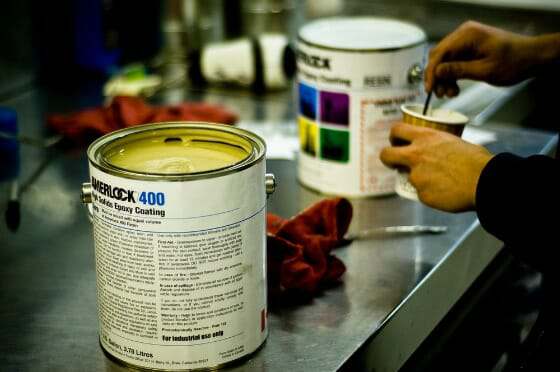
When you start considering an epoxy coating for your garage floor, it doesn’t take long to realize that not all are created equal. You soon find that there is water based and solvent based epoxy. Some manufacturer’s state they offer only 100% solids epoxy. Some are much less expensive than others for the same volume of product. So how do you know what differences to look for when comparing garage floor epoxy?
Because of this, it’s important to learn the basic properties of epoxy floor coating products before you decide to apply a floor coating yourself or hire a garage floor company to do the job for you. This knowledge will help you greatly when making a decision about which product is best for you. So let’s take a look at each type of epoxy available to better understand what these differences are.
The use of carrier agents in epoxy
Water or solvents are typically used as a carrier agent for some epoxy resins and assist in the adhesion, ease of application, and self-leveling properties. They also help to insure a longer period for application, also known as the pot life. As soon as you mix the part-A resin with the part-B hardener, the clock starts ticking as the epoxy begins its curing process and must be applied to the floor before the pot life runs out.
Because of their ease of application, these types of epoxies are more user friendly and tend to be the more preferred solution for the DIY crowd. The average pot life is around 2 hours, which means you don’t have to rush to get it down on the floor, and it rolls on smoothly like paint.
There are some disadvantages to these however. Once applied to the floor, these carrier agents evaporate leaving only the epoxy. So what you end up with is a thinner floor coating than what was initially applied. This happens because the carrier agent in the epoxy is not part of the actual floor coating.
This is defined as the percentage in volume of solids in epoxy and is most noticeable in the difference between wet film thickness and dry film thickness. If an epoxy is labeled as 50% solids for example, it would have a wet film thickness of approximately 7 mils. Once the carrier agent evaporates, it will have a dry film thickness of 3 – 3.5 mils.
Water based vs solvent based epoxy
Solvent used to be the preferred carrier agent in epoxy coatings for a few reasons. It can be applied in cooler temperatures and higher humidity and it does a better job at tolerating petroleum contaminates in the concrete surface. It used to have a slightly glossier surface than water based epoxy and in some cases is a bit more durable than their water based counterpart.
The biggest problem with solvent based products however is the high VOC’s content (volatile organic compounds). It cannot be used indoors at all due to the fumes. When used in the garage, proper respirators must be worn during application and any open flames such as a water heater or furnace must be extinguished due to the high flammability.
Because of the high VOC’s, many states do not allow solvent based products unless they have a lower VOC content. This has resulted in some solvent based epoxy products not being as good as they used to be. Consequently, they are getting harder to find as the industry has started using them less due to the tougher state regulations.
Water based epoxy on the other hand has come a long way since the states started prohibiting products with high VOC’s and has now become the more prominent epoxy in use between the two. In fact, many have proved to be as durable as most solvent based products and some are capable of just as much shine. Additionally, they do not produce any of the fumes and odor that is associated with solvent based epoxy which makes them environmentally safe as well.
Some water based epoxies can be applied to concrete that is still damp and can actually make for a good sealer to help stop hydrostatic pressure from moisture vapor transmission. This is why most epoxy primers are water based.
100% solids epoxy
A 100% solids epoxy doesn’t have any water or solvents to evaporate. As a result, they provide for a much thicker dry film coating of approximately 10 mils or more depending on the manufacturer and how it is applied. There are no VOC’s to worry about, thus making them environmentally friendly, and the coating cures solely by chemical catalization.
They are commonly used for commercial applications and by many garage floor coating companies as well. 100% solids epoxy is more abrasion resistant, chemical resistant, and stain resistant than its water based counter parts. They work well as a color coat and medium to accept vinyl acrylic flakes and can last upwards of 20 years or more. This makes it the most durable of the garage floor epoxies by far.
100% solids epoxy can be more difficult to work with however do its thicker consistency and shorter pot life of only 30 – 40 minutes depending on temperature. They can be applied as a DIY application, but it’s important for the person applying them to be confident in his or her skills and follow the manufacturer’s recommendations closely in order to achieve a successful application.
Though more expensive, 100% solids are the most cost effective garage floor coatings when comparing thickness and durability. Most epoxy paint kits sold aftermarket at the big box stores are not much more than 50% solids. They are designed as a one coat application and end up being 3 mils thick. There is aftermarket, multi-coat, water based garage floor epoxy systems that do better, but they still don’t compare to a 100% solids epoxy system.
A word about Technical Data Sheets
When making epoxy comparisons, be sure to take a look at the technical data sheets (also known as TDS) for the product. You can request these from the store or find them online. These sheets outline the properties and ingredients of the product and will give you a better idea of how one product compares to the other.
Knowing the differences in epoxy coatings is an absolute must if you are going to hire a contractor to do your garage floor. That way you will know exactly what you are getting for your money. If you are going to tackle the job yourself, then you are already one step ahead of the game when it comes time to determining which product is best for you.

I was going to paint my garage floor with a single coat kit by Valspar that I can get at Lowes. I’m now wondering if this is the best choice for me. I don’t mind spending more money as long as I get a floor that lasts. I don’t abuse my garage that much, but I don’t want something that will last only a few years or so either. I’ve seen companies online that sell the multi coat kits in high solids water based epoxy that include a color coat and clear coat. Are these that much better for the money?
Hello Richard. Yes, the high solids water based epoxy kits that come with your choice of color coat, optional color flakes, and a clear coat are a much better value for the dollar than the single coat kits that you can buy at your local home improvement center. They are a little more work but provide for a much nicer looking floor.
Thanks for this very simple and short but very informative article! You saved me from taking a wrong decision.
You’re welcome Rahul.
What are your thoughts or feedback on 80% vs 100% solids for a floor that is basically foot traffic in a sportsman club.
Hello Lou. An 80% solids will work just fine for that type of traffic. It’s also easier to work with if you are applying it yourself.
What are your thoughts about using a single coat or low cost water base epoxy, then top coating with a high end ppolyurethane clear? Would the two clash?
Hello Richard. The two will not clash, you can apply a quality coating over an low end or inferior coating. However, would you build a nice house on a poor foundation? The entire floor coating is completely dependent on the initial coat in terms of how well it adheres to the floor.
I picked up a few rustoleum water based kits when they were in sale a few weeks ago. I have some clear leftover from a concrete project in the back yard. I cant remember exactly what it was since it’s buried in the garage right now, but I had to thin it with xylene. I believe it is a poly. Anyways, how long should I let the water based epoxy cure for before laying the solvent clear on top? Also, could I scrub and etch the concrete on the morning and paint in the afternoon or should I wait longer? I wasn’t sure since it is water based. Thanks
Hello Jay. We can’t really advise you on that since you don’t know what it is. It may not even be compatible with epoxy.
As far as applying the epoxy, you should wait a minimum of 24 hours for the concrete to dry and the moisture within it to evaporate. If you try sooner you could very well end up with bubbles in the epoxy from out gassing.
I would like a 100% solids floor installed in the garage of the house I am havering built in Central Florida. Most of the paint contractors I have found use water based products. Can you reccomend a contractor? Also, is the quick drying product better in the long run? Thanks
Hi Larry. Contact Legacy Industrial and ask for Scotty. They are a distributor in central Florida and know a number of installers all over the state. Scotty can recommend one in your area that uses their product. Legacy sells 100% solids epoxy flooring systems that are of extremely high quality. The biggest advantage of the quick cure polyaspartic systems is the quick return to service. In the long run, a multi-coat epoxy system with a polyurethane or polyaspartic top coat is the best way to go for most people, though there are exceptions.
Can you use a solvent based topcoat with a water based undercoat?
Hello Troy. You can when using resinous 2-part coatings such as epoxy, polyurethane, or polyureas. It’s not advisable however with acylic coatings.
hi. there building a house on hat island washington state i am using a water base epoxy on the plywood floors insde the house is that ok . also i have a deck of master bedroom made of plywood wandering what would be the best product of epoxys to use , lots of rain in winter, deck faces the west
Hello Jim. You have to be careful when applying epoxy to wood by making sure that the floor does not flex at all under weight. Epoxy cures extremely hard and as a result it will not flex like regular paint does and it will crack. Also, epoxy is not designed to be used outdoors. The sunlight will cause it to turn yellow.
My concrete front porch takes a beating because the eve dumps snow n ice and the concrete is really pocked. Is100% dry solids a potential solution for this tricky area? Thank you.
Hi Eric. We are assuming you mean for a repair? If so then no, an epoxy patch is not best for outdoors. A polymer-modified cement patch would be much better for outside. You can read more about them here. If the porch is bare concrete, a penetrating sealer will stop that type of damage. It will not be slippery when wet and it combats freeze/thaw issues.
Hi! Thanks for the very informative article! I am thinking about having a professional company here in California put in a garage floor for me. I am concerned about toxicity. I have two young grandkids and I want to be sure it is safe for them. Your thoughts? Thanks!
Hello Trish. No worries about toxicity with epoxy. Most companies use 100% solids epoxy which has no VOC’s or they use a water based high solids epoxy with little to no VOC’s. The same goes for most polyurea or polyaspartic coatings as well. Polyurethanes can be solvent based however and produce some fumes that dissipate within 24 hours. Either way, once the product cures there are no environmental or health concerns to worry about. Before you hire a company, ask to see the Technical Data Sheets about the product they are using. The information there will tell you the level of VOC’s (volatile organic compounds) that you can expect during installation.
Hi, I have an older concrete garage floor that has many holes due to stones missing from winter snow and salt.
I would like to fill the holes and also feather edge an area of the concrete floor that is not level, allowing a pool of water to stand and not drain. What material should I use before applying an epoxy coating?
Hi Dave. We have an article that cover that exact question right here.
Hey guys, I just found your site and really enjoy the information I’m learning here, even if it’s a day late for me. Last night I did a basement room (about 12×14) with the Rustoleum Restore Metallic coating in their dark brown that I purchased from Lowes. I prepped the room with the package etching, although I used a sprayer versus the watering can to spread the etching on the concrete. I mixed it up and used only one package on the room. What I noticed this morning was that closer to the exit door where it was a thinner coat, I have what looks like little pock marks in the epoxy although when you run your finger over them, they are smooth. I also stepped on it this morning because it felt dry to the touch and noticed I left a sock print. My question is, can I go over the coat that I put down last night with another coat of the same product? Do I need to go over the initial coat with a sander to rough it up prior to putting the new coat on? and what do you do to get rid of the sock print? Thanks for all your great info and help
Paul
Hello Paul. The Rust-Oleum metallic coating is the same product as the RockSolid polycuramine coatings. They bought RockSolid and now use their product under the Rust-Oleum brand as well.
If you check the TDS sheets of the Rust-Oleum metallic coating, which you can find here, you will see that you have up to 7 days to recoat with this product. No sanding is necessary unless you pass that window. As long as the sock print doesn’t have ridges, you can coat right over it. If it does, you will want to smooth it out with a little sanding.
Shea: I recently had my garage floor painted and a water based apoxy applied as a sealer. I waited 4 days before I used it. Shortly after I began to get what’s called hot tire marks on the surface of the epoxy. The contractor repainted and repaired the damaged area with the same products. Afraid it would do the same thing, I put rubber mats over those area to protect the area. Can I apply a higher solvent base epoxy ( polyurethane, high solids water base) over my current sealer to avoid this problem and can you suggest the product and where I can get it? Thanks!
Hi Luther. We are assuming that when you say “painted”, you actually mean coated with water based epoxy? Paint never does well long term in a garage environment regardless of what you try to coat over it with.
You stated that the tire marks needed repair. If the epoxy actually lifted up, then polyurethane is not going to help. Hot tire pickup is caused from inferior water based product and/or poor concrete prep. No matter what you put on top, it will still lift up if the base product is inferior. If your issue is just black tire marks, then a good polyurethane will definitely help. You will need to rough up the surface with 100 grit sandpaper and then wipe it down with denatured alcohol before application.
You can find polyurethane garage floor coatings from garage floor specialists online. Our sponsors are a great place to start. Garage Flooring LLC, Legacy Industrial, and EpoxyMaster all carry high performance polyurethane coatings.
I have a 2 car garage that appears to have a low quality epoxy coating on it and I would like to have it redone and refinished. What product would you recommend? Would the floor need to be grinded and sanded down to remove the previous coating prior to a resurface? Is there anyone in the DC Metropolitan area that install these products or is it just as easy for me to do it myself?
Hello Rex. If it’s a low quality coating as you say, then yes, you will need to remove the coating via grinding before applying the new one. A coating is only as good as it’s weakest link. We aren’t familiar with companies in the DC area, but you should be able to find one. We have an article on how to choose a floor coating contractor here. You can do it yourself if you like. While it’s not too difficult, it will take some time as well as some research on the proper methods.
As far as product goes, we recommend a primer coat, high solids epoxy base coat (color coat) and a top coat or two of polyurethane depending on how much color flakes are applied if any. Our sponsors are a great place to start as they all offer commercial quality product.
There seem to be so many different brands of 100% solid epoxy. Are there any in particular that you would recommend to a DIY guy?
Hi Nathan. You are right, when you start doing your homework you will find quite a few. Most all are very good. Our recommendation is to purchase from a company that is going to give you great customer service and be able to answer any questions that you may have when getting ready for installation. That’s why we recommend calling them first to ask these questions and what days they are available. Most DIY installations happen on the weekends. It doesn’t help to call customer service on a Saturday to find out they won’t be in to help until Monday.
Most of our sponsors are available on the weekends. Call them to verify and ask question. EpoxyMaster, Legacy Industrial, and Garage Flooring LLC are examples.
I am interested in having a professional apply an epoxy coating to my garage floor. Part of my garage will be used to park my cars and a portion will be converted into a home gym with treadmills. Is a hybrid-polymer based epoxy better than a 93% solids polyurethane solvent base better/safer for my intended use.
Hi Erica. Hybrid polymer epoxy coatings are a marketing term used by one or two garage floor coating companies that we are aware of. It’s not an actual coating product. It’s a term for a coating system that consists of a high solids epoxy base color coat with a polyurea clear top coating. It very similar to 93% solids epoxy (high solids) with a polyurethane top coat. Both are excellent and you wouldn’t be making a wrong choice either way. Some floor coating companies like to use polyurea because it goes down thicker. They can apply just one coat of polyurea for the top coat when you would have to use two coats of polyurethane. Polyurea and polyurethane are excellent top coats with similar properties. Polyurea can sometimes be a bit glossier than polyurethane but also a bit more slippery when wet if an anti-slip is not used.
I have a 20 year old , Chicago area, garage floor that I want to coat. The areas that are under the cars are pitted from the winter road salt. Often white crystals will form on the cement even in the summer. So I assume salt has penetrated the concrete. The garage doesn’t have a moisture problem, I have tested it with plastic on sections.
Will the salt be an issue when coating my floor?
Hello Dave. Salt crystals form on concrete surfaces when moisture vapor works its way up through the slab bringing soluble salts to the surface. You have moisture coming from somewhere. It may just be from water that penetrates the surface of the concrete if you wash out the garage. This moisture will come back to the surface and evaporate leaving salt crystals behind. Humidity can cause salt crystals to form if no moisture in the slab is present. Or it could be from water that collects under the slab on rainy days and eventually works its way up through the surface. We suggest doing the moisture test a day or two after a rain storm to verify that you get the same results.
If the results are the same (no moisture), you will need to do your best to remove the salt from the surface before applying epoxy. The salts work like a fine dust, getting between the surface and the coating causing it to delaminate.
Can epoxy paint be use in walls or is it only for floors
Epoxy coatings are for floors only Marcelo.
Shea,
I have applied a few different solvent based epoxy coatings to garage floors in different houses I have owned with no problems and was satisfied with the results. My wife, however , has grown very sensitive to any solvent based coating or paints and so I am looking for the best water based garage floor coating that I can buy..have a large area this time also, about 1500 sq.ft.
Can you help?
thanks, Eric
Hello Eric. If you want a quality coating, than a 100% solids epoxy has no solvents and a high solids epoxy has just a little. Neither create a solvent smell like the solvent based coatings you are referring to. That is one of the many advantages to high solids, commercial grade epoxy. They are used indoors for hospitals just for that reason. Some high solids polyurea coatings are safe as well. Another option is to tint a commercial grade epoxy primer. These are water based and much higher quality than the water based kits you can buy at home improvement centers.
We suggest that you call Legacy Industrial, Garage Flooring LLC, and Garage Coatings.com by Versatile. Tell them what your restrictions are and why. These are all very good vendors that specialize in garage floor coatings and can suggest a quality system based on your needs.
thanks Shea….now I have to tell her how much the stuff costs…..
LOL… sorry Eric, we can’t help you there.
I purchased an epoxy kit from Menard’s, had it tinted, with the idea to put it on my 3 season room concrete floor. Originally the area was a patio, but became part of the house by the initial owner/builder in 2000 and it was carpeted. The room is 10×15, half drywall on 2 and a partial with large sliding windows making up the rest. One and a partial wall is the house with the siding showing (why?). I removed the carpet, and was told the concrete was “broom” finished?. I removed the quarter round and found a gap between the concrete and the slider doors that allow access into the house. The sliders that go to the outside has a nice finished piece of wood at the base, firmly attached to the floor. I have done the “coating test” and there does not appear to be any. I am concerned about the gap, should I fill it with caulk? Should I remove the finished wood strip from the outside slider to see if there is another gap? The concrete is rough, do I still need to etch, or grind the surface or will a good cleaning with a stiff scrub brush be sufficient?
Hi Nancy. You didn’t say what kind of epoxy you purchased, but our guess is that it’s a lower solids product. Because this type of epoxy doesn’t go down real thick, the broom finish will telegraph right through the epoxy. You would do best to grind the surface in order to smooth it out some and prep the concrete at the same time. Go ahead and fill the gap you can access with a self-leveling sealant such as SikaFlex. If it’s deep, you will want to use backer rod to fill most of the gap before you seal it. Install the quarter round over it once everything is completed. I wouldn’t worry about the nice finished piece of wood that attached firmly to the floor.
Hey Shea – thanks for your very prompt reply!! I apologize, what I actually purchased, after spending much time looking, is a Rust-Oleum EpoxyShield, 2 part-water based, basement floor coating product. I couldn’t find any information on the amount of solids, on the box or on the instruction sheet. Perhaps I have gotten the wrong thing. Oh well, going to try it anyway – it was not cheap and since its tinted I’m sure I cannot return it. Thanks again for your prompt and very helpful comments!!
No worries Nancy. What you purchased is exactly what we were thinking.
I used the Epoxy Shield professional floor coating kit in dunes tan color. I would like to use a flat or satin clear coat instead of the high gloss offered. I called in and rustoleum told me they didn’t make a satin or flat clear coat for the solvent based expoxy. What clear coat should I use?
Hello Bill. We recommend using a high performance polyurethane clear coat. They are available in both satin and gloss finishes. You will not find them at home improvement centers however. Here are examples from EpoxyMaster.
Thank you Shea!! I’ll start looking for it now
This is a little off topic but I am searching for a Enclosed Car Trailer floor. As supplied by the manufacture it has a composite wood floor. Looking for something that will stand up to hot tires, oil, gas and other petroleum products. Was looking at epoxy but seems they are not recommended. Any suggestions?
Hello Keith. Actually, you can use epoxy on wood if the floor is not flexible. We recommend contacting Garage Flooring LLC and ask for Justin. He helps people out with flooring for enclosed trailers all the time and can provide some options for you based on your requirements.
I am looking to do a floor in a small bedroom of my home, and need a covering for the concrete floor that will stand up to computer chairs. What would you suggest. Thanks.
Steve
It really depends on what kind of look you want Steve. RockSolid has a polycuramine coating that is low odor and should stand up well fairly well. You have a choice of clear, tan, or gray. Or if want something with more bling, they have a metallic coating as well.
Keep in mind that a coating will require grinding or acid etching. This isn’t something that everyone wants to do in the home. Another option would be interlocking tile. SwissTrax has their new vinyltrax flooring which could work well and look very nice.
Please don’t think I’m crazy BUT I have VCT in my small garden home (1200 sq ft) and hate it but it’s ON there. Instead of ripping it up, can I use 100% solid epoxy to fill the cracks first then a second coat and have it look like a different floor or do you think I’m SOL?
Your not crazy Heather. Read this article here.
I painted my garage with H & C Concrete Sealer Solid Color (solvent based) paint and applied two coats with a 14 hour period between the two. That was 17 days ago. My garage is on the ground floor of a half basement and we mainly live in the top half. We have kept the garage door open, utilized a dehumidifier, ran fans and the VOCs are still annoying (irritation of throat and eyes, etc.). My question is…how long before they dissapear completely and can I do anything to speed up the process?
Thanks,
Jeff
Hello Jeff. You are doing everything you can in terms of ventilating the fumes. What we suggest is to work on fume absorption. This article here has great tips that we know have worked well for people.