
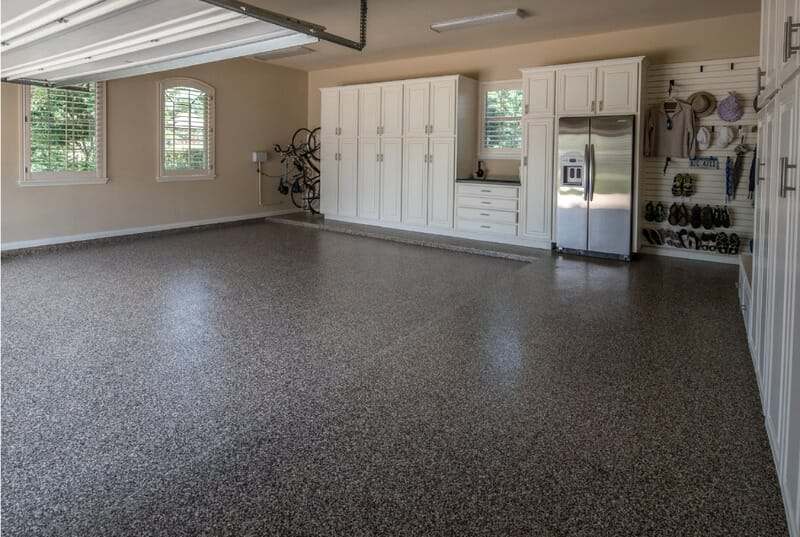
Garage floor coatings are one of the most durable, stain-resistant, and easy-to-clean decorative finishes available for garage floors and workshops today. They will protect the floor from the elements, instantly transforming your dull or ugly concrete surface into a professional-looking floor that combines beauty and functionality.
And since the garage has evolved beyond just a parking space, the benefits of concrete coatings have made them one of the most popular DIY garage flooring options today.
As a result, we will briefly explain what a garage floor coating really is. We will discuss the features, benefits, and how it is applied. More importantly, we will list the available coating options for DIY application, along with the pros and cons of each.
Additionally, we will provide excellent examples of where you can purchase quality coatings and DIY coating kits that we have reviewed and can recommend.
This article was updated in March of 2026 to reflect the most current trends and coating technology
What is A garage floor Coating?
A garage floor coating is a viscous thermosetting polymer resin that chemically crosslinks as it cures, creating a hard, durable, and chemically resistant wear surface. Epoxy, polyurethane, polyurea, and polyaspartic are the most common concrete coatings.
A catalyst activates the exothermic (releases heat) crosslinking reaction. For 2-part coatings, such as epoxy, the part-A resin/pigment is mixed with the part-B hardener, which serves as the catalyst. Moisture and/or oxygen in the air act as catalysts for single-part coatings.
Visit our Garage Flooring Gallery to view the various garage floor coating options.
Shop our collection of Pro-Quality Coatings from Top Vendors
Benefits of Garage Floor Coatings
Commonly used for both residential and commercial applications, a high-quality coating or coating system will protect the concrete from oil and related automotive fluids, stains, chemicals, spills, and other substances vehicles may track into the garage.
In addition, they seal the concrete to prevent liquids, deicing fluids, and road salts from penetrating the surface and causing damage.
Most notably, coatings are very easy to clean and to keep looking clean.
Commercial-grade coatings receive high reviews from home mechanics and hobbyists. They are popular in automotive and workshop environments where rolling floor jacks, jack stands, rolling toolboxes, and other mechanical equipment are used.
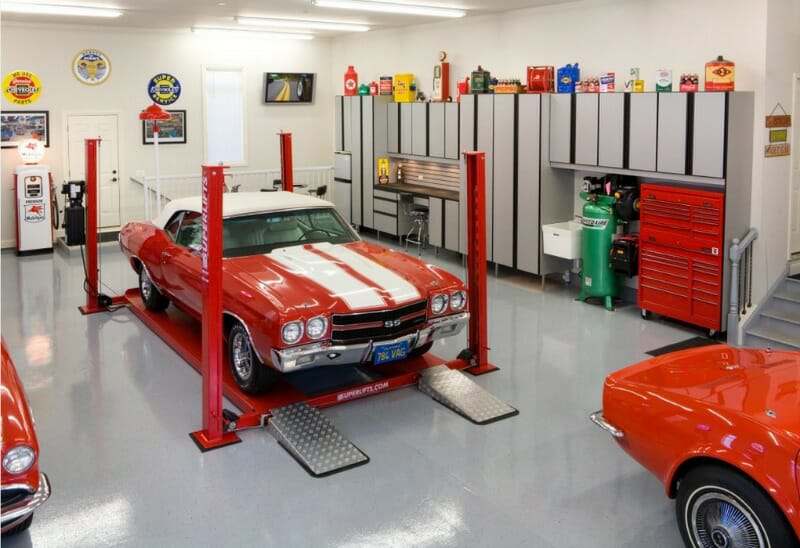
Furthermore, the high gloss and lighter colors of floor coatings reflect overhead and natural light. This results in a brighter work environment that makes more efficient use of available light.
Lastly, when applied to a properly prepared concrete surface, coatings can form a strong mechanical bond, making them highly resistant to peeling and hot tires. The overall result is a decorative, scratch-resistant surface that lasts for years.
Single Coat vs Multi-Coat Garage Floor Coatings
The most durable garage floor coatings are multiple-coat systems, and the industry standard for professional installers. They are also the most popular among DIY enthusiasts who want the best protection and value for their money.
These coating systems consist of a minimum base color coat, optional decorative color flakes, and a high-performance clear topcoat. The clear coat is essential for locking in the color flakes, protecting the color coat, and extending the coating’s life and durability.
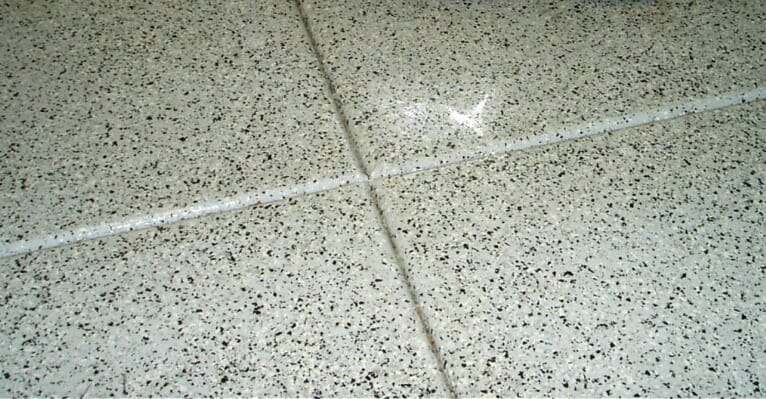
Many times, these are hybrid coating systems. In other words, the base color may be a thick, high-build epoxy coat with a polyurethane, polyurea, or polyaspartic clear top coat.
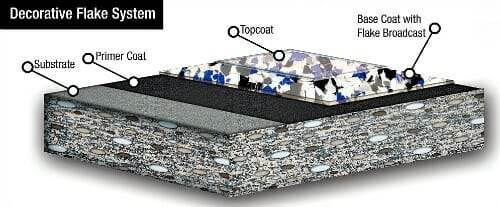
Options may include an epoxy primer coat for highly porous concrete, high-solids epoxy base coats, or other coatings. They are also used as a primer color coat for very light (white) or very dark base coat colors to achieve proper color tone.
Lastly, some are specially formulated to provide moisture-vapor-barrier protection for concrete with moisture issues.
Tan, beige, and various shades of gray are the most common base coat colors because they hide dirt best. However, high-quality coatings offer a wider range of colors for the DIY installer to choose from.

Other options include metallics and custom color-flake blends that match your style, home, or even your favorite sports team.
A more budget-friendly option for the DIY installer is a single coat application. Examples include a single color coat or a high-performance clear coat that protects and highlights the character of bare concrete.
Single coat applications are not as durable as multi-coat applications. However, they are less expensive to install and still effectively protect and seal the concrete, including stain protection. High-quality single-coat applications will also provide longer wear than budget, store-bought options.
How Thick are Garage Floor Coatings?
The overall thickness of a garage floor coating varies and depends on many factors. These include the type of coating material used, the number of coats applied, and the choice between random or full color flake coverage.
A typical commercial-grade garage floor coating system averages 8-12 mils of dry film thickness. These coating systems typically include a base color coat, partial color flake coverage, and a single clear coat. A mil is 1/1000th of an inch. Standard copy paper averages 3 mils thick for reference.
A concrete coating system that consists of an epoxy primer coat, a high-solids epoxy base color coat, full color flake coverage, and the appropriate clear coats can average 15-25 mils or more in overall thickness.
In contrast, a lower-performing single-coat kit, such as EpoxyShield by Rust-Oleum, averages only 3 mils dry film thickness. You can expect an overall thickness of 4–4.5 mils when the optional EpoxyShield Clear Coat is applied.
Are Garage Floor Coatings Slippery?
Most floor coatings are not slippery when they are dry. However, epoxy and other coatings can become slippery when wet. Typically, the glossier a coating is, the slipperier it becomes when wet.
A heavy application of color flakes can add texture to a coating and reduce slipperiness, but it is not a substitute for a slip-resistant surface. An anti-slip media is typically mixed into the final coat to achieve a non-slip surface.
Are Coatings and Garage Floor Paint the Same?
Concrete garage floor paint and 1-part epoxy paint are not the same as thermosetting garage floor coatings and provide far less protection. They are thin, water-based acrylic polymer formulations containing pigments, binders, and additives.
When applied to concrete, they dry like paint on a wall. All will peel from hot tires, generally sooner rather than later. Furthermore, they are much less wear-resistant and are only available in a satin finish.
The primary reasons for their use in a garage environment include their low price point, ease of application, and deceptive marketing tactics that prey on the average consumer’s lack of knowledge about coatings.
Of the two, 1-part epoxy paint performs better and is worth the few extra dollars per gallon. It incorporates 2-4% epoxy ester resin as an additive to enhance durability over standard paint.
DIY Garage Floor Coating Options
The choice of concrete coating materials available for DIY application has expanded in the last decade. Epoxy is no longer the only player on the field.
Some are easier to apply than others, and each has its own benefits and drawbacks that you should be aware of.
Epoxy
Epoxy has been the most common garage floor coating material for decades. It is a 2-part coating consisting of part A, an epoxy resin, and part B, a hardener/catalyst. High-solids (>85%), commercial-grade epoxy is typically 8-10 mils dry film thickness.
High-solids to 100% solids epoxy has self-leveling properties, provides an excellent build coat, and is the best medium for receiving a full-color flake application.
Epoxy is popular for use in industrial applications, warehouses, garage floors, and workshops. Return-to-service times are longer due to slower cure rates. You can walk on it in 24 hours and drive on it in 72 hours.
Epoxy Pros
- Longer curing time allows for the best adhesion to concrete
- High solids epoxy (>85%) will not peel from hot tires
- Provides the thickest build coat at 8-12 mils DFT and greater.
- Self-leveling properties
- Good impact resistance
- Best at hiding surface repairs and concrete imperfections
- Best for receiving full broadcast color flake applications
- Offers the most color options
- Excellent chemical resistance
- Good wear resistance and stain resistance
Epoxy Cons
- Shorter working time of 25 – 55 minutes
- Limited application temperatures between 60° and 85°
- Not UV stable – develops a yellow tint with exposure to sunlight
- Does not flex, making it less resistant to cracking
- Longer cure and recoat requirements add to the overall installation time
- Has increased in cost over the years
Polyurethane
Polyurethane is a thin coating with an average DFT of 2-2.5 mils. It is available in single-part and 2- part (2K) formulations. With some exceptions, it is primarily used as a final clear or colored topcoat for other coatings, such as epoxy.
Before the advent of polyurea, polyurethanes’ UV stability and superior wear, stain, and scratch resistance made it the go-to high-performance top coat for epoxy on garage floors, workshops, and in industrial applications for many years.
Newer water-based versions with low to no VOC content have become popular for indoor applications. However, they are not ideal for garage floors. They are susceptible to tire staining and to some chemicals and solvents.
Polyurethane Pros
- Great topcoat for epoxy
- UV stable
- Excellent chemical, stain, and abrasion resistance
- High gloss appearance
- Ideal for high traffic areas
- High flexibility increases abrasion resistance and impact resistance
Polyurethane Cons
- Can be finicky to apply and leave roller marks if not careful
- Sensitive to moisture and high humidity during application
- Requires multiple coats for application over full color flake floors
- Can be high in VOCs
- Moderate resistance to tire staining
Polyurea
The characteristics of polyurea are similar to those of polyurethane, but with some distinct advantages. It adheres very well to properly prepared concrete surfaces, it cures faster, and it’s thicker at 4-10 mils DFT. Polyurea is also more resistant to moisture and extreme temperatures during installation.
It used to be that only 2-part polyurea was available as a concrete floor coating and was used strictly by professional installers. Its extremely short working time of 15-20 minutes and fast curing time of 2-3 hours enabled same-day installation.
However, the arrival of single-part polyurea has been a game-changer for DIY garage floor coatings. The easy application, long working times, no mixing of components, UV stability, and extended wear have made it a favorite over epoxy.
It’s our #1 recommendation for most DIY installers looking for an incredibly durable, easy-to-apply garage floor coating system.
Single-Part Polyurea Pros
- Multiple color choices
- Excellent, clear topcoat for bare concrete or epoxy
- No mixing of A and B components
- Long working time reduces installation anxieties over other coatings
- Adheres well to properly prepared concrete
- Faster cure times = quicker return to service
- UV stable
- Excellent chemical and stain resistance
- High abrasion resistance – wears longer than epoxy or polyurethane
- Excellent impact resistance due to flexibility
- Flexible and better withstands the expansion and contraction of substrates
Single-Part Polyurea Cons
- Higher VOCs during application – NIOSH-approved respirator recommended
- Not as thick as high solids epoxy
- Won’t hide imperfections in concrete as well as epoxy
- Cannot be shipped to the South Coast Quality Air Management District
Polyaspartic
Polyaspartic is essentially an advanced type of polyurea. 100% solids polyaspartic is harder than polyurea and typically provides the best chemical, abrasion, and UV protection. It is primarily used by professional installers as a clear topcoat due to its very short working time (15-20 minutes) and quick return to service.
DIY-friendly polyaspartics have 65-80% solids content and/or slow-cure options allowing for longer working times. Depending on the solids content, it can be applied thicker than polyurea, making it an excellent choice as a clear topcoat for full color flake and outdoor applications.
It is also the most resistant to tire staining. However, the abrasion and scratch resistance of DIY-friendly polyaspartics is slightly less than that of single-part polyurea.
Polyaspartic Pros
- Excellent, clear topcoat over epoxy, polyurea, and full color flake applications
- Best UV stability
- Excellent chemical and stain resistance
- Long wear
- 2-3 mils thicker than single-part polyurea
- Shorter cure time means quicker return to service
Polyaspartic Cons
- Does not adhere to bare concrete as well
- Can be high in VOCs, similar to those of single-part polyurea
- Higher cost than single-part polyurea
- Typically not found in kit form and must be purchased separately
Moisture-Cured Urethane
Though not as common as the previously mentioned coatings, moisture-cured urethane (MCU) concrete coatings are fairly new to DIY installers. They are thin, single-part, high-performance, industrial-grade floor coatings designed to deliver exceptional durability and chemical resistance.
MCUs cure by reacting with ambient moisture in the air, creating a dense, tightly crosslinked surface that bonds aggressively to properly prepared concrete.
Newer aluminum-metallic MCU concrete coatings with long working times are becoming increasingly popular in workshops and some garages. They have high heat tolerance, making them less susceptible to welding burns. They are ideal for garages and workshops where floors are exposed to vehicle traffic, hot tires, dropped tools, oils, fuels, and heavy equipment.
Some MCUs may not require etching of the concrete before application. DuraGrade Concrete by Rust Bullet is one such example.
MCU Pros
- No mixing of A and B components
- Shorter recoat times decrease overall installation time
- Quicker return to service
- Better UV resistance than epoxy
- Excellent resistance to abrasion, chemicals, fuels, and solvents
- Excellent impact resistance
- Aluminized MCUs have high heat tolerances up to 500 degrees
- Excellent adhesion to properly prepared concrete
- Can be less expensive than some commercial coatings
MCU Cons
- Thin dry film thickness of 2-3 mils requires two or more base coats
- Some can be high in VOCs – similar to single-part polyurea
- Sensitive to moisture and excessive humidity during installation
- Can be finicky to apply and leave roller marks if not careful
- Aluminized MCUs are not as decorative and glossy
How Garage Floor Coatings are Applied
Garage floor coatings can be professionally installed or done yourself. A DIY installation can save you quite a bit on labor costs and materials. It’s not that difficult as long as you make yourself familiar with all the steps required and plan accordingly.
The first and most important step for a successful coating is preparing the concrete surface. The process involves etching or grinding the surface to create the proper profile for the coating to adhere to.
Next, concrete cracks are repaired. This includes any surface damage, such as pitting or spalling. It is important to use the appropriate concrete repair materials.
Once repairs are complete, the base color coat is applied, followed immediately by the optional color flakes. The clear coat is applied within the recoat window, after the color coat has cured for the minimum required time.
Read our complete guide on How to Apply Garage Floor Coatings
Most coatings require 24 hours before they can accept foot traffic and 48-72 hours before they can accept vehicle traffic. Some exceptions apply.
Where to Buy Commercial-Grade DIY Garage Floor Coatings
Most commercial-grade DIY concrete coatings for garage floors and workshops are purchased online from professional concrete coating vendors. These vendors provide the knowledge and experience required to assist DIY installers with all their project needs.
At All Garage Floors, we make it easy for you to find these vendors and shop for the coatings that best meet your needs and budget. Just visit our Shop Page and select a coating category.
Shop our collection of Pro-Quality Coatings from Top Vendors
Home improvement centers, hardware stores, and most paint stores typically do not sell commercial-grade concrete coatings. The primary reason is that they do not employ staff with the experience, knowledge, and time needed to provide proper customer service for such coatings.
Drawbacks to Garage Floor Coatings
As tough as garage floor coatings can be, they are not resistant to everything.
Welding is hard on floor coatings and can create burn marks from the hot slag that falls on them. In fact, metal fabrication in general can be rough on floor coatings. This is due to the tendency of heavy, sharp objects to be dragged across the surface.
If you are interested in a more utilitarian coating that makes cleanup easier while also resisting hot slag and grinding sparks, we suggest an aluminized MCU coating.
Furthermore, coatings are not a good choice for garage floors and workshops that have moisture issues from below the slab. An excessive rate of moisture vapor transmission from beneath the slab can cause coatings to delaminate.
Final Thoughts
As we mentioned, a garage floor coating can completely transform the appearance of your garage or workshop floor. It’s durable, easy to clean, highly stain-resistant, and flat out looks great.
One important point we want to make is that you genuinely get what you pay for with concrete floor coatings. If you want a budget product, you will get budget performance and looks. If you spend a bit more, you will be rewarded with a much more durable coating that performs better, lasts longer, and looks fantastic.
In the long run, it will actually save you both time and money to purchase higher quality coating products – by far.
So, whether you are turning your garage into a man cave, a working shop for car repairs and projects, or just a place to park your cars, it’s hard to beat the benefits of a quality garage floor coating system.
I LOVE the fact that you’re all about the floors! I just had mine done in high gloss (looks just like the blue and black swirl floor you have above) and it’s beautiful! My question is – can I buff it to keep the scratches and skuff marks down?
Hi Russell. Thanks for the kudos. No, coatings can’t be buffed to a shine like polishes on a car or wax on a floor. It will dull the finish. However, a benefit is that once the floor begins to look it’s age, you can lightly sand the clear coat and then apply a new one to make the floor look brand new again.
I just did the rustolium 2.5 car garage epoxy kit, I was surprised how I got floor done with one gallon.?? Now worried did not put on thick enough, I put the flakes as I went so could not go back over it . Will it be a total waste or can I put second gallon on over the floor with the flakes on it?? I can purchase mire flakes but not sure if it will cure right?? Any help would be appreciated.
Hello Sue. The Rust-Oleum EpoxyShield kits are an example of a budget-quality coating. That is why one gallon went so far. They are very thin coatings. You can learn more about them here. How long has it been since the coating was applied? Rust-Oleum has a four-day window to apply additional coats before further surface prep (sanding) is required. You can certainly apply another color coat in the same manner. However, if you are happy with the color tone, we would recommend applying the Rust-Oleum EpoxyShield Clear Coat instead. It’s a better quality coating that will lock in and protect the color flakes. In addition, it provides a more glossy finish and helps to prevent the possibility of hot tire pickup. Here is an example of it from Amazon.
Can I put full broadcast flake on top of RockSolid kit
Hi Thomas. No, the dry film thickness of the RockSolid kit is too thin to accept all those color flakes. That is why that option does not exist. Technically, it could be done if you applied it at a coverage rate of no more than 125 square feet per burst pouch. However, it would require twice as much base coat color material and three times as much clear coat coat material to cover all those flakes. Plus, it does not cover the cost of all the additional flakes you would need to purchase. This is all due to the low amount of material supplied in the kits to begin with. It would cost less to purchase a single-part polyurea full flake kit. The coating is twice as thick as RockSolid and performs much better.
Hi, I used a Behr 1 part epoxy floor coating with complete heavy coverage broadcast of flakes. What would be a top coat to use to get a gloss/high gloss shine ? Thanks
Hi Tommy. Yikes… a heavy coverage of color flakes on paint and not a thick epoxy coating is not going to turn out well. 1-part epoxy is a latex acrylic concrete paint with about 3% epoxy resin added. It is not compatible with the proper coatings required to cover a heavy broadcast of color flakes. In addition, all of those flakes on a very thin coverage of paint will not stay adhered well. 1-part epoxy paint has a dry film thickness of just over 1 mil. Color flakes are approximately 5 mils thick. There just is not enough paint thickness to properly wrap around all those flakes to stay put. This is why a very light broadcast is all that is recommended for concrete paint and 1-part epoxy paint.
Acrylic clear coats are compatible with paint, but they have to be applied very thin or they will turn cloudy and have curing issues. It would require multiple coats (4 minimum) to properly get all those flakes covered properly. In addition, acrylic clear coats are not the best for a garage environment. Even then, the entire system has a good chance of pulling up from hot tire pickup. There are ways to apply a a thicker epoxy to 1-part epoxy paint, but it requires roughing up the surface of the paint first. This will generally work with a light color flake coverage since they are spread out and lay much flatter on the paint. However, with a very heavy coverage, you will end up removing a lot of the flakes in the prep process.
I suggest reading our article here that discusses the differences between 1-part epoxy paint and epoxy coating. In addition, watch our video here that discusses applying clear coats to 1-part epoxy paint.
My contractor put clear coat resin on garage floor. Can you put rust-oleum polycuramine gloss clear coating kit over resin? Looking for some what high gloss as per you video. Great video by the way.
Hi Dave. It depends on what exactly the contractor applied to the concrete. A “clear coat resin” doesn’t tell us much 🙂 If it was epoxy for example, RockSolid can be applied over that. It requires that the surface first be roughed up with 120-grit sandpaper, sweep/vac, and then wiped down with denatured alcohol or equivalent.
I’m going to be buying an epoxy kid from a vendor that specializes in epoxy to cover 900sf. I’m trying to decide between grinding and pressure washing. I can rent a grinder and have access to a 3400 psi pressure washer with a turbo tip. The slab was laid about three years ago with a broom finish. There have been a few scissor lifts and ATVs on it but no cars been parked there for any extended time. Nothing’s ever been applied to the concrete. The grinder I’m able to rent is a single disk 120V electric which has low head pressure. I’m assuming I have to let the concrete dry for significant period time if I pressure wash it. Even if I grind it, I might want to pressure wash it to get rid of the dust. Anyone have an opinion whether I should grind and pressure wash, just grind, or just pressure wash.
Hi David. Pressure washing is not a recommended or approved concrete preparation procedure for thermosetting floor coatings (epoxy, polyurea, etc.). Etching is typically the minimum acceptable procedure for most coatings. Grinding is the industry standard for commercial quality coatings. Because you have broom finished concrete, we recommend grinding. If you etch, the thin raised edges of a broom finish provides a weak layer for coatings to adhere to. Grinding will knock down all those raised edges and provide a more suitable profile and surface for a quality coating. After grinding, vacuum the surface well with a shop vac. A little bit of dust on the surface is acceptable. However, if feel there is too much after a good vac, then apply denatured alcohol or equivalent liberally to a microfiber mop and wipe the surface down to remove it.
The last thing you want to do is introduce water to the concrete after grinding if you can help it. If you do, you will need to wait a few days for it to completely dry out. Pressure washing will drive water deep into the freshly open pores and you will have to wait even longer. If you don’t wait, the water within the concrete that is still evaporating will play havoc with the epoxy as it cures.
What are your prep recommendations on a previously coated with EpoxyShield floor? Is there a primer that gives good adhesion on the market?
Hi Ronda. The preferred method for applying new coatings to existing coatings is to degrease the surface and then rough it up via sanding. You can learn the process here. If you are applying a quality coating over an EpoxyShield coating, we highly recommend removing the EpoxyShield first via grinding. The entire coating system is only as good as what it is adhered to. EpoxyShield is a low-budget, low-quality coating that is known for adhesion issues with hot tires. If you are applying a coating within the Rust-Oleum family, then you can apply the Rust-Oleum Recoat Primer providing the current coating is still adhered well and not too worn out. You can learn more about Recoat Primer here. Do not use Rust-Oleum recoat primer if the new coating is not in the Rust-Oleum family.
what is the best way/ product to fill expansion joints before I epoxy the floor? I do realize the concrete might Crack there at some point. but a Crack is better looking than the half inch gap thats there now.
Hi Robert. We have an article here that explains how to fill contraction joints in the middle of the floor. We also list the various materials you can use and where to purchase them. If you want to fill the expansion joints at the perimeter of the slab, you can do that by applying a self-leveling polyurethane joint sealer, such as SikaFlex SL, after the floor coating is completed.
Recently had a problem where my backpack sprayer leaked and spilled 2 gallons of 30% vinegar on my garage floor. I neutralized it with baking soda, but it left big white stain on my floor. What type of coating or sealer can I use to restore my floor.
Thanks for your feedback.
Hi Jim. Can you provide more information? Is it a bare concrete floor? Do you currently have a coating system? If so, what was used?
I would appreciate your suggestion(s) on what base/topcoat should be considered.
* Detached garage (26×24) in Central Florida, floor is 10 years old but has no stains or imperfections.
* I likely will contract for the coating.
* A 4 post vehicle lift will be installed, occasionally moved on casters but not frequently.
* Some mechanical work will be performed in the garage but not frequently, it is not a commercial garage.
* Doors will not be kept open so UV shouldn’t be a problem.
* Easy sweeping and cleanup essential.
* Garage is climate controlled most of the time.
Preferences:
* High durability
* Anti slip OK but not super bumpy
* Flakes OK but not crazy about monster coverage. Do they add to strength ?
Thank you
Hi Gary. The first item to address, since you live in Florida, is possible moisture vapor transmitting up through the slab. However, since you are going to hire a contractor, they should be able to assess and test for that based on your location.
As for base coats, we prefer 100% solids epoxy when long-term UV exposure is not a concern. There are a few reasons for this. Epoxy cures more slowly than other coatings, allowing it to penetrate deeper and achieve the best mechanical bond. It also provides a 40% to 60% thicker build coat when applied at the proper coverage rates. Because 100% solids epoxy is self-leveling, it does a great job of hiding small concrete imperfections that other coatings can’t hide. This is advantageous on slabs with few to no color flakes. Lastly, it is the most tolerant of concrete moisture, which Florida slabs are famous for, and it has a deeper, wet-looking finish compared to other coatings.
Unfortunately, many concrete coating companies steer customers away from epoxy because they can’t complete a job in one day. This is due to the slower curing time required. Additionally, these companies are often limited to only one product brand, and epoxy isn’t available. They want to apply a polyurea or polyaspartic base coat instead. Beware of the companies that adamantly state epoxy is inferior. These are the same companies that make outrageous and incorrect statements about how inferior epoxy is to the products they are pushing.
That said, there is nothing inherently wrong with polyurea as a base coat, and it adheres just fine when the concrete is properly profiled and the applicators don’t rush the required minimum cure schedule. Just be aware that it won’t achieve the same build thickness as epoxy; it won’t self-level as well, and it won’t look as deep and glossy. If these features aren’t as big a deal to you, there is nothing wrong with choosing polyurea based on your needs.
High-solids polyaspartic is typically the best clear coat to apply. It’s water-clear, UV-stable, highly resistant to most automotive chemicals, and offers the highest scratch and wear resistance. The clear coat is the wear-and-abuse coat, so it needs to perform well. DO NOT use it as a base coat. Polyaspartic is the least tolerant of moisture in a slab and cures so fast that it doesn’t adhere as well to concrete. Steer clear of any installer that tries to tell you otherwise.
Color flakes do not add strength, but they do add impact resistance if applied to full refusal. That is a non-factor if you want light coverage. A light coverage of flakes will not make the floor bumpy either. I recommend adding an anti-slip media to the clear coat. Most are soft enough that you can walk barefoot on the floor, and they won’t snag mops, cloths, etc. during cleanups. Check with the installer about what they use.
Let me know if you have any more questions.
Thank you Shea !!
One more item. I previously filled the contraction joints with Sika Self Leveling Sealant, which does have flexibile properties.
* Can any of the recommended primers, coatings, clear coats be applied over the joint
* Or should the Sika be removed, if possible and then the layers applied
* Or should the layers be run up to the edge of the joint
Thank you,
Gary
Hi Gary. Unfortunately, the SikaFlex should be removed. Coatings will not adhere to it. In addition, it has too much flex and can cause a coating to crack if enough pressure is applied to the joint. You can run the coating up to the joint if you tape it off. The issue is that it gets a bit tricky because you need to remove the tape before the coating sets too much and becomes part of the coating. You can’t wait for it to cure like paint on a wall. Accessing the tape at all the joints while the coating is still soft also presents issues. If you remove the SikaFlex, you can use other compatible materials to fill the joint and create a seamless look. We have an article on it here.