
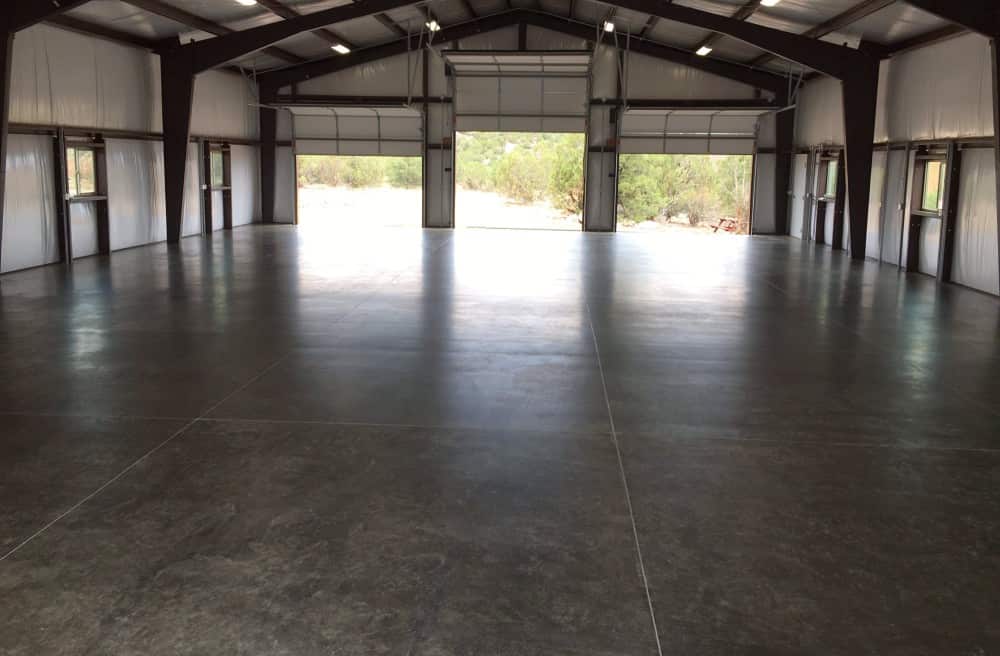
It’s not often that we get excited about a new product. However, when Concrete Sealers USA asked us to review a sample of their new TS210 concrete sealer and coating, we did “geek out” a little bit. In short, if you have been looking for a clear, concrete sealer and coating that is very durable, easy to apply, and provides great oil- and other automotive-chemical stain protection at a reasonable price, your search may finally be over.
So, what is TS210? It is an environmentally friendly, 2-part water-based, high-performance, acrylic-modified, aliphatic polyurethane sealer and coating. Designed for smooth troweled and power troweled finishes, it is highly stain-resistant and does not require acid etching or concrete grinding before application.
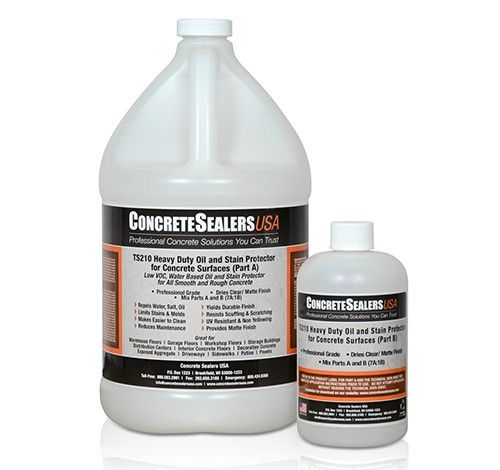
When applied, it not only seals your concrete garage floor or workshop from the elements but also provides a thin, durable topical coating in a non-glossy, matte finish. And if a matte finish doesn’t excite you, a newer semi-gloss finish is now available as well. TS210 is a fantastic garage flooring option for those who like the simple look of bare concrete.
Why we are excited about TS210 concrete sealer
High stain resistance, extended wear, and easy cleanup are always the key requirements people look for in a garage floor coating. Easy DIY application (no etching or grinding) and a budget-friendly price are always the next. The problem, though, is that long wear and high stain resistance rarely coincide with easy application and a budget-friendly price.
Until now, acrylic coatings have been the only easy-to-apply clear coating for bare concrete. The issue, however, is that most acrylic coatings are susceptible to damage from road salts, solvents, and petroleum products. This includes gasoline and other automotive chemicals. Their abrasion resistance is not good for a busy garage environment either.

Penetrating sealers are budget-friendly, easy to apply, and help protect concrete, but they do not perform nearly as well for stain resistance. They will not change the look of bare concrete either. This is because they are not topical, film-forming sealers (coatings).
If you want a more durable, appropriate clear coating for the bare concrete in your garage or workshop, you need to apply clear epoxy, polyurea, or a similar product. The growing popularity of the newer single-part polyurea is an example.
However, the drawback to these types of coatings is that the application is more involved. It requires acid etching or grinding of the concrete surface before application. They are also much more expensive.
As a result, there has always been a large gap between the easy-to-apply, yet not very durable, acrylic coatings and the high-performance epoxy or polyurea clear coatings. The latter provides excellent stain protection and durability that most people require for their workshop or garage floor.
TS210 concrete sealer fills this large gap. Like acrylics, it seals the concrete as a topical coating, is easy to apply, and does not require acid etching or grinding.
Unlike acrylics, it provides a thin, very durable coating that is much more scratch-resistant. More importantly, it repels oil, gas, and other automotive chemicals just as effectively as traditional high-performance garage floor coatings, but at a much lower cost.
This post may contain affiliate links. If you use these links to make a purchase, we may earn a small commission. You can read our full disclaimer here.
Benefits of TS210 as a polyurethane sealer
Polyurethane has always been considered a high-performance coating that provides great protection from chemicals and abrasion. More so than epoxy.
However, polyurethane typically does not adhere well to bare concrete. This is the reason why it is primarily used as a clear or color coat over epoxy floor coatings.
TS210 has solved the adhesion issue to bare concrete by modifying the latest polyurethane nanotechnology with a new generation of polyacrylate dispersions.
Formulated as a low solids, waterborne polyurethane, it enables the sealer to achieve high penetration into a minimally prepared concrete substrate to achieve a good mechanical bond. This penetrating action effectively seals the concrete and allows additional coats to chemically adhere to the sealer.
TS210 Benefits
- Repels water
- Resists dusting
- Excellent resistance to oil, grease, and other common automotive fluids
- Excellent chemical resistance, including acids
- Excellent abrasion resistance
- Excellent stain resistance
- Superior stain protection compared to penetrating sealers, including those containing fluorocarbons or fluorine.
- No hot tire lift
- Easy cleanup of spills
- UV stable and will not develop a yellow tint
- Easy to apply – no acid etching or grinding required
- Breathable
- Low VOC’s
- Can be applied to color-stained concrete**
** Testing for proper adhesion after staining is recommended
As you can see, these benefits are fantastic for a clear, concrete coating that does not require acid etching or grinding. You can visit their website here to learn more.
TS210 is also an excellent option for use on color-stained concrete. We highlighted an All Garage Floors reader who applied TS210 to his freshly color stained basement.
It will not create the glossy appearance of typical stained concrete, where the colors pop with vibrancy. Instead, it will slightly darken the stain color, creating a richer-looking finish. It is a good choice if you are not a fan of the high-gloss look. However, the newer optional semi-gloss finish will bring more of those colors out if that is your goal.
If using a colored dye, it is recommended to test for proper adhesion in an inconspicuous area first. Concrete Sealers USA wants to ensure that the colorant deposited in the concrete pores won’t block the penetration of TS210, which is required to achieve a good mechanical bond.
Acid staining does not require adhesion testing, as the stain solution etches the concrete and opens its pores. However, it may require an additional coat of TS210 due to the first being absorbed more than usual. Additionally, it may slightly darken the surface.
TS210 Wet Slip Resistance
One consideration about concrete coatings is slip resistance. Gloss is a significant contributing factor. The glossier a coating is, the slipperier it becomes when wet. Because TS210 has a matte finish, it is much less slippery than most other concrete coatings.
High slip resistance rating!
One of the big surprises with TS210 is the good slip resistance rating. Testing revealed a .65 Wet DCOF under the new ANSI/NSFI B101.3 rating requirements. A rating of .42 or greater is considered desirable. .65 is a fantastic rating for a coating, and the only one we are aware of that even offers slip-resistance information.
The new semi-gloss finish has a .45 Wet DCOF. Though not as high as the matte finish, it’s still a desirable rating and much better than a standard coating.
Other coatings require the addition of a slip-resistant additive to achieve ratings this high. Our unscientific wet-slip-resistance testing confirmed that this is the least slippery coating we have ever encountered.
What TS210 Concrete Sealer will not do
There are a few things that we want to make clear so as not to create any confusion. Though TS210 Concrete Sealer provides good protection for your concrete, workshop, or garage floor, it is not the equivalent of a commercial-quality, high-build, floor coating system.
Additionally, it cannot be used as a clear coat over other coatings, sealers, or paint. The specific purpose is for application to smooth, interior bare concrete only. It should not be used on broom-finished concrete.
Furthermore, because TS210 is a breathable, thin-mil coating, it should not be exposed to standing water for extended periods, nor extreme winter weather conditions that track in snow, salts, and deicing fluids that sit for long periods. Doing so may lead to delamination issues.
Lastly, it is not considered a self-leveling coating. It will not seal cracks or fill minor irregularities in your concrete surface either. All cracks and surface repairs should be completed before applying TS210.
TS210 Application
The concrete must have a smooth finish and be in reasonably good condition, with no bond-breaking agents present, such as concrete curing agents, sealers, or contaminants.
Coverage rates for TS210 are 800 – 1000 ft² per gallon for smooth-troweled and power-troweled concrete. A minimum of two coats is required. Coverage rates for the second and subsequent coats will be greater. This is due to the sealer not being absorbed by the concrete.
Easy application is one of the key benefits of TS210. As long as it passes a water absorption test, no etching or grinding is required.
To test your concrete, pour a shot glassful of water onto the surface. If it absorbs the water in 3-5 minutes, you can go ahead without additional prep.
Providing you do not need to make any crack repairs beforehand, the only other requirement is to properly clean your concrete. It’s important to make sure that all oil and grease stains are cleaned as well. If water beads and will not penetrate the concrete where oil or other contaminants are located, neither will the sealer.
Let the floor dry for a minimum of 24 – 48 hours, depending on the weather. The concrete must be completely dry throughout, not just on the immediate surface. This is important.
TS210 is a two-component sealer and coating. It requires mixing 7 Parts-A to 1 Part-B. The mixing is not difficult, but it is the most critical process. As long as you follow the instructions, you won’t have any issues. Pot life is approximately 2 hours. This is plenty of time to apply one coat to a typical 2-car garage.
Mix only that amount you will use for one coat. Otherwise, the remaining mixed product will become unusable. To apply, use a quality 1/4″ nap roller working out of a paint tray.
Work in smaller 10-12 ft² sections at a time. When applying, the sealer will take on a milky white appearance. Roll the sealer over the surface until it takes on a clear sheen.
Do not let the sealer puddle. Thin applications are what you want, not thick. If you initially applied too much to one section, work the excess into the next section.
After the first coat is applied, allow it to dry for 3-5 hours until it is tack-free. You will then wait one additional hour before applying another coat. If you wait longer than 24-48 hours between applications, you will need to rough up the surface with 120–150-grit sandpaper to achieve a mechanical bond.
Dry times are based on air temperatures of 70 degrees or higher. Temperatures as low as 60 degrees can almost triple the drying times.
Once the final coat is applied, it will accept light foot traffic after 5-7 hours and heavy foot traffic after 7-10 hours. Wait a full 48 hours before subjecting the floor to vehicle traffic.
Important notes
Please read the data sheets for TS210 before purchase. You can find them here. If you are not familiar with technical data sheets, read our article to learn more about why they are essential. The product description, recommended uses, application instructions, and limitations are clearly defined and easy to read for TS210. This will help to avoid any pitfalls you may encounter after purchase.
TS210 offers excellent 24-hour stain protection for oil, grease, and many other common automotive contaminants. Exposure to harsh solvents or solvent-based products, or the use of aggressive cleaners or detergents, can cause irreparable damage. This may require reapplication to restore the sealer and stain protection.
TS210 is intended to provide a reasonable opportunity to clean up spills. All spills should be wiped up immediately. In some cases, the product will act as sacrificial protection and will require reapplication.
You cannot apply TS210 to previously sealed, painted, or coated concrete. You must first remove the sealer or coating by grinding or other mechanical means.
Additionally, it is not intended for dusting or chalking concrete surfaces, surfaces with efflorescence present, or concrete with indications of moisture vapor transmission. Examples of moisture vapor transmission are darker areas of concrete that appear wet, and damp areas that form under mats, boxes, or other flat objects sitting on the concrete surface.
For extremely dense, burnished, or lightly polished concrete, a priming coat of TS210 may be required. You can create a primer by adding 1 Part water to 1 Part pre-mixed TS210. Apply the primer coat very thin and then follow the recommended recoat procedures.
Lastly, TS210 Concrete Sealer works best on concrete surfaces that are in good condition, with few defects or extensive repairs.
Our Review and Test Results of TS210 Concrete Sealer
Concrete Sealers USA sent us a sample of TS210 to test and review. The concrete we used as our test surface was 45 years old and had previously been tiled with VCT. The VCT had been removed two years prior, and the concrete was mechanically ground to remove the old glue. A densifier was then applied to the concrete.
Though the concrete was old, it was still in fair shape and had since been covered with interlocking garage floor tile. Our test area had a small surface crack, a few small divots, and some crazing, but it provided a nice clean surface for us to use. The black marks are color stains from the VCT glue.
We were first concerned about the densifier treatment. However, we found that it would still absorb small amounts of water. If your concrete will absorb water, then you can apply TS210.
The provided application instructions are very good. Since we were applying it to a small 4’x4’ test section, we used only a microfiber applicator pad that was pre-moistened with warm water.
As the instructions indicate, the sealer turned a whitish color when first applied. After working it in with the applicator pad, it soon took on a clear, wet sheen. We found that it goes down easily. We followed the recoat instructions and then applied a second coat.
The first thing we noticed was that the concrete had a slightly darker appearance. You can see this in the following images. Though the finish was not glossy, it was still very nice, and we liked how it highlighted the different characteristics of the concrete. As an example, some of the surface crazing, which was hard to see before, was now highlighted and added to the character.
We then let the coating cure for a full 72 hours before subjecting it to the various stain tests and scratch resistance tests we performed. Though you can drive on the coating within 48 hours, we wanted to ensure the coating was fully cured before we abused it with our unscientific testing.
Stain testing was first on the list. We applied used motor oil, anti-freeze coolant, DOT 4 brake fluid, automatic transmission fluid, automotive grease, gear oil, mineral spirits solvent, gasoline, carburetor cleaner, and acetone. We wanted to test it against battery acid, but we didn’t have access to any at the time.
Apart from the acetone and the carburetor cleaner, which evaporated rather quickly, we left all our test liquids and grease on the surface for approximately 24 hours. You can see some of these chemicals in the images below.
We then wiped up these areas with just a clean rag. The results were quite impressive for a coating that was so easy to apply.
We found no staining or visible change in the coating, except for the brake fluid. After wiping up the brake fluid, we found a slightly darker, translucent stain on the finish. However, when we gently wiped it down with some acetone, much of the stain disappeared.
Considering that most brake fluid spills are made while working on a vehicle and generally cleaned up fairly soon, we decided to do subsequent brake fluid tests of 3 and 6 hours. These test results did not stain.
Keep in mind that no coating is stain-proof. If you leave chemicals and oils on a coating for long periods, you run the risk of a stain developing.
Out of curiosity, we tested some used motor oil for 24 hours on a single visible crack. As suspected, the crack absorbed some of the oil, which then migrated under the coating. As we stated, TS210 will not bridge cracks like thicker coatings will. This is why all cracks must be repaired before application.
Abrasion testing of the coating was next. We used a steel floor jack that weighs almost 80 lbs, and slid it back and forth over the coating. We also picked it up and then roughly set it down. Both drills were performed multiple times with no visible signs of damage to the coating.
For our next test, we subjected the surface to a jack stand with thin, angled feet. These types of jack stands are known for damaging less durable coatings. We pressed down on the jack stand with some weight and slid it in circles and figure eights. Like the floor jack, we could not detect any noticeable damage to the coating.
Does this mean the coating is damage-proof? No, not at all. This is where the benefits of a matte finish are realized. When we leaned down near the ground and shone a light across the surface, you could see some minor marks and scratches that were left on the finish.
The newer semi-gloss TS210 would make these easier to see. This is a characteristic of all gloss coatings. Scratches, score marks, and general dust are easier to see.
Undeterred, we set about deliberately damaging the coating with a sharp screwdriver. This was done for two reasons. We wanted to see how hard (or easy) it would be to damage the coating. We also wanted to see how easily it could be repaired.
To our surprise, it took quite a bit of effort to sufficiently scratch the surface enough to expose the bare concrete. We then roughed up the area with 150-grit sandpaper, wiped it down with denatured alcohol, and then applied freshly mixed TS210 to the area.
After one application, the scarred coating was much less noticeable. These were very encouraging results! After we applied the second coat, you could only identify the area if you knew where to look.
The reason for our excitement is that durable coatings, for the most part, are difficult to repair without the repaired area standing out like a sore thumb. Again, we feel the reason for this is the matte finish. If it were the semi-gloss finish, we don’t think our results would have been quite as good.
Where to buy TS210 Concrete Sealer
TS210 can only be purchased directly from Concrete Sealers USA. One more benefit we forgot to mention is that it is available in multiple container sizes, which I will explain.
PURCHASE TS210 CONCRETE SEALER HERE
Many concrete coatings are only available in gallon sizes and larger. This can result in an unwanted expense when your garage is 450 ft², and 1 gallon covers up to 400 ft². It requires you to purchase another whole gallon when you only need enough for an additional 50 ft². You should never stretch coverage rates for sealers and coatings.
Concrete Sealers USA offers TS210 in quart, 1-gallon, and 4-gallon containers. This allows you to save money by ordering what you require down to the quart if necessary, instead of the gallon. Quart sizes are also great if you ever need to make repairs later in the coating’s life.
Final thoughts
Though our test concrete was not like-new, the TS210 polyurethane sealer brought out the concrete’s character and impressed us with its high-performance stain and abrasion protection. We are confident it will be a very popular concrete sealer and coating for garage floors and workshops once the word gets out. It fills a much-needed void in sealers at this price, given the ease of installation, protection, and durability it provides.
Though the matte finish is not a glamorous or highly decorative concrete coating, it does provide a nice functional look to bare concrete that many people enjoy. We recommend the newer semi-gloss finish if you want a decorative sheen that stands out more. Just be aware that cosmetic blemishes from extended use will be more visible.
You would need to spend much more on a coating for your garage floor or workshop to achieve better protection and longer wear. Regardless, TS210 should perform exceptionally well in a typical garage or workshop environment. This is what makes TS210 an exceptional value and a coating worth your consideration.
Great review. After a ton of research on different flooring options for my garage’s ancient cement slab, you guys have sold me on this.
Can you use this over a non-sealing concrete stain (not like H&C’s solid color product)? I’m thinking I want to put a little color in the floor before putting 2-3 coats of TS210 on it to protect it. I know it won’t look brand new, but the imperfections of the floor would add “character” to me.
Hi Tony. Yes, if you use an acid stain or some type of solvent based or water based penetrating stain, then you can apply the TS210 over it to protect the stain. We actually did some testing for stain as well. Because the TS210 is a matte finish, it will darken the color somewhat and make it look more rich. What it won’t do is make the color pop with vibrancy like the typical glossy clear coats will.
Awesome! I’m actually looking for a more subtle finish anyway, so “not popping” is a bonus. Are there brands of stain you would recommend from your experience? I’m flying blind here, and would like to avoid cheapo big box store brands if they aren’t any good. Thanks!
The type of stain that you use will sometimes depend on the color and look that you want, Tony. Acid stains, for example, are mostly earth tones and provide a variegated and mottled look. Acetone stains tend to create a more solid color with a larger choice of color. The newer water based stains have a larger selection of color like acetone, but they look similar to acid stains once applied. We have an article about them here.
Direct Colors has always been a good place to look since they carry both acid stain and acetone dyes. Legacy Industrial is a good place to purchase water based stains. These are not the only places that sell good product. Just make sure that you don’t buy a product that is sold as a stain and sealer in one. These are not true stains and can actually peel up from the concrete.
Thanks for the help!
How much prep would a new construction garage floor need? I read through the cleaning article, but it seems mostly intended for old/dusty/stained floors.
Thanks!
Hi Derek. If the surface will absorb a shot glass of water in 3-5 minutes, then the only prep that is required is to clean your floor. Just give it a light scrub down with some powdered laundry detergent or degreaser. Rinse well and then let dry out for 24-48 hours and you are good to go.
Great, thank you!
This is a great review – thank you. I’m planning to use this product on a newly placed slab in a detached garage. Epoxy and polyurea seemed like overkill for my use – just want some stain resistance and cleanability without a lot of expense and effort. This product seems perfect. I assume it is good to use on new trowel finished concrete after waiting a month and doing a moisture test?
Hi Dave. Yes, TS210 would make for an excellent choice in terms of stain resistance, durability, and ease of cleaning. As you are aware, a standard 4″ thick concrete slab requires a minimum of 30 days to cure first. Do the moisture test after waiting for the cure. No concrete prep is necessary to apply TS210 (other than a clean slab) as long as a sealer was not applied to aid in the cure and the concrete will absorb a shot glass of water in 3-5 minutes.
Could a traction additive be used with this product? Or it too thin of a build.
I was thinking say 2 or 3 coats with an additive in the final coat.
Hello Eric. We know that the manufacturer has been working to find an additive that works well, but the problem they have been having though is that the coating is just too thin. It really is not that slippery when wet, however, it’s not going to provide the same non-slip properties as bare concrete either.
If I were to coat my floor with TS210, and at a later date wanted a glossier finish, or even to go with an epoxy, or traditional gloss polyurethane cement/garage patint, would the TS210 cause any problems ??
Hi Daryl. You will need to remove the TS210 via grinding if you decide to go with a different coating in the future. It would not be compatible with other products.
Hi Shea,
Do you have a recommendation between the TS210 vs GhostShield 8510 vs PS101? I plan to use my garage for basic vehicle maintenance and other DIY projects.
I want to avoid having to grind or etch.
Thank you!
Hi Sunny. The TS210 is going to give the best protection since it is an actual coating and the other two options you mention are penetrating sealers. Oil and other fluids will just wipe right up without staining. If a stain did happen, it would only be on the coating and not the cement. You can just sand the stain off the coating and apply a little more TS210. You will not have to etch to apply TS210 as long as your concrete is not too smooth. If the concrete will absorb a shot glass of water within a couple of minutes, then no etching is necessary.
PS101 is a great concrete sealer and the least expensive by far, but oils and other petroleum products can stain if it’s not cleaned up in a timely manner. GhostShield 8510 with a densifier treatment is going to provide better oil protection that PS101, but it will be more expensive. In fact, it may be more expensive that the TS210.
Thank you so much! I read from other comments that they do not have an anti skid additive for the TS210. You mentioned that it is not too slick, but will this get better with normal foot and vehicle traffric?
Thanks again for your advice and the great website!
That’s correct, Sunny. TS210 is just too thin for successful application of an anti-skid additive. We know from experience that it is not as slippery as a regular coating can be. However, it will not have the same wet traction as bare concrete either. Normal foot and vehicle traffic will create microscopic scratches on the surface which aids in grip, but it still won’t be as grippy as bare concrete.
Could I use TS210 one a non etched floor that seems to have some very polished surfaces, and some more pourous surfaces. THEN, the goal would be using a more colorful colored floor paint ( like 1part epoxy, drylok, behr, or others), I would be using the TS210 as a primer, but wonder what options for a final coat might be, whether 1part epoxy paint, or another floor paint, with no etching.
Hi Daryl. As long as the very polished surfaces pass the water absorption test outlined in the article, you can apply the TS210 to those surfaces. TS210 is designed as a clear stand alone topical sealer that should not be top coated. It is also not a primer. Additionally, the type of products you are mentioning to coat over TS210 are inferior in stain resistance, chemical resistance, and abrasion resistance. If you want a colored floor that is going to provide similar protection, you will need to go with an actual 2-part epoxy or similar coating. Rust Bullet has their new DuraGrade Concrete coating which generally does not require acid etching. However, it will require prep for very smooth or polished surfaces.
Hi, this seems like a great product and I would like to use for my garage. I did a quick water test. The liquid did not fully absorb in 5 minutes. What is steps should be taken to prep the concrete so the TS210 properly adheres/seals?
Hi Jim. The concrete is absorbing it though, correct? If the water is not absorbing very well you may need to do a light concrete etch – nothing aggressive. One of the mild Eco friendly concrete etching solutions that you can get from you local home improvement center would most like do the trick. Just use about 2/3 of the granules in the proper mix. Once you rinse, let the concrete dry thoroughly and then test again.
Yes the water absorbed, but slowly. There was still a pool of water after 8 minutes or so, but less than originally poured on the concrete. I will follow up with the eco etch and retest.
I need to fill in where my floor has been saw cut. What product do you recommend for use with ts200? Thanks for the review. very helpful.
Hi Gregg. The proper material to fill the joints if you plan on coating over it will require light grinding to create a smooth transition and to create a proper profile for the TS210 to adhere to. Just keep in mind that this will alter the look (lighter color) of the concrete where this is done. For this we recommend an epoxy or polyurea with enough elongation to flex. We outline what products you can use here. The other option would be to coat the floor first and then fill the joints with SikaFlex or something similar.
Would you lightly compare HD6525-MMA by legacy to ts200 by concrete sealers? It appears as the ts200 is more of a matt finish. Which one would be best for a working home garage? Thanks
There are more differences in these two products besides the finish, Gregg. HD6525 is an MMA acrylic sealer, while the TS210 is an acrylic that has been highly modified with an aliphatic polyurethane. While MMA acylics are more robust in terms of wear and chemical exposure when compared to standard non MMA acrylic sealers, it does not provide the same durability, chemical and scratch resistance as TS210. Of the two for a garage environment, TS210 is the better choice if the finish is not a primary factor.
Hello, what is the life expectancy of TS210? Environment being typical garage traffic and home vehicle maintenance.
Hi Tyson. It’s always hard to gauge exactly how long a coatings will last. The abrasion resistance rating for coatings helps to determine how well it will wear compared to other coatings. TS210 has a good rating that is slightly lower than the typical glossy, high-performance polyurethane clear coats used on epoxy coating systems. You will most likely see close to 10 years before you may need to recoat.
Hi, I’m considering TS210 because I’d like to maintain the look of exposed concrete of my garage floor while benefiting from the sealing and coating attributes of the product. Since I’m already planning on grinding my 35 yr old floor to refresh overall look and texture, would you recommend a Polyurea clear coating like Nohr-s instead?
Thanks and continue the great work!
Hello Neil. What is the look that you are trying to achieve? TS210 is a thin mil coating with a natural looking matte finish. Polyurea, on the other hand, is a thicker mil coating that is very glossy. If grinding the surface, we recommend 100 grit diamond segments to create almost a honed look for TS210. It does not need an aggressive grind since it can usually be applied to concrete that has not been prepped at all. If applying polyurea, then you will want to use the typical 25 grit diamond segments.
I did some porosity tests on my concrete, and the results are mixed. Some areas absorb immediately, these were stuck under paint overspray that I pressure washed off.
Some areas (under the tire tracks) get dark and stay on top for a while. They don’t bead up like a sealer.
I’m the original owner so I know it was never sealed, but is that porous enough to accept the TS210?
How about dye, densifie, or a topical sealer?above, or a topical sealer?
I think I’ve decided against dyeing. Now I’m trying to decided between TS210, or Ghostshield 4500+8505. I really don’t want to start grinding.
I like the look in the picture here, it has a low sheen which is good enough for me.
Hi Scott. Based on your description, TS210 should work fine if you clean your slab well. The areas that get most of the tire traffic most likely have some plasticizers (oily substance) that have built up in the concrete. Our suggestion is to rent a floor maintainer with a black or green scrub pad. Use a strong TSP solution to scrub with and then rinse real well. This should make the areas where the tires roll more susceptible to absorption as well as the rest of the concrete. This prep will work well for the TS210, dyes, or any penetrating sealer combo (GhostShield) that you plan to use. Most other concrete coatings are going to require an acid etch or grind in order to adhere. Rust Bullet Duragrade has a clear that will not require it for your floor, but it will produce a very glossy finish.
I’m not sure it’s tire, though. The dark areas aren’t just limited to the tires, but sort of randomly all over the place.
Some of it is in the center of the garage where no tires have even been. Plus, all of my basement.
It eventually absorbs, just not quickly. I haven’t timed it though.
Those areas may just be spots where the surface of the concrete is more dense, Scott. Concrete density, color, and texture can vary throughout the surface of a slab due to the finishing and curing process, particularly if it was done by hand and not machine troweled.
Seems like it. My question is will it accept a simple penetrating sealer as-is, or require more involved prep.
If you clean the floor like we suggest it should be more than adequate for a penetrating sealer. It shouldn’t take much more than an hour to complete if that. Regardless, the concrete has to be cleaned first anyway before applying anything.
A little late to the party. I just had a slab poured and put Prosoco LS/CS densifier on it while still green (per the manufacturer’s instructions). My questions is; can TS210 be installed after 30 days as an additional stain barrier? I’d like to keep it as pristine as possible, I’ll be doing lighting maintenance, modification & some fabrication on my personal UTVs, tractor & zero turn mainly. Weekend warrior! If TS210 is NOT the product to use, what would you recommend? BTW – I would have bought PS104, the data sheet said wait 28 days. It appears to be the exact same formula as the LS/CS which required no waiting?
Hi J. Though the data sheets for Concrete Sealers USA PS104 and Prosoco LS/CS look similar, there are variations (not required in data sheets) in the formulas that will allow one product to be applied to green concrete while another needs to wait. In addition, PS104 has a siliconate sealer added which prohibits application to green concrete. The Prosoco product does not. The advantage to applying a densifier to green concrete is that it will help with retaining moisture in the concrete during the curing process. In addition, these type of densifiers are preferred for construction site work so that the concrete will be protected from ongoing work that generally takes place once you can walk on the slab. The advantage of waiting the 30 days is that there is much more calcium hydroxide present after the hydration process has taken place. This is what the densifier reacts with in order to provide the best densifying properties.
You may be OK with applying TS210 after 30 days. A straight densifier that does not have a sealer added(Prosoco) technically is not a sealer. If the concrete will absorb a little bit of moisture and not bead water, then you should be good. I would recommend giving Concrete Sealers USA a call when you hit the 28 day mark. Their customer service is very good and they will walk you through the process to determine if your floor qualifies or not.
I have a 5-year-old personal workshop with a machine-troweled floor. It’s used primarily for occasional automechanic work and woodworking–never for daily parking. I’d like to apply TS210 to the floor to protect it from further stains from spilled vehicle fluids.
Unfortunately, there are already two large stains on the floor–one from gear oil and one from antifreeze–that are each several square feet in size, as well as several smaller stains (no more than a couple inches) that are mostly motor oil. I’ve tried to clean those stains with several different cleaners, including Oil Eater and ACT powder. Neither made a dent in the stains, so I’ll just have to live with them “adding character” underneath my new sealer.
I’ve sprinkled (with my wet fingers) drops of water onto the bare concrete and both of those big stained areas. The bare concrete soaked up all the surface water within 5 minutes, and was dry in 10 minutes. After 10 minutes, the two stained areas were obviously soaking in some of the water, but still had beads of water standing on the surface (there were halos of damp concrete surrounding the beads). The indoor room temp was about 85F with high humidity and no sunlight or breeze.
How will these stains affect the application of TS210? The ConcreteSealersUSA web site for TS210 talks about priming overly dense/smooth surfaces with a diluted mixture of TS210. Will that work on my stained areas, too? Do I need to sand or acid etch those areas? How can I best prep those areas to help the TS210 to stick? Will etching affect how smooth the surface looks after the TS210 has been applied?
I spoke with CS’s customer support, and they basically said that unless my floor was brand new and perfect, I couldn’t use TS210. That seems to contradict this article, though. Any suggestions?
Hi Obi-Wan. Love the screen name. The areas with oil are going to need more work if you want to apply any type of coating. Machine troweled floors are better at resisting oil staining, but they are much worse for trying to remove the oil once it has soaked in. We prefer Terminator-HSD or Eximo over ACT (we’ve used Eximo ourselves), but it’s not that huge of a difference. The key is allow time for it to work and to reapply occasionally during that time. You would get better results if you sanded the surface first with 80 grit. This will open up the pores slightly of the smooth concrete and allow better penetration. The sanding will lighten the surface some, but either way, it’s not going to look like the rest of the concrete. Another option that works is to soak the area with a solvent such as kerosene. Once you know that the solvent has soaked in, and while it’s still damp on the surface, coat the area with Portland Cement (not premixed concrete). Portland Cement is very fine and acts as and excellent hygroscopic powder. Cover the area up and let it naturally draw the oils out. Be sure to apply enough that it won’t all get soaked. Give it a couple of weeks and then sweep it up and test.
We know the owner of Concrete Sealers USA. He is always extremely concerned about potential customers being satisfied with his products and instructs his employees accordingly. He will recommend not buying a product if he thinks it may not meet your needs. This is rare to find these days and one of the reasons we recommend the company. However, I think they are being too cautious in your case. We tested TS210 on an old concrete floor that was not in the best shape. It performed extremely well. I think that if you get the oil stained areas taken care of so that they will absorb some water, you should be just fine.
How does this compare to single part polyurea in terms of long-term chemical resistance (e.g. leaving dripped oil on the floor for 5 months during winter)?
Hi Sam. It’s going to be fairly similar in comparison. The polyurea may do a bit better. However, coatings are not maintenance-free and not intended to allow oil to sit for months on end like that. The coatings may discolor a little bit if allowed to sit that long. If you do a wipe down once every month or so you shouldn’t have issues with either.
I applied the first coat of TS210 to my garage floor today and it seems I underestimated the amount of coverage I needed to fully apply 2 coats. I plan on ordering an additional gallon, but it won’t arrive until outside of the 48-hour window for reapplication. The garage floor will be sealed off with no exposure to dust, dirt or other debris. Do you see this being a big issue for applying the second coat?
Hi Andrew. There is a reason for the 48-hour recoat window. Once the 48 hours have passed, the coating has closed up and crosslinked so tight that a new coat cannot chemically react and adhere to itself sufficiently. Once you pass that window, you will need to degloss the surface first before applying an additional coat. You can degloss it by scuffing with a green scrub pad using a floor maintainer or 150-grit sanding paper on a pole sander, orbital sander, etc. Once you sweep up or vacuum the light dust, wipe the surface with denatured alcohol or equivalent. Let it dry for about 15 minutes and then you can apply another coat.
We just had a barn/workshop built, and I don’t think a vapor barrier was installed. I was thinking that I’d use epoxy to help seal it, but one of your articles mentioned that this could have the detrimental effect of the concrete deteriorating just under the epoxy. Would TS210 be a good choice for my situation? I like the stain repellant feature, but I don’t know if I’d need to worry about the concrete deteriorating under this sealer. Thanks, and great web site!
Hi Mike. Do suspect moisture issues with the slab? Is it below grade or do you live in a wet area of the country and the slab is adjacent to a hill? Most moisture issues with water migrating up from below are due to below-grade slabs, water leaks under the slab, drainage issues where water pools against it, and so on. If the slab is above grade and water drains away, the lack of a moisture barrier should not be an issue unless there are other circumstances we are not aware of that would allow the slab to absorb moisture underneath. The majority of epoxy floors and similar are installed on slabs without a vapor barrier. If the slab has cured for 45 days or so, we would recommend moisture testing in a few areas using the simple plastic sheet test first. This will give you an indication if moisture is a concern. In regard to TS210, it is a breathable film-forming sealer. This means that, unlike epoxy, it will allow moisture vapor to travel through the coating (within reason) and not collect underneath it.
It is slightly below grade (down a hill). I thought I might have issues soon after the slab was poured, as moisture was apparent under anything that was left on the slab overnight. I will retest with your moisture tests tomorrow, now that it’s been over 60 days now.
Hi Mike. The evidence of moisture soon after was most likely due to the water content of the freshly placed concrete evaporating out of the slab. That is one reason why you need to wait a minimum of 30 days before applying a coating. Retesting now will give you a much better idea of what to expect.
Well, the moisture test using the piece of plastic resulted in no problems with moisture coming up, so that’s good. Unfortunately, the absorption test with the shot glass of water resulted in pretty much no absorption. I think it finally evaporated rather than being absorbed. The surface is pretty smooth, so I’m back to the drawing board trying to select a product, unless I was to grind it down, I guess.
Hi Mike. Was a cure-and-seal product applied immediately afterward by the concrete contractor? If so, then nothing can be applied without grinding first. However, if it was just power troweled or steel troweled very smooth, it will just take some sanding (not grinding) of the surface to break it up a little. This is easily done with a floor maintainer and some sanding screens. It’s not a messy job and will just require cleaning the surface when you are done. TS210 can then be thinned with water to create a primer coat first. Once it tacks up, you can apply two regular coats after that. I would suggest giving Concrete Sealers USA a call and speak to them about it. Tell them we sent you. They can guide you through the process.
Is there a benefit to applying a densifier/Hardener, i.e. PS103 prior to using the TS210?
Thanks
No, not really. PS103 hardens concrete surfaces. It does this by reacting with the calcium hydroxide in the concrete to produce CSH (calcium silicate hydrate). The CSH is deposited into the open capillaries and pores near the surface which makes it harder. This process can affect how well a coating such TS210 will adhere. Straight densifiers such as PS103 are commonly used as a treatment for shop floors and the process of polishing concrete. Though TS210 will not harden concrete, it does a much better job than densifiers at protecting it from the elements.
Hi Shea, I have decided on TS210.
My slab is 2 years old, even has some paint stains, and other junk on it, but I have an orbital floor cleaner with black and green pads and cleaner/degreaser and will be cleaning it up.
I had planned to etch with some Eagle Etch & Clean I have on hand as my water test utterly failed and it is only troweled, nothing has been applied to the slab. However, I read where you told a guy above who had failed water test that a the green or black pad should resolve his porosity problem. Is this an option in leu of etching?
Second, currently, I plan to just coat the concrete with TS210 (2coats), but I would love to have a SOLID light color under the TS210 to enhance shop lighting. Is there a white or light grey solid color that can go under TS210? I saw some Bear Solid Color Concrete Stain at the big box store and wondered??? I checked the acetone dye store, but they did not have light color that would be any better than plain concrete.
Thank you. -Mike
Hi Michael. Before etching, we would recommend scrubbing an area with a black orbital pad first. Let it dry and then see if it repels water or not. Sometimes this is all that is required for smooth troweled concrete. Stay away from the Behr concrete stain or any other brand that advertises rolling on a stain with a paint roller. These are what we refer to as fake stains and wrote an article about them here. They are essentially acrylic coatings that are heavily tinted. TS210 can only be applied to bare concrete and not coatings. However, you can stain the concrete with a true water-based stain or acid stain. They permanently change the color of the concrete, but they do not seal it or leave a film on the surface. Here is an example of a reader who used a concrete stain and TS210. True concrete stains are somewhat translucent and do not create a solid color.
Shea, if I choose a light color stain such as white, beige, light grey, amber, tan, or almond will it be noticeably lighter?
Pictures appear that it is so, but a concrete guy on a forum told me that he had never seen stain make concrete lighter.
Hi Michael. The color will get lighter when you apply a lighter stain over darker concrete. However, stains are translucent and the darker undertones of the concrete will still come through. Once a stain is applied, you can only go darker in color, not lighter. That is why when multiple colors are used, the lightest color is applied first. In addition, stains highlight all the imperfections in the concrete and give it character. If you don’t care for that, the only way you can a achieve a solid lighter color is to apply a colored coating.
have a new 3000 Sq/ft shop with heated floors. light mechanical use, wood working and RV storage. thinking about TS210 or Ballistix Squire or SC. What do you recommend? Info on your site is outstanding.
Hi Dan. We would recommend TS210 first based on your requirements. It would be the easiest to apply, it’s more budget friendly, and will perform well for the type of use you have planned for the space.
Hello Shea, I would like to use TS210 on our 4 year old shop floor, which is a 6″ fiber reinforced power troweled slab in good condition. However, I treated it with Eagle Natural Seal penetrating siloxane/silage sealer during construction. It accepts water, but somewhat slowly, so I suspect that some prep may be necessary. I will try a thorough cleaning with TSP to see if this helps. Do you have any thoughts on this situation? Thank you!
Hi Karl. Penetrating sealers are non-film-forming. TSP won’t do anything to remove the sealer if that’s what you are thinking. However, it is an excellent concrete cleaner and a good choice to use. We would recommend renting a floor maintainer from your local home improvement center and purchasing a couple green or black scrub pads to do the hard work. Because you used a penetrating sealer and the floor will absorb water, we believe you would be OK using TS210. If it was any other type of coating, such as epoxy, you would need to grind the surface to remove the sealer. We would recommend thinning the first coat to act as a primer as it states in the instructions. Apply two thin coats after that. Before you decide to purchase it though, call Concrete Sealers USA first. Tell them we sent you. Give them the info on your concrete and what you plan to do. They will be your best source of information.
Thank you so much, Shea! I really appreciate your advice and will give them a call tomorrow.