
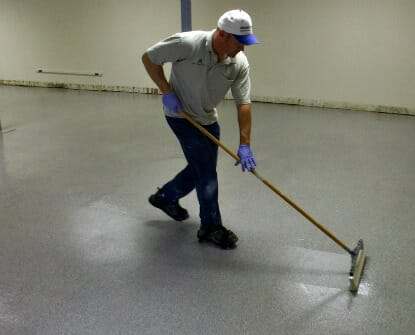
Should I apply a clear top coat to my epoxy garage floor coating? This is a reasonable question that pops up from time to time for the average DIY’er looking to save some money. The real question, however, is why wouldn’t you apply a clear coat? After all, there are many benefits to adding a clear top coat over the color coat for a garage floor.
Anyone who has installed a garage floor coating properly will tell you that the hardest and most time-consuming part is prepping the floor for the epoxy. Applying the epoxy goes fast. For many, it is the fun part of the job. So after all that work of getting the concrete ready, you should consider spending a little more time and money to ensure a longer-lasting and even more beautiful floor coating.
There are various clear coating options to choose from. However, the one rule to keep in mind is that the clear coat should perform just as well if not better than the color coat. With this in mind, let’s take a look at the top 10 reasons why you should apply a clear topcoat to your epoxy garage floor.
1. Adds durability and wear
A proper clear coat will extend the life and add durability to your garage floor coating. Depending on the type of clear used, it can provide better stain and chemical resistance than the color coat. Lastly, the additional coat adds thickness to the floor coating to absorb impacts better and reduce any chance of hot tire pickup.
2. Protects the color coat
A clear coat acts as a sacrificial layer to protect the epoxy color coat. Without it, the color coat can lose its luster from wear. Though resistant to most chemicals, some oil spills or leaks allowed to sit for long periods can discolor the coating depending on the quality of the color coat applied.
3. Protects the color flakes
If you apply paint chips or color flakes to your floor, the clear coat will lock them in and protect them from peeling up and collecting dirt at the edges. Cleaning the floor and other activities can cause color flakes to pull up or chip away. When a clear coat is added, the color flakes are protected by the clear coat layer.
4. It is easier to clean
A clear coat makes a garage floor coating easier to clean. Dust mops and microfiber mop pads can glide over the floor coating without catching color flakes. This is especially true if you have a heavy flake coverage on your floor. It also allows for scrubbing without the worry of losing color flakes or dulling the color coat.
5. A Clear topcoat Adds depth to the floor coating
The additional layer of a clear topcoat adds depth to the look of the garage floor coating. This creates a richer-looking surface that appears more luxurious and thicker than it is.
6. It Creates a glossier looking finish
A clear coat will add a glossy shine to the floor coating and reflect light better than the color coat.
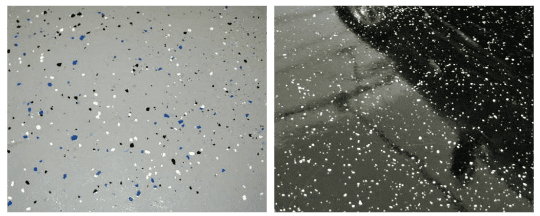
This is a great benefit when working on projects in the garage or automotive maintenance. The additional light reflection will brighten up your garage space. You may not need to purchase more overhead lighting or as much as you thought you might need.
7. A Clear Coat hides scratches better
All garage floor coatings will develop microscopic and sometimes larger scratches on the surface. A clear top coat helps to hide or camouflage these scratches so they are less noticeable and do not detract from the coating’s appearance. It does this by effectively acting as the sacrificial layer to prevent the color coat from being scratched which is much more obvious.
8. It’s a good medium for anti-slip additives
Anti-slip additives are hidden much better in a clear coat. Because most anti-slip media is translucent in color they will not stand out. Without a clear topcoat, they are added to the color coat instead. This makes the anti-slip granules much more visible as little bumps resembling sandpaper on the garage floor.
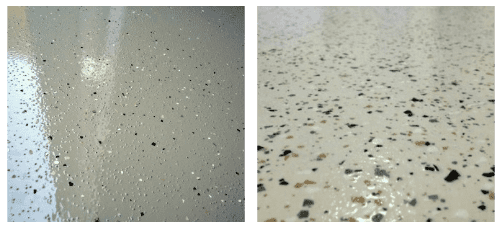
Furthermore, anti-slip media is more effective in clear coats. This is because many clear coat options are thinner in dry film thickness which allows the anti-slip media to protrude more. When used in thicker color coats, it does not protrude as much and is less effective.
9. Can be recoated to look new again
After many years of use, an epoxy garage floor coating can start to show its age depending on how much activity it has seen. If it has a clear topcoat, it can easily be roughed up with sandpaper to have a new coat of clear applied.
The sanding of the old top coat removes any blemishes, scratches, and other imperfections that the clear coating acquired over the years. Once the new clear coat is applied, your garage floor coating will look brand new again.
10. Clear topcoats just look awesome!
When you compare an epoxy floor coating with a clear coat to one that does not, there is no question about which looks better. The clear coat gives the garage floor that extra depth and showroom shine that screams “Look at me!”
If you’re on the fence about whether or not to add a clear topcoat to your garage floor coating, think about all the benefits it will provide in the long term. Yes, it will cost a little more money and yes, it may mean one more day of being without your garage. However, once you add a clear coat, you will be rewarded with a garage floor to be proud of for years to come. You will be glad you did it!
Update – Please read
Clear coats are designed for application over 2-part resinous coatings and single-part thermosetting resinous coatings. Do not confuse garage floor paint or 1-part epoxy paint as a garage floor coating. These are very thin acrylic latex paints that will not form a chemical bond with a resinous coating. Please read our article about applying clear coats over paint if this is your plan.
I just painted my new shop floor with Rust-Oleum EpoxyShield with color chips. The concrete was poured 6 months ago so no issues with that. I cleaned and prepared the floor before painting with the etching as directed. The finished look has blotchy areas where the epoxy dried heavier and roller marks where it was too thin. Some areas are shiny and some not so much. The floor temperature was only 50 degrees when applied. Could this be a reason for the dried look? Also, can I just apply a sealer over top this without sanding to give it a clean and clear finished look? What would you recommend? Thanks
Hi Jeff. Roller marks are typically caused when pressing too hard or pressing to stretch the epoxy out. This will also result in the epoxy being too thin in areas and creating color tone and gloss issues. Coatings should never be stretched and the roller should always remain wet and somewhat heavy with material. Also, the instructions clearly state not to apply it and let it cure in temps lower than 60 degrees. Are you sure it has cured? Assuming it has, the only way to fix it would be to degloss and rough up the surface with 120 grit sandpaper and apply another color coat. A clear coat will not fix the issue. If anything, it just highlights the problems.
Hey Shea, I just bought a new home and it’s coming with an epoxy floor installed by the builder. However at first look and feel the clearcoat on top is so thin at first I didn’t even think it was there. I haven’t done epoxy floors in the past it makes me believe that either cut it with some solvent or xylene it can’t be a build thickness more than 1 mm it really feels rough enough chips just flake right out, But I can tell if someone’s on there because it pulled in the cracks and it has a very very late sheen. My question is can I go back over and now having been done probably five or six months ago and put it on there nobody’s ever pulled into the garage or used the garage I’m wondering if I could just sand it up a little bit mop it and vacuum it out and then apply a poly top coat and get good adhesion. Do you think I can go back over this with a couple coats? If so what steps would you advise.
Hello Matt. If you are certain that the coating is adhered well, then you can apply more coatings over it. If it’s not adhered well, it doesn’t matter what you apply on top because it will still peel up and expose bare concrete. We have an article here that discusses the prep required.
Thanks Shea, what a great article.
Is there any ‘Go-To’ top coat you like best for a 2-part epoxy install with full-chip broadcast floor? I was looking at Rexthane as a possibility.
Hi Matt. Rexthane is a polyurethane coating that has to be applied thin. When going with a full color flake floor, you will need a minimum of three coats if you want to smooth out some of the rough texture of the flakes. We really like single-part polyurea. It’s over twice as thick than Rexthane once cured. Two coats on a full flake floor makes for an excellent clear coat. In addition, it wears much better than Rexthane. We are assuming you are applying the flakes into a high solids epoxy or other coating with a minimum dry film thickness of 5-6 mils? If not, all those color flakes will not adhere very well because the coating is not thick enough to accept them well.
Can you apply Rust-Oleum epoxy shield clear over a full broadcast flake finish with a Rust-Oleum polycuramine base ?
Hello John. Yes, you could apply Rust-Oleum EpoxyShield Clear over a full broadcast of flakes. It would require a minimum of two coats and preferably three. EpoxyShield Clear is a thin coating. The first coat will get absorbed by all the nooks and crannies of the flakes and will require two more coats to start smoothing things out a bit. What you can’t do though is apply a full color flake broadcast into Rust-Oleum Polycurmine. Like EpoxyShield it’s too thin of a coating to accept all those flakes. You a high solids commercial epoxy or polyurea as your base color coat to broadcast all those flakes into. It requires a minimum dry film thickness 6 mils for the flakes to adhere properly. Polycurmine is half of that.
Can you apply rust-oleum clear coat on top of a 1 part concrete epoxy? Or does it have to be put on top of rust-oleum epoxy shield?
Hi Yovanie. Paint is not intended to be coated with epoxy. However, if the Rust-Oleum clear coat is water-based then it can be applied. It will require that you first rough up the paint with 120 grit sandpaper first in order for the coating to apply. If it’s solvent-based, it will soften the paint and can cause it to bleed through the clear coat.
Quick question: What’s the best clear coat option in terms of finishing and durability to apply over epoxyshield garage floor coating?
Polyurethane, Rocksolid Polycuramine or epoxyshield premium clear coat?
I really hope you can help. I already have a box of Rocksolid but I wanna do the right thing.
Thanks
Hello Claudio. Have you applied the EpoxyShield coating yet?
Hi Shea, I have not. what do you suggest?
Thanks
If you are going to apply EpoxyShield, then we recommend staying within their line and apply the EpoxyShield clear coat. The reason for this is that when using non commercial quality residential kits like these, you will void all manufacture warranties when using a different product with it. The home improvement store DIY kits like these are not known for their high quality and you want to make sure you have some recourse if you have an issue.
Thanks again… You got me to reconsider… What are your thoughts on Sherwin…. Armorseal 8100?
Cheers
It’s slightly better than EpoxyShield. If you use ArmorSeal 8100, then you would really boost the overall performance by applying their ArmorSeal Rexthane I. It’s a moisture cured polyurethane with much higher abrasion ratings than ArmorSeal 8100 and it’s more scratch resistant. This would be a better performing system than EpoxyShield color and clear coat.
If it’s in the budget and you want something that is easy to apply, yet is a commercial quality coating system that will last 10-15 years or more, then we would recommend single-part polyurea.
Hi Shea,
Thank you for all your suggestions on this site. I have referred to many of them for installation of my epoxy garage floor.
I just finished installing 100% epoxy by Epoxy-Coat. However, the process was not without issues. I had a few surprises and made a few errors along the way; and as a result, I had to do much more work than what I bargained for. One of the errors happened in my last step of laying down two-part clear coat. Racing against time, my wife and I decided to speed up the process by rolling the coat with two rollers; however, I used one of the old rollers I had previously used for wall painting. It looked very clean free of any paint but during the clear coating process it must have left some contaminants on the floor. Consequently, I have several small spikes and craters in the clear coat. I am thinking of sanding the clear coat with 120 grit sandpaper and recoating it. Questions – Will I see the streaks from the sanding process after I recoat it? Will sanding produce cloudy surface where even after a fresh clear coat, I won’t see the true color of the epoxy and the flakes? Should I be concerned about any other issues and so is it better to just leave it the way it is?
Thanks for your help as always,
Hi Vijay. No worries about the clear coat. It can be fixed just as you suggest. Sanding between coats is a trick the pros use when doing metallic epoxy floors and garage floors without color flakes. It makes everything real smooth and glassy looking. The sanding will degloss and dull out the finish (which is necessary). You can use a heavier grit if necessary to smooth things out. Once sanded, sweep / vacuum and then wipe down the surface with denatured alcohol applied liberally to a microfiber mop pad. This will get any remaining dust and clean up the surface. Isopropyl alcohol will work if you your state does not sell denatured alcohol. A few minutes later you will be ready to go. As a tip, it’s always a good idea to have an extra new and clean roller on standby in case something happens 🙂 The new coat will make the color pop and everything will look glossy again.
Excellent. Thank you again. It gives me reassurance as I don’t want to make any more mistakes. Will keep extra new roller on the stand by. 🙂
One more quick question Shea in continuation of my earlier question,
After reading your other post, I realized that instead of applying another layer of clear coat, I might as well apply polyurethane to give the floor scratch resistance and UV protection. Again similar questions, Can I apply poly on top of the existing clear coat? Will cloudiness from sanding the clear coat show with polyurethane coat or will it be clear and shiny showing the richness of the base coat and the flakes? Thanks!
The same applies for any coating, Vijay. You can apply the polyurethane and you will have a more durable wear surface.
Can I apply Armorseal Rexthane I as a clear coat after I used
Rust-Oleum 304780 EpoxyShield Professional Floor Coating Kit, Silver Gray?
Hi Roz. Yes, you can. It requires that you apply it within 24 hours of applying the EpoxyShield Pro. If you wait longer than that, you will need to rough up and degloss the surface with 120 grit sandpaper first before application of Rexthane I.
Ty for your reply. It has been 48 hours now. Not sure I want to rough it up again. Do you recommend using their own brand Epoxy Shield Clear Finish Coat?
EpoxyShield allows for up to 76 hours for a recoat when using products within the EpoxyShield line. If you go outside that window, then the same procedure for roughing up the surface first applies. Of the two, Rexthane is going to provide longer wear.
Hi Shea, It has been 8 days since I used the EpoxyShield 2-Part Gray Gloss Garage Floor Epoxy Kit on my garage floors. It has had no traffic. Do I still need to sand the floor before applying the topcoat? 🙁 Will that affect the flakes and the gray color? If sanding is needed, would you recommend Rexthane I over Epoxy Clear coat?
He Lerone. Yes, you will need to rough up and degloss the surface first or the Rexthane will not adhere properly. You will lose some color flakes in the process, but not too many if they were applied to the coating soon enough to sink in and take hold. Rexthane is longer wearing and more chemical resistant clear coat than EpoxyShield clear. In addition it will not amber (yellow tint) if exposed to direct sunlight.
I just epoxy shielded my garage and want to add a clear coat on top. From what I’m reading 2 to 3 coats of clear? Is that correct?
Also how long do i wait between epoxy shield being done and clear coat? Thanks!
Hello Chris. If using the EpoxyShield clear coat, Rust-Oleum allows up to 72 hours to apply an additional coat without further prep. Past that, you will need to rough up and degloss the surface first with 120 grit sandpaper. If you are using a product other than EpoxyShield, then you have 24 hours to apply the clear coat. Two clear coats are more than sufficient.
Would the Rustoleum epoxy shield clear Coat work well to coat a stained concrete with nothing else on it?
And should I be worried about traction in the garage/shop floor. I live in South Dakota and the shop floor is going to unfortunately have some wet spots in winter and I don’t want a huge slip trip and fall issue despite the floors looking great and easy to sweep, maintain and clean
Hi Herb. We are assuming you are referring to decorative stained concrete and not oil stained 🙂 Did you use an acid stain or a water-based stain / dye? Was the floor prepped in any other way such as etching or grinding?
Acid based stain
Etched
Concrete needs to be prepped properly via etching or grinding for most coatings. An acid stain actually etches the concrete when it goes to work. As a result, the concrete should be OK for a coating. EpoxyShield clear will work. If it does not come with the kit, we recommend purchasing the Rust-Oleum anti-slip media to mix in with coating. This helps to provide an anti-slip surface when it gets wet.
Just as an FYI, Rust-Oleum EpoxyShield is considered a budget epoxy. It will last a few years before it shows wear or develops hot tire pickup. If you want something that will perform much better, we would suggest a single-part polyurea. It is actually easier to apply, it’s almost twice as thick for a single coat of clear, it will last 3x longer or more, and is more tolerant of road salts and deicing fluids. In addition, epoxy can amber (turn yellow tint) if exposed to direct sunlight or strong indirect sunlight. Polyurea is U.V. stable and will not do that. This particular product here is an excellent example if you want to learn more.
I’m planning to apply a Dy-Mark Epoxy Coat Garage Floor Kit. What would be a good clear coat on top of it?
Hi Paolo. We had to look this one up since it’s not available in the states. According to the data sheets, it appears to be a budget friendly, low solids, water-based epoxy. We recommend applying the same product in clear if they have it. The general rule is that the clear coat should always perform just as well, if not better than, the color coat. If they don’t have a clear epoxy, then we would recommend a clear polyurethane for concrete (not wood floors and furniture). The polyurethane will be more expensive, but it will have much better abrasion resistance (longer wear) and chemical resistance. Plus, it will be U.V. stable and not turn a yellow tint if exposed to sunlight.
Thanks for the recommendation. I saw this clear polyurethane coating available – Crommelin DiamondCoat Polyurethane Concrete Floor Finish, and I hope it works. Is it better to add the slip resistive additive? If so, how much shall I put?
Hello Paolo. That particular polyurethane is water-based. It’s not going to perform as well as single-part or two-part solvent-based polyurethane. In addition, water-based polyurethanes tend develop brown tire prints on the surface that are hard to remove. If using an polymer anti-slip media, you will want to use 3-4 oz. per gallon of coating. Makes sure to keep it mixed or it will settle to the bottom of your tray and get applied in clumps.
Hi Shea.
In regards to the dymark product.
Is it possible or OK to use the rustoleum clear coat kit on top of this epoxy base?
Thanks in advance
Hi Terry. Yes, it should work fine with that epoxy.
Hello I work with a wildlife sanctuary and we just did the two coats of seal krete epoxy-seal concrete and garage floor paint. We deal with move tables, caging and high traffic and want to make this floor last. The floor was done years ago but didn’t last long due to these issues. Armor seal 8100 was recommended but is out of stock at our local stores and we need this floor done in the next week or two due to animal volume. What top coat can we use to get the best out of our floor?
Hi Toni. Yikes… Unfortunately, what was applied is just an acrylic latex concrete paint with a little bit of epoxy resin added to make it more durable than standard paint. It is not an epoxy coating. It will not last under the conditions that you describe. In addition, it is not compatible with nor intended for a durable clear coat. It’s a stand alone product. This article here explains why and discusses options. ArmorSeal 8100 or any other type of true epoxy coating would have been a much better choice.
The only real option (as discussed in the article) is to sand the surface with 120 grit sandpaper and apply a water-based or 100% solids epoxy clear coat. Neither will have solvents in it that can soften the paint. This one by Rust-Oleum is a good example of what would work. The surface is much more durable than the paint and should stand up to the abuse you describe for quite a while.
I applied the light gray rustooleum 2 part epoxy garage floor package. It’s done and drying. Looks good but I feel like it could be thicker. I put my hand to it after 8 hours and I feel the flakes. Should I apply a coat of the rust oleum clear ?
Thanks
Hi Jordon. The reason you feel the the flakes is because a clear topcoat has not been applied to cover them. We would recommend applying the clear Rust-Oleum for the reasons mentioned above, one of which is to protect the color flakes. Rust-Oleum provides a 72 hour recoat window before further prep of the new coating is required.
What clear coat can or should I use?
Use Rust-Oleum EpoxyShield clear coat. Try to find it at your local home improvement store if you can so that you don’t go past the 72 hour recoat window. Otherwise, you will need to degloss and rough up the coating with 120 grit sandpaper first before applying it.
A few comments up you suggested a better product would be a single -part polyurea? When I google that a ton come up and it’s actually cheaper…. I put on the 2 part grey about 24 hours ago…
The problem is that the 72 hour recoat window is for Rust-Oleum products only. They are formulated to work that way together. If you go with a different manufacturer you are required to adhere to the standard 24 recoat window. This means roughing up the surface with 120 grit sandpaper first. This is an example of single-part polyurea that we would recommend. Keep in mind it’s going to be more expensive. Rust-Oleum EpoxyShield is a budget, thin mil DIY residential coating whereas single-part polyurea is a thicker mil, commercial quality coating. You aren’t going to find products like this at your local home improvement center or paint store.
If I put more than one coat of Rust-Oleum clearcoat epoxy on garage floor do I need anti slip additive in every coat?
Hi Larry. Anti-slip additive is only added to the final coat.
Shea
I j epoxy coated my garage floor and added the clear coat. Now the wife what’s the flakes to be added. The clear has dried for four days. Can I roll on another coat of clear then add flakes when its wet? After it is dry roll on one or two coats of clear over the flaked sections .
Richard
Hello Richard. What product/s exactly did you use?
Shea
I purchased the products at Home Depot and used their recommendation. Sorry I threw the cans in the trash I don’t know the name of the product. I assume it was a Home Depot product. I could go back and ask the sales person in their paint department.
Hi Richard. The problem is that each manufacturer has specific requirements in terms of recoating. You stated you used an actual epoxy. Based on that, you most likely are outside the recoat window. If you want to apply color flakes, it will require two coats of clear. You will first need to degloss and rough up the surface with 120 grit sandpaper in order for the coating to adhere. After that, apply the first coat of clear and the corresponding color flakes as you go. You would then coat over the color flakes with the second coat of clear.
I put down a coat of epoxyshield clear topcoat today, 2 days after my second epoxyshield epoxy coat. It seems to look good except for a few missed spots; but for those, I wouldn’t do a second coat. If I get another kit can I just touch up those spots with a roller, or would that leave bad looking marks? I’m worried I’ll miss spots again if I do a full second coat and be in a similar situation (plus it would require two new kits).
Rustoleum customer service thought it could work out if I do it tomorrow, but wasn’t confident in that answer.
Thank you for all the helpful information on this site.
Hi Cliff. I think I just answered your question on the GJ as well. The touchups will stand out just as much. Coatings do not blend like paint on a wall. If your goal is to not see those spots, then you will need to do the entire floor. The exception would be if you have contraction joints that act as a natural border. If the spots are contained in one section, then you can just coat that entire section only.
I applied 1 kit of rust oleum professional 2 part dark grey epoxy on a 20×20 garage floor prepped the 8 year old concrete and applied a very heavy broadcast of 1/4” chips -approximately 18 lbs, then 48 hours later I applied 2 kits – one heavy coat of rust oleum epoxy clear with anti skid, Unfortunately, even though I used 2 kits I see high lows. I called rust oleum and was told I put the clear on too heavy. They told me to sand the entire floor with 80-100 grit sandpaper then reapply another kit of rust oleum very lightly and that should cover the entire garage floor, what are your thoughts on this? I tried sanding a small area with 80 grit and a sander and the area still has a sheen and made the area smoother, is this due to the heavy clear coat?
Hi Jim. Rust-Oleum should not be applied thick or you can have a variety of issues. Only commercial quality 100% solids epoxy can be applied like that. It’s important to follow Rust-Oleums recommended coverage rates. Two coats should have been applied and not one thick one. They are correct about sanding and applying another coat. Heavy flake application creates a surface with many nooks, crannies, and valleys. Sandpaper does not always conform well to such a surface. A floor maintainer with a black or green scrub pad slowly run across the surface (dry) will accomplish the same thing. The squishy pads conform better to the rough surface. The goal is to degloss the current coating. Once you do, sweep / vac and wipe the surface down with denatured alcohol (or equivalent) applied liberally to a microfiber mop pad. After that, you should be good to go.
Thanks, it appears even with the 80 grid sandpaper on a electric sander I’m still not able to get to a dull finish. There is still a luster on the floor due to the heavy clear coat. I spent over 2-3 hours sanding the floor and washing, blowing and cleaning the floor of any dust. After all this work, do you think by applying a thin clear coat of the Rust Oleum clear will adhere to the floor? Thanks for your help!
Make sure you are not sanding all the high points on the surface, Jim. As I stated, sandpaper does not follow the contours of the nooks and valleys very well between all those flakes. The idea is not to sand epoxy down, but rather to degloss. The floor should have a slight haze to it. If that is where you are at, then it should adhere. Make sure to do the chemical wipe.
Thanks,, I took your advice and cleaned the floor with denatured alcohol and used a 3/8″ nap roller to apply a very thin coat of the Rust Oleum clear coat with the antiskid. I just made it with one kit of the clear on the 19’x19′ garage floor.
Floor looks much better with very few high/lows as before. Applying the Rust Oleum clear can be difficult as you cannot go over the same areas since you will see a different sheen in the floor and also easy to miss a spot when applying. I think people should be aware if using a heavy broadcast of chips 1 clear coat may not be enough, a 2nd light coat and maybe even a 3rd may be necessary to achieve a consistent finish
Great! Glad to hear it worked out well for you, Jim.
Hello Shea,
Im getting ready to Epoxy my garage floor, will do it in 2 sections as its about 70m2 and have too things (am fine with a visual line where the sections meet)
My prep is to fix all the chips, fill the cracks and grind down the concrete, will i need to do any other prep?
As for the epoxy im leaning towards the Rust-Oleum epoxy shield kit as its easily availably in Australia, I will purchase several more 5kg flakes so the entire floor is covered.
Let it sit overnight and the next morning remove the excess flakes with a scraper and vacuum.
Then apply top coat, Ive chosen a good quality Polyaspartic clear.
Is there any changes i should make or any recommendations?
Thanks Pat
Hello Pat. The concrete prep you describe is fine. The primary problem is your epoxy choice and for a variety of reasons. Rust-Oleum EpoxyShield is a thin, low solids, water-based epoxy that incorporates old technology/formulas. It’s a cheap, DIY residential quality epoxy that only lasts for a few years or so. It provides a dry film thickness of approximately 3 mils when applied to etched concrete. It will be even thinner when applied to concrete treated to grinding since more epoxy will be absorbed. Full color flake coverage requires a minimum of 5-6 mils dry film thickness in order to get all those flakes to adhere properly. You can’t apply EpoxyShield in one thick coat or it will not cure correctly. Lastly, it’s the weak link in the system. If you applied much fewer color flakes and then applied the polyaspartic clear coat, you would still experience hot tire pickup.
The type of coating system you desire requires a higher quality, higher solids epoxy that has a minimum DFT of 5-6 mils. A good polyurea or polyaspartic would provide the proper DFT as well. We would recommend checking with the vendor that you are purchasing the polyaspartic from. They should be able to provide the proper base color coat that you would need. We did a quick google search and came across this company here. There are more like it as well that can provide the type of coating that you need for a full color flake application.
Thanks for the reply Shea,
I have contacted the website you provided, They recommended i use sikafloor 264T also mentioned its one of the most popular products used in Australia commercially. I mentioned about a full flake application which also works.
Hi Pat. That is an excellent example of the type of epoxy coating that should be used for a full color flake application.
Appreciate the help Shea, I must admit getting back to new comments from an article dated 2016 is amazing, love the commitment.
Another Question regarding grinding the floor. As im doing the coating in two sections, thinking im better off grinding the entire garage, and is it ok to leave the other half with everything and cars stored for a week or should i apply a primer then store the cars and parts?
Yes, that is fine pat. Just make sure to keep it clean. The profile of the concrete will not change after the grinding.
Hello there. I have applied two coats of primer followed by three coats of basic 1-step garage floor epoxy paint. What type of clear coating or sealer might work? water-based poly? I worry that oil-based poly will look yellow.
Hi Jack. I wish you would have found us before you purchased and used all that paint. 1-part epoxy paint is not intended for a clear coat. It’s designed as a single-use product. Actual clear coatings approved for and durable enough for garage floor use are not compatible with paint. We have an article here that discusses what you are trying to achieve. The polyurethane you are looking at is not for concrete. It’s for wood floors and furniture. Do not use it. Home improvement centers do not carry polyurethane coatings for concrete.
The only type of clear coating for garage use that can be applied to paint is a water-based epoxy clear (hard to find anymore) or a 100% solids clear epoxy. Most clear coats have solvents in them and will soften the paint and cause it to bleed through the clear when applied. Water-based coating products and 100% solids do not have solvents. Rust-Oleum EpoxyShield has a new 100% solids epoxy clear that will work. You can find it here at Amazon. It will require that you degloss and rough up the painted surface with 120 grit sandpaper in order for it to adhere. If you skip this step it will just peel up. Also, all that paint you put down is susceptible to hot tire pickup and may still peel with the clear coat added. We just want to let you know before you buy it.
I thank you very much for the reply and i have read the articles. VERY informative. Thank you! I will be using rubber mats (intended for car/garage use – the Costco Coverguard type 3′ by 15′ mats….) to protect the floor from the tires. I had always intended to use the mats as an “insurance” to whatever coating or paint I applied; suspecting that even the best coatings would struggle with hot tires in the Arizona summer. So that leaves just foot traffic mostly. I guess i could just leave it “one and done” as your article said, and that isn’t so bad. I’m still contemplating using the water-based poly just as a clear protective coat over the acrylic latex paint. It is a cheaper option than the 100% solids clear epoxy product you mention. For just foot traffic do you see this as a viable, though admittedly a lesser quality option?
Hi Jack. I’m glad we can help. I hope you are not referring to water-based polyurethanes for wood floors and furniture. They are not compatible with garage floor paint nor intended for it. Again, a home improvement center will not have polyurethane coatings for concrete. There are proper water-based polyurethanes for concrete that are available from concrete coating vendors, but they are more expensive than the 100% solids Rust-Oleum EpoxyShield clear. If the cars will not be driving directly on the paint, then you could get by with a water-based acrylic clear if it will only see foot traffic. Examples would be Seal-Krete Clear Seal or Behr Wet-Look Sealer. No further prep is required other than a clean floor.
Excellent! thanks for the fast response. I am sure the poly I am speaking of is intended for wood floors. I’ll investigate those water-based acrylic sealers for concrete you mention.
Shea, quick follow up. I will say that in the past I have had challenges with such water-based acrylic clear sealers. Despite being applied very thinly, i’ve experienced the dreaded milky-white effect upon drying. So unless there is a high-confidence way to apply them (any that you know of?) , I may be better off leaving this floor paint “one and done”.
Hi Jack. As you stated, “thin to win” is the key. If your problems occurred when applying them to bare concrete, it could be that moisture was still within the concrete after the cleaning process and it had not dried out sufficiently. It then gets trapped by the sealer and turns cloudy. There are many reasons why it can happen, but that one is the most common.
Hi Shea,
Thanks for google search and getting me to best article on Epoxy floor.
We are trying to get paint for our garage (1 year Old) and after getting Quotes from couple of Vendors we are confused what to go with.
Option #1. Epoxy coating and polyurea coating.
Option #2. Epoxy Coating and Polyaspartic Topcoat.
Option #3. Epoxy Coating and Clear Coat on top.
# 1 & #2 Vendor gives 15 years/Life Time warranty.
# 3 Says 5 Years.
The price gap is almost 1/3 for #3 Option when compared to 1 & 2. However there is no guarantee/warranty.
If I go with Option #3, from the earlier comments I see that I can still apply one coat of POLYUREA COATINGS to make it strong & resistance to Oil/Scratches etc. Is it true?
If, after applying Expoxy & Clear coat, When can I apply SINGLE-PART POLYUREA COATINGS?
And also do we need to treat concrete (Grinding to open more pores so material bonds to concrete more). Option # 3, they are not going to grind the concrete, they are going to clean floor & apply epoxy.
Any help is greatly appreciated, Thank you in advance.
Hello Vishwa. We are glad you found us. First, there is a difference between paint and a true epoxy coating. This article here explains those differences. Options #1 and #2 are actual coating systems. They should include concrete grinding. We can’t tell you which one is the better deal since we don’t know exactly what kind of epoxy or polyurea and polyaspartic clear coats they will be using. Solids content, abrasion ratings, and chemical resistance charts available from technical data sheets help to compare. Both are what we call a hybrid system and are considered very good when using commercial quality coatings. Polyurea and polyaspartic are very similar in performance.
Option #3 sounds like paint or 1-part epoxy paint with an acrylic clear coat applied. This is a short-lived paint system that will not have nearly as nice of a finish as the first two. It will peel under hot tires at some point and is not very resistant to petroleum products. It is the type of system that we get many questions and complaints from unhappy people about how to fix or make it better. You cannot apply a polyurea coating to paint and acrylics. The solvents in the polyurea will cause the paint to soften and bleed through. In addition, it won’t stop hot tire pickup since it’s the paint that adhered to the concrete and not a true coating. Applying a high-performing clear coat to a poor quality base is like trying to build a home on a sand foundation. It’s just going to fail.
You get what you pay for with coatings and especially when you opt for paint. Option #3 does not sound like a professional coating contractor and more like a paint contractor or handyman. There is world of difference between the two. I suggest you read this article about choosing a floor coating contractor so that you know what questions to ask.
Thank you very much for the Reply.
Hey Shay. Thanks for all this information. You’ve been a great resource and this site is well laid out.
I’m about to lay down some Epoxyshield Professional on my garage floor(I’ve prepped throughly with TSP and degreaser, then use muriatic acid to etch), but I cannot find the Rust-Oleum epoxyshield clear coat anywhere in stock either online or in-person. Would it be ok to use either an Amourpoxy or a Legacy Industrial topcoat on the epoxy? and if so, would this topcoat provide more protection? Thanks in advance!
Hi Gavin. Raw material shortages have been affecting the coating industry, so it’s not too surprising that it’s currently unavailable. We checked ourselves as well. Yes, you can use one of the clear topcoat products by those you mentioned. Our first recommendation would be either Nohr-S single-part polyurea by Legacy Industrial or SPGX single-part polyurea by ArmorPoxy. Both are excellent, they are easier to apply than the EpoxyShield, and will provide more protection and longer wear than EpoxyShield. They are both chemically compatible with EpoxyShield so no further prep is required if you apply it within the recoat window of 10 – 24 hours.
Thank you for the quick reply!
After some considerable investigation on your site and what have you recommended to others, i’ve decided to go with the full Nohr-S single-part polyurea by Legacy Industrial treatment(I’m not going for the full . I’m returning the Epoxyshield as I’m worried that in the hot texas heat it will peel from the hot tires on it. I wanted it to last 5 years and it seems the polyurea will last a lot longer and save me more time/money in the long run.
Thanks again for this site! I can’t tell you how much of a good reference it’s been for me!
Hi Gavin. You chose a great product that will last for years over EpoxyShield. We are glad to have helped. It’s one of the reasons we started our website.
Hello,
Quick question, I am super confused.
I purchased and installed the two part epoxyshield tintable basement floor epoxy kit and it shows on the box that the epoxyshield professional clear can be applied to it. In the manual that came with the clear kit it says not recommended for basements. I am aware of the cautions of using a waterbased color coat and a non-waterbased topcoat. I guess I should have done more research. But i figured epoxyshield twopart coating would workbwith epixyshield twopart clear especially with it being on the side of the container. Help Confused its way to expensive to screw this up now the epoxy base looks beautiful but the owner wants the shine.
Hello Mark. Coatings are not like paint. You can apply a solvent-based coating over a water-based and vice versa. By any chance do you have an older solvent-based EpoxyShield Clear Coat? If so, that is why it would say that it is not recommended for basements. The VOCs from the solvents will create a strong odor that will get trapped in a basement for days. The newer EpoxyShield Premium Clear is a 100% solids epoxy that has no solvents and is very low in VOCs. It does not say “not recommended for basements”. However, Rust-Oleum seems to have it on backorder. If you have the older solvent-based version, I would recommend contacting Rust-Oleum Customer Service and ask if Rust-Oleum RockSolid Clear Coat would be compatible. It has a very glossy finish and is safe to apply in basements.
I plan to use MCP100 clear off of Amazon in a 500sq ft garage. My concern is regarding time. Do you think one person using a 1/8th notch squeegee and roller has enough time to spread 500sq ft properly before it starts to harden?
I was told by the MFR that one kit (3 gal) covers 250-275sq ft, So I will need (2) kits. Will this just cover one coat or multiple? I am not sure if I should mix both kits at the same time or mix the first kit to start.
Thanks as always.
Hello Steve. If you have not applied 100% solids epoxy before, then we recommend using two people. Once it’s mixed in the bucket it needs to immediately be poured onto the floor in ribbons. You then squeegee it out the predetermined amount of square feet and then back roll. You will need spiked shoes for walking back over it when you backroll.
Epoxy is exothermic (heat-generating). You never mix more than one kit at a time. 1.5 gallons is about the max. Larger volumes build more heat and significantly reduce the pot life. We’ve seen buckets melt from mixing too much volume or from leaving it in the bucket for too long before pouring it out. Two people allow for a much easier application and no worry about rushing. As one person is doing the back rolling for the first mix, the other person can begin mixing the epoxy a few minutes before the back rolling is complete. This ensures keeping a wet eged going at all times.