
Grinding a garage floor versus acid etching is a topic of much discussion when it comes to preparing concrete for epoxy or other garage floor coatings. Also known as profiling, concrete surface prep sometimes comes as a surprise to people when they find out that you just can’t paint or coat over the concrete and expect it to adhere properly.
Typical questions asked are “Why do I need to grind or etch my concrete?”, “Which method is better?” or “Why do I have to etch new concrete?” With these questions in mind, let’s look at why concrete has to be prepared properly for a coating and which method may be best for you to achieve the results that you need.
Why Do I Need to Etch or Grind my Concrete?
Unlike applying paint, garage floor coatings need to penetrate and bond mechanically to concrete in order to adhere properly.
The problem, however, is that concrete for a garage is almost always finished to provide a smooth and even surface. This finishing process reduces the porosity of the concrete. As a result, the thick and viscous nature of coatings cannot penetrate and soak into the surface very well.
Profiling the concrete exposes the pores so that the epoxy coating can penetrate into the surface much better in order to get the best bond. It also creates a rougher surface for the coating to mechanically adhere to. This is typically done by either grinding the surface or by acid etching in order to expose these pores. Poor profiling/concrete surface prep, or lack thereof, is the number one reason why floor coatings fail and peel up.
Contrary to what some DIY installers assume, newly poured concrete or concrete from a new home still needs the proper concrete surface prep. Though it is fresh and clean without any stains, the surface needs to be roughed up and the pores exposed in order for the epoxy to penetrate and bond to it.
Which is best, grinding or acid etching?
When it comes to preparing concrete for a garage floor coating, the best method is to grind the garage floor.
The reason for this is that the profile of the surface can be controlled to provide the desired outcome. It provides a rougher and more porous surface that is considered ideal. It will also remove excess laitance that acid etching doesn’t always remove.
 Concrete laitance is a very thin and weak layer of concrete at the surface which can be a result of the finishing process.
If a garage floor coating attaches to this weak layer, it can easily chip from impacts or eventually peel up, exposing a fine layer of concrete on the underside of the coating.
In addition, if you have any garage floor repairs that need to be made first, grinding will smooth out those repairs so that they don’t telegraph through the coating.
Professional garage floor coating contractors who warranty their work will always grind the concrete knowing that their floors will not fail due to insufficient concrete prep.
The problem with grinding your garage floor, however, is that it’s not always feasible for the average person to do so. There is the question of where to rent the equipment, how to control the dust, gouging of the surface due to inexperience, and finally cost. Sometimes it’s just not in the budget.
This is why acid etching is still a popular practice. If done properly, acid etching can provide a satisfactory surface for an epoxy coating to adhere to. It is fairly easy to do as long as you are safe.
It provides a better alternative to grinding for many and can be downright cheap in terms of cost.
The problem with etching is that the uniformity cannot be controlled like it can be with grinding. Because the density and finishing process of a concrete surface can vary, so can the effectiveness of the etching. This is why it is important to test multiple areas of the surface for porosity and texture once you have etched.
A simple method for testing is the water drop test. If the concrete immediately turns dark and absorbs the water, then that area is good. If it doesn’t, then you will need to etch those areas again. If you don’t test the concrete after etching, you run the risk of having areas of your coating that can fail.
The before and after images below are a great example of the differences between acid etching and grinding. This was an excellent demonstration that Epoxy Floor Co out of Australia did to show their customers.
The difference between the two prep methods is obvious. While the acid etched surface lightened the concrete slightly to expose the pores, the grinding removed the top layer of concrete, exposing the lighter color underneath and providing a rougher surface.
Note: If you have a sealer or coating on the concrete, acid etching will not work. You will have to grind the floor to remove it.
Additional Tips
If you are going to hire a floor coating contractor to install an epoxy coating in your garage, make sure that they grind the concrete. Any contractor that wants to acid etch is just cutting corners to reduce costs and should be suspect of providing a good quality floor.
If this is a DIY installation and you are fairly confident with your abilities, you can rent or purchase the proper grinding equipment necessary for the job. In most cases you should be able to grind a two or three car garage in less than a day. There is also the option of hiring someone to do it for you.
If grinding is not in the budget or you are not comfortable with doing it, then acid etching is your answer. If you are uncomfortable with using muriatic acid, there are a few commercially available products other than muriatic acid that can etch your floor safely as well.
Remember, acid etching will not remove dirt and oil from your concrete floor. It still needs to be cleaned first. Etching works by reacting with the free lime in concrete. If the concrete is coated in oil or grime, the acid will not be very effective.
Whether grinding or acid etching, if not done properly, your coating is destined for failure. It is the most important part of applying a garage floor coating and crucial that you do it correctly.
There is nothing worse than spending the time to apply a beautiful epoxy floor coating only to have it fail due to the improper profiling of your concrete. If you take the time to do it correctly, you will be rewarded with a coating that will adhere like it should.
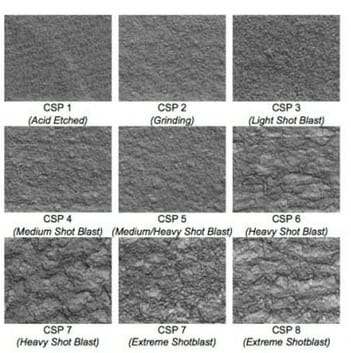
Note: Shot blasting is another form of mechanically profiling your concrete that is widely acceptable to grinding and is used by some professional installers. Due to the cost of renting these machines and the experience required to shot blast effectively, we did not discuss this option here.
We used the etching solution that came with our Rustoleum Epoxy kit. We are still trying to get the white residue (calcium carbonate) off the floor after the etch. We have been scrubbing and scrubbing with a lot of rinses. Is there any tips for this? I am going to borrow my father’s pressure washer for the next round of trying to get the residue off.
Hi Hannah. This is usually the result of letting the floor start to dry out before rinsing or not rinsing well enough. As you have found out, it can be a real bear to scrub off. We have found that mixing a solution of 1/2 cup TSP to 1 gallon of warm water helps to lift it. Pour some on an approximate 5’x5′ section, scrub with a stiff bristled deck brush, and then rinse with the pressure washer. Start from the back and work forward. This should do the trick. Don’t worry if it doesn’t come perfectly clean. As long as you get the majority of it, you should be fine.
Hi AllGarageFloors,
Your articles are amazing wish I read them before I started the prep. I did an acid etch and didn’t know that I have to neutralize it. I did pressure washing 4 times but the concrete is still white and powdery. I don’t have the patience to etch again and keep washing until I hate my life for starting this project. At this point can just grind and be done with it? Will remove the acid on top? Or do I have to still neutralize it and then grid? And I’m also mad that the products don’t come with proper instructions
Hi Frustrated 🙂 The white residue on the surface is not acid. It’s left over mineral deposits and insoluble calcium phosphate. It does need to be mostly removed before applying a coating or it will hinder proper adhesion. A light grinding will most certainly remove it, however, it’s still very important to neutralize the concrete as best you can first. If you don’t do this, the acid solution will remain active down in the concrete. In some cases, it can cause rebar to rust and expand (thus causing cracks) as well as wreak havoc on coating adhesion. Before you grind, soak the concrete with a solution of 1 cup of baking soda to 1 gallon of water. Let it sit for a few minutes to absorb into the concrete and then rinse off with a hose and nozzle. Pressure washing is not needed. Once it dries, you can grind.
Do you still need to power wash and degrease for oil residue before grinding? I am planning on coating my 50 year old garage with polyurea based on your other articles. Do you have any articles for how to cover the 6″ of block foundation that sticks up? Or how to deal with the 1/4″ air/expansion gap between by block and the floor?
Hi Tyler. If you have any significant oil spills or dirty concrete it’s important to degrease and clean the surface first. After grinding, make sure to check any oil spots with a water drop test to verify that it will absorb it and not repel it. If it does not absorb the water, then more degreasing of the spot will be required.
I forgot to answer your other two questions. The expansion joint between the slab and block stem wall can be filled with a self-leveling polyurethane filler such as SikaFlex SL after a coating is installed. This article here explains more about the different types of joints and what materials you can use to fill them with. For the block stem wall, we recommend color matching your coating with a standard concrete paint and then painting it as is. Stem walls are extremely porous and absorb a lot of material. It can get expensive buying the extra material that you would need to coat it. If you do want to coat it, the only prep work that is typically required is to clean it well. Do not apply the coating thick or it will slump and run before it can begin to cure. It may require two coats.