
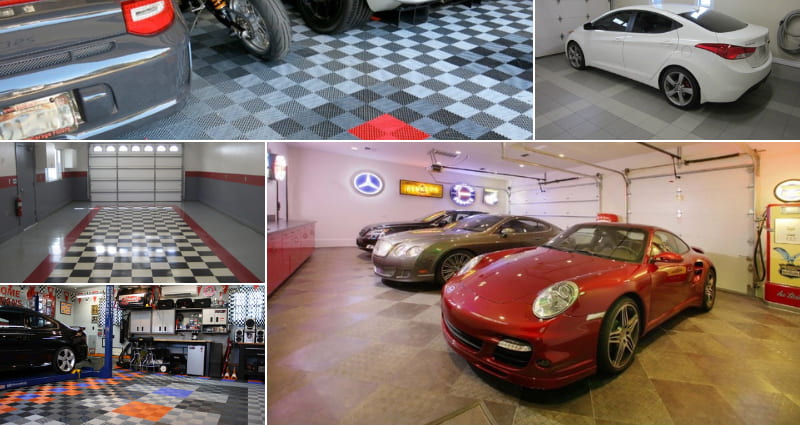
Never before have there been so many options available for garage floor tiles. Arguably the fastest-growing segment in garage flooring today, there are many styles and materials to choose from. As a result, we’ve put together this quick garage tile guide to make your selection easier.
Your options include interlocking tiles made of hard polypropylene plastic or rubber-like PVC. Then there are VCT tiles, porcelain or ceramic tiles, and even peel-and-stick polyvinyl garage floor tiles.
Some of these options can be an easy DIY installation while others may require some skill and experience. In addition, the durability and stain resistance of garage tiles can vary as well as the maintenance requirements to keep them clean and looking good.
However, they all have one thing in common. And that is the ability to custom design your garage floor with a variety of colors, patterns, and floor textures.
With that in mind, let’s look at the different garage floor tile selections available. We will discuss their features, benefits, and approximate costs. Hopefully, this will give you some good garage tile ideas and help you decide which is best based on your requirements and budget.
This post may contain affiliate links. If you use these links to make a purchase, we may earn a small commission. As an Amazon Associate, All Garage Floors earns from qualifying purchases. You can read our full disclaimer here.
Interlocking Floor Tiles
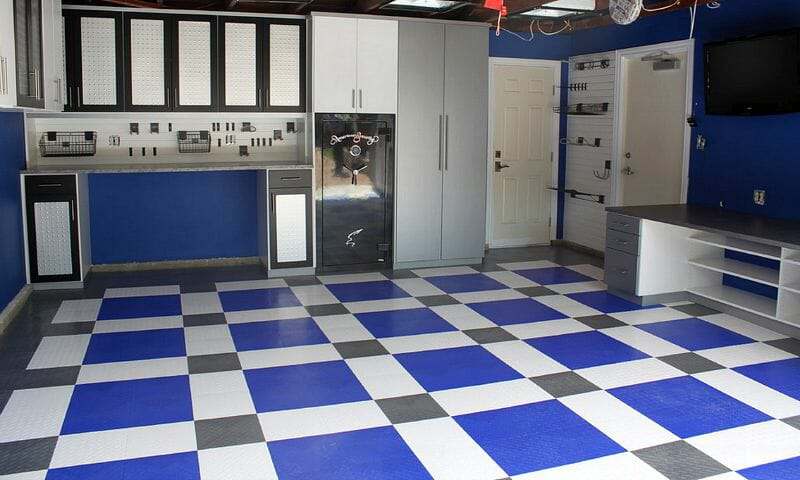
First on our list is interlocking garage floor tiles. Their fantastic looks, countless design options, and quick and easy installation have made them extremely popular. They are the primary reason for the fast growth in this segment of the market.
You can choose a solid color, multiple colors, or different tile sizes from 12”x12” to 24”x24” Plus, you can design racing-style checkered floor themes, create colored borders for car parking and storage areas, or even design walking paths between vehicles if you like.
Interlocking tiles are constructed of two distinctly different types of materials.
The first and most popular is polypropylene plastic. These thick and rigid plastic tiles snap together via a peg and loop connection. You can choose up to 18 different colors depending on the manufacturer.
Along with the multiple color choices, you also have two different tile tops to choose from. There are solid top tiles with various raised diamond designs, raised coin, and even carpets.

You can also select a vented or flow-through ribbed top. This design allows water, snow, and other debris to pass through the tile and keep it clean looking. Furthermore, it has a two-tone effect that many people like. This is due to the way light reflects off the ribbed structure on the surface.
The second choice of material for interlocking tiles is PVC or polyvinyl chloride. These tiles are thinner with a solid construction and a solid top. They have a flexible, rubber-like texture to them. Each tile connects via a puzzle lock system. The connective joints for PVC tiles are tight and prevent little if any water from migrating to the concrete below.
The numerous benefits of interlocking garage floor tiles are fairly impressive. Depending on which material you choose, they can be highly resistant to stains, chemicals, oils, and road salts. Plus, they will insulate from the cold concrete and create an anti-fatigue surface.
Furthermore, most provide a non-slip surface and are U.V. resistant so they won’t color fade in sunlight. Lastly, they are mold and mildew-resistant.
The best part of interlocking tiles is how easy and even fun they are to install. The tiles are “free-floating”, meaning that they are not affixed to the floor. They just snap into place. You can do an average garage in just a few hours.
This a great example of how easily interlocking tiles assemble
We suggest clicking on our article below for more detailed information. It will answer many of the questions that you may have. Plus, we include vendors that we recommend purchasing them from.
READ – What You Should Know About Interlocking Garage Floor Tiles
The cost for interlocking garage floor tiles varies greatly and largely depends on the type of tile material you choose. The starting price for the hard plastic polypropylene tiles is approximately $2.50 per square foot and can range as high as $5.
This is one of our Top Recommended vendors to purchase interlocking garage tiles
The cost of the rubber-like PVC interlocking tiles begins at just under $3 per square foot. However, the price can rise well over $8 per square foot depending on the tile thickness.
Vinyl Composite Garage Floor Tile
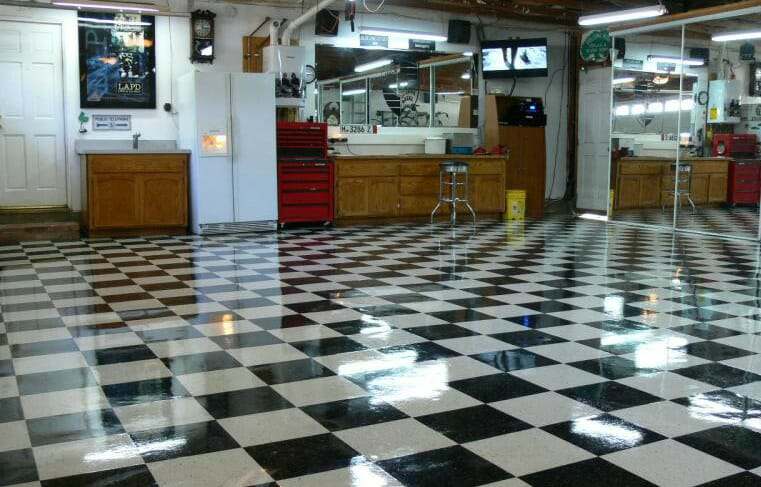
Vinyl composite tile, otherwise known as VCT, is another option that can provide the classy “retro” look to a garage floor that many people like. The traditional black and white checkered theme is easily the most popular.
Made of colored vinyl chips and limestone pressed together, they are available in a large variety of color choices. Each tile is 12”x12” in size, approximately 1/8” thick, and glued into place. These are the same commercial-quality tiles commonly seen in grocery stores, school hallways, and high-traffic businesses.
Once waxed and buffed to a glossy finish, VCT garage floors are fairly resistant to stains, automotive fluids, and road salts. They do tend to get a little slippery when wet. However, there are slip-resistant acrylic waxes that can be used.
Installation of a VCT tiled garage floor does require some basic DIY skills. It’s not a difficult job, but it will take the average person two or three days to complete. Besides gluing the tiles down, it also involves cleaning the concrete and filling any contraction joints, large cracks, or pitted surfaces first.
We suggest clicking on our article below to learn more about the installation of VCT tiles in a garage. We discuss installation, maintenance, and other topics about VCT that you may have questions about.
READ – Why VCT Tile is a Good Budget Garage Floor Option
In terms of cost, VCT can be a great low-cost garage floor tile choice. Tiles can sometimes be found for just under $1 each if you shop around for sales. This does not include the required adhesive and waxing supplies.
Peel and Stick Vinyl Garage Tile
Another option that is a close cousin to VCT in terms of looks is peel-and-stick garage floor tiles. Also known as self-stick tiles, they are constructed of PVC and have a semi-gloss, non-porous finish.
What makes peel-and-stick tiles unique is the pressure-sensitive adhesive on the back. This means that there is no glue required to put down on the concrete first before installation. Just peel off the paper on the back of the tile and press it into place on the concrete.
Unlike VCT, polyvinyl peel-and-stick tiles do not require waxing or special topcoats applied to the surface. As a result, they offer better protection against chemicals and solvents.
You typically have the option of a raised diamond tread or levant (smooth but textured) design. In addition, most standard tile size choices are 12” x 12” or 24”x24”. There used to be a variety of colors to choose from. However, most manufacturers have now limited their colors to black, white, and gray.
You can click on our article below to learn more about peel-and-stick tiles. We also include some vendors we recommend purchasing them from.
READ – What you Should Know About Peel-and-Stick Garage Floor Tiles
The cost of self-stick garage tiles can begin around $1 per square foot and get as high as $5 per square foot. The reason for the large disparity has to do with the tile thickness and construction.
The more expensive peel-and-stick tiles such as RaceDay are thicker and constructed of solid PVC throughout. Lesser expensive tiles may use fillers and not be as thick.
Porcelain Garage Floor Tile
Last on our list of options is porcelain tile. Surprising to most people, it is one of the most durable garage flooring options that can be installed. It has been used for years in professional automotive garages, vehicle showrooms, and hotel porticos where cars park or pass through.
Porcelain is extremely dense and has a compressive strength of over 20,000 lbs. per square inch. The high-density results in a moisture absorbent rate of less than 0.5%. This essentially makes it impervious to water absorption and extremely difficult to stain. This includes road salts, oils, and other automotive fluids.
When installed properly, porcelain tile garage flooring is very difficult to scratch, break, or chip. It’s also one of the easiest tile options to keep clean.
With good slip-resistance ratings available, porcelain does well in cold and wet climates where garage floors routinely see temperatures below freezing.
We suggest clicking on the link below to learn more. It answers many questions including what ratings you need when porcelain is used for a garage floor.
READ – Add a Touch of Class with a Porcelain Tiled Garage Floor
The cost of porcelain tile can quickly get expensive if you don’t shop around. DIY installation is difficult as well unless you have experience. As a result, installation can be another high cost if you need to hire someone to do it for you.
However, sales can sometimes be found for approximately $1 per square foot with the appropriate ratings for your garage floor. If you have some experience laying tile, then you will find that installation costs will be low as well.
Tips and Final Thoughts
Though the choices for garage floor tiles are many, there is no denying the fact that any one of them will completely transform the appearance of your garage. We recommend that you first establish how much your budget allows. Then determine which requirements are most important to you after that.
For ease of installation, nothing comes close to interlocking tiles. In terms of durability and stain resistance, porcelain tile is best. We would rank interlocking tiles as a close second.
If budget and low cost are a high priority, then VCT tiles or self-stick tiles can be the cheapest options if you shop around. Just keep in mind that installation will require some modest DIY skills.
No matter which garage flooring tile you choose, it can add character, flair, class, and even attitude depending on your design. Plus, you will have a garage floor that all your neighbors and friends will envy.
Wow, I didn’t know there were so many choices of tile for my garage floor. I really like the inter-locking tiles. I think my husband could install these without messing anything up!
I’m glad you liked the interlocking tiles Nancy. Yes, the nice thing about them is that they are so easy to install – even for your husband.
It’s nice to see all these choices. I really thought I was going to go with VCT for my garage, but I really like the idea of the interlocking tiles. I think it’s time to talk to the wife about our garage budget!
I’ve had VCT in my garage for over 10 years now and it still looks great. I did a blue and gray diagonal checkered pattern that looks fantastic. I get compliments everytime someone sees it. I don’t look forward to stripping it down and rewaxing each year, but it’s well worth it after I’m done.
Where can I find the blue tile in the main picture???? Ive been looking for that color everywhere!
The color is Black Blue and is a porcelain tile designed to look like natural slate. Sorry, but the local supplier that the home owner purchased it from is no longer in business.
Good luck with your search though!
I’ve learned a lot about vinyl tiles lately – the hard way. Would like to hear others’ comments.
I had intended to install two different colors of hidden seam interlocking tiles. Light grey in the shop area and dark grey where we park the vehicles.
These are a premium, 100% vinyl, 7mm thick tile. They were the best I could find on the market.
First problem was that the two different shades were slightly different sizes. Two of them could be forced to “mate” but a run of several tiles accumulated the error and after 16 tiles or so, the difference was about half an inch.
I can’t imagine they came out of different size molds so I suspect that the composition might have been different and the one lot shrank more than the other as it “aged”. Or perhaps the one lot was considerably older than the other.
We decided to use all the same lot to ensure they would interlock, and went with the light grey. The looked stunning. That is, until I started noticing tire marks.
These marks would not scrub out. Turns out, they were caused by a chemical reaction between the hot tire and the vinyl, which actually altered the tile. It was not so much in or on the vinyl as it WAS the vinyl.
We decided to go back to dark grey under the vehicles and to seal them with urethane. We were in the process of taking up the light grey tiles when we noticed gaps of about a 16th of an inch between the interlocked tiles.
Note that the garage has a heat pump and was maintained at 60 degrees all winter. On the day we noticed the problem, it was 70 degrees outside. The shrinking may have been due to temperature, but it may also have to do with the vinyl shrinking as it ages — apparently due to plasticizer evaporation.
For as long as it lasted, the floor was beautiful. My wife and I would practice dancing on it. We’ve taken it all up and are putting it on a pallet to ship back to the manufacturer.
Epoxy?
Hi Shea,
For starters, great website and it has been extremely informative. I just completed a garage that has an attached workshop (approx. 1200 sq ft total). I intend to restore cars in the garage (personal use, not commercial). Will porcelain floor tiles really hold up to tools and other heavy items being dropped on them and floor jacks rolling over them? How do I determine if a tile has the “appropriate rating”? Also (and you may not know the answer to this one), can I install a 2-post lift over the tiles or should I tile around the base-plates of the lift?
Thanks in advance, John
Thanks for the kind words John and congrats on your new workshop. The short answer is yes, porcelain holds up extremely well to abuse from the type of environment you will have. You might have missed our article that has answers to most of your questions regarding porcelain tiled garage floors. You can find it here. Regarding the lift, people have installed lifts on top of porcelain tile without issue, but we feel that the best install is to attach it directly to the slab and tile around the post.
Just reviewed the Armstrong website to find out about their VCT tiles. In their FAQ section they state that VCT is not recommended for garages because it does not meet building codes for flammability. Yet I see a lot of people using them. Your comments please.
Hi Gary, great question. Armstrong does not warranty their tiles for use in garages either, but as you state, people have been using VCT tiles in garages for years and years without issue. We’ve always found it interesting that the tiles meet flammability requirements in the home, but not the garage. The reasoning behind this is that certain types of fires that start in a garage, due to the various chemicals and other oddities that people store, can burn much hotter than in the home. If the fire is hot enough to ignite your VCT tile, then you have much bigger issues to worry about. Incidentally, these same VCT tiled garage floors always pass home inspection when the home is resold as well.
I nearly read your entire site a few weeks ago and decided to go with a VCT floor in my garage. It’s now complete, and I love the look….however….after the first rain, I drove my cars in the garage for the night and awoke the next morning to adhesive squirting between some of the tiles and a number of loose tiles where rain water had run off of our cars. Upon further inspection, I realized that wherever water got between tiles, the adhesive was breaking down. I now have a complete mess on my hands. Any recommendations? Thanks.
Hi there CJ. Sorry to hear about your tile issues. Generally when things like this happen it’s an installation issue that causes it so we have a few questions. Did you use a weighted vinyl floor roller on the tile during installation to press out any trapped air and increase adhesion? Did you wait at least 48 hours before driving on it? Did you seal the tile and then apply multiple coats of a quality acrylic floor wax on it? If you sealed and waxed the tile, did you damp mop it to clean the tile beforehand or did you wet mop? The only reason for water getting in under the tiles would be either poor adhesion which led to a tile edge curling up, wet mopping the floor initially before sealing which allowed water to get between the seams and up under the tile, or not sealing and waxing the tile properly or some combo of all three. Either of these would allow water to get in under the tile and cause a delamination issue.
What needs to be done is to pull the tile up in the areas where the water got to it. Scrape up the glue residue and let the floor dry for a day or two. While the floor is drying, you can use mineral spirits to clean up the edges and top surface of the tile that was pulled up. Once the floor is dry, reapply the glue and then the tiles when the glue is ready. Make sure to roll it properly and then seal and wax the tile.
Shea – Thanks so much for the response. To answer your questions…I followed the instructions that were provided on the side of the adhesive container. So I filled cracks, scraped off bumps, shop-vacked the area and laid the adhesive in 200 sq/ft portions. Since I laid the tile over an epoxied floor, the curing time seemed to be quite different than the instructions suggested. It said that I should be able to start laying tile within 20 to 40 minutes, but it took more than 4 hrs before the adhesive was ready to accept tiles. In the research I’ve been doing, it would seem that the presence of the epoxy could be playing a role in this problem. In addition to that factor, I didn’t roll it when it was complete. I did walk across every corner and assumed my body weight was enough to set the tiles. The adhesive container only “suggested” using a roller which is why I didn’t rent one….oh, and the fact that I’m a cheap Dutchman. After laying the tiles, I put two coats of sealer over the entire floor. I didn’t apply any wax because I wasn’t wanting a high-gloss finish. I did wait more than 48 hrs. before I drove on it.
Does that give you a fuller picture of the situation?
CJ, quality adhesive is important. Hopefully you used a name brand like Armstrong or equivalent. VCT can be installed over epoxy, but it’s important to make sure that the surface of the epoxy be roughed up a bit and not be left smooth. You can get away with using your body weight on the tile if you were setting them in your home, but you need to remember that you will be parking cars on these tiles, not people…. lol. The $20 investment to rent a roller really is worth it.
It’s good that you applied a sealer as it helps to keep the tiles from getting stained if contaminants get past the acrylic wax. But it’s also very important (for a few reasons) to apply the acrylic wax. The acrylic wax is the sacrificial layer that protects the tiles. Sealing the tile and then waxing the tile is standard procedure for VCT flooring. The sealer however just seals the tiles, it does not do a good job of filling in the joints in between the tiles to protect the underside from liquids. That is what the acrylic wax does. There are many good quality acrylic waxes available in a matte or satin finish if you don’t care for the gloss.
Our guess is that the main culprit of your issue is from not applying the acrylic wax since water was coming up from underneath the tiles. The other factors may have been a contributor as well. Sealing and then applying a quality acrylic wax (matte or satin finish) after you have reset the tiles should solve your problem. Your local janitorial supply is a great place to find good sealers and acrylic wax.
Shea – do you have a suggestion for a high-quality coating/wax for my tile? Thanks!
CJ, for a high quality product we like Hilway Direct. Their acrylic wax products have a higher solids content than most and are used commercially. They have a matte finish available. We recommend that you contact Justin Krauss from Garage Flooring LLC. He carries the line and can answer any question that you may have. You can find them here. Hilway has a complete line of cleaners, strippers, and waxes to make your job easier and to insure great protection for your tile.
Mate I need to make bigger my garage or rebuild my garage like double garage in tiles don’t know if you can help me or not??!! Thanks.i leave in Hampton park Vic.
Hello Ahmed. We’re not quite sure what you are looking for, but if it’s information on making your garage larger we really can’t help with that.
Hi Shea,
In your opinion, what are the top American made interlocking tiles other than Snaplock (Racedeck / Gladiator) and can you rate them by value? Also is SwissTrax made from our friends in Canada?
Hello Steve. Yes, SwissTrax used to be manufactured in California but have since moved their manufacturing operations to Canada. We have always been of the opinion that RaceDeck as well as SwissTrax are the top two competing lines of premium interlocking garage floor tiles available today. In fact, we have an article comparing the two. Our only real complaint about SwissTrax at the time was the fact that you could not combine their extremely popular RibTrax tiles with any other tile in their lineup due to size differences. That has recently changed, however, and we are currently writing a new article about changes that have been made by SwissTrax including some exciting new tile designs. In terms of value, both are excellent though you will typically pay more for SwissTrax due to more material being used in their product.
I am torn between RaceDeck Diamond and Norsk PVC garage tiles. I like the quality of RaceDeck, but not the sound when I walk on them. Norsk PVC is quieter to walk on, but I do not know if the surface will withstand the Florida sandy soil that is occasionally tracked in. Will my Ulti-Mate storage cabinets that stand on 4 legs sink into the Norsk PVC tiles? Both options have the under-side air ventilation grid that I want. This is for a residential garage with a Honda Civic and stored items. No car repair happening here. Thanks for your input.
Hello Karen. The Norsk tiles are a premium PVC tile and will withstand the sandy soil without issue. Your Ulti-Mate storage cabinets will not affect them as well. These type of flooring systems have been designed for that. Based on your requirements, concerns, and the fact that you will not be performing routine car maintenance and repairs, I believe the Norsk flooring is going to be the product that will make you most happy.
Have a two car garage with a heavy duty treated plywood floor. What recommendations for a tile floor?
Thanks, Brian
12″x12″ porcelain tile or larger will work Brian. Just be sure to choose one with a PEI rating of 4 or 5. Home improvement centers seem to almost always have some on special in the $1 per square foot range. It’s also important to make sure your sub floor is properly reinforced. If it flexes under load of a vehicle it can cause your tile to crack.
Am so grateful to have learnt about various types of garage floor tiles.
Where in Uganda can i get these tiles?
Hello James. We suggest that you contact the manufacturer for any of the tiles you are interested in. They will be able to tell you who the nearest distributor would be that could ship to you.
My garage floor is concrete, the garage floor is uneven and pulls water at one end
What product do you suggest I use.
Thank you
Husein
Hello Husein. I don’t quite understand what you are asking. Could you elaborate a bit more? Do you think tile will fix your issue?
use a wet dry vacuum to remove the unwanted water!
Hi Shea,
I wanted to put an epoxy coating on my garage floor but I found out there is a moisture problem. Can you recommend a product that I can put on the floor?
Hello Susan. The first thing you want to do is try to figure out what is causing the moisture issue to begin with. For example, make sure all water flows away from the foundation and does not collect up against it. Also, check that you don’t have any leaking pipes or drains under the foundation either. If your slab is below grade, sometimes there isn’t much you can do.
A product that we recommend applying to the concrete is a straight densifier. This one here is an example. Do not use a densifier with sealer added. It may require back to back treatments. Once the densifier is applied, it takes 7 days for it to react to the concrete and take effect. After that, you can test the concrete to see if you still have the moisture issue.
Thank you for the information.
I was also considering floor tiles. Is this an option? If so what do you recommend?
Yes, interlocking garage floor tiles would be a great option. They will allow the concrete to breath and dry out during periods when your moisture issue is most prevalent. They are easy to install and allow you to custom design how you want your floor to look. I suggest reading this article to see if it is something that interests you.
Do you have a recommendation for a specific porcelain tile?
We don’t in terms of brands or manufacturers, David. Tile is always going on sale from one vendor to the next. What we do recommend, however, is purchasing the appropriate rated tile.
Can I purchase in Australia?
Yes. Just do a search for garage floor tiles and you should find distributors in your country.
Hi Shea…in the polyurea coatings section you recently suggested to me that due to the efflorescence and dampness in my garage, I should consider interlocking PVC tiles instead of either coatings or G-floor rolls as the tile design will allow moisture to evaporate. I appreciate the suggestion and I have been looking into Racedeck tiles. I think I like the CircleTrac best, and I do not like the Freeflow. I live in Pennsylvania where we get a moderate amount of snow. Does melted snow from the cars need to be swept off the CircleTrac tiles or might it evaporate? With bare cement sweeping was rarely an issue as some melted snow was absorbed by the cement and some evaporated. Also, can you suggest edging products especially for the garage entrance side (and possibly for the other edges). Amazon carries a compatible “Snapfloors” product, but several of the reviews mention that they often come apart. Racedeck makes edges, but I have been unable to find reviews for them. Are they good? Big Floors sells Racedeck compatible (I think) edging by DuraGrid and another unbranded selection. Do you know if these are good quality?
We have an article here that discusses the different tile designs for winter weather, Tom. With solid top tiles, the snow will eventually melt and the water will puddle since it does not drain very well between the seams. It will eventually evaporate if you don’t broom it out. RaceDeck is considered the pinnacle of interlocking garage floor tiles. SnapLock Industries is the company that makes them. The Big Floors tiles are the private label version the Snaplock produces. Very nice tiles, especially for the money, but they are not the same quality as RaceDeck. You purchase edge ramps from which ever type of tile brand you choose. You will not find independent reviews on edge ramps. They are rarely an issue that comes up. Don’t buy tiles from Amazon. They are sold in packs and you usually have to buy more than what you actually need. It also limits how you want to design the floor since you can’t buy them one at a time. Buy them from Big Floors or RaceDeck direct if that is what you are interested in. Garage Flooring LLC is also a great source.
Hi Shea…thx for the helpful reply. I think I will go with Racedeck diamond interlocking tiles. I’ve read several of your articles re sealers, densifiers, and densifiers w/sealers. Due to the efflorescence problems I’ve been having (unable to uncover the source of moisture under the slab) I thought (based on reading your articles) that before installing the tiles it might be good to apply PS104 densifier/sealer. Since the efflorescence has caused some damage to some of the top layer of the concrete, I thought that applying PS104 might help reduce or eliminate the efflorescence and thus help reduce or eliminate further damage to the concrete. Do you think that is a good idea? or an unnecessary step? or would you suggest another product such as a penetrating sealer?
Treating your floor to PS104 would be a great choice, Tom. It’s a relatively inexpensive option that will help to reduce the moisture and efflorescence issues as you state, plus it’s very easy to apply. Just clean the floor really well and let dry for 24 hours before applying it. FYI – we have RaceDeck tiles in one of our garages and it sees heavy car maintenance all the time. It’s still performing flawlessly.
Hi Shea, I applied PS104 to my garage floor. It has rained several times and it looks like I’m only getting about 10% of the amount of efflorescence from moisture below the slab that I would have expected based on experience. So it seems to have helped a lot. My purpose was to help reduce the continued deterioration of the top layer of the cement that I plan to cover with interlocking tiles. I have ordered Racedeck diamond tiles and will install them when they arrive. I’ve read that a table saw is best for cutting the tiles, but I don’t have one. I can rent a circular saw or a manual tile cutter. I have experience with neither, don’t have clamps, and only have a small rolling tool cabinet with a workbench top to work on. My preference would be a tile cutter. The device claims it will work on up to 16″ tiles that are up to 1.5 inches thick. It works with ceramic tiles and I believe plastic. It looks like a large paper cutter. I believe it scores the tile and then snaps the end off. My concern is that after scoring the tiles, whether the snap off will work with the uneven, non-solid underside of the Racedeck tiles. Do you know if a tile cutter will work on Racedeck tiles? I also have a few places that I will need some special cuts around the feet of a built-in cabinet. I plan to purchase a coping saw for those few cuts. Does that make sense?
Hi Tom. No, those type of tile cutters will not work with plastic tiles. The properties of plastic will not snap like porcelain or ceramic does. You need to cut it. You can make all the straight cuts and circular cuts with an inexpensive jigsaw with a fine blade. Home Dept rents them, but a day’s rental with the blade is about half the cost of buying one. We have done two different garages in this manner. If you don’t trust yourself to make a straight cut, you can make a fence to guide the jigsaw. All you need is a straight edge, such as a piece of 1×2 that is a few inches longer than the 12″ tile, and a couple of spring clamps from your local home improvement center that cost approximately $10 for the pair. Mark a line on the tile that needs cut. Measure from the edge of the jigsaw blade to the outer edge of the base plate. This is how far from the line you need to measure to clamp your fence. You will get good at it after your first tile or two. If you have a flat file, you can file the edges clean in about 10 seconds.
Thanks Shea…will do as you suggest. You have been of tremendous assistance from helping me decide which products best meet my needs through suggesting the best ways to apply and install products. Without your help I likely would have purchased and installed products only to run into difficulties down the road. You have been a gem!
Thanks so much for the kind words, Tom!
Shea,
I have a slightly pitted concrete garage and would like to place porcelain floors directly over it. Can I just lay the tiles to the pitted concrete and use the thinset to fill the pits on the concrete?
Hi Terence. Yes, you can do that as long as the pitting is not too deep (> 1/2″). The key is to make sure there are no open air pockets under the tile at all.
If the pits are >1/2” what product do you recommend I use (since epoxy is not binding) and do I need to grind the surface to make it level?
Use a polymer-modified cement repair product. This here is an example from Home Depot. You won’t need to grind since you will be troweling a layer of thinset over it. Just trowel the repair material in level with the floor and you will be fine.
Can porcalin tile hold the weight of a car lift with 2 cars on it ?
Hello Steve. Yes, it will hold up just fine. The compressive strength of porcelain is incredible. The key is to make sure there are not any air pockets under the tile and that the thinset comes all the way out to the edge of the underside of the tile. This article here covers all the abuses that porcelain tile will withstand – including car lifts, jacks, and etc.