
One of the primary concerns about epoxy flooring or any other coating for the garage, is how slippery it may be when wet and what can be done in terms of an anti-slip additive to create a non-skid surface. Is it even necessary at all? The topic can get confusing with manufacturers recommending a wide variety of additives from sand, to aluminum oxide, or a small polymer based grit like Shark Grip.
Because resinous garage floor coatings such as epoxy, polyurethane and polyurea are non-porous, the surface created can be very smooth, almost like glass in some cases. While this type of surface is fine when dry, it can become as slippery as an ice rink sometimes with the introduction of water, mud, oils, or snow. So let’s try to determine if you need a non-slip additive in the first place and then take a look at what type is best for your epoxy floor and how to use it.
Do you need an epoxy non-slip additive?
When deciding whether or not you need a non-slip additive for your garage floor coating, one of the first things to take into consideration is the climate in which you live. If your garage will see an abundance of water from wet cars or melting snow, then a non-skid floor is worth considering. Snow and ice in particular doesn’t mix well with coated garage floors. If you live in a more arid part of the country it may not even be necessary.
Another consideration is how you plan on using the floor. If you are always involved with projects that can involve spilled fluids such as oil, anti-freeze, chemicals, or etc. that can create a slip fall hazard, then an anti-slip additive would help. Then again, there is nothing like cleaning up spills immediately that will alleviate slip fall accidents and not require a non-skid surface.
The type of floor coating system that you install can be a factor as well. If you choose a floor without paint chips or some other media such as quartz, then you will have a very smooth surface which is the most conducive to being slippery when wet. However, a floor with a ¾ to full color chip application will create a slightly irregular texture when top coated with polyurethane or a thinned epoxy or polyurea coating. This irregular texture can provide additional grip in a wet environment that a smooth floor will not.
Two little known facts about newly coated garage floors have contributed to some unwarranted claims about epoxy and other coatings being slippery as well. The first fact is that the coating will develop a static charge during the application and curing process that will last a few days or so. This charge will draw all the fine dust particles out of the air to collect on the floor and make it slippery. This charge will dissipate after a while however and the slippery dust problem will go away.
The second unknown fact is that a brand new floor coating will be extremely smooth (like glass) after the initial installation which can make it slippery when wet. Once the floor develops some traffic, microscopic scratches on the surface will appear (these are not visible in most cases) and increase the grip of the floor tremendously.
If you don’t want to wait for traffic and normal use to create these microscopic scratches, then you can always lightly scuff it with a pink or white buffing pad which will create a better grip. This will slightly remove some of the gloss of the floor, but it will still remain highly light reflective and be glossier than a matte finish.
Non-slip additives for coated garage floors
The most recommended additive to create a non-slip surface for epoxy, garage floor paint, and other garage floor coatings is ground polymer grit such as Shark Grip. You can find it here at Amazon
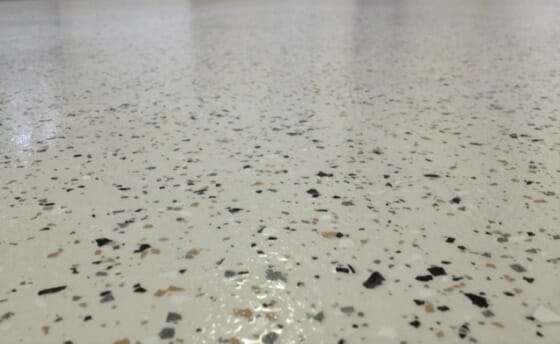
Because the grit from products such as Shark Grip is so small, it works well with a thin floor coating such as polyurethane. It also works well with a thinner water based epoxy like Rust-Oleum and Quikrete products which you can get from home improvement centers.
If your final top coat is thicker, such as 100% solids epoxy or a polyurea product, then you will need to go with slightly larger polymer grit. The micronized grit like that of Shark Grip and similar products is too small for the thicker coatings and has a tendency to sink below the surface and not be effective. You will want to use a grit size with a mesh between 30 and 60 (smaller numbers are larger in size) to achieve good results. You can find an example of that here from Legacy Industrial.
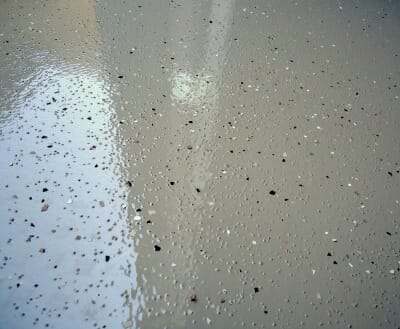
Another material that creates an excellent non-skid surface for epoxy coatings is an aluminum oxide additive. This is a more aggressive grit that is suspended in the final top coat like polymer grit. It works well in industrial type settings where maximum grip is desired or where extremely slippery conditions exist.
Despite claims from some companies however, this type of non-slip additive is not the most friendly to bare feet and skin. It’s aggressive nature can also create problems with catching mop strings and dirt when cleaning the floor. While it works well as a non-slip additive, it can be more than what most people want for a garage environment. It’s not the best floor surface either for young children that may trip and skin themselves on the floor.
Finally there is the use of fine silica sand. This works best when dispersed on top of the coat prior to the final top coat. The final top coat is then applied over the sand to create the bumpy surface required. While this type of non-skid will work, it’s best when used with a colored top coat because the sand is visible with a clear coat.
Some drawbacks to sand is that it can be too aggressive for a garage environment like aluminum oxide. Some say that the surface is similar to fine sandpaper and that it makes it harder to mop. It also has a tendency to break down over time and cause small cracks and pockets in the surface of the top coat as it wears.
How to apply non-slip additives
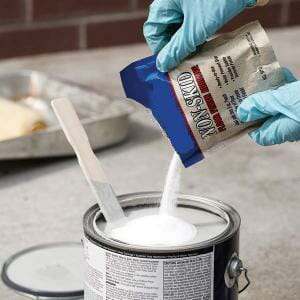 When installing a garage floor coating yourself, the generally accepted method to applying a non-slip additive such as polymer grit or aluminum oxide is to mix it into the final top coat prior to rolling it onto the floor. 3 to 4 ounces per gallon of epoxy or other coating is the recommended ratio. Any more than that will introduce clumping of the material and is not a desirable affect for the finish of the floor.
When applying it to 100% solids epoxy or polyurea, it’s best to mix it into the final top coat first and then pour the contents in ribbons across the floor. You can then roll and back roll the coating as usual. The non-slip grit will tend to disperse itself evenly across the surface of the floor this way.
If you are applying a polyurethane top coat or a thinner water based epoxy kit, then you will be working by rolling the contents out of a paint tray. It’s best to mix the additive into the coating then pour it into your tray. It’s important to note that while these additives do fairly well at staying suspended in the mix for a short while, they will sink to the bottom and should be remixed each time before pouring the contents into the tray.
Other methods involve sprinkling the additive on top of the coating or base coat before applying the final top coat or just tossing the non-slip additive on top of the final top coat. The problem with this is that you can get poor distribution of the non-slip aggregate or when applied to the top of the final coat, it can pull away with wear and create pockets in the surface that collect dirt.
Out of the different methods to achieve an anti-slip surface for garage floor coatings, our favorite is the mixing of polymer grit into the final top coat. It makes for the softest feel that won’t scratch your back up if working under a car or walking in your bare feet. Plus, it’s the least visible of the anti-slip additives, especially when applied to a floor with color chips.
Good stuff here.
Questions:
Can a 2 part epoxy coating be used over a 1 part water based epoxy?
Can polyurethane be used over 2 part epoxy?
Hello Tim. It can be, but we do not recommend it. The bond of 1-part epoxy to concrete is not nearly as good as 2-part epoxy. In addition, only a water-based 2-part epoxy can be used over 1-part epoxy. The only way it can be applied over it is to let the 1-part epoxy dry first. You will then need to sand the surface with 120 grit sandpaper to achieve a mechanical bond. 2-part epoxy is not chemically compatible to 1-part epoxy. This article about clear coats explains more. Yes, a polyurethane concrete coating (not wood flooring polyurethane) can be applied over a 2-part epoxy coating.
Can you recommend a 2 part product with anti-slip additives for an outdoor patio approximately 20×8? The concrete is 15 years old and has never been coated or sealed. I have already acid etched the surface and the finish is rough already.
Hello Todd. Outdoor coatings have special requirements due to the weather and strong U.V. rays from direct sunlight. Epoxy for example cannot be used outside. It is not U.V. stable and will turn yellow as well as chalk up. Special acrylic coatings (not from home improvement stores) and polyurethane coatings usually work best. ArmorPoxy is an example of a company that carries such product. You can view their acrylic and polyurethane outdoor coatings here. Another example is DuraGrade Concrete by Rust Bullet. You would add the anti-slip additive into the final coat.
I just want some mild anti slip. Would shark grip be a good option? Im thinking of the Polycuramine type floors by i guess now Rustoluem. Thanks!
Yes, SharkGrip will work well with RockSolid.
We applied an epoxy coating to a garage floor and it is now too slippery. Is there anything that can be done AFTER the coating has been applied? It’s been about a year.
Hello Deb. Yes, you can apply a clear coat with the anti-slip media mixed in. It will require roughing up the surface of the current coating with 120 grit sandpaper first, then wiping it down with denatured alcohol on a microfiber mop pad. We have more information on how this is done here.
Helpful thank you. I do have a question. We decided to hand sprincle sand on the first coat of polyurethane for traction. It turned out to be very hard to see and couldn’t tell where had sand and where it didn’t. The result was way way way too much sand so much so it was visible and patchy and terrible. I sanded out what I could cleaned it all up and applied a second coat. This seemed to hide a lot of it and helped however it is still not up to par. Should I keep adding heavy coats of poly or do I need to go back to the drawing board. At this point we just want to be done with it and have it look the best we can.
Sand the surface with 100 grit sandpaper and then apply one more coat of polyurethane. It should make a big difference this time around. Just be careful about applying polyurethane too thickly and follow the coverage rates for the product you are using. If put down too thick, it can develop bubbles from solvent flash and get a hazy look.
Hello, just wondering how you got on with your repair. I have the same problem. My sand was too uneven & the colour was also patchy as a result.
Any tips would be so welcome
Thanks in advance for your time
Any idea if I use Rustoleum RockSolid Metallic for my garage floor if I can add the Rust-oleum Anti-Skid Additive and if so, what recommendations do you have?
I appreciate reading about all of your tips!
Hello Sue. Yes, you can use the Rust-Oleum Anti-Skid. It needs to go into the the final coat. For RockSolid, you would first mix the polycuramine in the burst pouches as instructed. You would then pour it into a bucket and mix the 1 bag of the anti-slip media in with that. Immediately pour it out onto the floor in ribbons as RockSolid instructs in their coating applications. If you let the anti-slip sit in the bucket for very long, it will tend to settle and you will have one section of floor with too much anti-slip and one without enough. You would need 1 packet of anti-slip for each coating kit that is required to complete one final coat or single color coat.
I am going to be applying a 100% Solids Epoxy that has a clear epoxy top coat on top of a colored epoxy base. If I add anti-skid would you recommend putting it in the clear top coat or in the last application of the base colored epoxy? The instructions say to add flakes before the clear top coat (which makes sense), but would you suggest to apply the anti-skid also during that time?
Hi Alex. You always want to add the anti-slip media into the final coat. If not, any subsequent coating will just cover it up and it will be ineffective.
Hi, I purchased the rustoleum anti skid package and also the rustoleum epoxy premium clear coat. I was just reading the label and noticed the rustoleum epoxy premium clear coat also includes anti skid. Do you think this is enough to keep the floor from getting too slippery or should I include the additional anti skid package I bought?
Thank you!
Hello Chris. The anti-slip media provided with the clear coat is enough for most situations. You can add more if you like, however, the clear will loose gloss and the anti-slip will be more noticeable.
Hello.
I used super coat water based clear glaze (2 part) on top of epoxyshield coating on my garage floor. It’s been 24 hrs. I then checked the can. Unfortunately, 50% or more grit settled at the bottom of the can dispite mixing everytime when loading my paint tray. So the coating is slippery…
I plan to do another coat of the same at around day 4 or 5.
Can I sprinkle the antislip grit directly on the floor when back rolling? Or any other suggestions?. I plan to buy more Rust-Oleum anti slip additive too.
Hi Gcreto. The key to using the anti-slip after mixing it into the SuperCoat is to pour a small amount into the tray at a time. Just enough for a couple of roller refills. Then gently remix it from the can or bucket first each time you pour more into the tray. This pulls it up from the bottom and redistributes it before pouring more in. Sprinkling it on the surface makes for an inconsistent application that results in the tops of the anti-slip being exposed in many cases. You don’t want that as it will wear away. It needs to have a thin layer of coating over it to protect it.
Hi,
I recently installed a two part mettalic epoxy system in my garage. Yesterday, I installed a three component aliphatic urethane floor topcoat. I only mixed about 10 percent of the grit component as I still wanted a glossy look with a slight bit of antislip properties. However, I was noticed what seems to be some clumping of the material, presumed to be the added grit. It is slightly jagged, protrudes from the floor, and is white. So it does not look or fell too good. Is there anything I can do to correct the issue? Maybe sand it down without effecting the finish of the floor? Thanks!
Hi Derick. Yes, clumping sounds exactly like what you have. Anti-slip requires periodic mixing as you go or it tends to settle in the pan and then the roller picks it up. Unfortunately, once you begin to sand it will degloss the finish fast. You can either spot repair it by sanding and applying some additional polyurethane (it will be somewhat noticeable), live with it, or rough up the entire floor and do another coat, making sure to pay close attention to the anti-slip.
Hello,
We just had a floor system installed with chips they are saying it’s a water based not poly, we have had poly in the past. The floor feels like rough sand paper and the chips are flaking. What is the issue with this product? We are clean and have always steam mopped our garage floors, but this would seemingly be impossible.
Hello Billie. We need a bit more information to help with your question. What brand and type of product/s were applied? Was a clear coating applied? Was it a small, medium, or heavy color flake coverage?
Endurable contrete Armor and sealer the flakes were applied heavy and 2 coats of clear coat was applied.
We had to look up the technical data sheets for this product, Billie. Unfortunately, they don’t tell much in terms of the actual dry film mil thickness, solids percentage, or some of the other basics. Their clear sealer provides even less information. What we can gather, however, is that these are very thin mil coatings and not like your typical commercial coatings that are thick. The first clue was that it can be applied via a sprayer. Most standard epoxy coatings cannot be applied in this manner. They are far too thick and viscous. This would also explain why your color flakes are coming loose. The coating is not thick enough for the flakes to sink into and take hold very well. A standard color flake is approximately 5 mils thick. If we had to guess, the coating is most likely only 1.5-2 mils thick and the clear coat even less. This is most likely why it has a rough feel to it as well. High solids epoxy systems with a heavy flake coverage and high performance clear coat will have a texture to it, but it will not feel like sand paper. We recommend calling the installer and getting the manufacturer involved to solve the issue with your flakes coming loose as well as the texture issues.
Thank you for the valuable information. They sold us on this great product, ? Which seems to be questionable. I’m frustrated because they charged us an extreme amount more then what we paid in the past, boasting it’s bonding and longevity over typical material used. Like over 2 xs the cost. Anyway, I appreciate the information and will need to further address this.
Hello there!
I have a question for you guys and am hoping you can help me out.
I’m looking at putting some clear 2 party epoxy over my stone shower base. I’m wondering if I should apply some shark grit to my primary coat? I’m planning on brushing on stone and not raising much for thickness. I wasn’t planning on doing a top coat do you think I should?
Thank you
Hi Nicholas. Coatings can be slippery when wet, particularly in a shower environment. The SharkGrip or equivalent should be mixed into the final coat. There is no need to apply a top coat since this is for bare feet or sandals. Epoxy should not be used if this is an outdoor environment where the floor sees sun.
Awesome thank you for the quick response!
Just to confirm if only doing 1 single coat i would mix shark grit in as I’m mixing it? If I was to pour say 1/8-1/4″ thick instead of brush it on would the shark grit still work as it should or do you think it will settle and leave epoxy smooth on top? Would I be wise to do first pour and let set followed by final cost with shark grit mixed in? If I did this would both coats blend or would you be able to tell I’ve done 2 coats? Is sanding required after first coat? I’m trying to stay with only doing 1 single coat but want the grip.
Thanks for any response!
Hi Nicholas. What epoxy product are you planning to use and have you ever worked with epoxy before?
hello i ask for your help i want to apply epoxy on my storied parking in the basements with ramps as entrance and exit. which anti skidding additive can i use am having over 30000m2 of floor application.
can i also apply it on rumps? thanks
Yes, you can apply it to the ramps. The size of the media depends on the final coating it is used in. Thinner top coats require smaller sized media while thicker coats will will require larger sized media. If your only goal is to provide traction for the vehicles and you are not concerned about it being too rough for bare feet, then we would recommend an aluminum oxide anti-slip media.
Thank you very much.
Hopefully you can help. We have a kennel facility. We had the cement floors painted. They used macropoxy 646 for the base coat and Polylon with shark grit for the top coat. The floors are crazy slippery when wet. What could we do?
Hi Bobby. Sharkgrip is a fine micronized polymer bead that works OK for garage floors and other areas of foot traffic that see some moisture. However, it’s not going to be aggressive enough for a kennel that most likely gets hosed down on a daily basis and sees a lot of water on the floor. You need a larger grit anti-slip additive. Aluminum oxide granules do well, but they are not friendly to bare feet or mops, but it may be OK for the foot pads of dogs. A course polymer grit like this one here would most likely be the best choice as it will be OK for mops and dogs. It will require that another coat of the Polylon be applied with the new grit mixed in at the appropriate amount.
Thanks
Hello Shea,
We epoxy coated out garage with shield Crete and used their anti slip on the top coat (came in the box). The resulting floor is too rough for our liking (were planning to use the door for dance classes). Looking back we either would have totally removed epoxy or maybe used less than half of what it came with.
Is there any recourse now?
Thanks
Yes. If you apply another top coat it will bury most if not all of the anti-slip media. It will require deglossing the surface first by roughing it up with 120 grit sandpaper. A floor maintainer with a green scrub pad will work as well if you want to make it easier and quicker. Just hit the edges and corners with the sandpaper. Sweep / vac, wipe the surface down with denatured alcohol and then apply the new coat.
Thanks!
The product data sheet says that we only need to degloss if we apply another coat after 72 hrs. If we apply the coat tomorrow afternoon, it would be after 48 hrs.do we still need to use the floor maintainer?
Thanks
Good job reading the data sheets. If you remain within the recoat window then no additional prep is necessary. If you walked at all on the floor or it has been exposed to dust, then we would recommend wiping it down first with denatured alcohol.
Denatured alcohol is not sold in CA. Any other alternatives to wipe the floor?
Use Isopropyl alcohol.
I totally forgot to sand between coats. I applied the first coat a week earlier the first coat had a none slip additive, Will the none slip additive make it adhere a little more then if it was a smooth surface?
Hi Steve. No, the anti-slip additive will not increase how well it adheres. If it starts to peel anywhere in the near future, then you know that it did not adhere well.
We have a new barn being built that will house a 26 x 24 shop area. I would prefer a metallic epoxy with a non slip grip. What would you recommend a DIYer using. We are not have the floors sealed but do you need to allow a certain amount of time for curing?
We also have a 24 x 24 building getting new concrete that will be used as a guest house.
Hi M. Concrete needs a minimum of 30 days to cure before you apply a coating. While metallic epoxy systems can look absolutely stunning, they would not be our first choice for a workshop floor. The reason is that the darker colors of metallic and the high gloss will highlight every bit of dust, dirt, dusty tire prints, foot prints, scratches, etc. However, the anti-slip additive will help to tone down the gloss. Do not use a single coat DIY product. What you will need to apply is the traditional multi-coat epoxy system that you typically see pictures of. This consists of dark epoxy primer (brings out the depth of the coating), 100% solids metallic epoxy base coat, and the high performance clear coat with the anti-slip additive applied. This kit here is an excellent example of what you would need.
thinking of having the Epoxy Flake done around our pool area. We are here in the south and our backyard gets sun all day so the cement gets HOT. Does anyone know if the Epoxy Flake product absorbs the heat? Will it be too hot to walk on in bare feet?
Hello Karen. Epoxy is an indoor coating only and cannot be applied outdoors. You would need a specialized polyurea or polyaspartic deck coating for outside. Coatings on pool decks will sometimes run cooler. Also, the acrylic color flakes do not provide anti-slip protection if that is what you were thinking. We recommend doing a search for pool deck coatings in your area. Here is one example of a product that keeps concrete cooler.
Greetings,have a one year old epoxy garage floor that is very slick & shiny. I’d like to apply an aggressive non slip & dulling agent, any recommendations ?
Regards,
Hello Mark. The formula that makes the finish of coatings glossy contributes to a better abrasion rate and longer wear. Satin and matte finishes typically do not wear as well. A more aggressive anti-slip media in a slightly higher concentration will tone down some of the gloss and improve traction considerably. However, you have to be careful about the type of anti-slip media you use and how aggressive. Aluminum oxide can be much more aggressive, but it also makes the surface hard to clean. Microfiber mops and string mops will snag and dirt tends to embed around the bumps in the coating that such media will create.
We suggest using a more course polymer-based anti-slip media in a #16 – #20 size (lower is more course). It will require that you mix the media in with a new topcoat.
I like this article. I had a jackleg put a gray epoxy surface on the concrete landing in front of my garage door to smooth out the spaulding. It’s too slick. I want to add a final grit coat. Can I do that and how long to wait. The surface still seems a tiny bit sticky not hard. Thanks.
Hi William. It can be done. It will require adding anti-slip media into a clear coat or more epoxy. Assuming you are past the 24-hour mark, it will require roughing up the surface first with 120 grit sandpaper before applying the additional clear or epoxy coat.
I have a new concrete driveway, 2years old in brush finished. The edges weren’t brushed After sealing it is very slippery. Please help. I had a very bad fall when it’s wet.
Hello Puran. Driveways should not be sealed with coatings or they get slippery. Penetrating sealers should be used instead since they retain the same slip resistance when wet. What product was used exactly?
Hello. I am going to be using the Duragrade concrete on my garage floor. The plan is to do 2 coats of the color , throw the flakes and then a coat of clear. Do you think an anti slip is necessary? If so, I would just mix it into the clear and roll on on top of the flakes?
Hi Tyler. All coatings can be slippery when wet. If that is a concern, then we recommend using the anti-slip media in the final coat. Make sure to mix the clear and media in the bucket each time before pouring it in the paint tray. Otherwise, the media sinks to the bottom and clumps.
I did beautiful paintings on top of wooden stepstools using acrylic paints mixed with pouring mediums. I usually use ArtResin (epoxy resin) when I want a clear glass like finish. How do I get this effect on the step stools, but make them non-slip?
Hi JoEllen. Creating an anti-slip surface on a coating requires broadcasting or mixing into the final coat an anti-slip media. While this works fine for most floors, particularly those with color flakes, it will defuse somewhat the crystal clear look you get with ArtResin epoxy. I would suggest creating a test board to experiment with. Anti-slip media is usually mixed into the final coat first and then applied. However, ArtResin epoxy is 100% solids and goes on thick (compared to other clear coats). Most media when mixed into 100% solids epoxy that is applied thick will not have the desired effect. I would suggest using a salt shaker to shake the media out onto the surface immediately after the epoxy is applied. This will give it a chance to sink in a bit. I would divide the board into three sections to apply the media in a light, medium, and heavy broadcast. Once it has cured, you can gauge the look vs anti-slip function to see what would work best for you.
Hello Shea,
Could you help me please? .
I’ve put down 3 layers of 2 part epoxy paint. Primer & then 2 coats.
It’s for a new food production kitchen.
I wanted an easy to clean but with an anti slip element.
Sand was sprinkled on the top of the first base coat.
Then we used the top coat.
The sand layer wasn’t sprinkled evenly – now it just looks really patchy. Texture & colour coating.
It looks awful.
Whatsmy best option.
A, could i try another layer of paint.
So first sand with 120grit paper & paint over the uneven colour.
B, mix another layer of top coat with x amount of sand & go over everything
C, Sand the disaster sandy layer off (with a diamond grinder? ) & use the lighter sharkgrip product
mixed with topcoat to go over it.
I dont mindputting some effort innow to rectify but just want to go down the right path than waste more money & effort.
I need
I appreciate any advice.
Hello Linda. Sand is a very poor medium to use for anti-slip in coatings, particularly in a food prep area. It never looks good and makes the floor difficult to clean. It will catch and snag mop strings and be very abrasive on other floor cleaning equipment. My first concern, however, is the actual coating products you used. What primer was used and what kind of coatings exactly? Do you have brand names and descriptions? Once you get back with that info we can make a suggestion for you to fix the problem.
What additives would be best for an indoor barn basketball court to prevent slipping? It’s a concrete floor. I don’t want too much grip so that the kids stop to fast and get hurt or road rash.
Hi Tiffany. What coating are you planning to apply?