
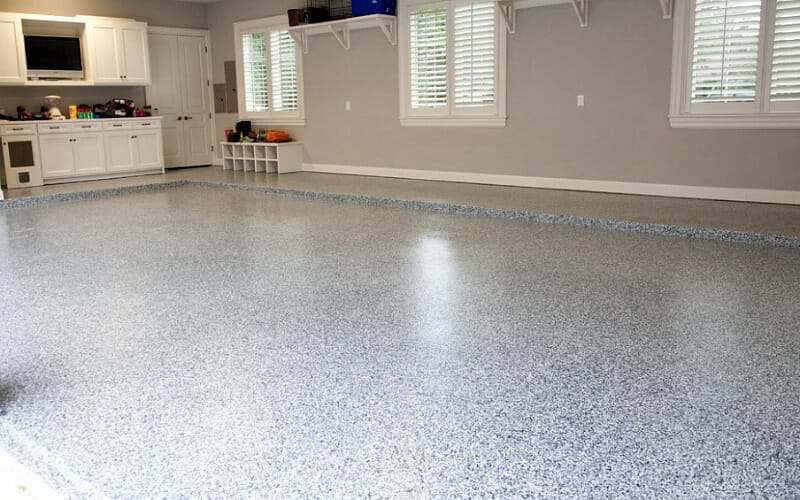
We know that choosing a clear top coat for a garage floor coating can get confusing. With several formulations available, how do you know which is best for you? Which type you choose may also depend on whether you are applying it yourself or having it professionally installed. For this reason, we have decided to review the various clear coat options available to help you decide which is best suited for you.
A clear top coat has many benefits. Besides enhancing the look of your color coat, it will also protect the optional color flakes and the rest of the coating from the numerous elements that a garage floor encounters. It does this by acting as the sacrificial layer.
The number one rule when choosing a clear top coat for your garage floor coating; The top coat should be of equal or greater performance than the epoxy base coat. Remember, your coating is only as good as the weakest link. It will only perform as well as the final coat that is applied.
With these factors in mind, let’s review the different clear coat options available for your garage floor coating.
Epoxy Clear top coats
The most well-known option for a clear top coat is epoxy. It’s available in water based, solvent based, and 100% solids formulations. This can allow for quite a bit of flexibility depending on your requirements.
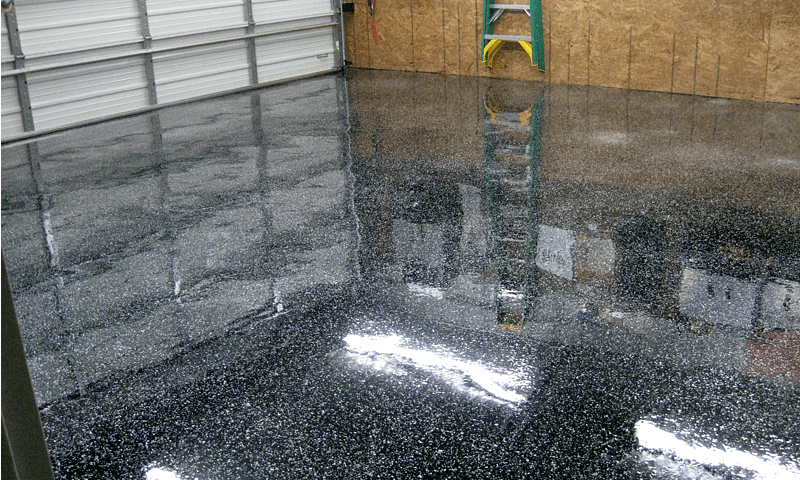
The main advantage of epoxy for a clear top coat is cost. Epoxy is the least expensive option in most cases and as long as it’s not solvent based, it will be low in VOC’s as well.
Epoxy can also provide for a thicker single coating of up to 10 mils depending on the solids content. If you have a full coverage application of color flakes, this can reduce the number of coats to properly cover the flakes down to as little as one single coat.
Pros
- Lower cost
- Low in VOC’s (solvent based the exception)
- Good chemical resistance
- High dry film thickness of up to 10 mils requiring fewer coats
Cons
- Less abrasion resistance than other coatings
- Scratches easier
- Not U.V. stable – ambers with yellow tint if exposed to sunlight
- Lack of flexibility
- Not exceptionally clear
- Slippery when wet
While the cost can certainly be attractive, epoxy as a clear coat does have its drawbacks and is usually the least desirable of top coat options. There are a few reasons for this.
Typically, epoxy is the least abrasion resistant of garage floor coatings. This means that it will wear faster, particularly the less expensive water based products.
Epoxy also scratches easier. The primary reason for this is that it cures to such an extremely hard coating that lacks any flexibility. This combination of hard surface and lack of flexibility can have many benefits in a high build color coat, but it causes small granules of dirt and sand to act like sandpaper when walking or driving over it.
While many of these scratches can be microscopic in nature, an abundance of them will degloss the finish after a while and give it a dull appearance. This can increase the effort of keeping the floor clean. Scratches can be much more noticeable with darker base coat colors and/or darker color flake applications as well.
Most epoxy is not water clear either. It actually has a slight tint to it that can look cloudy when compared to other top coat options. And despite the addition of U.V. stabilizing agents, epoxy will eventually amber when exposed (directly or indirectly) to sunlight.
If an epoxy top coat is all the budget will allow, however, don’t fret. It is still a much better option than no top coat at all. It will still protect the base color coat and color flakes (if applied), while also increasing the durability and longevity of your garage floor coating.
Polyurethane top coats
Up until the last few years, polyurethane, also known as “urethane” for short, has long been considered the high performance top coat option for garage floor coatings. And for most DIY applications, it still is.

The majority of polyurethane coatings are solvent based with the highest performing of these being the 2-Part aliphatic polyurethanes. The single part moisture cured urethanes generally come in a close second.
The exception to this is the newer water based, low VOC polyurethane coatings that are manufactured for parts of the country that have high VOC restrictions. Areas of Southern California are a good example. While these newer water based polyurethanes do not perform quite as well as their solvent based counter parts, they still perform better as a clear top coat when compared to the majority of epoxies available.
The most predominant benefit of polyurethane is high abrasion resistance. Abrasion is what wears down a garage floor coating and polyurethane can have up to 3 times the abrasion resistance of some of the best epoxy coatings.
It is also more resistant to chemicals. This can be a big benefit for the mechanic worried about chemical spills such as brake fluid, parts cleaners, and strong solvents.
Polyurethane is also U.V. stable. This means it will not amber when exposed to sunlight. When applied over epoxy, it will not completely stop the epoxy from turning amber, but it will slow down the process significantly.
If yellowing of the color coat is a strong concern, polyurethane can also be tinted to create a U.V. stable color coat that will not amber. This is a popular top coat option for those that prefer a solid color floor coating without color flakes.
Because polyurethane coatings have more flexibility than epoxy, they are much more resistant to the microscopic scratches and marks that epoxy can acquire. As a result, it holds its gloss much better and makes for an excellent choice to apply over metallic epoxy coatings and darker colors that show scratches easier.
Polyurethane is also very clear, it has a glossier finish, and it is more resistant to tire marks and stains. In addition, if you don’t care for the glossy look, it is one of the few coatings that are available in a satin finish.
Lastly, polyurethane is one of the easier top coats to apply. It has a much longer pot life and can be rolled out of a paint tray in most cases.
Pros
- High abrasion resistance for longer wear
- Excellent chemical resistance
- U.V. stable (will not amber)
- Better scratch resistance
- Cures very clear
- High gloss and optional satin finish available
- Good medium for anti-slip aggregate
- Now available in better water based formulas to meet VOC restrictions
- Easy to apply
Cons
- Thin dry film thickness can require multiple coats
- Does not adhere well to bare concrete
- Cost – more expensive than epoxy
- High VOC’s (water based the exception)
There are some things to consider when choosing polyurethane, however.
Though polyurethane can have a high solids content of over 70%, it has a dry film thickness of only 2-3 mils. It cannot be applied thicker like epoxy to compensate or you will experience bubbles, cloudiness, and a poor cure. This is why it does not make for a good build coat.
The thin dry film thickness also means that it can require applying multiple coats depending on the amount of color flakes applied. If no color flakes are applied, you can apply as little as one coat. A full color flaked garage floor can require up to 3 coats in order to properly fill-in all the irregularities and cavities that a full color flaked surface can create.
There is a benefit to the thin dry film thickness, however. It makes for a good medium to apply anti-slip aggregate. Anti-slip has been known to sink and be less effective in thicker coatings requiring a bigger diameter aggregate that is more visible.
Another consideration is expense. While one gallon of polyurethane is more expensive than high solids epoxy, the coverage rate can sometimes be more than double that of epoxy. If you only need 1 coat, it can actually be less expensive to use. However, if you need to apply 3 to 4 coats to cover all your color flakes properly, it will be more expensive than a single coat of high solids epoxy.
Polyurethane also has a higher VOC content than most epoxies due to its solvent base which requires that precautions be taken with application. A respirator should be worn and all open flames in the work area need to be extinguished. Always check with the manufacturer or vendor you are purchasing from about these precautions.
Polyurea and Polyaspartic top coats
The interest in 2-part polyurea and polyaspartic coatings for garage floors has grown tremendously in the last several years. New formulations that allow for better application techniques have made these a popular choice for the commercial garage floor coating market.
Why? Besides performance benefits, the fast cure rates allow for a 1 day installation of a complete floor coating system. This can be a big advantage for those that can’t live without their garage for more than a day.
Polyurea is a subgroup of polyurethane. Polyaspartic, technically known as polyaspartic aliphatic polyurea or PAP for short, is a type of polyurea. Both have similar benefits to polyurethane in terms of durability and protection, as well other benefits that polyurethane does not have.
As we stated, one of the main benefits to these coatings are the fast cure rates of only one to two hours. Since most coatings require that you wait a minimum of 8 to 12 hours before reapplication, multiple coats can be applied in less than a day.
Polyurea and polyaspartic coatings are also thicker than polyurethane. With an average dry film thickness of 4 to 8 mils for a garage floor application, 1 to 2 coats is all that is required.
Additional benefits include an extremely clear and glossy finish – even more so than polyurethane. High solids applications are low in VOC’s as well.
Polyurea and polyaspartic coatings are also more flexible (relatively speaking) than polyurethane. This makes them slightly more scratch resistant and impact resistant.
One last additional benefit is the ability to apply it in a much wider range of cooler and warmer temperatures. This really isn’t a consideration though if you are using epoxy as your base coat since it is less tolerant to temperature extremes during application.
Pros
- Excellent abrasion and chemical resistance
- U.V. stable
- Very high gloss finish
- Water clear
- Fast cure rates
- Slightly better scratch and impact resistance than polyurethane
- Low VOC’s for most high solids applications
Cons
- Most expensive coating option
- Very short pot life
- Not easy to apply – experience required
- Very slippery when wet
- Some formulations not as resistant to battery acids
While polyurea and polyaspartic coatings can make for an excellent top coat, there are some downsides.
The first is cost. Polyurea and polyaspartic are the most expensive of floor coating options to choose from. This is why polyurethane is still such a popular choice when the benefits are so similar.
Another is application. These coatings are not DIY friendly. Because they cure so fast, they can have an extremely short pot life of only 20 minutes. Unless you have prior experience with multiple coatings, applying these can be nerve racking and almost never go on smoothly for the average DIY application. They are best left to the professional to install.
Some manufacturers have been able to extend the pot life of these coatings with different formulations that are less in solids content. This can make them easier to apply, but it also makes for a thinner dry film thickness and higher VOC’s due to the higher solvent content.
Lastly, polyurea and polyaspartic are the most slippery of coatings when they get wet. This is mostly due to the very glossy finish. While they do meet ASTM coefficient of friction ratings when dry, a little bit of water or spilled fluids can make them slippery. It’s generally recommended to use an anti-slip additive in the final coat regardless of the climate you live in unless precautions to avoid a wet floor are taken.
*** update ***
There are now new single-part moisture cured polyurea coatings that are available. These new coatings have similar performance benefits as the 2-part fast curing polyurea and polyaspartic coatings, but are much easier to install with almost unlimited pot life. As a result, these are a great choice for DIY installation.
These coatings have a dry film thickness that is twice that of polyurethane and are available in clear as well as colored tints. You can learn more about single-part polyurea here.
Clear top coats to avoid
The one clear coat option you want to avoid for your epoxy garage floor is acrylic. Sometimes referred to as a “glaze coat” with some garage flooring kits, acrylic coatings are very thin and do not perform nearly as well as epoxy.
Acrylic coatings lack the same wear resistance, stain resistance, and scratch resistance. In addition, solvents such as gasoline and other automotive chemicals can cause some acrylic coatings to soften and smear.
Furthermore, they can only achieve a mechanical bond to epoxy where as the previous coatings discussed can achieve a superior chemical bond. In short, an acrylic top coat violates the number one rule. You would essentially be applying an inferior top coat that will reduce the performance of the overall garage floor coating.
Clear acrylic coatings are best used for clear coats on decorative concrete such as patios, walkways, and porches where foot traffic is the primary wear source.
Lastly, we suggest you read our article about mistakes to avoid when choosing a clear coat. Trying to buy a clear coat for a 1-part epoxy paint is one of those mistakes.
If you have applied or are thinking of applying a 1-part epoxy paint, then you cannot apply a clear coat to it. 1-part epoxy paints are an acrylic latex paint with a little bit of epoxy resin added for durability. This article here explains the difference. None of the clear coats discussed above are compatible with paint.
Final thoughts
Though epoxy is less expensive in most cases, it’s not the best choice as a top coat for a typical garage floor unless you are on a tight budget. It is still much better than not using a top coat at all, however.
For most people, polyurethane is likely the best choice as a clear top coat option. It’s one of the easiest to apply, it is U.V. stable, and provides many of the same benefits as a polyurea or polyaspartic coating, but usually at a lower cost. Plus, the thinner dry film thickness makes for a great medium to apply anti-slip aggregate if you so desire.
While a polyurea or polyaspartic top coat can make for an excellent choice, it’s best used if you choose to have your garage floor coating professionally installed. Many installers offer complete polyurea/polyaspartic garage flooring systems which can be a big advantage if you need to have it installed in the colder winter months or you are on a tight schedule and need it installed in a day.
Also, many of these same installers offer a hybrid of epoxy base coats and polyurea/polyaspartic top coats which can reduce the cost of the installation, yet provide the same benefits in terms of performance.
Finally, if you still have questions about the best top coat for your garage floor coating, be sure to consult with the vendor or floor coating contractor you intend to purchase from. Ask to review the TDS Sheets if they are not available online. And when installing a floor coating yourself, be sure to ask about compatibility if you are not using products from the same manufacturer.
Hello,
Thanks for all the info. If I understand correctly, polyurethane is UV stable and will not yellow but epoxy underneath it would. Is this correct? If we plan on doing a full flake epoxy floor with polyurethane topcoat, would yellowing be an issue since the only thing exposed would be the flake and the poly? I ask because the garage has about 3 or 4 inches of apron that extends beyond the garage door (north facing) and will always be exposed. Thanks!
Hello Tony. You ask a great question and it’s something we should have noted. Color flakes are U.V. stable as well. So if you are going with a full flake floor, you will not get any yellowing when you use polyurethane as your top coat.
Would a polyurethane topcoat be doable as a topcoat for water based acrylic stained concrete? At what temperature can it be applied? We really need to get our floor finished asap but are having trouble finding a good product that can be applied during the winter months.
Hi Ed. Acrylic stain is a topical film forming sealer already. It’s an actual acrylic coating that is tinted to create a translucent color. The only topcoat you could apply would be more water based acrylic. Polyurethane is not compatible. It’s solvent based and would soften up and deteriorate the acrylic.
Acid stains, as well as acetone and water based dyes are products that penetrated and stain the concrete. They are not film forming nor are they a sealer. They only change the color and do not protect the concrete. You can read about them here. They are the type of stains that need a topical coating to protect both the concrete as well as the stain.
Hi i want to put the best possible coat on a garage floor and not have to replace it in any hurry it is a new dwelling domestic not exposed to the sun except where it meets up with the drive way probably a lighter colour if possible what would you recomend a epoxy coat with polyurithane coating to be the best.
Kind regards
Kevin
Hi Kevin. There are many great products to choose from. Some of our current sponsors for example sell top quality commercial epoxy with high performance polyurethane and polyurea clear coats. You can find them on our sidebar. Legacy Industrial, Epoxy Master, and Garage Flooring LLC are examples. You will not find top product at home improvement centers and hardware stores. The new Nohr-S polyurea coating by Legacy Industrial is great product as well and will not amber, even if exposed in direct sun.
How do these garage floor coverings compare to “painting” a garage floor?
Hi Karen. Painting is usually done with a latex concrete paint. Coatings are much more durable. We suggest that you read this article about painting and this one about the difference between coatings to better understand the differences.
What is the waiting period to apply the top coat after the epoxy and chips have been applied? the floor is now dry to the touch – 12 hours. thanks
Hello John. If you can press your thumb to the coating without leaving a print you are good to go. Standard time is 10-12 hours for recoat.
I am trying to find the polyurethane that I need at Lowes. Everything they have says it has a natural amber effect and it is meant for wood. I found Spar Urethane, but that said it isn’t suggest for floors. Lowes wants me to buy seal Kreme gloss clear seal, but I don’t want to get something that Amber’s or scratches easily. I am very confused as to what to get right now.
Hello Scott. You are not going to find a polyurethane floor coating for concrete at home improvement centers. They do not specialize in concrete floor coatings and all you will find is for wood floors or furniture only. If you have a Sherwin Williams nearby, they carry polyurethane concrete coatings. If not, you will need to order it from the garage floor and concrete flooring vendors online. They are the experts and the ones who carry the good product. We suggest starting with one of our many sponsors. Here is an example.
I’m looking for assistance. I applied 2 coats of a 2 part semi gloss epoxy on a garage floor and back rolled an anti slip aggregate into the wet film of the 2nd coat. The end result is a rough surface, too rough of a surface to my liking and will hamper cleaning and sweeping. What product is recommended as a top coat that would lessen the roughness of the anti slip aggregate? Do you have to wait for the epoxy coat to cure before applying a top coat? I am looking for any reasonable solution short of sanding down the entire floor.
What product did you use exactly James?
There are so many options, the “bullet proof” option of an epoxy base with a poly clear top for UV protection is the hardest to work with. The water-based options are easy to work with but may not hold up to the hot tires, dropping tools and sliding around floor jacks. I’d be more comfortable with something I could buy in my local paint store instead of ordering online. I’ve come down to the Benjamin Moore Corotech line of coatings.
My question is this, does anyone have any feedback on what I found to be the best option for a DIY project for a 300sf garage floor:
– V155 Primer (https://www.corotechcoatings.com/product-detail/corotech/100-solids-epoxy-pre-primer)
– V400 Base Coat (https://www.corotechcoatings.com/product-detail/corotech/polyamide-epoxy)
– V500 Clear Top Coat (https://www.corotechcoatings.com/product-detail/corotech/aliphatic-acrylic-urethane-coating-gloss)
Thanks in advance for your help!
Hello Rich. In our opinion your choice for a primer is good. Though the color base coat is not considered a high solids epoxy, it is better than the low solids options available and will most likely be fine for the average garage. We do not agree on your choice for a top coat however. A polyurethane top coat should have an abrasion resistance rating in the neighborhood of 8 – 10 mg loss per 1000 cycles for garage use. This one is rated at a 44 mg loss. What this means is that it will scratch fairly easily in a garage. It will not hold up to the “sliding around floor jacks” scenario you outlined. Also, the data sheets lack the proper Regent ratings for chemical resistance (as does the epoxy). The manufacture uses a rating scale of poor through excellent which is intentionally vague and does not create an actual measurement to chemical resistance as do the Regent ratings.
This is an example of why we recommend contacting online coating vendors who specialize in coating garage floors. They know what product works and what doesn’t and can explain to you why. Most brick and mortar stores either lack the proper product or the experienced help to provide product for a garage floor that will last years.
Thanks for the quick and informative response!! I guess from here my questions involve the following – I have about 280sf of garage floor to cover, it’s only a year or so old with minimal foot traffic and maybe a drip or two of oil. Aside from the cost of what I need to wash and/or etch the concrete, what are some suggestions for a true 100% solids epoxy and poly clear that I can do myself with no help and possibly not exceed $500? With the 30 minute pot-life on the epoxy options I’ve seen, that is the biggest hurdle for tackling this all by myself.
Any and all help is greatly appreciated!!
You should be able to purchase and apply and excellent system consisting of a primer, high solids to 100% solids epoxy, and high performance polyurethane top coat for that price range Rich. We recommend checking Legacy Industrial and Garage Flooring LLC to start with. They both have high solids epoxy (over 90%) that is easier to work with than the 100% solids epoxy. The only difference is a little bit of solvent is added to the mix to make it easier to work with and create a longer pot life (approximately 45 minutes temperature dependent). Give them a call and ask questions. Some of our other sponsors have great kits as well.
I applied a 2 part epoxy rust oleum Metallic product (oil based) with flakes to my garage floor and want to apply a top coat to protect it. Which product would you recommend?
Also when I called a sponsor they could not recommend one of their products because I used a different manufacturer, any suggestions?
Hello Stephan. Epoxy is not oil based. Can you tell me whether or not it was the water based or professional solvent based version of the Rust-Oleum?
Yesterday I applied a second coat of grey garage Rust-oleum polycauramine to a utility room in my basement. As I will be moving heavy wheeled items in an out of the room(like treadmill, elliptical) I’m thinking a clear topcoat would be a good idea. What would you suggest, another topcoat of polycuramine or a urea/polyurethane based product?
Hello Jim. A clear top coat is a great way to protect the color coat from scratches and provide a deeper look. The Rust-Oleum polycuramine coating provides a seven day window in which to apply additional coats of the same polycuramine product (clear or color). However, the polycuramine clear coating will not provide the same scratch and wear resistance as a good polyurethane or polyurea. The problem is that Rust-Oleum does not recommend applying a different product over the polycuramine during this seven day window (in order to achieve a chemical bond) as they have not tested for compatibility with other products. As a result, if you want to apply a better clear coat you would need to wait the seven days and then rough up the surface with 100 grit sandpaper before applying a different product.
Sorry Shea my question was posted twice as my screen didn’t refresh to show the original was received. Is there a product you can recommend from a local distributor like Sherwin and Williams?
No worries Jim. We have to moderate comments or we would have dozens of spam comments everyday that are worthless to our readers. The best product that Sherwin Williams offers to the general public is ArmorSeal HS Polyurethane. It will do a better job than the Rust-Oleum polycuramine as a clear coat, but there are better polyurethanes that you can purchase from floor coating vendors online. For example, this polyurethane by Legacy Industrial has an abrasion resistance rating that is much better than the ArmorSeal product. Learning to read the data sheets helps to determine how well a product will perform compared to others. Of course budget is always a consideration as well.
I have applied 2 part epoxy-coat.com solids epoxy and also finished the garrage floor with lot of chips. what kind of top clear coat would be preferred to protect this epoxyfloor? would I be able to use sherwinwilliams “Minwax Super Fast Drying Polyurethane for Floors” ?
Hello Kris. We discuss the various clear coat options in the article including the pros and cons. A polyurethane or polyurea clear top coat are the better performing choices. If you have lots of chips you may require two coats of the polyurethane vs one coat of polyurea. Keep in mind you will need to rough up the surface of the epoxy with 100 grit sandpaper in order for the top coat to achieve a mechanical bond. You will loose some color flakes during this process, but not too many if they are sunk well into the epoxy. Since the epoxy has already been applied you are way past the window to achieve a chemical bond.
The Minwax is not for concrete floor coatings. It’s for wood floors and furniture. It’s extremely important to read instructions and technical data sheets for product before you purchase it. We suggest you read this article here that talks about what not to do when deciding on a clear top coat.
Shea,
I am grinding down old concrete in the service bay of a rental company, and am looking for the best possible material or combination of materials to use. I am torn between Epoxy-coat.com’s epoxy clear coat, with a final top coat of their polyurethane, or the AdvantaCoat polyaspartic clear kit. Both are relatively the same price, but I am not sure of the differences all that much. Being in a service bay, there will be rollers, dollies, jacks and tools on it constantly, as well as some gas, oils, and other fluids.
Your advice is greatly appreciated!
Before you go any further I suggest that you read this article here that discusses how to read the data sheets for coatings. It’s the best way to compare one type of coating to the next. Some manufacturers provide the technical data sheets (TDS) on their websites while others require that you ask. If a company will not provide a data sheet for any reason, then that is reason enough not to purchase the product. Whenever possible, we always recommend staying within a manufacturer’s own line of products. The reason for this is that it insures compatibility of products and makes it easier to get help with questions regarding application and etc. This is not always possible, however, since not all manufactures or vendors carry product designed as a complete system.
Epoxy-Coat never used to carry polyurethane until their customers started demanding it. Their data sheets are not listed so you will have to ask them for it. For the polyaspartic coating, I believe you may be asking about AdvaCoat? If so, their polyaspartic has great chemical resistance, but their abrasion resistance may not be as good. We suggest contacting them to ask what their taber abrasion results are in that regards. Either way, we always suggest contacting the vendor or manufacture to discuss what your needs are.
Hi Shea,
I just coated my garage floor (8 hours ago) with Rust Oleums “Professional” epoxy. I’ve since read online about the importance of a topcoat. You have convinced me to add one (Polyurathane) but I’m worried about timing… Ideally, I would have ordered from an online vendor but I believe I only have a short window now to recoat? I would prefer not to sand and potentially damage the existing flakes. Would the Sherwin Williams ArmorSeal Polyurathane be my best bet? What would you recommend?
Thanks in advance. I’ve found your website to be incredibly informative.
Hello Christian. Polyurethane can be difficult to find at a moments notice. The ArmorSeal HS Polyurethane will do a good job (better than Rust-Oleum clear epoxy) for a top coat if it’s available from a Sherwin Williams near you. Most other high performance clears need to be ordered online. If you can apply it within 24 hours of the epoxy then you will not have to rough up the surface.
I have a freshly painted garage floor with KILZ, 1 part epoxy garage floor paint with paint chips too. What is a good clear or top coat to protect the chips and give the paint a bit more durability?
What you used Jorge is a water based latex paint with a little bit of epoxy added. It is not designed for a clear coat. Most clears are solvent based and will soften your paint. Plus, you would need to rough up the surface of the painted surface before applying a clear in order to get a mechanical bond.
Hello!
I’m looking to finish the entry way to our home. So, I am not working with concrete, but a plywood sub floor. I plan to place skeleton keys on the sub floor and then cover with a clear epoxy, but am concerned about the yellowing of the epoxy as the door has windows. If I read it correctly, this article states that I can put a polyurethane coat on top of the epoxy to help prevent yellowing? I also need the epoxy to be a very clear coat in order to see the keys well. Would you recommend the type of epoxy used for counter tops? It will need to be a thick application as the surrounding wood flooring is about 3/4″ thick.
Thank you so much for your help! After reading many different articles, yours was the most helpful and I’m still a bit confused. 🙂 I have no prior experience with epoxy.
Hello Charity. 3/4″ of epoxy is going to be expensive depending on the size of the area. As a comparison, a typical multi-coat garage floor is averages 30 mils thick or 1/32″ of an inch. We suggest giving Scotty from Legacy Industrial a call. He has done projects like this before and can tell you what would be required and give you an estimate for material costs based on your square footage requirements.
Thank you, Shea!
Hello,
I would like to do a floor covering and then apply a stencil or design on top of it. What are my best options for putting down a base color, painting the design, and then sealing it?
Thank.
Hi Keith. You can use a base color coat of epoxy, polyurethane, polyurea, and etc. The entire finish will need to be roughed up with 100 grit sandpaper after is has been applied and cured. The reason is that you will need to create a mechanical bond where you want to stencil with paint. Acrylic paint will not form a chemical bond with a coating. Also, you will be outside the 24 hour recoat window after painting your design. Since paints are acrylic, the clear top coat will need to be water based epoxy or 100% epoxy. Any other type of clear top coat will have solvents in it which will soften the paint causing it to bleed into the coating. After you apply the clear epoxy, you can apply a more suitable clear top coat after that if you wish.
Thanks for the answers Shea, very helpful. As a follow on, if I wanted to do an acid stain to my garage floor, then apply the stenciled design, what top coat options would I have?
Your top coat options would be the same Keith. The reason is because of the acrylic paint you will be using. Most other clear coats will have solvents in them which will soften the acrylic paint and cause it to bleed as you roll it on.
Hi there!
About a week ago, my husband applied the Epoxyshield kit that Rustoleum makes, on our basement floor. We added quite a few flakes to it and I noticed how rough it is, so I’d like to used a top coat on it now. I’d like to use something that isn’t shiny because it’s in our basement. I also want to know if it’s too late to use a clear coat (for it to achieve the mechanical bond)? We have Sherwin Williams close by and I was going to see if they carried the Armorseal. Thanks so much!!!
Hi Rachel. Since it has been over a week since the epoxy was applied, you will need to degloss the surface in order to achieve a mechanical bond for the top coat. The window to achieve a chemical bond has passed. It will require sanding the surface with 120 grit sandpaper. You will lose some color flakes in the process, but hopefully not enough to notice if they are adhered well with the coating. Though the floor and flakes will look finely scratched and dull, a clear coat will bring the color right back and the scratches will disappear. We recommend using a polyurethane clear coat since these tend to be available in a semi-gloss or matte finish. Remember, do not confuse polyurethane for wood floors and wood finishes with polyurethane for concrete coatings.
Hi, I recently applied the rust-oleum garage floor kit to my garage floor. I was hoping to get alittle more depth by adding a clear coat. Is this possible, is there a product that would work well on top of the epoxy floor kit?
Thank you
Hello Jason. Yes, this is possible. Rust-Oleum makes an epoxy clear coat that is compatible. It can be hard to find at your local home improvement centers, however. It it’s not available from them, you can order it here from Amazon. Keep in mind that Rust-Oleum has a 72 hour recoat window. If you are past that you will need to degloss the current finish by roughing it up with 120 grit sandpaper first.
I painted my basement with sherwin Williams porch and floor enamel for concrete floors. I went to Lowe’s for a clear sealer. Per 2 salespersons recommendations, I bought and applied Clear-Seal a urethane fortified acrylic. It is high gloss and looks like it will scratch. Is there anything I can apply over this. The painting was time consuming for a pseudo wood appearance so I want to preserve it.
Hello Jeanne. The product that was recommend was correct for the paint that was used. Assuming it was a water based acrylic (safe for enamel paint), it can scratch more easily than other acrylics if you are not careful. You cannot apply any other coating over an acrylic. However, it’s fairly common to wax acrylic to protect it. The wax acts as a sacrificial layer and will scratch before the acrylic will.
Hi Shea Just curious..What does your garage floor look like?
Hello Mars. We get that question quite often. It’s a 3 car garage with a light grey coating. It consists of an epoxy primer, two full coats of 100% solids light grey epoxy that was applied with a gauge rake to smooth out the floor, no color chips, and two coats of a tinted light grey polyurethane. It’s a regular working garage for car projects, house projects, and etc. It was applied about 8 years ago and still looks great when the garage is clean.
Is Glaze N seal concrete Lacquer recommended for application over rustoleum rock solid garage floor epoxy-shield as a top coat?
Hello Chanel. No, Glaze N Seal should not be used. It’s an acrylic coating that is not compatible with resinous coatings and not nearly as durable. If you want to use a top coat, then use RockSolid Clear.
I have painted my basement laundry room floor with BEHR 1 part epoxy concrete garage floor paint and I used flecks. It was suggested that if I used a heavier coating of flecks, a clear coat would be necessary. HD recommends the Rustoleum Clear Coat – Do I really need to spend that much for a very low-traffic area or could I use something like the Seal-Krete Clear Gloss product?
Thank you! Bob Satterstrom
Hello Bob. 1-part epoxy paint is not intended to have a clear coat applied. It’s really as stand alone product that has the option of adding some flakes. This article here explains more about this. Adding an epoxy clear would require that you rough up the surface with 120 grit sandpaper in order for the epoxy to adhere properly. Doing this will remove a lot of your flakes. If you opt for that, you would need to use a water-based clear. Rust-Oleum clear coat is solvent based and will soften the paint and possibly cause it to bleed. Unfortunately, home improvement centers are not the best place to get info on floor coatings. Your best bet is a water-based acrylic sealer like the Seal-Krete product. It will adhere without prep and will work for a low traffic area. Just keep in mind that acrylics are a thin coating to begin with and you will need a couple of coats. Do not apply them thick! It’s thin to win. If they are applied thick, you will get bubbles, crazing, and other problems.
Hi Shea!
I have put down 3 thin coats of the Seal-Krete product and it looks good and seems to have sealed in all/most of the flakes. Again, Thank you!
You gave me great suggestions and with that – the most important thing being confidence that I had the right stuff and it was going to work out for us. I appreciate your help!
Great to hear, Bob! Thanks for the update.
Thank you for the information you have provided. Just to make sure I understand: if I use the Seal-Krete product- would I sweep or somehow try to remove any loose flakes before putting down a THIN layer of product? Otherwise wont flakes get caught in product on roller- or maybe that doesn’t matter?.
Again, I very much appreciate your help and advice! Especially in such a timely manner.
Bob Satterstrom
You are correct, Bob. Sweep the surface first with a semi-stiff broom to remove any loose flakes. If the flakes won’t loosen up when you do this, then they won’t when you roll on the acrylic top coat. If you do get some that stick to the roller it’s not a big deal. Good luck!
Hello I just had a Metallic epoxy garage floor done. One of the things I have noticed it is scratching. I have been doing research and I see that the floor needs a top coat. Now I have looked and looked but I cant seem to find one that will be pretty much bullet proof. We use our garage as a gym and we also park our cars on it. I want to protect it with something that will make it last for a long time. Can you help guild me to a product that is a high gloss top coat.
Hello Ryan. 100% solids epoxy is used for metallic coatings and is very hard and tough. This hardness is what causes the epoxy to scratch easier. Different tones of gray’s and tan’s don’t show them as much, but the high gloss finish of metallics with darker color options will definitely highlight scratches much more. I’m surprised that the installer did not offer a high performance clear coat option. Have you spoken with them about that and the option of adding a clear?
Keep in mind that no coating is bullet proof. If you want something that doesn’t scratch you will not find it. However, there are high performance clear coats that are much more resistant to scratching. These typically will be polyurethanes, polyureas, and polyaspartic coatings. These type of coatings are not as hard and flex more. That is what helps with reducing scratching. They also wear longer than epoxy and have better chemical resistance to staining. A high solids polyaspartic coating is one of the best clear coats you can apply, but they have a very short working pot life and are best installed by professionals who have experience with them. Are you looking to do this yourself or have someone do it for you?
Thanks for getting back to me. I spoke to the installer and I should have done more research on this before having it done. The installer had great references but I am learning that he doesn’t know much now. It scary. Is sounds to me he doesn’t do top coats or I should say doesn’t like to do it. So I will not be asking him to do it for me. I might have to see if I can find someone that knows how to do it correctly. If not I will have to do it myself. Do you have any product names you can recommend if I have to do it myself. Man the installers here in South Florida are something else.
Hi Ryan. I’m glad you mentioned where you are at. I recommend that you contact Legacy Industrial and ask for Scotty. Be sure to tell him we sent you. They are a distributor of commercial quality coatings that is located in Florida. He has a list of competent installers, some of which may service your area. If you want to apply a top coat yourself, it’s really not that difficult. He can recommend the proper product and explain the process for applying the clear. One thing to note is that metallic epoxies are some of the glossiest finishes available. Applying a clear will still keep it glossy, but it may not look as glossy as it is now.