
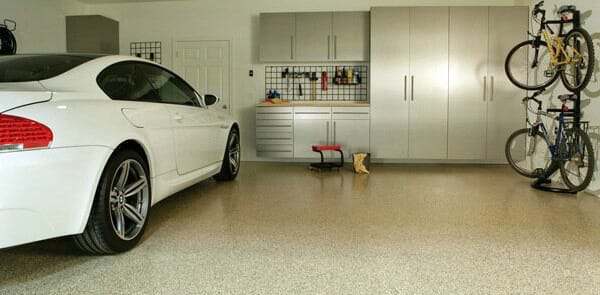
As a rule, when it comes to garage floor coatings we are hesitant to call any one product the best. There are many reasons for this. The most prevalent is that coatings come in various formulations and each has its own unique properties that may provide the best choice for a particular job. However, when it comes to DIY polyurea garage floor coatings, we think we may need to break our rule.
Legacy Industrial has introduced a new polyurea coating called Nohr-S that we feel is going to set the DIY floor coating industry on its ear.
Nohr-S was the original DIY commercial-grade polyurea garage floor coating introduced in 2015. This article has been updated to reflect the most recent product information for Nohr-S floor coating systems.
This post may contain affiliate links. If you use these links to make a purchase, we may earn a small commission. You can read our full disclaimer here.
Why choose a polyurea coating?
Polyurea garage floor coatings can have a few benefits over their epoxy counterparts. Fast return to service, excellent impact resistance, suitability for cold weather applications, and U.V. stability quickly come to mind.
The big problem with applying polyurea floor coatings, however, is the fact that they are not very DIY-friendly. Because of their very short pot life, they need to go down fast and with an expert hand.
Back in 2010, the only manufacturer to offer a DIY polyurea product had been RockSolid. Even then, it was not considered a commercial-quality coating. In 2014, they changed their formula to a proprietary Polycuramine blend that is easier to apply, but it’s still a residential-quality coating that loses many of the benefits of a true polyurea product.
Nohr-S has conquered both of these issues to deliver a commercial-grade polyurea coating that can be applied by the average DIY enthusiast.
What is Nohr-S?
Nohr-S is a commercial quality, single-component polyurea concrete floor coating and sealer. It is used primarily for garage floors, warehouses, automotive service centers, laboratories, food processing plants, high-traffic areas, and firehouses.
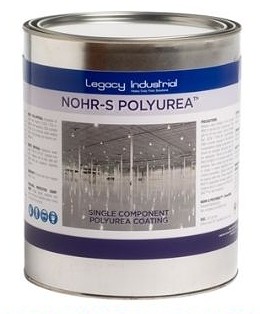
The cutting-edge formula is derived from a Scandinavian coatings manufacturer. It is used for coating marine vessels and oil drilling platforms in the North Sea.
This is some serious stuff that is a bit different from your typical polyurea coatings.
Single component means that there is no mixing together of A and B components like most other floor coatings.
Proper mixing of Part-A and Part-B components has been the bugaboo of more than one DIY project that has run afoul. This eliminates those worries and checks off one of the primary factors that lead to floor coating mistakes.
Nohr-S does require the addition of pigment packs for color. However, there is no measuring of separate A and B components. Just add 1 pigment pack for each gallon of Nohr-S and mix with a paint stick.
One huge feature of Nohr-S is that it has an unlimited pot life. This means that you don’t have to rush fast to get it down. This reduces cosmetic application errors as well as the anxiety about applying high-performance garage floor coatings.
As long as you keep a wet edge going on the floor, you can slow the process down where you are comfortable. This is a tremendous help for DIY applications to ensure a great-looking outcome.
Now that you know what Nohr-S is and why it’s different from your typical polyurea floor coatings, let’s discuss more of the benefits and what makes Nohr-S so durable and tough.
Benefits of Nohr-S polyurea coatings
A Nohr-S garage floor coating system provides similar characteristics to a premium epoxy and polyurethane garage floor coating in terms of durability, chemical resistance, abrasion, and stain resistance. It also has other added benefits that make it unique.
Benefits include:
- Unlimited pot life
- No mixing of A and B components
- No primer required
- Fast recoat times (1 – 2 hours)
- Can be applied in temperatures down to 35 degrees
- Self-leveling gloss finish
- No hot tire lift
- Excellent chemical resistance (no damage from fuel and solvent spills)
- Excellent abrasion resistance (long wear life)
- 100% protection against road salts and deicing fluids
- 100% U.V. stable (no yellowing)
- Excellent clear sealer and coating for bare or stained concrete
- 100% more flexible than epoxy (better impact resistance)
- Can be used for outdoor decks, balconies, and patios
Here is a link to Nohr-S Facts and Usage information.
Our Testing and Review of Nohr-S
Legacy Industrial sent us a quart can of Nohr-S Clear to test for ourselves. We applied the first coat to a concrete paver for the test sample. We sealed the can and waited an hour before opening it up and applying a second coat. You can’t do that with epoxy. It was very similar to applying paint.
After it was fully cured, we tested it against some typical automotive chemicals that a floor would encounter. We applied motor oil, transmission fluid, and brake fluid. Brake fluid is hard to detect in images, but it’s in the top right corner.
We left the fluids on the sample for a few days and then wiped them up with a rag and cleaned the surface with carburetor cleaner. We advise against using carburetor cleaner for cleaning up spills on floor coatings. We just wanted to illustrate how well this quality coating can withstand chemicals.

The surface was cleaned up without any visible signs of staining. You can see our attempt to clean the untreated surface where the brake fluid and transmission fluid eventually ran over the side. One note to make is that brake fluid can discolor most colored coatings if left on too long. It’s harder to detect on clear coatings.
Next, we set the sample out in the direct sun for 10 weeks to see how it would do. We could not detect any visible difference. There were no signs of U.V. damage such as yellowing or degradation.
This is a big advantage over epoxy floor coatings. If you are someone who likes to leave your garage door open for long periods, you don’t have to worry about the coating turning a yellow hue from sun exposure.
Additional advantages over epoxy
One of the primary benefits of a polyurea floor coating over epoxy is a fast return to service. Nohr-S is no different. Once applied, Nohr-S becomes tack-free within 1-2 hours and is ready for another coat. This means that you can apply a complete polyurea floor coating system in less than a day, not including floor prep.
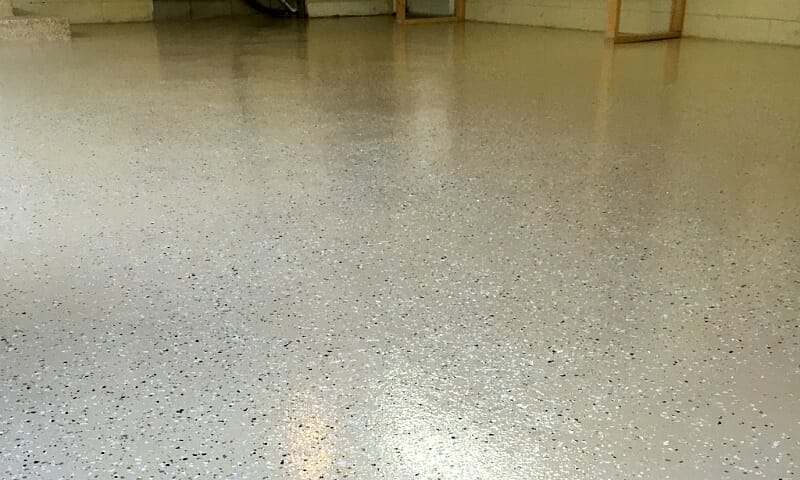
Most epoxy and polyurethane coatings require that you wait a minimum of 10 to 12 hours between coats. This can make a big difference if you are trying to get your floor completed in a weekend.
Epoxy also limits your minimum application temperature to an average of 55 – 60 degrees. This means that an epoxy garage floor coating is a warmer weather project. Nohr-S can be applied in temperatures as low as 35 degrees. This creates a much larger window for application if you live in a colder climate.
Another benefit of Nohr-S over epoxy is the 100% U.V. stability. This means that the coating will never amber (turn yellow) when exposed for periods of time to direct sunlight.
This can be a big advantage for those with southern exposures who like to leave their garage doors open. It can also eliminate the dilemma of where to terminate the coating if you have a garage floor apron that extends out past the garage door 6 to 12 inches.
Because Nohr-S is a single-component product with unlimited pot life, you have the potential to save money as well by not wasting any product. A great example is to compare it to the traditional garage floor epoxy kits.
Since the square footage of garage floors varies, it can be frustrating with epoxy kits when you figure out that the coverage rate of a product falls 50 ft² or so short and will require you to purchase an additional kit to cover the extra square footage.
Depending on the size of your garage floor, it’s not uncommon to end up with a 1/2 gallon or more of unused coating material that costs you over $100 a gallon. Because Nohr-S is sold in quart cans as well as gallons, it’s much easier to control costs by purchasing only what you estimate is needed.
Nohr-S is a Better Alternative to polyurethane
Polyurethane is an excellent clear topcoat that provides better gloss, chemical resistance, and abrasion resistance over epoxy. It’s also U.V. stable. However, it requires thin applications.
With an average dry film thickness (DFT) of 2 mils, a minimum of two coats of polyurethane should be applied over color flakes. More coats are required if you are applying it over a full flake floor.
Nohr-S provides similar protection, gloss, and U.V. stability as polyurethane, but the DFT of Nohr-S is twice as thick. This means that you can apply half the amount of coats required with Nohr-S as you would need for polyurethane.
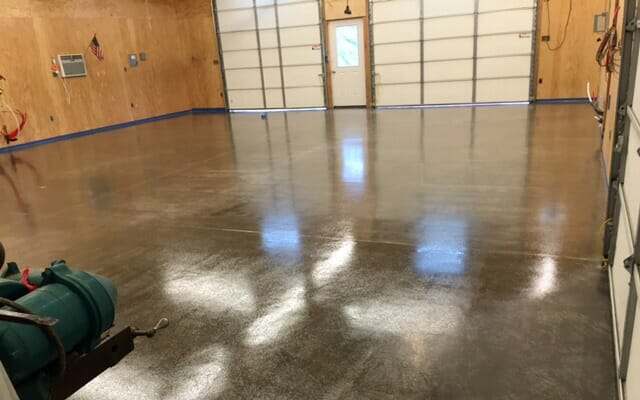
It also makes for a great clear coat over stained concrete as well as an excellent choice for those that like the look of sealed, raw concrete garage floor coatings. It will slightly darken the look of the concrete once applied.
Nohr-S Colors
Due to the popularity and high success of Nohr-S, Legacy Industrial is now offering 8 different colors, not including clear.
Purchase Nohr-S Garage Floor Coating Kits
Legacy Industrial now offers Nohr-S Polyurea in two different DIY garage floor coating kits that you can choose from. The first is the Nohr-S® Polyurea Aegis Coating Kit.
The Aegis kit includes 1 coat of Nohr-S Polyurea with the color-pigment additive, optional 1/4″ vinyl color flakes, and 1 coat of Nohr-S Clear Coat.
In addition, you have the option to purchase additional color flakes, anti-slip media for the final coat (recommended), Nohr-S primer, and premium application tools.
The second is the Nohr-S® Polyurea Full Flake KiT. This kit comes with enough 1/4″ vinyl color flake to cover the entire floor for that popular granite look.
Each kit comes with 1 base coat of Nohr-S to receive the color flakes, enough vinyl color flakes for a full broadcast, 2 Coats of Nohr-S Clear Coat, and anti-skid media for the final clear coat. We do recommend purchasing the Spike Shoes. These are needed for walking over the coating while broadcasting all the color flakes.
An important benefit to note with the full color flakes kit is that the required second clear coat and all of those color flakes add an additional 6-7 mils to the overall coating thickness. This makes the coating more impact resistant and adds durability.
Nohr-S Prime coats Available
Legacy Industrial does provide two Nohr-S primer coating options to choose from. These are recommended if you have very porous concrete or other conditions that may require the use of a primer
The first is Nohr-S ClearPrime – WB. This is a low-smell, fast-drying water-based epoxy primer that can be used with a variety of Legacy coating products besides Nohr-S.
It is also compatible as a primer for many other popular brands of garage floor coatings that do not offer primers. Examples are EpoxyMaster, UCoat It, EpoxyTech, Versatile Coating Products, Rust-Oleum, and more.
The second is Nohr-S Color Prime. This is a solvent-based, 5-hour pot life primer. It’s available in six different colors not including clear.
Solvent-based primers provide good penetration characteristics and can be a good choice for concrete that had previously been oil stained. Besides Legacy products, it’s compatible with many of the same brands as Nohr-S – WB.
Application
The application of Nohr-S is similar to other garage floor coatings. The most important part of the project is proper surface preparation. Acid etching or grinding of the concrete is required to provide the proper substrate for Nohr-S to achieve its excellent bonding characteristics.
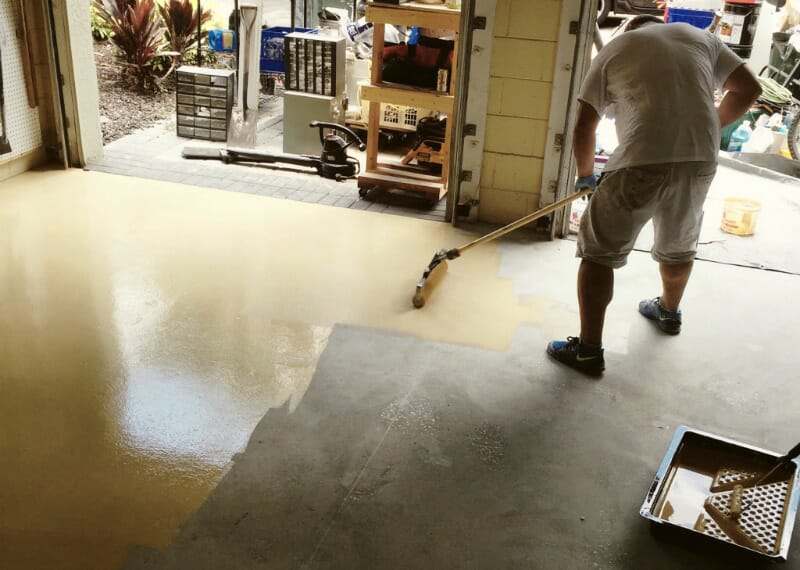
If you have an older or more worn garage floor, Legacy Industrial says a high PSI pressure wash may be all that is required. We recommend consulting with them first before making the decision to pressure wash, however.
Before application, it’s important to make any needed floor repairs such as filling cracks and spalled areas of the concrete.
If doing a full flake floor, the flakes are tossed into the first coat to full refusal. After the flakes have been properly scraped and swept/vacuumed up, a minimum of two coats of clear is applied. The first coat fills in all the nooks and crannies within the color flakes. The second coat is the wear coat that smooths out the surface somewhat.
Because Nohr-S cures to a glossy and hard finish, adding a non-slip additive to the final coat is highly recommended.
Coverage rates
Using a 3/8” nap roller, 1 gallon of Nohr-s will cover an average of 250 ft² at approximately 5 mils DFT depending on the surface profile. Expect the first coat to cover 200-225 ft² with the second coat up to 300 ft².
The DFT of 5 mils for the first coat is one reason that Legacy Industrial recommends the use of their Nohr-S primer for porous or irregular concrete surfaces. Nohr-S can be applied up to 10 mils thick per coat at a coverage rate of 100 ft² per gallon if needed.
What to consider before choosing Nohr-S
As versatile and friendly as Nohr-S is for a commercial polyurea garage floor coating, there are some things to consider before deciding if it is right for you.
Polyurea typically does not provide as high of a dry film thickness as 100% solids or even a high solids epoxy when applied at similar coverage rates. Nohr-S is no different. 250 ft² of Nohr-S will provide 5 mils DFT while a high solids epoxy will provide 8-10 mils DFT at similar spread rates.
If you have an older garage floor with many imperfections, then the use of a Nohr-S prime coat may be needed. Another option is a high-build epoxy coating. It may be a better choice for your color base in order to fill in all the small irregularities in the concrete.
However, if you have a fairly smooth garage floor without a lot of irregularities, then Nohr-S can make for an excellent choice. Thickness does not always determine how durable and tough a floor coating can be. The video below is a great example.
VOCs can be an issue as well. Unlike most other polyurea floor coating products, Nohr-S is not a low-VOC coating. It is a single-component solvent-based coating with a 72% solids content. As a result, it does produce strong fumes when it is first applied. The smell does dissipate fairly rapidly though within 24 hours after application.
Final thoughts
We feel Legacy Industrial has filled a much-needed gap in the DIY garage floor coating industry with the advent of Nohr-S. It has become a very popular product among the DIY crowd looking for an easy-to-apply, top-quality, high-performance garage floor coating.
In fact, Nohr-S is no harder to apply than the cheap garage flooring kits that are sold in home improvement centers. The difference in quality, protection, and longevity, however, cannot be compared.
We have a few different articles in our Reader’s Projects section that feature Nohr-S as well. One was a pitted and spalled garage floor renewed with Nohr-S as a DIY project. Another features a shop floor for Street Outlaws’ own Ryan Martin. You can see his Nohr-S floor here.
We would rank Rust Bullet as its closest competitor in this niche since it is a single-component floor coating system as well. The difference is that Nohr-S is a more traditional garage floor coating system. It goes on thicker and can achieve higher build coats.
The anxiety about applying commercial-quality, high-performance garage floor coatings is understandable. It’s one of the biggest determining factors when making a decision about the various garage flooring options available today. Though many homeowners are attracted to quality coatings, they are hesitant about installing them themselves.
Nohr-S eliminates these anxieties and can provide a top-quality garage floor coating that will last 10 – 15 years or more. Due to the increase in material costs for epoxy, a single-part polyurea system is priced similarly to a quality epoxy and polyurethane system. Though such a system costs more than the store-bought DIY epoxy kits, the additional expense is worth every penny.
It is mentioned several times that a DYI application requires primer…while a professional applicator need not use primer. What is this based on…quickness of the physical application…ability to smooth out a consistent thickness? It would seem that placing a second same color coat over the first would not be any harder than placing a color coat over a different color primer. Can you provide any more details on the basis for the DYI primer coat?
Primer is definitely recommended when applying a high solids to 100% solids epoxy coating. DIY polyureas and polyaspartics are a bit different. They are not as viscous as high solids epoxy and they do not set up as quick as some of the other polyureas and polyaspartics that are used by commercial contractors. As a result, they have good wetting characteristics and get good penetration on their own when applied to a properly prepared substrate. It’s not unusual at all to go with two color coats. The first acts as a primer coat and the second is the build coat.
I wanted to thank Shea for helping everyone so well!!
Also… Starting today the Nohr-S pigment packs are 1:1. In other words one can of tint will now pigment one gallon of Nohr-S.
Lastly, we launched two Nohr-S garage kits, pigmented and clear!!
Hi, I am definitely a newbie in the area of concrete/cement floor coatings, just started looking into them. I have finished part of my concrete basement into a woodworking shop, and looking into what would be the best coating to put on it. Moisture does not seem to be a problem in the basement, haven’t ever seen any issues in that area. Will sweep the floor a fair amount, obviously. Also, will have a couple of pieces of equipment that will weigh on the order of 600 – 700 pounds, that will be on mobile bases so that I can wheel them around, although that will definitely not happen often. What would be best to use in such an application? Would like something not slick, unless that would make sweeping very difficult, but I could also combo sweep/vacuum, not slick probably more important. Area will have an extensive dust collection system to grab dust from tools. Epoxy, Rock Solid, Nohr-s, others?
Hello Loyd. How was the surface finished? Was it troweled real smooth or does it have a little rougher texture? Also, do you want a coating for the decorative aspects or does that matter?
It was troweled pretty smooth, I was figuring I would have to etch or grind it in some fashion..The floor is only about 3 years old… Functional a little more important, but a coating for decorative is also a possibility, especially if it doesn’t hurt the functionality…. I can create dust, the area is pretty sealed off from the rest of the house, and it has exterior windows, it needs to be so that it can be an effective basement shop….
thanks for your help.
If the decorative aspect is not a deal breaker, then a good economical option that you may want to look at is another product that Legacy Industrial offers called HD40. It’s a penetrating stain guard sealer that is applied in multiple coats and then can be buffed to a satin shine. It kind of takes on the look of the concrete floors you see at home improvement centers. It’s not slippery, there is nothing to chip, and it makes cleanups a breeze. We did an article about it here from our Reader’s Projects page. One nice aspect is that if you do have some moisture, the sealer breathes and will allow water vapor to escape.
If that doesn’t interest you then your coating options are fairly open. As long as you stay with a commercial quality coating there is no reason to worry about casters damaging it when rolling around heavy equipment. Nohr-S is a great option. It might get a little slippery with saw dust on the surface, but you could always apply an anti-slip additive to help alleviate that. Another good option would be Rust Bullet. Concrete prep usually is not required and it’s very tough coating. RockSolid and some of the other DIY home improvement kits may not be the best choice. Our main concern is that they may not stand up as well to the heavy equipment.
If you decide to go with a coating, we highly recommend that you conduct a moisture test to verify that you don’t have any moisture issues. The one problem with basements that needs to be considered is that sometimes moisture can be a seasonal issue. If you test while it has been dry for quite a while the test may be different during the wet season.
Thank you for these comments. Im finishing a basement this was helpful since all these articles are about garages!
Your’e welcome K. Since most basement floors are concrete as well, the same information applies. Just makes sure to moisture test with a basement.
Thanks for the options, that gives me some ideas to look into further. I will probably do a moisture test, but I am in Colorado where it tends to be drier than other places, and the house sits on high ground so that it drains around it very well, I don’t expect any moisture problems. I may have further questions later about the anti slip additives. Thanks !
You are welcome Lloyd 🙂
Hi, everyone. I am Scotty from Legacy Industrial. I wanted to mention that we recommend using a primer for our Nohr-S Polyurea for a few reasons…
1. A primer helps eliminate the possibility of bubbling. Bubble events are not regular events, but over a well prepared floor the possibility is there. We want all of our customers to have a GREAT experience and therefore we recommend it!
2. Using our primer allows you to negate one of the two previously required pigmented/clear coats of Nohr-S. Saving you money!!
Here is our recommended strategy for using Nohr-S and if you use our Nohr-S Polyurea Garage Kit, this is already worked out for you…
Pigmented system:
Coat 1: Standard Primer
Coat 2: Nohr-S with pigment
Coat 3: Nohr-S
Clear System:
Coat 1: Nohr-Prime
Coat 2: Nohr-S
Coat 3: Nohr-S
I have new garage floor. Nice smooth finish but not shinny. 24 x 30 floor. What will be my approximate cost and application time?
Hello Benjamin. We don’t sell any of this product. All Garage Floors is an informational website only. However, if you look near the bottom of the article, we have red links to articles about the various vendors with a review of their single-part polyurea. Within those articles are links to the vendors themselves where you can make a purchase. Please give any one of them a call if have any questions. Once the concrete has been prepped via grinding or acid etch, a complete system can be applied in one day.
We have a new (unsealed, unused) 920 sq ft detached garage that will be used daily for mechanic work. Would we need to do an acid etch? What products, and what amounts, would you recommend? Not sure if we need to do a primer, epoxy, and top coat, or just a few coats of the Nohr-S? Also, we plan to use flakes and some of the non-slip additives. Any suggestion on the grade of those? Thank you
Hello Sandie. Yes, you would need to do an acid etch for sure if you elect not to grind. Nohr-S is a great product, but the concrete still needs the proper prep, new or not. You will need a minimum of 2 coats. One is the color coat and the other is the clear coat to lock in the color flakes and protect the color coat. Since it will be used for mechanics work as well, a primer is a good recommendation. You can figure out coverage amounts, including the anti-slip grit, and get pricing from Legacy Industrial right here. Just give them a call if you have any questions.
Hi I left some questions about coating a basement floor back in August, but due to unforeseen (ouch) knee surgery I haven’t gotten to the project yet, but am now. The questions were answered very well, but just wondered if I can contact anyone in particular, directly and personally, at Legacy Industrial to have a conversation about appropriate coatings? Again I appreciate the previous answers but thought a conversation a bit quicker than the back and forth here as questions come up.
Hello Lloyd. Give them a call and ask for Scotty. He is excellent with the DIY crowd and would be glad to help you out. Their contact info is here.
Hello, Great site for us DIY guys. I am pretty well sold on the Nohr-S for my new garage. One question regarding the Nohr-S is that I will have a section where a fair amount of welding and grinding will be conducted. Should I coat that section with the Nohr-S, use a different product or not coat it at all?
Thanks,
Bill
You have a couple options William. You throw down a welding blanket to protect the floor or you can just live with the burn marks that the welding and grinding can create in the coating. If you don’t put down a coating there, then we would recommend a penetrating sealer of some kind in order to help reduce staining and make cleanup easier.
Shea, I have posted and asked before about coatings for my new construction garage floor. I think I am leaning towards this product from Justin at flooring llc. With my floor being new construction and power trowled smooth, what etching system would you recommend to me? I also wanted to see if I could do more flakes on this than the standard epoxy kits sold at the store. I don’t think I can do a full flake with one base coat and a clear coat, but can I do more than the small amount those kits do?
Thanks for your advice and this site!
Grinding is the preferred way to prep for a coating Randy. We have an article about grinding here. A muriatic acid etch would be the other alternative if grinding is not feasible. Garage Flooring LLC also sells an excellent acid gel by Gel Tek that is easy and safe to use if you don’t want to work directly with muriatic acid. We have an article here that discusses how it works.
Yes, you can definitely apply more color flakes to the coating. Justin has many custom colors available for you to mix together. We suggest giving him a call. He can recommend the correct amount of flakes to purchase for the look that you want.
I am looking for a product to seal a 30 year basement floor. My mail concern is small cracks and radon gas. The floor has a few smooth parts from years of foot traffic. Is it necessary to grind or prep the flood and what sealer would work best?
Yes, Paul, you are still required to properly profile concrete for a coating. You will need to etch or grind the concrete before application. Since this would be for a basement, the first thing that needs to be determined is if you have moisture. A moisture test should be conducted to ensure a coating will work. Coatings such as epoxy or polyurea are sealers. They will effectively block radon gas.
Is there a supplier in the Salt Lake City area where I can purchase this product to apply on my residential garage? Thanks.
Hello Tony. Most vendors who carry single-part polyureas are concrete coating specialists. They don’t have stores around the country and only sell online. IMost ship for free. You can find Legacy Industrial Nohr-S here. They are in Florida. The closest to you that sells a similar product would be Garage Flooring LLC in Grand Junction, Co.
Hi Shea,
I live in Northeast in pretty snowy area in the winter. I was initially looking ArmorPoxy, solid epoxy kit (primer, base, clear coat) , then after reading this article. I am thinking Nohr-s may be a better option.
My garage is about 500-550 sqft 2 car garage about 20 years old, and i am planning to use Surface Gel-Tek for floor preparation.
The cost wise it looks like there is about $100-$150 difference between ArmorPoxy and Nohr-s and I am OK with that.
What option would you recommend for this? Solid Epoxy or polyurea?
Thank you.
Hi Tato. They actually are both excellent options. The main difference in terms of protection is that the ArmorPoxy system is going to provide an overall thicker coating which can help in terms of durability if your garage is used for a lot of projects other than just parking your cars and routine maintenance. The main advantage with Nohr-S is that it’s actually easier to apply and has a long pot life due to it being a single-part product (primer excepted). Additionally, it is completely U.V. stable, meaning there is no chance of ambering (yellow tint). Though the ArmorPoxy system has a U.V. stable high performance clear coat, the colored epoxy base can experience ambering over a period of time if the garage floor is exposed to direct U.V. light. This is usually something you want to consider if you have a south or west facing garage and you like to keep the door open for periods of a time. If you do, the full color flake option will prevent that from happening since color flakes are U.V. stable. If the garage does not face in those directions, then it’s usually not an issue.
Thank you for your insight. I decided to go with Nohr-s and prep the surface with Surface Gel Tek.
After cleaning and prepping the floor there are hairline cracks that were sealed with some kind of silicon type sealer and most of the silicon sealer came off after etching the floor. Should i seal these hairline cracks? and what can i use it? or primer coat in Nohr-s would be sufficient to cover these hairline cracks?
Thank you.
Hi Tato. The general rule is if can stick a finger nail in the crack, then it needs to be repaired. The reason for this is that as the coating cures, the thickness will shrink some since it’s not a 100% solids coating. Because the coating is thicker over the cracks, the shrinkage will be more than the surrounding coating and thus will expose where the crack is located. Simpson Strong-Tie is a good epoxy crack repair product that will flow easily into small cracks. You can sometimes get away with just wiping a flexible metal putty knife blade over the freshly filled crack in order to keep it smooth with the surrounding surface in order to avoid grinding the repair. It may require a second application after the first has cured since the epoxy may migrate some into the crack (this is a good thing). HomeDepot sells a similar product by Quikrete, but they have had many quality control issues with the application process. If your cracks are larger, we have an article here that discusses the different ways to repair cracks.
I see this article is from 2016, not sure if that’s before All Weather Floors polyurea was released or not.
Do you consider Nohr-S in the same class as AWF polyurea or is there something that makes Nohr-S superior between the two.
I’m prepping my garage floor now, pretty much have decided to go polyurea, just trying to decide which one.
Hi Darly. Yes, Nohr-S was one of the first single-part polyurea coatings to hit the market for DIY use. All Weather Floors polyurea is very similar in terms of protection. The one thing that makes Nohr-S stand out is the optional primer coat. It’s not mandatory for polyurea, but if you opt for the primer coat it helps to create the best bond, a thicker build coat, and ensures the best coverage rates for the polyurea.
What do I do if I have moisture from wicking or sweating? Just in one small area…about 3 feet by 7 feet long.
Hi Joe. Wicking and sweating are two different things. The first thing you need to do is determine which it is. You can do this by placing a 16″ square piece of plastic sheeting in the middle of the area when the concrete is dry and seal all the edges with duct tape or something similar. Don’t remove it until you notice moisture in the area again. If the concrete under the plastic is dry, then you have sweating. A sweating garage floor is condensation that forms on the surface of the concrete when relatively warm moist air comes in contact with a cooler surface. This not an issue since it would not inhibit the adhesion of the coating. If the concrete under the plastic is damp or the plastic has condensation on the inside, then you have wicking. Wicking is when moisture is drawn up through the concrete from under the slab. This in not good because excess moisture from below can cause a coating to delaminate in that area depending on how much moisture you have.
If moisture is the issue, then first try and determine if you can locate where it is coming from and fix it. For example, water that collects up against the slab and does not drain away is a common issue. If you can’t locate the source of the moisture, then the next step is to do a calcium chloride moisture test of that area to determine how much moisture you have in order to determine your next step.
Thank’s for your response…unfortunately the damp area never appears to dry completely…so it’s not possible to conduct the plastic test…any other suggestions? if I had water wicking, wouldn’t it spread? My damp area stays in one location.
If the area remains damp all the time, then it’s definitely water coming from below. The reason for not spreading further is that it evaporates. The amount of water coming from below will determine how far it spreads. There are many things that can cause this. It may be a leaky water or drain pipe under the slab. It could be water collecting outside against the slab that does not immediately drain away. Or, it could be ground water (which you can’t control) if the area is near a wall where the slab is below ground. If you can’t source where the water is coming from in order to stop it, then it will require a calcium chloride test to determine how many pounds of water is being produced in order to determine if a special epoxy moisture vapor primer can be used. This adds cost and will require grinding of the slab in order to apply the such a product.
Another option would be to treat the entire slab with a densifier and then opt for a flooring that breathes, such as interlocking garage floor tiles. The densifier won’t stop the issue, but it will definitely help to slow it down some. It will require running a large fan over the area first to help with removing the moisture from the surface if possible.
Can Nohr-S be placed over sikaflex 1A in control joints or do I need to use a different joint filler?
Hello Chris. No, you can’t use SikaFlex as a joint filler for coatings. It’s too soft, it can’t be sanded flush, and coatings will not adhere properly. We have an article here about how to fill contractions joints and what type of products to use.
Thank you for the information Shea.
I have a new garage (2 weeks old) and am researching floor finishes. I live in Phoenix AZ so it is very hot and dry. It appears this product will be good for the floor, however, I have a couple of questions. 1) how slippery is it when it gets wet, the garage is by the pool and will be used for entertaining also. 2) will the coating hold up to the heat, it is not uncommon for the interior of the garage to get above 130 degrees. 3) will it hold up if I apply to the garage approaches (direct sunlight)? The sun shines a lot.
Hi Lonnie. All garage floor coatings can get slippery when wet. The glossier they are the more slippery they can be – especially in bare feet. We highly recommend using an anti-slip additive in the final coat. It is safe with bare feet and will improve the wet grip while slightly toning down the gloss. Legacy Industrial has it in various grits and can advise which is best for your use. All single-part polyurea coatings will hold up garage heat in desert environments and direct sunlight where the garage door may be open.
Thank you
Where can I buy Nohr-S Polyurea products in South Florida?
Hi Norris. Nohr-S can only be purchased from Legacy Industrial. Their contact information and address can be found here.
Hi my garage is 672 sq ft how much Nohr-s would i need and what would the price be Thanks Tony
Hello Tony. We don’t sell products. You will need to contact Legacy Industrial about Nohr-S.
Can the clear nohr-s primer be tinted?
Hi Tony. That’s a great question! I suggest contacting Legacy Industrial and ask for Scotty. He will be able to answer that for you.
Thank you for being such an amazing resource for us DIY-ers! I’m currently looking to apply coating to my garage floor and the benefits of the Nohr polyurea (particularly the UV stability) are very attractive. I’m undecided between the Nohr system or an 100% solids epoxy; however, as the floor is older and I’m worried that I’ll need the thicker solution due to some uneven areas in the floor from grinding.
This article mentioned potentially applying a high solids or 100% solids epoxy as a base to build up the floor. Are there any specific recommendations for a good product which would help build up the floor under the Nohr coat?
I was looking at a product such as EPOXY-COAT with primer, followed by a Nohr coat, but wasn’t sure if I was potentially making a mistake by placing a 100% epoxy under a polyurea coat.
Hi Anthony. You have a few options if U.V. stability and hiding imperfections is your goal. The first would be a 100% solids epoxy color coat and color flakes broadcast to full refusal. The color flakes are U.V. stable and would completely cover the epoxy. In addition, full color flake floors are great for hiding and covering concrete surface imperfections, particularly with 100% solids epoxy. This would allow you to apply a couple coats of Nohr-S clear to completely encapsulate the color flakes. If you don’t want a full color flake floor, then the next option would be to apply a polyurethane over the 100% solids epoxy that is tinted the same color. You can then broadcast a light to medium coverage of color flakes onto the polyurethane (or no color flakes) and then apply a clear coat of Nohr-S or polyurethane over that. The most expensive option would be to apply the 100% solids epoxy and then a complete Nohr-S system consisting of a color coat, optional color flakes, and a clear coat. Legacy Industrial carries all of those products. Epoxy-Coat is an excellent epoxy as well. What you would need to do is contact Legacy Industrial to make sure that Nohr-S would be chemically compatible for 100% solids epoxy.
How can I find a distributor for legacy industrial products- such as NOHR-S Polyurea
Hi Anthony. There are a couple links in the article. You can also use this link here.
Shea-I like the single component nature of Nohr-S and am strongly considering for my top coat. However, I notice Legacy says you need at least 60% humidity. My garage is heated and now being November I don’t think I can guarantee that value. Are my concerns valid?
Thanks
Hi Dave. To our knowledge, Nohr-S does not require a minimum of 60% humidity to cure. However, HellFire clear coating does. Could you be confusing the two?
From the Legacy website on the Nohr-S system:
“Full Cure: 2-3 days (vehicles 3 days min)
Application temp: 30-90 deg.,50-90% rel. humidity”
That’s correct, Dave, it’s not a minimum of 60%. As long as you are 50% or above you will be fine. If you are right at 50%, it just takes longer for the coating to cure. Many times, people will humidify the space to raise the the humidity by 5-10 points or so. We suggest giving Legacy Industrial a call if you feel you are on the cusp or will be just below. Scotty has great tips for those who are approaching the winter months with lower humidity levels.
Hey there, Just had my garage floor poured today. How long should I wait to use a Polyurea finish?
Hi Trip. You need to wait a minimum of 30 days before applying a coating.
Has anyone tried NOHR-S on lanai pavers in Florida ?
Hi Crist. A polyurea is not the best application for pavers. However, give Legacy Industrial a call and ask for Scotty. They are located in Florida. Their HD6600 MMA sealer may be a better choice.