

The best garage floor coating kits, also known as epoxy paint kits, are not what you may think. If you were expecting a comparison of Rust-Oleum EpoxyShield, Quikrete, Valspar, RockSolid, or some other kit you’ve seen at your local home improvement store, you may be in for a surprise.
The best garage floor coating kits are the newer single-part polyurea coatings. They are the easiest to apply, longer lasting, and offer the best protection.
Not familiar with polyurea garage floor coatings? No worries, the majority of other people aren’t either. Consumers who want to apply a DIY coating to their garage floor are commonly familiar with the term “garage floor coating kit”, “epoxy paint kit”, etc. When using these terms, they are typically referring to epoxy coatings and the above-mentioned products.
Why? The reason is simple. These types of kits have been marketed and promoted for many years by the large companies that manufacture them. Rust-Oleum is a good example. These are the typical residential-quality DIY garage floor coatings. They are designed to be applied in one coat with the optional decorative color flakes to toss on top.
In addition, they are packaged in an eye-catching box that includes the coating, a small bag of color flakes, and an ECO-friendly etch/cleaner solution. It’s not everything you need to get the job done, but they like to use the word “kit” to sound all-inclusive for marketing purposes.
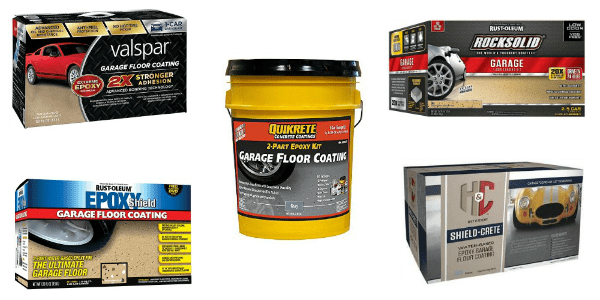
These are most prevalent in the home improvement centers and hardware stores where they are seen on a regular basis. As a result, this is all the average consumer is aware of for coating choices in many cases.
The problem with most of these garage floor epoxy products, however, is that they are on the low end of the scale in terms of quality, durability, and performance. This is particularly true when compared to the vast majority of garage floor coatings available.
We suggest reading this article here to understand more about what to expect with these types of coatings. In addition, we have a new article that explains the reasons behind the bad reviews of garage floor coatings.
Now that you know the history of these epoxy paint kits, let’s discuss what makes the newer single-part polyurea garage floor kits so much better.
What is a polyurea coating anyway?
Put simply, polyurea is a subset of polyurethane. It is a coating that seals and exhibits excellent chemical, stain, and abrasion resistance. The high elongation rate of polyurea makes for a flexible (relatively speaking) surface.
Coatings that flex provide very high abrasion and scratch resistance. This is one of the reasons why polyurethane and polyurea are much better topcoats than epoxy for most environments.
Polyurea is actually fairly new for a coating. It was commercially developed in the 1990s and was most known in the industry as a spray-on coating for bed liners, pipe linings, water tanks, pool coatings, etc. When mixed with a catalyst in a sprayer it can cure in as little as 5 seconds. It can also be applied in extremely cold and warm temperature conditions.
It was later developed as a 2-part polyurea polyaspartic roll-on concrete floor coating. This version has become very popular with many garage floor installation companies. The cure rates of less than two hours can provide a 1-day return to service for a complete garage floor coating system.
This is sold as an advantage over a standard epoxy garage floor system. Most epoxy systems require a minimum of three days to cure before a full return to service.
The high solids 2-part formulas used for these garage floor coatings are expensive, however. It requires experienced installers to apply properly due to the short working time (pot life) of only 20-25 minutes. This is why it has not been popular for DIY applications – that is until recently.
Why single-part polyurea coatings are better than epoxy paint kits
One particular formulation that has been introduced to the floor coating industry in recent years is single-part polyurea. Most polyurea formulas require mixing a part-A resin and a part-B catalyst – just as epoxy does.
Single-part polyurea does not require the mixing of two components. Instead, the oxygen in the air provides the catalyst that the coating requires to chemically cure.
Single-part polyurea is a commercial quality garage floor coating that is the easiest of all coating to apply – period.
With the addition of solvents in these formulations, manufacturers have created an extremely durable polyurea garage floor coating. It does not require mixing A and B components, has unlimited pot life, and can easily be applied to concrete.

Many mistakes from DIY epoxy coating applications are generated from improper mixing of the A and B components. The anxiety of this mixing process is a common deterrence that causes some people to shy away from installing epoxy in their garages.
Shop our collection of Single -Part Polyurea Kits from Top Vendors
RockSolid has tried to eliminate mixing mistakes with the introduction of burst pouches to mix A and B components, but problems still exist. The single-part polyurea coating eliminates this step and greatly reduces the chances of DIY installation errors.
To be more concise; Single-part polyurea is a commercial-quality garage floor coating that is the easiest of all coatings to apply – period.
Furthermore, the typical epoxy coating and garage floor coating kits, as mentioned above, are no match for the superior durability, chemical resistance, scratch resistance, and abrasion resistance of single-part polyurea coatings.
For example, commercial quality coatings provide a list of ratings based on testing. You can find these ratings as well as other pertinent figures in the Technical Data Sheets. This is what allows consumers to compare and evaluate how coatings will perform.
Abrasion resistance and chemical resistance are two standard tests that can provide very good information.
The example below is a chemical resistance chart that lists how a particular product will react to a variety of liquid chemicals including acids and solvents.
You can’t find this kind of information for your typical epoxy paint kits by Rust-Oleum, Valspar, H&C ShieldCrete, RockSolid, etc. It’s not listed. Instead, they use very vague terminology such as “anti-peel protection”, “2x stronger than concrete”, “hot tire resistant formulation”, and “long-lasting results”. They do not provide any testing data to back up these claims.
To their credit, RockSolid provides an abrasion resistance rating, but they do not provide chemical resistance data. The rating they provide for abrasion resistance is 40mg. This is how much material is lost during 1000 cycles for a CS-17 abrasion wheel test. The lower the abrasion numbers the better. As a comparison, many single-part polyureas test at only a 12mg loss.
Important to note is that each mg unit of loss is exponential. For example, a coating with a 4mg loss compared to a coating with an 8mg loss would last 3 times as long in terms of wear under the same conditions – not 2 times as long as most would assume.
Now, can you imagine how much better a 12mg loss coating performs than a 40mg loss coating when it comes to wear and abuse?
Additionally, polyurea is U.V. stable whereas epoxy is not. This means that your coating will not amber (yellow tint) over a period of time when exposed to sunlight. This is a typical complaint about epoxy paint kits.
Coating thickness is another issue. Most DIY epoxy garage floor kits have a dry film thickness of only 2-3 mils when applied at the standard coverage rates. Thin coatings such as these can sometimes create cosmetic issues with the color looking inconsistent and blotchy. This is due to the coating being absorbed at different rates into the concrete.
Single-part polyureas on the other hand have a 4-6 mil dry film thickness. The thicker coating makes for a more durable surface and does not suffer color inconsistencies.
Benefits of single-part polyurea coatings
- No mixing of A and B components
- Long working times so you don’t feel rushed
- Recoat times as little as 2 hours versus 10-12 hours
- No primer required
- Can be applied in lower temperatures – most epoxy paint kits require a minimum of 60°F
- Over 50% thicker coating than standard epoxy paint kits
- Long lasting – 10 years or more versus 2-5 years for standard epoxy kits
- No hot tire lift – water-based epoxy kits will get hot tire lift
- 100% U.V. stable for no yellowing – epoxy kits will turn yellow over time
- 100% more flexible than epoxy for superior scratch resistance
- Higher gloss ratings than most epoxy kits – maintains gloss longer
- High chemical and abrasion resistance – data not available for epoxy kits
- Excellent protection against road salts and deicing fluids
- Can be used as a clear sealer over bare concrete or stained concrete
- Available in both gallon and quart sizes to modify for any square footage
Single-part polyurea coatings can be used as a one-coat stand-alone system if you like. You can add color flakes or not just like the standard epoxy paint kits. You also have the option of applying a clear topcoat of polyurea for a two-coat system. This can provide for a full color flake floor of your choosing to get a real custom look.
Another advantage is that single-part polyurea is available in gallon and quart sizes. This allows you to order only what you need for your square footage to avoid overspending.
Most garage floor coating kits only allow for purchases of 250ft² at a time. If you have a 550ft² garage floor, you would need to purchase three kits. There is no way you could stretch out two kits for the 550ft² without cosmetic and performance issues.
Concrete preparation is the same for single-part polyurea as it is with any other epoxy coating kit. You need to etch or grind the concrete to create the correct surface profile. This will open up the pores of the concrete at the surface for the coating to penetrate and achieve a mechanical bond.
One characteristic of single-part polyurea to be aware of is that it is solvent-based. There will be some strong fumes during the application. However, most of the smell from the fumes dissipates within a few hours as the solvent evaporates out of the coating.
As with any solvent-borne coating, it’s not uncommon if it takes a few days for the smell to completely diminish. However, it will go away.
Polyurea coatings can also be more slippery when wet compared to epoxy. The curing process produces a tightly cross-linked structure that smooths out almost like glass. This is one of the reasons it cleans up so easily and is very difficult to stain.
If you live in a wet climate or worry about the floor being slippery, we would suggest adding an anti-slip additive to the final coat.
Additionally, they are not the best choice if you have a concrete surface with numerous cracks and/or surface irregularities. Though thicker than their epoxy paint counterparts, they still are not thick enough to fill in such surfaces. A high solids or 100% solids epoxy is a superior candidate since they are better at self-leveling with a dry film thickness of 9-10 mils and higher.
Lastly, single-part polyureas are packaged in clear only. They require you to mix in a pigment pack for the color you choose. However, this is not the same as mixing 2 components. Just pour in the pigment pack and mix it with a paint stick. This does not activate the coating, nor does it require you to immediately apply it after you mix in the color packs.
This post may contain affiliate links. If you use these links to make a purchase, we may earn a small commission. You can read our full disclaimer here.
Where to purchase polyurea garage floor coating kits
One of the best advantages of purchasing a single-part polyurea is that they are only available from vendors that specialize in concrete coatings. These are the same companies where professional installers buy their coating materials.
Legacy Industrial was one of the first vendors to offer a single-part polyurea in a DIY application. Called Nohr-S, we were so impressed with the coating that we wrote an article about it.
Some time afterward, ArmorPoxy made their SPGX polyurea available to the public. One of our readers in Chicago applied it to his garage floor and we did an article about the process here.
The latest to offer a polyurea coating in kit form is Garage Flooring LLC. Customer service is excellent and they are more than happy to help you and answer your questions. You can read our latest evaluation of their All Weather Floor polyurea.
Unlike home improvement centers, these vendors are experienced in garage floor coating applications and are extremely knowledgeable. They want you to be successful with your project. Customer service is excellent in most cases and they can answer any questions that you have about the product and application.
They are also very good at making sure you understand what you are purchasing. They will tell you if the product you are interested in is the best choice for you or not. We highly recommend contacting these vendors with any questions you may have before making a purchase.
Important to note is that these vendors are not national brand companies with brick-and-mortar stores that you can walk into. Products and materials are ordered online via their websites and then shipped directly to you. With some exceptions, most of these companies ship for free as well.
Though the coatings don’t come in a neatly packaged box with nice artwork and graphics, they can provide everything you need in true kit form for a successful application.
you would have to purchase and go through the process of reapplying an average of four water-based epoxy paint kits over the life of just one single-part polyurea coating.
The cost per square foot for a single-part polyurea coating averages about twice that of the lowest-priced, water-based epoxy garage floor kits. RockSolid polycuramine and the solvent-based Rust-Oleum EpoxyShield Professional coatings are priced midway between.
1 gallon covers approximately 250ft², the same as most epoxy paint kits. SPGX by ArmorPoxy covers 300-400ft² per gallon, but the additional square footage is reflected in their price point.
Though the initial cost of single-part polyurea garage floor coating is higher than the typical epoxy paint kits, they are a much better value. This is particularly true when you carry that expense out over the many years of use.
For example, you would have to purchase and go through the process of reapplying an average of four water-based epoxy paint kits over the life of just one single-part polyurea coating.
Are polyurea garage flooring kits the best of all garage floor coatings?
One important question that people want to know is how single-part polyurea coatings compare to other garage floor coating systems available. Is it better than epoxy? Is it better than polyurethane? Is this the best garage floor coating I can apply?
A single-part polyurea garage floor coating kit or system is the best choice for those who want a professional-looking, commercial-quality coating. It is the easiest to install and at a reasonable price point.
They deliver excellent performance and long life. They are best for the typical residential garage that will see light to medium-duty automotive repair and medium to heavy traffic. This includes inclement weather conditions and other hobby or home improvement projects that are performed in the garage.
Application is easier than epoxy paint kits. They will not experience the potential peeling, hot tire lift, color fade, and wear over 2-5 years that is typical of such kits.
However, in terms of ultimate performance and durability, nothing outshines a hybrid coating system. Such a system consists of an epoxy primer, a high-solids epoxy color coat, and one or two coats of a high-performance polyurea or polyaspartic topcoat. We discuss the best garage floor coating systems here.
Final thoughts
Needless to say, we are impressed with this product. Hands down, single-part polyurea is the easiest of all coatings to apply while still performing to commercial quality standards. It delivers excellent protection and performance at a reasonable price point compared to other products.
The large companies that provide inexpensive epoxy paint garage floor kits have been relying on relatively older epoxy coating formulas for years. We would not be surprised if one of them doesn’t come out with their own version of this polyurea shortly. It would eliminate many of the complaints about their products.
Until then, the biggest problem that single-part polyurea will face is a lack of exposure to the general public. The smaller companies that sell the higher-performing garage floor coatings do not have the budget for the type of national advertising that is required.
Though it’s not the cheapest garage floor coating, for the value it’s one of the best DIY garage floor coatings available that you can purchase in kit form.
Just bought a new build townhouse…so the garage is fresh and untouched. Anything I have to do to prep it other than sweep?
Thanks!
Ryan
Hi Ryan. Yes, you need to properly prep the concrete by either acid etching or grinding. This opens up the pores of new concrete and allows the coating to penetrate.
We were planning on doing our basement in the garage epoxy instead of carpet/wood/laminate. Would this be Overkill since it’s a basement, not a garage?
Hi Erica. It’s not necessarily overkill to use a product such as this if you want a flooring that will last for 15 years or more. Just to avoid confusion, single-part polyurea coatings are not epoxy. That said, applying coatings in a basement should be done with due diligence and some caution. Basement floors are known for moisture issues and coatings do not tolerate moisture well. A moisture test during the wettest months of the year should be performed first before attempting to apply a coating.
I know this is different than epoxy, that is why I was asking if this process was overkill since it seems to be a better route but basements don’t usually take the beatings garages do. 🙂
Wouldn’t a garage floor have moisture issues as well, since it is more open to the elements? We live in the Midwest where there’s plenty of moisture in the winter. ?
No worries, Erica. We just wanted to make sure since you mentioned garage epoxy. The moisture we are referring to comes from the ground under the slab. Most garage floors are what you call “above grade” – sitting on top of the earth, while basements are “below grade” – dug deep into the ground. Moisture content below ground can be much greater. Since concrete slabs are like a sponge and tend to absorb moisture if it’s present, it’s not uncommon for basement slabs to develop moisture issues. That is one of the primary reasons why basements can smell musty. Above ground slabs can develop moisture, but it’s much less common than basements.
Oh for real… why didn’t I think of that?! D’oh! ??♀️
Thank you so much for the help! ?
Hi Shea. What is the viscosity of a single-part polyurea compared to a high solid epoxy? I am looking to use an airless sprayer (Graco Magnum X7) and I know that it would take a lot of solvent to get a high solid to the right viscosity for a sprayer, so wondering if a single-part polyurea would be a better option. If you believe both options wouldnt work, do you have any recommendations besides a water based epoxy for an airless paint sprayer? Thanks!
Hello Zach. Concrete floor coatings cannot be applied via an airless paint sprayer, nor are they recommended to be applied in such manner by the manufacturers. The amount of proper solvents to thin the coating enough to be sprayed will harm the performance characteristics. In addition it would require multiple spray coats to achieve the same dry film thickness of a single rolled on coat.
That said, there are special polyurea and polyaspartic coatings that are designed to be applied with high pressure sprayers. Graco is one such manufacturer. These type of spray-on coatings are used for tank liners, pool coatings, and truck bed liners for example. They cure in a matter of seconds. Some people have experimented with spraying these type of polyurea coatings on concrete garage floors with some success, but the texture and expense has been an issue so far.
Since you even mentioned adding thinner to 100% solid epoxy I would highly suggest you put the ‘sprayer’ away and hire a professional that knows coatings to help you out bud.
Hi Shea, I just built a pole barn/garage. The concrete floor has a broom finish, not smooth. Is this a good enough texture for the Polyurea to adhere to?
Hi Kenny. A broom finish is not good for a coating and does not substitute for proper concrete prep. Coatings applied to a broom finish typically fail and begin to peel under tires and heavy traffic use. The high ridges of the finish are much weaker and tend to separate from the concrete or the coating. Broom finishes should be prepped with grinding to smooth out the surface and open the pores of the concrete for penetration of the coating.
Shea, makes sense to me, didn’t consider the ridges. Time to grind. Thank you
Hello, I’m in the process of building a 24×30 shop and the floor will be finished smooth with what looks like a floor buffer but has big fan blades instead. Will just chemical etching be enough or will it still have to be ground? Also will the polyurea coating hold up to hydraulic floor jacks, jack stands, etc…
Hello Bruce. It sounds like the floor is being power troweled. This type of surface is generally more dense and smoother than traditional steel troweling by hand. A strong acid etch will usually be sufficient, but it’s important to check various areas of the floor afterwards for porosity since acid etching does not give a consistent finish like grinding does. Yes, a polyurea floor coating system will perform well floor jacks, jack stands, and etc. as long as you aren’t carelessly dragging things around across the surface.
Hello, I’m pouring a concrete floor for a woodworking shop next week. How long should the concrete cure before applying a floor coating? Thanks
Hello Ray. You need to wait 30 days after the pour before you apply a coating.
Hi , I have some old and peeling epoxy that was put on my garage floor . Apparently the moisture got under it. What is the best thing to do at this point?? Have looked into Concrete Polishing but am told I must mop it after salt comes in during Winter. Don’t want to get ripped off again. I’m an older women and need help.Have any suggestions???
Yes, polished concrete is not a good choice for an everyday garage that is located in a climate with snowy winters. We talk about polished concrete here. What type of epoxy was applied originally? Has an actual moisture test been completed to verify moisture from under the slab?
A two part epoxy. No , I don’t think a moisture test was performed. What is the best remedy at this time . ?
I was hoping you would know what kind of epoxy, Sandi. Was it an inexpensive DIY home improvement store epoxy kit such as Rust-Oleum or Quikrete? If so, I would recommend doing a moisture test to determine if you have any and how much. It would require grinding a few spots down to bare concrete to conduct the tests. If it’s not too much moisture I would highly recommend the single-part polyurea. If the moisture is not too high, then you will need to grind the rest of the coating off before applying a new one. If the moisture is too high or you don’t want to do the grinding that is required, you can always cover the entire floor in an interlocking garage floor tiles. These do well on concrete with moisture issues and you would not have to do any concrete prep.
The epoxy was put on by a commercial company. Not sure how much experience they had. It was through Abbey carpet, a flooring company.I am told that a moisture test isn’t needed with the concrete polishing because they will just be Polishing the existing concrete
I’m not sure what you are asking at this point, Sandi. If it’s polished concrete you want, there is no getting around having to mop it during the winter to remove the road salts. If consistent maintenance is not performed during the winter time, the floor will loose its luster fairly quickly and need to be lightly polished again. That is why I linked you to our article on polished concrete for a garage floor. It’s not a good choice if you want to avoid all that. You can lay down a containment mat in the winter to catch these liquids, but it’s not going to preclude maintaining the finish of the floor. If you want to put down a quality floor coating, it’s going to require a moisture test to determine if it can be done since someone said that the old coating came up due to that. The other suggested option is interlocking garage floor tile since this can be laid directly over your current flooring. Moisture is not an issue with interlocking tile and you can custom design it however you like. Just let me know if there is a specific question and I will be glad to help out.
Where can I obtain quality interlocking floor tiles?? Certain brand that is good??? That sounds like it will be a pretty good solution to my problem. Thank you so much
We recommend Garage Flooring LLC. They have a large variety of quality interlocking tiles. Their TruLock Line is one of the best values. They also offer the best shipped price. Don’t hesitate to contact them if you have any questions.
Hi Shea, we have a new garage with a hard troweled surface (lots of swirls and water test doesn’t show water beading). I’m planning to apply the Nohr-S polyurea and I had some questions about prep with the hard trowel. I have read of the inconsistencies and dangers with acid etch so I’d prefer an alternative way to prep the surface. A couple people I’ve talked to indicated I should use a floor buffer with 40-60 grit paper to open up the pores. Would this be acceptable to prep the surface? I’m concerned that using a diamond grinder could mess up the currently level concrete and is excessive for new concrete.
Also, would I need to power wash after the buffing?
Appreciate your thoughts and I appreciate all the useful information on your site. Thanks!
Hi Matt. All concrete needs prep, especially new concrete since the troweling tends to close off more of the pores at the surface. Sanding is not going to be aggressive enough for a commercial coating. It either needs grinding with a 25 grit disc or acid etching. If you are worried about gouging the surface with a grinder then we would recommend using a Diamabrush on a floor maintainer. It’s a concrete prep tool that uses flexible blades. It’s not a concrete removal or leveling tool. You can read our article about grinding with it here. Once you are done, just shop vac the surface well and you are good to go. You don’t want to introduce water at this stage if you can help it.
Hi Shea, thanks for the advice several weeks ago. After talking with Scotty at Legacy, I opted for a single disc Edco grinder (with 18 grit Dyna Serts) with an Edco vacuum from a local rental shop. The Edco grinder worked great and I was able to get the hard troweled surface ground down within a couple of hours. The vacuum clean up took almost as long as the grinding.
One thing I learned was that my 6.5 bag (4000 psi) concrete garage floor caused the primer and polyurea to spread at almost double the coverage rate. I used the extra Nohr-S as an extra clear coat.
Thanks again for having a site with great information that allowed me to consider options and prepare for my coating.
That’s fantastic, Matt. Our goal is to help educate people and steer them in the right direction in order to avoid frustrating mistakes/results. Scotty is a great guy for working with the DIY crowd. Enjoy your new floor!
Hi, great article. Very informative
I am sold on single part polyurea coating. However, I am looking for a metallic look finish like what spartacote offers. Do any of the single part polyurea vendors offer that?
Hello KT. No, single-part polyurea is not the best medium for true metallic coatings. You need a 100% solids epoxy in order for the metallic pigment to flow properly and react with with solvents to get the typical metallic look. In addition, a dark epoxy primer is required to be applied first to provide a solid background color for the pigments.
This site is an amazing source of information. Thank you.
I have a 20×20 ft unattached garage in NW Iowa with a concrete floor. It was built about 10 yrs ago. From the start there were problems with the concrete pitting and having surface deterioration. I think it has to do with moisture. I have put an epoxy coat on it, thinking that might help (it didn’t much), and have patched spots with an epoxy patch, which does generally help. With time, the pitting and surface deterioration has largely stopped, but the floor looks fairly shabby.
My question. What overcoat, if any, would you recommend, and what prep would it require?
Hello Tom. If you have a moisture issue, then a coating is not going to perform well on the concrete. That would explain why the epoxy coating didn’t do well. The first thing you need to do before proceeding is to conduct a moisture test of the concrete. If you don’t have a moisture issue, then the pitting is most likely caused from freeze thaw and salt damage from winter weather. If that is the case, then you will want to thoroughly clean the concrete first and then make the proper repairs for pitting. We then recommend grinding the entire surface to prep for a quality coating. The single-part polyurea that we discuss in this article is an excellent option.
Thank you. That’s what I needed to know.
Hi Shea,
We are moving from Texas to Massachusetts and the 1st project we want to do is the basement floors. The house was built in 2018 and has smooth floors, but I saw in another post that this product might not be a good candidate for basements because it is below grade. Would some type of interlocking tile or epoxy be a better solution then?
Hello Jose. Epoxy and single-part polyurea are both coatings, so neither is a good choice if there is moisture present. Have you checked with the seller to determine if a moisture vapor barrier was installed before the basement was poured? If so, then moisture should not be an issue. If it wasn’t or you are unsure, you can always conduct a moisture test. The key here though, it to do it during the wet months to ensure the best conditions for it to be present. It doesn’t do any good to test during a dry part of the season only to find out that the basement does transmit moisture through the floor during the rainy season. If coatings are not an option due to moisture, then interlocking tile is a great solution. They breathe and allow moisture transfer. There are many great style to choose from and some even look like beautiful hardwood flooring.
Hi Shea
I have a 2 car concrete garage floor approx 25 yrs old
It had some moderate pitting from salt and age
Pitting was limited to the center of the floor. Perimeter is pristine.
I degreased, pressure washed and fixed pitting with sakrete flocoat
I then used a sanding block to smooth irregularities
Next, I plan to acid etch before applying a single part polyurea coating
Any issues, concerns or recommendations before I proceed?
Thanks much
David
Hi Dave. What grit did you use when sanding the Flo-Coat? Polymer-modified repairs do not respond well to acid etching since it lacks much of the free lime that it reacts with in natural concrete. That is why grinding is preferred when smoothing out repairs. Grinding wheels are typically a 25 grit and provide the proper profile for the coating to mechanically adhere well. If the grit was not aggressive enough, you can always try roughing it up more with a 20 grit rub brick like this one. Everything else sounds good. Just be sure to neutralize and rinse well and don’t let any of the etching solution dry on the surface. You will want to give it a good 24 hours to dry – longer if the humidity is up.
Thanks for the reply Shea.
Clarification on a couple points.
First, I used a rub brick just like the one you recommended, but only on the repaired areas. Not on the perimeter areas that are pristine and untreated
Note- the repaired area that I used the brick on is not perfectly smooth and has some rough texture. I am OK with that as long as you think the coating will adhere and perform. Or are you suggesting more aggressive sanding with a powered grinder?
Next, I watched a video online where the guys acid (muriatic acid) etched the surface before applying the polyurea coating. To be clear, you are recommending NOT to do this on any of the surface? You then said to “Just be sure to neutralize and rinse well and don’t let any of the etching solution dry on the surface.” Please clarify.
Thanks
David
No, you can acid etch the entire floor, David. That is why I said the rest of your plan is good. The repairs do not react well to acid, meaning, that it has no effect in terms of etching and is why you need a rough profile. If you used a 20 grit rub brick then you should be good to go. I hope that clears things up.
Thank you Shea
Your advice is invaluable.
Now I’m ready to purchase the coating material. 1-Do you recommend a particular brand or vendor? 2-Kit v alacarte? 3-number of base coats? Clear finish coat? Non slip?
I really appreciate your wisdom as I’m really trying to get this right the first time!
You are welcome, David. All three vendors we list in this article have excellent product. I know that Garage Flooring LLC is having a limited time sale right now. All of these vendors offer kits to make ordering easier, but you can order additional material if needed. Some kits come with application tools and some don’t. However, don’t rely on just those tools alone. It’s best to make a list of what you need and purchase any additional application supplies from your local home improvement center. You can always take back what you don’t need. If you have any questions about ordering from the vendors, give them a call. They want you to have a successful outcome and are happy to help with proper selection for coverage and etc. These vendors know what they are doing. There is generally one base color coat, optional color flakes, and then one clear coat. For extra an durable floor, Legacy Industrial offers a primer coat to go down first. This article here is a great example of one persons project using Nohr-S by Legacy Industrial. Polyurea can be slippery when wet. If your garage is one to have water tracked in an good footing concerns you, then we recommend the non-slip additive.
Thank you for all the info on this website. It has been extremely helpful in helping me decide how to approach a garage floor that has started pitting and spalling due to all of the mag chloride they put on the roads here in Colorado. I have decided to use a gray tinted polyurea coating with random broadcast paint chips. I am in the process of doing some cleaning of the floor and patching some small areas in the floor with EpoxyShield. Then I will rent a grinder to prep for the coating. My question is about the difference between the Legacy Nohr-S product and the Garage Flooring LLC product. The Nohr-S uses a primer to prevent bubbling and then 1 tinted coat of the polyurea. The Garage Flooring LLC uses 2 tinted coats of the polyurea and no primer. Do you think using 2 tinted coats and no primer would hide the patch jobs and any discolorations in the garage floor better? Or, is it better to get the one with the primer to prevent bubbling and some of the other minor problems that could occur with putting down the polyurea coating? I am just trying to make the right choice for my situation. Thank you in advance.
Hi Todd. Epoxy primers don’t hide patch jobs. What hides that is good grinding of the patch after it has cured in order to provide a smooth transition from the patch to the surrounding concrete. It’s just like what a good auto body shop does with a dent before they paint. What the primer does is assist with good adhesion, it helps build a thicker base coat, and it will prevent bubbles of the color coat due to outgassing. Two color coats of a polyurea will do almost the same thing. Because you are grinding and not acid etching, adhesion will be good with both vendors. Color flakes also do a good job of camouflaging imperfections in the surface as well. Both kits have outstanding abrasion ratings for wear. You really can’t go wrong with either one and you won’t have issues with winter weather again as long as you periodically clean the floor during the winter.
Thank you for all of the great information Shea! I ultimately decided on Legacy’s Nohr-S and my garage floor now looks fabulous. My neighbors keep telling me, it looks like a professional did the job. Thanks again for your help.
That’s great to hear, Todd! Thanks for reporting back on your results.
Thanks for the wonderful articles.
I’m looking to finish an old concrete floor in my basement. The house was built in 1915. Not sure how old the floor is. It doesn’t seem to have moisture problems. It’s not a very even floor however. And some parts are getting adjusted to make it more level.
I’m wondering weather a polyurea coat or 100% solids epoxy would be better for this application which may have some moisture. Also, would it make sense to use self leveling concrete to smooth out the floor first. If so, how long should I wait after leveling the floor before applying the floor coat. And would a primer be worth using before the polyurea if that’s what I go with.
Also, do you have any brand recommendations?
Hi Evan. Because basements are well below grade they are notorious for moisture issues in the concrete floor. Before you do anything, we highly recommend proper moisture testing with a few calcium chloride kits to determine what kind of moisture you may have. It’s best to do it during a wet month. Testing during dry months can give you false results. Coating do not breathe and as a result they do not stay adhered well when moisture vapor builds up underneath. Yes, a self-leveling polymer-modified concrete is recommended to even out the floor. Do not use the self-leveling concrete for underlayments that are sold in the home improvement stores. It is not the same thing and it is not designed as a wear surface. Once the floor is level, it will require grinding to smooth everything out. An epoxy primer with a 100% solids color base coat is best at hiding small imperfections in the surface.
Thank you Shea. I’ll get the kits to test moisture today. Are the concrete densifiers that act as vapor barriers ok to use on the old cement to strengthen it and hopefully prevent moisture issues?
It’s also getting to be colder here. In the 50s outside. Not sure about in my basement. Will I need to wait until spring if I use epoxy?
I’ve also been a little confused as to epoxy primers with 100% solids versus using multiple layers of epoxy. Some sites make it sound like the first layer is considered a primer coat. Could you make or link a few primer options?
Oh, and do I have to wait a full 28 days after having the self leveling cement put in before using the primer so that it fully cures?
Thank you for your wisdom.
Densifiers can be applied, they require a full 7 days to react and come to full strength. They are not considered a vapor barrier, but they do work to slow down moisture intrusion – to a point. Epoxy cannot be applied in temps lower than 60 degrees. If the basement and the concrete are above that, then you can apply it. 100% solids epoxy does not have any carrier agents to evaporate (solvents or water). As a result, when applied over small spider cracks and rougher surfaces, the wet film thickness does not shrink. What you see when it is wet is what you get. Multiple layers of epoxy with less solids content will not do this. The carrier agents evaporate as the epoxy cures and the coating thickness shrinks. The less solids, the more it shrinks. As a result, small spider cracks and other imperfections that looked to be smoothed over when wet are exposed and showing after the epoxy cures. This article here explains why an epoxy primer should be used with high solids epoxy. This is an example of an epoxy primer. Many of our sponsors carry such product. 100% solids epoxy will not hide a poorly finished surface, however, unless an expensive and thick slurry is applied. Yes, you do need to wait up to 28 days for the moisture to evaporate and the concrete cure properly before applying a coating. The manufacturer will list this in their data sheets.
Bit of an off-beat question, but I’m looking to apply a coating to my basement floor. I’m interested in using the area for a hockey training center, so my primary concerns are friction (so pucks would slide as ice-like as possible) and impact resistance (from hockey sticks and pucks, etc.)
Long story short, do you think polyurea would be a good covering to use for my needs? Thanks in advance.
Hi Nic. We are assuming that your basement floor does not have a moisture issue with the slab and the proper moisture testing has been done. It’s the high gloss of a coating that will make it slippery. The more gloss the better. We would not recommend a single-part polyurea though. These are solvent-based and have a strong smell during installation that will get trapped in the house for days. It dissipates quickly in a garage where you have adequate ventilation. A high gloss coating that is very tough and would not have any VOC’s to contend with would be a 100% solids polyaspartic coating. The issue with these is that they are a very fast cure product with a 20 minute pot life. It usually requires a couple people with some experience to get it applied in that short of time, but it can be done DIY. Have you investigated the interlocking tiles for hockey like these here? There is no worry about moisture from the slab, plus they are easy to install.
My garage floor is 13 yrs old. Has EPOXY coating. Has dulled over the years. I want to put a top coat on it to bring back the shine. No cracks are present. Can I power wash the floor, and then coat with a CLEAR COAT one part polyurea?
The color is a darker brown with flakes…. So, i am thinking a clear coat would do just fine. As I read the polyurea is solvent based, will it dissolve the existing coating or just stay on the surface… no, i do not know how the original coating was applied..i bought the home from the original owner… didn’t ask.
thanks.
Hi Jim. A single-part polyurea will work well on epoxy. However, you have to do more prep than just cleaning the surface. It will require that you rough up the surface with 120 grit sandpaper in order to provide a rough enough profile for the polyurea to achieve a mechanical bond. A floor maintainer with a 100 grit sanding screen will get the job done much faster. Shop vac the surface and then wipe it down with denatured alcohol applied liberally on a microfiber mop pad and you will be ready. The floor will look brand new once you get the clear coat on. Be careful about pressure washing. We would suggest just scrubbing with a short deck brush.
I live just outside of Toronto, ON, Canada. Can you recommend a Polyurea supplier in my area?
Hi Craig. I’m sorry, but we do not have any knowledge of suppliers in Canada. However, we do know that Garage Flooring LLC ships to Canada. If you contact them and give them your info they can tell you what it would cost. We did an article recently on their AWF Polyurea here. It also includes the link to their product and website.
I have an outdoor patio that I paint year after year with a garage paint costing about $40/gal. I also want to do my garage and it is also paint year after year. I’ve kind of had with this and want to do either the full epoxy or the Polyurea.
However, I have a couple of questions:
– I would imagine I have to strip both. What would you recommend: a acid wash, navel jelly, grinding???
– Could you recommen a course of action.
I like that the 2 part would last 20 years and if I’m going to do this I want to do it right. More work now & Less work later.
Thanx,
Joe
Hi Joe. Just as an FYI, acid will not strip paints and coatings. To strip paint, you need to use chemical strippers that are specific to paint stripping. Naval Jelly is not a good example as it is a rust remover and not a paint stripper. Grinding is the best method for removing paint since it also preps the concrete surface for a coating at the same time. If you use a paint stripper, you will still need to acid etch or grind the bare concrete once the paint is removed. Paint stripping is messy, time consuming, and usually involves just as much work or more than grinding does. This article here from Bob Vila talks about different paint stripping products you can use.
In terms of the coatings you are interested in, a good epoxy system is excellent for a garage floor, but it cannot be used outdoors. It is not U.V. resistant and will turn yellow and chalk up. What you need for a patio is a quality outdoor acrylic coating (not from a home improvement center) or polyurethane (urethane for short) coating. ArmorPoxy is one such company that offers coatings such as these. You can view them here. In addition, DuraGrade Concrete by Rust Bullet is another that can be used outdoors. As with any outdoor coating, we high recommend using an anti-slip additive in the final coat.
Thanx.
But just wondering about where to go for suppliers????….Any recommendations which companies to contact??
Just follow the links in our previous response, Joe. You can buy direct from ArmorPoxy – tell them we sent you. The link to DuraGrade Concrete lists a couple of places where you can buy the product as well. We also have a link here about grinding if that helps.
Again, Thank You.
Joe
You are welcome, Joe.
My garage floor was previously painted with one of the epoxy kits. What do I have to do in order to use the polyurea product?
Hi John. If you want the strong adhesion of the single-part polyurea, then you need to remove the previous epoxy paint kit coating via grinding to get to the bare concrete. The extremely strong bond of single-part polyurea and no hot tire pick up is dependent on the polyurea being applied to properly prepared bare concrete. If you apply it to the epoxy, the entire coating can still peel much more easily since the epoxy is what is adhered to the concrete. If you want to apply it to the epoxy anyways, we have an article here that explains how to do that.
I had a 36 x 42 garage built in 2006. They used fiber reinforced concrete. They did not put on any type of sealer. I get a white powder when you walk on it. Since there has never been a sealer on this floor, do I need to etch it?
Hello Mark. Yes, concrete always requires the proper prep for coatings. The white powder you refer to is called concrete dusting. This is the result of a very thin layer of weak concrete at the surface that is typically created from too much bleed water during the finishing process. We highly recommend grinding for a coating versus etching when the concrete has this condition. Grinding will remove the weak upper layer and etching will not. If this weak layer is not removed, then the surface of the concrete that the coating is attached to can continue to dust and cause delamination of the coating. Something else to be aware of is that if you etch, the tiny fibers of the reinforced concrete will be exposed at the surface and will stick up when the coating is applied. These fibers are typically cut at the surface during grinding, but need to be burned off or sanded off if you etch.